Showing posts with label Diocesan Synod. Show all posts

Monday, March 14, 2016

Fair buzzing in Oban

Victorious table at dinner
I've mulled it over for the past five days, but now I realise that Synod reports are being demanded - not, happily, from me - right left and centre and it's time I put down my take on the Argyll and The Isles Diocesan Synod. The main impetus, to be honest, came from two online sources: the Primus' blog, in which he said his synod had 'a buzz', and the commiserations of friends on Facebook that I should be enduring this thing.

I'll deal with the latter first. The only commiserations I might have deserved lay in the fact that the Synod itself was held in (yet another) windowless room on a gloriously sunny day in a location next to a sea loch and an attractively wooded shore line: I did get stir crazy, and spent the lunch break picking my way down to a beach and over dub and mire as the birds sang round me. The rest of the time I was really enjoying myself, both on the pre-Synod day (it's hardly worth it to bring people from such a far-flung area unless they get a decent shot at socialising) and during Synod itself.

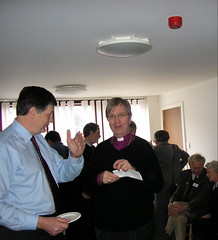
And that brings me to the former stimulus: I don't know what caused the buzz at the St Andrew's Synod, but I have a good idea of what contributed to our buzz. (I'd really like to know, by the way, what manner of buzzing goes on elsewhere ...) First of all, of course, we have an extraordinary bishop who could cause a buzz in a morgue. He delivered an ode, for Heaven's sake. But actually it was more than this. I am convinced that the excitement arose from the fact that instead of sitting in stupor listening to presentation after presentation we were allowed to talk to each other, about everything from the balance sheets to the first time we'd encountered the Holy Spirit.

This was achieved by a variety of methods, but primarily by the fact that on the Pre-Synod day, reviewing our progress with Building the Vision, we had two facilitators making us mix - moving people from one table to another after the manner of a Snowball waltz, for instance. At Synod, each table had a facilitator (I was one) to get people talking, as at General Synod a couple of years ago. And yes, we talked about the accounts and as a result made demands for more detail, clarification, amplification ... Before anyone asks, I had a plant at my table, an accountant who could make more sense of a balance sheet than I care to, so that I could merely render into words the data he fed me.

By the end of the two days, I came to this conclusion: people are excited by what brings them together in a situation like this. They become animated by the chance to share it with others whom they don't really know - because this unlocks the kind of honesty you sometimes find in a hospital ward, the honesty of strangers, when inhibition and fear of something you say coming back to bite you can be cast aside. So that is what lay behind the astonishment of the imported facilitator when she remarked on the alacrity with which pairs and groups got to grips with the Big Questions - she couldn't believe how little fencing she met as she moved round.

I have to confess that I enjoy facilitating a group. I love being able to make people feel at ease with one another and with the topics they've been asked to consider. I love realising I've managed to break the ice without losing anyone under it.  It feeds all sorts of my own needs for interaction - and that's before we get on to the subject matter under discussion.

I haven't mentioned the other aspects of this meeting, that had me and others in Oban from late on Monday afternoon till late afternoon on Wednesday. I've not talked about a riotous dinner after the Synod Eucharist, nor about the quiz that my table won and the Bishop's Easter Egg (our prize) that I suspect may have vanished to Cumbrae. I've not mentioned the Monday night, the dinner on the pier with old and new friends, nor the delight of watching a first-time visitor grow in confidence as the days went on. I can't tell you how much I laughed, nor how much I was laughed at. It was all part of the whole.

So yes: there was an enormous buzz at the Argyll Synod. There was laughter, there were tears, there was pastoral work being done over lunch breaks, there was kindness, there were friendships rekindled. For me, there was also the knowledge that it was my last: I've served on General Synod for the past 10 years as alternate or elected representative, and it's time to step down. I'm not a committee person, and I hate being trapped indoors. But even with all that, I'm sure of one thing. I'll miss it.

Friday, March 08, 2013

A ridgewalk with the Third Age


A suitably splendid scene for a brief retrospect on last week's Argyll and The Isles Diocesan Synod, the above photo shows the moment when Bishop Kevin installed the new Dean, Andrew Swift, in the Cathedral in Oban. I was right at the back of the Cathedral, having arrived at the very last minute from Taynuilt, where we were staying and where we had gone to change into gladder rags for the Synod dinner, but a phone waved speculatively in the air seemed to do not badly, thank you.

Anyway, enough of the formalities. Argyll is unlike the more urban dioceses in that it holds its synodical gatherings over three days. After all, people take to planes and boats to get there - it seems only fair to give them a decent time to socialise, no? And anyone who cares to can attend, especially the pre-Synod day. This year's speaker, Ann Morisey, was the best yet. She talked about the Ages of our lives - not seven, as Shakespeare described them, nor the three of past generations, but the four ages we now see living: children (dependant); adults (generative, working); the active retired (new!); the old (dependant, letting-go). And of course, more than half of her listeners were the active retired on whom the church depends, and of whom, dear reader, I am one.

I'm not going for a blow-by-blow here. But I started thinking about the business of loss of status - the loss of status that is part of letting go. We all, I suppose, acquire varied status during our lives, and some people have the dickens of a job letting it go. Retirement can spell doom and depression for some, rather than joyous freedom. Men seem more bothered than women. I also thought about the things that apparently keep us going for longer - singing seems to be one, dancing another, and church membership and activity seems to be jolly good for one.

But this status thingy. People acquire status in church circles - and suffer a new bereavement when it is taken from them. We all know the criticism voiced of people who hang onto jobs in church - but do we think of why these jobs are so dear to these people? Should we all be practising letting go of things, sitting lightly on our little importances so that the wrench will be less?

Maybe it depends on why we do these things in the first place. And an echo of the instruction to pray secretly in your own room comes to me when I think of this. We do love to dress up in our church, and there is much to be said for the depersonalisation of the individual that is one result of this. But I wonder if every one of us, for our own future good, needs to think about why we cling to our assumed responsibilities.

In a voluntary organisation there will always be a need for someone to step forward. There was much talk this year of ridgewalking, with all the excitement and danger that the term implies. Suddenly it feels as if the diocese has set off on its precarious ridge walk with a song in its heart - and the Third Age to the fore.

Thursday, March 08, 2012

When two or three are gathered together ...

I have been attending the diocesan synod of Argyll and The Isles for some years now - since before I retired, come to think of it - and my memory of both it and the General Synod tends to involve an overwhelming desire to nod off after lunch. This could, of course, be blamed on the nature of our synod meetings: because people have to travel so arduously to come together in Oban, we have a two-day event - and the clergy have three days -  with a jolly dinner (left) after the pre-Synod day and the Synod Eucharist. (This year we all piled into a large bus in the rain and were swept out to the Bishop's palace by the shore to drink wine before returning to the Gathering Halls for dinner, but that's another story that might include my speculating on the effect on the neighbours if we'd all invaded the wrong house ...)

But to the Synod. This year, despite all the junketing, I didn't sleep at all at Synod. For a start, I had work to do; the entire meeting was held round tables on which were bowls of grapes and chocolates and bits of paper and a marker pen, and I was facilitating the discussion at one of them. I would never have believed the positive effect that this simple move had: instead of sitting in rows, able to communicate briefly and surreptitiously with at most two people, we were made to sit with people from all over the diocese and we were encouraged to talk with them, get to know them a bit, and - most importantly - come to trust them as we spoke.

By the time we came to the discussion of the Anglican Covenant, the knitting lady had laid aside her knitting and we were all leaning forward over the table. People became passionate but there was no hostility, and there were moments of sharing that seemed to belong to a real family. We could, it seemed, have gone on all afternoon, and found it hard to stop when we were called to order. It was alive, this church, and I could see that life on faces elsewhere in the room.

I don't yet know the outcome of our discussion. It will be assessed from written responses of the groups and then shared. I got the impression that we thought the Covenant un-Anglican, and that we felt very aware of our uniquely Scottish identity. But I had more than an impression of something else, something very closely tied to the presence that was in the midst of us as we gathered together.

And for me at Synod,  that was a first.

Thursday, March 03, 2011

Taking off in Argyll and The Isles

This slightly hazy photo (courtesy of Al) is all I have to remind me of Diocesan Synod - that and the rather dog-eared copy of the Synod papers, with all the doodles and remarks that aid concentration when we're talking about money. If you look closely, you will see an angel, and in the far left a bishop - our new Bishop Kevin making his post-prandial speech at the Synod Dinner. The accordion between angel and bishop is not part of the speech, which consisted, hilariously, of the safety briefing before a flight. The angel is a member of the cabin crew, and by this stage in the proceedings is wearing the chastity girdle and the golden wings - for when the engines fail. There is a lighted halo at her feet. Her opposite number - for it is too big a plane for one angel - is on the other side of the stage.

Reader, I was that angel. Seems I may be up for a new post: Bishop's Fool. It has a suitably Learian twist, I feel - Shakespeare, not Edward. It was all good clean fun and I ended up dancing, unwisely, in rubber-soled shoes: I don't usually stay for ra jigging.

Synod itself was wonderfully optimistic. Having arrived at a properly God-centred vision of our future, we were already well on our way to behaving as one always feels a church should be. The one cloud on the horizon as far as I was concerned, the one bit of contrary weather on the flight, was the revelation that we still carried some dinosaurs on board - the kind that have never realised how strange it feels these days for a church of which two thirds of the punters are women to use a creed with the words "who for us men and for our salvation". I felt moved to speech at that point, and they backed off into the swamp, but I have a feeling they may well resurface before we're finished.

But I niggle. No-one spoke for too long, and everyone seemed to depart in peace. The weather was kind and I managed to get to the deli for my lemon-infused olive oil and one or two other good things. We've taken off in a new direction and are travelling hopefully. Happy landings!

Wednesday, March 17, 2010

Lighten our darkness ...

Anyone who read my last post will have thought: dismal. That's how she feels: dismal. And they'd have been right. And now I'm home again and I'm seriously tired - for whatever you feel, it's a demanding drive home after a long day - but I'm not dismal any more. Synod threw up things to concern and galvanise, and I may in time return to some of these things, but by teatime yesterday I'd cheered up.

Most of this transformation was effected by +Mark's sermon and charge to members of Synod at the Eucharist, where I found myself reaching for a truly old-fashioned medium ( the service booklet and a pencil) to record some of it. He was wearing a huge and extraordinary ring,* which had belonged to Bishop Forbes at the time of the 18th century Jacobite risings, and reminded us of the faithfulness it represents - the faithfulness of the Episcopal Church which over the years has fed others, not least the Episcopal Church in the USA. He exhorted us to a burning desire to proclaim the love of God in the communities we serve - serve as opposed to live in. The fact that at the moment we have no bishop does not stop our ministries, and we've not to let anyone tell us differently. Our task, he went on, is to be people who are open - open to the seeking of others, to those who will join us briefly and then move on; open to those who struggle elsewhere because of rules and regulations and find in our worship and our structures an openness and freedom. When we get bogged down in buildings and quinquennials we must ask: Who will I bring the light of God to today? This, said +Mark, is what we are about. The church has a voice - not of rules, commandments or exclusion, but simply a voice of love. He ended with the stirring reminder that today, in us, is the fulfilment of God's promise.

Somehow, that worked. And the good humour and yes, the love, survived the airless conditions of our windowless venue and the haphazard arithmetic of the tellers (why, I ask myself, was I chosen as a teller, again?) By the end of business this afternoon, we were ready to believe the bishop's closing words: we are a beautiful diocese, one which most people in the world want to visit, and whatever we might think, visitors find it wonderful to go to church on a Cal Mac ferry. We must stop moaning about long drives and difficulties, demolish the barriers that keep people from church, have the courage to speak about our church in the ordinary places where we find ourselves; we must enable the joy of faith and the love of God to be seen through us.

Yes, it worked. And I'm glad to have been proved unduly pessimistic: Moray diocese is fortunate in having a bishop who can light up a room, and we are lucky to have him on loan. Now we just need to find Another of The Same, as the old hymnbooks used to say. Here's to the election!

*For more about this ring, see Hugh's comment on this post.

Monday, March 15, 2010

Argyll Synod

Diocesan Synod this week - and a meeting of the Electoral Synod that as yet does not have any electing to do. It means a two day visit to Oban, with people having to stay away from home and travel some of the most challenging roads in the country to get there. In past years I've felt a certain anticipation - there's a social element, a dinner, a sense of the diocese meeting for once instead of ploughing lonely furrows in scattered pockets of Episcopalianism. And for the past 5 years or so there's been Bishop Martin, and he always raised spirits just by being himself. I don't feel that sense of anticipation this year. We need to be able to elect another bishop, and one of our choosing - and Canon Law, like Time's winged chariot, is pressing down on us.

As we all head to Oban tomorrow, like so many bedraggled homing pigeons, we could do with the prayers of our friends, wherever they are, that all will be well.

Thursday, June 07, 2007

Spotted at Synod.


Blogging provost Kelvin at the end of a generous lunch break at Synod today. The lunch was not generous - I brought a piece. Now +brian is looking at the house of bishops. He is witty. I shall pay attention.

Monday, March 12, 2007

Guest Blog

I'm having a first today: a guest blog entry from my friend Hugh on the subject of the new marriage liturgy for the Scottish Episcopal Church. One of the drawbacks of the Diocesan Synod was the shortage of time to discuss any of the issues covered, with the result that anyone with a point they wished to make was inevitably hustled to fit into a very restricted timescale. I asked Hugh to present his take on the new rite in the form he would wish it to be considered, and it is this written version that I am publishing here:

May I firstly make clear where my own personal stand is regarding the background debate on human sexuality.

I have no difficulty with Civil Partnerships. Indeed I welcome them as giving legal rights to those of the same gender in committed relationships, comparable to those who are married (that is as husband and wife.) I welcome too that they are now openly able to acknowledge their relationships. I do not know what form a civil partnership takes. I presume that there is an exchange of vows comparable to those in marriage. I am equally supportive of those of the same gender who would wish to make these vows in church and in the context of a service of blessing.

What I do not like is changing the meaning of words to accommodate different situations. The word ‘Marriage’ should retain its ancient meaning – the union of a man and a woman. That is male and female. You might like to think about the language of a plumber, who speaks about ‘marriages’, ‘unions’ and ‘male and female connections’. You cannot plumb a house using the language of ‘civil partnership’.

However that little aside highlights the essential difference between Marriage and Civil Partnership. Marriage is fundamentally about Procreation. Civil Partnership is about Legal Rights. In both there are statements about commitment to the other. (I appreciate fully that there is a whole history of other baggage about that has obscured this.) Public perception is that Marriage and Civil Partnerships are about Romantic Love and that is where the confusion lies.

Marriage is about the potential to participate in creation with God in bringing to birth, quite literally, a new life. This is not the potential of a same gender partnership. (The nurture of a child natural or adopted is a different issue.) And before anyone speaks of the marriage of older people and ‘the potential for new life’ they should simply ponder centenarian Abraham and barren Sarah.

There is also another distinction between Marriage and Civil Partnerships. It is both Legal and theological. It is possible for a decree of Nullity to be declared regarding an unconsummated marriage. This can never be applied to a Civil Partnership.

Because of these differences we should not equate civil partnership with marriage. The Marriage Liturgy should therefore clearly embrace the images of gender, as in the older Rites, which speak of the ‘man and the woman’, ‘the bride and the bridegroom’ ‘husband and wife’. I have stated above that I have no difficulty with same gender partnerships, nor am I opposed to them be recognised in a in Liturgy designed for them. Indeed if that strengthens them in their Christian life it is to be welcomed.

Such a Liturgy should not however be synonymous with the Marriage Liturgy, which as it is at present has been so emasculated that it would be perfectly possible to be used without any reference to gender. And if the word ‘marriage’ were to be broadened in meaning, the Liturgy could be used without any change by a same sex partnership. (Parliament has defined same gender unions as Civil Partnerships and declined to use the word ‘marriage’.) I am saddened that some – not all by any means – same-sex couples demand the right to use that word. I request that they should show the same dignity and respect for heterosexual couples as they request of them. .

I am well aware that my beliefs regarding civil partnerships are not shared by all within the Scottish Episcopal Church and that there are huge tensions within the Anglican Communion. There is extreme pain and integrity at both extremes of the debate. Despite a member of the Liturgy Committee’s statement that the Marriage liturgy is ‘for the marriage of a man and a woman’, his statement still remains open ended and does no more to preclude the use of the service by same-sex couples than does the wording of the Liturgy itself. There then remains what I term a ‘Trojan Horse’.

Everything we do must be in conformity with the Gospel. We cannot proceed in the very delicate process of mutual understanding if there is any shadow of subterfuge, deceit, or manipulation. How we do things is just as important as what we do. I have explained above the distinction I make between Marriage and Civil Partnership. I make no distinction between the integrity of those in either relationship. We cannot proceed, however, with the listening process whilst there is the potential of a ‘Trojan Horse’. Trust is immediately undermined.

When the church comes to a common mind regarding same sex unions there will be no difficulty for an appropriate variation of the Marriage Liturgy being produced for that use. The Bishops could easily authorise it over night for experimental use.

Thursday, March 08, 2007

Synod season again

And then you chop it up ....
I've been on my travels again. Two days, one night in Oban for the Argyll Diocesan Synod (ok - I know: The Isles as well - it's just such a fistful) felt like a much longer period. We covered so much and sat still for far longer than I find agreeable, and had no exercise other than oral - but then, anyone who goes to INSET days know just what I mean.

This is such a sparse diocese - I realised this week that there are fewer communicant members of the church than there are pupils in Dunoon Grammar School - and money, or the lack of it, looms large in all our dealings. I don't do well when people start waving balance sheets, but even I can see that we're going to have to find ways of doing church that are different from the days when people attended on a Sunday as a matter of course. And of course our synod is peculiarly our own, and all the more entertaining because of its peculiarities.

Actually, I had almost the last word in the proceedings, because I raised the question of the "listening process" called for at the last Lambeth Conference. There may be listening going on - the church taking on board the experiences of GLBT Christians - but I have been singularly unaware of any such thing in our neck of the woods. I was delighted by the reaction of some of the clergy after the synod ended even as I felt the daggers in my back from other quarters, and I felt a new hope that we might be on the verge of removing our collective heads from the sand and looking, however cautiously, at what the rest of the world is doing. Thing is, it seems so obvious: religion is surely humanity's response to God, but humanity is God's creation - so how dare we object if there are differences between us? We should be rejoicing in the diversity of creation and looking to benefit from the gifts of all.

And of course, if you're not religious none of this will matter two hoots. And that, friends, is our problem, not yours.