Showing posts with label Edinburgh. Show all posts

Tuesday, June 17, 2014

Time to think ... about Synod

P's & G's, complete with MDF gallery?
By the time I finish writing this, I'm sure everyone else will have moved on. But if I had attempted a blog post about Synod at the weekend, when all the other bloggers (sounds rude, that) were getting their posts out, I would have written something I'd subsequently regret. No; I needed time to reflect. And I'm glad I did - I hope I remember to return to why later.

Having been one of the signatories to a Rule 10 motion that would have hastened us along the path to legislating for same-sex marriage in church, I was pretty fed up when the motion failed to attract the two-thirds majority that would have allowed us to deal with the subject in open debate. Synod wanted the debate - but not quite enough of us wanted it. I have a strong suspicion that the secret ballot, as we tautologously referred to it, along with the confusion resulting from a bishop-led objection to a show of hands, led to several inattentive or merely poor souls voting the wrong way - in other words, not as they actually thought they were voting.

This raises another scunner (no, auto-correct, not scanner: I'm Scottish.) The venue for this year, the once-grand and now modernised cavern of P's & G's, didn't make for the same contact with the chair as we had in the more regimented but better-lit surroundings of Palmerston Place. Punters in the middle or rear of the space couldn't communicate confusion or unreadiness without a great deal of palaver involving roving mikes and the bearers of the mikes peering into the throng to try to find the confused/challenged/challenging one. This being the case, it was more than ever important for the various chairs to speak with clarity and decision, and certainly not to rely on the overhead screens to make up for the deficiencies in their own communication skills. (People don't always cast their eyes screenwards in moments of stress, especially when they're rummaging through their Synod papers and have their reading glasses on anyway.) And, as every teacher knows, you can't simply assume that everyone is paying attention the moment you open your mouth; the table-group layout makes (again, as every teacher knows) for covert communication or simple distraction.

But the single thing that got to me this year was the sudden descent of a whole bunch of protagonists into fuzzy, warm and ultimately vapid religious jargon. And tone. There. That's it. There's a whole raft of expressions that belong in this jargon, and some others that are pressed into service and will never be quite the same again (like Francis of Assisi after Margaret Thatcher had appropriated his words).  "Unpack" comes to mind, and they're not talking about the messages (shopping, if you're not from these parts). No-one called a spade a spade, let alone a bloody shovel, and there was no place for what one commentator has described as "honest fury". Those who were feeling such fury had nowhere to go, because it would have been smothered in soft fuzziness, smiled at and forgiven.

Now, I was personally grateful for individual kindness and concern in the aftermath, even as I still raged for friends old and new whose hurt and frustration were all too apparent - but I have huge problems for this kind of institutionalised, forced gentleness. For a start, I think it betrays the god I believe in. I think it castrates the prophet and makes a virtue of passivity. And where was the passion, the leadership that would have given some sense of a vibrant community realising its past and grasping the opportunity to move into a new, juster present?

I can't at the moment think if I'm actually at the end of my time on Synod, or if I have another year to go. Maybe someone reading this will be able to tell me. The Primus gave us a sliver of hope that things may move in 2015, but who knows whereI'll be then? A friend gave me even more hope in that  his perceptions have changed post-Synod, and that is joyous news. That's the news that makes me glad I waited to post this, as there would have been nothing to redeem the situation had I leapt in. But if anyone is planning any more soft play areas for the church, any more padded "conversations", I'll be returning to a quip that was going the rounds on Facebook recently:

If anyone asks you "What would Jesus do?", remember that overturning tables is always an option.

Monday, June 11, 2012

Proud - and twittering

Another Synod gone, and only one photo on my camera of the proceedings (it is surely appropriate that I use one of Fr. Kelvin addressing Synod) - the rest were all of socialising and food. I had more to do this Synod than in previous years, which was interesting and rewarding, and we sang the Sanctus from Mr B's Kilbride Mass at the Eucharist, which people joined in with gusto and seemed to enjoy, but the main event was, I suppose, the one that attracted most attention - the vote on the Anglican Covenant.  We seem to have spent forever kicking it around without actually shooting for goal, so it was good to get the the point of voting on whether or not the Scottish Episcopal Church was going to take it further or reject it.

The debate was civilised and serious - no ranting, no raised voices, but thoughtful points well made. One speaker summed up the Covenant wonderfully when he likened it to a blancmange with shards of glass in it - work that one out. Someone at some point had referred to a French proverb: fier comme un Ecossais. and for me the real surge of pride in my church came at the moment when the votes against adoption were called for. There was a sudden rustle as a sea of voting slips - pink, yellow, purple - rose into the air; people held them high, like so many eager pupils wanting to be seen, rather than the more usual nonchalant pose. The Covenant was firmly rejected, and it felt good then to go on and affirm our desire to remain as part of the Anglican Communion. (You can read a much more knowledgeable account of the proceedings here, where you'll also learn of other good things that took us out of any tendency to navel-gaze;  I'll stick with my own take).

We've come a long way since the 2006 Synod where I moaned about being patronised for blogging, but some things haven't changed. This year it was Twitter. Again. Someone stood to make the point that he'd been brought up to listen attentively to speakers, and that it surely wasn't right that people should sit distracted by tweeting, passing comments online and so on. No, this person wasn't a nonagenarian; he was still just the right side of forty, making me one of the generation that, apparently, had made him thus. And I learned today that the aforesaid Kelvin was at an event where he had been invited to contribute to a discussion on social media - but where all phones and computers were to be turned off. So it's obviously still an issue in too many circles for me not to have another wee rant.

These people who want to stifle digital discussion are, it seems to me, living in what I have just heard deliciously described on the radio as an imagined analogue past - a past where, as the speaker said, everyone read their newspapers from cover to cover and was wonderfully and diversely informed. I'd say this imagined past was also one in which people hung on every word of every speaker at events like Synod, be they never so tedious, and never doodled on their Synod papers; where no-one passed a note to his neighbour or - more disruptively - whispered to her pal. My first reaction to hearing this complaint the other day was to tweet about it - for one of the wonderful things about social media is that we no longer have to seethe internally when confronted with patent nonsense. 

I would contend that if someone speaks interestingly, arrestingly, movingly, that person will be heard with as much attentiveness as anyone could wish for. If they say something memorable, it may well be tweeted and retweeted - a way of sharing a special moment. Most of us turn to less respectful use of social media when we are bored. Stick up a boring speaker and people will either drift off into sleep or check on their email or share a ribald thought online - and that's fine, you know, because as far as I'm concerned the biggest sin in a speaker is to be a bore. I've called in the past for a live back-channel; this year we had a time-delayed one showing what was being said on Twitter after the session had ended, so we're moving forward. 

We're moving forward all right. No-one presented a paper which they then proceeded to read aloud to Synod - they reminded us of what page it could be found on and assumed we'd had the sense to read it. We were moved, entertained, and - largely - involved. But God preserve the church - and me - from the people who want to keep us in the imagined analogue past. Apparently Plato said that using writing would mean that our memories would suffer. We seem to have got past that without going entirely to the dogs, yes? I shall take heart from the knowledge that the perpetrator of the patronising remarks that so irritated me in 2006 is now an amiable blogger. Here's to the next Synod... 

Monday, August 23, 2010

Janice Galloway at the Book Festival

The tent is packed. It's a big enough space for you to forget it's a tent, except that the walls wave gently as doors are opened, and there are tiered seats rising into the gloom and faces occupying almost all of them already, for the bus up Leith Walk took for ever and we are late. Another five minutes and we'd not have been allowed in ... but here we are. Two seats, not too far back, not too much off centre - lucky. We peel off jackets, subside gratefully. It is very warm. This is Edinburgh, for Pete's sake - feels more like Rome.

The lights dim, a spotlight picks out two white plastic chairs. Two women appear and sit on them. One of them, in a longish, blackish dress and a fawn cardigan, is Janice Galloway, the writer; the other, in trousers and a red top, Ruth Wishart, the journalist. Ruth Wishart speaks first - such a familiar voice, though I don't know that I've ever seen her. The first five minutes are taken up with banter about ice - someone has blundered, there is no ice to put into various orifices, to throw down the writer's cleavage - and it's hot. Galloway joins in. "Hello, Edinburgh." She begins quietly - will we have to strain through the traffic noise that deeves at these events? But no. The ice duly arrives, the talk loosens, we can hear just fine.

Thank God for that. Galloway begins by reading from one of her most physical of short stories, Blood. I know it well, wonder how far she'll read, how Mr B'll react if she goes right to the end. But she contents herself with the awfulness of the dental extraction - the sucking sensation, the black wiry hairs on the dentist's fingers, his callous jocularity. I love how she reads. She has a way of stressing words with just the right dry emphasis to make sure of their impact, and her body language is that of the born comedian. Her specs come off, go on again, are waved for emphasis. She reads, she talks about her writing, about teaching, about the kind of teacher who shouldn't, like herself when she asked a pupil: who do you think you are? And I wish all teachers had that degree of self-awareness, only our schools would be sadly undermanned.

In the gap before audience questions, I realise that the tent is flapping. Alarmingly. Great scooshes of wind drive a patter of rain over the heaving dark blue above our heads, and I picture the whole caboodle falling in, the huge gantries of lights crashing down on us, and I wonder if there'd be time to get under the tiny seats. You can tell I've spent a week in a San Francisco hotel. But the professionals under the spotlight don't falter. Galloway doesn't falter when the first question - from a teacher, of course - turns out to be banal and leads nowhere. She barely answers it, but leads us off on another ramble through psychology and parenting and life - and then there are other questions and before we know it the session is about to end. There will be a final reading.

But it doesn't end with more of Galloway's writing. It ends rather with her reading one of Edwin Morgan's poems - Edwin Morgan who has died 26 hours earlier. She reads it as beautifully as she does her own work. And then, urging us all to go to a book-signing, she leaves.

And we leave. It takes ages. And I'm so glad the roof didn't fall in.

Thursday, March 19, 2009

1984 revisited: the Miners' gala


Miners' gala
Originally uploaded by goforchris.
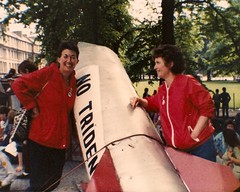
When I first thought of marking the 25th anniversary of the Miners' Strike, this is the photo that I was determined to find. It shows me and a pal from Dunoon CND on the back of a CND float, waiting to take our place in the Miners' Gala procession through the streets of Edinburgh to Holyrood Park. There, in a huge tent, we heard speeches from Bruce Kent and Mick McGachey - a considerably more impressive leader than Arthur Scargill ever was - and met some women who'd been in Dunoon for the action earlier in the year.

It was an extraordinary experience, both exhilarating and sad, but one where, in the midst of all the church hellishness and lack of warmth, I felt at one with so many people. (I had plenty to choose from - there were 10,000 people there). The missile on the lorry, as well as the badges with which we were adorned, made it immediately obvious where our sympathies lay, and people lining the streets cheered us as we passed. I clearly remember passing a group of miners on a street corner - we'd paused to negotiate a tight bend - and hearing one of them call out : "Save our pits, Missus!" - and I remember too thinking that I didn't know where to start.

Thatcher's Britain was a hard place for many Scots, and that June day in 1984 underlined the fact. But it was a day of intense comradeship which made me forget for a while all the stuff back home, and I think my expression shows that.

And it was a day when two ten-year-old boys were allowed by their mad mothers to ride on the back of an open lorry. Now, how many chaps have that to look back on?

Saturday, March 29, 2008

Riding high

Rather like this photo I took today from a helicopter over St Mary's Cathedral, Edinburgh - the confusing symmetry of the crescents and the way you can see why it's quite a long way from the bus to the cathedral when one is late for the Synod Eucharist. The helicopter in question belonged to Jensen Button, the F1 racing driver, until about 10 months ago, and was quite alarmingly old, I felt, at more than 25 years. Apparently most helicopters are, according to the pilot - don't quite know what he meant by this, but he reserved the information till we were landing, which was probably wise.

It was interesting to contrast this flight, on a grey and decidedly blowy day, with the flight over Las Vegas four weeks ago. This felt very ... real, especially when it bumped about a bit. I had been fairly sanguine about it all after my first ride, but today's flight was more like I'd imagined. I left my insides, I think, somewhere above Arthur's Seat.

Fun, though - and the last of this year's Christmas presents. There's always Glasgow from the air, now .....

Saturday, January 05, 2008

Art and fish in the snow


Christmas market
Originally uploaded by goforchris.
We chose the first really wintry weather to make a trip east, where the snow was, by the time I took this pic, falling in large blobs. We were visiting the Royal Scottish Academy in Edinburgh to see the Joan Eardley exhibition, and it was from the garden room below the galleries that I caught this view.

I loved especially the paintings of the Glasgow urchins - the main attraction, as far as I was concerned - but found myself unsettled by the perspective in some of the landscape or - particularly - cityscape paintings. I need an artist to explain to me why someone who has the skills would deliberately skew the perspective on, say, an Italian facade so that it looks like a child's attempt at realism. I know that I could see the point of the increasing abstraction of the paintings of children, so it's probably ignorance on my part. Comments welcome.

Apart from this, we were drowned in slush-puddle by a speeding White Van Man (bastard), enjoyed more Catriona-visiting, and had a great lunch in the newish Loch Fyne Restaurant in New Haven, along the front from Leith. Mr B and I had the set lunch menu (£11) - we chose a pickled herring salad starter and pan-fried dorade on mash with pesto and a side order of veg. Ewan and Morgane had mussels, fish pie and amazing puddings, which they pronounced excellent. The fish was great - I've been missing fish over the Christmas season - and the veg inspired me to try this way with savoy cabbage. I like to feel when I eat out that either this is something I'd be proud to have made myself or that I would never in a month of Sundays create anything as wonderful. Yesterday's meal came into the former category, and I was well content. The service was slowish - it was quite busy, even at 1.30pm - but the surroundings relaxing and cheerful, with just the right level of background noise/music to ensure that we could talk comfortably but not worry if Catriona got fed up. In the event, she was angelic, and much admired (of course).

Now we're back in the grey, wet west and Mr B is cooking tonight. I'm already looking forward to my next trip ...

Monday, May 21, 2007

TeachMeet07


TeachMeet07
Originally uploaded by Edublogger.
I'm taking myself off to Edinburgh to socialise with a bunch of people, mostly male, mostly far younger than I am, all still working, who know far more about Web 2.0 technology than I'll ever know. Why do I bother?

Mainly because they appear still to be alive, that's why. In my last years at work I became depressed by the lack of enthusiasm for teaching displayed by relatively young colleagues, and the growing cynicism which made the expression of enthusiasm unlikely unless you were old and conceited. Like me.

I may or may not learn anything at this gig. But I shall find something of interest, meet up with some new people as well as others whom I really only know online, and feel reassured that there are some areas of teaching which are alive and well and firing on all cylinders. AB feels this will be a day of preaching to the converted - but it's important for the converted to have the chance to confirm one another in what they do. The unwired wilderness is still quite a big country.

Besides, the food part looks promising ...

Wednesday, December 13, 2006

Christmas medley, anyone?

Just back from a visit to Edinburgh - a heady mix of a stay with dear friends, a meeting of the Lay Learning committee of the SEC and a visit to the German Christmas Market in Princes Street Gardens, where I took this rather low-quality pic on my phone. I would have had my camera had it not been for the horizontal rain on a snell wind as we left the car; actually we had a sufficiently long splash of dry to glug down a mug of scalding gluwein at the market stall and feel suddenly much cosier. We were not, however, tempted by the big wheel - it looked decidedly shoogly to me, and a sure ringer for a bout of hypothermia.

And the Lay Learning? I have much to debrief on this one, but came away thinking about the balance between content and delivery systems in any sphere of learning. There's a debate into which I stuck a toe over on John Connell's blog which threw me into reflecting further on this; the tension between knowledge and the communicating of same is complicated by the problem of having to engage with an audience which, unlike school pupils, can turn away and demonstrate only indifference - even harder to deal with than hostility. And the problem of sentences like that last one is that one loses the will to live ploughing through them - could do better, Blethers!

On a lighter note, a thought about Christmas carols. As we skelped home through the incipient floods on the M8 we listened to a sampler CD of new carols. After one particularly ebullient offering, we were struck by a mental image of the Christ-child, square-faced and open-mouthed, wailing inaudibly as the heavenly hosts gave it laldy over the manger. Makes you realise how very good are some of the by now classic arrangements - a case of content not matching delivery systems in many of the new ones.

We made it home in tempest, storm and wind - another quote for the carolophile!