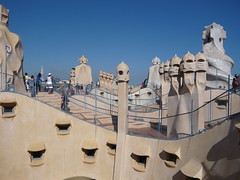
I realise as I reflect on the Barcelona trip that by far the greatest single influence on my photos and on my memories is the work of Antoni Gaudi, previously known to me only as the creator of the crane-surrounded towers of La Sagrada Familia. The photo here is of the roof terrace of Casa Milà, 'La Perdrera', the extraordinary apartment block in Barcelona, so nicknamed because the façade looks like solid rock (the name means "the stone quarry").
The apartments we saw on one of the upper floors was fascinating in its early 20th century domestic detail, but the real joy was the roof terrace, with its serried ranks of helmeted chimneys and ventilators like soldiers of Sparta or Middle Earth, glittering with tile work (the trencadis, or broken ceramic pieces) or smooth concrete. Wandering the undulating walkways in the bright sun was an exhilarating experience, at once surreal and calming, as if the equilibrium between earth and sky was mirrored in the architecture.
A comment on my earlier post about La Sagrada Familia suggested that it was a waste of resources to complete a building that belonged to the tastes of a previous era, and while I always acknowledge that de gustibus non est disputandum, I shall dispute the idea that resources spent on art are wasted. Many years ago, a teacher I admired gave me notes he'd used in teaching poetry to recalcitrant adolescents, the first words of which were: Poetry, like all the arts, is useless. It went on to enumerate the benefits to the spirit of art, but that first line never failed to bring forth a protest.
Yes, we can concentrate on feeding the poor and ensuring that people are properly housed, and such are the proper aims of society. But any society that cannot find the lightness of spirit - and yes, maybe the lunacy - to invest in something of beauty (taste, again!) misses something really important, I think. And of course, we can argue that all these workmen drilling and cutting and polishing in La Segrada Familia are being paid to do so, and their families are better off because of their labour, and the community benefits from all the paying punters like me who go to gaze and wonder.
No, I was thrilled by what I saw - the Basilica, the unfinished Crypt in Colonia Güell, and this, La Perdrera - and enthused in a way I've not felt in many places. As for the taste of another age - well, there are all these Perpendicular and Norman buildings calling out for restoration and upkeep, all over England, and we don't tend to disparage their even older style, do we? And as for the method of designing these wonderful structures - the hanging bags of lead shot suspended over mirrors that you can see here - this left me gobsmacked.
I'm glad that, even in this rational age, we're still a bit crazy,
Showing posts with label Gaudi. Show all posts
Showing posts with label Gaudi. Show all posts
Thursday, September 30, 2010


Friday, September 24, 2010
Window on the future
A highlight of the recent Fahrt to Barcelona was the visit to La Segrada Familia - the iconic, unfinished basilica which I first noticed while trying to text-wrap round an image of its towers for the school's entry in a newspaper competition. We ran a school trips section, and this particular photo taxed my fairly rudimentary skills with Pagemaker. But the jumble of towers and cranes seen from the streets of Barcelona give little indication of what is inside.
I'm used to gloom and relative silence inside the ecclesiastical buildings I've visited (there are many). Not here. Strangely, it was not the bedlam of workmen who have to make the interior ready for the Papal visit in November that made the greatest impression. It was the light - a pale, greenish/pinkish glow that suggested a mystery beyond the merely holy - the mystery of life itself. The columns are organic in their construction, arching up like great trees to split into smaller branches and then into leaf-like fans supporting the ceiling. They seem to be in no recognisable pattern, and yet nothing seems out of place. The flow of stone is elegant and natural, and the light from windows - stained glass or otherwise - permeates the space from hundreds of openings. We were told of plans to fill some of the light-apertures with coloured glass - I think the accompanying photo shows how this might look (at the top of the pillar in the middle ground)
Outside, I was aware of the contrast between the sculptures round the door we had entered by and the ones on the Passion Façade by which we left. The older are of conventional style, though placed among Gaudi's fantastically melting stonework as in a gigantic dripping candle. On the Passion façade, however, Subirach's sculpture is starkly modern, almost cubist in appearance, and intensely powerful, as the road to the Cross is depicted as an upward path on the Western side of the building. Some of the detail escaped me in the bright midday sun - I only noticed the women covering their faces when I looked at the photos I had taken.
If it does indeed take another 20 years for this amazing building to be completed, it is unlikely that I shall see it. But even as it is, Gaudi's vision has transformed my idea of what a church can be. I shall never be satisfied again!
Subscribe to:
Posts (Atom)