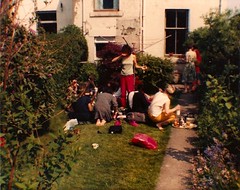
It’s an interesting experience, appearing in court. Although I’d been a juror in the High Court in Glasgow, it wasn’t really any preparation for the strange intimacy of the local Sheriff Court, where the twenty-seven women who were arrested at the January demo were tried over the weeks after Easter. I’d had a couple of visits to earlier trials – a typical fine handed out would be £70 for painting a CND symbol on a wall, but few of the women intended to pay fines, so were facing a week in Cornton Vale instead. On the day when this photo was taken, however, I was appearing as an expert witness – expert by mere dint of being local, I might add – as well as gracious hostess to a picnic in my back garden for the women who turned up in support of their friends.
It’s fair to say that, unlike the women on trial, I enjoyed my time in court. I had a chance to point out the anomaly that had women arrested for trespassing on American property on one day of the year when at any other time you would be greeted politely and asked if you needed help to find someone. I appeared in disguise, of course – little black cotton dress (with pink rosebuds all over it), black fitted jacket, dark tights, high heels – and smiled at the Fiscal and took the oath rather than merely affirming. (On another occasion the Fiscal and I had played in the same amateur orchestra, but that’s small towns for you). At the end of my first stint in the box, he invited the Sheriff to agree that I was “a charming witness” – a claim which caused loud hilarity in the public benches. And I’m happy to say that everyone for whom I appeared got off, and to express my admiration of these young women who conducted their own defence.
Of course, all this had its downside, and that, I’m afraid, happened in church. Because I’d arranged for some of the women to camp in the church grounds that week, I was denounced (seriously!) at the end of the Eucharist, and before we knew it our church wasn’t somewhere we felt we could go any more. A young cleric, a distinct lack of moral courage, a deeply conservative congregation and some economy with the truth left us stranded. At the time we didn’t see it coming, though hindsight - and a friendly policeman – pieced it all together afterwards. Of course there was a lot more to it than I can possibly write about, and looking back over twenty-five years it seems almost unbelievable. And it is thinking about this that led me to consider what I’d have done with this blog had I been writing it in 1984.
Only thing was: we weren’t on our own. There was a choir. Mr B’s choir. They vanished, along with us. And they deserve another post.
Showing posts with label Greenham women. Show all posts
Showing posts with label Greenham women. Show all posts
Sunday, March 15, 2009


Wednesday, March 11, 2009
1984 revisited: The nick
As I commented in Monday's post, 27 women were arrested at the demo outside the American base at the beginning of 1984. As darkness fell and the majority of the demonstrators headed for the ferry through the snow that was beginning to fall, the women from Dunoon & Holy Loch CND decided that we couldn't abandon those now in police custody and agreed to meet at the local police station in an hour or so. Just time to go home, get warm, eat something (and in my case cook something first, for my chaps were panicking) and find something warmer to wear.
And so I ended up spending that Saturday evening outside the doors of the police station, wearing Mr B's duvet coat, singing loudly to encourage those held within. Every so often, the doors would revolve and spit out one of the women, released for now, uncertain of whether or not the ferries would still be running but glad to see us waiting. We took it in turns to ferry carloads to the pier, gave out chocolate, reassured them about timetables. The snow continued to fall, and we scuffed huge CND symbols on the grass. Learning that if we made enough noise the women still held inside could hear us, we made a great deal. There was in immense sense of family and responsibility. After all, these women had travelled from the south of England to demonstrate at our base - the presence of which had turned Dunoon into a garrison town, a chunk of Ardnadam into foreign territory and the Holy Loch into an obscenity - and we were grateful.
By eleven o'clock we were informed that the four women still in custody would be remaining in police cells till Monday morning. We should go home, the duty sergeant told us, not unkindly. Come back the next day if we liked - we could visit. So there I was, having my first ever chance to visit those in prison, turning up on the Sunday with cartons of orange juice, some toothbrushes, toothpaste, books. And my first ever time locked in a cell - brown gloss painted brick walls, bright red gloss on the door, bench on two walls, plastic cushioning in blue. Funny, I can't remember the individual people I visited - only their gratitude, their smiles, their resolve. They didn't seem to me worthy of incarceration, but they must have upset someone.
As the weekend ended in a raw thaw, I contemplated work, normality, and a return, as it were, to Thatcher's Britain. I knew that I felt completely alienated from the government - and that normality seemed more strange than what I had just experienced. 1984 looked like being an interesting year.
Monday, March 09, 2009
1984 revisited: The Demo
1984, the year of the Miners' Strike, the year Thatcher showed conclusively who ruled Britain, began with a month of wild weather. Thunder, gales, snow - the lot. And on January 21, 500 women turned up, on a raw day which brought snow by nightfall, to protest at the US navy Site One: the nuclear submarine base on the Holy Loch.
At the time, I was heavily involved in the local CND. Moving to Dunoon and living there with two young children had galvanised a political activity which had been lacking in my complacent youth; my comparatively recent discovery of God had made it even more important and I was heavily involved in the preparations for this demo. Most of the women travelled up from the peace camp at Greenham Common; the rest of us were local.
I feel a burst of dramatic present coming on ...
It is bitterly cold. The gritting lorry has passed along the shore road at the gates to the American pier - and back again - and then back in the other direction: three loads of grit. The base ship, which only sails if there is a threat of war in normal circs, has gone - on an exercise, we are told; we know better. When I arrive, there is already a fire on the pebble beach, and women - in shawls, in bundles of coats and jackets, draped in blankets - are huddled round it like refugees. You can spot the locals, as we tend to wear waterproofs and overtrousers and climbing boots, but we all look like survivors of some nameless holocaust. The only men in sight are in police uniforms, apart from two nattily-dressed gents. I approach the one in the lambskin coat and burberry scarf. He admits that he is a "posh policeman" - we decide Special Branch. It turns out that many of the police have been drafted in - from Dumbarton, we think.
We spend the day doing the crazy things one does on a demo: country dancing in the road, a great deal of singing ("Whose side are you on?", into the ear of a policeman I'm embracing at the time); there is a die-in on the road with appropriate painted outlines (they don't really take, in the grit). Some Greenham women charge the fence and are hauled away; others sit several deep to barricade the entrance and are also dragged off. The grit makes a dreadful mess of backs exposed as clothes are hauled up in the process, and my pal Winnie, in an absurd orange woolly hat, carefully notes names and times and constable numbers in her little book. She is a designated observer for the day, with instructions to avoid arrest.
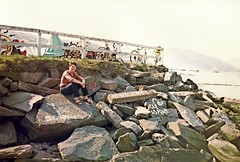
Later, not having been arrested, I clamber down to paint the rocks holding up the car park. (The photo shows me sitting there, months later: I wasn't so into photography in these days, and I feared for my camera should anyone not like what I did with it). I am interviewed on film, though I'm not sure who's doing the interview, and I speak to someone from The Times - the respectable face of the demo. I marvel at the courage of some of the women - moral and physical courage. The younger ones are magnificent, and I feel middle-aged and staid.
By the time darkness falls - about 4pm on this gloomy day - there have been 27 arrests. My mother (in Glasgow) is sure I will be locked up, and Mr B, seeing my sister alone at the door in the dark, is appalled at the thought that he will have to cook the dinner for the family. By the time I get home, I am frozen and exhausted, but there are 27 women, none of them local, in the local police cells and I know I shall have to go out again.
But that, as they say in all the best tales, is another story.
At the time, I was heavily involved in the local CND. Moving to Dunoon and living there with two young children had galvanised a political activity which had been lacking in my complacent youth; my comparatively recent discovery of God had made it even more important and I was heavily involved in the preparations for this demo. Most of the women travelled up from the peace camp at Greenham Common; the rest of us were local.
I feel a burst of dramatic present coming on ...
It is bitterly cold. The gritting lorry has passed along the shore road at the gates to the American pier - and back again - and then back in the other direction: three loads of grit. The base ship, which only sails if there is a threat of war in normal circs, has gone - on an exercise, we are told; we know better. When I arrive, there is already a fire on the pebble beach, and women - in shawls, in bundles of coats and jackets, draped in blankets - are huddled round it like refugees. You can spot the locals, as we tend to wear waterproofs and overtrousers and climbing boots, but we all look like survivors of some nameless holocaust. The only men in sight are in police uniforms, apart from two nattily-dressed gents. I approach the one in the lambskin coat and burberry scarf. He admits that he is a "posh policeman" - we decide Special Branch. It turns out that many of the police have been drafted in - from Dumbarton, we think.
We spend the day doing the crazy things one does on a demo: country dancing in the road, a great deal of singing ("Whose side are you on?", into the ear of a policeman I'm embracing at the time); there is a die-in on the road with appropriate painted outlines (they don't really take, in the grit). Some Greenham women charge the fence and are hauled away; others sit several deep to barricade the entrance and are also dragged off. The grit makes a dreadful mess of backs exposed as clothes are hauled up in the process, and my pal Winnie, in an absurd orange woolly hat, carefully notes names and times and constable numbers in her little book. She is a designated observer for the day, with instructions to avoid arrest.
Later, not having been arrested, I clamber down to paint the rocks holding up the car park. (The photo shows me sitting there, months later: I wasn't so into photography in these days, and I feared for my camera should anyone not like what I did with it). I am interviewed on film, though I'm not sure who's doing the interview, and I speak to someone from The Times - the respectable face of the demo. I marvel at the courage of some of the women - moral and physical courage. The younger ones are magnificent, and I feel middle-aged and staid.
By the time darkness falls - about 4pm on this gloomy day - there have been 27 arrests. My mother (in Glasgow) is sure I will be locked up, and Mr B, seeing my sister alone at the door in the dark, is appalled at the thought that he will have to cook the dinner for the family. By the time I get home, I am frozen and exhausted, but there are 27 women, none of them local, in the local police cells and I know I shall have to go out again.
But that, as they say in all the best tales, is another story.
Subscribe to:
Posts (Atom)