The letter I've just been posting on Letters from the Past is full of interest. My father must have been underemployed on duty that night, or simply more than usually fascinated by the current news. I've managed to find the speech of Churchill's that he comments on - I'm so impressed by what you can find online these days - and have linked to it; and the opinions he shares on Churchill, and on left-wing journalists, were quite at odds with what he calls my mother's "liberal sympathies" - though I never remember my father expressing political views in my hearing when I was of an age to take any notice of them.
There are also some insights into rationing and food - I realise with increasing clarity just how big a part food played in alleviating the tedium of service at home. It is worth noting, however, in the light of his penultimate paragraph, that he never, ever, became "really fat"!
Sunday, January 30, 2011


Sunday, January 23, 2011
Hats from the past

This morning it felt as if my obsession was spreading. For reasons I shall not go into*, I found myself in church, at the start of the service, standing with the small children who have so miraculously appeared in our congregation. They, and I, were wearing strange hats, kindly handed out by Andrew. As if by magic (no, I know it isn't - he reads blogs) he gave me a hat just like the one in the photo on the left, which shows my father sitting in the door of his bivvy somewhere in the Western Desert, probably in 1942. It felt absolutely right to jam the RAF forage cap on the side of my head, not just because I'd been uploading this photo the other day but also because when I was a small child I used to play for hours wearing father's forage cap. (There was also a proper, hard, peaked cap, but I didn't like it as my head was too small and it tended to birl round on the top of my pigtails as if it had a life of its own).
Maybe it's a sign of age that the past suddenly becomes precious - but I wonder what that formidable intellect with whose words I am working would make of all this.
*Oh, all right then. Andrew was introducing the theme of "calling" by getting people to assign roles to hats. If you get me.
Saturday, January 22, 2011
Walking in the air
The photo accompanying this post shows how magical this afternoon was. After a morning swathed in dank fog, we set out from the still-foggy coast to climb through the forest above Blairmore - and came out into the last of the light as the sun set. The whole of the Firth of Clyde, as far as we could see in all directions, was swathed in fog, with the Inverkip Power Station chimney half its usual size and the hills above Gourock cut down to mere bumps. It felt like being in an aircraft - or, as Rob pointed out, like The Day After Tomorrow.
You can see the rest of my (phone) photos of the view by clicking on the one here.

You can see the rest of my (phone) photos of the view by clicking on the one here.
Friday, January 21, 2011
Stringent
My current preoccupation with Letters from the Past means I have less time - and fewer thoughts - to post on this blog, but after a flurry of suggestions from Ewan about how I could enrich its content I found myself examining my attitude to what I'm doing there.
For widening my remit, so to speak, sent me hunting for such things as photos, references to the RAF base from which the letters were written, links to other sites. I became aware of the huge numbers of photos and memories now preserved online, and I was seized by the need to tie my contribution to a larger picture. But in a sense, the letters I'm reproducing have something more relevant to my own field of interest, something that makes them stand alone. The writing in them is wonderfully clear, succinct and evocative of my father's voice - the last of which is, of course, of more personal interest. Today's entry , for example, describes the weather as being "stringently cold". I've never come across that particular use of "stringent", and it's perfect.
These were, of course, the letters of one highly-educated scholar of English to another. I can only imagine the pleasure his references gave when the letters arrived in war-grim Glasgow. And it is this kind of feature that brings me to realise that the real interest, for me, lies in the letters themselves.
There is a whole box of them.
Thursday, January 20, 2011
A blog from World War 2
For the past week I've been reading through a box of letters written by my father to my mother in 1945. Having spent a month or so in Glasgow on the first home leave in three years, he was posted to an RAF base in deepest Essex. From there he at first expected to be sent to Northern Europe - he was a cipher officer - but as the weeks went by he settled into a life of excruciating boredom, in which the hight points were the many letters he received from home and the weekly attempt at making a phone call to his wife.
During that period he must have written on average three letters per week, in tiny handwriting on miserable paper. Often delivery was held up, so that whole bundles of letters would arrive together - though this seems to have been more of a problem with letters from Essex. When it came to the Sunday evening phone call, he might have to book a slot 3 hours in advance, and then have to endure a bad line or an interrupted connection - a far cry from the instant communication we take for granted now. Nine months of these letters survive, with gaps; they end when he left for home to attend the birth of his first child: me.
The letters fall into three sections - the personal, obviously, much of which I have edited out; the literary, mainly dealing with the books he devoured as his main source of entertainment; and the political, as he comments on the progress of the war, the likelihood of demobilisation and the attitudes of his fellow-officers. Every now and again there is the casual mention of something huge, historically speaking, but they are fascinating primarily as an insight into our recent past.
You can find the letters, as well as photos from the desert war, on the blog Letters from the past.
Tuesday, January 18, 2011
Waste of parents?
I'm currently working on a fascinating project to put online a great collection of letters from my father written during 1945 and therefore covering the end of the war with Germany and the dropping of the atomic bombs on Japan - and I'll put up a link just as soon as I get started on the text. But in preparation for starting I've been reading these letters, and I've been learning.
Two things leap to mind. The first is of interest, probably, only to me: I was going to be called Caroline Mary. The initials are the same - but I can't so far find out when I became the me that I know instead. The other, however, is more profound. I was wondering why I knew so little about my own parents, so little about what they thought about the big things. I realised that in fact it was because I hadn't asked the right questions - especially of my father, who died when I was 32. Ok, you say - you were an adult. What stopped you asking the questions?
And the answer is, I think, that I didn't know what questions to ask. I also lacked the confidence to ask them. I don't think I became that confident questioner until ... well, until now, I suppose. I simply didn't know enough. They were my parents, and that was enough - a kind of force-field prevented my straying too far, and I didn't know the way anyway. So that feeling that keeps coming over me - the idea that we waste our parents, the resources that they represent - is something I have to recognise and, to quote Larkin, clothe as destiny. Maybe we are all destined to "waste" our parents; to dismiss their recollections as old hat or irrelevant, to assume that we know it all without recourse to their wisdom. Maybe the force-field is omnipresent between the generations, and maybe it is inevitable and even necessary.
So I forgive myself my thoughtlessness, and will attempt to make amends to myself now. And while I'm at it, I shall keep on growing up.
Maybe.
Saturday, January 15, 2011
Voyage into 3D
I've come over all industrious in the last couple of days - started work on a new blog to make use of fascinating family archive material from World War 2 - but before I lose sight of it, I must record our recent outing to the movies. This is something we tend to do on average once a year - a post-Christmas treat involving the empty cinema (everyone else being back at work/school), a morning screening and a large and leisurely lunch afterwards. Because I believe that a big screen and superb sound effects merit a big movie and special features that wouldn't be the same on the telly, we didn't see the apparently excellent The King's Speech - we shall, but probably on DVD - but went to a 3D screening of The Voyage of the Dawn Treader - the third in the Narnia films.
Of the books, this was perhaps one I didn't particularly enjoy, but boy, did it make a good movie! There we sat, in our shades (modern 3D involves not red and green lenses, but things that look like pale sunglasses), captivated by the effects as Eustace the dragon swept at us out of the screen and the green fog (see picture) threatened to engulf us all. The moral transformation of said Eustace - which might well have seemed nauseating - was wonderfully acted, and Aslan (Liam Neeson) as ever sent shivers up the spine. It was a great outing - and the threatened sick-making effect of the 3D wasn't in evidence, despite the problem of getting the specs to balance comfortably over the ones already on my nose.
Magic, in fact.
Moving swiftly on: parenting and education
Considering my own childhood - and I realise it must seem odd to many - led me inexorably to think about my own role as a parent trying to encourage children to learn, do homework and so on. I was about to say that by comparison with my own parents' involvement, I was a complete failure - but then I thought about the outcome for both sons and decided that was a tad sweeping. So what do I remember?
The Word Tin. Son no.1 used to produce this, when he was in P1, with a look of doom. We had to pick words out of a tobacco tin (where on earth did I lay my hands on this item?) and he had to recognise them. At the time he was four and a half and it was torture. Later, there was more amusement to be had in thinking up outrageous sentences with which he could demonstrate the meaning of words. And that, I have to admit, is all I can remember from the Primary school years. I have very little recollection of what - if anything - I did to help no. 2 son. He used a thing called the word-maker, and progressed to a sentence-maker, but I didn't seem to do anything. Could this be because by then I'd gone back to work?
When your children attend the secondary school in which both parents teach, the experience is somewhat different from the norm. I was certainly involved in helping both sons with English - rescuing one from having to do North and South for Higher by spending a whole Easter holiday studying the Larkin set texts so that he could use them in the exam a month later actually involved me in the most God-awful scene with his class teacher, who happened to be my boss. I did a bit of Standard-grade Latin with both of them. And when no.1 son became editor of the school magazine, he recruited me as the Editor-in-chief because it was more convenient for him - and look where that got us.
Actually it got me into what I see as the most important single piece of education I ever undertook. I don't know how many evenings I spent in the school while both sons in turn ran the magazine, teaching myself to do desktop publishing (Adobe Pagemaker) when they left and the boy who knew how to do it let us down, sharing hilarious pressure with successive generations of student journalists when the photocopier jammed/ran out of ink/got too hot, going off with them to competitions in Edinburgh and to the Scottish Parliament, sitting in on interviews with Frank Pignatelli, then Director of Education for Strathclyde, and John Smith, leader of the Labour party. Pupils who were shy learned to use the phone, to contact advertisers, to sell advertising; others learned touch-typing without ever taking Business Studies, coaxed ancient Macintosh Classics to work years after they should have recycled, learned to use the scanner and the value of white space on the page.
Did this make up for the fact that we had television on every night? That there was a small telly in the older son's bedroom, linked to the ZX Spectrum but also to an aerial? That they both had radios and listened to music incessantly, from an early age? That we allowed an 11 year old to have a modem and a year's subscription to BT's precursor of the internet (what on earth was it called?) so that he would come and beg: "Can I go online now?" before he was in secondary school? At the time I felt I was failing, when I'd find one of them sweating over something for the magazine the night before some important exam, but now I'm less sure.
But there's so much more to think about in this early exposure to the medium I'm using now that I think I'd better leave it to another post. It's a long way from the Word Tin ...
Thursday, January 13, 2011
The parental role in education

The chat on the radio today was looking at the perceived failure of state schools adequately to prepare their students for the competition to enter the top universities, and asking how much parental pressure/support/coercion was needed to supplement the work of the school. As a teacher, a parent and - a long time ago - a child, I think I have quite a rounded picture of this - but in this post, I'd like to share the part my home played in ensuring that I succeeded in what I set out to do.
By the time I was ten, we lived in a Victorian terraced house in the West End of Glasgow, with four bedrooms and two public, as well as a large kitchen, a wash-house and a lined loft. Loads of room into which one could vanish - but in winter it was cold, and we tended to live between the dining-room and the kitchen. That meant piano practice was less assiduous than it might have been, but was generally done before the evening meal - perhaps on the premise that food would replace the heat lost during practice. Dinner was over by 6pm - both parents were teachers, both home at the same time as us. For the next three hours, my sister and I sat at the dining room table and did homework - and there was always a great deal of this. (We were at a grant-aided selective school, and we could be asked to leave if we didn't work). Until about 7pm, we weren't allowed to make a noise. In fact, I got hell once for throwing a pencil down on the table, as my father had fallen asleep in his chair and I woke him. Once his post-prandial kip was over, however, we had two hours in which both our parents took a hand in our struggles.
Father was always deeply critical of the teaching in the English department of our school, so we had a great deal of incredibly thorough input on texts we were studying. That went without saying. What was more remarkable, I thought, was that he would also work out from first principles what was going on in the Physics problems I had such trouble with - sums involving moment, I recall with horrifying clarity. My mother, meanwhile, would sit down with my tiny, battered copy of Caesar's Gallic Wars or, later, Virgil's Aeneid (Book 2) and, as she put it, "break the back of it" before I set to work on my preparation for the next day's terrifying oral translation session round the class. She also pushed us to work at French, which I personally hated because of the accent involved, and made several visits at parents' evenings to ask why we had so little written homework in French (lazy teacher; fluent as married to French woman but no fire in his chubby belly). That holiday in Paris, by the way, was by way of encouraging me at the end of S2 - I can still remember the chagrin when the lift man in our hotel corrected my pronunciation of "quatrième".
All this must have taken an enormous amount of dedication and energy on the part of two people who had already taught for a whole day - or even the half day done by my mother, who would then have had to shop (no car, so limited to what she could carry each time) and deal with our sizeable and dusty-corner-ridden house. There was no thought that my sister and I should do housework, other than during a holiday. But perhaps the biggest single contributing factor was the absence of a television. Despite my sense of deprivation at never having seen Quatermass or Emergency: Ward 10 my father refused to have a set until I had graduated (I lived at home when I was at Uni). He said I'd become an addict and that would be the end.
How right he was. I'll return to this subject - I want to think about my own deficiencies when it came to fulfilling the parental role - but for now, I'll indulge my latest addiction. Another go at Bubbles HD before I head out?
Monday, January 10, 2011
Catharsis in Walford

What nonsense all this is. The most unexpected people suddenly stop watching the programme, or write letters or post their ire on websites. People are upset to find this sort of thing in their living-rooms, and Mumsnet is raging. What's going on?
Classically, the purpose of drama - and particularly of tragedy - is catharsis: the purging of pity and terror. You watch the drama unfold, you become involved, you suspend disbelief, you weep, rage, gasp, feel fear and relief - and by the end, if it's been well done, you feel wrung out, devoid of all emotion. Judged by this set of criteria, EastEnders has got it about right, I'd say - except that people have forgotten the rules.
A few weeks ago I watched Patrick Stewart as Macbeth, in a strangely bleak production of Shakespeare's tragedy. For anyone who has forgotten the plot, Macbeth, a soldier, acts on the urgings of some strange women and murders his king. He then becomes king, but fears his best pal Banquo may suspect, so has him bumped off. He is more than somewhat annoyed that the inept thugs who do this for him fail to murder Banquo's wee boy. Later he has the wife and children of one of his former friends horribly murdered in their house as the children are getting ready for bed. That last bit is particularly horrid. I wasn't aware of cries of horror and demands that the play should never be put on again.
Or what about Hamlet, whom Shakespeare has plotting to murder his uncle for the whole length of a long play? In the course of trying to find the perfect moment, Hamlet bumps off the father of his girlfriend without knowing or caring who he is, sends his two best chums from school to certain death in a foreign country and acts in a totally unsuitable way towards his silly mother. Do people write angry letters about the portrayal of life with a step-father?
Course they don't. It's only a play, silly. So why do they think EastEnders is any different? Ronnie has been an unstable character for years - of course she's not going to get to be happy and fulfilled. Nor is she going to accept her lot if there's a chance of doing the dirty on someone else - we know this; we've been prepared for it. No-one would leave an hours-old baby in its cot in the care of its grandpa? Well yes, they would. People are wary of passing around a newborn - there's a sort of mystique, a fragility that binds a new baby to its mother, and if the mother is suddenly taken ill it's an alarming prospect for even the most gung-ho stranger to look after this tiny infant. And it was Hogmanay, and they were all drinking and Alfie is good-hearted but inept and Charlie has never been the most savvy of men.
If I were an EastEnders producer, I'd be thinking I'd succeeded here. Everyone's talking about it, it's on the news programmes and radio chat shows and in the serious Sundays as well as the red-tops. What more could they ask? So people seem to think it has to fulfil a public service role and show bereaved Ronnie behaving well and bravely - where's the mileage in that? This way, the story has legs. Jessie Wallace gets to act her socks off. It's not real life, whatever people have come to assume. It's a play. Fiction. Drama. Either watch it, or hit the remote.
THE END
Sunday, January 09, 2011
On lecterns, and cold hands
Brass eagles don't usually leap into the mind when the weather is cold - monkeys are much more likely. However, today I want to consider a brass eagle like this one, a lectern in a chilly church on an icy Sunday. Specifically, and not to detract from this magnificent specimen in the Cathedral of The Isles, I want to consider the lectern in Holy Trinity, Dunoon, and its effect on me this icy morning.
Today was my turn to preach. Having read the gospel (it was a lay-led service), I propped my notes on the lectionary as usual - and found that they wouldn't stay put unless I held on a bit. (The lectionary at this early point in the year lies a bit lop-sided when open at the right page). I tend to hang on to the wing-tips anyway, as it anchors the hands in a decorous sort of fashion.
Halfway through I had a vision. It was not an angelic vision, nor was it helpful. I pictured myself as in a heat-imager: starting off quite red and glowing, in my good wool coat to the ankles and the fur-lined boots. Within moments, my hands are blue, then black. The glowing red is drained out of my shape, passing instead to the eagle. By the end of the sermon, my frozen body retreats and the eagle, glowing like the Phoenix, takes off and soars down the church.
There you are. I told you it wasn't helpful. But I must try to do something different with my hands next time.
Or wear gloves ...
Friday, January 07, 2011
Hibernation ended

I've been thinking about this as I prepare a sermon for Sunday, and the idea of living through change in oneself has taken over. I can remember how overawed I became shortly after finding I was expecting my first child - I was standing at a bus-stop in Clarence Drive when I was suddenly overcome with the enormity of the changes this as yet invisible child would produce in my life. (If I'd known it would involve leaving the West End of Glasgow and living in Dunoon I might have panicked even more, but there you are). But now, all these years on, I look back calmly and with huge satisfaction at the way it all panned out: what was I afraid of?
Only thing is, I don't think satisfaction is what it's about. Not this change, not this Epiphany. I have a worrying feeling that it may be about continual growth, continuing challenge, continual willingness to try, to accept, to move on. Tonight I noticed it was significantly lighter at 4pm than it has been. Hibernation is not an option, is it?
Oh, darn ...
Sunday, January 02, 2011
Kate Atkinson, again

This is the fourth book to feature Jackson Brodie, who sidles into the plot some time after I became hooked on the story of Tracy, ex-cop, security firm owner, lonely and overweight. It was Tracy and her acquisition of a child that had me reluctant to move around the plot - for Atkinson never leaves you with only one strand to follow - and Brodie and the dog that enters his life who had me laughing aloud, sometimes in horror. The story is dark in places, and complex in its interweaving of time-scales and histories, which is where the second reading will come in - I don't feel I'll fully appreciate the book until I do this. I loved the details of the past - Vesta curries, Smash instant mash - and the fact that they shared a place with the use of Twitter and Facebook. Too often, I feel, novelists opt for a present that seems never to have changed - kind of Orwellian, in a way - and forget that readers might share a past with the characters.
I don't think I've really explained why I'd recommend this, other than that it's the usual well-written, gripping story with a twist in its tail. You can see my first thoughts on it here, but apart from that just go and read it for yourself.
Wednesday, December 29, 2010
Traditional and effective
The photo accompanying this post records one of these satisfying grandmother moments. I'd been holding Anna (4 weeks old) in the hope that she would drift off to sleep, but she didn't appear to be able to settle. Perhaps her sister was too interesting, or she just didn't want to miss out, but she was tired and scratchy and it was obviously time for the Wise Woman to make a reappearance - and sing.
 I've written of this before, when I was singing to that lively three-year-old in the background (can't help feeling it wouldn't work now, but I'll return to that). This time I sang another lullaby, Watts' Cradle Song, to an American (I think) tune arranged by Mr B for our women's choir, 8+1. The melody is in the alto range, and I've had it on the brain for the past few weeks. The words were somewhat random , as I'm hopeless at remembering them, but phrases like "here's no ox about thy bed" seemed suitably soothing, and after gazing intently at me as I sang, Anna's eyes drooped and in no time at all she was sound asleep. She was sitting in this upright position, too, so the sense of communication was very real - until she flopped. I continued singing quietly as I put her to bed, and that was that.
I can't stress how important I think this live singing is for young children. It's not the same when nursery rhymes, lullabies and so on are played on CDs or - worse - distorted by electronic toys. The vibration, the tailoring of volume to the moment, the possibility for variety - these all contribute to what is, after all, as old as the hills.
Incidentally, big sister still loves to sing - though she does give me a row for using the traditional words as the end of Mary had a baby. You can't please all the people all of the time ...
Friday, December 24, 2010
Christmas Eve, differently
Traditions endure - and yet things change. Until a couple of years ago, Carols from King's was the background to my big Martha moment, making stuffing, cooking sausages, doing funny things with giblets. The house smelled wonderful, and there were either visiting family dotting in and out of the room or we were anxiously anticipating their arrival through whatever weather obtained at the time - though to be honest it was usually gales and rain. I would have spent the morning lugging a turkey home, depositing it in the shed to keep cool - not schlepping round the Bishop's Glen in the sunshine marvelling at the frosticles on every branch and wondering why I felt so strange.
Because I do feel strange. I find it disconcerting to be packing a suitcase and trying to remember shoes as well as boots (for the socialising, you know), to be stressing about catching the first ferry in the morning and hoping the fog doesn't return. Instead of looking tidy and prepared, the house is its usual slightly random self, with the addition of a Christmas tree (above) and cards on every available flat surface (another casualty of our straitened workforce; I lost the will to hang them on their holders). I'm cooking nothing other than tonight's dinner, and have a relatively empty fridge in anticipation of a visit to Tesco on the way home.
But first there's Midnight Mass, with incense, candles, carols, that lovely bit of Liszt on the organ, singing with other musicians - all the things I love and which keep me here when I could already be relaxing with my family. I shall not feel as joyous rising at 7ish when I've been in bed well after 2am; hence this moment snatched from organising myself to relax over a blether. But now I must make sure I've packed ...
Happy Christmas when it comes - and let's hear it for Western Ferries!
Thursday, December 23, 2010
Controversial nativity?

I was looking for an illustration to this post when I came upon this story. Apparently the BBC production which has just ended, The Nativity, is being attacked as being anti-Jewish. I didn't clock that, but after wondering early in the week if this drama was going to work, despite the appealing casting of Mary and the atmospheric setting, I found tonight's climax extremely moving and well done.
I suppose the difficulty is that the story is so well known. How do you explore the characters of people who have been household names for 2,000 years? And we know the ending, don't we? How do you surprise and grip an audience with the best known story in the Western world? (I think I'm being careful here). In the end, I think they did it by concentrating on the humanity of Mary and Joseph, on Mary's extreme youth and Joseph's understandable misgivings. All these dreams - who among us wouldn't say "It was only a bad dream" and sulk off? Did you not find yourself begging Joseph to take Mary's hand as she begged him? Did you not sit up in your seat and will them to find somewhere to stay, even though you knew they would? Suffer through that labour in the filth of the stable? Smile "At last" as Joseph reached for Mary at the moment of birth?
There were moments that took me outside the circle of the drama: I couldn't take that quietly-spoken Irish Gabriel, and I wanted wings like drifted snow and eyes as flame, not to mention the heavenly host. I kept spotting Tucker under the admirable strength of one of the Magi, and I marvelled at the awfulness of Herod with his pale eyes and the ghastly sweating illness that perhaps Art Malik might have cured if he'd still been at Holby City. But these are the dangers of all dramatic production, and my willing suspension of disbelief kicked in with a vengeance tonight.
And I loved the gradual convergence of planets and star to form that wonderful celestial light at the critical moment, shining down into the mess and confusion of a shed full of troubled shepherds and men who had travelled such a long way. This birth was hard and bitter agony for us ...
Maybe the controversy arose because there is no way of telling this story and making it blandly acceptable to everyone.
Tuesday, December 21, 2010
Revelation
That blackbird ...
Originally uploaded by goforchris.
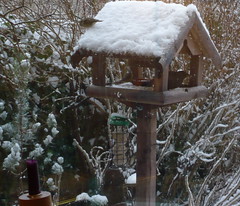
Having recently learned
the shocking truth that
birds lose something like
a third of their weight
overnight, I look at
the puffball shape of a
round robin with new eyes.
Go for it, little one,
I whisper, madly, at the window,
smile encouragingly as tiny tits
hurl themselves at the table
where this morning's food is
piled, tut when the blackbird
and his wife - a sturdy wench
in brown - spend far too long
over breakfast and leave the
shivering siskins on the bare tree.
The snowy garden is swathed in
fog as another day in the deep freeze
begins, and I, insulated from reality,
imagine myself St Francis
and smile with fatuous fondness
as my small visitors struggle
for their very lives.
©C.M.M.
Sunday, December 19, 2010
Amid the winter's snow ...
Well, we were lucky. After yesterday's snow, yesterday's hypochondria about sore throats, all the cancellations of services seen on Twitter, Holy Trinity attracted between 50 and 60 souls to our Advent carol service. There was one missing singer, marooned in the hinterland by high, snowy, impassable roads, with the attendant sudden feeling of exposure at the bottom of the harmony as one alto carried the burden alone, but things could have been worse (not for the marooned singer, I suppose - I'm glad she's safe and Facebooking)
I love Advent services. I love the darkness, the restraint, the fact that it's not Christmas yet. I think I always felt like this, even in my heathen days when I didn't really know about Advent. And today underlined something else in the makeup of that feeling. For today could so easily have been a disaster, or cancelled. As it was, it felt precarious, something that might blow out in an instant, like a candle. As the candles on the strange wooden candelabra dripped onto the peace angels hanging under them, as the sopranos' pew candle guttered low in some unseen draught, as the singers in the middle of the group struggled to read their words in the growing dark, there grew this sensation of something at once very human and utterly other, something like a frail glass bauble that could break if you held it too hard.
It was wonderful that it happened, wonderful to see people from outside our small congregation piling in as the snow fell outside, wonderful to see the work that had been done in all sorts of ways to provide candles, the tree, the fabby mulled wine. (I had three glasses: very warming).
Not perfect, but wonderful.
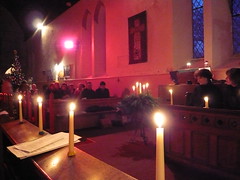
I love Advent services. I love the darkness, the restraint, the fact that it's not Christmas yet. I think I always felt like this, even in my heathen days when I didn't really know about Advent. And today underlined something else in the makeup of that feeling. For today could so easily have been a disaster, or cancelled. As it was, it felt precarious, something that might blow out in an instant, like a candle. As the candles on the strange wooden candelabra dripped onto the peace angels hanging under them, as the sopranos' pew candle guttered low in some unseen draught, as the singers in the middle of the group struggled to read their words in the growing dark, there grew this sensation of something at once very human and utterly other, something like a frail glass bauble that could break if you held it too hard.
It was wonderful that it happened, wonderful to see people from outside our small congregation piling in as the snow fell outside, wonderful to see the work that had been done in all sorts of ways to provide candles, the tree, the fabby mulled wine. (I had three glasses: very warming).
Not perfect, but wonderful.
Saturday, December 18, 2010
Glasgow Royal cheers
It's snowing, inconveniently, but I'm not going to mention it again. Instead, I'm going to indulge in a wee paean of praise for the Plastic Surgery department at Glasgow Royal Infirmary - and no, I wasn't having cosmetic surgery. Just in case you ask. It was a very tiny bit of cutting and stitching that was required, though I suppose the resulting biopsy may lead to a further visit.
The great thing is that I'm not anything like as bothered by that thought as I was. The people I met there - especially Jim the nurse - couldn't have been better at mixing professionalism with the appearance of personal interest; the building was newish and therefore cheering; the atmosphere in theatre was calm and unthreatening. My face, having had any vestiges of moisturiser swabbed off it, was swathed in drapes, so I couldn't see anyone, but I was able to listen to the instructions as someone practised tiny stitches on my temple (I never thought of the bit in front of my ear as the temple, but there you are) and join in the discussion about how difficult it was to explain the difference between a granny knot and a reef knot. (To be honest, I think the instructing surgeon was better at surgery than language - it was my idea to call it a granny knot when one stitch had to be removed and redone)
Even the horrid sensation of the local anaesthetic was alleviated by the cheerful warning that it would be like a dental injection but wouldn't last, and by the discussion of the relative merits of the words "prick" and "scratch" in describing the sensation of an injection - apparently they worry about people's reactions to the former - and by the realisation that it worked so well. I was grateful for the fact that I was seen almost as soon as I got there (early: we were anxious about the black ice on the pavements and our ignorance of the hospital layout) and that it was still light when we finally escaped ...
...to some lovely tea and a large chunk of carrot-cake in nearby Brewhaha. Very therapeutic - I recommend it. But let's hear it for the NHS - at least in Glasgow Royal.
Wednesday, December 15, 2010
Another Advent poem
I've posted another Advent poem on frankenstina. I'm grateful for the commission that led me to write it, and hope that as the magazine in which it now appears (the SEC's lovely publication Inspires, which seems to me to grow in stature with each edition, my own contribution notwithstanding) is out in the public domain it is now all right for me to post the poem.
The idea of a recurring need in our deepest places – for warmth, for love, for reassurance – seems to me especially poignant and powerful in the last months of the year. As the days shorten after the equinox, this can be felt as a disturbance, a restlessness of spirit reflected in the irregular rhythms of the free verse of the opening section of the poem. This settles into metre to reflect the idea of this experience recurring every year through the ages, a sort of incantatory passage in homage to our Celtic ancestors for whom the coming of the light was in every sense such an important event.
Subscribe to:
Posts (Atom)