Showing posts with label memories. Show all posts

Tuesday, July 04, 2017

Memories of a Hillhead infant


It was this picture that started it. I've been rummaging among my old teaching materials and came upon a small buff book, with cartridge-paper pages that are half blank, half ruled in light and heavier red. This pre-dates all the other stuff I found, as it comes from my childhood. From 1952, I would say, when I was in Infants 2 in Hillhead Primary School in Glasgow. A chance remark on the Facebook conversation that followed its publication there brought memories flooding back - far too many for that medium. And it struck me that this is social history as well as my history, and I find it fascinating. That's what brings me back to Blethers after so many months. I want to write it down before I forget, or before no-one who was there is around to remember with me.

Let's begin with Christine Findlay, pigtailed in Primary 2. By this time she will be almost 7, because her birthday is in September. This meant that she started school in January, already 5 years and 3 months old and able to read. She is no longer playing with Plasticene and lacing cards (the latter, for some reason, a great thrill; something never seen at home).
Presumably for reasons connected with accommodation - and perhaps staffing - her class was called 1e and the school day began at 1pm and ended at 4pm. She travelled by tram from her top-flat home in Hyndland along Great Western Road to the foot of Cecil Street, where she crossed the main road with the help of a traffic warden. (He was once knocked down while she waited beside the road - perhaps this story will reappear). The lunchtime journey cost a ha'penny - the "Ha'penny Special" for school children; the return a whole penny. A yellow ticket at lunchtime, a blue to go home. Six months later her class became 1a and attended school in the morning. I cannot recall - see: it's going already - if the beloved Miss Buchanan survived the transition to morning class or if it was then that Mrs Reilly appeared, a red-haired, vivacious woman confusingly addressed by older pupils as Miss Forrester.

It is her class that provides this book, and some of my clearest memories. I can actually remember writing some of the legends in it, drawing the pictures to go with the writing exercise. In the course of it, we moved on to joined-up writing, copperplate. But before I go there, a vivid, stressful moment...
We were writing the letter l, lower-case, on the same kind of ruled paper as is above. And I couldn't work out how long the letter l (lower case) should go on. How many lines? Two thick and two thin? It looked far too long and wavering. I was distraught. We were forbidden erasers. Even when I saw a friend - was she a friend? - doing what looked a more correct version, there was no way I could hide my shame. I was a fool, and I blushed. That perky child in the picture - wearing, I notice, the regulation school winter jersey with the collar (striped in school colours) through which one threaded the school tie under the gym-slip - was feeling anything but perky.

But I progressed. My writing became fairly spectacularly neat copperplate - an example occurring in the day we learned about Diogenes. There is a wonderful picture of someone else's vision of how he might live here, but this is what I drew.

On other days we drew such things as the Glasgow coat of arms (so hard, these fish!) and a cuckoo which still looks quite convincing. All with this amazing writing underneath. Of other learning I remember less; I was bored much of the time during reading lessons because I was already a fluent reader and became cross at people who read aloud each individual word. Clearly, I was not destined to be a patient person.

I think there were forty children in my class, boys and girls equally distributed. The "a" designation referred to our birth dates, and all of us had our birthdays between September and December. We were the oldest class in the year group, we had had two terms of education more than the rest of the year. We felt superior, and no doubt we acted that way. We had embarked on our Hillhead journey. And the next time it's raining and I have little more to do, I'll regale the waiting world with a few memories of the next stage of that journey ...

Thursday, February 23, 2017

Rummaging in the cyber past


I retired over 11 years ago. After all these years of teaching English I found I was missing the discipline of writing - for when I set essays, particularly to senior classes, I tended to write one myself. It was something I liked to do, to contribute to the discussion, as well as believing you shouldn't ask people to do something you weren't prepared to do yourself. At the time, blogging was pretty new - and it was really the only shared form of communication, the first step in what we learned to call Social Media. My sons were already blogging. I was seduced.

And it was in that first year of blogging that I began to meet people outwith my own circle (there - Blogger doesn't like "outwith" any more than it ever did), several of whom were (another new word at the time) edubloggers. Some of them were Scots, so that I met them physically in Glasgow ("You're Blethers, aren't you?"); some were much further away. And one of the more distant edubloggers I also met, and it's a good story.

I can't remember the exact sequence of events, but it was in November 2006 that I blogged about my input into the classroom work of Anne Davis - allowing her to use my photos as a classroom resource for creative writing, commenting on some of the pupils' work, thoroughly enjoying that little bit of teaching again. Three months later, we met - in San Francisco - thanks to Ewan's social engineering. We were on a month's tour of our American friends, one of whom had just dropped us off at our SF hotel. The cases had just appeared, when the phone rang. You don't expect anyone to phone you in a strange city - but it was Anne, also in town for a conference. Could we meet for dinner?  And we did, and you can read a short blog post about it, though it doesn't mention my recording a podcast for her pupils.

But I must tear myself away from this nostalgic wandering among the archives. The reason I'm doing it appears in the photo at the top: Anne sent me this book that she and a colleague, Ewa McGrail,  have written (and it costs a fortune to send a book from the USA) and it has the most lovely dedication on the front page and several references to me, all wonderfully flattering, scattered throughout the text. I'm delighted to get it, and to relive that time - which in many ways feels like another life. Even this blog post, full of links that take ages to find because I keep reading what I'm rummaging among, reminds me of that era.

Now, of course, it's all short-form communications. Social media rules, and the most unlikely people turn up on Facebook. Blogging is much less of a thing. And yet ... I find myself returning to blethers when I want to say something longer than a sentence, or something that I haven't got a proper photo for (because Blipfoto seems to have turned into my regular blog spot, in a strange way - maybe because of the interest of photographers). And when I was reading the book this morning, and reflecting on how I'd celebrate its arrival, I thought about children's writing and the joy of having it read by more than just the classroom teacher - to say nothing about having comments added by outsiders.

Children - and we've been talking primary school pupils throughout this - still love to have their best work displayed on the classroom wall. There is a place for this sort of controlled online interaction - on the much bigger wall, as it were, of the internet. This book, Student Blogs, seems to me to cover so many of the areas that might worry the cautious teacher - everything from accessing photos to Creative Commons and beyond - as to encourage any teacher to have a go.

Unless, of course, no-one can write more than 140 characters at a time these days. Just like The President ...

Friday, August 12, 2016

Hoolies I have known ...

This startling photo was taken by Karen Brodie last Saturday as the participants in the Festal Evensong that had just celebrated 140 years of the Cathedral of The Isles poured out in a swish of red and gold onto the steps and stopped to pose. Small people to the front, they said, and some of us obliged. Far be it from me to lurk in the shadow of a mitre ...

It's been a long time since my first posing on these steps as part of an ecclesiastical extravaganza - the picture below was taken in the summer of 1973, when I have to say I felt as if I had a bit part in a Fellini film. It wasn't long after that that I was confirmed in the Episcopal Church, and another 6 months would see me uprooting myself from Glasgow and moving to Dunoon on the back of an invitation from the priest whose institution as priest-in-charge of Cumbrae as well as of Holy Trinity Dunoon was the occasion for that bit of finery. You can see that in those days we were soberly dressed in black (I think they were our MA gowns, and cassocks for the boys) whereas nowadays we are more Whoopie Goldbergish in red (donated by an American church). The red gowns used to have dreadful white polyester scarves, but we managed over time to lose these ...

And if you look closely at the two photos, you should recognise one constant - or rather, four constants: the four members of the St Maura Singers, a relatively new group back then; a somewhat older one now. Two men, two women. We (the women) were both pregnant in the first photo; decidedly not so last weekend. So it's been a while, and we've seen a great many hoolies in this lovely place.

There's nothing quite like a full house to boost the spirits; nothing quite like a good choir to sing with to make the spirits soar. I reckon I've been lucky to have my faith journey as well as a chunk of my musical life linked into the Cathedral on Cumbrae - or the Cathedral of the Holy Spirit, or the Cathedral of The Isles, if you prefer - for it remains special, full of benevolent spirits and still numinous in the incense-remembering silence of an evening alone in the Butterfield building. I've shared it with musicians, with retreat groups, with a Cursillo weekend, with a preaching workshop, and simply with our friend Alastair who is the organist there. But no matter when I go or with whom, this is my place* - which may explain why I look so pleased with myself in Saturday's photo.

That said, it was a crazy weekend. Many of us who made up the choir had arrived on the Friday for dinner and had rehearsed until 10pm; the following day we began at 10am and went on till 1pm with a 15 minute break; the Evensong - an enormous sing - took up the afternoon; we rehearsed till 10pm in the evening. On Sunday, we began at 9.45am to practise for the Eucharist (a Mass setting we'd never seen before); when that was over and we'd grabbed a salad it was back to get ready for a concert at 3pm. I haven't worked so hard in years, and neither has my voice.

I attribute its surprising resilience to a summer spent singing along to Leonard Cohen, actually - it's fair ironed out the break around Middle C that used to cause me such bother, and in a summer of builders and no choir it's been good to have something to sing with. How long, O Lord ...?

A final thought: I have no idea what anyone not involved in this kind of thing makes of it. It's clearly formed a big part of my life, and I've had a lot of fun. But normal? I don't think so ...


*This is not strictly true, you understand: there are probably hundreds of people who'd say the same, but ...

Monday, February 01, 2016

Of urban open spaces and a post-war childhood

I was reading the other day about a dispute over an area of land in the West of Glasgow which is currently used as a (relatively) wild place for children to play, for people to grow things, to be free, and which is threatened by proposed housing development. The writer went on to enlarge on the features that make it so important to retain its use for recreation, particularly the benefits to children's health and wellbeing of such unstructured play in a traffic-free area in a city.

It had me thinking of my own childhood freedoms, also in the West End of Glasgow - freedoms positively enhanced by the relatively recent World War 2. I'm sure I've mentioned much of this before - the place where the land-mine demolished a bit of Polwarth Gardens' tenements, and the huge blocks of red sandstone that still littered the site sticks in my mind, although as a Novar Drive kid I didn't stray there often; we were very territorial in these days. My usual companions lived in the next close and we barely tolerated strangers ...

My usual playground was an open space in Novar Drive where the end of Lauderdale Gardens didn't reach as far as the Novar and was linked to it by a muddy track over empty, hilly ground. On the lower side, which has now been built on, there was a rubbish dump, an infill site, I suppose, where building debris (a result of bombing?) shared the space with more mundane litter like soot left by chimney sweeps (great face-paint) and at the top of which was the underground air-raid shelter in which we sometimes lit illicit fires. To the far side of the dump were two brick-built shelters with thick concrete roofs; we rarely went inside (too smelly) but played Kingball, precariously, on the roof of one.

When it snowed, I borrowed a sledge from a neighbour whose daughter was a good 6 years older than me - she would be at school and I'd be hurtling down the sloping field, often alone, for hours. I have a feeling that the winter I'm recalling was my first at school, when Hillhead Primary had an intake in January; some primary teacher must have doubled up and taken my class in the afternoon after her morning class had gone home. My mother, already having to attend to my 2 year old sister, would despair at converting my wet, grubby morning self into a schoolgirl in time for the 1pm start. (Crazy idea, now I think of it again.)

When the days grew longer,  we spent hours climbing the stunted hawthorn trees on the hillier side of this area; swinging from branches and making dens under - or on top - of them. And then there were the marathons, when we ran round and round a small path that cut through the long grass until we were gasping and scarlet in the face ... and the hiding places in the grass where we used sticks for rifles ... to say nothing of playing chase the arrows all over Hyndland, all the way to Clarence Drive ...

I was always grubby, always scratched, always exhausted by the time our parents summoned us all from the windows of our flats. When we left Hyndland for a "low door" in Broomhill I was devastated. At the age of 10, my life outwith school had been changed for ever. Shades of the prison house ...

I looked up my old haunts on Google Earth. They're barely recognisable, though "my" tenements haven't changed. This first picture is of the play area I've described in such tedious detail. The whole tenement block on the right is new - that's where the rubbish and the overground air raid shelters were. The trees are new - though clearly they've been growing for a while. The play-park just visible on the left is new, and I would have scorned it as tame and at the same time treacherous (I always got sick on swings).

 The second picture looks from the same place as the first, down Novar Drive. New tenements on the left - but you can make out where the old ones begin, with a lane in between which was always there. The top flat we lived in has the bay window just before that tall chimney head on the right of the road. It all looks very crowded, with the cars on either side. We played in the street and in our wilderness, and no-one worried. (Actually, children don't know the secret worries of the mother marooned with a baby in a top flat who suddenly can't see her firstborn and wonders where it might be ...).

What I'd actually like to know is how my own offspring would have fared in this environment, instead of the seaside town we brought them up in - and even how their children would cope with a top flat. What I do know for myself is that I couldn't return.

It was good, though, back then ...

Saturday, January 02, 2016

Sere or sage?

No, it's not a typo. In fact, I'm rather pleased with the title of this post, which came to me with the delightful inconsequence that sometimes surprises me. The punning possibilities are wonderfully appropriate too ... look it up yourself (if you need to, erudite reader) and see for yourself. But not, perhaps, before you've read this, my little New Year's ramble through my head ...

Like my friend Mother Ruth, I've been thinking I ought to get back to blogging more - the thought coinciding this time with the reflective season. As my memories of Christmas tend these days to be trotted out on Blipfoto, I'm reflecting this new year on what comes with the passing years. Is it honour, love, obedience, troops of friends (there's a theme here) and nothing more? Is it in fact none of these? (obedience? I ask you!) Is it something more ... inward?

Well, yes, actually. Inward, with outward manifestations. And it's to do with confidence. Not, I hasten to add, the confidence that had the 10 year old me scooshing along a slide in the ice, sure of my balance and the supple joints that kept me upright; not the confidence that takes you down a rocky path even faster than you clambered up it. No. There are endless nibblings that erode physical confidence by the time you get into that seventh decade. But I've recently realised that I no longer fear being somehow "found out", and that's a big compensation.

So what kind of fraudery was I scared of being discovered in? Perhaps the easiest to pin down was one I've mentioned before. When I moved to Dunoon with my five-week old baby I discovered that everyone I met regarded me as a fully-fledged, adult mother who also happened to be a fully-fledged member of the Scottish Episcopal Church. In fact, my membership of that body was almost as young as my son, and I no more felt like an adult that I did a Klingon. (Why did that comparison slide in there?) I was playing a part, and surely it was only a matter of time before I was found out.

Five years later I became a member of the General Synod of this church I had only recently joined. I was the youngest lay member, for sure, and may even have been younger than the most juvenile clergyman present (remember - they were all men, in these far-off days. There were only 13 women on the whole body in this, its final manifestation; we had voted ourselves into extinction by the time my stint was over). I looked in awe at practically everyone present, and was sure they thought me a child. The only person who seemed on the same planet as me was Richard Holloway; one day, at lunch, he offered me "some barbecued peas" and we laughed.  Did he realise how I felt?

But to the present. The joy of being the age I am now is that I know who I am, what I can do. I am less likely to take on something that I don't feel comfortable doing, so the things I do undertake I undertake confidently. I care less, much less, what people think of me - whether it's the colour of my hair (currently a sort of Pentecostal red) or my political opinions. The people I love may disagree with me about issues large or small, but it won't stop me loving them. I have fewer bosom buddies than in my teens, but have learned the importance of knowing who can be relied on in a corner.

I could, I realise, go on and on ... Bishops are all younger than me; clergy have to earn my respect like anyone else; I don't worry about fashion (did I ever, much?); I don't mind people knowing I watch East Enders (hasn't it been black over Christmas?); I no longer read books because I should. I find myself able to speak to all sorts of people on all sorts of topics, from bereavement to equal marriage, and find them listening as if I actually have something to say.  I will no longer be patronised.

Perhaps all this is what lies behind the wearing of purple, the living in a van, being Lady Violet Crawley ... all these impossible old women of popular culture. Purple doesn't go with the hair right now, and I'd find a van chilly, but I can see a future here ...

Thursday, December 24, 2015

The ghosts of Christmas Past

It's a strange phenomenon, the power of Christmas Eve to resurrect memories so strongly and yet so randomly. As I listened to the first of the closing voluntaries from the Service of Nine Lessons and Carols from King's, there came into my mind a memory of myself, in my late teens, stricken with some inconvenient malady on Christmas Eve and spending that short afternoon in bed with the radio on, drifting in and out of sleep. I can't remember what ailed me, and cannot think it lasted, but at the time it felt unreal and solitary as the day darkened.

The small me in the photo (I think I was two) lived in blue dungarees and had to be coaxed out of them for family Christmas tea. (The yellow duck didn't join us - his red felt beak was too chewed for respectable company). We ate Christmas lunch, I remember clearly, in our top flat in Novar Drive, Hyndland, and went for tea to my grandparents' house in Hyndland Road. The whole extended family - the Stewarts, that is - would turn up there at some point in the day, though as I was the first of my generation I was the sole child for the first few post-war years. Families tended to live close, and there was public transport for those who were beyond walking distance.

I was remembering this morning how in my early married life I didn't do any Christmas food: my parents' house was ten minutes' walk from our flat (still in Hyndland) and we went there for lunch and stayed, stupefied, until it was time for bed. My first ever Christmas cake was made just before I had my first child - I'm sure I've recounted how, having slipped on ice in Clarence Drive, I had such a sore behind that I couldn't sit down, and dispelled my fears by baking. But the Glasgow Christmasses didn't end with our emigration to Dunoon; Cal Mac ferries seem to me to have run on Christmas Day and we headed back to Glasgow with our baby son. I do recall, however, that on the first year in Dunoon I iced the cake just before heading out to Midnight Mass: for the first time in my life I was attached to a church and had singing to do.

The long years of running Christmas myself occupied the greatest part of my life, having ended only five or six years ago. It still seems odd not to be making stuffing on Christmas Eve, and ramming it into a recalcitrant bird before church, odd not to waken to the smell of cooking and worry that the overnight temperature had been too high - or too low if the smell wasn't making it as far as the bedroom. There are no small children for whom stockings will have to be filled. I no longer have the restless wait for all the grown-up family to be safely here, nor the unholy rush between the end of term and the 25th. There is, theoretically, all the time in the world.

Time, in fact, to miss family; to look forward to seeing some and regret not seeing others; to have a suitcase packed and worry about taking the right things or forgetting presents or cooking brandy. Time to think about having dinner so that we can have a proper rest before our midnight sing/play/pray (have I got the intercessions? the music?) Time to wonder how we ever had the energy to drag sleeping choristers from their beds to come with us (really).

Now these choristers are cooking turkeys, looking after young children, preparing for visitors, in different parts of the country, and we are here, with the dark firth calm at last and the rain peppering the windows. Everything changes but the message of that distant birth. Even the carols - tonight our introit will be Advent Song, which is only four years old. And then Advent will be over, the waiting over.

And it will be Christmas.

Monday, February 23, 2015

Another birthday, more memories ...

Another week, another rush of birthday memories. My second son was born on a bleak February day 37 years ago, exactly 4 years and one week after his brother. Writing that, it seems absurd that it was only four years, for in that time my life had changed so completely. For one thing, it seemed as if I had completed the transition from my Glasgow childhood - including university, work and marriage - to the adult life I've lived ever since. Not only that: I'd moved from the odd transience of our initial 18 months after moving to Dunoon with our 5 week old first child, 18 months when the fact that we were living in a council house used by the education department held out the promise of a possible return to the city - I'd moved from that to the house I still live in, overlooking the Firth, as solid a house as I'd lived in as a child. I'd made new friends, at least one of whom had already moved away to another life; I'd joined the church choir, become a vestry member. It was as if no-one had actually realised that I was a novice mum, a novice church member, a novice adult. From this perspective, 37 years on, I feel that four years are but a blink, but then they were a life-changing lifetime.

Having a baby in Dunoon - and are babies still born here, I wonder? - was very different from my
Glasgow experience. No due-date induction here; this was a GP maternity unit and you waited "until baby is ready". In my case, that meant waiting almost a fortnight past the due date that I at least had calculated with some accuracy: a fortnight of dragging my poor mother for walks up the Bishop's Glen in the hopes of getting something started, of complaining of the heat in our draughty sitting room of an evening when others were huddling round the fire. When I eventually reached the stage of thinking something was happening, it was the middle of the night; I phoned the hospital and was told to go back to sleep and come in after breakfast. Talk about anti-climax.

The morning was grey; there was light snow falling. I waddled carefully up the path to the car, waving goodbye to #1 son and grandma. I was admitted, the only patient on the maternity ward. And then it all stopped again. Another woman came in, I remember, clearly pregnant but convinced she just had a stomach upset. By teatime, she had a baby - she'd mixed up her dates. I was still unmoved. My GP arrived, told me he'd leave it to his colleague the next day if nothing happened before then. Nothing did. And so, two weeks later than I'd anticipated, I was induced after all.

But it was still very different. I was brought my lunch, and ate it between contractions. "You'll need all your strength", the nurse said. My husband arrived, suffering from flu and looking worse than I felt. Four hours later, #2 son was born, delivered by one of my lovely GPs in a pink shirt and a plastic apron. "You've got another great big boy here, Mrs McIntosh," he told me. We were left - husband, baby and I - in the delivery room, to get acquainted. We wondered at the red eyes of this large baby - the effort of birth had affected us both. He looked solemnly at us. Later, over a cup of tea, he was returned to me, clean and sleeping. "He's got all his bits," I was reassured. There was no-one else in the small ward - the other mother was next door.

In that half hour or so, while the nurses went for their tea (I presume) and the early evening darkened outside, I knew I was happy. This doesn't often happen - frequently we look back and recognise happiness after it's over. But I was suffused with a happiness that I knew and owned, and I've never forgotten it.

One sad memory from the week that followed: I could never bear saying goodbye to 4 year old #1 son at the end of afternoon visiting. He used to cry, and when he'd left, I cried too, in that bleak time in hospitals between visiting and teatime - and see how that is the same time when I was so happy on this date? And so began the juggling that is the lot of anyone with more than one child ...

So, #2 son, if you read this from wherever in the world your extraordinary job takes you, this shows once more how much more memorable your children's birthdays are than your own. Of course, you and your brother already know this - and you in your turn will still be remembering, God willing, in 2055.

How, I wonder, will you choose to record the memories then?

Monday, February 16, 2015

I remember it well ...

 I've been thinking about birthdays today - not least because it is the birthday of my firstborn. Now he's a very adult person and has been around for longer than the clarity of my memory would lead you to think, and that's the point, really, of this post. All through Saturday, I was remembering that Valentine's day over 40 years ago, when I was leaving to go to the maternity hospital and suddenly my husband turned up, having been sent home from work because the school boiler was burst. No maternity leave, just chance making the mid-term weekend slightly longer. And then I could go on to remember the very strange day indeed when I was subjected to then customary rigours of being induced on my due date, and faces came and went, and I lost interest in how my life was going to be changed for ever and concentrated on the more pressing (as you might say) matter in hand.

The birthday is actually today, because even with induction and much yelling from two midwives, the business of labour took so long. But it is the clarity of the memories that lead me to the conclusion that actually one's birthday is of far greater importance to one's mother than to oneself.  I think that unless one is a small child excited about presents and parties the whole business of remembering the actual day is one in which only a parent can fully participate. I remember with some angst my lack of
preparation for the birth - my refusal to go out and buy baby garments, for some reason connected with superstition and not counting chickens. My parents, I remember, turned up one afternoon at my flat in Hyndland bearing a Mothercare bag and insisted I stash it somewhere sensible ...

We, of course, had complicated matters by deciding to move to Dunoon. Mr B was already working
there, and the early mornings were fraught with getting up in the dark and wondering if the ferries would be running. There were nights when the boats were off and he couldn't get home. There was the strangely transient feel to my existence at the very time when I suppose I should have been building a nest. And I can remember it all.

I suspect we're all the same, we mothers. My mother - above, holding a rather small me - used to tell me how, high on whatever pain relief they gave you in these days, she hallucinated that there were men dancing on the roofs of the houses on the other side of Great Western Road from Redlands. She also told me they offered her tripe for her tea. (She declined.) And she always made sure she gave me something great for my birthday - many of the most esoteric books on my shelves came through her.

The other baby photo is of the one whose birthday falls today. I won't embarrass him by giving him a name. But I wanted to record the moment I realised that no landmark birthday of my own has ever seemed as unforgettable as his - or his brother's.

But that's next week ...


Thursday, December 18, 2014

Long ago, in a universe far away ...

I have been thinking I ought to write to the College of Bishops about that pronouncement that is now all over yesterday's Herald, quite apart from anywhere else, but my exhibitionist side actually prefers to ruminate here, where anyone can see it and no-one can decide to interpret it in their own way in private. Strangely, it was learning of the death of Bishop Michael Hare-Duke that stirred up the memories that, it seems to me, make this latest situation so absurd.

Long long ago, when I was very young and had only been a member of the SEC for 5 years, I was chosen to be one of the two lay representatives from Argyll and The Isles to sit on the Provincial Synod. This relatively small body met annually in Perth, and it was with some trepidation that I travelled there that first year (it was 1978, the day Pope John Paul 2 was elected) to find that I was the youngest person in the Synod and hadn't a clue what was expected of me.  I remember spending many hours debating the language of the New Liturgy - what is now the 1982 Liturgy and itself regarded as positively old hat. As the years passed - during which the Provincial Synod abolished itself and the RCC and I vanished from the wider church and concentrated on my day job - I became aware of what was going on and who was who in the hierarchy - and one of the most interesting of the bishops was Bishop Michael, the poet and thinker who did so much to shape the 1982 Liturgy.

But to my point. One of the first issues I recall being involved in voting about was The Remarriage in Church of Divorced Persons. This gave rise to much heated discussion and seemed a Very Important Matter Indeed. And then there were women. In the run-up to this particular Synod my husband answered a phone-call (I was out). The conversation ran thus:
"May I speak to Christine, please?"
"I'm sorry, she's out. Who's calling?"
"It's George."
(Suspiciously) "George who?"
(Plaintive)"George the bishop."
"Oh. Hello. She's not here."
"Give her a message, will you? For God's sake tell her not to vote for women priests."
"Oh. Right. I'll tell her."

And he did. At the Synod the next week, a lovely older woman (maybe the age I am now) told me I was the kind of woman who ought to be ordained. I didn't know whether to be gratified or horrified. Her son became one of our bishops, incidentally, but he is no longer with us.

It should be painfully obvious why I'm telling these anecdotes. I'm now older than any of the current diocesan bishops, and have a far longer memory than to be able to let their current burst of ill-placed authoritarianism pass without asking them what in all seriousness they think they're at. If it weren't so serious, so damaging to people I care about and the institution I still, after all the years and all the setbacks, care about also, I'd laugh. I'd laugh the way I do when I hear small children playing - "Let's make it that you're the mummy and I'm the daddy"... "Let's make it sound as if we can actually tell people what to do/think/believe."

I'm sorry. We're adult Christians. We've learned about justice, compassion, equality, fairness - not to mention common sense. And long ago, Bishop Michael Hare-Duke exemplified these qualities to a very young, very inexperienced new Christian. The last time I met him was some 7 years ago - at the first Provincial conversation about the status and experiences of gay Christians. We were both much older - but he at least hadn't changed.

Friday, September 26, 2014

Radio 4 discusses Maths - a poem of bewilderment


Radio 4 discusses Maths

There’s a magic number
called e, that has the 
power to solve the world’s
problems, to be practical in ways
we never dreamed, and I
think of pi and other
imponderables, and I feel my brain
reeling, eyes fluttering, under
the onslaught. It was ever
thus, x years ago, when I sat, 
uniformed but uninformed
at a wooden desk scarred quite
fascinatingly by the past.
Are there any numbers out there
that cannot be written as a 
fraction? That’s it. I break, 
fractured by fractions
and irrational numbers.


© C.M.M. 09/14


I wrote the above yesterday, on the proverbial back of an envelope, while listening to Radio 4's Melvyn Bragg discussion on the radio. I stopped eating my toast while a horribly familiar sensation from my distant schooldays crept over me. My brain had gone into free fall  and my tenuous grasp on the discussion had snapped. However, I was happy that normal activity was still intact: the poem just flowed out and I've only changed one line since. 

I am grateful to my friend Frank for sending me the mathematical statement that provides me with an illustration when all else would have been as meaningless as ... e.

Thursday, September 18, 2014

I voted YES because ...


By the time I have finished writing this post, the polls will have closed. In fact, I shall shortly stop writing so that I can watch the 10 o'clock news, not because I expect to learn anything new about the Referendum Poll just closing all over Scotland, but because I feel I'm living through a moment in history that I can't bear to miss.

Today I voted YES. Actually, I voted ... what? three weeks ago? Because I had a postal vote, left over from a previous election which clashed with a holiday. I felt excited when I posted it, and I felt excited today, all over again. Not that my local polling station gave much sign of its huge importance in  today's events - it's a dreary place, in a rather dull street, and there is little on the pavement outside to lift the heart.

Today I voted YES. And in that vote, and in my hopes, are all the memories. Memories of the first time I began to feel aware of the effect on my life of the policies that I had always imagined affected ... other people. I shall never forget the sudden pang of realisation that I had brought my young firstborn baby to live next to a foreign nuclear submarine base: the US Navy's Site One. When that first child was joined by a second, I was on the road to activism. Throughout the miserable '80s I demonstrated, made speeches, appeared on radio and television and went to court as an expert witness in several trials of Greenham Women arrested when they came to join us in demonstrating against the Holy Loch base. I picketed polling stations; I leafleted countless households. Always the word came back: What can we do?

I remember more. I remember hearing a British Naval officer addressing a meeting in Ardentinny Hall, telling us that in the event of an accidental explosion at the Coulport base across the loch, Glenfinart Bay would somehow, miraculously avoid the blast as there would be a ... dent, a distortion of the blast circle. I remember the day Thatcher was re-elected, and the despair I felt; I remember drinking champagne in the sun that day in 1997 when Tony Blair was elected, and I remember the fading of that hope as his government ploughed on, betraying all that we had hoped for. I remember marching with thousands through a frosty Glasgow, protesting against the Iraq war. It happened anyway.

I remember too that day I stood on the Royal Mile watching the strange assortment of people that told us Scotland had its own parliament again - the Queen, Donald Dewar, Sean Connery. The Red Arrows thundered overhead. Something was changing. And of course I remember - how could we forget? - the day we learned that something else had happened against all expectation, that the SNP had won an overwhelming majority and that we were bound to have a referendum.

All this streams behind us tonight. Whatever the result of this closely-contested poll, we will never be the same. We have engaged with the issues in an unprecedented fashion and we have grown in confidence as a nation. I hope personally that the fearful have not prevailed this night, and that our new hope and new alignments will carry us forward from tomorrow morning. But even if the NO vote wins, we cannot go back to the old certainties, the old obedience.

And as I finish, I can be proud that the children I so feared for in their infancy have grown into the men they are - one with a vote today, the other disqualified by living elsewhere. My vote in this Referendum began with them, and the future is theirs.

Wednesday, April 30, 2014

Exam stress? What exam stress?

I have a feeling that Scottish school pupils are sitting their English SQA exams today. If not, it was yesterday - we retired teachers become quite hazy about these once crucial dates - and, incidentally, I'd be fascinated to see what the new English exam paper looked like, if anyone reading this can tell me. But the discussion on the radio took me further back, as I was suddenly overcome with the sensation of being 17 and in the middle of my own Highers.

I am one of the age group who sat the very first Scottish O-Grade. Because I attended a selective senior secondary school, in the double-language stream, we were told that we would merely take such O-Grades as were deemed necessary for us individually, "in the by-going" as they said. No exam leave as such - just the day of the exam itself. We all sat Arithmetic; I also took the exams in Physics, Chemistry and Maths (not my best subjects, so an insurance policy) as well as Geography (which I would then drop until S6).

So my memory of being 17 actually slipped back to one day in S4, when I was 16. I think it may have been yesterday's sun that did it; I sat O-Grade Arithmetic on a glorious sunny morning in Hillhead High School and then I took off. I met my mother at Queen Street station at lunchtime - she coming from the school where she taught mornings, I fresh from the sums - and we hopped on a train to Edinburgh. There we climbed Salisbury Crags, sat in the sun, and went for our tea before the train home. It was my first taste of freedom.

And it was this freedom that came back to me as I listened to people recounting their exam horrors, the stress they were under, the nerves and the late night studying and the lack of sleep. I honestly remember nothing of these. I recall the freedom of being alone in the empty house with hours of study before me - for we did have exam leave in S5 - and the chance to do what I wanted when I wanted. As the sun moved round to the back garden I would take my chemistry notebook outside to swot equations (I never really understood chemistry, so everything had to be learned by rote. I scraped a Higher). I grew tanned and relaxed, though there was always some turquoise ink staining the hand I'd used to cover what I was learning. I'd take afternoons off and walk the half-hour or so to school for orchestra practice, sauntering in as the bell went at 4pm, enjoying seeing friends and adored music teachers as we rehearsed for the Glasgow Music Festival (unaccountably, this was always at the end of May, so we were actually working our butts off at the same time as studying; I actually found the tension of the Festival much worse than that produced by exams).

By the time I reached my last exams (what were they in S5? French? Chemistry?) I had been off school for perhaps a fortnight and was bored with my holiday. Yes, I did last-minute revision, but it never felt more than a kind of obligation. Maybe we'd been so rigorously pushed in class that we knew most of the stuff already. The Hamlet stuff I'd mugged up so assiduously went out of the window when I saw the question (about Shakespeare's tragic heroines - I ask you!) and switched regretfully to comedy with Twelfth Night; the Latin was its usual slightly worrying breeze of being finished almost an hour early (I never liked going over what I'd written in an exam). I always assumed, I think, that I'd pass - even in the subjects I was destined to scrape through I never believed I'd actually fail - and I was eager to get on with orchestra and end-of-term nonsense and being out in the sun with my pals. (Hillhead in these days had open corridors ...)

So my memories clashed happily with the programme on the radio as I wandered in and out of the sunny garden and felt 17 again. As to whether I'd care to be 17 again ... that's another matter.

Ah. There's something I forgot to mention: I experimented with cigarettes, in exam leave. Daring, huh?

Friday, December 20, 2013

Mamma Mia, or what happens when you run out of tenors ...

You have to laugh. All these years of singing - it's a good 50 years since I last sang in the Hillhead High School madrigal group, at the time the acme of my singing career - singing said madrigals, to say nothing of masses, introits and anthems, hymns, funeral sentences ... I won't go on. You get the picture. When I was in my early 20s my ambition was to sound like Alfred Deller, and I got pretty close, even if in the doing of it I sang sharp because I wasn't using my whole voice; when I sat Higher Music in S6 I was made to sing soprano and cope with Gretchen am Spinnrade, inter alia. Since then I have been a sort of alto in various ensembles, from the St Maura Singers (a quartet, still singing together) through the New Consort of Voices (a group formed in Glasgow University, in which I met Mr B and in which we both sang till we left Glasgow for the wild west) to the Hesperians. This last was a four-part choir that we formed within six months of our arrival in Dunoon - we put the word out in the school and contacts formed quite literally on the street, and one September evening we hired a room in the school and waited. Within 30 minutes we had sufficient voices to cover the parts, and six months later performed Vivaldi's Gloria in public.

Eventually we ran out of tenors. The Americans left Dunoon, and some of our men with them. Age took its toll on others. We disbanded the choir and concentrated on church music. And then, years later, we retired - and behold: the women who had been young newcomers in the last years of the Hesperians wanted to sing again, and 8+1 was formed. Eight women, one man. Now there are ten of us, and the name is merely that and no longer a description.

And all this history is to tell you why you have to laugh. Because 8+1 can and does tackle the kind of music which has been my life all these years - but that's not all we do. And it's because we do other stuff that two weeks ago we sang a set of songs from ABBA's Mamma Mia, with a backing track, at a Christmas Party in Benmore Gardens Gallery, and are still the talk of the steamie. (These days, the steamie is the supermarket, where yesterday I met the organiser of the event: "best ever", she said.) It was completely OTT, that performance, because the backing track (yes, we have a backing track) got stuck on "High" and Mr B couldn't get it down before the one-page intro finished with the result that this choir of women, only one of whom is under 40, had to belt out the songs as if we were in the movie. We had not a microphone among us, but we made a helluva sound and we loved every moment of it.

Worse is to follow. I had never been a fan of ABBA (too old) and I hate musicals. I had to learn these blooming songs from the sheet music while everyone else was singing them from past knowledge - and "Waterloo" on the page ain't easy, rhythmically speaking. But now I've got them - and I'm stuck with them. For the past month I find myself singing snatches of Abba as I walk round the shops or hike up a glen. I fill silences with sudden bursts of song. I am handed a copy of Carols for Choirs and sing "Thank you for the music". No wonder ABBA were/are so popular. I shall never be the same again.

Now - where's that copy of "A spotless rose..."?

Thursday, November 21, 2013

Do you remember...?

Well of course I remember. I was eighteen, for God’s sake. Impressionable, emotional, in love with too many people to enumerate - including the President of the United States. John F. Kennedy was everything our politicians weren’t - think of the ancient Harold McMillan, his successor Alec Douglas-Home and before them Eden and the antique Churchill. Ok, the forty-something Harold Wilson had just won an election, but with his Gannex and his pipe and his portly waistcoat he was never an icon and seemed never to have been young. So yes, I remember where I was and what I was doing when I heard Kennedy had been shot, that strange dark November evening and the weekend that followed it.

It was a Friday, so whatever the dates fall on it will always be Friday in my memory. I was late home from school - orchestra practice ran till after 5pm on Friday evenings, and then we had to get a bus home - and my sister and I had our evening meal alone as our parents prepared to go out for the evening. Strange, that - they so rarely went out on the razzle. We had no television - my father thought, probably rightly, that we’d never do any homework again if we had one. It was our habit of a Friday evening to walk round to our grandmother’s house to spend the evening watching Russ Conway and other shows (our grandmother was strangely engaged by boxing matches) and eating cakes at suppertime. It was dark, of course, and the streets were quiet as we made the 10 minute walk.

I remember my aunt coming to the door and telling us the telly was off. Something had happened, and there would be no Russ Conway show that evening. Sure enough, there it was - the globe turning on its black background. There may have been music - that I don’t recall. Some time after our arrival, the news came on, accompanied by the by now familiar scratchy images of the motorcade, of Jackie Kennedy apparently trying to climb out of the car, of the agent leaping up behind her. Were they trying to hold hands? It was all very confusing and no-one was telling us more than we could see. The dislocation of time and weather - it was one of these made-for-tragedy sunny days in Texas - made it seem unreal, or at least removed in the way old war footage was.

I kept a daily diary in these days. Hell mend it, I still do. But when I looked it up the other day, I could see only the bald fact, recorded almost as an afterthought on a busy and self-absorbed Friday. (I know now, with hindsight, that I am incapable of recording the big life-events in anything other than the baldest of prose in my diary - the poetry comes later, when feeling becomes possible). “President Kennedy of the US was assassinated about 7pm our time in Dallas, Texas. He was shot through the head and died 3/4 hour later”. The next day’s diary records that I couldn’t stop thinking about it - “it’s terrible”. But then I went to see “From Russia with Love” and cheered up, apparently.

In a way, I was more reflective after the absurd - for it seemed absurd even then - shooting of Lee Harvey Oswald by Jack Ruby. I think I perhaps saw that live on TV (another visit to Grandmother; she must have wondered what hit her). I recorded that there was speculation that Oswald had actually been shooting at “the other man in the car” (Governor John Connally) - haven’t heard that one since. By the time we reached Monday morning, I had worked myself into such a state of generalised angst that I felt like throwing up and didn’t go out to school until halfway through the morning - the images from the papers, Jackie Kennedy in what at that time I thought of as a grey skirt splattered in black blood, the knowledge that the funeral would follow later that day (why on earth was it so soon?) - all these had an impact that I wonder at now, when we expect movie-quality disasters on tap, immediately.

Looking back, I realise that the events of that day remained monochrome and censored for a long time. It was years later that we saw bits of the Zapruder tape, and later still that horrific moment when Kennedy’s head exploded in a pink cloud. The theories multiplied and became as much of the history as the event itself, and the world moved on and Bobby Kennedy was shot and Gerald Ford was shot at and so was Ronald Reagan and Pope John Paul and the twin towers fell and I grew older and less impressionable. Maybe.  


But when they ask that question - Do you remember what you were doing when Kennedy was shot? - I can relive it in a flash. Oh yes. I remember.

Friday, October 04, 2013

The men in the radio

We were listening to music on the radio the other night - hardly surprising; we do this every night in life - and for some reason discovered, Mr B and I, that we had both as children pictured tiny musicians inside the radio every time an orchestral concert came on. In these days, of course, there was considerably less music to listen to; the Third Programme didn't come on until after 6pm (heralded, I recall, by the wonderful theme used by Britten in his Young Person's Guide) and I went to bed shortly after (we're talking the 1950s here). Later, thanks to the acquisition of a more modern radio, I discovered Radio Luxembourg and pop music, though that was only audible after dark. (Don't ask me why; I suspect it may have something to do with Physics.) In the light evenings, you could barely hear Elvis through the static. The nostalgia trip was completed with the joy of finding a photo of the radio we had in the kitchen - can you not just see the tiny musicians, in their evening tails, ranged behind the golden cloth front?

We both hated, I discovered, the singing on "Listen with Mother" - on at 1.45 every weekday. I can still hear the voice of Daphne Oxenford in my mind's ear. The man who did the duets with Eileen Brown  ("Hob shoe hob ..." - aargh) was known as Uncle George. How sinister. You can see we had a fascinating ramble into our childhoods, separated by the width of the country but strangely similar in some ways.

Another moment of nostalgia, absolutely nothing to do with the above, came with the remembering of how I came to know what someone with a broken collar-bone might look. (If you follow me on Facebook or Twitter you'll know why I was speculating). There was this book, you see, a "Teach Yourself" book, on home nursing or some such terrifying area of self-improvement. It was blue, but apart from that looked like the book on the right. I think there were photos in it, but there were also the most terrifying line drawings, showing you how to bandage such injuries
as a fractured jaw, a fractured thigh (horror!) and - you've guessed it - a
broken collar bone. You would recognise the last injury by the forward
droop of the shoulder and limb, I recall, and the face of the victim would,
according to the illustration, bear a face of patient suffering. As I spent
quite a lot of time in the post-war years being ill with such things as measles and whooping cough (the first child caught everything. I was doomed) I tended to read anything that came to hand - and this book was one of the most gripping.

Another book I recall being horrified by was a collection of prints of work by war artists, the most worrying of which showed the aftermath of an air-raid. But my post-war traumas (not brought on by anything but my parents' conversations and the sight of the land-mine destruction along the road; I'm not that old) belong, I feel sure, to another post ...

Sunday, June 23, 2013

Elephants, Proms, and the American Mad Mouse

So the Kelvin Hall is to close. Gosh. It's taken me a while to catch up on this news, and it would seem that the arena was used for a final fling only last night. It's to reopen "by the end of the decade" as the - presumably very much bigger - Hunterian Museum, thereby merging two arenas, as it were, of memory, as far as I'm concerned.

So, as the space is cleared for whatever huge refashioning is to take place, I thought I'd take a totally gratuitous amble round my memory, beginning in childhood. I'm talking small child with parents, really, when I recall going to the Kelvin Hall Carnival - that magical time that straddled the Christmas holidays when the hall was filled with rides and amusements and the Circus lurked in the arena in the far left-hand corner of a space made bigger, it seemed to me, by the thundering machines that filled it. The Chairoplanes were always at the entrance - remember them? The whirling seats on the end of their chains, their screaming occupants high overhead, virtually horizontal as the momentum grew. I was never allowed to go on that (maybe because of this accident), and I don't know that I wanted to, but ... And the motorbikes, a faintly scarey ride of my almost-teenage years, a roundabout that at top speed made you feel as if you and your bike were heading straight down a dark tunnel, holding on for dear life as the centrifugal force tried to hurl you off.

My later memory of the Carnival involved going after school with three friends. We must have been about 15, I think, and the American Mad Mouse had arrived - a primitive and relatively small scale roller-coaster. The worst bit about it was the way you had to sit in the narrow, rocket-shaped car: astride a central seat with your legs out in front of you. I was stupid enough to go at the rear, and as we mounted the first steep incline, I realised I had three hefty schoolgirls to all intents and purposes sitting on my lap. Not a good moment.

I think I made it to the circus once. I was always being ill in the winter and you had to book. My parents probably gave up. I don't think I liked it much.

Later memories involve the SNO Proms. After the tragic destruction of the St Andrew's Halls, the Proms were rehoused in the Kelvin Hall arena. (We always said it smelled of elephants.) I shall never forget the rituals that quickly grew up - queuing just behind the red pillars at the front entrance (see photo) until the doors opened, then running like maniacs across the acres of empty floor to the entrance of the arena to get in the front row of the promenade area, where there was a bench laid all along the front of the stage, about three feet from the orchestra. Possession of a bums-width bit of bench meant you could sit out the hour's wait for the concert to begin, and go on sitting, if you wanted, during the concert. You were so close to the conductor and orchestra that you felt part of it, and you could catch the eye of players who might even - joy - wink at you. Who wanted to pay for a seat when you could have all this fun? I heard an astonishing amount of music this way over, I suppose, four or five years of prom-going.

And now it's closing. There's a sober chance I might never see it reopened. (Gosh. Again.) The hall is over - but the memories linger on ...

Sorry. Enough already.

Thursday, May 09, 2013

Pervixi ... in memoriam ABF

ABF and Mr B, 2012

I don't know what prompted me to take the above photo, but today I'm glad that I halted, called to the others to stop and smile in Great Western Road on a suddenly chilly Corpus Christi evening last year. It was my last but one meeting with one of my oldest friends. Alastair Fulton - forever ABF in my memory - died last week, and as I shall miss his funeral, in St Mary's Cathedral which we had just left when that photo was taken, this is my memory.


ABF was one of the first people I met outwith the 60-strong contingent of undergraduates from my old school when I went to Glasgow University as a fresher. He was a leading light in the Cecilian Society, and it was there that I realised what a wonderful comic actor he was - to say nothing of the wonderful tenor singing voice that years later joined the New Consort of Voices and brought him, memorably, to the Cathedral of The Isles on Cumbrae. On that occasion, he appeared at breakfast in the North College wearing yellow ochre pyjamas decorously covered by his borrowed surplice, having forgotten a dressing gown. Strangely, another ineradicable memory involves Alastair singing The Judge's Song from Trial by Jury wearing a white cardigan on his head: the Cecilian concert party used to perform for such oddly-named organisations as The Scottish Girls' Friendly Society (can this be real?) and in this particular concert performance ABF obviously felt the lack of costume and seized the cardi from one of the sopranos.

One year I invited him as my partner to the QM Ball; he was a splendid dancer and I've never been so entertained by any dance partner since (sorry, Mr B!).
The evening fled past on a wave of hilarity. Decades later, ABF loved to recount the memory of my father, appearing in his dressing gown at 3am to see his eldest daughter safely into the house and to engage this amusing young man in the kind of conversation he too loved. As ABF prepared to leave, my father told him that he would find "the usual offices", should he care to avail himself, on the landing.

Later, when I had left university and was a student at Jordanhill College, my school placement for teaching practice in Latin took me to Jordanhill College School, where ABF was now on the staff of the Classics department - a strange sense of continuity, of nothing really changing - and, five years further on, we found ourselves both on the staff of Hillhead High School, a happy coincidence that had Alastair turning up outside our marital home every morning to give me a lift to work and found us practising Byrd in a corner of the music department.

Over the years, the contact remained, intermittent but easy. ABF regarded Dunoon as dangerously rural; on one visit he became agitated as we walked along the (pavementless) coastal road at Toward. "There's someone coming," he hissed. There was indeed a distant figure, on the other side of the road, heading our way. "Do you know this person? Should we greet him?" More recently, sitting in the sun in our garden, it was he who realised that there was a thrush nesting in one of our shrubs, and carefully assisted me to retrieve the laundry from the line to avoid disturbing it. And constantly, over the years since I retired from teaching and took up blogging, he has been an assiduous and hilarious poster of comments - erudite, irascible, argumentative, hilarious. As he shared my tendency to midnight computing, I would often laugh myself into a state that rendered sleep impossible.

I realise I've only given a snapshot of a life here - the bits I saw and enjoyed. I know Alastair had his difficult times, and I know my mother used to enjoy meeting him in the cafés around Byres Road. I appreciated hugely his presence at her funeral, as I enjoyed sharing him with my family and friends at our Ruby Wedding party. I saw him twice last year - at the afore-mentioned occasion in St Mary's, and at the funeral of a friend's mother. He phoned me in Holy Week, amazingly upbeat and as amusing as ever despite the illness I'd only just heard about. His death came as a horrible surprise.

It's hard to write this in the knowledge that one of my favourite readers will not be commenting on it this evening; it's hard to think I have lost yet another person who would always have the answer to the difficult - or merely crazy - linguistic query. The heavenly choir may even now be rejoicing in the song of a new tenor - but down here the gap is immense.

Make sure they get the Latin right, Alastair ...

Pervixi; neque enim fortuna malignior unquam
Eripiet nobis quod prior hora dedit.

Petronius Arbiter

Wednesday, April 10, 2013

De mortuis

What does someone of mature years who tries to live under/up to a belief-system that encourages compassion say about the passing of Margaret Thatcher? If she's wise, perhaps she says nothing. But if she's not as wise as she might be, is not as Christian as she ought to be and in addition is a blogger, what then? Blog as catharsis has always been a reason to keep writing, and despite my best intentions to think of something else, it keeps coming back to this ... this toothache of an internal dialogue. Besides, the media - social and professional - keep banging on about it; I hear politicians mouthing blandly political platitudes while others leap to condemn any outbursts of unseemly celebration.

So, for what it's worth, my take. I've just caught up on what Russell Brand had to say, and found myself sympathising. But he was a child of the Thatcher years, and I was an adult. I had somehow avoided any interest in politics in my student days, then I'd had a family and stopped thinking at all for a bit (you did that, in these days - your job wasn't kept open for you when you had a baby) - and then Thatcher came along and suddenly I was involved in the single-issue politics of CND and the US Navy Nuclear Submarine base, Site One, in the Holy Loch. We had a Tory MP in Argyll, the hectoring tones of Thatcher were omnipresent, and I have never felt so alienated or disenfranchised in my life as I felt in these days. I met miners at demonstrations, chanted "Maggie Maggie Maggie! Out Out Out!" at EIS rallies, met more veggie anarchists than I knew existed, gave evidence at the trials of Greenham women and was suddenly no longer welcome in the only church I knew.*

She came to Dunoon one day - must have been in 1976, I think - and was outside the baker's as I walked past (no, I didn't shake her hand). Her car passed as I and #1 son were waiting for a bus; she waved, and son treacherously waved back - and yet then I only knew she was a Tory. Presumably she was supporting the local candidate - but I didn't really know, then, what I came to know in the early 80s. And the strange thing is that hearing that voice on the radio the last couple of days brings it all back - even the genius who voiced her Spitting Image puppet evoked the same sick feeling. Not rational, really - gut feelings of the most basic sort. Not arguable, not at all.

So where on earth am I going? The thoughts that crowd in include this: We shall all die. Some of us will grow old first, and some of us will be frail or demented or both. But we shall still be the people we are now, and the people we were before. And, you know, I think I want people to think of me in some putative future as they do now. I've always believed in not patronising old people, just as I don't believe in patronising the young.

Thatcher's last word on her eviction from office by her party was that she would never forgive them. Fine. She was a politician who chose her job and stuck to it ruthlessly, and in the end her fellow-Tories were ruthless in getting rid of her. She set back the cause of women in high office by years - and I can think of other women in politics whom I admire and have admired far in excess of any reluctant admiration Meryl Streep's film might have engendered.

So I can't face even thinking about what the proposed funeral arrangements imply in terms of divisiveness, the reopening of old sores, the effect on people struggling through their lives under the current Tory economies, the cost of policing and the threat to public order. I shall do my best to avoid the media coverage. And I shall try to say as little as possible.

De mortuis nil nisi bonum? Aye, right.

*Everything changes. That too, I'm glad to say.

Thursday, February 14, 2013

Just war memories in Lent

I went to the first meeting of the Lent Course today and found myself involved - or perhaps trying not to get too involved, or trying not to talk too much which is an associated matter - in a brief discussion of Just War Theory. I first came across this a long time ago, when I attended my first RCC* in Edinburgh and had to second a motion put by the man who many years subsequently became our bishop. At the time of agreeing, I hadn't realised that seconding a motion would mean rather more than simply sticking my hand up, and I was horrified to find out that I was expected to speak to the gathering for about 10 minutes.

Of course, once I had prepared what I wanted to say, and typed it out double-spaced on, I think, A5 sheets of paper, I found the whole thing rather shockingly enjoyable. At the time, I had not yet returned to teaching after the weans, and it had been some six years or so since I had addressed a class, but the combination of a microphone, a largish audience and the applause at the end proved irresistible. It was also the fatal move that had me not only going along to a local CND group (in 1980 this was quite radical in a US Navy garrison town) but also becoming publicly vocal, and TV and radio interviews followed, as well as requests for copy from Peace News and other publications. Heady stuff, which didn't end till the navy left and I was not anywhere to be seen in the public deliberations of the Scottish Episcopal Church.

I went to Greenham Common too ...
It fascinates me now to see how mainstream such thinking has become in church circles, how we can discuss the ethics of Christians and violence without polarisation. My disappearance from church matters was directly linked to my CND activities, and I didn't enjoy much of the fallout. But today I relived that early introduction to the dilemmas of violence and proportionality, and I felt glad that I'd gone through the four minutes to midnight era and emerged into the morning.

But I do love a good demo ...

*Representative Church Council - where most of the laity functioned. The Provincial Synod at the time had 10 lay members, if I remember correctly - I was one of them.

Saturday, May 05, 2012

Hugh Lyons, RIP

Hugh on the bonfire
Originally uploaded by goforchris.
Hugh Lyons was an adventurer. I was aware of him around Holy Trinity Church for some time before we really spoke with each other - that came about after the Eucharist one morning when he'd reappeared after one of his spells away. He told me that he'd attended the church in Cromwell, New Zealand, that we too had attended when we were staying with our friend Edgar. He'd discovered that we'd been there only a week before him because Edgar had just died and he told someone he'd known him. He'd been touring on his beloved bicycle, and he was full of wonder at the coincidence.

I think it is that sense of wonder that will remain with me now that Hugh is no longer going to reappear in Holy T, browner and leaner than ever, after one of his expeditions. That, and the wonderfully alive man who never seemed to feel the cold or bother about the rain; who wore shorts in the summer and jeans in the winter; who willingly directed traffic in the dark for winter night concerts and vanished into the dark without ever asking for a lift.

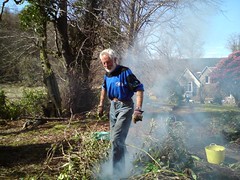
For Hugh was one of these people who just do things. Whether it was clearing out gutters, pottering round the bottom of the building pulling weeds from the perimeter, or leaping suicidally onto my bonfire one gardening session because the rhododendron branches weren't catching (see photo), Hugh was there with his own solution to the problem. And his eyes would light up with glee at what he'd achieved.

He died, suddenly and without warning, in Australia. His last conscious act was riding his bicycle. One of the last things he did in the grounds of the church was to cut back the cherry tree that menaced the windows. Some of us thought he'd killed it - but no. This year it's burgeoning again. It's hard to think that Hugh too might not be alive and flourishing on this bright day when his ashes were buried in the churchyard.

Rest in peace, Hugh - and rise in wonder.