Showing posts with label choral music. Show all posts

Thursday, July 28, 2016

Cross-Pollination

I haven't posted for a bit. It's not that I haven't been sitting at my desktop: far from it. But from being someone who rarely uses earphones (they were so uncomfortable) and hasn't listened to much of what might loosely be termed popular music since the age of 18 (a while, then) I've spent most of the time doing just these two things. I always did love a good love song, back in the day, and I've always preferred what might be termed music to slit your wrists to ... And now I've rediscovered both, and as Facebook friends will hardly have failed to realise, I've been listening to Leonard Cohen.

I specified a sort of cut-off date for my interest in pop; it coincided with the rise of the Beatles and my discovery of Palestrina and Byrd and these two geniuses shaped my musical tastes for the rest of my life, I thought. Yes, there were other passions - Tippet, Tchaikovsky, Sibelius, to name the composers on some of my early LPs - but the music I loved to sing, and to sing along with, belonged to the Renaissance. I developed a voice as similar to the counter tenor as I could, and my reading abilities flourished as I sang in an octet (The New Consort of Voices, for anyone who was around Glasgow Uni circles in the late 60s/early 70s) and the quartet that still performs today with only a change in the soprano line, the St Maura Singers. We started a larger choir when we moved to Dunoon - The Hesperians, from the women of which group the current 8+1 choir was born. There was a church choir, intermittently - it tended to suffer from church politics and eventually vanished.

All this was made easier, of course, by the fact that I'd married a musician who works magic with choirs. But living with a musician also tends to influence some - not all - of the music played at home. Because of that influence, I've learned almost all I know. But because the current choir, 8+1, sings everything from Ah Robyn to Mamma Mia, there's been a shift in my earworm availability, and one of our repertoire got stuck that way: Leonard Cohen's Halleluia. And it was seeing a video on Facebook/YouTube of a live performance by him, a recent live performance, that started me on the online trawl for other songs of this performer who was in his mid-70s at the time the recordings were made - and that's what I've been singing along with for the last two months.

So what made me want to reflect on this? Here's a thing. For the whole of July until today, we've had work going on in our dining room. The painter finished only this morning. The floor is varnished, the room is clean - and empty. It has a wonderful acoustic. So yesterday the two of us, Mr B and I, sang and recorded St Magnus' Hymn - the two-part 12th Century piece that begins "nobilis, humilis...". And after the first go, when I was singing at my usual mezzo pitch and straining slightly on the high E, I went down an octave and immediately sounded - and felt - better. This is an area of my voice that I've been unhappy with recently; helping out on the second soprano part has led to the neglect of the lower end of my voice, with the break at Middle C becoming more troublesome than it has been since I was in my early 20s. But yesterday it was fine, with an equal resonance taking me down to F.

Why? Presumably because the ageing voice of Leonard Cohen means he now sings in his boots, and that's what I've been singing along with. I've not been belting it out, just crooning, but that gentle exercise has been enough to make the difference. I feel somehow vindicated - that I've not wasted the tradesmen-minding hours listening on headphones, but have done something my laziness has too often stopped me doing when I've not practised vocal exercises. And I've learned some cracking new songs ...

Friday, December 20, 2013

Mamma Mia, or what happens when you run out of tenors ...

You have to laugh. All these years of singing - it's a good 50 years since I last sang in the Hillhead High School madrigal group, at the time the acme of my singing career - singing said madrigals, to say nothing of masses, introits and anthems, hymns, funeral sentences ... I won't go on. You get the picture. When I was in my early 20s my ambition was to sound like Alfred Deller, and I got pretty close, even if in the doing of it I sang sharp because I wasn't using my whole voice; when I sat Higher Music in S6 I was made to sing soprano and cope with Gretchen am Spinnrade, inter alia. Since then I have been a sort of alto in various ensembles, from the St Maura Singers (a quartet, still singing together) through the New Consort of Voices (a group formed in Glasgow University, in which I met Mr B and in which we both sang till we left Glasgow for the wild west) to the Hesperians. This last was a four-part choir that we formed within six months of our arrival in Dunoon - we put the word out in the school and contacts formed quite literally on the street, and one September evening we hired a room in the school and waited. Within 30 minutes we had sufficient voices to cover the parts, and six months later performed Vivaldi's Gloria in public.

Eventually we ran out of tenors. The Americans left Dunoon, and some of our men with them. Age took its toll on others. We disbanded the choir and concentrated on church music. And then, years later, we retired - and behold: the women who had been young newcomers in the last years of the Hesperians wanted to sing again, and 8+1 was formed. Eight women, one man. Now there are ten of us, and the name is merely that and no longer a description.

And all this history is to tell you why you have to laugh. Because 8+1 can and does tackle the kind of music which has been my life all these years - but that's not all we do. And it's because we do other stuff that two weeks ago we sang a set of songs from ABBA's Mamma Mia, with a backing track, at a Christmas Party in Benmore Gardens Gallery, and are still the talk of the steamie. (These days, the steamie is the supermarket, where yesterday I met the organiser of the event: "best ever", she said.) It was completely OTT, that performance, because the backing track (yes, we have a backing track) got stuck on "High" and Mr B couldn't get it down before the one-page intro finished with the result that this choir of women, only one of whom is under 40, had to belt out the songs as if we were in the movie. We had not a microphone among us, but we made a helluva sound and we loved every moment of it.

Worse is to follow. I had never been a fan of ABBA (too old) and I hate musicals. I had to learn these blooming songs from the sheet music while everyone else was singing them from past knowledge - and "Waterloo" on the page ain't easy, rhythmically speaking. But now I've got them - and I'm stuck with them. For the past month I find myself singing snatches of Abba as I walk round the shops or hike up a glen. I fill silences with sudden bursts of song. I am handed a copy of Carols for Choirs and sing "Thank you for the music". No wonder ABBA were/are so popular. I shall never be the same again.

Now - where's that copy of "A spotless rose..."?

Thursday, July 19, 2012

Peirles Paramour...A journey into our past

Fragment from text of document 
I've been singing again. Back to where, in a way, it all began - and the time when the text on the left was at once wondrously strange and increasingly familiar. If you sat Higher Music in Scotland in 1964, it may well seem familiar to you too - for that year one of our set works for study was a group of pieces from Musica Britannica Vol XV - Music of Scotland 1500-1700, edited by Kenneth Elliott. I have a clear memory of standing round the piano in the Music Room (Room 16) of Hillhead High School with a group of friends, singing our way through this particular song as best we could, the sight-reading of music and language taxing our brains and leading to much hilarity - before we started again, determined to get it right.

After I left school I met Kenneth Elliott at Glasgow University, not because I studied music (though I did, for one year, to make up the so-called "science" subject in an Arts degree) but because I sang with a small group who actually performed this music he'd spent so much work on. We were invited to his house for evenings of singing and wine; we stiffened the ranks of various University choirs as they struggled to meet his demands. I've been singing it, on and off, ever since.

And this is why, a couple of days ago, I found myself singing this music of a Scotland that few really know about - singing it with the St Maura Singers, the quartet that has been a thread through my life since the late 60s, rehearsing for a memorial concert for Kenneth Elliott which will take place in the original home of the St Mauras, The Cathedral of The Isles on Cumbrae. We're doing a whole programme of this music, almost all of it for four voices, and one of the pieces is Support Your Servand - which in fact we've never performed. I was eighteen again, suddenly - and it was as if we were seeing it for the first time.

Read the words again. Read them aloud. How are you pronouncing them? How, gentle reader, will we pronounce them? This is a discussion we have every time we perform any of these pieces. Are the "oi" sounds as in "hoy!" or simply the modern "sore"? And we listen to recorded performances - much lauded - in which the accent is so ... Scottish? ancient? ... as to be incomprehensible, and we wonder if anyone in the audience will have a clue. And then we found what Kenneth himself had to say about it, and it was wonderful.
I would once again urge singers to pronounce the Scots texts as naturally as possible, without recourse to the extremes of local dialect: these text are related to the courtly tradition of Scots poetry, written by sophisticated Scots of burgh, song- or Grammar-school and university, in touch with, if not even part of castle and, ultimately, court culture, rather than the rustic precursors of bothy balladeers, kailyard confectioners or Doric dropouts.

I can hear Kenneth's voice here - and a degree of exasperation (I would once again urge..) Obviously he's had this conversation before. So we will not roll our 'r's more than normally, nor will we sound like The Corries on a culture trip. The music - in all its complexity or its deceptive simplicity - will speak as well as we can achieve. And despite all the people who have sung it since, we will know that we were there very early on in the performing of it.

And somewhere, I think Kenneth will be smiling.

Monday, February 13, 2012

Carver, Tallis and ghosts


We don't go to concerts often these days - we're as likely to be performing as listening, to be honest, and the late-night return, involving as it tends to an hour's wait for the last ferry or the long drive over the Rest, puts us off, rather, especially in winter. But on Saturday we made an exception, and the resulting evening was one that we both considered well worth the trail. It also achieved an interesting bringing-together of various elements in my life, and I hope to be able to convey something of this.

The concert was in the Kelvingrove Art Galleries, and I found out about it on Facebook and booked it online. In that simple sentence you have the beginning and end of a loop: I spent many a wet winter Saturday afternoon in childhood looking at the animals and the armour in the Art Galleries, now a very different place: to my recall the animal displays were all round where we sat as an audience, forming a sort of ghostly backdrop.  And to get there we drove through Broomhill and Hyndland and over Gilmorehill. I found myself wishing I still had my parents living in Broomhill, remembering Hyndland for both my early childhood and the excitement of buying the tiny flat we lived in when we were first married, thinking of the strange thrill of being around the university on winter evenings, whether for pleasure or - occasionally - study. I reflected on how carelessly the young me had felt ownership of that whole area, without thought or fear, how I had walked the dark streets alone and heedless.

But the concert - ah, the concert. The Tallis Scholars were singing "our" music - Tallis, Allegri, Byrd, the incomparable Robert Carver. They sang it perfectly - the best choral singing we'd ever heard live. Of course we knew their excellence - we have several recordings, and that's why we went - but the live performance overwhelmed me with its wonderful creamy sound, the perfect intonation, the flawless phrasing, the ebb and flow and the heart-stopping wall of sound of the word "Jesus" when it came, over and over, throughout Carver's motet O Bone Jesu. For Allegri's Miserere, there was a group of singers - the ones whose part includes the magic high treble notes - somewhere in a gallery above us and to the left, so that when they sang I was suddenly aware of the vast emptiness of the rest of the building, lurking art-filled and ghostly while some thousand people gathered at its heart. So there we sat, packed, still and silent, raptly caught up in something beyond the human in the unforgettable shared experience that we would, in the end, all describe differently.

More memories, more ghosts. We too sang in the Art Galleries once, when we sang with The New Consort of Voices in the late 60s and early 70s. It was hard to get an audience for Byrd and Palestrina in those days, and the few people who listened did so as they drifted about the space during an afternoon organ/vocal recital. We tried to sing in the way that the Tallis Scholars do now, we sang the same music (from the same edition of Byrd, I noticed), and no-one took any notice except for Kenneth Elliott. We even sang Carver, so I feel I know the music from within. I don't get singing like that so often now, for we don't have enough contact with others who can do it - and it annoys me to think that I sing better now in what must be my vocal twilight than I did when I was young.

We fortified our bodies with a delightful early meal in Konaki. The whole evening was a delight. And I have to thank the very current medium of Facebook for unlocking it all.

Wednesday, December 07, 2011

Advent song in audio

For all the lovely people who commented so appreciatively about the new anthem this week, I've made my first attempt at uploading a video to YouTube. The photos are all from this time of year, most of them taken from my window as a flaming dawn broke, or in Holy Trinity church where the recording was made. We're both delighted that people liked it as much as they did.

Sunday, December 04, 2011

Advent Song

Look, God, look
in the vastness of your dark
hear this song
in the chorus of the world
where I sing
for the glory of your coming
held by love
as the music pours from me
a flame within
as the night falls around me
hear my prayer
and come through the darkness
hold me waiting
as you wait to be born.

©C.M.M. 11/05
I wrote these words six years ago. Advent for me, as I've probably blogged before, is a wonderfully Celtic experience born of darkness and tiny lights and being out on the edge of the hugeness of what to the ancients must have seemed a limitless sea. I cannot conceive of Advent in the Antipodes. Not long after I wrote it, Mr B, aka the musician John McIntosh, mentioned that he might like to set it to music, but it took him to this year to do it, and it was finished about three weeks ago. It is quite, quite lovely.

Today it was performed for the first time. And I really mean that: until this afternoon we had never heard it with the four voices for which it was written. But today we had an Evensong at Holy Trinity, a variant on the traditional Anglican choral service in which a quartet - including me and Mr B - sang the anthem, the responses and a plainsong psalm with a harmonised response for the congregation. The church was dimly lit - a combination of half our usual lighting, all the candles, the red heaters that give at least the illusion of warmth, and tiny lights clipped to our music stands - and the atmosphere electric. When we stood at the back of the church to begin with the Matin Responsory, the silence was absolute; when Andrew prayed, the silences between his words fell like a blessing; when we sang the Advent Song I felt once again the limitless power that takes over when we are all totally immersed in the moment. There was for me the additional dimension of hearing people take such care over my words - it's an awesome thing to write something and have it handed back to you so beautifully. 

Andrew's brief homily reminded us in no uncertain terms that Advent is not Christmas. I don't think anyone there this afternoon was in any doubt about the magic of the season: the exquisite tension of the waiting, the longing. The great sound of the final hymn - Lo, He Comes - came like an explosion of emotion. And when it was over, and we finally tore ourselves away from the place where the  barriers between earth and heaven had grown very thin indeed, it was snowing. 

On a day such as today, I would be no-one else, and nowhere else. 

Sunday, October 30, 2011

Accentuate the positive?


Chorus responds
Originally uploaded by goforchris.
Been thinking about positives, perhaps to counter the foul day we've just had - rain and wind and low cloud hour after hour, though now there's a bright star mocking me as I look out before bed. But to the things that make life interesting, rewarding ...

Like the other night, when I went to Ayr to hear Voskresenije perform there. I have organised maybe as many as eight performances in Dunoon by this Russian choir, but this year I had to go elsewhere to hear them and to renew the friendship with the conductor that has built up over the years. So ... I am energised by live music, by interacting with people from other cultures, by the laughter that arises from imperfect understanding of another's language. And I enjoy bearhugs - big Russian ones.

What else makes a difference? I enjoy the company of clever people, people who have ideas, people who enjoy sharing them. I don't care if I've met them before - as long as the conversation begins, it is good. I love conversation.

Tomorrow brings another energising activity: a performance. I love singing, and tomorrow our female ensemble will perform in Dunoon and wow an unsuspecting audience with Songbird and other great songs. Adrenaline surges are good for the psyche.

And then there's a good book ... for I have always, as long as I can recall, been able to lose myself in fiction. And movies, with great sound.

All these can happen, and do, regardless of the weather. But I really could do with some sun, just to complete the picture. And less rain. J' attendrai ...

Monday, May 02, 2011

Still singing after all these years ...


Are we all ready?
Originally uploaded by goforchris.
Readers of this blog will know that I sing a bit. Yesterday the group with which I have done more singing than any other came to Dunoon to perform in Holy Trinity - my church. It is something that rarely happens - we do most of our performing in the Cathedral of The Isles - and it meant a great deal to me. To make "our" music in "our" place, at last, felt as if a story was being completed.

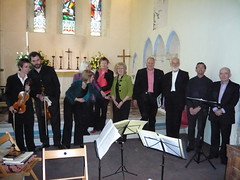
The story began 42 years ago - and that horrifies me, when I write it. In 1969 the St Maura Singers formed and sang Evensong, as I mentioned in my last post, and we've been at it ever since. Our soprano - wearing a purple jacket in the pic - moved away and mutated into an alto; her place was taken by a teenager just out of school (dark green jacket). Yesterday we were all together, along with another bass (white beard) and an instrumental ensemble, giving a re-run of our 40th birthday programme.

It was a lovely afternoon. The weather was perfect, the afternoon tea on the lawn unsurpassable, the audience a good size - and mostly drawn from outwith the HT congregation, which was healthy for the coffers. The church itself proved what we who worship there have always known: it has a superb acoustic and a wonderful atmosphere, peeling paintwork notwithstanding. It doesn't suffer from the curse of wealthier churches - thick pile carpeting and cushioned seats - and the hassocks had all been piled away to increase resonance.

Personally, I was soaring on adrenaline. A combination of singing first alto in "When David Heard" and making a decent job of John McIntosh's* settings of Dave Whyte songs left me wrung out after it was over - and starving. I was as high as the proverbial kite, and as always found myself wondering how long we'll be able to do this.

At 65, I realise it can't be much longer. Our soprano is the only one not in that age range. But what a privilege still to be performing like this - I only hope I'll know myself when it's time to give up!

*OK - he's Mr B. But he has another life ...

Sunday, August 15, 2010

More forties


Choir stalls
Originally uploaded by goforchris.
Another of those days when there seems to be a kink in time. I have sat in these choir stalls, in the Cathedral of The Holy Spirit, Cumbrae, more times than I can count - rehearsing, participating in services, waiting to be confirmed - or as today, listening to the music of my fellow-musicians in a concert.

Today saw the culmination of 41 years of singing with the St Maura Singers - we had intended it as a 40th anniversary concert, but illness meant cancellation last Autumn and today we resurrected that programme, having managed to reassemble with the two extra singers required by some of the music. During those 41 years of singing together, the quartet has frequently performed the early Scottish music arranged by Kenneth Elliott, who is now 81 but was 40 when we were discovering this music. So it was forty years that vanished into the fold of memory as I listened to the string ensemble play, and to the ravishing Lamento della Ninfa of Monteverdi, and I was at once young again and wondering how many more times I would be able to experience this particular joy.

Most of the music this afternoon came from the 16th century, but two notable exceptions were the very new arrangements by John McIntosh (aka Mr B) of folk songs - The Broken Brook and Nancy - originally commissioned by Cappella Nova. The shifting, folk-based syncopations of Nancy had caused our augmented group more problems than we might care to admit, and we were thrilled that it actually came together - proof of which was that wonderful sigh from the audience in the moment before the applause began.

The other high point for me was that at last we got to perform the Tomkins When David Heard. I've gone on about this before on the blog; this afternoon's performance became somehow electric so that we balanced on a fine wire between emotion and perfection and ended in a silence that seemed eternal.

If this afternoon's performance were to turn out to be the last time the voice held out, the last time I would have the privilege of singing this stuff, I would be content. Not so content, however, that I don't hope we can do it again ...

Saturday, January 02, 2010

What am I listening to?

I don't tend to listen to any particular music more than once in any given time unless I'm learning it: in a house full of live music and CDs and Radio 3 there seems not enough time in any life to go over and over the one piece. I suppose that's why I tend not to listen to music on my iPod - talking books or poetry seem more appealing. But after joining briefly in Kelvin's little chat about the perceived boredom factor of the King's College carol service, I found myself arrested by a lovely piece of music in a great performance and thinking: This is what I am listening to, right now, and it's special.

"This" was a piece of choral music, Nesciens Mater, by Jean Mouton. His real name was apparently Jean de Holluige, and scholars have yet to discover why he was known as "Mouton", but he was born in the Pas de Calais before 1459 and rose to become court composer to the French kings Louis XII and Francis I. The motet I was hearing is based partly on plainsong melodies, distributed among eight voices in an elaborate canon - but that's not what you hear. Instead the music transcends its mathematically precise construction to create a wonderfully spiritual, contemplative meditation on the Virgin Birth - magical, really. And the performance, by the Monteverdi Choir under John Eliot Gardner, was perfect.

And that brings me back to what I was trying to say about the King's service. Ok, I made the point that every time they sing this service there is someone coming to it for the first time - look here for this year's example of discovery - and it is good that what they hear should be flawless. But is it necessary to assume that the perfection born of months of practice and disciplined learning is boring? Boring for whom? Maybe those of us who grew up with Carols for Choirs may indeed feel we don't want to sing the Willcocks descant to "O Come all ye Faithful" again - but you try singing another one and you'll soon realise, if you're musical enough, why the Willcocks has survived so long.

I hinted a couple of posts ago that the magic does go out of some of the familiar seasonal rituals as we grow older. It's be a bit sad if it didn't. But I don't think we should equate our need to provide what we see as new and exciting with the need of others to experience it - expecially at Christmas. Now, go and find that BBC record* with the Jean Mouton on it, and forget everything else.

*BBC Music Magazine Collection, Vol.16 No.4: Christmas Choral Music

Tuesday, April 07, 2009

Out of the deep?

A quick post to show I'm still alive, as I set off in the rain for Cumbrae and Choral Evensong, for which we haven't yet begun to practise. Practise as a group, that is, for I've just been singing through my own alto parts with Mr B playing/singing bass. And the joy is that as we ran through Boyce's All the ends of the World I could hear in my head the wonderful suspensions, the resolved crunching moments in my own part, and felt that perhaps after all I was entering into my own Holy Week. And then there is the psalm - Out of the Deep - to that great dark setting by Walford Davies. I can't wait.

And yet I can't help reflecting how that whole week, as Jesus headed towards what he knew was to come, ordinary people were busily doing their thing all around him. Maybe the disciples felt stressed by the crowds, the fuss, the carry-on in the Temple, the approaching Passover. Busy, busy, busy. Just like the rest of us. But today I shall switch my life off and concentrate. Just got to travel there first.

Thursday, November 20, 2008

Voskresenije


Voskresenije
Originally uploaded by goforchris.
Well, it was worth it. The running about, the phone calls, the panic over whether or not we could reheat the sticky Wassail Cup in an urn - all forgotten in the triumph of a full house (or at least a full church) and a riveting performance from our visiting Russian choir.

The Choir's name Voskresenije is Russian for "Resurrection".
The choir was formed in 1993 and all the members are present or past students at St Petersburg Conservatoire of Music. It occurred to me that perhaps an element of resurrection is present in the choir each time it returns with new, younger members, although Anatoly Artomonov, one of only 3 basso profundos in St Petersburg, is a welcome constant. (Last night he was singing low A - two octaves + two tones below Middle C, for those who know of such things)

The conductor, Jurij Maruk, has led the Novosibirsk Chamber Choir, the Wladimir Minin Choir in Moscow, the Marininski Theatre Sacred Music Choir and the St Petersburg Radio and Television Choir. He too has been on every visit to Dunoon - this was his 7th. The programme this year consisted of many items new to the audience - and they lapped it up. The enhanced socialising effect of the warm cider cup had several of the audience wondering why they'd never made it to Holy Trinity before, and more than one remark was heard to the effect that this was a "great tradition".

All of which leaves me with the realisation that I've done seven of these events already. I was positively youthful when it all began, you know...