Showing posts with label performance. Show all posts

Saturday, May 04, 2013

A requiem for Philip II

As dawn breaks and church bells toll slowly all over Toledo, an elaborate funeral procession winds its way through the city's streets. Clad in black vestments of mourning, the Archbishop leads the procession, followed by the upper echelons of ecclesiastics and then the nobility, each in turn, according to his rank. The cortège stops at several pre-determined locations where the choir sings a responsory, each station representing a stage in the journey of the soul of the deceased towards eternal salvation. As the dignitaries enter the Cathedral, usually dark and sombre, they are overwhelmed by the light of thousands of candles covering the funeral monument, or catafalque, a vast construction as hight as the cathedral itself, engraved with Latin tributes in honour of the deceased. Silence descends upon the church, and the solemn invitatory Circumdederunt me gemitus mortis begins the Matins of the Dead.

On a wet Friday evening in Glasgow we experienced a wonderful performance of A Requiem for Philip II by Cristobal de Morales *(c.1500 - 1553) in the acoustically fantastic central hall of Kelvingrove Art Gallery and Museum. The above comes from the programme note, and Paul McCreesh, directing the Gabrieli Consort, set the scene before the singing began. We were told the performance would last about 70 minutes without a break, and would be liturgical in feel. As you can see from the photo of the performers' waiting seats (and bottles of water!), taken from my seat, we were at the front, very close to the singers.

The seventy minutes passed without my noticing them. I have never been so immersed in a performance, so swept along on a tide of plainsong and polyphony that I never once looked at my watch. The singing was peerless - four countertenors, two tenors, four baritones, two basses and, doubling the bass part, the muted bajon (dulcian) - with solo groups and tutti ensembles, solo plainsong prayers and readings  and the full-bodied singing of the mass. I felt I was a part of it; it's the kind of music I love to sing and I felt every cadence, every nuance, every false relation in such a way that when it was finished I was exhausted in the same exhilarated way that I feel after singing myself. The moment when the singers turned and walked off the stage and away in a long, singing procession round two of the adjoining galleries was electrifying. I also realise how privileged I am in that my education and subsequent experience in choirs mean that I can understand Latin well enough to participate in what is being sung without constantly referring to the programme, and that I was sufficiently familiar with the words of the mass and the plainsong customarily used for, say, the Sursum Corda to be immersed in the liturgy and to delight in the resonant tones of the bass singing the priest's part.

I realise as I write this that I'm doing a very inadequate job of conveying a very special occasion. The sizeable audience, completely silent and still for the whole performance, didn't erupt in applause; rather this began slowly, gently, as people shook themselves from their absorption, and grew to a sustained crescendo as the choir returned for several bows, only dying when the conductor had disappeared down the stairs away from the hall. We hurtled down the road to the ferry in a whirl of exuberance with our heads full of polyphony and caught a ferry within an hour of the last notes being sung.

The kind of evening I don't get very often, the kind of music that makes me glad to be alive...

*You can hear bits of the performance here, as well as buy it!


Monday, May 02, 2011

Still singing after all these years ...


Are we all ready?
Originally uploaded by goforchris.
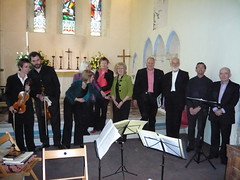
Readers of this blog will know that I sing a bit. Yesterday the group with which I have done more singing than any other came to Dunoon to perform in Holy Trinity - my church. It is something that rarely happens - we do most of our performing in the Cathedral of The Isles - and it meant a great deal to me. To make "our" music in "our" place, at last, felt as if a story was being completed.

The story began 42 years ago - and that horrifies me, when I write it. In 1969 the St Maura Singers formed and sang Evensong, as I mentioned in my last post, and we've been at it ever since. Our soprano - wearing a purple jacket in the pic - moved away and mutated into an alto; her place was taken by a teenager just out of school (dark green jacket). Yesterday we were all together, along with another bass (white beard) and an instrumental ensemble, giving a re-run of our 40th birthday programme.

It was a lovely afternoon. The weather was perfect, the afternoon tea on the lawn unsurpassable, the audience a good size - and mostly drawn from outwith the HT congregation, which was healthy for the coffers. The church itself proved what we who worship there have always known: it has a superb acoustic and a wonderful atmosphere, peeling paintwork notwithstanding. It doesn't suffer from the curse of wealthier churches - thick pile carpeting and cushioned seats - and the hassocks had all been piled away to increase resonance.

Personally, I was soaring on adrenaline. A combination of singing first alto in "When David Heard" and making a decent job of John McIntosh's* settings of Dave Whyte songs left me wrung out after it was over - and starving. I was as high as the proverbial kite, and as always found myself wondering how long we'll be able to do this.

At 65, I realise it can't be much longer. Our soprano is the only one not in that age range. But what a privilege still to be performing like this - I only hope I'll know myself when it's time to give up!

*OK - he's Mr B. But he has another life ...

Thursday, July 29, 2010

Singing grief

I was involved in one of our all-too-infrequent rehearsals with the St Maura Singers yesterday - an expanded SMS, with two extra singers to make it possible to sing some new music. It was salutary that we had to spend an hour on a new piece that lasts all of 3.50 minutes - the slightly jazzy, displaced rhythms of Mr B's beautiful setting of Nancy had experienced musicians fumbling for the groove (so to speak, in my jazzy sort of mood ...)

But what struck me yet again was the incomparable beauty of Tomkins' When David Heard. I sing first alto in this, and found myself, on the first run-through, almost unable to continue. David's reaction to the news of Absalom's death goes from from the heart-broken repetitions of Absalom my son, over and over, over and over, to the words every parent can recognise: would God I had died for thee. It starts simply, bleakly almost, but then becomes more insistent - and then we're back with Absalom, my son, quietly, dying into the final cadence, as if David has no more energy to express the grief that has overcome him.

As I grow older - or simply old - I find this harder and harder to sing with the detachment I was able to enjoy when I first encountered the piece in my 20s. And yet the music is ruined by gusty, emotional lines or operatic emoting - for it is the music itself that paints the words, and the music needs every ounce of concentration to let it speak. By the end of a performance I am exhausted, and yet it lasts only five minutes.

The performance I've linked to is a tad slow for my taste - just a fraction - but lets the music work. If you've never heard it, go and listen.

Monday, October 19, 2009

Love's Labours Lost


Love's Labours Lost
Originally uploaded by goforchris.
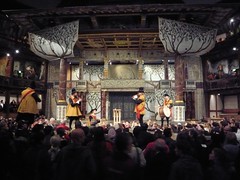
I know I've blogged about this already, but I needed to return to the experience of the Globe Theatre and Love's Labours Lost when I didn't have a cat's bottom distracting me by hiding the screen, to say nothing of the typing paws.

The thing is that in all my life I've only once been to a performance of a play by Shakespeare that I didn't know already, and that was so long ago that I have only the vaguest memory of it. (I think I was still at school, and it was at Jordanhill College and may have been As You Like It) And it struck me forcibly that much of what I get from a performance of, say, Hamlet, comes from anticipation and speculation: how will the Ghost be treated? How will they stage the prayer scene? How will Hamlet say the big soliloquies?

Think of the Olivier film of Hamlet. Olivier took a part of one of Hamlet's speeches about the King's behaviour and used it as a voice-over for the very beginning of the play, so that the words about "particular men" who, "carrying the stamp of one defect", "take corruption from that particular fault" and so is brought to disgrace. The whole slant of the character of Hamlet is changed by this, as he seems to be talking about himself in a way that would suggest he is very aware of why he is unable later on to kill his uncle - and yet his soliloquies show that he cannot understand his difficulties.

I've gone into that simply to show how very different the experience of a play is to someone who has studied it for years - and to wonder what Will himself would have thought of such a reaction. Maybe he'd have torn his hair out, maybe he'd have been puzzled. But it was fascinating to try to "keep up" with an unfamiliar play, without benefit of the text, and not find myself laughing at something several lines too late. I noticed an earnest fellow in the row in front of me poring over the text as the play unfolded - but felt he was missing more than he gained.

Enough. No more. 'Tis not so sweet now as 'twas before - and I've gone on long enough. The words of Mercury are harsh after the songs of Apollo: You that we; we this way.

Friday, December 28, 2007

Big deal?


Audience
Originally uploaded by goforchris.
I've been reflecting on how it felt to sit in a famous venue like the Royal Albert Hall and hear Mr B's work performed to an audience of 5,000 (you can see a selection of them in the photo). I had my own small stake in the piece, having adapted the words of two of the verses from the translation of the Gaelic, so I too had my name announced before they sang. And yes, it was exciting - especially in anticipation - and yes, I felt proud.

But mostly, you know, it felt like any other gig. And I wonder if this is the point about this performance thing. If you do perform, an audience is an audience whether there are 50, 500 or 5,000 people in it, and it's important to perform well to them. The strange familiarity of having Jonathan out there doing the biz - instead of having him play for us on Cumbrae - had an effect on the novelty of the venue, and this was reinforced by the familiar ambiance of the somewhat spartan environment o the Artists' Bar at the end of the show.

So yes - it was a great evening, but the next audience will be, I think, every bit as important. Mind - it'd be a blast if 5,000 tried to squeeze into our wee church!