I had the interesting experience yesterday - yes, I know there was a wedding going on, but there was life beyond that - of experiencing for myself the difficulties of writing for someone else. On Thursday, I saw a tweet from @commentisfree asking for someone to write, in a hurry, about the experience of being a grandparent. It was already 11am, and the deadline was 1pm. Great, I thought, I like a challenge - and I qualified on the grandparenting side. So after my coffee I set to, and duly dispatched the required 250 words. (I think I maybe wrote 252 words)
Back came a mail saying they'd use it. I'd seen the online tale about Gwyneth Paltrow badmouthing her grandma; I expected to see my stuff online. A phone call later in the afternoon, however, told me it'd be in the paper as well, so I duly bought one of Dunoon's limited stock of guardians the following morning.
To put it briefly, my piece was crap. It had been edited out of all recognition, into a jaggedly unimaginative lump devoid of paragraphs ( I know - space restrictions) with the sequencing altered and so drastically cut that it didn't actually make sense. They didn't even get my "comment is free" name right. Someone who knows me well said it didn't sound like me at all, and I was glad to hear this. I gave heartfelt thanks that usually I write only for myself, and that our local paper treats what I write with respect. I know newspapers have to consider column inches and that once a paper's out that's it - it can't be changed - but I had never really considered the implications for print journalists.
Thing is, I'm not a print journalist. I'm not a journalist at all. Putting that castrated rubbish in the paper makes it look as if "amateurs" can't write to save themselves, and makes this "amateur" determined that she won't do anything so silly again. But if they're going to invite submissions, the Guardian needs to think about what they're doing.
To balance all this, I have to report that when the online version appeared - and you can read it here - it was more or less what I had written, and - better still - the mistakes I pointed out to @commentisfree Jessica were immediately remedied. Maybe this happens every time anyone writes for print media - and maybe that's why I'm becoming such a fan of online reporting.
But there's still something nice about seeing it in print ...
"Blether - n. foolish chatter. - v.intr. chatter foolishly [ME blather, f. ON blathra talk nonsense f. blathr nonsense]" - Concise Oxford Dictionary.
Saturday, April 30, 2011
Wednesday, April 27, 2011
Of plain chant, coal heavers and feathers...
I've referred recently to singing plainsong - though the singing of the example on this Wiki page wouldn't encourage anyone, I fear - which possibly gives me more sense of completeness that any other music, at least in the church setting of much of my own singing. The accompanying illustration comes from the modern setting of Compline, and shows the traditional notation in a clear modern typeface.
I was first drawn to this music in my impressionable youth - before I had anything to do with church other than as a musician. In the late 60s, there was not much of it around, certainly not on the Third Programme, but when I turned up in the summer of 1969 to sing Evensong in The Cathedral of The Isles with the newly-formed St Maura Singers, we had to learn quickly - a new psalm or two, the Magnificat to Tonus Peregrinus - and I had my first go at deciphering neums and four-line staves.
All this was a long time ago, I remember ... anyway, I've sung the psalms and Compline to plain chant over the years since then, and have discovered a thing or two. The first was that I found it easy to read once I had the hang of it, and to work out where the semitones fell (always the pitfall if you don't) and the implications of the interesting groupings of notes (that last link, by the way, gives considerably more detail). But after that, the biggest discovery was the wonderful sense of control, of the line conveying the words without the need for any irritating "interpretation" on my part, of the flexibility when a trained group (or a solo cantor) is able to give slightly different emphasis to one word by lingering infinitesimally on it - all this seemed to me to allow for meditation actually to take place without getting in the way. The pause at the central colon in the psalms turned out to be just right for the breath required for the second half, and the antiphonal singing allowed for the smooth flow from one verse to the next, without worry, without the need for any mnemonic. It felt relaxed and prayerful.
It isn't always thus. People can sing this stuff without any feeling for it at all and ruin the effect. Sometimes I've heard plainchant that might as well be someone selling coal in the street (they don't, any more, but I recall the cry of "coaaaaaal briquettes" from my youth). However, the same goes for any music, and there are murderous performances to be heard on the internet any day of the week. But if you're lucky enough to find yourself in a position where you can enjoy the feather on the breath of God that is eloquent plain chant, or better still to take part in making it happen, you'll know what music you'll hear in at least one of the many mansions of heaven.
Sunday, April 24, 2011
The Cross gets in the way ...
![]() |
| Paschal Candle in Holy Trinity by Sharon Barnard |
Where am I going with this? Let me give another snapshot, this one of a moment as we were drifting to the door at the end of this morning's Eucharist. I overheard possibly the oldest member of the congregation declare to the person next to him that he didn't care for the big cross in the choir, and her reply that she liked it but it had got in the way, rather. It came to me that there was something to be said about that ordinary remark - because the Cross does "get in the way", keeps getting in the way, and the significance of it can be a stronger influence on people than the day of Resurrection - the day in which we all suddenly become cheerful and joyous and tell each other that Christ has risen. I think it's the sudden cheer that leaves me reeling, not sure how to be, not sure how ...
I think I'm not far off what it must have been like, back then. I cannot see how the all-too-human followers of Jesus could feel anything but exhausted and incredulous at the news that his body was no longer there, and I imagine Mary Magdalene hardly daring to hope that what had happened to her wasn't a wishful dream. In a way it doesn't matter if that's how she and they reacted - what does matter is what happened as a result of this day. The long-term view, in a way.
I can still remember my first real Easter, the first time it had an effect on me. It was in 1973, and that's a lot of Easters ago. I think I'll perhaps post about that first Holy Saturday in the scented darkness of the Cathedral of The Isles (yes - there again) but not now. And I need to write about some of the other things I hold dear. But today - God showed us something, and we stand amazed. Exhausted, and amazed. And we don't really know what to do with our knowledge ... or at least, this writer doesn't.
Resurrection is profoundly disturbing, after all.
Saturday, April 23, 2011
Birdsong in Gethsemane
In the darkling garden
a lone bird drops
liquid notes like dark blood
beneath the quiet trees. And then
silence. And in the silence
the old struggle surges
as flesh and soul pull
apart. The body aches
to be the prayer, to feel
the God’s warmth
in the darkness. But
there is only stillness
and the blood’s song
and the everlasting longing
as somewhere far away
innocence sleeps.
C.M.M. 04/11
Friday, April 22, 2011
Holy Week observed
The picture here comes from the beginning of my personal Holy Week, when I spent three days at the Cathedral of The Isles on Cumbrae. I have done this for more years than I care to remember, and the effect is always to prepare me mentally for the Triduum - the experience of which would be difficult if approached from the business of my mind in the latter weeks of Lent.
So what is so special? Maybe a simple account will suffice. We arrived on Monday, worn out physically by a week of car journeys, singing, grandparenting and socialising - all good fun, but cumulatively exhausting. We were appalled to find, that morning, that our tenor was completely unable to sing because of a bug, and that one of our fellow-residents in the College was absolutely dripping with the cold and in fact grew more ill as the days passed. We carried hand gel everywhere and took to sniffing First Defence like addicts. We have, after all, two concerts coming up, one voice to a part. We could not catch a cold. We were not happy, and we wanted to go home.
However, we had a job to do - we had undertaken to sing Evensong for the three days; the Warden is a good tenor and loves to sing with us (he says, though he is not always serious ...); we had +Kevin to cheer us and Jonathan Cohen to play for us. And so we rehearsed, we sang plainsong, we made sure it was as perfect as we could make it. We attended Morning Prayer before breakfast, and Mass before lunch. The sun shone, we took walks by the sea and to the top of the island. And gradually the peace took a hold and we felt ourselves begin to relax.
The quiet rhythm of such a life is something hard to find when we're at home. At the Cathedral, we are free to concentrate on beauty, stillness and prayer. We were responsible only for our music-making; the organisation was in other hands. There was no cooking to do, no shopping, no phone ringing. There were interesting conversations, as well as utterly hilarious ones.
And now we are back in our home parish, and the experience goes on. We have responsibilities again, but personally I am better able to deal with them for having had none. And I am grateful, as always, for the opportunity to make music and worship in one of the most beautiful churches I can imagine.
I've sung in Cumbrae for 41 years. I fell off my metaphorical donkey in the same choir stalls as I now inhabit, and was confirmed there in September 1973. I used to pine every time I left, until I learned that I was able to return when I needed to. I have met and talked to some of the most significant people in my life there.
And it is there that I sing plainsong. I love plainsong. I'll be back ...
Saturday, April 16, 2011
Episcopal hoolie on Cumbrae
Well, that was another wonderful Argyll and The Isles hoolie. And Bishop Kevin has now been seated in his southern cathedra - in the Cathedral of The Isles, on the island of Cumbrae. The photo I've chosen for this post seems to me to sum up what I love about these events - and this is the kind of thing I first did in 1973, when I felt as if I'd been transported into a Fellini film.
The prayer over choir and clergy having been made with due solemnity, the thurifer, who was also MC for the day, led us out of the Lady Chapel door, round the outside loo, along the path past the annexe, down the stairs, across the lawn and up the stairs to the main door, on which Bishop Kevin would shortly thunder with his staff. But there is no way this assorted crew was going to make an orderly procession of it, as choristers who only sing together for special occasions hitched up their Whoopie Goldberg choir robes and ambled after the smoke, and it was of this I thought as Bishop Idris, the former Primus, used an idea given to him by the PB of the Episcopal Church in the USA.
This came in his sermon, in which he asked why the Bishop always came at the rear of the procession - like a Western shepherd rather than an Eastern one. The picture painted was of a circus procession, in which there was always someone bringing up the rear, armed with a bucket and shovel. We were not, exhorted +Idris, to leave our Bishop to clean up our mess.
The choir, as I said, had met that morning for what turned out to be rather less than two hours of rehearsal together, only half of which was actually in the church: the clergy choreography took up the first hour and even so didn't cater for the drama of the snapped thurible chain and the singed altar-cloth. But despite the potential for chaos (the words herding and hens come to mind) the service was actually lovely, and in places extremely moving. For me, the high point came during the Litany, when the bishop knelt in front of the altar and a stillness grew where before there had been movement and drama.
And I can't believe I've come so far without mentioning The Purvey. The lunch in the cloisters before the service, and the fantastic tea after it, were both miracles of catering and far too moreish for people who had work to do. The socialising was noisy to the point of riotous - who says the church is dying?
Of course I know that it's not like this every day. There are days when there is a handful of people at a service, and the organist has to preach as well as play. But what I will say is that I have been attending such services here for the past forty years, and renewal and excitement have been there throughout. I'd like to think, however, that it'll be a good few years before another bishop knocks on the door of the cathedral - maybe long enough for this alto to have hung up her red robe?
Sunday, April 10, 2011
A plank of the past
I first read The Moving Toyshop in my teens. In fact, I may have been swotting for my Highers, or maybe the few O Grades I was compelled to sit in case I didn't make Higher (Science, Maths - that kind of thing). Be that as it may, I have a strong recollection of sitting in the small park in Marlborough Avenue, in the leafy environs of Glasgow's Broomhill, laughing aloud in the sunshine, to the distress - and I think this is in itself a Crispinism - of all animate nature. And it was The Moving Toyshop that was so entertaining me that irregular French verbs didn't get a look in, though why I would be reading in the park instead of the garden I can't think - unless I knew I would be caught not swotting if I stayed at home.
I didn't read the book again - you tend to remember the plot of a 'tec if you re-read it too soon - and found that the intervening decades had in fact wiped all memory of plot clean from my slate, and left me with only the quotations that have become part of my daily discourse. I can only give a flavour here: this moment comes so near the beginning of the novel that my delight at having begun a re-read was unbounded. Cadogan, a poet, has missed the last train and hitched a late-night lift from a lorry driver. As he climbs into the cab of the lorry, this conversation ensues:
"The Ancient Mariner did this better than me," said Cadogan cheerfully as they started off. "He at least managed to stop one of three."
"I read abaht 'im at school," the driver replied after a considerable pause for thought. "'A thahsand, thahsand slimy things lived on and so did I.' And they call that poetry." He spat deprecatingly out of the window.
I will leave the present reader to deduce what kind of life has allowed me to quote that bit of Ancient Mariner in that particular accent. Frequently.
Oh all right - I know it's a specialised sort of amusement, but it is so beautifully written - and I'd just love to replicate the moment when a bell-boy wanders through the bar of a hotel calling "telephone call for Mr T.S. Eliot" and Fen, the amateur sleuth who is also Oxford Professor of Eng. Lit., says "that's me" and leaves the room. (Oh all right again - I'd have to be Sylvia Plath or somesuch...). And it was in this very book, before I'd ever darkened the door of an Anglican church, that I learned that the Lord's Prayer at Evensong is curtailed before "...for thine is the Kingdom..."
So there you have it. An education in itself, beautifully written, extremely silly, utterly dated - and completely hilarious. I'm going to go back to another Crispin soon ...
Thursday, April 07, 2011
Riotous Science
What a day! My first ever visit to the Science Centre in Glasgow took place today in full-on Grandma mode, and very interesting it was too. The photo here shows the young children's area before it became wildly busy, but already my granddaughter is a blur in the middle distance as she sprints from the crawling tunnel complex back to the hydraulic play area.
I suppose it was a similar moment that led, some forty minutes later, to our losing her for five minutes - a heart-stopping five minutes of pounding round a multitude of small bodies looking for the one that answered to "Catriona". She had simply wandered in the wrong direction while my attention was elsewhere. I have now recovered, though Mr B, having suffered a second disappearance when Cat vanished through a door in Wonderland that was too small for him to follow, may never be quite the same again.
However, sanity was restored by a quiet visit to the African giant snails. They are truly huge - about the size of my hand - and chomp lettuce leaves with an alarming intensity that makes the Very Hungry Caterpillar look like an amateur. We acted out a conversation with the chomping one in French, much to the consternation of another child who happened along.
The Centre is a riotous place on a school holiday, but there is a wonderfully diverse range of things to do and see. And for the record: I was much better at getting the bike wheels to turn than Annabel Goldie on the telly t'other day. I felt quite smug.
Now, however, I merely feel my age ...
Friday, April 01, 2011
Sin and self
Been thinking about sin. Or Sin, if you like. (It's Lent, after all.) In many ways it's an old-fashioned concept these days. It's also a word that is bandied about as an adjective in current thought, when applied to instances of badness - but that's a use which seems to let too many of us off, in a way.
After all, I haven't murdered anyone, nor have I cheated anyone out of their rights, or their money, or their partner. I tend not to lie, and I try to avoid fruit with a big food-miles tag. Most of the people I live among could say the same, I'm sure - especially, surely, all the good folk in church. And yet every week, or more often if we're particularly pious, we admit to having sinned in "thought, word and deed". What do we think we have done? Do we think at all? Do we just say these words because they're there?
I still have a long way to go in this line of thought. But I wonder if perhaps sin is rooted in self-absorption - from the inability to walk in someone else's shoes, or the refusal to do so. And if you're a religious person, you might recognise that as something that ensures that God doesn't get a look in. Not really. And then there will be a long string of consequences ...
Hmmm.
Friday, March 25, 2011
Annunciation and burial
for Neil McKellar
A bird is singing
in the tall trees
over and over the same
liquid notes spilling over
the dug earth. A requiem,
perhaps, for the soul that is
gone into the sunlit morning.
Quiet words. Dust. The green
of the grass of this spring
surrounds the stones
as an old man is taken
home and the angel announces
to the startled girl
that a new life will come and be
God and the bird is joined
by all his fellows in a
sudden chorus of pure joy.
C.M.M. 25 March 2011
Wednesday, March 23, 2011
A country funeral
Yesterday, unbelievably when I look at this jolly photo from last June, we attended the funeral of Canon Roy Flatt, on the right of the pic. I've never been to a church service where more than half the congregation were outside the church: such was the crowd that turned up at Christ Church, Lochgilphead, that we stood in the grounds - some under awnings that (unnecessarily, as it turned out) sheltered the speakers that relayed the proceedings, some in the sun under the trees.
Roy had made up the order of service himself, and there was much poetry and good moments of silence in which we could hear the rooks in the tall trees of the churchyard. It felt very calm, and very natural. The coffin was carried past us at the end, to the strange combination of Nunc Dimittis and When the Saints go Marching in, and the burial took place opposite the church porch. Our feet sank in the moss, we moved from the chilly shade into the warm sun, and it was over.
This was the best kind of funeral: a day was full of calm and affirmation and warmth of greeting and friendship. The drive home was glorious, and the world felt peaceful.
RIP, Roy.
Wednesday, March 16, 2011
Spring contrasts
This morning was swathed in fog, here on the Clyde coast. It was cold, damp, grey and depressing. It looked as if it might stay like that all day, might continue to be a dismal backdrop to a comfortable life.
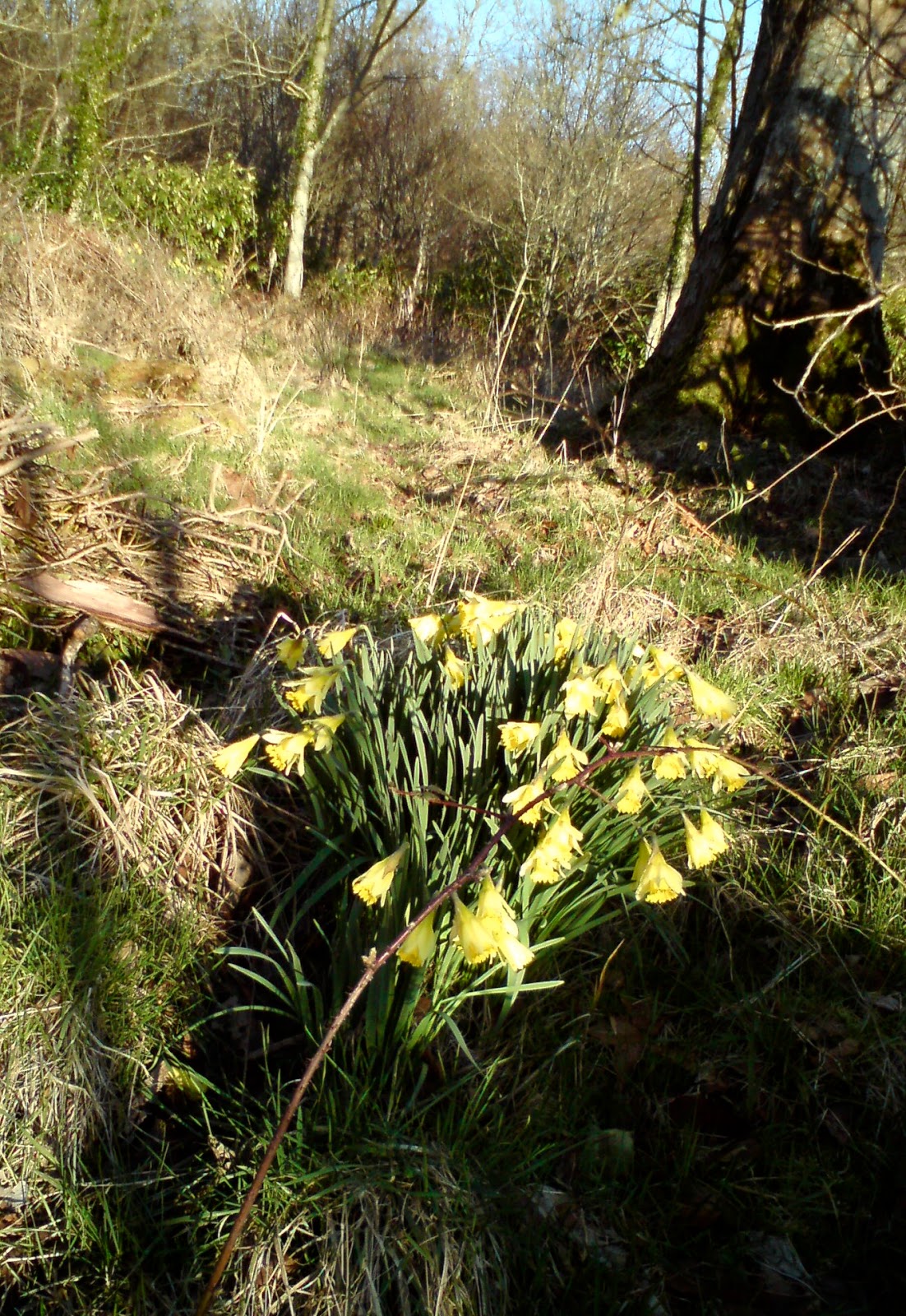
Around 2pm , there was a sudden lightening of the sky. By three o'clock the sun was shining, and half an hour later I was in this sunlit wood where the daffodils that lurk untended in the rough grounds of Toward Castle were golden among the brown tussocks.
Later, I walked by the calm sea. Peewits called in their creaky voices as five of them at least wheeled and dived above the fields. The sun gleamed on the water.
I felt my spirits rise.
But in Kuji City, it looks as if Spring will never come again. I found the Kuji City blog, and on it this image, among many others. There are videos that show a desolate road winding among piles of rubble. No-one speaks.
The silence is broken by what sounds like crows calling. It looks cold, grey and sad. I cannot begin to imagine what it is like to have lost everything so suddenly and so completely. And now it seems as if there is further horror to come as control slips from those dealing - how heroically - with the threat of radiation from the damaged nuclear reactors.
And I was depressed?
Labels:
earthquake,
Japan,
Kuji,
Spring,
Tsunami
Tuesday, March 15, 2011
Once more Ultreya ...
Last weekend saw the first Cursillo in Scotland weekend for almost two years, after a period of reflection leading to a determination to return to the basic ethos of the movement. And Cursillo #59 seems to have been worth the wait, with sixteen participants showing all the signs of having been overwhelmed by the dedication of the team and the love of God. At the Clausura, in Dunblane Cathedral for the first time, they spoke movingly - and in some cases wittily - about their experiences.
They spoke to a good crowd of the Fourth Day - the people who have been on previous weekends - who had braved the snow and sleet to be there to welcome them. This effort on the part of people who are for the most part not in their first youth, is typical of the commitment that puts the weekends on in the first place, for Cursillo is an extremely labour-intensive phenomenon. The amount of stuff that has to be transported, unpacked, set out, removed, inventoried, packed up and taken away again is remarkable - many, many heavy boxes-full. And yes, the people involved in doing the donkey-work can, like anyone else, become tired and scratchy. I was helping with some of it on Sunday, and by the time of the closing Eucharist I felt more like a bath and a lie-down than jolly hymn-singing.
But then the magic happened, just when it should, at the moment of Communion. As I received the chalice from someone I know from her own weekend, and from her service on team when I was Lay Rector, I knew once more the joy that all this service brings and returned to my place with an idiot grin on my face.
Mind, the evening was still spent in dribbling stupor ...
Thursday, March 10, 2011
Caught up in the past
I've been so taken up by the process of blogging my father's wartime letters that I find myself adopting his style of delivery on occasion, although this is not in fact something new for me. As a young teacher I was assailed by the chap who taught next door through the partition wall - he'd heard me sounding just like my father as I taught and recognised it from a time when they were colleagues. But I realise that as I knew him so well, I know when his tongue is firmly in his cheek - as when he is discussing the new family allowance scheme. His reference to the brutal and selfish father could hardly be further from himself, though he is right in describing my mother as an ardent feminist: nice to know it came from somewhere!
Another thing that struck me was the amount of the allowance: 5/-. How many of my readers say "five shillings" when they read that? It's a rare indicator of age, as is the relative value of money. Apparently the average wage for an agricultural labourer at the time was £3/7/101/2 for a 49.4 hour week, according to this site, while another fascinating site points me to a worth of £25.30 for that 5/- if calculated by reference to average earnings (though I'd be happy for someone to correct me in this if I've made my usual hash of reading statistics). It certainly gives a dimension to the other letters concerning money, and to my father's reckoning that he had far too much cash accumulating in his current account because of the lack of opportunity to spend any of his RAF pay.
I've been stymied in my attempts to find any really detailed history of Redlands private hospital for women in which I was born and where my own first son was born four years before it closed, though by that time it was run by the NHS in Glasgow. But it's a fascinating exercise, this digging in the past; my main regret is the unasked questions of my own youth. We don't tend to become interested in our parents till they're history?
Probably not.
I haven't a clue why the font of this - and the size - are so odd. Blogger is not always instinctive!
Monday, March 07, 2011
Playing away...
Must post briefly about yesterday's gig with 8+1 in Rothesay. One of the things about singing in a smallish group with no natural base (such as a church choir has, for instance) is that every now and again you want to perform. It's just that - we don't need money for ourselves, as we are perfectly happy to pay for our singing just as we would for any other class, like tap-dancing or mediaeval history; but every performer benefits from having an audience now and again. And what an audience we had on Bute! St Paul's, the wee pisky church on the front that is sister to our Holy Trinity in Dunoon, was packed - we could even see heads in the balcony, which may in fact have belonged to The Local Paper. It's estimated that there were 70 paying customers, plus a few others.
It was, quite simply, a great performance. It had all the tightness of a live event, the rhythm, the excitement. We were singing mostly popular stuff - Gershwin, Sting - with a few Spirituals and a bit of French thrown in - and the audience loved it. We could see flashes as people took photos - the one I've used is courtesy of Rob, biased by his being the other half of a soprano - but some at least belonged to the unattached. I haven't posted a link to a recording made of one song, simply because an iPhone recording, made off-centre, doesn't do this event justice. We had such a ball, and enjoyed every minute.
We've been invited back. I'm dead impressed by the good people of Rothesay - they were knowledgeable and gracious in their enthusiasm. They kept thanking us - I kept telling them we were having fun, and should be thanking them. And the people in St Paul's - they put on a great bunfight. Nothing seemed to be too much bother. It was well worth the journey.
And we have another gig on Friday ...
Thursday, March 03, 2011
Taking off in Argyll and The Isles
This slightly hazy photo (courtesy of Al) is all I have to remind me of Diocesan Synod - that and the rather dog-eared copy of the Synod papers, with all the doodles and remarks that aid concentration when we're talking about money. If you look closely, you will see an angel, and in the far left a bishop - our new Bishop Kevin making his post-prandial speech at the Synod Dinner. The accordion between angel and bishop is not part of the speech, which consisted, hilariously, of the safety briefing before a flight. The angel is a member of the cabin crew, and by this stage in the proceedings is wearing the chastity girdle and the golden wings - for when the engines fail. There is a lighted halo at her feet. Her opposite number - for it is too big a plane for one angel - is on the other side of the stage.
Reader, I was that angel. Seems I may be up for a new post: Bishop's Fool. It has a suitably Learian twist, I feel - Shakespeare, not Edward. It was all good clean fun and I ended up dancing, unwisely, in rubber-soled shoes: I don't usually stay for ra jigging.
Synod itself was wonderfully optimistic. Having arrived at a properly God-centred vision of our future, we were already well on our way to behaving as one always feels a church should be. The one cloud on the horizon as far as I was concerned, the one bit of contrary weather on the flight, was the revelation that we still carried some dinosaurs on board - the kind that have never realised how strange it feels these days for a church of which two thirds of the punters are women to use a creed with the words "who for us men and for our salvation". I felt moved to speech at that point, and they backed off into the swamp, but I have a feeling they may well resurface before we're finished.
But I niggle. No-one spoke for too long, and everyone seemed to depart in peace. The weather was kind and I managed to get to the deli for my lemon-infused olive oil and one or two other good things. We've taken off in a new direction and are travelling hopefully. Happy landings!
Sunday, February 27, 2011
Lilies of the field?
I'm a great one for a bit of symbolism, and tend to become inordinately excited when I'm surprised by something beautiful. I knew that last year I'd dumped the crocus bulbs under the hedge, to make room for something else in their pot, and I knew that I'd seen some insipid yellow flowers through the kitchen window, but I had no idea that today's sun would bring out the delicate mixture of colours in the picture. There there were, in all their fragile beauty, producing a huge swelling of delight as I came home from church in the early afternoon.
And the symbolism? Well we'd just had our new bishop, Kevin, celebrating the Eucharist in our church, three weeks after his consecration. The congregation was about double the size it had been a couple of years ago; the children were so ... uninhibited ... that I'd had to bellow the intercessions, and we'd had a jolly lunch party afterwards. And yet we all know how fragile our economy is, how easily the building could become too much to keep going, how people can die or drop away. There seems no sensible reason why we're there, why we keep going, why people put so much into making sure the beauty of the liturgy is there, week in week out.
But today it all came together. The sun shone, Cowal looked beautiful, the crocuses were in full bloom, and we had our new bishop in his church on the hill. And I thought of the lilies of the field, and how little I'd cared for these flowers that were so pleasing me today. And like all the best symbolism, there lay behind the coming together a greater truth, one that shatters or slips away in the moment when I try to express it, so I won't try any more. Let the picture be enough.
Friday, February 25, 2011
Out of the dark ...
It's amazing how a sudden change in the weather can make such a difference to life. Perhaps I should qualify that. When I lived in the city - and it's 37 years since I did - the weather was a backdrop, no more. I noticed if it wasn't raining, and can recall the peculiar smell of sun-warmed dust mingled with privet flowers in the late summer, but I have no recollection of prolonged gloom or subsequent depression on my part. Even in Dunoon, when I was at work, the main drawback of awful weather was the trail from the carpark to the main entrance - you could be soaked before you knew it - but I often felt how cheerful the yellow-painted English corridor was on a dark morning, and enjoyed the obvious delight my classes took in my similarly-painted classroom. It didn't really cross my mind to care about the weather - I was too busy, and didn't get out much except at weekends.
Now, however, it's different. This is the first winter I haven't gone abroad at all, and it's had an effect. The past week has been distinguished by a complete absence of sun - the rain hasn't fallen every day, but it's been dark. Some days it felt as if we were stuck on the edge of a huge ocean, as we could see nothing of the other side of the firth. Everyone you met mentioned it. It was hellish.
And then came today. The morning was like all the others - grey, misty, a hint of drizzle in a slight breeze. Until suddenly the wind got up and the clouds rolled back. The photo above was taken about 5pm, and shows the high tide completely covering the beach below the shore road at Toward. We walked along here, and out the Ardyne, and I felt like a new person. A squadron of oystercatchers flew overhead on some important mission; their cousins shared a field with the sheep and a scattering of curlews. The waves were brown and green in the low sunlight, and it was almost unbearably bright, as if we'd been in a cave for a week. The light reminded us, oddly, of the shore south of Monterey in California at the same time of year, though there were no tales of mountain lions to terrify.
And then the sun set and it was dark again. But the effect remained - and with it the thought that, as Larkin said, "It will be spring soon, it will be spring soon."
Friday, February 18, 2011
Notes on a letter from the past.
I've just been posting another of my father's wartime letters on Letters from the Past. In this one, he is rejoicing at the confirmation that my mother was expecting their first child: me. Obviously, it is fascinating for me, and much of this letter is taken up with the news rather than the progress of the war and service life. But I am especially struck by the fact that at this time I seem to have been going under the name Caroline Mary - a sort of working title with the same initials as the name I ended up with - Christine Margaret.
I shall be fascinated to discover if the change to the name occurs before the birth - and how, for heaven's sake, did they know that it was a girl? Dr Kate Harrower was well known as an outstanding practitioner, but this knowledge was surely well beyond her powers. And how old-fashioned and wonderful the insistence on my mother stopping work - the fiercely feminist Dr H was obviously having none of this!
On a sadder note, the Willie Skinner referred to in this letter was, I think, a close friend of my mother's younger brother. She used to become emotional at the mention of his death even when I was an adult - a real underlining of the agelessness of the young who die in war. As my father rarely mentioned the serious business of war, but chose in my youth to dwell on the humorous moments - as when he emerged naked from the Mediterranean to find Churchill and Monty standing on the beach - I had to remind myself frequently that war meant death and misery. This was one of the few deaths to touch our family personally.
Thursday, February 17, 2011
Bubbling away
Time for confession. I've become addicted to a game. And it's on my iPad - so I don't even have to visit the study to play it. Bubbles is described as a hybrid puzzle-shooter game combining elements of puzzle, shooter, strategy and action games. I'm glad it apparently involves all these apparently thoughtful things that might keep my aged brain functioning, for it's up there on a par with Tetris in my addiction stakes.
Apart from the danger of repetitive strain injury (I play with the middle finger of my right hand, if you're interested) there's the problem of seeing life as a series of bubbles to be burst. I realised I had it bad when I looked up from losing a game (I don't actually know how you win it) and visualised the black jacket of someone talking on the television suddenly disintegrating as a black bubble hit it.
I've recently found Tetris on Facebook, which may go some way to weaning me off Bubbles, but the lure is strong. Anyone got something else I can waste my time with?
Subscribe to:
Posts (Atom)