Showing posts with label book reviews. Show all posts

Monday, March 11, 2013

Yes, I'm still reading ...

It's been a while since I last reviewed a book - November saw the last, I think - and I've almost forgotten what I've read since then. However, two of the books are sitting on the desk beside me, mute reproaches, and if I deal with them now they can find a home on a shelf. If there's any room, that is.

The first of them takes up the story of Robert Merivel, who first appeared in Restoration. In Merivel, A Man of his Time, Rose Tremain shows us a much more mature Merivel, a man in his late 50s who considers himself "much decayed" (ouch) with a life to look back on and one last great adventure to undertake. There is a lover, a trip abroad, a bear. There is the King, now also much decayed, and there is the melancholy of the end of a life imperfectly lived. Merivel is self-mocking and sad, and Tremain and her hero take us expertly through a world in which glitter disguises squalor and favour is given and withdrawn in turn. I was absorbed by the writing and made melancholy by the inevitability of ending, whether of a novel or of a life. So there.

And then I read Toby's Room by Pat Barker. A strange, inconclusive story of the 1914-18 war, of a brother and sister and their friend whose face is destroyed by shrapnel, it is described as "a riveting drama of identity and damage, of intimacy and loss", and "Pat Barker's most powerful novel yet". I dunno about that; I found myself driven to explore some of the history of Queen Mary's Hospital and the work of the artists who recorded the progress of early plastic surgery there, and in some ways I wish I hadn't. Having read the bood some months ago now, I find I've forgotten the conclusion of the narrative and can recall as it were the incidentals - but incidentals that are themselves far more important than any fiction could be.

I'd saved up the fat paperback The Villa Triste by Lucretia Grindle for a trip - the other two were hardbacks - and was engrossed by her story of wartime Italy and its resulting deaths in modern Tuscany. The time-switching typographical devices became easy after the first time, and the mystery remained - for me anyway - a mystery until satisfyingly late in the story. I liked Palliotti, Grindle's detective, and I loved Florence and the descriptions of backstreets and Sunday family eating.

And now I'm reading War and Peace, in the new translation. I've read about 200 pages of very small print, and there are another 1000 to go. I'm enjoying it more now than I was at first, having arrived in a War bit rather than the opening Peace section, and I shall certainly say more once I've finished it. Suffice it to say that I've learned from a translator's note that Russians consider the book an easy read, and I'm actually seeing why ... but of that more anon. Just don't give me any more books till I've finished it!

Saturday, November 17, 2012

Plotless novel of the religious life

My mother gave me a copy of Sylvia Townsend Warner's novel The Corner That Held Them for Christmas in 1992. I read it at the time with moderate enjoyment; I have a feeling that my life then meant I only read in bed, for I failed to be properly engaged with this, a story of which the heroine is a convent, a story which has no real plot. Perhaps it's necessary to read it in a shorter time, to give it due attention. The convent of Oby, in a hidden corner of Norfolk, was founded in the twelfth century by Brian de Retteville in memory of his wife, Alianor, who had once dishonoured and always despised him. The story opens thus: Alianor de Retteville lay on her bed and looked at Giles who was her lover. Ok, you think, she's going to end up a nun...and we'll follow her story. Great. But it doesn't work like that.

As the back cover of my edition tells us: A good convent should have no history. Its life is held with Christ who is above. History is of the world, costly and deadly ... Yet the events of history carry a certain exhilaration with them. This book is rather like that ideal convent; only it has history instead of heroes. The nuns are human, but they have their eyes on heaven - some of the time. The priest who comes to them as a gift from heaven during the Black Death - is he all that he seems? But soon he is subsumed into the life of the convent; Prioresses come and go; the tower is completed and collapses; nuns die, are disgraced, disappear; the Bishop makes a visitation.

At my second reading - when to be honest I could remember only the beginning from twenty years ago - I loved it. I was completely hooked, finishing it in a rush before heading off on holiday, unwilling to let it wait till I came home. It's like a window into a religious community, one of which you see the start but which will live on once you shut the window again; a walk alongside the often worldly sisters who in their ambitions, squabbles, jealousies and pleasures seem fit inhabitants of this Benedictine convent which was established for such chequered motives.

The period is depicted convincingly, with all its miseries and fears, its discomfort and instability, and the language is convincing without being in any way archaic. "We were interrupted, were we not?" says the prior of another religious house to the prioress of Oby. "By the way, what became of your mad priest?"

I shan't tell you. But if you can get hold of this excellent book, do.

Friday, May 04, 2012

Stylish nonsense

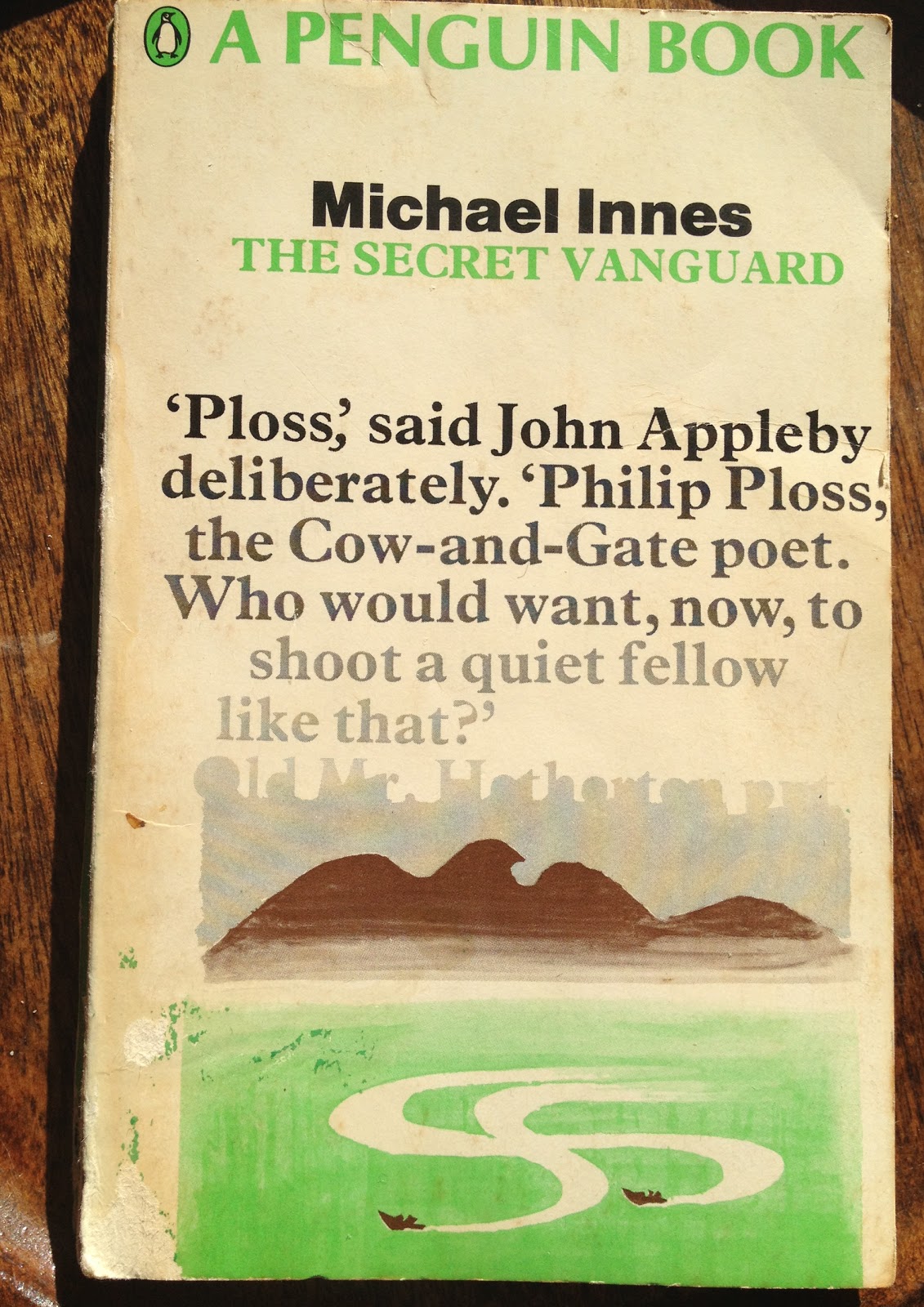
There are times when the brain shrinks and all one needs is the soothing assurance of a good friend - like, for instance, when one has a beastly cold and wants only to sit in the sun and read without being disturbed in body or in spirit. That's why I have been back at the shelves in my bedroom bookcase, the one with the neat shelves that will only hold old paperbacks (I've discussed such books before, yes?) The illustration is of my own copy of Michael Innes' The Secret Vanguard - you'll not find that on Amazon, I think, though there is a more modern printing out there - one dating from the late 1960s. The book itself was written in the early 1940s, a slim thriller rather than a detective novel, and a close relation of Buchan's The Thirty-Nine Steps.

I have been a devotee of the Buchan since before I was ten - I can picture myself reading it in the house we left in my eleventh year - and in the last few years of teaching English I read it aloud to a barely-literate class who sat with the books open in front of them: one of them sighed as we reached the end and told me, in all seriousness, That was the best book I've ever read. The Secret Vanguard is a rather more sophisticated take on the same themes of pursuit, betrayal, patriotism and looming war, and it is the sophistication of the writing that I love. As Sheila Grant, the heroine, is pursued through the Highlands by unknown foes to whom she gives wonderfully insane nicknames, the twists of the plot take place with minimal preparation: a supposed ally is suddenly a foe because he has chosen the wrong photo of himself; a haven becomes a den of villains when she reads its name upside-down on a piece of writing-paper. Innes never beats us about the head with his plot; we are expected to keep our wits about us and our inner eyes open wide to see what he is describing; we hear the tones of his educated protagonists and the mistakes made by those for whom English is a foreign language. And we never, ever, feel that the author will let us down with some clumsy over-explanation.

In many respects this is a silly book - there is no real development of character, no growth, no hidden message to send us off thoughtful. What it does do is provide the delight of impeccable prose, the absurdity of characters planted in unlikely situations, and the threat concealed under the call of a distant bird. If you've never read any Innes, this wouldn't be a bad place to start.

And then there will be so many further delights to look forward to...

*The Wikipedia entry for J.I.M. Stewart (Michael Innes) lists all his books as well as the information that he shared my birthday. I never knew that.

Wednesday, May 02, 2012

Rite of passage

I became acquainted with the writing of Michael Arditti through the meticulous and often hilarious Easter, and wishlisted his rite-of-passage novel A Sea Change on the strength of that. Perhaps my reading of Jubilate - and the ensuing comment-fest on that post - might have prevented me from continuing optimism, but I'm glad it didn't.

A Sea Change is a fictional story grafted onto history: the story of the SS St Louis, a German liner that left Hamburg in May 1939 carrying 900 Jewish refugees fleeing Nazi Germany after years of persecution and the terrors of Kristallnacht. During the voyage, 15 year old Karl grows up, becoming a man despite his earlier defiant refusal to be Bar Mitzvah. His perception of the events leading up to the sea journey is convincingly self-obsessed; we learn his ambivalent attitude to his family and their past even before they all set sail and witness how he manages to reconcile much of the turmoil within himself even as the world around him becomes more threatening.
SS St Louis in Havana

The story is told by Karl himself, recalling the events when he himself is an old man addressing his own grandchildren - so we never worry that he will not survive the voyage or its aftermath. In a way that focusses us on the plight of all the ordinary - and extraordinary - Jewish families on board; we are never reminded that this is fiction but carry instead the burden of the knowledge of the book's truth. I was fascinated by the attitudes of different characters to Jewishness, tradition and each other, and by the feeling of helplessness brought when money and previous status count for less than nothing.

So why do I still feel slightly cheated? Is it the tendency to long-windedness that creeps into the writing? The slightly banal over-description that I feel needs the pen of a good editor? After all, it's not as if the author is replicating the thought-process of a 15 year old: the 70+ year-old Karl is an academic who is, presumably, capable of sophisticated thought and writing even if he is doing it for his grandchildren. Is it the rather careful punctuation of over-long sentences in what should be a more rapidly-moving narrative? (This sounds odd, coming from a pedant like me.) I'm not sure. But this gave me a fascinating glimpse into a corner of the past of which I knew only a little, into the practices of Judaism, into the relationship with ordinary Germans as well as Nazis, and into the dehumanisation of a people which is the necessary precursor to abuse.

Monday, April 23, 2012

Fragmentation capured in a first novel

Writing on Shakespeare's birthday, I'm tempted to report that my withers are wrung by Samantha Harvey's The Wilderness.  This is a first novel, and it's masterful. From the opening section, written in the present tense, the confusion that so tellingly mirrors the state of Jake's mind began to seep into my understanding of what was happening: is Henry really in that prison? and why was Helen slumped at the kitchen table?

Jake is suffering from Alzheimer's, the condition progressing as does the novel. His story unfolds in a series of episodes, and if I were sitting down to do a study of it - as I might have had I still been teaching, for example - I would confirm for myself the precise uses of past and present tense: I suspect the sections in the past are reliable and rationally perceived while the present is used for the increasingly random impressions conjured up by Jake's disintegrating brain.

Harvey captures convincingly the struggle of the early moments of disease - the strategies adopted to disguise or foil its depredations, the ease with which others can cope with something that is filling the sufferer with dismay. The story goes on its fragmented way, some moments recurring while others open up aspects of the mysteries of life and relationships, until we reach what feels securely like the present - only to find that Jake has almost disappeared.

I can't say I enjoyed this book. It was too disturbing for that - too threatening of the glib reassurances we give ourselves. The writer is in her 30s, and I marvel at the depth of her imagination and - presumably - research. I don't know that I could bear to write such a novel at the age I am now.

But I'm glad to have read it.

Sunday, April 15, 2012

Deeply satisfying

A couple of weeks ago now I finished reading Vikram Seth's An Equal Music - though if I'd read the review published on the Amazon page to which that link takes you, I don't know that I'd have bothered. This book is another of several lent to me by a good friend who knows my taste to such an extent that if she thinks I'd enjoy one I tend to give it a go, and so came to this book cold, as it were, with very little handle on what it was going to turn out to be.

It's a story of music, of love and of loss. The hero, Michael, plays second violin in a string quartet, and though he has a girlfriend - who is a less than satisfactory pupil on the violin - he is filled with regret and longing for the girl he loved when he himself was a student. So in that respect it is a love story, in which I felt he involved himself almost without will, as if he was unable to prevent any of the actions he took after seeing Julia on a London bus. It is significant that it is not the bus he is on at the time - they are bound in different directions and the tension of the situation builds gently but inexorably through the story.

The main player in this novel, however, is music. The tension between the members of the Maggiore quartet rings true, their individual temperaments as taut as the strings of their instruments, the differences between them sublimated in their combined music or - occasionally - wrecking it. I felt I knew these musicians and their constant preoccupation with their art, the way everything is seen in terms of how it will affect their music. When Michael is threatened with the loss of his violin, it is like an impending death; when a fridge in the house where they rehearse makes a noise somewhere between two notes it is identified and it disturbs. Bells sound a perfect G and music enters dreams. And when the Maggiore decide to play Bach's The Art of Fugue it takes over their lives.

The sense of loss permeates the story from the start, although at first I was not sure whose loss it was going to turn out to be. I'm not about to give away this most telling feature, but it works. Seth has brought off the feat of writing about music in such a way as to convince someone who is involved in music-making. And that is where I'll leave this deeply satisfying book.

Thursday, March 29, 2012

Never constituted to be a saint*

I finished reading Richard Holloway's Leaving Alexandria last week, but was overtaken by sunshine and the desire to be out of doors so that by the time I might have blogged about it I was too tired to make sense - and I feel that Richard himself might have approved of my priorities.

The book is subtitled A Memoir of Faith and Doubt, and while I was reading it I saw a tweet from an acquaintance opining that surely he'd talked enough about both these things. I disagreed - in 140 characters, natch - because it's obvious that both have been a presence for most of the author's life. If something matters, you talk about it, especially if your talking and your writing are fluent and persuasive.

I loved it. I loved the way it conjured up the childhood of the movies and the hills, and I was appalled at the thought of a boy of fifteen going to the school that would turn him out for ordination - or not - at the end of his studies there. Fifteen! Holloway is painfully honest about the guilt that the normal preoccupations of a teenage boy cost him; his description of his struggles with sex seems to hold at once the pity of the older man for his youthful self and the rawness of that self at the time.

The book was enlivened in another way by the familiarity of knowing not only the author but some of the people mentioned, being familiar with Old St Paul's both in the time when he was Rector there and again now, when I also know the house in which he and his curates lived and where that disastrous attempt at communal living took place. I found lights coming on in corners of my memory, of conversations illuminated decades after they took place. I laughed aloud at the thought of the matching donkey jackets, boots, trousers and bicycles, and was glad that the author too seemed to be laughing.

But it is in the defining of faith and doubt that this book makes its mark, and when it reaches the point at which Holloway resigns as Bishop of Edinburgh, he spells out the precise nature of his problem:
I felt glutted with the verbal promiscuity of religion and the absolute confidence with which it talked about what was beyond our knowing. The irony was that in one of Paul's great poems, God chose to empty himself of language and become a life. But along comes Christianity and turns it back into words, trillions of them, poured out incessantly in pulpit, book and on the airwaves, reducing the mystery of what is beyond all utterance to chatter.  (...) Religious language had ceased to be able to convey the mystery of the possibility of God for me because it confidently claimed to make present that which I experienced as absence; though it was an absence that sometimes feels like a presence ...

And then I am back in the words of another hero of mine, the poet R.S. Thomas, and realise that there is only one word more needed from me.

Amen.

* Leaving Alexandria, p.350
There is a great new review from Ruth here

Friday, March 09, 2012

Another for the suitcase

I've just finished Erin Kelly's novel The Poison Tree. If you follow the link to Amazon, you can watch a short video of the author talking about the story and the impulse behind it, so in a way all I need to say it that I found it gripping, well-written and alarmingly convincing.

It's set in 1997 London and ten years later in a house on the Suffolk coast, and it is only now, as I start to write this, that I remember the Prologue that I read a couple of weeks ago, and how it set up the tension and mystery that persists throughout that long hot summer (was it hot in Scotland? - must check) and resurfaces in the later time period. This is a coming-of-age story, but it is also the story, ultimately, of a woman who has everything to lose and the strength to protect what she loves.

There is murder at the heart of the story, but until it happened I was unable to predict who would die and how. I was sometimes unable to read it at bedtime - I try to avoid over-stimulation past midnight - but I knew I was drawn into the life in the big house beside the wood and the recklessly amoral life of Biba who befriends the narrator, Karen. Kelly manages to demolish the intervening years, no matter how many, to revive our own time of hedonism and irresponsibility, whether in the '90s or - as in my case - the '60s, though on reflection I recognise my own relief at not being stranded in a life of sex, drugs, rock & roll by simple virtue of living at home. The seductive nature of such freedom and its corrosive effect creep out of the heat and the haze of spliff-smoke, all of which vanish like smoke after the evening of murder and its results.

The Poison Tree ends in the dark, in the wind, in the cold. There will be life after the story ends - but Karen is no longer who she was, in more ways than one.

Great for the suitcase.

Saturday, February 25, 2012

Restoration, in more ways than one.

I've recently discovered Rose Tremain - I'm still in that lovely place when you realise that someone whose writing you enjoy has written loads of novels, all waiting out there for another foray - and I thought until a moment ago that I had reviewed The Road Home, which I read in the autumn. This is an entirely modern story, the story of an economic migrant from Eastern Europe whose experience of London gives a new perspective that I - mere country bumpkin that I have become - found not unfamiliar. I triumphed and suffered with Lev, and was eager to repeat the experience.

Restoration was an entirely different experience, except as regards the skill of the writer. Where I had felt sympathy for the Lev, the economic migrant, I began with nothing but distaste for the physically unattractive, bumptious, facetious Merivel, whose infatuation with King Charles II and irrepressible appetite for food, colour and sex seemed to make him a typically Restoration figure. But as I persisted with his story, Merivel's journey towards his own restoration took hold, and the book had won.

Merivel tells his own story, speaking as it were directly and self-consciously to the reader, and Tremain's language throughout is such that I could believe in the historicity of the characters - if there were anachronisms and anomalies I wasn't aware of them. The life of the Restoration period comes alive in all its colour and contradictions, and left me feeling once again how lucky I am to live now. Merivel's original calling is that of physician. As such he is aware of the dreadful variety of ailments that can carry people off, the threat of plague, the fragility of life. The cures he has access to are horrific, and as for childbirth ...

The Restoration of the title is historical, personal and metaphorical. It's a great book. I'm looking forward to the other title I got for Christmas, but I shall save it for a bit. Joy.

Saturday, December 31, 2011

Round-up

Last read of the year
I realise, through the Lemsip-induced haze of another cold, that I've been remiss in reviewing books recently. It's not that I've given up reading - nothing can replace that comfortable joy of having a good book on the go - but simply that other things, usually music, family or church, got in the way. So here, on the last day of the year, is a round-up of stuff I've read recently.

Unless, by Carol Shields, was an odd book. It was beautifully written, and I enjoyed reading it immensely - but realise, at several months' distance, that I had to check the Amazon review to remind me of one of the threads. But I loved the involvement in the mind of writer heroine Reta, her anxieties about her eldest daughter who drops out of university and sits on a street corner in Toronto with a placard saying "Goodness", her tussles with her insensitive publisher, and I was completely convinced by her wonderful conversations with her friends.

After that, I had a quick scamper through some old Penguins. Sweet Danger and The Crime at Black Dudley, both by Margery Allingham, convinced me that I was right to consider The Tiger in the Smoke the best I've read of her books - the style remained seductive, but the plots were pretty daft. They were really old Penguins too - the original green and white covers, with yellowing pages, foxed at the edges.

One of my birthday books I had added to my wish list purely on the grounds of its Amazon description. The Stranger's Child, by Alan Hollinghurst, is a great tome (I read it in hardback - quite risky reading in bed when sleepy, lest it fall on one's nose) covering the span of almost a century with complete conviction and mastery. In one sense, it is a novel about a biography - a biography of someone we have already met in the opening chapters, just before the outbreak of World War 1. But it is also about Englishness, and about how people change over time, and about manners and customs and society ... and it is beautifully written and just challenging enough to keep me flipping back to check my memory against that of various protagonists.

Then I was lent A.D. Miller's Snow Drops as a suitably small paperback for a plane journey. This kept me riveted for two flights and the time in between, and I agreed with the reviewer who said it 'reads like Graham Greene on steroids'. Snowdrops are apparently the corpses that appear when the snow of the Russian winter melts, and the winter in Moscow is as much a character in this story of love and betrayal as Nick , the English lawyer, and Masha, the Russian girl he loves. The writer used to be The Economist's Moscow correspondent, and he convinces with every word. As I look forward to a trip to Russia in the coming year, I can't help wondering if 'grandma's summer' will be over and the cold air will already be threatening the winter to come...

I finished the year with another Josephine Tey, having so unexpectedly enjoyed The Franchise Affair. I had tried The Daughter of Time in my teens - I have a feeling my mother gave me it when I was off school with some bug - and completely failed to become interested in this tale of a convalescent detective solving the mystery of Richard the Third from his hospital bed. Who killed the Princes in the Tower? Perhaps they weren't killed at all. Was Richard the horror depicted by Shakespeare? Check the origin of his sources. The book is intricate, painstaking and fascinating. I shall never look at history in the same way again. The mature me loved it, and I finished it yesterday. The picture above is of the edition - now 50 years old - that I read; it seems to me a suitable illustration for an end-of-year blog post.

I have now started one of my Christmas books - two pages of The Girl who kicked the Hornet's Nest already have me feeling more cheerful about this wet Ne'erday - and there are others waiting in the wings. Now, off the computer and back to the books ...

Wednesday, November 09, 2011

Another small discovery

I've mentioned before how wonderful old Penguin books are for travelling. Compact little things, with small print and little in the way of fanfare or decoration, they are just what is needed for a train journey to Glasgow, or even - as recently - a trip to the hairdresser, involving, as it does for me, a rather chancy ferry service and subsequent irritating waits when I've just missed one. The book on the right, Josephine Tey's mystery story The Franchise Affair, has been back and forward across the Clyde several times, resulting in a certain degree of dog-earing and culminating in yesterday's trip to wait for Mr B in Inverclyde Hospital. It was there that I finished it, and was so aware of the loss of my distraction that I began to make a nuisance of myself ...

But I digress. This is another book that's been on my shelf for years, and I don't know why I never got round to reading it. Published in 1948, it would have been completely contemporary in its language, mood and setting - former soldiers in all walks of civilian life but possessed of unlikely skills, life in a small English town returning to quiet normality, church and tea-shops the centre of life and gossip. The mystery concerns the accusations made against two women who live in a dilapidated big house, The Franchise, to the effect that they kidnapped and beat up the fifteen-year-old girl who accuses them. The burden of helping them falls on a local lawyer, whose quietly contented life is changed for ever as a result. The story was apparently based on a similar event from the 1800s.

I find it hard to pin down what makes me so sorry to have finished it. The language is quietly perfect, the descriptions of life in Milford, 'where the last post goes out at 3.45', effective and completely suited to be the voice of Robert Blair, bachelor, golfer and the senior partner in Blair, Hayward and Bennet. The details describe much of my childhood, so that the women in their hats and gloves step obediently into line and the subtle differences in class and breeding are as soothing as they would now seem hilariously anachronistic. Perhaps it's simply the business of feeling safe in a novel - safe from grammatical blunders as much as from any device of the plot.

The detection side of the story is less complicated and less requiring of any genius on the part of the main protagonist than many, with the result that once the last piece fell into place the result was a forgone conclusion, but the characterisation and the subsequent lives of the women and Robert himself were of sufficient interest to keep me gently involved. The novel seems at some time to have been made into a film, and I could see it being a TV series that would pander to the Downton audience (I know - there are 30 years between them, but ...). It is, however, the book I have enjoyed so thoroughly. I'm glad I discovered it, lurking there ...

Sunday, October 23, 2011

Poets in a Landscape

A long time ago - we're talking half a century here - I found a dun-coloured hardback book in the school library and took it out for a fortnight. I took it out again later in the year as my mother hadn't finished it when I first brought it home, and I noticed that no-one else had borrowed it in the intervening months. I suspect it was only there because the author had been a pupil at the school. Later, I was to regret not having nicked it when I had the chance, but I was an honest adolescent and it didn't cross my mind. Years later, my mother spotted the same book, reissued as a "Lost Treasure" by Prion, and bought it as a present for me, unregcognisable in the attractive paperback illustrated here. And so Gilbert Highet's Poets in a Landscape found its way onto my bookshelves in 1999, and I see that it's still possible to buy it online.

It has taken me till now to re-read it in its entirety. Maybe it's not a book to be galloped through with the voracious speed of my teenage self, for apart from the section on Catullus I recalled little of it. Highet, whom my parents apparently knew at university, draws pictures of the great Roman poets - Catullus, Horace, Virgil, Propertius, Ovid, Juvenal - in their own locations, visiting their special places in Italy, seeking out ruins and rumours, legends and literary fragments, recreating the lives they led and the people they encountered.

At the first time of reading this book, I had visited only one of the places he describes. The so-called Grotte di Catullo at Sirmione, which the poet know as Sirmio, are in fact the ruins of a huge lakeside house of a later date than the poet, but the peninsula jutting out into Lake Garda is an evocative place, and even as a teenager I found myself quoting Tennyson as I walked round 'sweet Catullus' all-but-island, olive-silvery Sirmio' - for Highet is never afraid to complement the works of the ancient poets with their more recent echoes in the poems of others.

The book takes us through the Italian countryside and the boiling streets of Rome, beside the cool springs of Clitumnus and the echoes of the now-ruined Forum, translating chunks of Latin poetry into his own, preserving the metre and as far as possible the tone, so that someone with no knowledge of Latin could still feel they were within touching distance of the works as well as the life of ancient Rome. His description of hot exploration of the Italian countryside as he sought out unremarked ruins is as powerful as his evocation of the Dark Ages, when the glories of the Palatine Hill were ruined and buried and dogs scavenged around the capitals of hidden columns. A fairly recent visit I made to Rome has left me with powerful impressions of my own to recall - including pictures painted of the period before archeologists started work on these strange mounds and apparent caverns, but above all it is the sound of the poetry that has returned.

Whether I was realising how the metre of popular songs worked - as exemplified by a line about Julius Caesar: Watch your wives, you poor civilians, here comes
              Baldhead Lover-Boy!

or, as I suddenly recalled it from Thornton Wilder's The Ides of March:
              Here he comes, the bald whore-monger - Romans
              lock your wives away! -
or taking delight in some erudite explanation of some facet of language that I had never previously considered, this book proved a joy.

I may even get down my copy of Horace Odes (Odes lll, if you're interested) and see if I remember how the Latin works ... O fons Bandusiae, splendidior vitro...

Sunday, August 21, 2011

Helped by The Help

Belting through fiction as I am this summer, I feel that at least this one merited the (relatively brief) time I spent on it. I rattled through Kathryn Stockett's The Help in the way I recall from my childhood holidays, when friends would come calling at the door and I would be hidden upstairs reading something I couldn't bear to put down. And yet, as someone says on the Amazon page linked to above, it was also a book I was sorry to leave.

Set in Jackson, Mississippi, in 1962, the story is told in three different voices as Aibileen, Minny and Miss Skeeter tell their part in it. My heart sank a little at the beginning when I realised that at least one of the voices replicated the Southern speech of the narrator, for that was one of the things that stopped me from reading The Color Purple, but it's so cleverly accomplished that it soon became an integral part of my enjoyment. I think it may have to do with the complete lack of self-consciousness in the writing - there are no apostrophes underlining missing consonants, for example. It was no time at all before I was hearing these voices in my head, and relating them to my own contact with the Deep South a few years ago.

As with all novels set against a historical background, there is an inevitability about the grand sweep of events, but the individual experiences of the extremes of racial prejudice in Mississippi are gripping in their awfulness, their humour and their variety. The two maids and the lone white woman who takes their part against the prevailing mood are resourceful and brave - and cast a bright light not only on racial attitudes but also the assumption that 'help' is a necessity for a middle-class white woman and that white gloves and polished silverware are the norm in polite society.

I loved this book. At times I was horrified, at others I thought I knew what was coming and was proved wrong. Sometimes I had to put the book aside so that I could sleep. I loved the descriptions of the ... food, actually. I have eaten that food - the fried squash, the cornmeal, the grits - and it all came back in a flood. And over all I have a new respect for my dear friends Ruth and Ed, who lived through this time and fought for the rights of the black people of Alabama. The Help added another layer to the understanding that grew when I visited the Civil Rights Institute in Birmingham, and for that I am grateful.

But aside from all that, it's a great read.

Friday, August 12, 2011

Jubilate fails to grip

I thoroughly enjoyed Michael Arditti's Easter - so much so that I laughed aloud at the first page and exclaimed with horrified delight at another. I recommended it and lent it to people. So when a friend recommended Jubilate by the same author I bought it with a click (I know - one-click ordering is very dangerous for me) and looked forward to reading it on holiday.

Sadly, the experience didn't repeat itself. I found myself quite readily putting it aside for a chat, or dozing in the sun with it on my lap. I found that by the end of the book I still had no feel for the main characters, and the other pilgrims were characterless. I didn't even feel the need to flip back to check which was which, as I had at the beginning of Easter (and a list of dramatis personae would have perhaps helped in Jubilate).

The religious experiences described didn't really do it for me either. Gillian's faith was a pale shadow in the background, and Vincent's glimpses of the divine lacked, I felt, any conviction. I wondered if the two points of view and the sequence of chapters somehow diluted the effect of the narration - Gillian's story begins at the end of a pilgrimage to Lourdes and Vincent's at the beginning - because the two stories were too similar. There wasn't enough revelation when each narrator came to key events, so that the technique that worked so well in Easter seemed to fall short in Jubilate.

All that said, I've learned enough about a pilgrimage to Lourdes to ensure that I never think of going on one - in a way it comes across as a festering blight on the face of the country - and I did finish the book. But I can't agree with Peter Stanford writing in The Guardian  when he talks about the urgency of a great romance, and the metaphysical debate didn't exercise the grey cells much, I'm afraid. Maybe it was all a bit too close to reality, maybe it lacked the exaggeration that made Easter such a show-stealer. In fact, what I recall now is a sense that this is a dutiful record of a love story on a pilgrimage, but one that lacks passion of any kind. It might almost have been real - and sometimes that's not enough.

Wednesday, July 06, 2011

Chew, don't swallow.

Another blog post, another novel. It's not that I've been devouring fiction more than usual, more a failure to blog that brings this about. I began Margaret Atwood's The Blind Assassin before I went to France - a mistake, as it is a fat book and not mine own, so I didn't want to stuff it into my flight bag. I had just begun to feel at home in the complexities of the tale when I left, and it took me a while to get back into it, for there are different voices narrating the components of Iris and Laura Chase's life together and I was, frankly, confused.

I think it was the effort required that initially put me off reading a book that's sat on the bookshelf for long enough to acquire a sun-tanned lower half (sorry, Morgane) - but it was self-disgust that kept me at it this time. I don't want to subsist on Mills & Boone in my declining years, after all ...

Iris Chase is remembering, as her body ages and her heart gives warnings of mortality. She is recalling the circumstances of her younger sister's death, and in doing this tells the story of their childhood together and their adult fates. As Iris is now old, the story covers much of the twentieth century - wars happen and mark the novel's protagonists, political events hinder their aspirations, society changes and with it their own lives.

The blind assassin of the title appears in the strange fiction that runs through the novel - much as the odd story of the sorcerer in Oranges are not the Only Fruit - but seems to seep out into reality as Laura Chase suffers in real life only to survive as a legend. Newspaper items surface as a contemporary commentary on Iris' memories, and Atwood's mastery of tense and person, of location and mood, pervades the whole, as it did in Alias Grace. I feel I've had an introduction to two centuries of Canada after these two books - and want to re-read the classics I read twenty years ago to check on what I found there.

Another holiday book for when you know you won't be disturbed - a book to chew rather than to swallow, and deeply satisfying.

Saturday, July 02, 2011

Emma Donoghue's Room

I've always had a difficulty with books entirely written in a voice with which I'm uneasy. I never managed, for example, to read The Color Purple all the way through, because the narrator's English was so heavily Deep-South that the spelling of it gave me a headache. I managed with Sunset Song, but that is a masterpiece. And I managed with Room, by Emma Donoghue, although I nearly gave up after the first ten pages. And maybe the fact that I didn't points to the masterly handling that makes this book extraordinary.

We all read in horror, watch the news with unbelieving avidity, when a story breaks of someone held hostage, sexually abused, exploited, and then, miraculously, discovered and liberated. We unite in condemnation of the abusers, and wonder at the shadowy figures of their victims - but we don't often think about the effect on their lives of what they've been through. They're free, and we thank God, or the police, and move on.

This novel forces you to stay in captivity, physical and mental. It is told by Jack, who is five and was born in the room where he lives with his mother, Ma. He watches carefully regulated television, but the rest of his experience is of the confined space in which they live - a space where the beeps of the security lock on the door herald the nightly visits of Old Nick, the provider of Sunday Treats and the abuser of his mother - and Jack's father. The five-year-old's perception of what he experiences means that for a while after reading the book you too start seeing things differently, and even when he is able to experience Outside for the first time he has his own particular interpretation of what he finds there.

Jack is a captivating and fascinating narrator who has no judgement to pass on his prison because it is all that he knows. By the time he cuts off his long hair and finds that he still has the strength to cope with the world, we too have developed a changed perspective of our lives.

A book group would have a ball with this disturbing and engrossing novel.