Regular visitors to this blog must be wondering if I've gone off. You may very well be correct in that supposition, but the truth is that since the Cursillo weekend I've been too exhausted/busy/preoccupied to do anything but do all the things I have to and stagger to bed. Today, for instance, I've been assisting in a flitting - all these boxes! - and earlier in the week I was too busy dealing with the fallout from a bit of thoughtlessness to be writing about it.
But I shall return - and there's surely a post from all this experience. Meanwhile bed seems very inviting ....
Thursday, April 30, 2009


Monday, April 27, 2009
Mission accomplished
 We survived. Don't be fooled by the excellent, jolly cake, supplied by Black's of Dunoon - all the food was of the highest quality and nothing like survival rations - but the experience of serving on team at a Cursillo weekend is not one you can repeat too often, and one which provides an example of the sheer stamina and determination of a bunch of people in late middle age who might be expected to sit around over the weekend, enjoying the Spring sunshine and congratulating themselves on not having to work any more. But goodness, do you pay for it!
And was it a success, this weekend? I think so, for the majority of the participants. It's not actually possible to evaluate the experience immediately. Some people can find the effect of the weekend overwhelming and need time to reflect. Others are overjoyed by what they find and can't wait to serve on team themselves, to fill in the other side of the experience. And still others feel distanced, alienated even, from what happens in the course of the weekend, only to show in their subsequent lives that something has changed. I know that we had participants who fall into the first two categories, and only time will show if we had the third.
But through the total exhaustion that engulfs team members - usually when they are halfway home and feel a bit as if they've been let out of prison - one thing stands out as the reward. For if only one participant tells you, maybe in a quiet, personal moment, that they have had a wonderful time, or been helped to cope with the difficulties of their ordinary life by the support they have received over the weekend, then it is all worth it. Every last, aching, sleep-deprived moment of it.
And that happened on weekend #57.
Wednesday, April 22, 2009
Cursillo weekend
The car is packed. There is room for only two people, and the back seats are folded away. The curious might assume we were going on a camping trip, but in fact we're off to Millport, to a Cursillo weekend at The College. The contents of the car are, in microcosm, a good representation of the kind of planning and detail that goes into these weekends: only one small suitcase each for our own possessions, with the rest of the space going to everything from tartan tablecloths (carefully ironed) to piles of music. For we are serving on team, and self becomes very much the afterthought as we strive to make everything flow smoothly for the participants.
And when it's all over we'll be exhausted. I know that now. In fact, just thinking about all we have to do before then makes me tired now. But I know that once the participants arrive, once the team is really working hard, there won't be a moment to feel tired, or daunted, and that on past form we'll probably find ourselves surprised once more by the joy that took us there in the first place. Here we go ...
And when it's all over we'll be exhausted. I know that now. In fact, just thinking about all we have to do before then makes me tired now. But I know that once the participants arrive, once the team is really working hard, there won't be a moment to feel tired, or daunted, and that on past form we'll probably find ourselves surprised once more by the joy that took us there in the first place. Here we go ...
Monday, April 20, 2009
Calling all ostriches
Sometimes I'm struck forcibly by the choice we make in deciding whether or not to watch/read/listen to the news. Today I read in some detail of the resurgence of Nazism in Austria, in a piece accompanied by the photos of ancient Nazis in bits of wartime uniform celebrating Hitler's birthday. And this evening I watched President Ahmadinejad of Iran denounce Israel as a racist state, and heard the comment that the situation between Iran and the West could become "very serious indeed".
Suppose I had simply read a book at lunchtime, had watched something else or - just as likely - fallen asleep in front of the telly this evening? I would not have any of these stories to ponder, not have anything to trouble my sleep other than the organisation of the imminent Cursillo weekend. And yet it is possible that I am more concerned about the latter right now, simply because I can do something about it - in fact, I have to do something about it tomorrow.
Back in the '80s, my desire to do something about the presence of nuclear weapons on my doorstep got me into all sorts of bother. At the time, I wondered at the ostrich mentality of many of the people I doorstepped for CND. As I become older, it's easier in a way to stick my head in the sand of unknowing - until I think about my grandchildren. And I begin to wonder what might yet lie ahead.
Maybe I'd better just read that book ...
Saturday, April 18, 2009
Nectar in a tin
 I'm indebted to Neil for reminding me of the drink that was the mainstay of my childhood. Creamola Foam must have been a cheap alternative to the red cola and fizzy orange that appeared at parties and on holiday visits to cafés, but my main memory of drinking it is very clear - so clear that I can taste it now - and strongly linked to one place. That place is on Arran, at a point in North Glen Sannox (not to be confused with Glen Sannox, but a less-well-known glen slightly to the north) where huge slabs of pale grey granite jut out into the very middle of the North Sannox burn. This is still one of my favourite places on earth, and will forever be associated with what would be a typical 1950s picnic: Macvitas, triangles of Dairylea cheese, floury muffins with strawberry jam, slightly flattened from their sojurn in a rucksack - and Creamola Foam, preferably orange flavour, made in a plastic tumbler with water scooped precariously from the burn.
This was Creamola Foam at its best, and it's easy to see why it was a winner for whoever was carrying the drinks: a small tin and a spoon make for much less of a load than a bottle of diluted squash. Perhaps the location explains why I recall it with such fondness, for I am now convinced that in my childhood we never drank anything like enough water and at the end of a muddy walk we'd be parched with a thirst that made this chemical concoction into nectar.
To the best of my recollection, we never bought this stuff for my own kids - though I'm open to correction if they ever read this - because I have a feeling I tasted it in later life and realised my tastes had moved on. Just as well, really - it doesn't seem to exist these days.
Update: Neil assures me I did indeed buy it for him - he wouldn't have mentioned it otherwise.
Wednesday, April 15, 2009
Talking with the gardener
Is he real? and can I trust
the joy which sears across my soul
with such delicious pain?
The light is white, a curtain sparkling
so that I can barely look, can
hardly see the face I love.
Am I remembering? But the voice
which said my name – my given name –
it is the same, the cadences
which bring my heart to song each time.
My tears still well, the picture flows
and changes as the light refracts
– why do I weep? He asked me that
and yet I cannot bear to say
that what is joy for all the rest
is not enough without the touch
which now I know I cannot have.
I would not have run, that night
of horror when the others fled –
not while he still breathed and stood
and spoke and suffered with that kiss
which I could never give.
So what is real? Is this enough
to share with joy and tell the world
that death can have no final word?
I cannot say. I need to hold,
to smile, to talk, to love, to be –
the shadow moves. The joy recedes
becomes more patient, calmer now
and I, alone among the trees
must share my moment with the rest
and know it is no longer mine.
But I was here. I loved. I lost.
©C.M.M.
Friday, April 10, 2009
Good Friday reflection
PASSION
Does it feel real? Crouching
in the evening chill while
leaves overhead silver in the breeze
I struggle for wakefulness
even in this cold. He is not asleep
but staring in the dark closes the eyes
on my blank mind. A sudden cough
startles but the numbness returns.
A lone insect whirrs and in the city
a child calls for its mother
as the feet stir the dead leaves
and the torches come
and the kiss betrays. Lord,
I whisper, I should have watched.
Is it real? The weight of wood
is real enough, but my bearing it
seems beyond bearing and cannot be.
The slow steps seem not mine,
but made by someone
I cannot bear to inhabit. The nails
oh the nails
hotly sliding through the jolt
the hammer makes
in my body in my body
in my body in my body
two strokes each
the strokes of an expert -
it is done. Up, up – lifted up and over
the heads of the crowd I see
the city in the noon light and know
this eternity will not last long
but is it real?
It is finished. Is it
accomplished? Your words, Lord.
The emptiness is there still
as the untimely darkness covers
my failure to attend. The cross still
stands, but empty now. Empty.
©C.M.M.
Gethsemane
Midnight. The church is quiet, dark. The sacrament is gone from the altar of repose, and shortly the candles will be extinguished, though already it feels as if the light has left Gethsemane. It is cold. The disciples have fled in disarray, and the night moves towards the new day.
The watch is over.

The watch is over.
Wednesday, April 08, 2009
Not rolling stones then
It is the Wednesday of Holy Week. The day before Maundy Thursday, when for the hours before midnight the sacrament will rest on an altar decorated with moss and tiny trees and candles, many candles. But today it is only Wednesday, and two women are to be seen heading up the hill opposite the gates to Benmore Gardens. They are accompanied by two rampant spaniels, and their pockets bulge strangely.
Some way up the hill, they pass a fallen tree and come to an abrupt stop, exclaiming in delight. The tree is draped with curtains of moss, and it is this which has caught their attention. Moments later, they have produced plastic carrier bags from their bulging pockets and filled two of them with the moss. They then continue uphill. Later, they can be seen scrambling precariously up a steep bank to reach some particularly succulent sphagnum. It seems to matter little that they are not in their first youth, nor that they are rapidly becoming somewhat dishevelled. They press on, each now burdened with two bags. They are laughing as they speculate what any passer-by might think. Escaped lunatics? Eccentric campers with their shopping? But in all the years in which they have done this, they have never met a soul. No-one has ever had to wonder.
This day, however, is graced by fleeting sun. It is, after all, April. The schools are on holiday, and there are trippers in the land. People who have come to Cowal to walk the forest paths, in these straitened times, rather than flee to the Canaries. And so it is that a host of such travellers appears on the path. The first four pass quickly, perhaps because they have dogs who may become entangled with the rampant spaniels. But the remaining two greet the women… pause …and then it comes.
“What have you got in the bags?”
“We thought it might be shopping.”
And they laugh. And so Mrs Heathbank and Mrs Blethers – for our mad women are indeed the writer of this blog and her pal - have to come clean, for the first time in ten years. And the great thing is that it is a joyous moment, that the strangers think it sounds a wonderful thing, that they regret that they are only visiting for the day. We tell them that they are the first people ever to ask about the bags of moss, and the woman tells us:
“Don’t mind me – I’m just a nosey bitch.” And then she gives us a hug, for good measure, and we part as if we had known each other for years.
A good day, I think.
I wonder slightly about the change in person at the end of this account, but it doesn't work if I keep it in 3rd person. Purists can save their comments for another time...
Tuesday, April 07, 2009
Out of the deep?
A quick post to show I'm still alive, as I set off in the rain for Cumbrae and Choral Evensong, for which we haven't yet begun to practise. Practise as a group, that is, for I've just been singing through my own alto parts with Mr B playing/singing bass. And the joy is that as we ran through Boyce's All the ends of the World I could hear in my head the wonderful suspensions, the resolved crunching moments in my own part, and felt that perhaps after all I was entering into my own Holy Week. And then there is the psalm - Out of the Deep - to that great dark setting by Walford Davies. I can't wait.
And yet I can't help reflecting how that whole week, as Jesus headed towards what he knew was to come, ordinary people were busily doing their thing all around him. Maybe the disciples felt stressed by the crowds, the fuss, the carry-on in the Temple, the approaching Passover. Busy, busy, busy. Just like the rest of us. But today I shall switch my life off and concentrate. Just got to travel there first.
And yet I can't help reflecting how that whole week, as Jesus headed towards what he knew was to come, ordinary people were busily doing their thing all around him. Maybe the disciples felt stressed by the crowds, the fuss, the carry-on in the Temple, the approaching Passover. Busy, busy, busy. Just like the rest of us. But today I shall switch my life off and concentrate. Just got to travel there first.
Wednesday, April 01, 2009
To see the object
There's a poem over on frankenstina which I wrote a while ago while thinking about a friend who had died. However, it seems to have become as much a meditation on faith, for that is how it communicated with several people who were unaware of the original stimulus.
An interesting exercise in "seeing the object as in itself it really is": my first essay in Ordinary English at University dealt with the necessity of considering only the text and not muddying the waters with background information. I don't think I wrote a very good essay ...
An interesting exercise in "seeing the object as in itself it really is": my first essay in Ordinary English at University dealt with the necessity of considering only the text and not muddying the waters with background information. I don't think I wrote a very good essay ...
Monday, March 30, 2009
Professional or protesting?
When I was teaching in school, I used to take my form class to the registration-period assemblies that were the norm. If there was a visiting chaplain, he/she had two minutes in which to sell an impression before the bell rang and the moment was gone. The big events of the calendar were unmarked other than by a half-day at the end of term. And I thought assemblies were designed to give religion the tiniest toe-hold you could get away with within the law - and I deplored every minute of them.
Today I took part in an Easter Assembly, flying the Piskie flag along with the RC and C of S chaplains. In all, each half of the school had a half-hour slot. I put together a series of readings and meditations and poems which gave an insight into what happened in Holy Week, including a grim account of what, historically, crucifixion entailed. There were obvious parallels with the situation in the Middle East today. It was all to be delivered by pupils, who would be chosen for their reading/dramatic ability. None of this was under my control; I simply turned up today to work my iPod and read about 5 lines.
And it went exactly as I had expected. How can you expect pupils to know how to react to something new (and God, was it new to most of them) if their teachers are allowed to behave like surly adolescents? Not all of them, of course – but from where I was sitting I could clearly see an unprepossessing-looking guy sitting ostentatiously doing his marking, busily erasing something as vigorously as possible, paying not a bit of attention to anyone or anything. The readers hadn’t been rehearsed – because the drama teacher was too busy. The choir had ducked out of the promised contribution. And even when a member of staff did in fact think that this was a good idea, the remark to a child that “We’re supposed to expose you to this kind of thing” doesn’t really fit the bill.
On my way in, earlier in the morning, I was greeted by a former colleague: “I see you’re here to peddle your superstitions” – and there are no prizes for guessing where he stands. Now, I have sat through the dreary non-religious funeral of a colleague at which that same sceptic spoke at length, endeavouring to bring some sort of permanence to a memory, some sort of meaning to a retirement cut short. And I sat in the required silence, listening, not praying – not doing anything other than offer the polite response required of any adult in the situation. I didn’t accuse him of self-aggrandisement, or of attempting to reduce a life to an end-of-term entertainment. Nor, for that matter, did the other Christian colleagues sitting beside me.
I have to do further assembly-type gatherings until a new rector is found for my church. I’m already thinking how I can work on one year-group at least to undermine this culture of philistinism and ill manners. I expect adolescents to behave like that – though in fact I only saw one senior girl actually doing so, and amused myself be stopping her dead by watching her. But in these straitened times, I’d be wanting to tell teachers in the employ of the authority that they have a job to do, and that if they can’t actually do it they might care to think again about their vocation – maybe a career as a G20 protester? (I could teach them a thing or two about that too).
I have other, half-formed thoughts about this to which I shall return, but that’s enough for now. Let me just say that today’s assembly did nothing in the way of proselytising, and that if I were to attend an assembly led by a Muslim – or a careers advisor - I’d expect to behave exactly as I would with any other visiting speaker. It’s called professionalism.
By the way: the music (Missa Luba) was great over the new PA system. And seriously loud.
Sunday, March 29, 2009
Looking the part
I'm off to school again tomorrow, for the Easter Assemblies. I suddenly find myself thinking about work clothes rather than prayers, for I hardly ever wear, say, a formal jacket these days. It's rather like when I returned to work after the eight years of mummyfying (no, I know the spell-check doesn't like that. Tough) and didn't actually know what to wear.
It's living here that's the problem. There seems no reason ever to wear a coat other than a waterproof; absolutely no reason to appear properly dressed in Somerfield's; certainly no reason to go for a walk in anything other than one of my many cagoules and techy trousers. After all, I'm in a seaside town - a holiday town, only no-one really comes here for holidays any more - and ever since I arrived here, from Glasgow, I've dressed as though I was on holiday. Except, of course, when I was working, when I could have been anywhere. And the new school seems to be such a very warm place that layers are essential - can't exactly strip off to the semmit, now, can we?
And that is why, tomorrow, I shall look out a jacket and a shirt and look .... purposeful.
Thursday, March 26, 2009
Single-sex teaching
Well, well. It's a strange feeling to see the BBC Scotland news featuring something I did several years ago and hailing the development as something new and exciting. I'm talking about the "experiment" in Kilsyth Academy's English department, where they have decided to teach boys and girls in separate classes. They are evangelical about the positive effect on the work of all concerned.
Of course, I'm glad about all this. I'm glad someone else has cottoned on to something I've known for years. Because it must be eight or nine years since I first offered to solve the gender imbalance in a yeargroup by taking a boys' class as they started S2, and five or six years since I attempted to publicise the results of this experiment. Of course, we weren't blogging then; the only computer in my classroom belonged to the now defunct Pupils' View magazine and I merely circulated memos - which obviously didn't get very far.
The news story ended with the reporter wondering how their Standard Grade results will benefit - if at all. I can tell them already - at least, if they're anything like my boys. I taught this same mixed ability class from S2 - S4 - three years together for boys whose predicted grades ranged from Credit 1 down to Foundation 5. In the event, no-one achieved a Foundation award: of a class of 30 I had 15 Credits (8 of them at Grade 1) and 15 General, of whom only two were a Grade 4. The most able boys helped the less able without the slightest embarrassment or resentment on anyone's part; every one of them found that they were able to write more effectively and express genuine emotion without fear of ridicule. One boy startled me in S4 by announcing that he had learned John Donne's Batter my heart off by heart because he thought it was "amazing", and offered to recite it to us all. Another became fascinated by Doris Lessing's The Fifth Child and wrote, off his own bat, a critical evaluation of it. So much for the fear that an all-male class would read nothing but so-called macho texts.
Many of these boys stayed with me for Higher English, though for that they were rejoined by some girls, and most of them did extremely well. One of them even comments on this blog from time to time. In all the time I taught them I looked forward to their period in the day as a time of hard work, enthusiasm, adventure and frequent hilarity.
So I wish the boys - and the girls - of Kilsyth Academy well. I hope their teachers enjoy the classes and the opportunity for some exciting cooperation. But I wish someone had told the Beeb about my class - because whatever it is, it's not a new idea.
Wednesday, March 25, 2009
1984 : finis
Before drawing the curtain on my 1984, a few last thoughts. Writing about it was strangely cathartic, and I wonder if I would have felt less affected had I been able to blog about it at the time. Certainly I became aware during the fall-out period that the priest involved in making sure we wouldn't still be around our church by the time the Presiding Bishop of ECUSA (the Episcopal church in the USA) visited the congregation that autumn was terrified Mr B would bring a case of wrongful dismissal - he even had a tame lawyer on hand to dig him out of the hole. At the time no-one was interested in what had actually happened; the priest was more to be believed than those pinko peace people. Actually, that's not true: one couple invited us for dinner and asked us to tell the story.
In the end, I grew tired of the pressure. After appearing in three TV programmes - the most notable being Northern Frontier - and taking on several speaking engagements and after realising that my phone conversations were not private I decided to back off a bit and concentrate on teaching. I didn't go near the Episcopal church for several years, and I still haven't resolved that bit of my past. The people who were involved in making things unpleasant are mostly dead now, and the ones who remain are old. Their places have been taken by a new generation of Christians who practice what they preach - and yes, some of them do preach. There is a great deal more honesty around, though I never take it for granted. And most of them don't have the remotest idea of what happened during the Miners' Strike of '84. Site One has gone, and the pier where we demonstrated looks decrepit. The only Americans are holidaymakers, more or less, and their housing schemes transformed by the very Scottish gardens of their new owners.
Would I do it again? There's only one answer. Yes, I would.
Tuesday, March 24, 2009
Lenten poem
There's a new poem over at frankenstina, actually written last week for the Lent Blog, Beauty from Chaos, where you will find many good things for this season.
The poem began in my head as I sat in church, looking at our wee congregation and thinking about the journey we all face through life.
The poem began in my head as I sat in church, looking at our wee congregation and thinking about the journey we all face through life.
Monday, March 23, 2009
1984 revisited : Greenham Common
The last act in an extraordinary year came in September, when word came that the Greenham Common Peace camp were inviting women from all over Britain to come for a day of meetings and action at the Cruise Missile base on the Common. By this time I had returned to full-time teaching, but I still had relative youth on my side and beside ... they had come to our base, and Sheena (from Dunoon CND) and I felt we owed them. All these years later, I can still call up vivid flashbacks ...
It is a fine evening, that Friday in late September, when Sheena and I drive to Glasgow to meet a bus in George Square. We leave around teatime, by which time every seat in the bus is taken. All these women, and one black labrador (gender unknown) I have a rucksack full of strange little bags of food - marmalade rolls and a boiled egg (breakfast), more substantial cheese sandwiches, fruit and so on for lunch, bits and pieces of cake, dried fruit, juice, water - and hope that we will indeed stop at service stations as promised for the missing meals. Our first stop, however, is a traffic jam in the Borders. Most of us take the opportunity for a comfort break by the road in the lee of the bus. It's all very bonding. We drive through the night, sleeping in snatches like Eliot's Magi.
We arrive in Newbury, Berks, at 5.30am. The bus drops us at the main Gate, where we can see tents and signs of not-your-average-camp in the old sofas beside small fires. By this time I feel dreadful as a full day's teaching followed by very little sleep catches up on me. Someone puts up a blue tent and invites me to lie down. When I waken again it is light, and there are voices outside. Sheena brings me a cup of hot water, boiled over a wood fire. It tastes like Lapsang Souchong and I begin to feel better. I crawl out and eat my breakfast sitting on a battered leatherette armchair as the sun slants over the camp.
We spend the morning roaming the narrow paths which follow the perimeter fence. Elizabeth, an elderly Communist lady with dyed red hair (not lik e mine - hers was orange) becomes incensed when a young soldier berates me and Sheena for a couple of dykes. She shrieks at him about his parentage and we drag her away. This is, after all, a peaceful protest. We are terrified by the sudden appearance of two police people on massive horses which take up the entire path, forcing us into the bushes to avoid broken toes. They laugh at us and go their way. We come to another small camp, and a painted notice telling us: There are no asterisks on the notice, but this is a family blog. We talk to soldiers through the wire, to policemen, to some RAF types. There are things hanging on the wire fence - baby shoes, photos, paper doves.
We are invited to join a group of women for some tea. They show us their 'benders' - tents supported on bent saplings which return to being trees when the canvas is removed. These are easier to dismantle in a hurry when the slurry-spreader comes: apparently one of the more effective means of harassment practised on the camps. We follow the fence round, and come to Blue Gate. There the thought of the Common's pits defeats us, and we trot down the road to a small pub where, alone of all the pubs in the area, the landlord welcomes Peace Women. I realise a long-held ambition and ask for "A pint of your best bitter, please". We discuss the level of stamina required for life at the camps, in the light of the fact that we're ducking out after a morning. We head back up the road.
We meet some women who came to Dunoon for the trials and whom I had last seen eating tomatoes in my back garden. There is a scene of great warmth and rejoicing, and we join them in a circle round the entrance to the base to sing songs together. There must be about 50 women there, and we share stories. By this time it is quite warm, though I realise that I'm in the kind of survival mode which prevents me from removing any layers. I feel very grubby and wonder if I smell.
The bus comes back for us at 6pm, 13 hours after leaving us, and we head off into the evening. I lie on the floor with the black labrador (sign of how desperately tired I am) and sleep all the way to Southwaite Services, where I am sufficiently revived to eat bacon and mushrooms. 4am sees us back in a George Square which is still alive with Saturday night, and we drive round over the Rest and Be Thankful, arriving in Dunoon shortly after 6am.
That evening the BBC carries the brilliant drama-documentary "Threads" and I become aware that I feel better because I've tried to do something. And every time I've viewed that film since - it's been a valuable resource - I remember that day, these women.
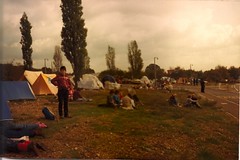
It is a fine evening, that Friday in late September, when Sheena and I drive to Glasgow to meet a bus in George Square. We leave around teatime, by which time every seat in the bus is taken. All these women, and one black labrador (gender unknown) I have a rucksack full of strange little bags of food - marmalade rolls and a boiled egg (breakfast), more substantial cheese sandwiches, fruit and so on for lunch, bits and pieces of cake, dried fruit, juice, water - and hope that we will indeed stop at service stations as promised for the missing meals. Our first stop, however, is a traffic jam in the Borders. Most of us take the opportunity for a comfort break by the road in the lee of the bus. It's all very bonding. We drive through the night, sleeping in snatches like Eliot's Magi.
We arrive in Newbury, Berks, at 5.30am. The bus drops us at the main Gate, where we can see tents and signs of not-your-average-camp in the old sofas beside small fires. By this time I feel dreadful as a full day's teaching followed by very little sleep catches up on me. Someone puts up a blue tent and invites me to lie down. When I waken again it is light, and there are voices outside. Sheena brings me a cup of hot water, boiled over a wood fire. It tastes like Lapsang Souchong and I begin to feel better. I crawl out and eat my breakfast sitting on a battered leatherette armchair as the sun slants over the camp.
We spend the morning roaming the narrow paths which follow the perimeter fence. Elizabeth, an elderly Communist lady with dyed red hair (not lik
 e mine - hers was orange) becomes incensed when a young soldier berates me and Sheena for a couple of dykes. She shrieks at him about his parentage and we drag her away. This is, after all, a peaceful protest. We are terrified by the sudden appearance of two police people on massive horses which take up the entire path, forcing us into the bushes to avoid broken toes. They laugh at us and go their way. We come to another small camp, and a painted notice telling us:
Wimmyn: don't sh*t on the Common. Sh*it in the pits.
We are invited to join a group of women for some tea. They show us their 'benders' - tents supported on bent saplings which return to being trees when the canvas is removed. These are easier to dismantle in a hurry when the slurry-spreader comes: apparently one of the more effective means of harassment practised on the camps. We follow the fence round, and come to Blue Gate. There the thought of the Common's pits defeats us, and we trot down the road to a small pub where, alone of all the pubs in the area, the landlord welcomes Peace Women. I realise a long-held ambition and ask for "A pint of your best bitter, please". We discuss the level of stamina required for life at the camps, in the light of the fact that we're ducking out after a morning. We head back up the road.
We meet some women who came to Dunoon for the trials and whom I had last seen eating tomatoes in my back garden. There is a scene of great warmth and rejoicing, and we join them in a circle round the entrance to the base to sing songs together. There must be about 50 women there, and we share stories. By this time it is quite warm, though I realise that I'm in the kind of survival mode which prevents me from removing any layers. I feel very grubby and wonder if I smell.
The bus comes back for us at 6pm, 13 hours after leaving us, and we head off into the evening. I lie on the floor with the black labrador (sign of how desperately tired I am) and sleep all the way to Southwaite Services, where I am sufficiently revived to eat bacon and mushrooms. 4am sees us back in a George Square which is still alive with Saturday night, and we drive round over the Rest and Be Thankful, arriving in Dunoon shortly after 6am.
That evening the BBC carries the brilliant drama-documentary "Threads" and I become aware that I feel better because I've tried to do something. And every time I've viewed that film since - it's been a valuable resource - I remember that day, these women.
Friday, March 20, 2009
1984 revisited: The choir
Shortly after the Miners' Gala, our church choir, led by Mr B, took part in a festival of choral music in the Cathedral of The Isles, Cumbrae. This choir was a delight - they sang in tune and sensitively, they were well-disciplined, they read music, they had sweet voices. And, as you can see from the photo, the majority of them were children: the head chorister was about 14 when this photo was taken. In fact, the adult voices were one per part, with Mr B doubling as bass - and it occurs to me that at least two teenage choristers are missing from this photo.
What is obvious, however, is the fact that they are not happy. For this was their last trip together before the tidal wave from the activities detailed in the last few posts swept this choir away: the organist was relieved of his job and most of the choir left with him. A few stayed on with his replacement - and it is interesting now to wonder if he would have been so hastily despatched had there not been an eager wannabee waiting in the wings - but there was to follow an entirely barren period in the musical life of this church which lasted for some years.
And it's a sad fact that these children had a sudden and unpleasant encounter with the realities of church life, with the effect that most of those pictured here didn't really darken the door of a church again. But today I'm remembering them with joy and pride. They were a great bunch, and I loved singing with them.
This post is dedicated to the memory of Craig, Head Chorister. May he rest in peace and rise in glory.
Thursday, March 19, 2009
1984 revisited: the Miners' gala
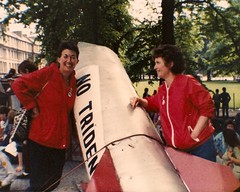
When I first thought of marking the 25th anniversary of the Miners' Strike, this is the photo that I was determined to find. It shows me and a pal from Dunoon CND on the back of a CND float, waiting to take our place in the Miners' Gala procession through the streets of Edinburgh to Holyrood Park. There, in a huge tent, we heard speeches from Bruce Kent and Mick McGachey - a considerably more impressive leader than Arthur Scargill ever was - and met some women who'd been in Dunoon for the action earlier in the year.
It was an extraordinary experience, both exhilarating and sad, but one where, in the midst of all the church hellishness and lack of warmth, I felt at one with so many people. (I had plenty to choose from - there were 10,000 people there). The missile on the lorry, as well as the badges with which we were adorned, made it immediately obvious where our sympathies lay, and people lining the streets cheered us as we passed. I clearly remember passing a group of miners on a street corner - we'd paused to negotiate a tight bend - and hearing one of them call out : "Save our pits, Missus!" - and I remember too thinking that I didn't know where to start.
Thatcher's Britain was a hard place for many Scots, and that June day in 1984 underlined the fact. But it was a day of intense comradeship which made me forget for a while all the stuff back home, and I think my expression shows that.
And it was a day when two ten-year-old boys were allowed by their mad mothers to ride on the back of an open lorry. Now, how many chaps have that to look back on?
It was an extraordinary experience, both exhilarating and sad, but one where, in the midst of all the church hellishness and lack of warmth, I felt at one with so many people. (I had plenty to choose from - there were 10,000 people there). The missile on the lorry, as well as the badges with which we were adorned, made it immediately obvious where our sympathies lay, and people lining the streets cheered us as we passed. I clearly remember passing a group of miners on a street corner - we'd paused to negotiate a tight bend - and hearing one of them call out : "Save our pits, Missus!" - and I remember too thinking that I didn't know where to start.
Thatcher's Britain was a hard place for many Scots, and that June day in 1984 underlined the fact. But it was a day of intense comradeship which made me forget for a while all the stuff back home, and I think my expression shows that.
And it was a day when two ten-year-old boys were allowed by their mad mothers to ride on the back of an open lorry. Now, how many chaps have that to look back on?
Tuesday, March 17, 2009
1984 : many meetings
A few moments to reflect on the strangeness of Easter 1984, and on what happens if you're an Episcopalian living in a small town when you suddenly can't attend your own church any more. I'll deal with that first. If you are still in possession of any religious faith, you have a choice: go to a church of another denomination, drive north for 50 minutes in the hope of catching a Eucharist in Inveraray, or take the ferry (and your car) and take your pick of Piskie churches in the great Over The Other Side. When you have two young children, the last is not an attractive option. I gave up for a bit, and was rescued by the kindness of a local C 0f S minister and some of his congregation who welcomed me in their study group. But it's not the same, and it's unlike living in a city.
And other strangenesses? Like the array of people who seemed entangled in my life - Kay Carmichael, the writer and broadcaster, who came to my house and tried to help with the fall-out; Captain James Bush (USN, retd) of the Center for Defense Information, who came to a local meeting and stayed the night chez moi, accompanying me to the court to hear one of the trials for himself, Col. David Pike of the Public Information branch of SHAPE who met me and another office-holder in the local CND group for lunch. And of course there was the evening when I was taken to the coal pier to be interviewed for a radio programme by George Hume and Stewart Millar - the pier because they wanted the background noise of water and seagulls; luckily it was June - and could barely speak when Hume probed about the church. (We adjourned for a G&T and tried again, with more success)
It is still obvious how strange the local situation was when seen by other eyes - and how strange it is that we made so little of it, really. When I look back at my journal (for I've been writing up my life for a very long time) what strikes me is the dispassionate tone of the writing. Maybe you can get used to anything.
Subscribe to:
Posts (Atom)