Wednesday, December 29, 2010

Traditional and effective

The photo accompanying this post records one of these satisfying grandmother moments. I'd been holding Anna (4 weeks old) in the hope that she would drift off to sleep, but she didn't appear to be able to settle. Perhaps her sister was too interesting, or she just didn't want to miss out, but she was tired and scratchy and it was obviously time for the Wise Woman to make a reappearance - and sing.

I've written of this before, when I was singing to that lively three-year-old in the background (can't help feeling it wouldn't work now, but I'll return to that). This time I sang another lullaby, Watts' Cradle Song, to an American (I think) tune arranged by Mr B for our women's choir, 8+1. The melody is in the alto range, and I've had it on the brain for the past few weeks. The words were somewhat random , as I'm hopeless at remembering them, but phrases like "here's no ox about thy bed" seemed suitably soothing, and after gazing intently at me as I sang, Anna's eyes drooped and in no time at all she was sound asleep. She was sitting in this upright position, too, so the sense of communication was very real - until she flopped. I continued singing quietly as I put her to bed, and that was that.

I can't stress how important I think this live singing is for young children. It's not the same when nursery rhymes, lullabies and so on are played on CDs or - worse - distorted by electronic toys. The vibration, the tailoring of volume to the moment, the possibility for variety - these all contribute to what is, after all, as old as the hills.

Incidentally, big sister still loves to sing - though she does give me a row for using the traditional words as the end of Mary had a baby. You can't please all the people all of the time ...

Friday, December 24, 2010

Christmas Eve, differently


More history
Originally uploaded by goforchris.
Traditions endure - and yet things change. Until a couple of years ago, Carols from King's was the background to my big Martha moment, making stuffing, cooking sausages, doing funny things with giblets. The house smelled wonderful, and there were either visiting family dotting in and out of the room or we were anxiously anticipating their arrival through whatever weather obtained at the time - though to be honest it was usually gales and rain. I would have spent the morning lugging a turkey home, depositing it in the shed to keep cool - not schlepping round the Bishop's Glen in the sunshine marvelling at the frosticles on every branch and wondering why I felt so strange.

Because I do feel strange. I find it disconcerting to be packing a suitcase and trying to remember shoes as well as boots (for the socialising, you know), to be stressing about catching the first ferry in the morning and hoping the fog doesn't return. Instead of looking tidy and prepared, the house is its usual slightly random self, with the addition of a Christmas tree (above) and cards on every available flat surface (another casualty of our straitened workforce; I lost the will to hang them on their holders). I'm cooking nothing other than tonight's dinner, and have a relatively empty fridge in anticipation of a visit to Tesco on the way home.

But first there's Midnight Mass, with incense, candles, carols, that lovely bit of Liszt on the organ, singing with other musicians - all the things I love and which keep me here when I could already be relaxing with my family. I shall not feel as joyous rising at 7ish when I've been in bed well after 2am; hence this moment snatched from organising myself to relax over a blether. But now I must make sure I've packed ...

Happy Christmas when it comes - and let's hear it for Western Ferries!

Thursday, December 23, 2010

Controversial nativity?


I was looking for an illustration to this post when I came upon this story. Apparently the BBC production which has just ended, The Nativity, is being attacked as being anti-Jewish. I didn't clock that, but after wondering early in the week if this drama was going to work, despite the appealing casting of Mary and the atmospheric setting, I found tonight's climax extremely moving and well done.

I suppose the difficulty is that the story is so well known. How do you explore the characters of people who have been household names for 2,000 years? And we know the ending, don't we? How do you surprise and grip an audience with the best known story in the Western world? (I think I'm being careful here). In the end, I think they did it by concentrating on the humanity of Mary and Joseph, on Mary's extreme youth and Joseph's understandable misgivings. All these dreams - who among us wouldn't say "It was only a bad dream" and sulk off? Did you not find yourself begging Joseph to take Mary's hand as she begged him? Did you not sit up in your seat and will them to find somewhere to stay, even though you knew they would? Suffer through that labour in the filth of the stable? Smile "At last" as Joseph reached for Mary at the moment of birth?

There were moments that took me outside the circle of the drama: I couldn't take that quietly-spoken Irish Gabriel, and I wanted wings like drifted snow and eyes as flame, not to mention the heavenly host. I kept spotting Tucker under the admirable strength of one of the Magi, and I marvelled at the awfulness of Herod with his pale eyes and the ghastly sweating illness that perhaps Art Malik might have cured if he'd still been at Holby City. But these are the dangers of all dramatic production, and my willing suspension of disbelief kicked in with a vengeance tonight.

And I loved the gradual convergence of planets and star to form that wonderful celestial light at the critical moment, shining down into the mess and confusion of a shed full of troubled shepherds and men who had travelled such a long way. This birth was hard and bitter agony for us ...


Maybe the controversy arose because there is no way of telling this story and making it blandly acceptable to everyone.

Tuesday, December 21, 2010

Revelation


That blackbird ...
Originally uploaded by goforchris.

Having recently learned
the shocking truth that
birds lose something like
a third of their weight
overnight, I look at
the puffball shape of a
round robin with new eyes.
Go for it, little one,
I whisper, madly, at the window,
smile encouragingly as tiny tits
hurl themselves at the table
where this morning's food is
piled, tut when the blackbird
and his wife - a sturdy wench
in brown - spend far too long
over breakfast and leave the
shivering siskins on the bare tree.
The snowy garden is swathed in
fog as another day in the deep freeze
begins, and I, insulated from reality,
imagine myself St Francis
and smile with fatuous fondness
as my small visitors struggle
for their very lives.

©C.M.M.

Sunday, December 19, 2010

Amid the winter's snow ...


Closing voluntary
Originally uploaded by goforchris.
Well, we were lucky. After yesterday's snow, yesterday's hypochondria about sore throats, all the cancellations of services seen on Twitter, Holy Trinity attracted between 50 and 60 souls to our Advent carol service. There was one missing singer, marooned in the hinterland by high, snowy, impassable roads, with the attendant sudden feeling of exposure at the bottom of the harmony as one alto carried the burden alone, but things could have been worse (not for the marooned singer, I suppose - I'm glad she's safe and Facebooking)

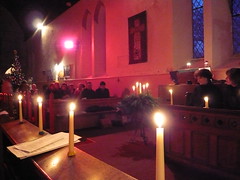
I love Advent services. I love the darkness, the restraint, the fact that it's not Christmas yet. I think I always felt like this, even in my heathen days when I didn't really know about Advent. And today underlined something else in the makeup of that feeling. For today could so easily have been a disaster, or cancelled. As it was, it felt precarious, something that might blow out in an instant, like a candle. As the candles on the strange wooden candelabra dripped onto the peace angels hanging under them, as the sopranos' pew candle guttered low in some unseen draught, as the singers in the middle of the group struggled to read their words in the growing dark, there grew this sensation of something at once very human and utterly other, something like a frail glass bauble that could break if you held it too hard.

It was wonderful that it happened, wonderful to see people from outside our small congregation piling in as the snow fell outside, wonderful to see the work that had been done in all sorts of ways to provide candles, the tree, the fabby mulled wine. (I had three glasses: very warming).

Not perfect, but wonderful.

Saturday, December 18, 2010

Glasgow Royal cheers

It's snowing, inconveniently, but I'm not going to mention it again. Instead, I'm going to indulge in a wee paean of praise for the Plastic Surgery department at Glasgow Royal Infirmary - and no, I wasn't having cosmetic surgery. Just in case you ask. It was a very tiny bit of cutting and stitching that was required, though I suppose the resulting biopsy may lead to a further visit.

The great thing is that I'm not anything like as bothered by that thought as I was. The people I met there - especially Jim the nurse - couldn't have been better at mixing professionalism with the appearance of personal interest; the building was newish and therefore cheering; the atmosphere in theatre was calm and unthreatening. My face, having had any vestiges of moisturiser swabbed off it, was swathed in drapes, so I couldn't see anyone, but I was able to listen to the instructions as someone practised tiny stitches on my temple (I never thought of the bit in front of my ear as the temple, but there you are) and join in the discussion about how difficult it was to explain the difference between a granny knot and a reef knot. (To be honest, I think the instructing surgeon was better at surgery than language - it was my idea to call it a granny knot when one stitch had to be removed and redone)

Even the horrid sensation of the local anaesthetic was alleviated by the cheerful warning that it would be like a dental injection but wouldn't last, and by the discussion of the relative merits of the words "prick" and "scratch" in describing the sensation of an injection - apparently they worry about people's reactions to the former - and by the realisation that it worked so well. I was grateful for the fact that I was seen almost as soon as I got there (early: we were anxious about the black ice on the pavements and our ignorance of the hospital layout) and that it was still light when we finally escaped ...

...to some lovely tea and a large chunk of carrot-cake in nearby Brewhaha. Very therapeutic - I recommend it. But let's hear it for the NHS - at least in Glasgow Royal.                  

Wednesday, December 15, 2010

Another Advent poem

I've posted another Advent poem on frankenstina. I'm grateful for the commission that led me to write it, and hope that as the magazine in which it now appears (the SEC's lovely publication Inspires, which seems to me to grow in stature with each edition, my own contribution notwithstanding) is out in the public domain it is now all right for me to post the poem.


The idea of a recurring need in our deepest places – for warmth, for love, for reassurance – seems to me especially poignant and powerful in the last months of the year. As the days shorten after the equinox, this can be felt as a disturbance, a restlessness of spirit reflected in the irregular rhythms of the free verse of the opening section of the poem. This settles into metre to reflect the idea of this experience recurring every year through the ages, a sort of incantatory passage in homage to our Celtic ancestors for whom the coming of the light was in every sense such an important event.

Monday, December 13, 2010

A new look at Advent with a new birth

After a week of dead brain and frozen imagination, I've found the words to express how I felt when little Anna was born. You can see the result here.

But for readers who don't go for poetry, a word of explanation. I always find Advent incredibly special. The culmination of it all is of course the Midnight Mass of Christmas Eve, but as with Holy Week and Easter, the preparation and participation in the whole journey is all. This year feels very different. The arrival of Anna on the day before Advent Sunday, on the first day of the snow that brought the country to a halt, seemed to bring an end to my anticipation, my waiting and longing, before it had even begun. It's inevitable, I suppose, that annual repetition and my own aging will bring a familiarity that might tend to dull the keen edge of the Advent mystery, but this birth and its timing meant that once more a mystical birth was replaced in the front of my preoccupations by a very human birth.

Now I have two Advent grandchildren - see this poem about Alan - it strikes me that the season may never be quite the same again. But maybe this is how it should be - because if there's one thing I've learned in all these years it is that you can't stand still or you turn into a fossil. And we can't have that, can we?

Sunday, December 12, 2010

An old friend rediscovered

Have you ever spent years, on and off, looking for something, becoming convinced that a malevolent guest has nicked it, or that you somehow never had it in your house in the first place, and then discovered it lurking in plain view on the bookshelf where it ought to have been all along? No. Must just be me then. The book in the picture has eluded me for ages, and now there it lies. And why would you care, do I hear you ask? Therein lies my tale - or part of it anyway.

I grew up reading this book, this very edition. It's old (published in 1937), the cloth and card cover is frayed and faded, the pages yellowing at the edges. It has a Glasgow Corporation Education Department stamp in it, but I never took it from a school - it must have been one of the many books brought home by my father to meet my insatiable demands for reading material in the days when I was always ill (and therefore stuck in bed) and devoured print voraciously. My most vivid memory is of lying propped up on one arm in bed in the tiny maid's room where I used to sleep (see post about winter, below) early on a Sunday morning, reading this and eating Pontefract Cakes. (I know - liquorice before breakfast. But it pins it down as a Sunday, for I was only allowed to buy sweets on a Saturday) The room in which I was reading means I was not yet 10 years old, for we moved house when I was 10.

So here I am, reading Conan Doyle's Sir Nigel and its prequel, The White Company (set in the period after Sir Nigel but written first) not once, but several times, in my childhood. My relatively early childhood - probably eight at the first reading. I remember that I found Sir Nigel an easier read, but that may have been the size of the print - my copy of The White Company belonged to my mother, and was printed in 1930. But having just found it, I'm reading Sir Nigel again - and marvelling. For a start, I realise how much historical knowledge I picked up from these books - and the reader isn't spared the details, or the long description, or the mediaeval ballad sung by the hero. But the main boggle is reserved for the language. Here's a wee sample:
"I am no subject of yours, proud Abbot!" he cried at last. "My house has ever been vavasor to the king. I deny the power of you and your court to lay sentence upon me. Punish these your own monks, who whimper at your frown, but do not dare to lay your hand upon him who fears you not, for he is a free man, and the peer of any save only the king himself."

No wonder I grew up with a grasp of English that I never found in my pupils. "These your own monks"! Wow! And the complexity of the syntax - and I never questioned, never faltered, for I was caught up in the story and had already fallen for Nigel - and I'm only on page 54. And randomly, from page 307, I find the sentence: "Then it was he that I heard behind us". Not much chance of mixing up subjects and objects and the anomaly of the verb "to be" after that lot, was there?

I could go on, but life calls. I must just point out that what sent me looking for this was a summer holiday in the early '90s, in Benodet on the coast of Brittany. A wet day sent us driving inland in search of the sun. We found it - in Josselin. And the name tweaked at my memory, and sent me to the Michelin guide. Sure enough, the monument to the Bataille des Trentes - if you've looked up the first link, to Wikipedia, you'll find out about this - was close by. Actually it took some finding, being stuck between two bits of motorway down a narrow lane, but it was there, and I had never really known it was real. We looked, we came home, and I went hunting the book. I couldn't find it. I don't know why or how it has returned to my shelves, but I am glad to see it.

Right glad, in fact - the language is getting to me.

Friday, December 10, 2010

On parenting, and further

I've borrowed this video* from Ewan because it has me and Mr B in it, doing what we did for the past couple of weeks: Grandparenting. You'll see our step is still quite sprightly - we were only on day 4 and neither had yet succumbed to the lurgie which subsequently befell us. And looking at it reminds me of the thoughts which swirled in and out of my consciousness during that time, and gives rise to the following reflection...

When you have a baby - and it doesn't need to be your first; the second merely re-awakes what came before - everything changes. You might, for insance,  do something totally crazy,  like moving house five weeks after the birth, selling your neat West End flat and taking up residence in a council house in Dunoon, hastily done over after the previous teacher moved out. A move such as this masks what might have happened anyway; I'm thinking of the impulse to comfort and convenience which has you buying a hideous pair of trousers (grey, with orange and black checks) merely because they have an elastic waist and don't need taken up (they seemed ok at the time because I no longer lived in the city and besides no-one knew me in Dunoon). I'm thinking of the effort it takes to wash, change, dress, undress, dress again your new infant, which leaves you too frazzled to do more than hurl an outer garment (only criterion: waterproofing) over your besmotered** top and aforementioned breeks before you heave the pram down the steps and hit the weather. I'm thinking of how suddenly it's ok to go our without a scrap of makeup on your face - something you haven't done since you were ... oh, fifteen? ... and sometimes without even moisturiser (a wee touch of baby cream, maybe?). Life contracts to a primitive level in which only the infant matters - and perhaps the food on the table to keep you, The Great Provider, topped up.

Ok, perhaps not every new mother lets herself go in such abandoned fashion. It took me years to get over the idea that I had moved to a seaside resort and therefore would never need to dress respectably again - maybe I never did. Get over the idea, I mean. Maybe the situation merely compounded a tendency that was already present. But while I was in snow-bound Edinburgh, being Super-Gran (ipsa dixit, I know), I  realised that I was in danger of doing it again. I wore the same pair of (warm, practical, techy fabric) black trousers every time I went out, and changed into the same pair of (warm, practical, supremely comfortable, soft techy fabric) trousers to be indoors. I had three other pairs with me that never saw the light of day. I rotated a trio of fleeces, and my jerseys and varied tops remained in the case. I washed what needed washed, and didn't think about what to put on. I didn't actually care. It might be midday before I realised that the tight stretchy sensation about my face wasn't a ski mask; it was my centrally-heated skin, drying out nicely because I'd been too busy making Peppa Pig and Grandfather Pig climb the side of the bath in valiant rescue operations of Little Brother George (blooming millstone that game turned out to be) to put on moisturiser - let alone warpaint. And suddenly it'd be dark outside again, and time for bedtime stories and an hour or so of stupor while Lord Sugar pronounced and fates were decided, and then we'd all stagger to bed again.

And that was before the addiction to Lemsip kicked in ...

*We were going to church (Spiky Mike's), BTW
** This word is found in Chaucer. I use it often. I'm not going to spell it out - you're an educated lot.

Thursday, December 09, 2010

Change of face?

Goodness. That was exciting - and quite disconcerting. For a full 24 hours it seems I have been someone else, though it took a remark on the phone and ABF's comment on the previous post to alert me to the fact that I seemed to have turned into a Russian vocal ensemble, all without my noticing. How alarming. 

The explanation was annoyingly simple. I'd been setting up a new blog for my pal Jurij (he's not said if he likes it yet, so it may simply be strangled at birth) and had foolishly taken no steps to dissociate my own identity from it. Blogger didn't do this to me before - I already run two blogs, and to my knowledge I never appear as frankenstina - but the new Blogger is disturbingly more akin to Wordpress in its complexity (and no doubt in its flexibility) and strange things are happening. F'rinstance, the box I'm currently posting in doesn't look the way it always has - to the extent that I'm wondering if this post is going to arrive on the wrong blog. 

If it doesn't, and if I've reverted to my former persona, then all is well. But note to self: don't set up new blogs in the middle of a telephone conference. And don't work on them after midnight.

Simples!

Wednesday, December 08, 2010

The anatomy of enjoyment ...

I've dragged myself away from the latest Kate Atkinson (Started Early, Took my Dog) partly in an effort not to gallop through it too swiftly (memories of childhood again: after the Saturday trip to the library I had to be careful to leave myself at least one book for the school week evenings), partly to note what I'm so enjoying in the process of exposition that I'm currently reading.

So - I note the skill with which the characters are introduced and are linked, like a flow-chart or the diagram of some organic chemistry process (very dimly recalled from school), as someone on the fringes of one character's observation becomes the focus of the next chapter, and so on. And I love the skill with which the necessary details are drawn in - the mental asides, the references to each character's past which give us just what we need to empathise, but never enough to bore with superfluity. I already feel I know two new people, as well as having a progress update on her recurring hero, Jackson Brodie (clever, that, to ensure that a newcomer to her books will know enough, without boring the afficionado).

And the writing. I now recognise what's going on - the fluidity of syntax which sits comfortably with the internal monologue that is part of all our lives, that conveys context and emotions, reaction and reasons. Much of it uses what in another context might be regarded as a spot of comma-splice, but it isn't: the stream of consciousness rarely makes mistakes but rather defies the rigidity from which in another life I fought to release my students.

Right. I think I'm about to have another Lemsip and read some more. But can I share one final joy? I'm reading the book in hardback (it was a gift) - and it has its own silky attached bookmark, like the ones in a lectern bible. How civilised is that?

Tuesday, December 07, 2010

Ghosts of winters past

Pretty, innit? Snow on Newhaven Harbour, with the Forth Bridges in the distance. A good cue to get me started, as the Forth Road Bridge was closed for a time last week because of snow/ice/not-gritting-lest-the-bridge-is-corroded-by-salt. Now the country is closed, it seems - all these poor souls stuck on the M8 yesterday, and perhaps still as far as I know. Could have been us, too - but we left Edinburgh on Sunday, when the road was absolutely clear. Someone loves us ...

But to my theme. It's obvious why yesterday's terrible stramash happened: people rose early for work, as the world now seems to do, saw that it was dry - and set off. When they were on their way, strung along the ends of the motorway or whatever, the snow began. Someone jack-knifed; they all ground to a halt. Result: blocked road. Gritters couldn't get along it. No point in whining that folk ought to have stayed at home, as several moaners did on Radio Scotland this morning. They didn't have the choice when they set out. Perhaps the gritter moguls should have trusted the weather forecast and sent the lorries out early - but that's easy to say now. Besides, it was apparently too cold for the salt to have much effect - certainly the bit of path I spilled water on while emptying a basin (our waste pipe was frozen) is now a sheet of ice, despite my immediate application of salt at the time.

I don't remember this massive disruption from my past. I do remember fierce winters - for heaven's sake, I can just remember a morning when we had a coal briquette in the range surrounded with potato peelings*, in what must have been the winter of 1947 when the pipes in the tenements all froze and people had to use stand pipes in the streets. I can remember being sent home from school when the outside lavatories froze - the joy when the jannie would appear in the classroom with his mop in his hand and whisper to the teacher and we'd all go home just after playtime. (Presumably our bladders were supposed to last till we got home). I remember the joy of sledging all alone when I was home and my pals weren't - the virgin snow above the old air-raid shelters in Novar Drive. And of course I remember the brown sugar of the old snow in Great Western Road, and trudging up the hill in the snow to the number 10 tram terminus. And there were wonderful patterns of ice on the inside of the windows in the mornings - ferns, mainly, and starbursts. They were especially beautiful in the small maid's room off the kitchen where I slept, I remember. And I was the lucky one - the range in the kitchen kept the temperature in my wee room bearable.

Of course it must have been bad. And writing this has answered my question to myself, now I think about it. I saw only the effect on me. We didn't have a car, and there were trams (though I don't know how well they functioned in snow, and now there's no-one alive in my family who can tell me, dammit). We were accustomed to put on multiple layers of clothing and walk. We had wellies - though once I had a warmer pair of boots, in blue leather with crepe soles to which the snow clung in such layers that walking became impossible. We made fantastic slides in the playground and hurled ourselves along them; we were consumed with rage when the janny salted them while we were in class (presumably they had rudimentary Health & Safety even then). I loved the snow, my parents didn't seem unduly perturbed by it, we didn't have to worry about loved ones who were driving across the country/flying to London/travelling to Paris. My father had the longest commute - from Hyndland to Springburn - every day, and the rest of us took the tram, about 4 stops, I think.

Maybe we expected less. Our shopping was local, our messages limited to what we could carry. The shops had basics, and seasonal basics at that. When I was really small, we still had rationing. We had powercuts and candles, coal fires and a range in the kitchen. I can remember my mother cooking on it in a powercut. We all had chilblains every winter. It must have been grim, and I would probably hate it now.

We did, however, survive - and I look back on my childhood winters with undiluted pleasure. But excuse me while I go and turn up the heating ...

*This was, I believe, because the stockpiles of coal were frozen solid and no coal could be taken off them.

Monday, November 29, 2010

Reflections on a man's place

At last - I've got on to a proper computer so that I can blog. Meet Anna, my new granddaughter - whom we're currently waiting to greet home. She's wonderful and well and her big sister can't wait.

All this had me reflecting on my own experience of childbirth, and how things have changed. When Anna's father was born, in Dunoon Hospital, I stayed in for a week - not because I was ill, but because that's what we did. It was very restful and we all had a good laugh on the ward, doing one another's hair and eating chocolate cake. I daresay we moaned a bit too. One thing we didn't see all that much of was our men; they appeared at evening visiting, which was for fathers. Grannies, friends and siblings came for an hour in the afternoon. The rest of the time was for us to slob around in, look like frights, sleep with our mouths open, have showers - all without caring. There was no-one to see. The babies slept in the little nursery; we could have them when we wanted and fed them when they wanted - but when we wanted some down-time, they were looked after and we didn't worry. Time enough for that when we got home.

Now, it seems, fathers take up residence in the ward. They lie on the bed, sit holding the baby while mum takes a shower, chat to other dads. Other visitors have regulated times, but the dads are there all the time, apparently. The baby is beside the mother's bed, and she changes nappies as if she were at home. Dads are pressed into service. The atmosphere is a far cry from the peaceful space I remember. I would find it completely stressful to have other people's husbands in the same space as my dishevelled self - we used to spend the hour after teatime putting our faces on and washing our hair so's to look wonderful for evening visits. Progress? Total involvement?

Of course, there was a time when childbirth was Women's Work. Men were banished from the cave/hovel/whatever, and the Sacred Mysteries remained just that. I would never want to return to the perils of childbirth in the raw, but I wonder if the ancients didn't have something. Maybe we need a kind of via media.

Now, back to the kitchen. Someone has to do the cooking, after all ...

Tuesday, November 23, 2010

The waiting season

It's cold, tonight. At the end of this afternoon, the sky behind us grew in a wonderful flaming intensity over the still, shining sea lying like steel between us and Bute - and then died, leaving only the afterglow on the hills. Now the night is nailed to the sky with hard, bright stars - not my words, but taken from a poem by Vernon Scannell which I cannot for the life of me track down. It must've been in an anthology in school, and these lines come into my head often at this time of year, for it's an Advent/Christmas poem and the season is almost upon us.

As readers of this blog will know, I love Advent. I love it especially out here on the western fringes of Europe, when the darkness intensifies and makes all the more special the promise of light to come. I have written a new poem for Advent, but as it is to appear in Inspires magazine I shall leave publication online till after I've seen it in print. However, I shall not be beginning Advent in the west this year: I shall be in the city, in the East, waiting for another birth as the season of Advent begins.

I don't know how much blogging I'll be doing while I'm there, but the iPad will accompany me. It does little for the accuracy of my typing but much for my sanity. There is also a highly addictive game on it, for which I blame Ewan. But I'm going in order to be useful, so games and blogs may not be in order. Watch this space, though ...

Sunday, November 21, 2010

Godly weans

Oh dear, I fear I'm pushing the boat out: another post and it's not tomorrow yet. But I have this awareness of time's winged chariot vying with the need to blog something - so here goes.

We had weans in church again this morning. Other than a fortnight ago, it's been so long since we had noticeable childer in Holy T that the last representatives of the genre are now turning up with their own, so I've read about things like Godly Play with only a remote interest, as one might consider the current drive in parts of the world to protect the tiger as a species. But Godly Play went on at the back of church today, and at the communion these lovely children trooped up to the altar rail with wonderful cardboard crowns on their heads, and we knew what they'd been doing while we got on with the usual stuff. (Actually, it wasn't the usual stuff; it was the Grey Book liturgy making its monthly appearance. I find it harder and harder to say the Prayer of Humble Access - but there you are)

We'd heard the odd noise, the odd surreptitious clatter, the quiet reading of the crucifixion story from the back - but we'd apparently missed the bubbles, produced by one of them and hastily pressed into service as 'prayer bubbles'. And it all worked because we knew they were there and because we knew they were being well looked after by someone with a purpose and enthusiasm and experience. Mary, you're a star!

Another fold

This cloud - taken from tags in this blog, using Tagxedo, has nothing to do with what I'm thinking, other than that I should be doing something else, like wrapping presents ... but it's fun, and only took a few moments ...

But I was thinking, yet again, of the way time crumples when you undertake annual tasks. Stir-up Sunday, familiar to generations of Anglicans as the day when the collect for the day reminded them that it was high time to stir up their puddings and such for Christmas, may have morphed into the feast of Christ the King, with the collect only mentioned before the service in case any of us was relying on it, but my fruit has been soaking in booze for a week and now the cake is in the oven. Two years ago I wrote a poem about the same sense of a folding in time, when the intervening years vanish in the routine (lining the cake tin - still the same palaver) and smells of cake-making.

Today I was recalling the first time I baked my own cake, instead of going back to sample my mother's cake and perhaps purloin some for our own house. I was on maternity leave, it was cold, and I had slipped on the frosty pavement in Clarence Drive, having gone to the shops before the sun reached that spot. At that time a good stone over my usual weight (I'd think nothing of it now - darn!) I came down with a crash on my rear end. Panic and pain. Would the baby be all right? (yes - still is, as far as I know) Had I cracked my coccyx? (probably, but nothing was done about it). Whatever long-term problems might arise, it was too sore to sit down that afternoon, so to take my mind off the pain and the angst I baked a Christmas cake.

Actually, the memory makes it sound more spontaneous than it must've been; I recall I had planned things, had been given a recipe by a friend whose cake I'd enjoyed, so I must have had the fruit soaking and needed only the impetus to turn it into something. That self-same cake from the self-same recipe is now in the oven, about to have its hat put on and the temperature lowered. Before I go to bed I shall pour the fruity left-over booze over it and wrap it up carefully, and another year will begin (I'm kinda governed by the liturgical, I fear). Perhaps the child who did not suffer from the fall will phone. Life will stagger on.

And then there are puddings to turn to ...

Monday, November 15, 2010

Celebrating MacCaig in style

This is The Library in Waxy O'Connor's pub in Glasgow, where I spent a delightful evening with seven others reading and discussing poetry in honour of Norman MacCaig's 100th birthday. The interesting thing was that I'd never met any of these people before (except Mr B - I met him 43 years ago), and that the medium of communication that brought me there was Twitter. (That makes it sound as if there was nothing else to interest about the evening, but don't be fooled)

I am grateful to Bill Boyd for instigating this evening on several counts. Let's begin with the prosaic. Instead of the usual Sunday of getting the dinner in the oven, eating it and then dozing in front of the telly till it was time for bed, we hied off to Glasgow, ate wonderful tapas in Café Andaluz (ah, the green chillies!), had coffee with Duffy (an irrepressible FP - again arranged via Twitter) and then realised a long-held ambition to visit the building with the flaming torches outside the portico. What is more, we both stayed awake, didn't yawn, and talked all the way home.

And, less prosaically - indeed, positively poetically - I found the desire to write welling up again. I realised how seldom I have the chance to share poetry, to enthuse and be understood, to listen and to discover new things and revisit old friends - and all this in the company of a group of people whose link was the poems of one man. Somehow that cut out all the distractions of shared lives, all the small gossipy details that distract, leaving us with the words, the ideas, the mastery and the mystery that is great poetry. We didn't need to be polite, to make small talk, to organise anything, and that was a release.

Of course it couldn't last. But we were outside in the freezing street before Bill realised that I was a certain Ewan's mother. And then we weren't discussing poetry at all. We were roaring with laughter. And that too was good. A good night, in fact. I look forward to the next one.

Sunday, November 14, 2010

I am the enemy you killed, my friend ...


Moonrise over the Cross
Originally uploaded by goforchris.
Strange Meeting

It seemed that out of battle I escaped
Down some profound dull tunnel, long since scooped
Through granites which titanic wars had groined.
Yet also there encumbered sleepers groaned,
Too fast in thought or death to be bestirred.
Then, as I probed them, one sprang up, and stared
With piteous recognition in fixed eyes,
Lifting distressful hands as if to bless.
And by his smile, I knew that sullen hall
By his dead smile I knew we stood in Hell.
With a thousand pains that vision's face was grained;
Yet no blood reached there from the upper ground,
And no guns thumped, or down the flues made moan.
"Strange friend," I said, "here is no cause to mourn."
"None," said that other, "save the undone years,
The hopelessness. Whatever hope is yours,
Was my life also; I went hunting wild
After the wildest beauty in the world,
Which lies not calm in eyes, or braided hair,
But mocks the steady running of the hour,
And if it grieves, grieves richlier than here.
For of my glee might many men have laughed
And of my weeping something had been left,
Which must die now. I mean the truth untold,
The pity of war, the pity war distilled.
Now men will go content with what we have spoiled,
Or, discontent, boil bloody, and be spilled.
They will be swift with the swiftness of the tigress.
None will break ranks, though nations trek from progress.
Courage was mine, and I had mystery,
Wisdom was mine, and I had mastery:
To miss the march of this retreating world
Into vain citadels that are not walled.
Then, when much blood had clogged their chariot-wheels,
I would go up and wash them from sweet wells,
Even with truths that lie too deep for taint.
I would have poured my spirit without stint
But not through wounds; not on the cess of war.
Foreheads of men have bled where no wounds were.
I am the enemy you killed, my friend.
I knew you in this dark: for so you frowned
Yesterday through me as you jabbed and killed.
I parried; but my hands were loath and cold.
Let us sleep now . . . ."

Wilfred Owen

Saturday, November 13, 2010

Progress Report, anyone?

This pic shows the end of a fascinating exchange on Twitter last night, one which sums up much of what I love about social media - but which in a way saddens me, in that the very praise that gave me genuine pleasure showed how slowly things move in educational circles.

The work that @digitalmaverick is referring to and commending to @janeyk419 is a blog, Progress Report", maintained through 2006 and 2007 by first a couple of S4 students and then by one of them. It began when the two girls came to me for private tuition; following an excellent Standard Grade result one of them returned to the blog for further mentoring as she worked for her Higher English. It became more widely known when I spoke about it at an early TeachMeet at the invitation of Ewan, aka no. 2 son.

So far, so satisfying. But note how long ago that was: four years have elapsed since that blog was being used to improve the writing skills of the students involved, four years since I realised my ambition to use technology to disseminate advice which in the normal classroom I might have had to repeat over and over again to different individuals and groups. The blog itself is as old-fashioned in blogging terms as the one I'm writing now, and the formative assessment given in the comments is what I've built up over a career in the classroom - no change there. After my talk at the TeachMeet, I expected a huge growth in the use of such basic technology to further all kinds of learning - including the fairly traditional model practised by me.

And that's why I was so surprised last night, to find that someone actually recalled this event vivdly enough to consider it outstanding, and that it was not in fact so old hat now as to be past mention. I suppose I thought there would be examples of outstanding practice all over the social networks, an explosion of exemplars that would render this now inactive blog redundant, a curiosity at best.

I left the classroom just as the possibilities of this medium were opening up. There was at the time one classroom's worth of laptops on two trolleys, and you booked them weeks in advance. Any one class was lucky to get them for a period a week, and the labour of tracking them down and finding that someone hadn't plugged them in to recharge put you off the notion as often as not. I don't know how much better provision is now, but I do know that more and more pupils have their own technology. I gather from some former colleagues that they find it a drag to use computers more than is absolutely necessary, but it's been 6 years since I was in school and I'm limited in my local contact now.

I do, however, have one question: how much detailed formative assessment takes place online these days? (unless it's one of these things that are not done any more) It seems to me an obvious area for widespread sharing, for teachers to be of use way beyond the walls of their classroom. Maybe there's loads, and I'm just showing my lack of current experience; in which case, dear readers, I wait for your correction - and your links!