Friday, March 25, 2011

Annunciation and burial


Funeral on Lady Day
for Neil McKellar

A bird is singing
in the tall trees
over and over the same
liquid notes spilling over
the dug earth. A requiem,
perhaps, for the soul that is
gone into the sunlit morning.
Quiet words. Dust. The green
of the grass of this spring
surrounds the stones
as an old man is taken
home and the angel announces
to the startled girl
that a new life will come and be
God and the bird is joined
by all his fellows in a
sudden chorus of pure joy.

C.M.M. 25 March 2011

Wednesday, March 23, 2011

A country funeral


Musta been funny anyway!
Originally uploaded by goforchris.
Yesterday, unbelievably when I look at this jolly photo from last June, we attended the funeral of Canon Roy Flatt, on the right of the pic. I've never been to a church service where more than half the congregation were outside the church: such was the crowd that turned up at Christ Church, Lochgilphead, that we stood in the grounds - some under awnings that (unnecessarily, as it turned out) sheltered the speakers that relayed the proceedings, some in the sun under the trees.

Roy had made up the order of service himself, and there was much poetry and good moments of silence in which we could hear the rooks in the tall trees of the churchyard. It felt very calm, and very natural. The coffin was carried past us at the end, to the strange combination of Nunc Dimittis and When the Saints go Marching in, and the burial took place opposite the church porch. Our feet sank in the moss, we moved from the chilly shade into the warm sun, and it was over.

This was the best kind of funeral: a day was full of calm and affirmation and warmth of greeting and friendship. The drive home was glorious, and the world felt peaceful.

RIP, Roy.

Wednesday, March 16, 2011

Spring contrasts

 This morning was swathed in fog, here on the Clyde coast. It was cold, damp, grey and depressing. It looked as if it might stay like that all day, might continue to be a dismal backdrop to a comfortable life.

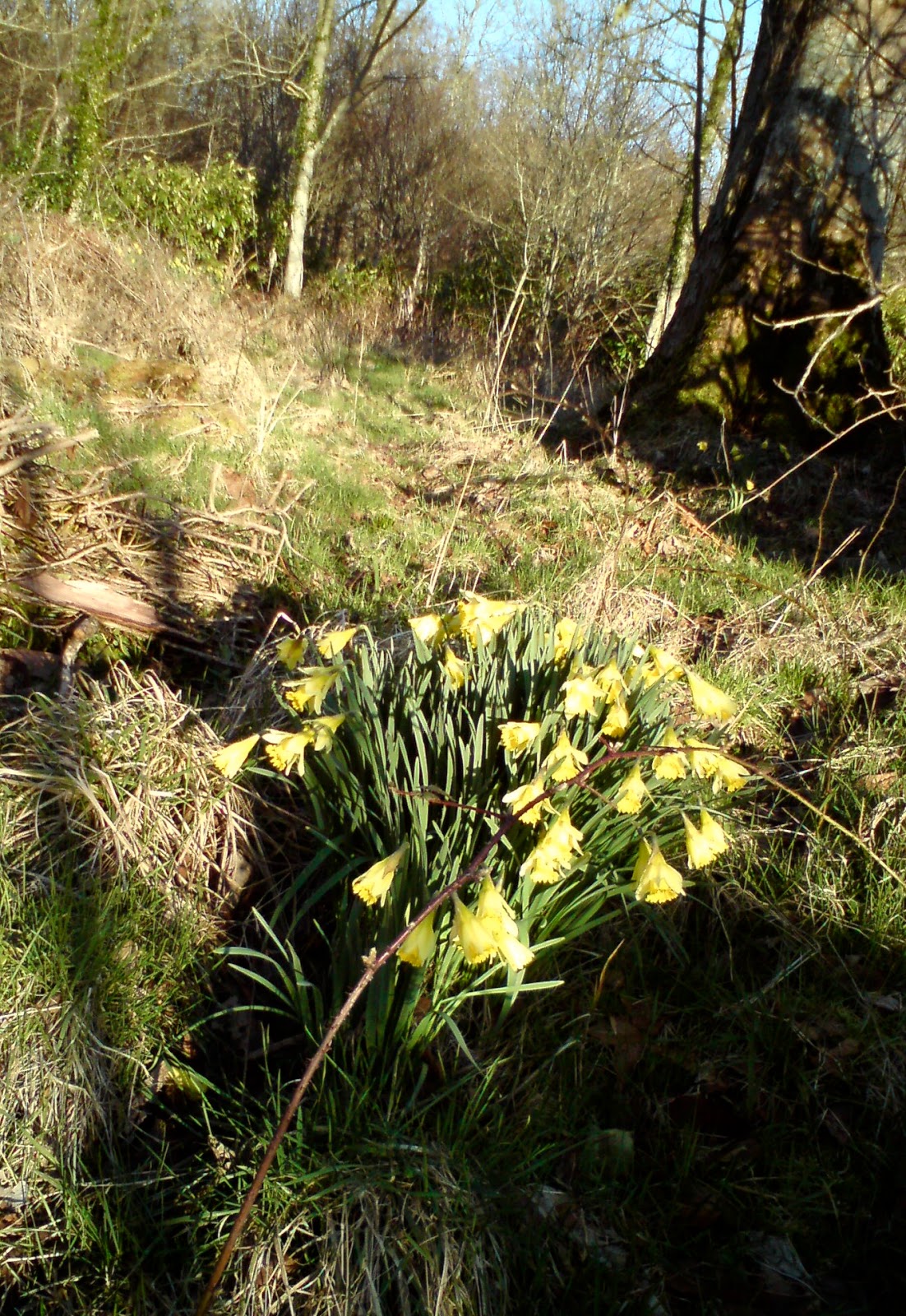
Around 2pm , there was a sudden lightening of the sky. By three o'clock the sun was shining, and half an hour later I was in this sunlit wood where the daffodils that lurk untended in the rough grounds of Toward Castle were golden among the brown tussocks.

Later, I walked by the calm sea. Peewits called in their creaky voices as five of them at least wheeled and dived above the fields. The sun gleamed on the water.

I felt my spirits rise.

But in Kuji City, it looks as if Spring will never come again. I found the Kuji City blog, and on it this image, among many others. There are videos that show a desolate road winding among piles of rubble. No-one speaks.

The silence is broken by what sounds like crows calling. It looks cold, grey and sad. I cannot begin to imagine what it is like to have lost everything so suddenly and so completely. And now it seems as if there is further horror to come as control slips from those dealing - how heroically - with the threat of radiation from the damaged nuclear reactors.

And I was depressed?

Tuesday, March 15, 2011

Once more Ultreya ...

Last weekend saw the first Cursillo in Scotland weekend for almost two years, after a period of reflection leading to a determination to return to the basic ethos of the movement. And Cursillo #59 seems to have been worth the wait, with sixteen participants showing all the signs of having been overwhelmed by the dedication of the team and the love of God. At the Clausura, in Dunblane Cathedral for the first time, they spoke movingly - and in some cases wittily - about their experiences.

They spoke to a good crowd of the Fourth Day - the people who have been on previous weekends - who had braved the snow and sleet to be there to welcome them. This effort on the part of people who are for the most part not in their first youth, is typical of the commitment that puts the weekends on in the first place, for Cursillo is an extremely labour-intensive phenomenon. The amount of stuff that has to be transported, unpacked, set out, removed, inventoried, packed up and taken away again is remarkable - many, many heavy boxes-full. And yes, the people involved in doing the donkey-work can, like anyone else, become tired and scratchy. I was helping with some of it on Sunday, and by the time of the closing Eucharist I felt more like a bath and a lie-down than jolly hymn-singing.

But then the magic happened, just when it should, at the moment of Communion. As I received the chalice from someone I know from her own weekend, and from her service on team when I was Lay Rector, I knew once more the joy that all this service brings and returned to my place with an idiot grin on my face.

Mind, the evening was still spent in dribbling stupor ...

Thursday, March 10, 2011

Caught up in the past

I've been so taken up by the process of blogging my father's wartime letters that I find myself adopting his style of delivery on occasion, although this is not in fact something new for me. As a young teacher I was assailed by the chap who taught next door through the partition wall - he'd heard me sounding just like my father as I taught and recognised it from a time when they were colleagues. But I realise that as I knew him so well, I know when his tongue is firmly in his cheek - as when he is discussing the new family allowance scheme. His reference to the brutal and selfish father could hardly be further from himself, though he is right in describing my mother as an ardent feminist: nice to know it came from somewhere!


Another thing that struck me was the amount of the allowance: 5/-. How many of my readers say "five shillings" when they read that? It's a rare indicator of age, as is the relative value of money. Apparently the average wage for an agricultural labourer at the time was £3/7/101/2 for a 49.4 hour week, according to this site, while another fascinating site points me to a worth of £25.30 for that 5/- if calculated by reference to average earnings (though I'd be happy for someone to correct me in this if I've made my usual hash of reading statistics). It certainly gives a dimension to the other letters concerning money, and to my father's reckoning that he had far too much cash accumulating in his current account because of the lack of opportunity to spend any of his RAF pay.


I've been stymied in my attempts to find any really detailed history of Redlands private hospital for women in which I was born and where my own first son was born four years before it closed, though by that time it was run by the NHS in Glasgow. But it's a fascinating exercise, this digging in the past; my main regret is the unasked questions of my own youth. We don't tend to become interested in our parents till they're history? 


Probably not.


I haven't a clue why the font of this - and the size - are so odd. Blogger is not always instinctive!

Monday, March 07, 2011

Playing away...

Must post briefly about yesterday's gig with 8+1 in Rothesay. One of the things about singing in a smallish group with no natural base (such as a church choir has, for instance) is that every now and again you want to perform. It's just that - we don't need money for ourselves, as we are perfectly happy to pay for our singing just as we would for any other class, like tap-dancing or mediaeval history; but every performer benefits from having an audience now and again. And what an audience we had on Bute! St Paul's, the wee pisky church on the front that is sister to our Holy Trinity in Dunoon, was packed - we could even see heads in the balcony, which may in fact have belonged to The Local Paper. It's estimated that there were 70 paying customers, plus a few others.

It was, quite simply, a great performance. It had all the tightness of a live event, the rhythm, the excitement. We were singing mostly popular stuff - Gershwin, Sting - with a few Spirituals and a bit of French thrown in - and the audience loved it. We could see flashes as people took photos - the one I've used is courtesy of Rob, biased by his being the other half of a soprano - but some at least belonged to the unattached. I haven't posted a link to a recording made of one song, simply because an iPhone recording, made off-centre, doesn't do this event justice. We had such a ball, and enjoyed every minute.

We've been invited back. I'm dead impressed by the good people of Rothesay - they were knowledgeable and gracious in their enthusiasm. They kept thanking us - I kept telling them we were having fun, and should be thanking them. And the people in St Paul's - they put on a great bunfight. Nothing seemed to be too much bother. It was well worth the journey.

And we have another gig on Friday ...

Thursday, March 03, 2011

Taking off in Argyll and The Isles

This slightly hazy photo (courtesy of Al) is all I have to remind me of Diocesan Synod - that and the rather dog-eared copy of the Synod papers, with all the doodles and remarks that aid concentration when we're talking about money. If you look closely, you will see an angel, and in the far left a bishop - our new Bishop Kevin making his post-prandial speech at the Synod Dinner. The accordion between angel and bishop is not part of the speech, which consisted, hilariously, of the safety briefing before a flight. The angel is a member of the cabin crew, and by this stage in the proceedings is wearing the chastity girdle and the golden wings - for when the engines fail. There is a lighted halo at her feet. Her opposite number - for it is too big a plane for one angel - is on the other side of the stage.

Reader, I was that angel. Seems I may be up for a new post: Bishop's Fool. It has a suitably Learian twist, I feel - Shakespeare, not Edward. It was all good clean fun and I ended up dancing, unwisely, in rubber-soled shoes: I don't usually stay for ra jigging.

Synod itself was wonderfully optimistic. Having arrived at a properly God-centred vision of our future, we were already well on our way to behaving as one always feels a church should be. The one cloud on the horizon as far as I was concerned, the one bit of contrary weather on the flight, was the revelation that we still carried some dinosaurs on board - the kind that have never realised how strange it feels these days for a church of which two thirds of the punters are women to use a creed with the words "who for us men and for our salvation". I felt moved to speech at that point, and they backed off into the swamp, but I have a feeling they may well resurface before we're finished.

But I niggle. No-one spoke for too long, and everyone seemed to depart in peace. The weather was kind and I managed to get to the deli for my lemon-infused olive oil and one or two other good things. We've taken off in a new direction and are travelling hopefully. Happy landings!

Sunday, February 27, 2011

Lilies of the field?


I'm a great one for a bit of symbolism, and tend to become inordinately excited when I'm surprised by something beautiful. I knew that last year I'd dumped the crocus bulbs under the hedge, to make room for something else in their pot, and I knew that I'd seen some insipid yellow flowers through the kitchen window, but I had no idea that today's sun would bring out the delicate mixture of colours in the picture. There there were, in all their fragile beauty, producing a huge swelling of delight as I came home from church in the early afternoon.

And the symbolism? Well we'd just had our new bishop, Kevin, celebrating the Eucharist in our church, three weeks after his consecration. The congregation was about double the size it had been a couple  of years ago; the children were so ... uninhibited ... that I'd had to bellow the intercessions, and we'd had a jolly lunch party afterwards. And yet we all know how fragile our economy is, how easily the building could become too much to keep going, how people can die or drop away. There seems no sensible reason why we're there, why we keep going, why people put so much into making sure the beauty of the liturgy is there, week in week out.

But today it all came together. The sun shone, Cowal looked beautiful, the crocuses were in full bloom, and we had our new bishop in his church on the hill. And I thought of the lilies of the field, and how little I'd cared for these flowers that were so pleasing me today. And like all the best symbolism, there lay behind the coming together a greater truth, one that shatters or slips away in the moment when I try to express it, so I won't try any more. Let the picture be enough.

Friday, February 25, 2011

Out of the dark ...


It's amazing how a sudden change in the weather can make such a difference to life. Perhaps I should qualify that. When I lived in the city - and it's 37 years since I did - the weather was a backdrop, no more. I noticed if it wasn't raining, and can recall the peculiar smell of sun-warmed dust mingled with privet flowers in the late summer, but I have no recollection of prolonged gloom or subsequent depression on my part. Even in Dunoon, when I was at work, the main drawback of awful weather was the trail from the carpark to the main entrance - you could be soaked before you knew it - but I often felt how cheerful the yellow-painted English corridor was on a dark morning, and enjoyed the obvious delight my classes took in my similarly-painted classroom. It didn't really cross my mind to care about the weather - I was too busy, and didn't get out much except at weekends.

Now, however, it's different. This is the first winter I haven't gone abroad at all, and it's had an effect. The past week has been distinguished by a complete absence of sun - the rain hasn't fallen every day, but it's been dark. Some days it felt as if we were stuck on the edge of a huge ocean, as we could see nothing of the other side of the firth. Everyone you met mentioned it. It was hellish.

And then came today. The morning was like all the others - grey, misty, a hint of drizzle in a slight breeze. Until suddenly the wind got up and the clouds rolled back. The photo above was taken about 5pm, and shows the high tide completely covering the beach below the shore road at Toward. We walked along here, and out the Ardyne, and I felt like a new person. A squadron of oystercatchers flew overhead on some important mission; their cousins shared a field with the sheep and a scattering of  curlews. The waves were brown and green in the low sunlight, and it was almost unbearably bright, as if we'd been in a cave for a week. The light reminded us, oddly, of the shore south of Monterey in California at the same time of year, though there were no tales of mountain lions to terrify.

And then the sun set and it was dark again. But the effect remained - and with it the thought that, as Larkin said, "It will be spring soon, it will be spring soon."

Friday, February 18, 2011

Notes on a letter from the past.

I've just been posting another of my father's wartime letters on Letters from the Past. In this one, he is rejoicing at the confirmation that my mother was expecting their first child: me. Obviously, it is fascinating for me, and much of this letter is taken up with the news rather than the progress of the war and service life. But I am especially struck by the fact that at this time I seem to have been going under the name Caroline Mary - a sort of working title with the same initials as the name I ended up with - Christine Margaret.

I shall be fascinated to discover if the change to the name occurs before the birth - and how, for heaven's sake, did they know that it was a girl? Dr Kate Harrower was well known as an outstanding practitioner, but this knowledge was surely well beyond her powers. And how old-fashioned and wonderful the insistence on my mother stopping work - the fiercely feminist Dr H was obviously having none of this!

On a sadder note, the Willie Skinner referred to in this letter was, I think, a close friend of my mother's younger brother. She used to become emotional at the mention of his death even when I was an adult - a real underlining of the agelessness of the young who die in war. As my father rarely mentioned the serious business of war, but chose in my youth to dwell on the humorous moments - as when he emerged naked from the Mediterranean to find Churchill and Monty standing on the beach - I had to remind myself frequently that war meant death and misery. This was one of the few deaths to touch our family personally.

Thursday, February 17, 2011

Bubbling away

Time for confession. I've become addicted to a game. And it's on my iPad - so I don't even have to visit the study to play it. Bubbles is described as a hybrid puzzle-shooter game combining elements of puzzle, shooter, strategy and action games. I'm glad it apparently involves all these apparently thoughtful things that might keep my aged brain functioning, for it's up there on a par with Tetris in my addiction stakes.

Apart from the danger of repetitive strain injury (I play with the middle finger of my right hand, if you're interested) there's the problem of seeing life as a series of bubbles to be burst. I realised I had it bad when I looked up from losing a game (I don't actually know how you win it) and visualised the black jacket of someone talking on the television suddenly disintegrating as a black bubble hit it.

I've recently found Tetris on Facebook, which may go some way to weaning me off Bubbles, but the lure is strong. Anyone got something else I can waste my time with?

Wednesday, February 16, 2011

Recycling gay marriage

Sometimes I can't help myself. It happened this morning. At least I didn't reach for the phone - but I did send a mail. What was it that so disrupted my peaceful breakfast? A phone-in on the radio. Call Kaye -without the eponymous Kaye - was looking at the proposed English legislation that will allow gay couples to be married in a religious ceremony. Apparently the Scottish government won't be following. The punters were asked to air their opinions. And afterwards, they could have their say about recycling.

Usually I turn off at this point. I find phone-ins an irritant I can do without. But this morning I let it get under my skin, and that was that. I don't intend to rehearse the whole sorry tale - none of it was new. But two things stuck out and drove me to action. The first was typified by the woman who took the "it's a sin and we don't believe in it" attitude; the second by the man who said, politely and less concisely than I am about to, that Christians are nutters and should be allowed to do what they liked because no-one outside cared.

Trouble is, the dogmatic attitude of the woman made the man's attitude perfectly understandable. It was when the presenter said that there hadn't been much coming in from Christians by way of support for the idea that I could bear it no longer. I didn't say much - just that this Christian felt ashamed of belonging to a church that felt bound to ideas formulated when it was assumed that people suffering from epilepsy were possessed by demons. It's annoying, though - I wanted to say so much more, but went for the soundbite. The good news is that as far as that bit of the programme was concerned, I had the last word.

Now ... recycling, anyone?

Saturday, February 12, 2011

Class wars in Doyle

AS I start this post, I notice that the photo accompanying the one about +Kevin's consecration has vanished. I hope it's a temporary affliction - Flickr has been a tad flaky these last couple of days. Today, however, I am considering a much more resilient medium - my mother's ancient copy of Conan Doyle's The White Company. If you're not familiar with this mediaeval story, take a look at the chapter headings and you'll get a flavour of the tone of this, the original story about Sir Nigel Loring to which Sir Nigel was a prequel. (Did they talk of prequels in the late eighteenth century? I think not)

The left-hand page bears this dedication: To the hope of the future, the reunion of the English-speaking races, this little chronicle of our common ancestry is inscribed.
South Norwood, September 29, 1891.

This last information, incidentally, is particularly interesting to me now because of the fact that members of the greater Blethers clan now live in South Norwood; I try to picture Conan Doyle among the older houses there, perhaps using the same railway station that we frequent on our visits.
I'm not going to tell the story. You can buy it on Amazon if you're interested. And I've already gone on about how I read this stuff before I was ten, no doubt becoming in the process the finicky dinosaur I now seem to be. But what struck me most powerfully in this latest reading of it was the dreadful injustice of the class system of the time - the lordship of the Norman rulers, the haughty king who didn't deign to speak English, the automatic assumption that the squire of gentle birth would ultimately earn his spurs and his knighthood while the brave archer who saved everyone's bacon time and time again would marry the innkeeper woman who had looked after his feather bed and stagger about in his old age (about 50) and chase the pretty girls while the aged Lord Chandos would ride to battle in his late 60s and die gloriously.

Even worse was my realisation that in my childhood I accepted this hook, line and habergeon (go on - look it up). When the Jacks, the poverty-stricken country French, storm the castle of Villefranche in an episode that I used to be too scared to read in bed at night, they are described as bestial and sub-human, and their assault on our noble heroes seems shocking and an affront to the natural order of things. But did I notice, all these years ago, how Doyle sets the framework for the episode? The wife of the Seneschal of Villefranche describes how ugly the people are, how she "cannot bear it" and so "my trusty Raoul goes ever before me with a cudgel to drive them from my path" - to which her chaplain murmurs "Yet they have souls, fair lady, they have souls!" He is quickly slapped down, because the Seneschal has heard "that you have said to them that their souls are as good as ours". It were better, he goes on, if the priest were to stick to saying Mass.

I fear that as a nine-year-old I probably skipped through this bit to get to the awful moment when the body of the squire is dangled outside his friend's window in the dark. But I'm really glad I've re-read it, seen more of what was implied, realised that it's not just a tale of derring-do. I probably won't read it again.

Life, as they say, is too short.

Friday, February 04, 2011

'Tis done ... we have a Bishop!

Don't they look jolly? The chaps in the gold hats are the current bishops of the SEC; the others are either retired or from overseas - but the one in the centre, the one with the biggest smile, is Bishop Kevin, the new bishop of Argyll and The Isles. I managed to get this, among a clutch of snatched-and-blurred pics, by leaping in an unladylike fashion onto a pew in the cathedral as they finished the photo-call; you can just see the official photographer in the bottom left.

But enough of the technical stuff. On a day when the wind threatened to lift the roof and the rain battered down on the alarmingly glass roof of the choir, an unfeasibly large number packed the cathedral to see Bishop Kevin consecrated and Bishop Mark give up the burden of looking after us - it's been a long haul, and he's been brilliant. There was a considerable invasion of Edinburgh folk, obviously loathe to let +Kevin go, and a selection of luminaries from other parts of the province, all interested by the Argyll weather and the possibility that gaiters might be worn (they weren't). Kilts there were, however, and some tartan trews, and tweed - not to mention the odd fleecy jumper.

The Right Reverend David Conner, Dean of Windsor, preached a sermon that drew heavily on Philip Larkin's poem Church Going. Written 60 years ago, it gives a picture of the poet - and Larkin himself took part in a TV film that showed him, bicycle and all - visiting a church, going in only when he is "sure there's nothing going on". Larkin, said the Dean, was like the Greeks in the Gospel of the day who wanted "to see Jesus". Although Larkin said he was "bored, uninformed", he nevertheless often found himself "tending to this cross of ground" because of what it held, what it had held over the ages, and this was a commonly-found attitude of the majority of people nowadays, who still have this hunger without really knowing what it is they seek. Bishop Kevin's role was to be a leader in mission, relentless in his prayerful quest to show the love of Christ in the world so that those who seek find not barriers and impenetrable theology but rather the answer to the need they might not fully understand, the "hunger ... to be more serious".

"Reach out, my friend," he said in conclusion, "reach out, but dig deep."

The digging will soon begin, but for this weekend, it seemed, the celebrations were paramount. And after a service lasting over two hours, the hungry horde scuttled along the road like so many Mary Poppinses under their billowing brollies and descended on the purvey in the Argyll Gathering halls. When we left, five hours after arriving, the rain was still falling steadily. We surfed home through the gathering gloom, crashing through the potholes that seemed to have multiplied since the morning. At least we didn't crash the car. Summer consecrations must be more dangerous - we drove into a ditch after the last one.

Thursday, February 03, 2011

Wild things

This wild and wooly day happened to coincide with a fairly long-standing arrangement to visit Edinburgh, so having chipped the ice from the windscreen this morning we set off in the sunshine across the calm Firth of Clyde to do just that. The journey took us just over two hours, door to door, and we arrived in time for coffee. Yeah, yeah - we'd heard the weather forecast; we knew it wouldn't last ...

We leave Newhaven as the wind begins to drive rain in our faces. We've enjoyed a lovely lunch, hugged our grandchildren, heard the new drum kit. It's 3.30pm and we reckon we'd better head for home. We are not even past the city boundary when we learn that Western Ferries have gone off - Cal Mac don't seem to have been running since mid-morning. The traffic is already nose to tail as we edge out onto the M8 and towards Glasgow.

In the four mile traffic jam before the Kingston Bridge we decide we're driving home over the Rest and Be Thankful, via the Erskine Bridge because we've ended up in the wrong lane to go along Great Western Road. By now, the motorway is flooded in the low-lying bits, and great gouts of water fly up from under wheels and crash onto our roof. Every so often a gust hits us with the force of a giant fist. We have heard the same news bulletins till we could repeat them verbatim, but we keep Radio Scotland on for the traffic updates as we whizz over the Erskine Bridge in a lull and on towards Loch Lomond. And it is as we embark on the lochside road that I realise we are listening to Get it On. Now, I have only just clocked this programme, thanks to Ewan, and it strikes me it might while away the drive if we make a request. I entrust this task to my pal Di, in the back seat with her iPhone. Ask for "I remember you", I instruct - they're looking for songs that should never be covered, and it's sure to come into that category.

And so it is, best beloved, that forty minutes later, after we have braved the dark battering of the Rest and the long run down Glen Croe, as we hurtle through Strachur, we hear a message for "Di and Chris, driving home" and find ourselves singing along with Frank Ifield at the top of our voices. What fun. The miles have sped by and we're as jolly as a school trip on speed. We don't even care that it's taken us four and a half hours to get home.

Pity Mr B (driving) has to spoil it all. He announces that he feels like the coach driver - on a Saga outing.

Ah well.

Wednesday, February 02, 2011

Enjoying an old 'tec

In keeping with my current preoccupation, I've dipped back into my childhood years again with this excellent Penguin Classic, The Tiger in the Smoke by Margery Allingham. I'm sorry about the blurred illustration - it's the one I found on Amazon which is identical to my own copy, and I was delighted to be able to slip it into my reticule for a flight to London last week. I've remarked before on how wonderfully practical these older Penguins are, with their small bulk and small print - have we all become averse to reading something that looks densely-packed on the page?

I first read my parents' hardback copy of this book in my early teens, and although I haven't read it since, the sense of menace lingered over the years. It's a wonderfully-written 'tec novel; the language is sophisticated and delightful and never misses a beat. I knew I would love it afresh on the first page - "The fog had crept into the taxi where it stood panting in a traffic jam" - and this Eliot-like fog is the "smoke" of the title. As a novel, it obeys the classic unities of place and time for over three quarters of its length, taking place over two days in a restricted area of London in a dense post-war fog.

The tension throughout is maintained by that fog, and by the sense that the forces of evil are somehow connected to even the most innocent-seeming protagonist in the story. And although I began to remember just as the denouement came into sight, the need to pursue the plot to its conclusion was as powerful as I can recall experiencing. This is one of Allingham's later stories involving Albert Campion, and all the better for it - though I may find myself scouring Amazon for one of the earlier ones.

If you haven't tried any of these stories, this is a good place to start. I envy you.

Sunday, January 30, 2011

A fascinating letter

The letter I've just been posting on Letters from the Past  is full of interest. My father must have been underemployed on duty that night, or simply more than usually fascinated by the current news. I've managed to find the speech of Churchill's that he comments on - I'm so impressed by what you can find online these days - and have linked to it; and the opinions he shares on Churchill, and on left-wing journalists, were quite at odds with what he calls my mother's "liberal sympathies" - though I never remember my father expressing political views in my hearing when I was of an age to take any notice of them.

There are also some insights into rationing and food - I realise with increasing clarity just how big a part food played in alleviating the tedium of service at home. It is worth noting, however, in the light of his penultimate paragraph, that he never, ever, became "really fat"!

Sunday, January 23, 2011

Hats from the past

It's amazing how one - or at least I - can become obsessed with a subject. I've always known this - at least from the period of Ancient Rome, closely preceded by Alpine climbs and climbers of the late 19th and early 20th centuries, both of which dominated my early secondary school career. Right now, of course, it's Letters from the past, the Desert War (no letters - all destroyed) and the last months of WW2 as seen through the letters of my father.

This morning it felt as if my obsession was spreading. For reasons I shall not go into*, I found myself in church, at the start of the service, standing with the small children who have so miraculously appeared in our congregation. They, and I, were wearing strange hats, kindly handed out by Andrew. As if by magic (no, I know it isn't - he reads blogs) he gave me a hat just like the one in the photo on the left, which shows my father sitting in the door of his bivvy somewhere in the Western Desert, probably in 1942. It felt absolutely right to jam the RAF forage cap on the side of my head, not just because I'd been uploading this photo the other day but also because when I was a small child I used to play for hours wearing father's forage cap. (There was also a proper, hard, peaked cap, but I didn't like it as my head was too small and it tended to birl round on the top of my pigtails as if it had a life of its own).

Maybe it's a sign of age that the past suddenly becomes precious - but I wonder what that formidable intellect with whose words I am working would make of all this.

*Oh, all right then. Andrew was introducing the theme of "calling" by getting people to assign roles to hats. If you get me.

Saturday, January 22, 2011

Walking in the air


Walking in the air
Originally uploaded by goforchris.
The photo accompanying this post shows how magical this afternoon was. After a morning swathed in dank fog, we set out from the still-foggy coast to climb through the forest above Blairmore - and came out into the last of the light as the sun set. The whole of the Firth of Clyde, as far as we could see in all directions, was swathed in fog, with the Inverkip Power Station chimney half its usual size and the hills above Gourock cut down to mere bumps. It felt like being in an aircraft - or, as Rob pointed out, like The Day After Tomorrow.
You can see the rest of my (phone) photos of the view by clicking on the one here.

Friday, January 21, 2011

Stringent

My current preoccupation with Letters from the Past means I have less time - and fewer thoughts - to post on this blog, but after a flurry of suggestions from Ewan about how I could enrich its content I found myself examining my attitude to what I'm doing there.

For widening my remit, so to speak, sent me hunting for such things as photos, references to the RAF base from which the letters were written, links to other sites. I became aware of the huge numbers of photos and memories now preserved online, and I was seized by the need to tie my contribution to a larger picture. But in a sense, the letters I'm reproducing have something more relevant to my own field of interest, something that makes them stand alone. The writing in them is wonderfully clear, succinct and evocative of my father's voice - the last of which is, of course, of more personal interest. Today's entry , for example, describes the weather as being "stringently cold". I've never come across that particular use of "stringent", and it's perfect.

These were, of course, the letters of one highly-educated scholar of English to another. I can only imagine the pleasure his references gave when the letters arrived in war-grim Glasgow. And it is this kind of feature that brings me to realise that the real interest, for me, lies in the letters themselves.

There is a whole box of them.