Saturday, September 29, 2012

Big weans: Avignon Fahrt, part 3.


Retreat
Originally uploaded by goforchris.
Sometimes - often, in fact, our Avignon trip made me feel like a teenager. A young teen - say 15, or as I was at 15 - and I felt I was in the right company. Two incidents might illustrate this, quite aside from the ongoing lightheartedness that comes from submitting all to the care of The Person In Charge, a carefree approach that I remember fondly as I prepare for a more adult, responsible trip.

The first took place in the Fondation Vasarely, where a couple of guides took our divided group through a series of cube-shaped exhibition halls and attempted to explain what the artist had in mind. I think. Our group had the less able guide; it was a warm afternoon; we had eaten lunch and not been able to find coffee; the couches were comfortable. I found myself wondering how I would help this guide to made her presentation engaging. It would have helped if she'd done her homework, I suspect, as she read, laboriously, from a pamphlet. She may even have been doing simultaneous translation: clever, but not calculated to hold the wandering attention. And in the end, wandering happened. We wandered off, drifting past one screen into another space, peeping round corners, finding the stairs to the upper gallery. The photo shows our guide, in her red dress, sloping off. She might have been mopping a tear, but I suspect she was on the phone, seeking transport, rescue from the philistines - something like that.

The other event was spontaneous, crazy and fun. There is a carousel in the middle of the Place de l'Horloge in Avignon, just down the road from our hotel. It is an old-fashioned, two-tier roundabout, with traditional horses and other carriages. One evening, as the horde - there were 48 of us - headed out for dinner, the carousel stood waiting, empty - and probably about to shut up shop for the night. And suddenly we were all leaping aboard. I got a horse - I loved the horses as a kid. We didn't think about paying - The Leader would take care of that. Round and round we went, up and down, laughing like zanies. We could see people stopping, taking photos - you can make out a man in a cafe doing just that on the right of the photo. The music struck up, and suddenly we were all singing "I'm getting married in the morning". At the top of our voices. The crowd grew. Someone remarked to The Leader - for he was not aboard - that it was wonderful to see old people enjoying themselves so much. We must have looked utterly absurd - the youngest was probably 60 - but we didn't care.

The music stopped, we clambered - stiffly - down. People applauded, and we went on our way. Big weans, all of us.

Monday, September 24, 2012

Of bulls, flamingoes and rice

A feature of our recent trip to France was the journeys we made around the area - we had a bus and driver at our command throughout (the driver looked to be about 12 years old). On the Sunday we went south, to Arles, arriving mid-morning. All we knew about the day was that we'd had to change our eating arrangements: a restaurant where we were booked for lunch had been obdurately and mysteriously closed after the booking had been made. When we  arrived, it looked as if Arles had also been closed, and the bus dropped us off at the end of a blocked-off street. The barriers were over head height, and wired together - you can make them out in the photo on the left. Apparently we had arrived on the Feria du Riz and had no idea of what might happen. We set off on our walking tour, accompanied by an excellent American guide. (Oh, the joy of a good guide, and oh, the tedium of a poor one). We were delighted by the garden of the hospital where Van Gogh was taken minus his ear, and by being able to snap the cafe he famously painted at night and see that it was much the same even if the street wasn't. And we loved the way the Roman remains were somehow mingled with buildings still in use, so that the whole effect was somehow casual and random.

We arrived at lunchtime. We'd already seen the huge vats of paella being cooked on ever corner, and the backstreet cafés were tempting, but we had a notion to be close to the action. Having heard the wild roars from the Roman Amphitheatre, we had a taste for the excitement of the promised bull run; we wanted to see what was happening. We sat at a table beside the barricaded road. Bands played, vying with one another. Lines of horsemen - and women - paraded up and down the road with what looked like spears (they weren't). They wore the kind of hats that made them look special, and sat with their legs straight in long stirrups. They were Camargue cowboys, and they looked invincible. We waited for paella and action. A gun went off. There was a distant roar, and then the clattering of hooves on tarmac. By this time I was peering through the barrier, just in time to see a swirl of horses, dust, and - fleetingly - the small, black bulls corralled in the centre of the horses. This was how it worked, then: they had to keep the bulls under control as they all pelted along. Just where I was standing, a bull escaped, turned round, started back the way it had come. Great horsemanship, more swirling, and it was back in the equine corral. Youths dashed after them, trying to catch the tail of a bull. Later - for they did it about 10 times - young boys joined in and with the reduction in speed were able to catch up, wrestle the bull's horns. One of our party, wine-glass in hand, chased after them too. She spilled not a drop. I thought fleetingly of health and safety. I also thought more about how exciting I'd found it - I'd thought I might be crippled by disapproval. I even wrote a poem about it, which you can see, along with a great photo by a friend, here.

The afternoon saw us wandering the paths of a bird sanctuary in the Camargue. It couldn't have been more of a contrast. There were flamingoes, egrets and mosquitoes - though we only became aware of these the next day, when we realised that we hadn't spread the repellent under sleeves. One even bit me through my t-shirt. It was hot, and the tall grasses rustled in a gentle breeze. I loved it. And I loved the restaurant in which we ate the meal we hadn't had in the Camargue. La Cuisine de Dimanche in Avignon has inspired me now I'm home and cooking again - you can read what I wrote about it on Trip Advisor.

And now I feel I've written enough for now. I may have to share what happened with a Carousel, and in a modern art gallery. But I have another trip to prepare for ...

Friday, September 14, 2012

Avignon Fahrt: episode 1

Pont St Bénezet
Before last week, I think I knew two things about Avignon. There was a bridge, and there had been popes there. You can read about the popes here - suffice it to say that they were on the whole French, or rather Occitane, and they preferred not to leave France - and as for the bridge, the photo shows how it is now only half a bridge. You can read why here; its other name is the Pont St Bénezet. And that's all I've got to say about that, because the trip I've just been on had so much more about it than simple history.

Bedroom, Hotel Palais des Papes
I was on a Fahrt - in this case, a group of 48 or so people who all knew most of the others, either from past trips or through mutual friends. For me this had the effect of rendering me child-like: instead of feeling any responsibility for anything, I simply went with the flow and trusted our leader to make it all work. And it did. We were only there for five nights, but we saw and did so much that it both passed in a flash and felt like a longer visit. Avignon itself was lovely, and the hotel - not the first choice: we were apparently gazumped by a German group - an inspired location for such a group. Picture it: right next to the palace of the popes, with another square, the Place de l'Horloge to the front, in an old stone building with narrow corridors, a spiral staircase and stone walls left as a feature in the bedrooms, filled completely with Fahrters. (This last feature was just as well - any normal person finding themselves there with us might have been less than happy). Our room had a view of an internal courtyard and our friends' bedroom windows; we were happy because it was silent and we had air-con and felt no need to open the window at all. The beds were four-posters minus the drapes - we hung our hats on the posts - and we had two doubles, for some reason.

The faces of the staff (behind) reflect apprehension
The food in the hotel dining room was just great - though I feared for the effects of the multiple chocolate puddings on the first night. The low point came on the Monday morning; we didn't have an early start, which may have encouraged the management to set our petit déjeuner outside on the terrasse. It was a lovely warm, still morning; the town was coming to life around us; the tour-groups would soon begin to pass and be beguiled by the sight of these jolly, friendly people chatting away at the little tables - surely this must be a charming place to be, they would doubtless think - and all seemed wonderful. And then the lorry turned up. Think Dyno-rods. Two men stuck a clear (my god) plastic hosepipe into a drain and turned on the suction. We tried not to look, but soon the stink of diesel was joined by another smell and our leader went to remonstrate. Big gallic shrug - was this specially for our benefit? The sewer must be cleared or .... This is where the benefit of Farhting became apparent. (No pun intended, but have it if you will). We laughed. Hysterically. It was then that a second lorry hove to, slightly to one side, and a man leapt out and began hosing down the street and watering plant pots. He too had an engine running. And then the third lorry arrived: the street sweeper. It swept slowly past. It was bedlam.

By the time it was quiet again, a last flock of oriental tourists was treated to the spectacle of the late breakfasters sitting with scarlet faces, tears running down their cheeks. Peaceful it was not - but we'll not forget Avignon in a hurry.

This post has gone on long enough. I'll return to some of our days out another time. À la prochaine ...

Monday, August 27, 2012

A child's-eye Eucharist

I had an interesting experience at church yesterday - a first, I'd say, in 34 years. Instead of sitting in the front pew where I can hiss at the organist if he falls asleep, I was in the social area at the rear with an assortment of children. Two of them were with me; I'd taken the chance to have my granddaughters with me all morning and so was responsible for the smallest child present (Anna is 20 months old). As the older children actually do creative things during the service, I watched the tiny and joined in the singing in a faintly distracted fashion - and in a way, apart from greeting a different bunch of people at the Peace and going up to read because it was my turn, that was it.

Oh, I received the Sacrament, and it was lovely to have the weans blessed - but in fact I felt like a different person. Instead of being aware of every word, every nuance, every move in the Eucharist, I could hear practically nothing of what was said. My concentration was entirely taken up with the area around me and the small people in it, and if you asked me what the sermon was about I'd be hard pushed to tell you.Even the singing sounded a bit distant, and when I joined in I think I startled the children around me. What seemed important to me was that they were there, that they were happy, and that people seemed happy to see them. My two obviously felt relaxed and safe, and neither of them seemed inclined to make loud noises - not even Anna, who modulated her questions ("What's that?") to a suitable sotto voce. Catriona, the elder, who has just started school, was so engrossed in her colouring-in activity that she was still at it as the congregation came down to join them at coffee time; her only regret was that she couldn't dance in the aisle as her granddad played the organ.

So ...? So I think that the ministry exercised by those who work at the church experience for children is an amazing piece of giving - giving not only to the weans but also to the rest of the congregation, who are able to feel the joy of having children in church without the stress of wondering what they'll do next. So I think that if there is a facility like this in church, this is where parents of a young child should take that child rather than struggle with it in the pews where the battle distracts everyone around them. So I am really happy that this happens in my church, but equally happy that I personally don't have to do it every week.

For make no mistake: this is giving, self-giving with a vengeance.  And I thank God for it.

Friday, August 24, 2012

A trip worth making

I've been doing a bit of gadding this week. Two visits in three days to the Edinburgh Festival leaves this west coast resident a tad shattered, but before the madness of Cowal Games takes over (we usually escape, but that's another story) I felt the need to mention the concerts we attended. They were teatime affairs, an hour or so in the Kirk of the Greyfriars leaving the city-dwellers time to get to another concert and the migrants to catch the last ferry home. One was chosen on the basis of my preferences, the other for Mr B. The first was the wonderful Ricercar Consort performing Purcell and Blow, with the most stunning countertenor singing I've heard from Robin Blaze and Carlos Mena. I think I had a silly grin on my face for most of the hour, and the packed audience erupted in applause and foot-stamping at the end.

I was less sure I would enjoy the next concert, the world premiere of James MacMillan's Since it was the day of Preparation, performed by the Hebrides Ensemble and Synergy Vocals, but I need not have worried. You can find out about the piece itself through the video link above, but I'm interested right now in my own reaction to it. For a start, I wondered how much it mattered to me that not only the story but also the actual words were so familiar to me - and not just familiar, but important. John's Gospel account of the burial and resurrection of Christ triggers a movie in my head, one that ran gratefully with the music as accompaniment - would a piece based on Hindu scriptures have had the same impact? Throughout, I enjoyed the plainsong-like line of the narration - and then, during the final of several instrumental meditations, I was electrified to realise that the solo horn was playing fragments of the Exultet - this in a prolonged conclusion to the story that ends with the words "were every one of (the other things that Jesus did) to be written, I suppose that the world itself could not contain the books that would be written." The horn music kept disintegrating into incoherent burblings, even into barely audible puffs of air over the mouthpiece, so for someone who has sung the Exultet several times these phrases threw up an interesting train of thought - something along the lines that the Resurrection is a mystery that defies definition, but that nevertheless produces exultation.

The performance was wonderful. The singing was flawless, the instrumental music likewise. I loved the handbells (tapped, not rung, for the most part) as Christus sang, and the staging that had the tenor open the piece from halfway down the church. I'd have to hear it again to know how far it works for me as a purely musical experience - would I even hear the horn sighing, or the pianissimo cello, or would I wonder if something had gone wrong? - but I joined with everyone else in that (again) packed audience in rapturous applause at the end.

It had been worth the effort - even if we did have to wait 45 minutes for the last ferry.

Friday, August 17, 2012

This fasting caper ...

I wonder how many who are reading this saw the fascinating programme about fasting and ageing on the telly? I recorded it - presumably during the Olympics - and got round to watching it last night. Beginning with the aged (as in 101 years old) Sikh gentleman who completed the London marathon, who ate only child-sized portions of food and was very thin,  we were gradually convinced that it we were to cut out food altogether for 80 hours or so, or perhaps have two days a week with only one 500 calorie meal in each day - eating what we liked the rest of the week - we would lose weight, lower cholesterol, lower blood sugar: in short, we would become physically younger and fitter and less likely to fall ill.

Of course we know we in the West eat far too much. Apparently our bodies were built to expect lean times - perhaps we weren't fast enough to catch up with dinner for a couple of days - and malfunction if these days of forced fasting don't happen.  I was so convinced I was tempted to try the 500 calorie days idea - until I went through a day with it in mind.

Today I swam half a mile before breakfast, which I then felt hungry for and consequently enjoyed enormously. I worked with my brain through a three-hour meeting, ate some brown bread straight out of the machine along with 4 dates and a banana, then pounded up a steep forestry track for half an hour and down again, hurrying because I wanted to be at church in time. And then I cooked the above delicious dinner (salmon, spiced lentils, mint yogurt dressing, salad, glass of white wine) and wondered how I'd do this fasting caper.

I guess one has to find out if intense physical activity is possible while fasting, and to plan what mealtime you'd choose for your one meal of the day. I suspect mine would be the evening meal, simply because of the social conditioning that makes it a ritual pleasure.

How about you? Anyone?

Sunday, August 12, 2012

Of broom pods, technology, and speed

After a week of glorious sunshine and pleasing photos, why do I post this pic of black broom pods? Ok - it's because it suits my mood at the moment. The bush in question is in Ardentinny, on one of my favourite paths through the fields by the shore, leading to the beach. Today, there was a notice warning that the brambles (not yet ripe) should not be picked because chemical spraying was in progress. The path was lined with the dead remains of plants that had, admittedly, been encroaching on the narrow track, but surely they could have used a strimmer? It looked so miserable ...

And then we passed the sign that says "No Camping. No fires." We came to the beach. I expected people - it's Saturday, and the weather all week has been glorious. But there were tents - at least half a dozen of them - and at least two fires, and noisy groups already getting wellied into the sauce. A north-east wind was blowing, the clouds were hanging on the hills just thickly enough to dim the sunshine that I knew was shining hotly in my own garden. It was depressing and horrid and we came straight home again. Black broom pods ruled.

And then one of these delightful technology moments came just in time to lift my mood. I had a video chat with Jurij, a musician in St Petersburg - someone I've known for ten years or so, but have never Skyped until today. The ability to see someone while you talk to them makes communication so much more effective than either emails or voice chat - if you can speak a bit of a foreign language, ask yourself how well you write it - and we were able to clear up some difficulties in arranging a concert in Dunoon (Jurij directs Voskresenije, the vocal ensemble who will soon be back touring the UK) with great good humour.

That, and Mo Farah's Olympic triumph, banished the black pod mood. On the other hand, the two events meant that a blog post begun 5 hours ago is now being finished at midnight. And I'm aware it's a tad scrappy. But at least I'm not mad any more. Let not the sun go down on your black pod moments ...

Saturday, July 21, 2012

I and me and chord sequences

Oh bother. I'm feeling a grump coming on. Having spent longer than is sensible reading old green Penguins - see past entries - I buy a couple of books at the church coffee morning. One, the first Simon Serrailler thriller by Susan Hill, I enjoy immensely and am glad to discover there are many more - though a chance conversation with a pal who has most of them leads me to guess at the dénouement earlier than I would have liked (deduction based, if you're old enough to recall it, on memories of the TV series The Virginian).

There is, however, one fly in that particular ointment - a solitary grammatical howler that stabs me to the heart in the middle of such a well-written book. As it's about two-thirds of the way through, I find I'm slightly on edge for the rest of it. Will it happen again? But it doesn't, and I'm glad.

And now I'm onto an American murder story - just started it. The Faces of Angels by Lucretia Grindle. Follow the link and read the reviews - sounds good, eh? Set in Florence, interesting perspective on a murderous attack near the beginning - all very promising. And then the glaring errors slip in, one after another. "I" instead of "me" - that sort of thing. I don't know if I can go on reading it, for I suddenly find myself becoming critical of descriptions, names (Kirk. I ask you...), vocabulary. I develop a sudden loathing for the word "gotten".

I used to get irritated when Mr B didn't like some piece of music because of some poor chord progression or somesuch (many a modern hymn suffers from this). But I shall not be irritated again. Not by that, anyway. Because I am just as bad, and right now I'm sufficiently irritated at myself, let alone at writers who should know better or composers who didn't do enough harmony at school.

As I said: bother.

Thursday, July 19, 2012

Peirles Paramour...A journey into our past

Fragment from text of document 
I've been singing again. Back to where, in a way, it all began - and the time when the text on the left was at once wondrously strange and increasingly familiar. If you sat Higher Music in Scotland in 1964, it may well seem familiar to you too - for that year one of our set works for study was a group of pieces from Musica Britannica Vol XV - Music of Scotland 1500-1700, edited by Kenneth Elliott. I have a clear memory of standing round the piano in the Music Room (Room 16) of Hillhead High School with a group of friends, singing our way through this particular song as best we could, the sight-reading of music and language taxing our brains and leading to much hilarity - before we started again, determined to get it right.

After I left school I met Kenneth Elliott at Glasgow University, not because I studied music (though I did, for one year, to make up the so-called "science" subject in an Arts degree) but because I sang with a small group who actually performed this music he'd spent so much work on. We were invited to his house for evenings of singing and wine; we stiffened the ranks of various University choirs as they struggled to meet his demands. I've been singing it, on and off, ever since.

And this is why, a couple of days ago, I found myself singing this music of a Scotland that few really know about - singing it with the St Maura Singers, the quartet that has been a thread through my life since the late 60s, rehearsing for a memorial concert for Kenneth Elliott which will take place in the original home of the St Mauras, The Cathedral of The Isles on Cumbrae. We're doing a whole programme of this music, almost all of it for four voices, and one of the pieces is Support Your Servand - which in fact we've never performed. I was eighteen again, suddenly - and it was as if we were seeing it for the first time.

Read the words again. Read them aloud. How are you pronouncing them? How, gentle reader, will we pronounce them? This is a discussion we have every time we perform any of these pieces. Are the "oi" sounds as in "hoy!" or simply the modern "sore"? And we listen to recorded performances - much lauded - in which the accent is so ... Scottish? ancient? ... as to be incomprehensible, and we wonder if anyone in the audience will have a clue. And then we found what Kenneth himself had to say about it, and it was wonderful.
I would once again urge singers to pronounce the Scots texts as naturally as possible, without recourse to the extremes of local dialect: these text are related to the courtly tradition of Scots poetry, written by sophisticated Scots of burgh, song- or Grammar-school and university, in touch with, if not even part of castle and, ultimately, court culture, rather than the rustic precursors of bothy balladeers, kailyard confectioners or Doric dropouts.

I can hear Kenneth's voice here - and a degree of exasperation (I would once again urge..) Obviously he's had this conversation before. So we will not roll our 'r's more than normally, nor will we sound like The Corries on a culture trip. The music - in all its complexity or its deceptive simplicity - will speak as well as we can achieve. And despite all the people who have sung it since, we will know that we were there very early on in the performing of it.

And somewhere, I think Kenneth will be smiling.

Friday, July 06, 2012

Journey begins in bloggers meeting

People who don't know about blogging still - after all these years - sneer at the idea. I'd rather meet people and have real conversations, they say. What they don't understand, of course, is how much more real your conversations can be with someone whose blog you follow - making it possible to meet someone you've met for only five minutes on one previous occasion and know where they are in life, what interests them, whether or not they might enjoy a bacon roll on Largs seafront ... You get my drift.

And so it was, dear, persistent reader, that Mr B and I had lunch with a certain weel-kent blogger known as Mad Priest, along with Mrs MP and two well-behaved collie dogs, at a pavement table outside Nardini at the Moorings, handy for the Cumbrae ferry - of which more anon. I am happy to report that we blethered non-stop for over an hour and a half, ranging through various ecclesiastical topics (liturgy, for example) to the merely gossipy (you can guess that bit, especially if you're a Pisky). We were heading on to Ayr for a party, and the MPs were - on my recommendation - taking the ferry to Cumbrae.

It's always a risky business, commending something you hold dear to someone else. This holds for poetry - oh, the risk of exposing your favourites to a new class of students - for music, and certainly for special places. People who know me know how special the Cathedral of The Isles has been to me for the past 43 years; now I was sending two people there without me, in the hope that they too would find it special. So it was with immense delight that I read Jonathan's blog post this morning. Quite apart from the relief, there is the interest of a new slant on a familiar place, the lovely photos taken by someone else of features I have grown to love, the affirmation that here indeed is a special, holy place.

And I even learned something new. About Elton John. Go and read it for yourself.

Saturday, June 30, 2012

Hamlet, revenge!

I was interested to see that at least one person had offered on Amazon the very copy of Michael Innes's Hamlet, Revenge that I have just finished reading for the first time since my teens. I first read the book - this copy of the book - when I had just been studying Hamlet for the first time, in school - for we all know Shakespeare wrote the play for Higher English students - and was firmly in its grip, to the extent of learning soliloquies off by heart because I wanted, in some way, to own the words. I have a feeling, in fact, that this would be the very first Michael Innes I read, having recently embarked on my parents' shelves of Edmund Crispin and realised the joy of the green Penguin.

I'd like to look briefly at some of the things about this old favourite that caught my attention this time round. I was pretty certain I remembered who had committed the murder, though not how or why, though there were big tracts of the detection that had escaped me. And I noted that this, like the later A Private View, is a proper detective novel as distinct from the crazier fantasies that I've previously reviewed. I have a horrid feeling that I prefer the fantasy, and have tended to become bored by the minutiae of detection presented in the more traditional examples of the genre, but I'm justifying the frivolity of my current reading matter by paying proper attention to it - should I really be thinking of a PhD in the subject?

But I digress. What actually struck me most is the realisation that I used to feel quite comfortable with the social distinctions underlined in these books - whether among the toffs at Scamnum Court or the academics at Oxford; whether poking fun at foreigners or caricaturing Scots and their way of life. Now  the word most commonly used to describe a black man leaps out of the page and the fact that it is actually being applied to an Indian academic seems doubly odd, and the affable quiddities of the Duke of Horton seem anachronistic and not to be indulged. There is the threat of the impending war (Hamlet, Revenge was first published in 1937) and there are no mobile phones. In fact, much detective fiction would not exist in its original form, it seems to me, if mobile communications had been available - when Appleby, now an Assistant Commissioner of Police, embarks on a foolhardy solo venture in A Private View, a phone in his pocket would have ended the whole escapade before it got under way.

But I am still entertained. The language is beautifully precise and stimulating - did readers of detective fiction simply have more erudition half a century ago? (or more, dammit - or more!) Or is it like Shakespeare, now the preserve of an elite but once much more widely enjoyed? Did readers read and non-readers toil merely? I am in a world that comforts strangely, despite the murders and the fogs. Perhaps it is just that it is the world in which I was young - for the fifties are a far-off land nowadays - the world in which my well-read parents provided an endless supply of reading matter to a voracious child, where escape from whatever small ills might afflict me was within reach whenever I chose to take refuge in it. (I still remember my father denying knowledge of where I was when small friends came to the door asking 'can Christine come out to play': did he know, I wonder, that I was deep in a book?)

Yes, I am still entertained. But I grow a-weary of the smell of old, yellowing paper ...

Tuesday, June 26, 2012

A mug's game ...

I wouldn't describe myself as a royalist. Nor do I collect china - I've never even owned a display cabinet, something I feel marks me out as one who has not yet arrived. But the other day I nipped into the local Dunoon Ceramics shop (where the mugs are cheaper than elsewhere) and bought the mug on the right, the gold and white job celebrating the Queen's Jubilee. Why? Because it struck me that, together with the other two in the picture, it might some day be of interest, if not value, to my afterbears. So in a sense, this post is for the attention of my sons, lest in a moment of impatience when I/we are no longer around, they chuck the entire contents of the cupboard in the hall into a skip.

I don't know if there were mugs commemorating the Silver Jubilee - probably they exist. I don't have one. I only had sons at the time, and no mini-afterbears to inherit. But the other two are of interest. The one on the left is an early example of the kind of thing Dunoon Ceramics turned out in their early days. The factory arrived in Dunoon in the same year as we did - 1974 - and turned out thick stoneware mugs and pots, seconds of which sold in The Pot Shop for much less than the perfect articles. I think the Silver Jubilee mug is an obvious second - you can see the imperfections in the glaze, and the handle has some odd chips. It might, of course, have been one of the slung mugs in Mr B's 1977 performance of Britten's Noye's Fludde, in which case it's had a hard life. I don't think I've ever drunk from it.

The Coronation mug, on the other hand, actually bears the marks on the glaze made by my teeth over many years. I think this one came free with the labels from several tins of drinking chocolate. I was seven, and it came to me at the same time as I lost my tonsils, just before the Coronation in 1953. In fact, Coronation Day was the first time I was allowed out of the house after the operation, when we all crammed into the flat below ours to watch the only television in the close. This was where Sanchia Peilou the harpist lived, and we sat surrounded by four concert harps in her elegant Hyndland drawing room which rather dwarfed the television screen at the end opposite the bay windows. The adults drank whatever it was adults drank on these occasions, and there were canapés that tasted odd to me, though I may have been tasting with a distempered appetite at the time.

Anyway, there they are. More curious than valuable, they might amuse some day.

Sunday, June 24, 2012

The Pisky and the Press

The astute/interested/bored reader of this blog will know that I've been otherwise engaged these last few days - benign activities to do with grandmotherhood have taken all my energies. But normal service has now, sadly, been resumed and I need to pick up on the story that flitted by in a haze last week, when the visiting grandchild was sleeping in the study and the computer visited only briefly.

The story is the one that appeared last week in Scotland on Sunday. You can read it, and you can fill yourself in on another point of view here, where another Pisky blogger was quicker off the mark than I am. A week ago I merely reflected that I had been, perhaps, fortunate, in that I too had received a request: This year instead of the printed Synod Summary, there will be an extra edition of inspires online. We are asking different people from around the province to write up the various sessions and wondered whether you would be willing to write 450 words about the final session - but had in the end not been able to write about the Standing Committee because I was prevented from attending the final session. Fortunate? Well, yes - because by the last morning of Synod I tend to be a bit brain-dead and I'd have had to listen carefully and understand what was going on, but even more so because I'd probably have indulged in some light-hearted comment and got myself lampooned in the press for so doing.


Actually, it's not the press I'm cross about. If Scotland on Sunday has nothing better to report on from a Synod that displayed common sense and humanity on several issues, that's their problem. Their sales dropped by almost 10,000 in the past year, declining, it would seem, at a rate that would make the church blanch. No, I'm afraid its the anonymous church spokespersonman who disowned a lighthearted remark about the potential wiping out of synod members by legionella as being "insensitive and unfortunate". 


So why am I so fed up? In one way, it's because I'm not surprised. And how depressing is that? Do I still feel, as I used to, that actually people like me have no place in this church? People who like a joke, who think unruly thoughts, who ... who are actually ordinary? Maybe it's also a bit of a drawback being young? In addition, I'm fed up because it reminds me of how it feels when you think you're doing something good as a Christian and a church member, only to find that the church disowns you. It can take a while to get over that sort of thing, in my own experience. Maybe one never does. Certainly, the church that seems to have no sense of humour, that bends before a feeble bit of journalism, that seems anxious to toe whatever line a secular society sets for it - that's not an institution I want to be associated with.


But let's end on a positive note. Had I been approached for my take on the original story, I'd have told the newspaper, politely but firmly, that there was no problem in someone having a humorous slant on something we were all talking about at Synod (for we were, and there was much black humour, even among the elderly who might be expected to take umbrage). But let me also say this:
Being a Christian does not mean I've had a humour bypass. Being a Christian does not mean I have no temper. Being a Christian does not automatically make me  less outspoken, less prone to irritation or rushes of blood to the head. Being a Christian may have made me more aware of elements in me that I need to think about - but I do not feel it requires me to be subnormal. Above all, it does not require me to be boring, dull.


I respect - and indeed love - many of the people I know through the Pisky church. I find them stimulating, inspiring and gracious. And that, I guess, is why this story makes me so very fed up.


Saturday, June 23, 2012

After the rain

I have just realised something wonderful. I've suspected it for a few weeks, but today I was sure. I seem to have got my sense of smell back after two years of ... well, nothing, really.

That's not quite true. Be accurate, woman. After a particularly foul bout of sinusitis, I realised I couldn't smell things. It began with the azeleas - the common, yellow ones that have such a strong smell. Other seasonal plants came and went and I couldn't smell them either. Cooking tended to smell of hot metal - although curries made it through to the brain. Nasty smells eluded me too, so I began to fret about the possible consequences ...

Enough. Today the sun came out after hours and hours of rain, and we went for a walk - through the Arboretum, along the path through the woods. And I realised I was being drowned in the incense of the wet pine trees in the sunshine, the tang of the eucalyptus, the intensity of the cut wood by the path. It was wonderful, and I thought I'd lost it forever.

The Philadelphus in the garden had come out while we were walking - its bubble-gum sweetness, along with the stink of the turk's cap lilies beside it, always said solstice, holiday-time ..... I shall be able to smell the bog-myrtle that has always been the Arran of childhood, I shall enjoy the hot smell of rain on the dusty road.  I used to think that if I had to lose a sense, smell would be a no-brainer. But I shall never think of it so lightly again.

Maybe we need to lose something before we truly appreciate it ...

Friday, June 15, 2012

Never Seconds trends on Twitter

I love it. The power of Twitter, that is. I can't be said to love the council for whom I used to work and in whose area I live, nor the idiocy that had them ban a blog about school dinners, nor the illiteracy of the hapless employee who was chosen to write Argyll & Bute's public statement about their reasons for such an action. And I fear, from the relative silence of the council's Twitter stream, that they will currently be buckling under the strain of the incoming flak - I've had to delete the column as it updates too rapidly for me to read at the moment. The blog in question has attracted 2543350 hits and the stat counter shows a new hit every second. You can go and look for yourself while I ramble happily here.

When I ran a school newspaper in an Argyll & Bute school, they did a feature on school meals. We didn't actually think this was out of line - that's not a royal 'we', despite the Jubilee season, it's my pupil editors with my approval - but rather something that would appeal to anyone who'd ever eaten school dinners. As as result, my articulate and wonderful editors - and gosh, haven't they done well in later life? - were hauled over the coals and told that a school meals supervisor had left her job ... Did that really happen? I don't remember being brought into the fray, as the pupils in question assured me there was no need, in another example of fortitude under fire and independence of thought and other worthy attributes that I was proud to help foster.

I've had my ups and downs over social media this week, but today's outpouring shows, perhaps, why people fear it so much. Yes, there is the odd numpty who uses a trending hashtag to post nonsense (usually sexual) on Twitter, but it was easy to filter them out of my screenshot and most of what I've seen reflects the mainstream view: that banning a pupil from taking photos of the food she has paid for and is about to eat is high-handed, authoritarian nonsense. Of course, they will justify it by saying they've banned mobile phones in schools or making some other similarly thoughtful response. People tend to want to ban anything that might expose their workings to public scrutiny - and nowadays, that's virtually impossible. The workings need, then, to be such that the organisation or individual is proud to have them on display - and that, chums, includes the food we feed our children. Martha, whose blog has caused all the furore, seems to rate most of her more recent meals pretty highly - do the council know something she (and we) don't?


I loved my time as teacher editor of The Pupils' View. I'm proud of what my former pupils have achieved, just as I was proud of them at the time. But right now I'm glad I don't teach any more, glad I don't work for Argyll & Bute council, glad I'm not answerable to anyone on this subject. I suspect I'd be too full of rage this morning to work effectively. But if I were still involved, I'd have the satisfaction of knowing that my MP, the Minister for Education, was on my side. How? Because I'd have read it on Twitter.


Footnote: and - again on Twitter - I learn that the Chief Executive of Argyll and Bute Council has reversed the decision to ban the blog. Cheers!

Monday, June 11, 2012

Proud - and twittering

Another Synod gone, and only one photo on my camera of the proceedings (it is surely appropriate that I use one of Fr. Kelvin addressing Synod) - the rest were all of socialising and food. I had more to do this Synod than in previous years, which was interesting and rewarding, and we sang the Sanctus from Mr B's Kilbride Mass at the Eucharist, which people joined in with gusto and seemed to enjoy, but the main event was, I suppose, the one that attracted most attention - the vote on the Anglican Covenant.  We seem to have spent forever kicking it around without actually shooting for goal, so it was good to get the the point of voting on whether or not the Scottish Episcopal Church was going to take it further or reject it.

The debate was civilised and serious - no ranting, no raised voices, but thoughtful points well made. One speaker summed up the Covenant wonderfully when he likened it to a blancmange with shards of glass in it - work that one out. Someone at some point had referred to a French proverb: fier comme un Ecossais. and for me the real surge of pride in my church came at the moment when the votes against adoption were called for. There was a sudden rustle as a sea of voting slips - pink, yellow, purple - rose into the air; people held them high, like so many eager pupils wanting to be seen, rather than the more usual nonchalant pose. The Covenant was firmly rejected, and it felt good then to go on and affirm our desire to remain as part of the Anglican Communion. (You can read a much more knowledgeable account of the proceedings here, where you'll also learn of other good things that took us out of any tendency to navel-gaze;  I'll stick with my own take).

We've come a long way since the 2006 Synod where I moaned about being patronised for blogging, but some things haven't changed. This year it was Twitter. Again. Someone stood to make the point that he'd been brought up to listen attentively to speakers, and that it surely wasn't right that people should sit distracted by tweeting, passing comments online and so on. No, this person wasn't a nonagenarian; he was still just the right side of forty, making me one of the generation that, apparently, had made him thus. And I learned today that the aforesaid Kelvin was at an event where he had been invited to contribute to a discussion on social media - but where all phones and computers were to be turned off. So it's obviously still an issue in too many circles for me not to have another wee rant.

These people who want to stifle digital discussion are, it seems to me, living in what I have just heard deliciously described on the radio as an imagined analogue past - a past where, as the speaker said, everyone read their newspapers from cover to cover and was wonderfully and diversely informed. I'd say this imagined past was also one in which people hung on every word of every speaker at events like Synod, be they never so tedious, and never doodled on their Synod papers; where no-one passed a note to his neighbour or - more disruptively - whispered to her pal. My first reaction to hearing this complaint the other day was to tweet about it - for one of the wonderful things about social media is that we no longer have to seethe internally when confronted with patent nonsense. 

I would contend that if someone speaks interestingly, arrestingly, movingly, that person will be heard with as much attentiveness as anyone could wish for. If they say something memorable, it may well be tweeted and retweeted - a way of sharing a special moment. Most of us turn to less respectful use of social media when we are bored. Stick up a boring speaker and people will either drift off into sleep or check on their email or share a ribald thought online - and that's fine, you know, because as far as I'm concerned the biggest sin in a speaker is to be a bore. I've called in the past for a live back-channel; this year we had a time-delayed one showing what was being said on Twitter after the session had ended, so we're moving forward. 

We're moving forward all right. No-one presented a paper which they then proceeded to read aloud to Synod - they reminded us of what page it could be found on and assumed we'd had the sense to read it. We were moved, entertained, and - largely - involved. But God preserve the church - and me - from the people who want to keep us in the imagined analogue past. Apparently Plato said that using writing would mean that our memories would suffer. We seem to have got past that without going entirely to the dogs, yes? I shall take heart from the knowledge that the perpetrator of the patronising remarks that so irritated me in 2006 is now an amiable blogger. Here's to the next Synod... 

Friday, June 01, 2012

Elizabeth's song


The babe leaps in my womb,
and the Spirit has filled all my soul:
blessed are you among women,
and blessed the fruit of your womb!
And why is it granted to me,
that the mother of my Lord should come?
For behold, when your voice came to me
the babe in my womb leaped for joy.
And blessed is she who believed
that the word of the Lord would in her
find fulfilment and dwell among men.

C.M.M.

Written a couple of years ago when a friend asked if I could write a song-like version of Elizabeth's words, posted this night after the celebration of the Visitation of the Blessed Virgin Mary to Elizabeth.

Tuesday, May 22, 2012

Old haunts again

Back at the old paperbacks again - my third Michael Innes in three weeks,  a reversion to almost-childhood with one of my favourites, Operation Pax. And before that, although I read a new book in between, I re-read Hare Sitting Up. I could remember very little of the latter; but the former - as its dog-eared appearance testifies - is another matter. Strangely, although I could remember whole chunks of the narrative, the outcome of the plot eluded me once again until I was nearing the end and began to pick up the clues that the incisive Sir John Appleby was noting.

You don't really read these books for the detection. I never did - I loved instead the frequently baroque plots and poised prose - even when I was 18, as I know I acquired this copy when it was newly out. It was the summer holidays before I began university, and I can't help wondering now if the Oxford-based setting of the plot gave me romantic illusions about the next three years.

The story is fantastical, rooted in its time (the early '50s) with ex-forces undergraduates and biological warfare to the fore. Innes recreates the language, the society and the preoccupations of the day in his books - so reading them 60 years after they were written brings a familiar echo to someone my age. (I'd be fascinated to know how a 30-something feels about them - chaps? got a moment?) And he is a master of the telling impression - the figure seen out of the corner of an eye, the sense of danger conjured up by a fleeting footstep, the shadow in the Oxford mists.  He is also the master of the literary nod: in Operation Pax the central character of the first section is Kenneth Graham's Toad if ever anyone was.

I shall doubtless soon return to modern fiction, give up the re-reading for new paths. But I have a journey coming up, the small Penguins beckon, and I feel self-indulgent and idle.

What's new?

Saturday, May 19, 2012

Grey May thoughts

The weather remains thoroughly and dispiritingly wintry - for winter in these maritime parts is just like this: raw winds, smirring rain with the odd downpour, grey skies, temperatures stubbornly below 10ºC (didn't get above 7º yesterday). The good weather came before the trees or the psychology were ready for it, and hasn't returned - so none of the joyous sense of life renewed has come to cheer as yet. And it's past mid-May. I think of all the songs, madrigals, rejoicing in this month - Now is the month of Maying, O lusty May - and have a wry smile.

And today we're celebrating a 60th birthday in what I think of as the younger end of my generation. At least two friends have just passed this landmark, one I look back at from what was supposed to be the sunlit uplands of retirement (never mind). Others are on the point of celebrating the Ruby wedding that we passed two years ago. And some are ill unto death. Life is very short, and I want the sun to shine.

I hope there will be champagne. That's all.

Sunday, May 06, 2012

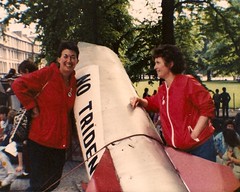
Miners' Gala 1984


Miners' gala
Originally uploaded by goforchris.
I’m riding on a lorry through
the Edinburgh streets. Beside
me is a missile, quite small,
made of cardboard painted
silver. Should be black.
Upturned faces in the sun
stare white; some shout:
Save oor pits, missus –
as if this missile
had the power to sweep away
the English government of the day
and blow it back to when
their fathers walked in
heavy boots, pale in the
morning sun and back,
black-faced at dusk
from hellish pits of endless toil
that now would end
and they would miss. And I
and my missile trundle on,
an incidental sideshow
in Thatcher’s Circus 84.

C.M.M 05/12

I don't know why this day all those years ago should suddenly come into my head - I was thinking, perhaps, about the expectation we have of people who put themselves forward in politics and how often that expectation is completely misplaced. In the '80s, my activities were focussed on getting rid of nuclear weapons, which came bound up with the Scottish hostility to the Thatcher government. All this seemed to come together at the annual Miners' Gala in Edinburgh during the now famous miners' strike.