Been thinking about positives, perhaps to counter the foul day we've just had - rain and wind and low cloud hour after hour, though now there's a bright star mocking me as I look out before bed. But to the things that make life interesting, rewarding ...
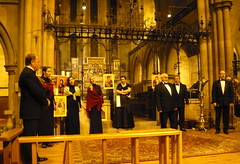
Like the other night, when I went to Ayr to hear Voskresenije perform there. I have organised maybe as many as eight performances in Dunoon by this Russian choir, but this year I had to go elsewhere to hear them and to renew the friendship with the conductor that has built up over the years. So ... I am energised by live music, by interacting with people from other cultures, by the laughter that arises from imperfect understanding of another's language. And I enjoy bearhugs - big Russian ones.
What else makes a difference? I enjoy the company of clever people, people who have ideas, people who enjoy sharing them. I don't care if I've met them before - as long as the conversation begins, it is good. I love conversation.
Tomorrow brings another energising activity: a performance. I love singing, and tomorrow our female ensemble will perform in Dunoon and wow an unsuspecting audience with Songbird and other great songs. Adrenaline surges are good for the psyche.
And then there's a good book ... for I have always, as long as I can recall, been able to lose myself in fiction. And movies, with great sound.
All these can happen, and do, regardless of the weather. But I really could do with some sun, just to complete the picture. And less rain. J' attendrai ...
Sunday, October 30, 2011


Monday, October 24, 2011
The Willing Suspension of Disbelief...

One of the very first expressions I learned in my youthful study of poetry came with the ballads that constituted much of the diet deemed suitable for fourteen-year-olds in the late '50s. "The willing suspension of disbelief", I was told, was the essential ingredient in the enjoyment of any drama, whether it was a ballad involving talking crows or a play whose action hinged on the say-so of a ghost. I was reminded of this in the immediate aftermath of the final episode of the wonderful Spooks on BBC1 last night, when more than one friend opined on Facebook that it was a bit predictable and unduly melodramatic, and now I can't start work without writing, briefly, about why I think this is sad.
I have to say that my disbelief was well and truly suspended - not just last night, but all through the series - though I must admit that, very properly, I don't have a clue what goes on in the machinations of 5. But what I am well-attuned to is emotional truth and good acting, and I'd say we had that in spades. Look at Harry. Last night the character was put through the trauma of having the woman he loved die in his arms, and the actor had to express grief in a manner in keeping with the character he played. Have you ever wondered how someone you know, perhaps fear, certainly respect, would react to an extreme situation? The acting in this scene was on a par with the greatest screen acting - different in scale, obviously, from that on a stage - in that all the rawness was expressed in near silence, with gestures redolent of hopelessness, disgust, love, compassion, loss ...
You get the picture? We don't need our drama to reflect our own narrow lives. Whether it's the best episodes of Star Trek - think of Picard in full Shakespearian mode in First Contact - or the death of Hamlet, we want catharsis: the purging of pity and terror so necessary to the dramatists of ancient Greece.
Maybe the trouble is the disengaged watching of drama that occurs in our own sitting-rooms. Maybe we're too used to discussing the action as it occurs, putting the TV on hold while we answer the phone or make some tea, playing computer games at the same time as we watch. Catharsis isn't possible without complete involvement. And I'd argue that complete involvement precludes the self-awareness that criticises technique - unless, of course, the drama itself is unworthy of attention.
But Spooks? Spooks was worthy all right.
Sunday, October 23, 2011
Poets in a Landscape

It has taken me till now to re-read it in its entirety. Maybe it's not a book to be galloped through with the voracious speed of my teenage self, for apart from the section on Catullus I recalled little of it. Highet, whom my parents apparently knew at university, draws pictures of the great Roman poets - Catullus, Horace, Virgil, Propertius, Ovid, Juvenal - in their own locations, visiting their special places in Italy, seeking out ruins and rumours, legends and literary fragments, recreating the lives they led and the people they encountered.
At the first time of reading this book, I had visited only one of the places he describes. The so-called Grotte di Catullo at Sirmione, which the poet know as Sirmio, are in fact the ruins of a huge lakeside house of a later date than the poet, but the peninsula jutting out into Lake Garda is an evocative place, and even as a teenager I found myself quoting Tennyson as I walked round 'sweet Catullus' all-but-island, olive-silvery Sirmio' - for Highet is never afraid to complement the works of the ancient poets with their more recent echoes in the poems of others.
The book takes us through the Italian countryside and the boiling streets of Rome, beside the cool springs of Clitumnus and the echoes of the now-ruined Forum, translating chunks of Latin poetry into his own, preserving the metre and as far as possible the tone, so that someone with no knowledge of Latin could still feel they were within touching distance of the works as well as the life of ancient Rome. His description of hot exploration of the Italian countryside as he sought out unremarked ruins is as powerful as his evocation of the Dark Ages, when the glories of the Palatine Hill were ruined and buried and dogs scavenged around the capitals of hidden columns. A fairly recent visit I made to Rome has left me with powerful impressions of my own to recall - including pictures painted of the period before archeologists started work on these strange mounds and apparent caverns, but above all it is the sound of the poetry that has returned.
Whether I was realising how the metre of popular songs worked - as exemplified by a line about Julius Caesar: Watch your wives, you poor civilians, here comes
Baldhead Lover-Boy!
or, as I suddenly recalled it from Thornton Wilder's The Ides of March:
Here he comes, the bald whore-monger - Romans
lock your wives away! -
or taking delight in some erudite explanation of some facet of language that I had never previously considered, this book proved a joy.
I may even get down my copy of Horace Odes (Odes lll, if you're interested) and see if I remember how the Latin works ... O fons Bandusiae, splendidior vitro...
Friday, October 21, 2011
Boy in the Striped Pyjamas

I found it very powerful, this film. I'm fascinated by the apparently normal family lives of Nazis immersed in the horrors of the Final Solution, by the glimpses of a humanity suppressed - perhaps permanently - by the demands of the job of extermination. The film was full of foreboding, from the moment when the family of the Kommandant arrives at their new house in the country, a gloomy, echoing building of small windows - one of which, in the boy's bedroom, commands a distant view of what he thinks is a farm - right through to the end which I couldn't help wishing would not be so. The gradual realisation by the boy's mother as to what exactly was happening in the camp, the growing tensions within the family as the 12 year old daughter became Nazified - these, I felt, were explored in the film at an adult level, being conveyed less in words than in expressions, gestures, the glance of an eye that was quickly averted.
The tension of the last fifteen minutes of the film, and the understated conclusion, left me wrung out and sad to an extent I had not expected - more, even, than the much bigger sweep of Schindler's List. I'm glad I recorded it.
Sunday, October 16, 2011
Quietus made with a bare bodkin?
In P.D. James' excellent novel The Children of Men, there is a scene where the protagonists come upon a Quietus - the moment when a group of old people for whom there are no longer enough carers are gathered to process quietly into the sea. Bingo - another lot of old folk gone.
I was irresistibly reminded of that this morning when I attended the local Red Cross centre to get my annual flu jab. My lovely GP practice had taken over the centre to process its old and vulnerable with maximum efficiency, and to that end we were handed a small ticket - a raffle ticket, come to think of it - with a number on it and told to sit and wait in a room packed to the gunwales with ... old people. It reminded me of buying cheese at the deli counter in the supermarket. "Don't worry, they're moving pretty quickly," we were told.
 And they were. Every minute or so a doctor or a practice nurse - all casually dressed, as in a dress-down Friday only it's Sunday sort of fashion - would appear at a door and shout above the hubbub of what sounded like a particularly jolly party "number 120 please" or whatever, and another old person (sorry to keep saying this, but they were - none of the lot we saw appeared to be of the young vulnerable variety, apart from an obviously pregnant girl) would hurry off, arms bared, jackets, jerseys and cardis flapping in their wake. Mr B and I studied the forms we had signed. The surgery logo (right) suddenly seemed sinister: At the bottom of the road there is the promenade. Seagulls wheel overhead. We have listened to your heart. It is time to go ...
Suddenly it's me. 127. I go into a room where there are several tables - old school desks? - and sit beside one. The jab, done while the nurse and I share my growing mirth at the situation, is virtually painless and over in seconds. She says nothing about having a wee seat for a bit - this is something several people, including Mr B, are told - and I exit, still giggling.
Spared for another year, I guess ...
I was irresistibly reminded of that this morning when I attended the local Red Cross centre to get my annual flu jab. My lovely GP practice had taken over the centre to process its old and vulnerable with maximum efficiency, and to that end we were handed a small ticket - a raffle ticket, come to think of it - with a number on it and told to sit and wait in a room packed to the gunwales with ... old people. It reminded me of buying cheese at the deli counter in the supermarket. "Don't worry, they're moving pretty quickly," we were told.

Suddenly it's me. 127. I go into a room where there are several tables - old school desks? - and sit beside one. The jab, done while the nurse and I share my growing mirth at the situation, is virtually painless and over in seconds. She says nothing about having a wee seat for a bit - this is something several people, including Mr B, are told - and I exit, still giggling.
Spared for another year, I guess ...
Tuesday, October 11, 2011
Birthday remembering

A life of 93 years plainly takes more than a single blog post to recall. There are insights on the blog I've just finished, insights into the person who was there before I was born. So today I'll celebrate instead the memory of someone who was, I now realise, incredibly wise and sensible in her dealings with the world and with people. Some people have a habit of asking, in moments of stress or irritation, 'What would Jesus do?'. I find, as life flows around me in currents that pull me in directions I could never have imagined, tugging me into situations where I too need wisdom, that I have changed that question. 'What would Mother do?' I ask.

And tonight, we're having a party - her two daughters and the sons-in-law Margaret Findlay was so grateful to have. We shall drink champagne in a toast to a woman who signed the pledge in early childhood but who relented in her 80s when we began taking bubbly to her birthday lunches. Here's to you, mother - cheers!
COMMUNICATING
Today I would have phoned -
wished to share the small
details of my life, the
safe return, the laughing
at the rain which fell
as if the Flood would come.
But had I rung the number
as familiar as my name
you would not be there.
A stranger’s voice would say
your words, and the strangeness
would be too much to bear.
And contemplating this
a glacial shifting in my soul
gave promise that in weeks not lived
the frozen tears would find the way
and spill into a distant sea like
drops into the ocean of my love.
May 2005
Friday, October 07, 2011
Macs I have known
It was coming - we all knew that. It was just a matter of when. But knowing someone is terminally ill doesn't really lessen the impact when the end comes, not even when one has been with the person almost to the end. So it was, I think, with the death of Steve Jobs. And though my only connection with the man was the tenuous one of knowing that my #1 son had interviewed him once, I have been using Macs more or less from the start.
In the latter half of the 1980s, the teacher who had started the latest incarnation of the Dunoon Grammar School magazine left for another post, and the then pupil editor, one Neil McIntosh, decided it would be efficient if I were to take over from him. After all, I could check copy accurately, and I had a car - as well as being sufficiently malleable to run down the road in said car to retrieve any important kit forgotten by the editor. At that time the school had two Apple Macs sitting in the maths classroom that was the hub of computing in the school, and as I took over the pupil editorial team had decided they would start in-house publication of the Pupils' View instead of taking copy down to the local paper. Somehow they learned/taught themselves how to use Macs instead of the BBCs that had previously reigned, and the empire was born.
 As these machines were, in theory, portable, and had custom-made carry-bags to facilitate carriage, we tended to have one home at the weekends, and gradually I became familiar with a mouse and such things as hypercard. When #1 son left school and started on a journalism course, he acquired his own - by now a Mac 2 Classic - which we still have, in its box, in our loft. Later, we substituted a Mac LC for the Amstrad we had at home and the ZX Spectrum on which the budding journo had started at the age of 10, and in the fullness of time connected it to the Internet.
The Pupils' View eventually made enough money to purchase its own computer, and a shiny blue bubble of an iMac appeared in my classroom. So desirable was it that we chained it to the desk with steel cables, and life was never quite the same again. I learned to use Adobe Pagemaker, and was able to teach other non-geeky types - literary, but non-geeky - to use it. The empire grew, as did the collection of Mac Classics, discarded by Business Studies and the like, along my back wall - still functioning well enough for the juniors to produce copy and my senior students to type their RPRs on.
 Currently, we own two iMacs - one each. Still sitting ready but disused in the loft is the LCII. I have a 6 year old laptop that saved my sanity recently when my iMac needed a brain transplant, and I have an iPad. I have used PCs - they were issued to staff for registration in my last years in teaching, and I used a friend's to upload photos and Skype home when I spent a month in New Zealand. I was able to make them do my bidding - but they seemed unfamiliar and clunky and on one occasion I and the owner of the PC were unable to locate a bunch of photos after I'd downloaded them. I was not impressed, and had not the slightest desire ever to own one.
 People much cleverer than I at this sort of thing seem devoted to their PCs and don't like Macs at all. But I have never had to struggle, never even had to use one of #2 son's much sought-after Mac Guides (produced about 1990). I've found that once I'd seen something work on a Mac, I've been able to do it - or even to work it out after a word at a Teach Meet or whatever. Nowadays, I don't know how I could live as I do without the communication I enjoy with people all over the world. I'd be an increasingly grouchy pensioner stuck in Dunoon with an increasingly useless passenger ferry unable to cope with travel three seasons out of four. (Don't say a word).
So, for my life as it is, I have one person to thank. That person is Steve Jobs.
In the latter half of the 1980s, the teacher who had started the latest incarnation of the Dunoon Grammar School magazine left for another post, and the then pupil editor, one Neil McIntosh, decided it would be efficient if I were to take over from him. After all, I could check copy accurately, and I had a car - as well as being sufficiently malleable to run down the road in said car to retrieve any important kit forgotten by the editor. At that time the school had two Apple Macs sitting in the maths classroom that was the hub of computing in the school, and as I took over the pupil editorial team had decided they would start in-house publication of the Pupils' View instead of taking copy down to the local paper. Somehow they learned/taught themselves how to use Macs instead of the BBCs that had previously reigned, and the empire was born.

The Pupils' View eventually made enough money to purchase its own computer, and a shiny blue bubble of an iMac appeared in my classroom. So desirable was it that we chained it to the desk with steel cables, and life was never quite the same again. I learned to use Adobe Pagemaker, and was able to teach other non-geeky types - literary, but non-geeky - to use it. The empire grew, as did the collection of Mac Classics, discarded by Business Studies and the like, along my back wall - still functioning well enough for the juniors to produce copy and my senior students to type their RPRs on.


So, for my life as it is, I have one person to thank. That person is Steve Jobs.
Wednesday, October 05, 2011
A cold turkey
Well, that was interesting. As I've mentioned in passing, I recently had to cancel a holiday because of back trouble. A low disc - L3, I believe - had misbehaved sufficiently to put pressure on a nerve, causing referred pain in front of my hip and down my thigh. I still have a large numb area on one leg, akin to the sensation caused by a dental anaesthetic. The pain was bad enough to require strong pain relief, and I ended up taking co-codamol 30/500 in gradually decreasing numbers for the best part of three weeks. The relief it gave, especially in the early days when I took two tablets every 6 hours and 400mg Ibuprofen every 8 hours, was immense. No pain - just a dreamy vagueness and lethargy. Great.
I took the last dose of co-codamol on Sunday evening. Monday I felt smug, stupidly - my back seemed better almost all day, and I only needed a couple of plain paracetamol to be able to sleep in comfort that night. Tuesday, however, was another matter. I had to go to three back-to-back Diocesan meetings in Oban, and by the end of the two-hour car journey to get to them (and I wasn't driving) I felt sure I was catching flu. Paracetamol took the edge off the aching shoulders and legs and the pounding headache, but failed to deal with the sudden floods of heat, the stomach cramps, the burning soft palate. I became less and less able to focus on the matter in hand, and by the time we got to discussing diocesan communications, I was barely civil.
The drive home was made bearable by easy conversation, drinks of water, and curiously strong mints. By this time I had considered the possibility of withdrawal symptoms, but feared I might instead have infected a whole room-full of Piskies - and the diocese of Argyll and The Isles can't afford to lose people in this manner. I headed straight for Google and found reams of stuff from people whose intake of codeine had far exceeded mine, but whose symptoms were all familiar. Some of the comments on blogs and help forums (fora?) made sensible suggestions about dealing with the situation, and several were adamant about going cold turkey - not tailing off the drugs, not taking another one just to get through the night.
Today has been better, though I still had the headache at breakfast. Now, at 11.30pm, I note that I've reached the magic 72 hour figure which should mean it's over, more or less. Apparently that's what it takes to get rid of the last traces. I was prescribed the codeine by one doctor and told how often to take it, and in what combination, by another. It was wonderfully effective. But I think I would have liked to have been told how I would feel when I stopped taking it, and perhaps advised how best to deal with the symptoms of withdrawal.
And I shall never again wonder how people become addicted to the stuff.
Wednesday, September 28, 2011
Being fair to the taxman?
I completed my online tax return the other day. It reduced me to weeping and gnashing of teeth, and it took me all morning and made my lunch late. That's bad. All the years I was employed as a teacher, I only did perhaps a couple of returns before they brought in PAYE, so this assault upon me as a result of doing the self-employed thing came as a cruel awakening.
Part of the cruelty comes in the letter the tax people send you - the ones that tell you to get it done by October if you're filing a paper return, but allow you to the New Year for the online stuff. It arrives in May. The language is especially minatory, despite their attempts to lighten up by introducing the contractions of an informal register. So: This notice requires you, by law, to send us a tax return ... but you have till three months after the date of this notice if that's earlier. I would disapprove of that, I think, were I to attack it in a professional capacity ... but I digress. The greatest threat is yet to come.
If you don't file (that wee informal touch again) by the deadlines, you will have to pay penalties and interest as follows.
• One day late and you will be charged an initial penalty of £100 (even if you have no tax to pay or you have already paid all the tax you owe).
• Three months late and you will be charged an automatic daily penalty of £10 per day, up to a maximum of £900.
• Six months late and you will be charged further penalties, which are the greater of 5% of tax due or £300.
• Twelve months late and you will be charged yet more penalties, which are the greater of 5% of tax due or £300. In particularly serious cases you face a higher penalty of up to 100% of the tax due.
So why am I making all this fuss? (It is the law, after all). Two reasons. The first is that my fellow-teachers and others in PAYE schemes, who never have to deal with their own taxes, might be interested to see what they're missing out on. But secondly, and far more importantly, is the lack of efficiency of the Tax Office.
Mr B got a letter on 9th March, in which HM Revenue and Customs told him that he had underpaid tax. Apparently the SPPA had given them the wrong tax code, and they intended simply to take the money. Several phone calls and letters later, they are still "dealing with it". The most recent phone call was prompted, I may add, by the sight of the letter I had with all these penalties listed for late submission.
Perhaps I am merely being naive. Perhaps in fact HM Revenue and Customs find their tax sums as difficult to deal with as I do. Perhaps we ought to cut them a bit of slack and not expect them to be as efficient as we're expected to be.
But I find myself incapable of such magnanimity. And the worse of it is that I shall now be hounded to my grave by these people, whether I ever work again or not. I'll get back to you on this. As the tax office folk say on the phone - bear with me.
Wednesday, September 21, 2011
The silver linings

The second plus for me was being able to attend the funeral of Kenneth Elliot. One of the discoveries of my time at university was the pleasure to be found in singing the music of 16th and 17th century Scotland, a tiny portion of which I had studied for my Higher Music. At that time, Mr B and I were founder members of a vocal ensemble - The New Consort of Voices - and a fond memory is of an evening when the eight of us were invited to Kenneth's house to drink wine, eat olives and sing the music he had been working on. Later in his life, he too looked back to that particular bunch of students - because we were enthusiastic, young, sang without wobbles and sang his stuff the way he wanted it. At least, we did before the wine had flowed too freely ...
Yesterday, five of that Consort were at the funeral in St Mary's Cathedral in Great Western Road, Glasgow. Yes, there were other people too, but we were remembering a particular era, a time of discovery and handwritten manuscripts, of late nights and laughter, of traumas involving delicate harpsichords and wayward visiting counter-tenors. We marvelled at how old we were becoming, and how some people looked just like their fathers (these tended to be people we hadn't seen since uni). The funeral service was beautifully put together; a scratch choir under Alan Tavener sang just as they should have, and George McPhee was the perfect organist. I was particularly struck by Kelvin Holdsworth's words - as he told us, he had only met Kenneth at the very end of his life, but he struck exactly the right note in a manner we all appreciated. (And no, there was no pun intended - I never think of good puns when I need them). Kenneth would have approved of the whole thing.
Today I'm paying for the fact that I couldn't spend ten minutes in every hour lying on my face in the last two days - but to compensate I realise even more forcibly that I couldn't have survived a walking holiday such as we had planned. We shall go another time - but these silver linings were one-off affairs. Etna can wait.
I hope ...
Later: I was waiting to retrieve a photo for this post, and somehow it's arrived here after midnight. I've not gone crazy - just think Tuesday rather than Wednesday for the posting date!
Sunday, September 18, 2011
Marking time
How strange life feels when you put everything on hold. Right now, I should be somewhere in the air above Europe, en route for a walking holiday in Sicily. Instead, I am sitting like an Edwardian duchess on a hard chair blogging through a drug-induced haze. I'm not even at church this sunny morning, as we shall be there this afternoon celebrating a baptism and a blessing as well as the Eucharist.
And all because of an afternoon's weeding. Two weeks ago today I engaged in a fairly ladylike fashion with the weeds sprouting among the white stones that are supposed to be a decorative feature of our front garden. They are devastating on the knees if you kneel down, so I didn't. I walked over the stones, bending from the waist.
Fool.
After a week of ruefully admitting that I had a sore back, I took myself to the GP. And went back two days later. And made myself ill with one lethally effective painkiller, saw a wonderful physiotherapist, went back to the GP and had an Xray. Finally - or maybe not - I had an NHS24-arranged visit from an out-of-hours doctor when I had spent an entire night sitting up playing bubbles on the iMac and feeling sorry for myself.
And here I am. I've turned into a Zombie. I'm told they're frightfully in these days. I find myself relieved that I'm not crammed into a tourist flight, not about to spend a week in a hard Sicilian bed, not having to be cheerful when I feel glazed. I shall be able to recover my ailing iMac a week earlier than planned, and I shall be glad to see my friends Csaba and Melinda celebrate their baby and their already wonderful marriage.
Are these, then, the silver linings to this particular cloud? Perhaps. But we shall have that holiday in Sicily. Just let me get my back sorted ...
- Posted using BlogPress from my iPad
Tuesday, September 06, 2011
Poetry roulette
What a brilliant app the Poetry Foundation one is! I downloaded it on my iPad a few weeks ago at the suggestion of Ewan McIntosh, and on this grey morning I've been indulging myself in having a spin among the poems - hundreds of them.
The format reminds me of the games we used to play with these little folded bits of paper that I never know how to fold to make them fit on the forefingers and thumbs so that a few movements would tell you your fortune - or whatever. Only this is much more sophisticated. Two 'wheels' of concepts at the top of the screen can be individually spun, so that one spin might bring you "optimism and spirituality" and another "love and grief". For each combination there appears, instantly, a list of poems - in some cases over a hundred titles - and at a touch, the chosen poem is there on the screen.
You can add any poem you particularly like to your favourites, and the complete accessibility of the resources makes the app a joy to use.
When I left my last teaching job, I wondered fleetingly where I would find the sudden surprises that browsing through the latest anthology to arrive in the department could bring. Now I wonder no more. I shall never reach the end of this trove of treasure.
And, chums, it 's free.
- Posted using BlogPress from my iPad
Sunday, September 04, 2011
Health update on a Mac
The blog's gone a bit quiet recently, I know. Partly it's been my need to keep up with my father's Letters from the Past - there have been quite a few recently, and I'm trying to keep them to the dates on which they were written 66 years ago. Soon he will go on leave to attend my birth, and the strange journey will be over. There are no letters kept from the time after that - I suspect my mother my have had her hands full in the months till my father's demobilisation, and the wonderfully evocative letters which the ones I have hint at perhaps dried up - or were replaced by phone calls. I don't know, but I shall miss them.
But another reason for my unblogging is the fact that my desktop iMac has ... well, died. It's been staggering a bit for some weeks now, but I was managing to cajole it along with frequent emptying of the cache and so on. Yesterday, however, it turned up its toes and wouldn't let me past the sign-in stage. It's going to the doctor in the Apple Store this week - just in time before my Apple Care runs out - and I shall be able to report on the experience.
Meanwhile I am relying on the laptop I bought (a PowerBook G4) when I retired six years ago. This blog began on the laptop, and I used to feel totally at home on it. Now, however, the screen feels small and dim and the angle on my desk is all wrong (though it is crammed in front of the iMac) and I keep reaching for a mouse. The fan keeps whirring alarmingly, and as I type I'm aware that what is on the screen isn't keeping up with my flying fingers. The various apps tend to be out of date and there are too many things I can't use. Worst of all, I had promised myself that this would be the week I would do my tax return. Last year's stuff is all ... on the sick machine. I can't bear to start on this one. I shall procrastinate further.
And before you ask: yes, it's all backed up.
Wednesday, August 24, 2011
Who's under the bed now?

I don't want to review the series - I'm feeling idle and there is ironing to do. But I was contemplating the tense finale, as The Hour (the fictional programme in the drama) went out live as the Suez Crisis deepened and the denouement approached. And it came to me how much we've changed from the days when the media were the props of government - or have we? Is it merely the ease and efficiency with which secrecy is broached that has changed? Do we simply have different terrors under the metaphorical bed? Is it just our expectation that has altered?
I don't know. But out of it all came one thought. Spies, subversives and whoever it is that inhabits the underbed space of the day don't actually bring about the downfall of governments. The governments do that for themselves. All that the subversives do is bring the dirty tricks out into the open.
Is it ironic that I shall now look forward to the next run of Spooks?
Sunday, August 21, 2011
Helped by The Help

Set in Jackson, Mississippi, in 1962, the story is told in three different voices as Aibileen, Minny and Miss Skeeter tell their part in it. My heart sank a little at the beginning when I realised that at least one of the voices replicated the Southern speech of the narrator, for that was one of the things that stopped me from reading The Color Purple, but it's so cleverly accomplished that it soon became an integral part of my enjoyment. I think it may have to do with the complete lack of self-consciousness in the writing - there are no apostrophes underlining missing consonants, for example. It was no time at all before I was hearing these voices in my head, and relating them to my own contact with the Deep South a few years ago.
As with all novels set against a historical background, there is an inevitability about the grand sweep of events, but the individual experiences of the extremes of racial prejudice in Mississippi are gripping in their awfulness, their humour and their variety. The two maids and the lone white woman who takes their part against the prevailing mood are resourceful and brave - and cast a bright light not only on racial attitudes but also the assumption that 'help' is a necessity for a middle-class white woman and that white gloves and polished silverware are the norm in polite society.
I loved this book. At times I was horrified, at others I thought I knew what was coming and was proved wrong. Sometimes I had to put the book aside so that I could sleep. I loved the descriptions of the ... food, actually. I have eaten that food - the fried squash, the cornmeal, the grits - and it all came back in a flood. And over all I have a new respect for my dear friends Ruth and Ed, who lived through this time and fought for the rights of the black people of Alabama. The Help added another layer to the understanding that grew when I visited the Civil Rights Institute in Birmingham, and for that I am grateful.
But aside from all that, it's a great read.
Wednesday, August 17, 2011
Scraps of memory

If you don't know what I'm talking about, I have to explain that Googling "scraps" tends to take you to strange places; "die-cut scraps" provides more information. And that's what they were - coloured pictures, of all manner of people/animals/flowers, die-cut either into squares (boring) or round the outline of the picture, as in the illustration above. These were sold in sheets, linked as shown, often but not always of the same picture. You carefully took them apart, trimmed the paper tags, and put them into your collection. Strangely, it was more fun to acquire sets of scraps by barter than be simply buying them. You would look out for pictures that you already had an example of - these blooming angels came in many sizes and cloud-colours - and traded your own less precious scraps to acquire them. The most precious of all were "pre-wars" - though now I look at example of Victorian scraps online I wonder which war we were referring to. They were identified by the muted quality of the printing - fewer dpi, I think - and the quaintly old-fashioned subjects, and they were worth any number of scraps bought just last week.

I feel sure my books are still lurking somewhere in the midden I call home, but I can picture them now. The top right corner of each page is dark grey with years of spitty fingers, and the books are entirely dog-eared. The Season came and went, and the scraps returned to obscurity until the next year. I don't know what made me think of it, but I have already spent over an hour looking for the collection. I can't see my grandchildren being at all interested, but I can't help wondering if the only people who might collect scraps nowadays will be my age. Take a look here if you're interested.
Friday, August 12, 2011
Jubilate fails to grip

Sadly, the experience didn't repeat itself. I found myself quite readily putting it aside for a chat, or dozing in the sun with it on my lap. I found that by the end of the book I still had no feel for the main characters, and the other pilgrims were characterless. I didn't even feel the need to flip back to check which was which, as I had at the beginning of Easter (and a list of dramatis personae would have perhaps helped in Jubilate).
The religious experiences described didn't really do it for me either. Gillian's faith was a pale shadow in the background, and Vincent's glimpses of the divine lacked, I felt, any conviction. I wondered if the two points of view and the sequence of chapters somehow diluted the effect of the narration - Gillian's story begins at the end of a pilgrimage to Lourdes and Vincent's at the beginning - because the two stories were too similar. There wasn't enough revelation when each narrator came to key events, so that the technique that worked so well in Easter seemed to fall short in Jubilate.
All that said, I've learned enough about a pilgrimage to Lourdes to ensure that I never think of going on one - in a way it comes across as a festering blight on the face of the country - and I did finish the book. But I can't agree with Peter Stanford writing in The Guardian when he talks about the urgency of a great romance, and the metaphysical debate didn't exercise the grey cells much, I'm afraid. Maybe it was all a bit too close to reality, maybe it lacked the exaggeration that made Easter such a show-stealer. In fact, what I recall now is a sense that this is a dutiful record of a love story on a pilgrimage, but one that lacks passion of any kind. It might almost have been real - and sometimes that's not enough.
Tuesday, August 09, 2011
Very naughty indeed

Now, living in the peace of Argyll, I visualise bits of London I know - like Croydon - ravaged by fire and anger. I think of the daytime activity of clearing up, in defiance of the possibility that night will bring more destruction. Last night I read the tweeted commentary of people in London and elsewhere, and realised from the responses of some of my contacts that there was a great tide of immoderate comment that was passing me by. Suggestions about dealing with the riots ranged from the sensible to the homicidal; reactions to these from the shocked to the angry.
And what business have I to comment? Here we have cool, fresh evenings in beautiful surroundings, and I live a comfortable, cushioned life in which the noise from the pubs coming out irritates rather than threatens. As someone who has taken part in demos and sung at police lines and learned how to remain safe during NVDA* I know how it is possible to demonise the forces of the law - but there's where the comparison ends. Last night I watched a report on YouTube by an incredibly brave guy in Clapham who was asking looters if they were proud of what they were doing as they looted the shops of electrical appliances (they left the bookshop alone, natch). "What's that about?" he asked. And on Twitter people demanded draconian clamp-downs that others said would make things worse; some offered to pray for London and others felt patronised by the offer; some seemed intent on appearing cool whatever happened.
Do I have a take on it? I don't know. I suspect that if I were living in the middle of it all I would be forgetting all my liberal instincts as fear took over - fear for my safety, for my property, for my livelihood. As it is, I worry about family and friends and am glad to hear they're ok. I look at angry youths being bestial and defensive women nicking tellies and I'm not surprised to see police wielding batons with a will. Fear and rage are powerful emotions and once things get going reason goes out of the window. So no, I don't know what I think, other than that it's hellish and I'm sorry for anyone who has to live with it. I'll stick right now with the wisdom of a two year old boy who saw the TV news this morning: "People are being very naughty."
Quite the most balanced response I've heard so far.
*NVDA: non-violent direct action
Monday, August 08, 2011
Reflecting on a link
 I've been thinking about the most recent of the Letters from the Past, in which my father introduces the subject of the bomb dropped two days previously on Hiroshima. Two things struck me simultaneously: the fact that the bomb took fifth place, coming after my mother's health (she was only seven weeks off having me), the weather, the imminent demobilisation of a teacher colleague and the possible timing of his own; and the statement that he finds the news of this bomb "extremely depressing" - even though it will shorten the war and his own incarceration in the RAF.
It also interests me that he should be so ready to link the invention and use of such a weapon with the tenets of conventional religious belief - and saddens me that I never thought of discussing such matters with him. I was, of course, too young, too selfishly caught up in my own life, too ignorant of politics, religion or indeed practically anything at all serious - too much of a child, even at the age of 32, to talk to him about anything that mattered. (He died when I was 32.) I now like to think that he would have approved of my activities in the '80s, marching with CND, making speeches, appearing on radio and several TV programmes, and that his assertion that I had "thrown reason out of the window" when I told him that I intended to be confirmed in the Episcopal Church after rejecting religion for the previous ten years would have been tempered by the struggles I had with that same church over my political activities.
Putting these letters online has been a fascinating experience, and the letters of August 1945 are the ones that inspired me to do it in the first place. Often I catch myself thinking they have been written to me - and then I see a speculative reference to my as yet unborn self and smile. But primarily their interest to others will lie in the authentic voice of a highly articulate and educated man of the time, expressing casually but succinctly what must have been in the minds of many like him. They come to an end in just over a month's time. I shall miss him...
Sunday, August 07, 2011
Grey day transfigured
It's a grey morning. I'm already damp because my umbrella was in the car and I had to fight my way down the drooping garden so my legs are uncomfortable and I'm already chilled. As we swish up the back streets of Dunoon to church, I wonder what I'm doing. My mood matches the day; most of my summer activities are over; the sun has gone. I'd have been better staying in bed with a book. The organist seems in no better fettle, and I forgot to tell him we are supposed to be keeping the Transfiguration, so we don't really speak. Besides, we're a bit late.
There is no heating in church - it is, after all, summer - as I sort out hymnbook and liturgy (thank God - not the Grey Book). There are also no children, as the Rector is on holiday and has taken Mrs Rector who does the Godly play at the back of the church. Apart from some scraping and banging from the rear, later revealed as "sorting the electrics for the coffee", it is relatively quiet as the organ music begins. I recognise the music after the opening, drifting notes: the organist is improvising on a modern/traditional scottish folk tune. It is absolutely, heart-rendingly beautiful.
I am plainly not alone in thinking this. I hear a whisper from somewhere behind me: Ohhh - that's lovely. And a stillness falls on the people, even those who are still arriving. Prayer is suddenly possible, distraction and restlessness quietened by the lilting line, and I am glad I have come. Even when the music enters a dark, sombre place it seems entirely appropriate (I subsequently learn that the organist was distracted by the thundering down the aisle of Someone on A Mission and had to go where a wrong note took him) and the melody emerges, intact and serene, just in time for the final quiet cadence.
I am now in a place where anything can happen; the gloom has been dispelled and the transfiguration is possible. And reflecting on the experience, and the prayers and farewells and greeting of long-missed friends that took place when the Mass was over, I note that we need this variety. We need joy and noise and exuberance, and we need silence and mystery.
And somehow, in the profound silence, there is music at the very heart of things.
Subscribe to:
Posts (Atom)