Does anyone read Bacon's Essay's in school any more? I doubt it. They don't really strike one as everyday fare for your average 16 year old. And yet ... I have provided a link there that leads to one of the essays, Of Death, that I read when I was in S4, one whose opening sentence sticks in my mind to this day - and I have not exactly read them regularly since. I did, however, on one occasion in living memory - in the 90s, I think - find myself being given sole charge of a wonderfully sparky group of new S3 pupils for the whole of their Standard Grade course, and filled the short month of June with a crash course in Bacon. They rose to the challenge, and when I set them the further challenge of 'doing a Bacon' over the summer holidays, came up with some wonderful almost-parodies.
And in a way, that's what I'm doing now. Only I'm not bothering to write in a Baconesque style - I doubt I could - but rather seek to examine fear in much the same spirit as Bacon might. That adventure that formed the hub of my last post - we've been dining out on it, as I knew we would, and some people - in the comments on the blog, or on Facebook, or to my face - have expressed wonder at our bravery in surviving all this. Of course, it wasn't bravery. It was necessity - and I suspect that though they sometimes coincide, that wasn't the case for us. Why? Because there was no fear to overcome.
Think back to Bacon (for of course you've checked the link by now - no?) Men fear death, as children fear to go in the dark. That's the line that sticks - and it's true, even if we'd object to the male presumption these days. But that's because we have time in which to contemplate our mortality, worry about the nature of our dying, fret about its propinquity. (I think I'm being infected ...) But when we were in that little speedboat, weighed down with boots and packs so that if we'd fallen into the sea we'd have had a job ever coming up again, all during that time when the waves were breaking over us and the cliffs seemed too close, there was really no time to feel afraid. I wasn't happy, and in fact every fibre of my being was screaming - but it wasn't in fear. No, it was screaming something like "You stupid people - this is not a good place to be! It's wet and dangerous!" - and so on, like a nagging parent you soon get used to ignoring.
Even when we had to transfer from one bouncing boat to another, all I could feel was a kind of distaste - and a strong desire not to make a fool of myself. I realise now that the latter pushed aside the realisation that people could be trapped between boats, crushed or killed - because it was afterwards that I thought about these outcomes. At the time there was a bit of swearing, the odd shriek, and obedience ("Now, lady - jump!" and I jumped). There was none of the paralysing fear that grips your gullet, gives you pins and needles in your hands, makes you want to vomit. How do I know these symptoms? Because I can get them - when I have to catch an early flight, perhaps, or when I think something awful has happened/might happen to someone I care about - not consistently or predictably, but with hideous randomness of occasion and severity, rendering me useless and nauseous and able to think only of the worst possible outcome.
Perhaps Hamlet had it all along. It's "some craven scruple of thinking too precisely on th'event" (outcome, here). I wasn't thinking of the outcome, I was thinking only of the present - or, to be more precise, I wasn't thinking at all. I was doing. Hamlet again, fighting pirates - "In the grapple, I boarded them": he wasn't thinking while he fought, because he had to get on with it; it was only when he allowed himself to fret about the morality of killing his uncle in cold blood that he was in trouble. When his uncle was obviously indulging in wickedness, Hamlet could bump him off in hot blood and die content. (Sorry for the spoiler, if you don't know the story ...)
To round this off, I want to think briefly about war. We've been watching these old guys who were once young and seasick on the approach to the Normandy beaches and who are now lauded as heroes - and yes, they are heroes, and survivors, and human, and ordinary, all at once. When I was a post-war child, listening to my parents' stories, whether of bombs on neighbouring tenements or booby-trapped oases in the Western Desert, I used to wonder how people could bear it. How did they survive at all? Why did they not simply die of fear, curl up in a corner and never come out again? And I suspect that the answer is that when something frightening is happening to you, you get on with it. As long as it's actually happening, and you have to act in some way, there isn't time for the fear to overflow. The adrenaline has other uses than to make you feel sick. These soldiers who landed on the beaches - they were sick with the sea and God knows what else, but when the ramps were down they were off, and they were soldiers.
And of course, I know all this - but actually I know it as I know far too many things: from fiction. From reading. But it has taken me till now, because someone else landed me in a situation that could have had a very different ending, to own the knowledge that fear will only paralyse if you let it.
And, not to end on a moralising note, I have to confess that I've been seduced by Bacon, and may read some more of his essays before I close that tab. Because the books are gone, long gone ...
Showing posts with label Shakespeare. Show all posts
Showing posts with label Shakespeare. Show all posts
Saturday, June 07, 2014


Monday, January 10, 2011
Catharsis in Walford

What nonsense all this is. The most unexpected people suddenly stop watching the programme, or write letters or post their ire on websites. People are upset to find this sort of thing in their living-rooms, and Mumsnet is raging. What's going on?
Classically, the purpose of drama - and particularly of tragedy - is catharsis: the purging of pity and terror. You watch the drama unfold, you become involved, you suspend disbelief, you weep, rage, gasp, feel fear and relief - and by the end, if it's been well done, you feel wrung out, devoid of all emotion. Judged by this set of criteria, EastEnders has got it about right, I'd say - except that people have forgotten the rules.
A few weeks ago I watched Patrick Stewart as Macbeth, in a strangely bleak production of Shakespeare's tragedy. For anyone who has forgotten the plot, Macbeth, a soldier, acts on the urgings of some strange women and murders his king. He then becomes king, but fears his best pal Banquo may suspect, so has him bumped off. He is more than somewhat annoyed that the inept thugs who do this for him fail to murder Banquo's wee boy. Later he has the wife and children of one of his former friends horribly murdered in their house as the children are getting ready for bed. That last bit is particularly horrid. I wasn't aware of cries of horror and demands that the play should never be put on again.
Or what about Hamlet, whom Shakespeare has plotting to murder his uncle for the whole length of a long play? In the course of trying to find the perfect moment, Hamlet bumps off the father of his girlfriend without knowing or caring who he is, sends his two best chums from school to certain death in a foreign country and acts in a totally unsuitable way towards his silly mother. Do people write angry letters about the portrayal of life with a step-father?
Course they don't. It's only a play, silly. So why do they think EastEnders is any different? Ronnie has been an unstable character for years - of course she's not going to get to be happy and fulfilled. Nor is she going to accept her lot if there's a chance of doing the dirty on someone else - we know this; we've been prepared for it. No-one would leave an hours-old baby in its cot in the care of its grandpa? Well yes, they would. People are wary of passing around a newborn - there's a sort of mystique, a fragility that binds a new baby to its mother, and if the mother is suddenly taken ill it's an alarming prospect for even the most gung-ho stranger to look after this tiny infant. And it was Hogmanay, and they were all drinking and Alfie is good-hearted but inept and Charlie has never been the most savvy of men.
If I were an EastEnders producer, I'd be thinking I'd succeeded here. Everyone's talking about it, it's on the news programmes and radio chat shows and in the serious Sundays as well as the red-tops. What more could they ask? So people seem to think it has to fulfil a public service role and show bereaved Ronnie behaving well and bravely - where's the mileage in that? This way, the story has legs. Jessie Wallace gets to act her socks off. It's not real life, whatever people have come to assume. It's a play. Fiction. Drama. Either watch it, or hit the remote.
THE END
Monday, October 19, 2009
Love's Labours Lost
I know I've blogged about this already, but I needed to return to the experience of the Globe Theatre and Love's Labours Lost when I didn't have a cat's bottom distracting me by hiding the screen, to say nothing of the typing paws.
The thing is that in all my life I've only once been to a performance of a play by Shakespeare that I didn't know already, and that was so long ago that I have only the vaguest memory of it. (I think I was still at school, and it was at Jordanhill College and may have been As You Like It) And it struck me forcibly that much of what I get from a performance of, say, Hamlet, comes from anticipation and speculation: how will the Ghost be treated? How will they stage the prayer scene? How will Hamlet say the big soliloquies?
Think of the Olivier film of Hamlet. Olivier took a part of one of Hamlet's speeches about the King's behaviour and used it as a voice-over for the very beginning of the play, so that the words about "particular men" who, "carrying the stamp of one defect", "take corruption from that particular fault" and so is brought to disgrace. The whole slant of the character of Hamlet is changed by this, as he seems to be talking about himself in a way that would suggest he is very aware of why he is unable later on to kill his uncle - and yet his soliloquies show that he cannot understand his difficulties.
I've gone into that simply to show how very different the experience of a play is to someone who has studied it for years - and to wonder what Will himself would have thought of such a reaction. Maybe he'd have torn his hair out, maybe he'd have been puzzled. But it was fascinating to try to "keep up" with an unfamiliar play, without benefit of the text, and not find myself laughing at something several lines too late. I noticed an earnest fellow in the row in front of me poring over the text as the play unfolded - but felt he was missing more than he gained.
Enough. No more. 'Tis not so sweet now as 'twas before - and I've gone on long enough. The words of Mercury are harsh after the songs of Apollo: You that we; we this way.
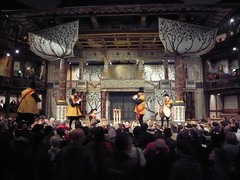
The thing is that in all my life I've only once been to a performance of a play by Shakespeare that I didn't know already, and that was so long ago that I have only the vaguest memory of it. (I think I was still at school, and it was at Jordanhill College and may have been As You Like It) And it struck me forcibly that much of what I get from a performance of, say, Hamlet, comes from anticipation and speculation: how will the Ghost be treated? How will they stage the prayer scene? How will Hamlet say the big soliloquies?
Think of the Olivier film of Hamlet. Olivier took a part of one of Hamlet's speeches about the King's behaviour and used it as a voice-over for the very beginning of the play, so that the words about "particular men" who, "carrying the stamp of one defect", "take corruption from that particular fault" and so is brought to disgrace. The whole slant of the character of Hamlet is changed by this, as he seems to be talking about himself in a way that would suggest he is very aware of why he is unable later on to kill his uncle - and yet his soliloquies show that he cannot understand his difficulties.
I've gone into that simply to show how very different the experience of a play is to someone who has studied it for years - and to wonder what Will himself would have thought of such a reaction. Maybe he'd have torn his hair out, maybe he'd have been puzzled. But it was fascinating to try to "keep up" with an unfamiliar play, without benefit of the text, and not find myself laughing at something several lines too late. I noticed an earnest fellow in the row in front of me poring over the text as the play unfolded - but felt he was missing more than he gained.
Enough. No more. 'Tis not so sweet now as 'twas before - and I've gone on long enough. The words of Mercury are harsh after the songs of Apollo: You that we; we this way.
Wednesday, October 07, 2009
Shakespearian evening
To The Globe last evening, to see Shakespeare's Love's Labours Lost. Quite an experience! Our already excellent seats were upgraded even before we could sit in them because there was a dirty big camera in front of them, and so we found ourselves in the best seats, in the very middle of the lowest seated area, behind the groundlings. They in turn were not just in front of the stage, as I expected, but were actually enclosed by two ramps which angled round in front of the main apron and were used by the the actors for sudden appearances - and by the deer which wandered in and out and died under the arrows of the Queen and her ladies.
I have to admit that I didn't know this play, and I was fascinated to experience it for the first time as Shakespeare's audienced did. How hard they must have listened! Or were some of them like Polonius (I do know Hamlet!) - remember, he's for a jig or a tale of bawdry or he sleeps? L'sLL is a torrent of verbal humour, in this production combined with a great deal of slapstick that had the audience guffawing. It all felt very Elizabethan, right down to the rigours of sitting on a wooden bench, even if we had been supplied with hassock-like cushions. And people did drink beer, though I didn't see any sellers of sausages (I believe they replaced the ice-cream lady in Will's day). And at the end we all applauded in time to the final dance-music while the cast jigged wildly on the stage, overcoming the gloom produced by the message of the death of the queen's father.
A fascinating experience, then, culminating in a headlong dash over the cobbles of Will's Bankside as we headed for the speedy train home.
I have to admit that I didn't know this play, and I was fascinated to experience it for the first time as Shakespeare's audienced did. How hard they must have listened! Or were some of them like Polonius (I do know Hamlet!) - remember, he's for a jig or a tale of bawdry or he sleeps? L'sLL is a torrent of verbal humour, in this production combined with a great deal of slapstick that had the audience guffawing. It all felt very Elizabethan, right down to the rigours of sitting on a wooden bench, even if we had been supplied with hassock-like cushions. And people did drink beer, though I didn't see any sellers of sausages (I believe they replaced the ice-cream lady in Will's day). And at the end we all applauded in time to the final dance-music while the cast jigged wildly on the stage, overcoming the gloom produced by the message of the death of the queen's father.
A fascinating experience, then, culminating in a headlong dash over the cobbles of Will's Bankside as we headed for the speedy train home.
Subscribe to:
Posts (Atom)