Does anyone read Bacon's Essay's in school any more? I doubt it. They don't really strike one as everyday fare for your average 16 year old. And yet ... I have provided a link there that leads to one of the essays, Of Death, that I read when I was in S4, one whose opening sentence sticks in my mind to this day - and I have not exactly read them regularly since. I did, however, on one occasion in living memory - in the 90s, I think - find myself being given sole charge of a wonderfully sparky group of new S3 pupils for the whole of their Standard Grade course, and filled the short month of June with a crash course in Bacon. They rose to the challenge, and when I set them the further challenge of 'doing a Bacon' over the summer holidays, came up with some wonderful almost-parodies.
And in a way, that's what I'm doing now. Only I'm not bothering to write in a Baconesque style - I doubt I could - but rather seek to examine fear in much the same spirit as Bacon might. That adventure that formed the hub of my last post - we've been dining out on it, as I knew we would, and some people - in the comments on the blog, or on Facebook, or to my face - have expressed wonder at our bravery in surviving all this. Of course, it wasn't bravery. It was necessity - and I suspect that though they sometimes coincide, that wasn't the case for us. Why? Because there was no fear to overcome.
Think back to Bacon (for of course you've checked the link by now - no?) Men fear death, as children fear to go in the dark. That's the line that sticks - and it's true, even if we'd object to the male presumption these days. But that's because we have time in which to contemplate our mortality, worry about the nature of our dying, fret about its propinquity. (I think I'm being infected ...) But when we were in that little speedboat, weighed down with boots and packs so that if we'd fallen into the sea we'd have had a job ever coming up again, all during that time when the waves were breaking over us and the cliffs seemed too close, there was really no time to feel afraid. I wasn't happy, and in fact every fibre of my being was screaming - but it wasn't in fear. No, it was screaming something like "You stupid people - this is not a good place to be! It's wet and dangerous!" - and so on, like a nagging parent you soon get used to ignoring.
Even when we had to transfer from one bouncing boat to another, all I could feel was a kind of distaste - and a strong desire not to make a fool of myself. I realise now that the latter pushed aside the realisation that people could be trapped between boats, crushed or killed - because it was afterwards that I thought about these outcomes. At the time there was a bit of swearing, the odd shriek, and obedience ("Now, lady - jump!" and I jumped). There was none of the paralysing fear that grips your gullet, gives you pins and needles in your hands, makes you want to vomit. How do I know these symptoms? Because I can get them - when I have to catch an early flight, perhaps, or when I think something awful has happened/might happen to someone I care about - not consistently or predictably, but with hideous randomness of occasion and severity, rendering me useless and nauseous and able to think only of the worst possible outcome.
Perhaps Hamlet had it all along. It's "some craven scruple of thinking too precisely on th'event" (outcome, here). I wasn't thinking of the outcome, I was thinking only of the present - or, to be more precise, I wasn't thinking at all. I was doing. Hamlet again, fighting pirates - "In the grapple, I boarded them": he wasn't thinking while he fought, because he had to get on with it; it was only when he allowed himself to fret about the morality of killing his uncle in cold blood that he was in trouble. When his uncle was obviously indulging in wickedness, Hamlet could bump him off in hot blood and die content. (Sorry for the spoiler, if you don't know the story ...)
To round this off, I want to think briefly about war. We've been watching these old guys who were once young and seasick on the approach to the Normandy beaches and who are now lauded as heroes - and yes, they are heroes, and survivors, and human, and ordinary, all at once. When I was a post-war child, listening to my parents' stories, whether of bombs on neighbouring tenements or booby-trapped oases in the Western Desert, I used to wonder how people could bear it. How did they survive at all? Why did they not simply die of fear, curl up in a corner and never come out again? And I suspect that the answer is that when something frightening is happening to you, you get on with it. As long as it's actually happening, and you have to act in some way, there isn't time for the fear to overflow. The adrenaline has other uses than to make you feel sick. These soldiers who landed on the beaches - they were sick with the sea and God knows what else, but when the ramps were down they were off, and they were soldiers.
And of course, I know all this - but actually I know it as I know far too many things: from fiction. From reading. But it has taken me till now, because someone else landed me in a situation that could have had a very different ending, to own the knowledge that fear will only paralyse if you let it.
And, not to end on a moralising note, I have to confess that I've been seduced by Bacon, and may read some more of his essays before I close that tab. Because the books are gone, long gone ...
Showing posts with label Hamlet. Show all posts
Showing posts with label Hamlet. Show all posts
Saturday, June 07, 2014


Saturday, June 30, 2012
Hamlet, revenge!

I'd like to look briefly at some of the things about this old favourite that caught my attention this time round. I was pretty certain I remembered who had committed the murder, though not how or why, though there were big tracts of the detection that had escaped me. And I noted that this, like the later A Private View, is a proper detective novel as distinct from the crazier fantasies that I've previously reviewed. I have a horrid feeling that I prefer the fantasy, and have tended to become bored by the minutiae of detection presented in the more traditional examples of the genre, but I'm justifying the frivolity of my current reading matter by paying proper attention to it - should I really be thinking of a PhD in the subject?
But I digress. What actually struck me most is the realisation that I used to feel quite comfortable with the social distinctions underlined in these books - whether among the toffs at Scamnum Court or the academics at Oxford; whether poking fun at foreigners or caricaturing Scots and their way of life. Now the word most commonly used to describe a black man leaps out of the page and the fact that it is actually being applied to an Indian academic seems doubly odd, and the affable quiddities of the Duke of Horton seem anachronistic and not to be indulged. There is the threat of the impending war (Hamlet, Revenge was first published in 1937) and there are no mobile phones. In fact, much detective fiction would not exist in its original form, it seems to me, if mobile communications had been available - when Appleby, now an Assistant Commissioner of Police, embarks on a foolhardy solo venture in A Private View, a phone in his pocket would have ended the whole escapade before it got under way.
But I am still entertained. The language is beautifully precise and stimulating - did readers of detective fiction simply have more erudition half a century ago? (or more, dammit - or more!) Or is it like Shakespeare, now the preserve of an elite but once much more widely enjoyed? Did readers read and non-readers toil merely? I am in a world that comforts strangely, despite the murders and the fogs. Perhaps it is just that it is the world in which I was young - for the fifties are a far-off land nowadays - the world in which my well-read parents provided an endless supply of reading matter to a voracious child, where escape from whatever small ills might afflict me was within reach whenever I chose to take refuge in it. (I still remember my father denying knowledge of where I was when small friends came to the door asking 'can Christine come out to play': did he know, I wonder, that I was deep in a book?)
Yes, I am still entertained. But I grow a-weary of the smell of old, yellowing paper ...
Monday, October 19, 2009
Love's Labours Lost
I know I've blogged about this already, but I needed to return to the experience of the Globe Theatre and Love's Labours Lost when I didn't have a cat's bottom distracting me by hiding the screen, to say nothing of the typing paws.
The thing is that in all my life I've only once been to a performance of a play by Shakespeare that I didn't know already, and that was so long ago that I have only the vaguest memory of it. (I think I was still at school, and it was at Jordanhill College and may have been As You Like It) And it struck me forcibly that much of what I get from a performance of, say, Hamlet, comes from anticipation and speculation: how will the Ghost be treated? How will they stage the prayer scene? How will Hamlet say the big soliloquies?
Think of the Olivier film of Hamlet. Olivier took a part of one of Hamlet's speeches about the King's behaviour and used it as a voice-over for the very beginning of the play, so that the words about "particular men" who, "carrying the stamp of one defect", "take corruption from that particular fault" and so is brought to disgrace. The whole slant of the character of Hamlet is changed by this, as he seems to be talking about himself in a way that would suggest he is very aware of why he is unable later on to kill his uncle - and yet his soliloquies show that he cannot understand his difficulties.
I've gone into that simply to show how very different the experience of a play is to someone who has studied it for years - and to wonder what Will himself would have thought of such a reaction. Maybe he'd have torn his hair out, maybe he'd have been puzzled. But it was fascinating to try to "keep up" with an unfamiliar play, without benefit of the text, and not find myself laughing at something several lines too late. I noticed an earnest fellow in the row in front of me poring over the text as the play unfolded - but felt he was missing more than he gained.
Enough. No more. 'Tis not so sweet now as 'twas before - and I've gone on long enough. The words of Mercury are harsh after the songs of Apollo: You that we; we this way.
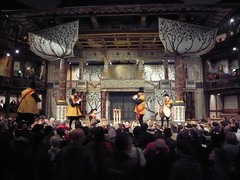
The thing is that in all my life I've only once been to a performance of a play by Shakespeare that I didn't know already, and that was so long ago that I have only the vaguest memory of it. (I think I was still at school, and it was at Jordanhill College and may have been As You Like It) And it struck me forcibly that much of what I get from a performance of, say, Hamlet, comes from anticipation and speculation: how will the Ghost be treated? How will they stage the prayer scene? How will Hamlet say the big soliloquies?
Think of the Olivier film of Hamlet. Olivier took a part of one of Hamlet's speeches about the King's behaviour and used it as a voice-over for the very beginning of the play, so that the words about "particular men" who, "carrying the stamp of one defect", "take corruption from that particular fault" and so is brought to disgrace. The whole slant of the character of Hamlet is changed by this, as he seems to be talking about himself in a way that would suggest he is very aware of why he is unable later on to kill his uncle - and yet his soliloquies show that he cannot understand his difficulties.
I've gone into that simply to show how very different the experience of a play is to someone who has studied it for years - and to wonder what Will himself would have thought of such a reaction. Maybe he'd have torn his hair out, maybe he'd have been puzzled. But it was fascinating to try to "keep up" with an unfamiliar play, without benefit of the text, and not find myself laughing at something several lines too late. I noticed an earnest fellow in the row in front of me poring over the text as the play unfolded - but felt he was missing more than he gained.
Enough. No more. 'Tis not so sweet now as 'twas before - and I've gone on long enough. The words of Mercury are harsh after the songs of Apollo: You that we; we this way.
Subscribe to:
Posts (Atom)