Showing posts with label childhood. Show all posts

Tuesday, July 04, 2017

Memories of a Hillhead infant


It was this picture that started it. I've been rummaging among my old teaching materials and came upon a small buff book, with cartridge-paper pages that are half blank, half ruled in light and heavier red. This pre-dates all the other stuff I found, as it comes from my childhood. From 1952, I would say, when I was in Infants 2 in Hillhead Primary School in Glasgow. A chance remark on the Facebook conversation that followed its publication there brought memories flooding back - far too many for that medium. And it struck me that this is social history as well as my history, and I find it fascinating. That's what brings me back to Blethers after so many months. I want to write it down before I forget, or before no-one who was there is around to remember with me.

Let's begin with Christine Findlay, pigtailed in Primary 2. By this time she will be almost 7, because her birthday is in September. This meant that she started school in January, already 5 years and 3 months old and able to read. She is no longer playing with Plasticene and lacing cards (the latter, for some reason, a great thrill; something never seen at home).
Presumably for reasons connected with accommodation - and perhaps staffing - her class was called 1e and the school day began at 1pm and ended at 4pm. She travelled by tram from her top-flat home in Hyndland along Great Western Road to the foot of Cecil Street, where she crossed the main road with the help of a traffic warden. (He was once knocked down while she waited beside the road - perhaps this story will reappear). The lunchtime journey cost a ha'penny - the "Ha'penny Special" for school children; the return a whole penny. A yellow ticket at lunchtime, a blue to go home. Six months later her class became 1a and attended school in the morning. I cannot recall - see: it's going already - if the beloved Miss Buchanan survived the transition to morning class or if it was then that Mrs Reilly appeared, a red-haired, vivacious woman confusingly addressed by older pupils as Miss Forrester.

It is her class that provides this book, and some of my clearest memories. I can actually remember writing some of the legends in it, drawing the pictures to go with the writing exercise. In the course of it, we moved on to joined-up writing, copperplate. But before I go there, a vivid, stressful moment...
We were writing the letter l, lower-case, on the same kind of ruled paper as is above. And I couldn't work out how long the letter l (lower case) should go on. How many lines? Two thick and two thin? It looked far too long and wavering. I was distraught. We were forbidden erasers. Even when I saw a friend - was she a friend? - doing what looked a more correct version, there was no way I could hide my shame. I was a fool, and I blushed. That perky child in the picture - wearing, I notice, the regulation school winter jersey with the collar (striped in school colours) through which one threaded the school tie under the gym-slip - was feeling anything but perky.

But I progressed. My writing became fairly spectacularly neat copperplate - an example occurring in the day we learned about Diogenes. There is a wonderful picture of someone else's vision of how he might live here, but this is what I drew.

On other days we drew such things as the Glasgow coat of arms (so hard, these fish!) and a cuckoo which still looks quite convincing. All with this amazing writing underneath. Of other learning I remember less; I was bored much of the time during reading lessons because I was already a fluent reader and became cross at people who read aloud each individual word. Clearly, I was not destined to be a patient person.

I think there were forty children in my class, boys and girls equally distributed. The "a" designation referred to our birth dates, and all of us had our birthdays between September and December. We were the oldest class in the year group, we had had two terms of education more than the rest of the year. We felt superior, and no doubt we acted that way. We had embarked on our Hillhead journey. And the next time it's raining and I have little more to do, I'll regale the waiting world with a few memories of the next stage of that journey ...

Monday, February 01, 2016

Of urban open spaces and a post-war childhood

I was reading the other day about a dispute over an area of land in the West of Glasgow which is currently used as a (relatively) wild place for children to play, for people to grow things, to be free, and which is threatened by proposed housing development. The writer went on to enlarge on the features that make it so important to retain its use for recreation, particularly the benefits to children's health and wellbeing of such unstructured play in a traffic-free area in a city.

It had me thinking of my own childhood freedoms, also in the West End of Glasgow - freedoms positively enhanced by the relatively recent World War 2. I'm sure I've mentioned much of this before - the place where the land-mine demolished a bit of Polwarth Gardens' tenements, and the huge blocks of red sandstone that still littered the site sticks in my mind, although as a Novar Drive kid I didn't stray there often; we were very territorial in these days. My usual companions lived in the next close and we barely tolerated strangers ...

My usual playground was an open space in Novar Drive where the end of Lauderdale Gardens didn't reach as far as the Novar and was linked to it by a muddy track over empty, hilly ground. On the lower side, which has now been built on, there was a rubbish dump, an infill site, I suppose, where building debris (a result of bombing?) shared the space with more mundane litter like soot left by chimney sweeps (great face-paint) and at the top of which was the underground air-raid shelter in which we sometimes lit illicit fires. To the far side of the dump were two brick-built shelters with thick concrete roofs; we rarely went inside (too smelly) but played Kingball, precariously, on the roof of one.

When it snowed, I borrowed a sledge from a neighbour whose daughter was a good 6 years older than me - she would be at school and I'd be hurtling down the sloping field, often alone, for hours. I have a feeling that the winter I'm recalling was my first at school, when Hillhead Primary had an intake in January; some primary teacher must have doubled up and taken my class in the afternoon after her morning class had gone home. My mother, already having to attend to my 2 year old sister, would despair at converting my wet, grubby morning self into a schoolgirl in time for the 1pm start. (Crazy idea, now I think of it again.)

When the days grew longer,  we spent hours climbing the stunted hawthorn trees on the hillier side of this area; swinging from branches and making dens under - or on top - of them. And then there were the marathons, when we ran round and round a small path that cut through the long grass until we were gasping and scarlet in the face ... and the hiding places in the grass where we used sticks for rifles ... to say nothing of playing chase the arrows all over Hyndland, all the way to Clarence Drive ...

I was always grubby, always scratched, always exhausted by the time our parents summoned us all from the windows of our flats. When we left Hyndland for a "low door" in Broomhill I was devastated. At the age of 10, my life outwith school had been changed for ever. Shades of the prison house ...

I looked up my old haunts on Google Earth. They're barely recognisable, though "my" tenements haven't changed. This first picture is of the play area I've described in such tedious detail. The whole tenement block on the right is new - that's where the rubbish and the overground air raid shelters were. The trees are new - though clearly they've been growing for a while. The play-park just visible on the left is new, and I would have scorned it as tame and at the same time treacherous (I always got sick on swings).

 The second picture looks from the same place as the first, down Novar Drive. New tenements on the left - but you can make out where the old ones begin, with a lane in between which was always there. The top flat we lived in has the bay window just before that tall chimney head on the right of the road. It all looks very crowded, with the cars on either side. We played in the street and in our wilderness, and no-one worried. (Actually, children don't know the secret worries of the mother marooned with a baby in a top flat who suddenly can't see her firstborn and wonders where it might be ...).

What I'd actually like to know is how my own offspring would have fared in this environment, instead of the seaside town we brought them up in - and even how their children would cope with a top flat. What I do know for myself is that I couldn't return.

It was good, though, back then ...

Friday, October 04, 2013

The men in the radio

We were listening to music on the radio the other night - hardly surprising; we do this every night in life - and for some reason discovered, Mr B and I, that we had both as children pictured tiny musicians inside the radio every time an orchestral concert came on. In these days, of course, there was considerably less music to listen to; the Third Programme didn't come on until after 6pm (heralded, I recall, by the wonderful theme used by Britten in his Young Person's Guide) and I went to bed shortly after (we're talking the 1950s here). Later, thanks to the acquisition of a more modern radio, I discovered Radio Luxembourg and pop music, though that was only audible after dark. (Don't ask me why; I suspect it may have something to do with Physics.) In the light evenings, you could barely hear Elvis through the static. The nostalgia trip was completed with the joy of finding a photo of the radio we had in the kitchen - can you not just see the tiny musicians, in their evening tails, ranged behind the golden cloth front?

We both hated, I discovered, the singing on "Listen with Mother" - on at 1.45 every weekday. I can still hear the voice of Daphne Oxenford in my mind's ear. The man who did the duets with Eileen Brown  ("Hob shoe hob ..." - aargh) was known as Uncle George. How sinister. You can see we had a fascinating ramble into our childhoods, separated by the width of the country but strangely similar in some ways.

Another moment of nostalgia, absolutely nothing to do with the above, came with the remembering of how I came to know what someone with a broken collar-bone might look. (If you follow me on Facebook or Twitter you'll know why I was speculating). There was this book, you see, a "Teach Yourself" book, on home nursing or some such terrifying area of self-improvement. It was blue, but apart from that looked like the book on the right. I think there were photos in it, but there were also the most terrifying line drawings, showing you how to bandage such injuries
as a fractured jaw, a fractured thigh (horror!) and - you've guessed it - a
broken collar bone. You would recognise the last injury by the forward
droop of the shoulder and limb, I recall, and the face of the victim would,
according to the illustration, bear a face of patient suffering. As I spent
quite a lot of time in the post-war years being ill with such things as measles and whooping cough (the first child caught everything. I was doomed) I tended to read anything that came to hand - and this book was one of the most gripping.

Another book I recall being horrified by was a collection of prints of work by war artists, the most worrying of which showed the aftermath of an air-raid. But my post-war traumas (not brought on by anything but my parents' conversations and the sight of the land-mine destruction along the road; I'm not that old) belong, I feel sure, to another post ...

Tuesday, February 26, 2013

Seeing the daffodils


Yesterday I posted about suddenly realising I could still feel what it was like to experience the world as when I was a child. And today I read the next bit in Michael Mayne's This Sunrise of Wonder and began to think again about this business of how we see the world around us. Is it simply the realisation that our time here is so limited - and getting shorter by the day? Is it also the fact that as we shed responsibilities - job, mortgage, family, aged parents - we are allowed to become like children again? (And if so, it's the best argument yet for not raising the retirement age).

Anyway, this is what John Updike has to say on the matter: (and yes, Mayne is quoting Updike; I'm not quite at the bonkers stage yet) :

Like my late Unitarian father-in-law am I now in my amazed, insistent appreciation of the physical world, of this planet with its scenery and weather - that pathetic discovery which the old make that every day and season has its beauty and its uses, that even a walk to the mailbox is a precious experience, that all species of tree and weed have their signature and style and that the sky is a pageant of clouds. Ageing calls us ... into the lowly simplicities that we thought we had outgrown as children ... The act of seeing is itself glorious.

Today, the sky is a perfect blue. The sea is darker, and in the open water there are small, north-wind-driven waves. But under the wall that faces the sun, there are daffodils in bloom.

Monday, February 25, 2013

LIfe in the bubble of wonder


On the boat
Originally uploaded by goforchris.
Do you remember being a child? Oh, yes ... all these years ago ... But do you really remember? Do you ever find yourself re-inhabiting that wonderful bubble that could enclose you when you were small, when your imaginative world was the be all and end all; when the world of adults was an enabling machine, but little to do with you? Or are you so caught up in the business of being a grown-up that the bubble has long since burst, scattered like the rainbow, now only a damp circle on the concrete of your life?

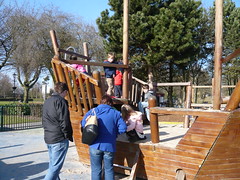
I'm reading Michael Mayne's book This Sunrise of Wonder - at last, Jim, if you're reading this! - and it's fair got me thinking. Especially after last weekend, when I was visiting a Thomas the Tank Engine paradise with my four grandchildren and their assorted parents. Before we all headed away from the hotel and the theme park, we spent a couple of hours in a nearby playpark. The contrast with the theme-park rides was striking. Yes, there were swings and roundabouts, but there were also climbing frames and the wonderful galleon in the photo. And it was the galleon that kept all four of them playing together the longest. I could hear the oldest allotting roles to the others, who weren't really paying much attention; the smallest child was ferrying sand to the top of the chute that is just visible exiting the hull in the bottom corner; another had purloined a bottle of water the better to demonstrate the drainage the same chute afforded. There was another hiding under the deck, and the strange child that found himself in the middle of the gang was pressed into service as a pirate. And no-one wanted to come away.

And the combination of the book and the grandchildren's enjoyment of imaginative play brought an epiphany. I could remember my childhood bubble. And what was better: I could remember it in such a way that I could feel it again, feel it the way I did when I was under ten (the family moved house when I was ten; it's a useful watershed in my library of mental images of childhood). Here are some of the stand-outs:
  Sitting on the grass in front of our holiday house in Arran, around 6pm on the first of July, gazing at the hills at the head of Glen Cloy, smelling the bog-myrtle on the breeze, ready to burst with happiness because the summer was a lifetime long and I was back in the place I loved more than any other.
 Walking behind the rest of my family after a trip to the cinema - alone, because I was in a movie and Byres Road was actually Dodge City and a dangerous environment.
  Playing under and on top of the kitchen table, because it was a boat. The trick was to get onto the top without falling into the sea of the rest of the floor.
  Spending hours in a hollowed-out rhododendron bush with a few friends as the Arran rain teemed down, happy as could be because our 'house' kept the rain out.
  Looking forward to time alone - on a bus, on a train, in my bed - because I wanted to "think" - which I now realise was re-entering a bubble which was always there.
  Climbing rocks on the shore in the conviction that I was on a sheer rock-face on some distant mountain.

I could actually go on all day. Even writing these makes me feel I want to go out to play. The point is that it was all wonderful. Imagination took me way beyond what anyone else would have seen. On the odd occasion when I have a grandchild to myself, I like to put that child into a situation where they too will wonder at something I love - is this because I now need an excuse to be child-like?

Dammit. I don't need excuses. I'm fortunate in that I worked with young people for my whole life - ok, they were teenagers, not tots, but they were amazingly easy to make young again with a little encouragement. I was able to avoid growing up. I grow old, I grow old ... but I'm not going to succumb to the equivalent of Eliot's rolled trouser-bottoms: no. I may have reached the cardigan/tweed skirt era beloved of a previous grown-up generation, but there's nothing appealing there. Who cares what the world thinks?

I've had a taste of life in the bubble again. The life of wonder has been re-awakened, and it's ... wonderful.

Monday, January 02, 2012

Glass baubles and messages


Glass bauble
Originally uploaded by goforchris.
I was remarking with friends last night how traditional my style of Christmas tree is. We sat, side by side on the sofa, mellow with drink and food, and stared at it: multi-coloured lights, random decorations from the past 40 years, and fragile glass baubles, eight of them, which have miraculously survived their annual trip down the loft ladder and back, as well as two flittings. My memories had been further jogged by the sight of the Downton Abbey tree, dripping with lametta - I remember that my father always insisted that there had to be a generous quantity of lametta or it just looked silly, and who was I to demur? It's many years since I used these silver strips to hang from the tips of the branches (a third of its length to be draped over, the rest to dangle), but I replaced my forty-year-old multicoloured Pifco lights only last year (they had died in their box) and they in turn had been my attempt to replicate the inch-long pointed coloured bulbs of my parent's lights.

Of course, I've been on about all this before, as several of the links above will lead the diligent new reader to discover. But last night the brain wandered off somewhere, and lo: there were other memories. Like being sent for the messages. What age was I, for example, when I had to go for potatoes by myself? Maybe six, seven? I remember being given the brown leather shopping bag, with a folded newspaper inside. Don't forget to get the paper put under the potatoes to keep the bag clean. And off I went, up Novar Drive to the top, to the grocer's shop in what we called "Wee Hyndland", the row of shops opposite St Brides Episcopal Church and Hyndland Parish Church in all their red sandstone splendour. There were no roads to be crossed - presumably it was thought a safe errand. It was, however, terrifying. First I had to make myself seen in the queue of adults - women, natch - and hand my bag over to a large man with a bald head and a blue apron. It was all very well for my mother to direct him what to do with the newspaper, but words failed me and I watched despairing as he shot a shiny scale-pan of earthy potatoes - could it have been half a stone? a quarter stone? - into the bag in which I could see the still-folded paper reposing uselessly down one side.

I think I got a row for that, and I know I suffered mass disapprobation on the day when, for some unfathomable reason, I was sent to collect the newspapers for all the houses in 66 Novar Drive. It was a windy day. Much of the "pavement" was a muddy sidewalk beside allotments (plots?). People didn't like their mud-spattered, randomly-ordered newspapers. But I think I was maybe five at the time, and looking back I think there was either lunacy or child-abuse at work.

Amazing, isn't it, what can come to mind under the stimulus of a drop of champagne and the peeling of some King Edwards?

That's Christmas for you ...

Wednesday, August 17, 2011

Scraps of memory

Does the pic above stir a flood of memories, dear reader? If it does, I fear you may be approaching the sere, the yellow leaf, as I am ... but let's have another wee wallow in the 50s, huh? For some reason I cannot fathom, I bethought me the other evening (what has happened to me? Shakepeareitis?) of the days when I used to collect scraps and, in the appointed season, to exchange them with other small girls in a highly ritualised form and always in the same place.

If you don't know what I'm talking about, I have to explain that Googling "scraps" tends to take you to strange places; "die-cut scraps" provides more information. And that's what they were - coloured pictures, of all manner of people/animals/flowers, die-cut either into squares (boring) or round the outline of the picture, as in the illustration above. These were sold in sheets, linked as shown, often but not always of the same picture. You carefully took them apart, trimmed the paper tags, and put them into your collection. Strangely, it was more fun to acquire sets of scraps by barter than be simply buying them. You would look out for pictures that you already had an example of - these blooming angels came in many sizes and cloud-colours - and traded your own less precious scraps to acquire them. The most precious of all were "pre-wars" - though now I look at example of Victorian scraps online I wonder which war we were referring to. They were identified by the muted quality of the printing - fewer dpi, I think - and the quaintly old-fashioned subjects, and they were worth any number of scraps bought just last week.

The sacred place for the Scrap Season (remember how there used to be a time for skipping, a time for ball games and a time for scrap swapping?) was the shed of the girls' playground in Hillhead Primary School. Along the wall on the right in this photo, there used to be a bench, and it was there that we sat, usually on wet days, with our scraps in convenient books, one scrap (or set, if you had different sizes of the same scrap) to a page. I had two such books, which I think were old school text books, with cloth covers and plenty of pages. When a potential customer came along, you handed over your own books and took hers; you then leafed through the pages looking at the scraps lying inside and when you found one you wanted, you put it up in the manner of a bookmark. The books were returned, and you then went through the marked scraps, either putting them back inside the book as not being available, or offering them for one you wanted yourself.

I feel sure my books are still lurking somewhere in the midden I call home, but I can picture them now. The top right corner of each page is dark grey with years of spitty fingers, and the books are entirely dog-eared. The Season came and went, and the scraps returned to obscurity until the next year. I don't know what made me think of it, but I have already spent over an hour looking for the collection. I can't see my grandchildren being at all interested, but I can't help wondering if the only people who might collect scraps nowadays will be my age. Take a look here if you're interested.

Thursday, January 13, 2011

The parental role in education

The radio was on this morning, wittering away in the background, when I caught a few sentences and realised that Call Kay was inviting us to consider the role of parents in their children's education. I didn't listen for long, lest I be tempted to contribute (I have phoned this programme twice in the past - don't want to get a name for myself) but it started a train of memories. Hence the photo. It was taken - by me, as I'm not in it - in Paris. I was 14 at the time, my sister 11. I know this because I can recall my mother telling some French waiter that we were "onze et quatorze" - and so right in the age range that I can remember most vividly when it comes to thinking about school, homework and study.

The chat on the radio today was looking at the perceived failure of state schools adequately to prepare their students for the competition to enter the top universities, and asking how much parental pressure/support/coercion was needed to supplement the work of the school. As a teacher, a parent and - a long time ago - a child, I think I have quite a rounded picture of this - but in this post, I'd like to share the part my home played in ensuring that I succeeded in what I set out to do.

By the time I was ten, we lived in a Victorian terraced house in the West End of Glasgow, with four bedrooms and two public, as well as a large kitchen, a wash-house and a lined loft. Loads of room into which one could vanish - but in winter it was cold, and we tended to live between the dining-room and the kitchen. That meant piano practice was less assiduous than it might have been, but was generally done before the evening meal - perhaps on the premise that food would replace the heat lost during practice. Dinner was over by 6pm - both parents were teachers, both home at the same time as us. For the next three hours, my sister and I sat at the dining room table and did homework - and there was always a great deal of this. (We were at a grant-aided selective school, and we could be asked to leave if we didn't work). Until about 7pm, we weren't allowed to make a noise. In fact, I got hell once for throwing a pencil down on the table, as my father had fallen asleep in his chair and I woke him.  Once his post-prandial kip was over, however, we had two hours in which both our parents took a hand in our struggles.

Father was always deeply critical of the teaching in the English department of our school, so we had a great deal of incredibly thorough input on texts we were studying. That went without saying. What was more remarkable, I thought, was that he would also work out from first principles what was going on in the Physics problems I had such trouble with - sums involving moment, I recall with horrifying clarity. My mother, meanwhile, would sit down with my tiny, battered copy of Caesar's Gallic Wars or, later, Virgil's Aeneid (Book 2) and, as she put it, "break the back of it" before I set to work on my preparation for the next day's terrifying oral translation session round the class. She also pushed us to work at French, which I personally hated because of the accent involved, and made several visits at parents' evenings to ask why we had so little written homework in French (lazy teacher; fluent as married to French woman but no fire in his chubby belly). That holiday in Paris, by the way, was by way of encouraging me at the end of S2 - I can still remember the chagrin when the lift man in our hotel corrected my pronunciation of "quatrième".

All this must have taken an enormous amount of dedication and energy on the part of two people who had already taught for a whole day - or even the half day done by my mother, who would then have had to shop (no car, so limited to what she could carry each time) and deal with our sizeable and dusty-corner-ridden house. There was no thought that my sister and I should do housework, other than during a holiday. But perhaps the biggest single contributing factor was the absence of a television. Despite my sense of deprivation at never having seen Quatermass or Emergency: Ward 10 my father refused to have a set until I had graduated (I lived at home when I was at Uni). He said I'd become an addict and that would be the end.

How right he was. I'll return to this subject - I want to think about my own deficiencies when it came to fulfilling the parental role - but for now, I'll indulge my latest addiction. Another go at Bubbles HD before I head out?

Tuesday, December 07, 2010

Ghosts of winters past

Pretty, innit? Snow on Newhaven Harbour, with the Forth Bridges in the distance. A good cue to get me started, as the Forth Road Bridge was closed for a time last week because of snow/ice/not-gritting-lest-the-bridge-is-corroded-by-salt. Now the country is closed, it seems - all these poor souls stuck on the M8 yesterday, and perhaps still as far as I know. Could have been us, too - but we left Edinburgh on Sunday, when the road was absolutely clear. Someone loves us ...

But to my theme. It's obvious why yesterday's terrible stramash happened: people rose early for work, as the world now seems to do, saw that it was dry - and set off. When they were on their way, strung along the ends of the motorway or whatever, the snow began. Someone jack-knifed; they all ground to a halt. Result: blocked road. Gritters couldn't get along it. No point in whining that folk ought to have stayed at home, as several moaners did on Radio Scotland this morning. They didn't have the choice when they set out. Perhaps the gritter moguls should have trusted the weather forecast and sent the lorries out early - but that's easy to say now. Besides, it was apparently too cold for the salt to have much effect - certainly the bit of path I spilled water on while emptying a basin (our waste pipe was frozen) is now a sheet of ice, despite my immediate application of salt at the time.

I don't remember this massive disruption from my past. I do remember fierce winters - for heaven's sake, I can just remember a morning when we had a coal briquette in the range surrounded with potato peelings*, in what must have been the winter of 1947 when the pipes in the tenements all froze and people had to use stand pipes in the streets. I can remember being sent home from school when the outside lavatories froze - the joy when the jannie would appear in the classroom with his mop in his hand and whisper to the teacher and we'd all go home just after playtime. (Presumably our bladders were supposed to last till we got home). I remember the joy of sledging all alone when I was home and my pals weren't - the virgin snow above the old air-raid shelters in Novar Drive. And of course I remember the brown sugar of the old snow in Great Western Road, and trudging up the hill in the snow to the number 10 tram terminus. And there were wonderful patterns of ice on the inside of the windows in the mornings - ferns, mainly, and starbursts. They were especially beautiful in the small maid's room off the kitchen where I slept, I remember. And I was the lucky one - the range in the kitchen kept the temperature in my wee room bearable.

Of course it must have been bad. And writing this has answered my question to myself, now I think about it. I saw only the effect on me. We didn't have a car, and there were trams (though I don't know how well they functioned in snow, and now there's no-one alive in my family who can tell me, dammit). We were accustomed to put on multiple layers of clothing and walk. We had wellies - though once I had a warmer pair of boots, in blue leather with crepe soles to which the snow clung in such layers that walking became impossible. We made fantastic slides in the playground and hurled ourselves along them; we were consumed with rage when the janny salted them while we were in class (presumably they had rudimentary Health & Safety even then). I loved the snow, my parents didn't seem unduly perturbed by it, we didn't have to worry about loved ones who were driving across the country/flying to London/travelling to Paris. My father had the longest commute - from Hyndland to Springburn - every day, and the rest of us took the tram, about 4 stops, I think.

Maybe we expected less. Our shopping was local, our messages limited to what we could carry. The shops had basics, and seasonal basics at that. When I was really small, we still had rationing. We had powercuts and candles, coal fires and a range in the kitchen. I can remember my mother cooking on it in a powercut. We all had chilblains every winter. It must have been grim, and I would probably hate it now.

We did, however, survive - and I look back on my childhood winters with undiluted pleasure. But excuse me while I go and turn up the heating ...

*This was, I believe, because the stockpiles of coal were frozen solid and no coal could be taken off them.

Friday, April 23, 2010

Rose, thou art sick ...

Feeling oppressed by the latest in a series of colds - after 6 years without one, I've had 4 in the past year as well as a proper dose of flu - I found myself recalling the colds of childhood. Nowadays, children have their own dedicated medicine - Calpol in varying strengths, for instance - but in the late '40s and '50s there didn't seem to be any such thing. This morning I was suddenly taken back to the taste of Disprin crushed in a teaspoonful of raspberry jam, and the bottle of pink liquid - may have been called Mystol - that was dripped into my nose from a glass dropper to relieve congestion. And I remembered the miserable long nights when I would waken with a raging thirst and try to eke out the tumbler of water that had been left beside my bed - why, in God's name, did I not get up and replenish it? Was I too small to reach the sink?

At that time my parents' bedroom seemed miles from where I slept in the maid's room off the kitchen. The distance must've worried them too, for when I was seriously ill (as when I had whooping cough, for instance) my long-suffering father would sleep in the kitchen on the camp bed he'd brought back from the Western Desert; later I can remember changing beds with one or other of my parents - who never enjoyed sleeping in a double bed - so that someone could keep an eye on me. This was a great treat, as my own bed had a horsehair mattress of fairly unyielding discomfort, and I found their beds miraculously comfortable. Less yielding was the stone hot water bottle that my father liked - you could break a toe on it, or send it crashing through the floor to the flat below if you tried to kick it out of the bed. (I think that was probably an exaggeration, but it convinced me)

Another thing about Being Ill in those days was the fact that I seemed to spend interminable hours - days, even - in bed. You didn't get up until you were better in these days; I suppose the house was cold and there was no telly to seduce you, but it was a feature of recovery that when I did emerge into the family again my legs would be as wobbly as those of a new-born colt. I read hundreds of books - I clearly remember reading Edward Whymper's Scrambles amongst the Alps when I was eight, having run out of anything more suited to my own age group. Perhaps my progress in English was directly linked to all these shivery days in bed.

All this reminiscing is making me feel worse, but I have one last memory of a symptom which to this day tells me I'm under the weather: when I was ill, the toothpaste never tasted right. Does that ring any bells out there?

Saturday, April 18, 2009

Nectar in a tin

I'm indebted to Neil for reminding me of the drink that was the mainstay of my childhood. Creamola Foam must have been a cheap alternative to the red cola and fizzy orange that appeared at parties and on holiday visits to cafés, but my main memory of drinking it is very clear - so clear that I can taste it now - and strongly linked to one place. That place is on Arran, at a point in North Glen Sannox (not to be confused with Glen Sannox, but a less-well-known glen slightly to the north) where huge slabs of pale grey granite jut out into the very middle of the North Sannox burn. This is still one of my favourite places on earth, and will forever be associated with what would be a typical 1950s picnic: Macvitas, triangles of Dairylea cheese, floury muffins with strawberry jam, slightly flattened from their sojurn in a rucksack - and Creamola Foam, preferably orange flavour, made in a plastic tumbler with water scooped precariously from the burn.

This was Creamola Foam at its best, and it's easy to see why it was a winner for whoever was carrying the drinks: a small tin and a spoon make for much less of a load than a bottle of diluted squash. Perhaps the location explains why I recall it with such fondness, for I am now convinced that in my childhood we never drank anything like enough water and at the end of a muddy walk we'd be parched with a thirst that made this chemical concoction into nectar.

To the best of my recollection, we never bought this stuff for my own kids - though I'm open to correction if they ever read this - because I have a feeling I tasted it in later life and realised my tastes had moved on. Just as well, really - it doesn't seem to exist these days.

Update: Neil assures me I did indeed buy it for him - he wouldn't have mentioned it otherwise.

Tuesday, January 01, 2008

Ancient History

When I was but a little tiny girl – see photo for charming visual aid – we didn’t really make much of a deal of Hogmanay. My parents may have stayed up to sip a decorous sherry, but to the best of my knowledge there were no drunken visits from neighbours, and I was well on in years – well, maybe 13 – before I too could see in the New Year. Later, of course, there were the years of feeling some pressure to be out ‘having a good time” – but the reality never proved enticing enough and it wasn’t till I moved to Dunoon that socialising the night away seemed feasible, with children in tow. Later still, of course, there was the dreadful night when my children seemed to tow me home after too much jollity – but we’ll draw a veil over that.

New Year’s Day, however, always seemed to have a special brightness in my childhood memories. For a start, it always seemed to be sunny and cold, so that a walk in the morning to give us an appetite for our delicious dinner seemed positively enticing. I recall one occasion when it was so cold that the pools of revellers’ vomit were frozen on the pavements, and when my father pointed out with some glee the peculiar gait of the very drunk – a sort of Michael Jackson moonwalk, performed in slo-mo with great concentration and ending in disaster when a change in direction was required. Of course, we didn’t expect our mother to come on these morning outings – she cooked, and I? we? had our father to ourselves, which might just lead to an adventure like taking a shortcut through the coal yard by the railway or an exploratious meander (and that’s a quote) through the woods of Dalsholm park.

I was recalling all this last night as we drove home after the kind of relaxed enjoyment that is possible with close friends, good food and champagne with hibiscus flowers at the bottom of the glass (I know – but it was dead festive). We passed a lone youth in a hoody, sitting on a bench near the deserted stadium in the rain. His demeanour suggested despair, and he looked about 15. Who knows what had landed him there: too much drink, drugs, loneliness, being dumped – or simply a house full of noisy adults he couldn’t bear to face. I’m glad I was so strictly brought up – it made life much easier.

Happy New Year, chums!

There are actually two literary references in the above. Usual rules apply.