I was reflecting the other day how much more difficult simple faith (in God, mostly, on this occasion, but not exclusively) has become in the past century or so. And I think I was ruminating ruefully - do you have a vision of a sad cow? Trouble is, we know too much. All of us, in varying degrees, are equipped with more awareness of what constitutes our surroundings than were our forebears.
Start with something non-religious. Think of these medical dramas which show even the time of my own childhood, the documentaries which show doctors as white-coated invincibles, the patients as wide-eyed innocents ready to believe that all will be well as they descend into what Robert Frost called "the dark of ether". Nowadays fully-fledged hypochondriacs like me can look up procedures, statistics, symptoms, photos (God preserve us from the photos) and learn doubt. We realise when we are being soothed, and the best that can happen is that when we're actually in extremis we feel soothed. It's when normality returns that the doubt arrives.
And I think it's much the same with religion. All the old certainties - from hell to heaven and places in between - are now subject to the scrutiny of science and knowledge. We know what's up there, out there, beyond ... it's not a mystery any more. We can no longer feel sure that God's in his (note - his) heaven, which is up there in the sky. I remember wrestling at University with the teleological and ontological proofs of the existence of God, at a time when I didn't believe in anything. It was a struggle, but not a spiritual one. It changed nothing; it was easier than Formal Logic; I passed the exam.
All this conspires to make me increasingly irritated at people who assume that if you adhere to a faith you are either "throwing reason out of the window" (what my father said when I announced I was going to be confirmed at the age of 28) or are somehow sufficiently ill-informed to accept a child's version of religion. (I also become irritated at Christians who insist that that's the only way, but that's another story). Someone who thinks and challenges and argues is going to bring that attitude to what they call God - and if having done so they can find themselves happy with the language and attitudes of a faith system, that is where they will exercise their minds as well as their souls.
God - that word we use to describe the indescribable, remember? - God hasn't shrunk because we know the workings of the world that we used to consider a sacred mystery. God isn't the little shrivelled creature of some celebrated fiction. My understanding of this word, this concept, is of something at once all-encompassing and omnipresent and at the same time tiny enough to be within every mind that allows itself to wonder, every heart that allows itself to melt. God is in every moment of thankfulness; still there when the heart hardens and shuts God out.
When a faith-structure allows for this kind of vision, provides the framework of beauty and wonder and loss of the self-consciousness that inhibits, gives space for sorrow and joy and the tears of both, that is what I call Church. When I find myself in it, I am grateful. When it is threatened - and it can so easily be threatened - it is like an impending death. When it solidifies into something else, I'm better off without it, sad though that feels.
But try explaining that over the dinner-table. Or on a bus.
Showing posts with label church. Show all posts
Showing posts with label church. Show all posts
Tuesday, February 28, 2017


Monday, August 24, 2015
No scones, no stereotypes

 But yesterday I realised that I'd been indulging in a spot of Mission (with a capital M) on Saturday. Yes, it was on the initiative of Provost Kelvin and his pals in St Mary's Cathedral, but there I was walking through the streets of my native city, in the middle of the Pride parade, holding aloft a placard saying "The Episcopal Church Welcomes You". And as I've remarked already, people clocked this, pointed out the placards and the big plastic banner (quite heavy after an hour) and took photos of us and - on more than one occasion - gave us the thumbs-up.
The surprise element in Mission. That's what was up on Saturday, and what used to work, I felt, when I was teaching. It was underlined by Kelvin's wee badge: Yes, I am real. Not for me the polite presence behind a tea-table or the lone voice on the doorstep - because both would put me off religion for a start. Mission as the unexpected presence, the assertion that one can be a Christian and not conform to stereotypes - that's where I belong.
Another problem nailed. Cheers, Kelvin!
Monday, April 27, 2015
Being Wilma, or a day in the life of a church organist.

Now we can't tell from this picture if Wilma is any good at the organ. After all, she's a wee old wifie who'd be fair game for a sneer anyway. But that's not the point. This is:
If the organist plays a prelude (the music before the service, if it's not a familiar word) he or she (I shall give this dual gender up from now on - take it as read) has probably taken time to choose what to play (I can't do that one again - someone will notice I did it last week ...) and had a bit of a practice at it. If she wanted to use the pedals, that would probably mean spending time in the unheated church (midweek church is usually baltic) because she doesn't have an organ in her sitting-room.
Sunday comes, and Wilma is there early enough to change her shoes and get her music out. She may have to put the hymn numbers up as well, but she hopes someone will be there to help with this. Five minutes before the service begins, she sits on the organ bench. There is bedlam in the church as people greet one another loudly, argue over whose turn it is to read, or just catch up on the week's news. She starts to play, straining to hear the quiet passages above the noise. It's still noisy as she finishes, but as if by magic the very fact of her ceasing to play quietens people - because someone will likely announce the first hymn any minute now.
And that's only the Prelude.
By the end of the service, the valiant Wilma has played five hymns and accompanied the singing of the Liturgy. (We're in a Pisky church ...). Depending on the preference of the celebrant, the procession will either wait for Wilma to play something else (a Postlude) or will start processing in the expectation that she'll get going in a moment. So Wilma plays again. This week, she's playing something rather beautiful by Orlando Gibbons. Last week, she hadn't had time to look out something and instead extemporised on a tune that had been used for a hymn. She has a gift for improvisation, but is never satisfied with her own efforts. This matters not a jot: the congregation had burst into spontaneous applause at the end. Not so this week. The Gibbons flows serenely to its conclusion and, released from prayer and politeness, the congregation gets back to its conversations.
Wilma isn't happy. She knows all too well that the Gibbons met the musical needs of perhaps two people in the church besides herself. She also knows that she could improvise tear-jerkers or rabble-rousers every day of the week, but that wouldn't make her happy either. She can't help wondering if the people who applaud one week and not the next know how insulting they are. She ponders the possibility of playing nothing outwith the actual service (and did you know that the use of "outwith" is confined to Scotland and that's why I have a red dotted line under it just now?) Would it worry people, having nothing to signify that it was time to be quiet, time to go for coffee?
Who knows. Most of all, actually, Wilma wishes one thing.
She wishes they wouldn't applaud.
Thursday, December 18, 2014
Long ago, in a universe far away ...
I have been thinking I ought to write to the College of Bishops about that pronouncement that is now all over yesterday's Herald, quite apart from anywhere else, but my exhibitionist side actually prefers to ruminate here, where anyone can see it and no-one can decide to interpret it in their own way in private. Strangely, it was learning of the death of Bishop Michael Hare-Duke that stirred up the memories that, it seems to me, make this latest situation so absurd.
Long long ago, when I was very young and had only been a member of the SEC for 5 years, I was chosen to be one of the two lay representatives from Argyll and The Isles to sit on the Provincial Synod. This relatively small body met annually in Perth, and it was with some trepidation that I travelled there that first year (it was 1978, the day Pope John Paul 2 was elected) to find that I was the youngest person in the Synod and hadn't a clue what was expected of me. I remember spending many hours debating the language of the New Liturgy - what is now the 1982 Liturgy and itself regarded as positively old hat. As the years passed - during which the Provincial Synod abolished itself and the RCC and I vanished from the wider church and concentrated on my day job - I became aware of what was going on and who was who in the hierarchy - and one of the most interesting of the bishops was Bishop Michael, the poet and thinker who did so much to shape the 1982 Liturgy.
But to my point. One of the first issues I recall being involved in voting about was The Remarriage in Church of Divorced Persons. This gave rise to much heated discussion and seemed a Very Important Matter Indeed. And then there were women. In the run-up to this particular Synod my husband answered a phone-call (I was out). The conversation ran thus:
"May I speak to Christine, please?"
"I'm sorry, she's out. Who's calling?"
"It's George."
(Suspiciously) "George who?"
(Plaintive)"George the bishop."
"Oh. Hello. She's not here."
"Give her a message, will you? For God's sake tell her not to vote for women priests."
"Oh. Right. I'll tell her."
And he did. At the Synod the next week, a lovely older woman (maybe the age I am now) told me I was the kind of woman who ought to be ordained. I didn't know whether to be gratified or horrified. Her son became one of our bishops, incidentally, but he is no longer with us.
It should be painfully obvious why I'm telling these anecdotes. I'm now older than any of the current diocesan bishops, and have a far longer memory than to be able to let their current burst of ill-placed authoritarianism pass without asking them what in all seriousness they think they're at. If it weren't so serious, so damaging to people I care about and the institution I still, after all the years and all the setbacks, care about also, I'd laugh. I'd laugh the way I do when I hear small children playing - "Let's make it that you're the mummy and I'm the daddy"... "Let's make it sound as if we can actually tell people what to do/think/believe."
I'm sorry. We're adult Christians. We've learned about justice, compassion, equality, fairness - not to mention common sense. And long ago, Bishop Michael Hare-Duke exemplified these qualities to a very young, very inexperienced new Christian. The last time I met him was some 7 years ago - at the first Provincial conversation about the status and experiences of gay Christians. We were both much older - but he at least hadn't changed.
Long long ago, when I was very young and had only been a member of the SEC for 5 years, I was chosen to be one of the two lay representatives from Argyll and The Isles to sit on the Provincial Synod. This relatively small body met annually in Perth, and it was with some trepidation that I travelled there that first year (it was 1978, the day Pope John Paul 2 was elected) to find that I was the youngest person in the Synod and hadn't a clue what was expected of me. I remember spending many hours debating the language of the New Liturgy - what is now the 1982 Liturgy and itself regarded as positively old hat. As the years passed - during which the Provincial Synod abolished itself and the RCC and I vanished from the wider church and concentrated on my day job - I became aware of what was going on and who was who in the hierarchy - and one of the most interesting of the bishops was Bishop Michael, the poet and thinker who did so much to shape the 1982 Liturgy.
But to my point. One of the first issues I recall being involved in voting about was The Remarriage in Church of Divorced Persons. This gave rise to much heated discussion and seemed a Very Important Matter Indeed. And then there were women. In the run-up to this particular Synod my husband answered a phone-call (I was out). The conversation ran thus:
"May I speak to Christine, please?"
"I'm sorry, she's out. Who's calling?"
"It's George."
(Suspiciously) "George who?"
(Plaintive)"George the bishop."
"Oh. Hello. She's not here."
"Give her a message, will you? For God's sake tell her not to vote for women priests."
"Oh. Right. I'll tell her."
And he did. At the Synod the next week, a lovely older woman (maybe the age I am now) told me I was the kind of woman who ought to be ordained. I didn't know whether to be gratified or horrified. Her son became one of our bishops, incidentally, but he is no longer with us.
It should be painfully obvious why I'm telling these anecdotes. I'm now older than any of the current diocesan bishops, and have a far longer memory than to be able to let their current burst of ill-placed authoritarianism pass without asking them what in all seriousness they think they're at. If it weren't so serious, so damaging to people I care about and the institution I still, after all the years and all the setbacks, care about also, I'd laugh. I'd laugh the way I do when I hear small children playing - "Let's make it that you're the mummy and I'm the daddy"... "Let's make it sound as if we can actually tell people what to do/think/believe."
I'm sorry. We're adult Christians. We've learned about justice, compassion, equality, fairness - not to mention common sense. And long ago, Bishop Michael Hare-Duke exemplified these qualities to a very young, very inexperienced new Christian. The last time I met him was some 7 years ago - at the first Provincial conversation about the status and experiences of gay Christians. We were both much older - but he at least hadn't changed.
Tuesday, June 17, 2014
Time to think ... about Synod
 |
| P's & G's, complete with MDF gallery? |
Having been one of the signatories to a Rule 10 motion that would have hastened us along the path to legislating for same-sex marriage in church, I was pretty fed up when the motion failed to attract the two-thirds majority that would have allowed us to deal with the subject in open debate. Synod wanted the debate - but not quite enough of us wanted it. I have a strong suspicion that the secret ballot, as we tautologously referred to it, along with the confusion resulting from a bishop-led objection to a show of hands, led to several inattentive or merely poor souls voting the wrong way - in other words, not as they actually thought they were voting.
This raises another scunner (no, auto-correct, not scanner: I'm Scottish.) The venue for this year, the once-grand and now modernised cavern of P's & G's, didn't make for the same contact with the chair as we had in the more regimented but better-lit surroundings of Palmerston Place. Punters in the middle or rear of the space couldn't communicate confusion or unreadiness without a great deal of palaver involving roving mikes and the bearers of the mikes peering into the throng to try to find the confused/challenged/challenging one. This being the case, it was more than ever important for the various chairs to speak with clarity and decision, and certainly not to rely on the overhead screens to make up for the deficiencies in their own communication skills. (People don't always cast their eyes screenwards in moments of stress, especially when they're rummaging through their Synod papers and have their reading glasses on anyway.) And, as every teacher knows, you can't simply assume that everyone is paying attention the moment you open your mouth; the table-group layout makes (again, as every teacher knows) for covert communication or simple distraction.
But the single thing that got to me this year was the sudden descent of a whole bunch of protagonists into fuzzy, warm and ultimately vapid religious jargon. And tone. There. That's it. There's a whole raft of expressions that belong in this jargon, and some others that are pressed into service and will never be quite the same again (like Francis of Assisi after Margaret Thatcher had appropriated his words). "Unpack" comes to mind, and they're not talking about the messages (shopping, if you're not from these parts). No-one called a spade a spade, let alone a bloody shovel, and there was no place for what one commentator has described as "honest fury". Those who were feeling such fury had nowhere to go, because it would have been smothered in soft fuzziness, smiled at and forgiven.
Now, I was personally grateful for individual kindness and concern in the aftermath, even as I still raged for friends old and new whose hurt and frustration were all too apparent - but I have huge problems for this kind of institutionalised, forced gentleness. For a start, I think it betrays the god I believe in. I think it castrates the prophet and makes a virtue of passivity. And where was the passion, the leadership that would have given some sense of a vibrant community realising its past and grasping the opportunity to move into a new, juster present?
I can't at the moment think if I'm actually at the end of my time on Synod, or if I have another year to go. Maybe someone reading this will be able to tell me. The Primus gave us a sliver of hope that things may move in 2015, but who knows whereI'll be then? A friend gave me even more hope in that his perceptions have changed post-Synod, and that is joyous news. That's the news that makes me glad I waited to post this, as there would have been nothing to redeem the situation had I leapt in. But if anyone is planning any more soft play areas for the church, any more padded "conversations", I'll be returning to a quip that was going the rounds on Facebook recently:
If anyone asks you "What would Jesus do?", remember that overturning tables is always an option.
Friday, April 25, 2014
Cascading across the years ...
Next week there is to be a meeting in Pitlochry - a Cascade Conversation called Listening across the Spectrum. Cascading I understand - I was once sent on a course on managing stress, on the understanding that I would share with my colleagues in school the insights gained over four sessions. Perhaps it was my failure to induce a hypnotic trance in my cascadees that rendered the cascading less than fruitful; I did enjoy the afternoons away from the weans, and found the experience of being almost-hypnotised fascinating but that wasn't really the point. But this conversation won't be about stress, and I shouldn't imagine it will be facilitated by a hypnotherapist. No, this is part of the process for discussing same sex relationships throughout the Scottish Episcopal Church.
What - again, do I hear you ask? Well you might, especially if you have nothing to do with church circles. But I'm saying it too. I was invited to attend this conversation, and part of me is deeply scunnered that a standing commitment prevents my going - but part of me is cheering quietly. Why? Because it's years - yes: years - since I asked the previous Bishop of Argyll when we were going to begin the so-called "Listening Process" in our neck of the woods; it's years since the powerful day of intense conversations in Oban led to a province-wide day in Stirling. It's almost two years since our Synod threw out the Anglican Covenant. I don't think I can bear to pussyfoot around the same elephant in the room again. What are we playing at?
This is what it says in the most recent online Inspires: The Cascade Conversation is being held because the subject of human sexuality is one on which there are differing views and because it raises controversial and challenging issues not just for the Scottish Episcopal Church but for all denominations. During the Cascade Conversation, it is hoped that participants will engage with the subject, and with one another, in a way which synodical procedure does not always permit. In trying an alternative way of addressing a complex subject such as human sexuality, it is hoped that the Church as a whole will both learn and benefit.
And that sounds just fine, doesn't it? Or does it? What do we actually mean by "trying an alternative way of addressing a complex subject such as human sexuality"? I shudder to think. In my no doubt naive and thoughtless fashion, I long ago reached the realisation that the faith I had come to well into my adult life meant that I was going to have to get away from the comfortable and the customary and do things that part of me shrank from - like lying down in the road in front of a foreign power's nuclear sub base, for example, like standing up in a court of law and saying yes I was a Christian and that yes in moments of extreme provocation I would use bad language to a police officer (the Sheriff thought that was perfectly reasonable, since you ask), like making political speeches from the back of a lorry, like going on telly. And it meant also that I was going to have to stand up for justice and truth and fairness in society - and in the church.
I have to confess that I've shed much of the respect for form and authority that I had half a lifetime ago. So any injunction that what transpired in the confines of an assembly was to remain secret would tend to have the opposite effect on me - because I've had enough of hugger-mugger discussions and decision-making. People find it difficult to accept that some of their fellow-Christians are different from themselves? Tough. I find it difficult to accept that some of my fellow-Christians are narrow-minded bigots. I find it really tough to keep a civil tongue in my head when provoked. And I really, really struggle to love people who behave in an unlovely fashion - and that includes myself. But I look at congregations and I see in them gay people, with and without partners, and I see people like me who have been a part of the conversations in the wider church, and I wonder: why are we ignoring this elephant in the very rooms it currently inhabits? Why do we need to wait till conversations between carefully selected people have taken place before we learn more and learn to be more whole? Are we so terrified of the real struggle that loving and understanding will involve?
And it's that struggle that matters. If this Cascade Conversation is going to pour over the church (see - I'm expanding the metaphor) in such a fashion that it will sweep away complacency and sheer bloody ignorance and will in its place bring understanding and a sense of shame for the awfulness of our past attitudes and an urgent desire to right the wrongs done to LGBT Christians over the years, then it will be a joyful flood indeed, and I shall be deeply sorry not to have been a part of it.
I'm not holding my breath. But I'd love to be proved wrong.
What - again, do I hear you ask? Well you might, especially if you have nothing to do with church circles. But I'm saying it too. I was invited to attend this conversation, and part of me is deeply scunnered that a standing commitment prevents my going - but part of me is cheering quietly. Why? Because it's years - yes: years - since I asked the previous Bishop of Argyll when we were going to begin the so-called "Listening Process" in our neck of the woods; it's years since the powerful day of intense conversations in Oban led to a province-wide day in Stirling. It's almost two years since our Synod threw out the Anglican Covenant. I don't think I can bear to pussyfoot around the same elephant in the room again. What are we playing at?
This is what it says in the most recent online Inspires: The Cascade Conversation is being held because the subject of human sexuality is one on which there are differing views and because it raises controversial and challenging issues not just for the Scottish Episcopal Church but for all denominations. During the Cascade Conversation, it is hoped that participants will engage with the subject, and with one another, in a way which synodical procedure does not always permit. In trying an alternative way of addressing a complex subject such as human sexuality, it is hoped that the Church as a whole will both learn and benefit.
And that sounds just fine, doesn't it? Or does it? What do we actually mean by "trying an alternative way of addressing a complex subject such as human sexuality"? I shudder to think. In my no doubt naive and thoughtless fashion, I long ago reached the realisation that the faith I had come to well into my adult life meant that I was going to have to get away from the comfortable and the customary and do things that part of me shrank from - like lying down in the road in front of a foreign power's nuclear sub base, for example, like standing up in a court of law and saying yes I was a Christian and that yes in moments of extreme provocation I would use bad language to a police officer (the Sheriff thought that was perfectly reasonable, since you ask), like making political speeches from the back of a lorry, like going on telly. And it meant also that I was going to have to stand up for justice and truth and fairness in society - and in the church.
I have to confess that I've shed much of the respect for form and authority that I had half a lifetime ago. So any injunction that what transpired in the confines of an assembly was to remain secret would tend to have the opposite effect on me - because I've had enough of hugger-mugger discussions and decision-making. People find it difficult to accept that some of their fellow-Christians are different from themselves? Tough. I find it difficult to accept that some of my fellow-Christians are narrow-minded bigots. I find it really tough to keep a civil tongue in my head when provoked. And I really, really struggle to love people who behave in an unlovely fashion - and that includes myself. But I look at congregations and I see in them gay people, with and without partners, and I see people like me who have been a part of the conversations in the wider church, and I wonder: why are we ignoring this elephant in the very rooms it currently inhabits? Why do we need to wait till conversations between carefully selected people have taken place before we learn more and learn to be more whole? Are we so terrified of the real struggle that loving and understanding will involve?
And it's that struggle that matters. If this Cascade Conversation is going to pour over the church (see - I'm expanding the metaphor) in such a fashion that it will sweep away complacency and sheer bloody ignorance and will in its place bring understanding and a sense of shame for the awfulness of our past attitudes and an urgent desire to right the wrongs done to LGBT Christians over the years, then it will be a joyful flood indeed, and I shall be deeply sorry not to have been a part of it.
I'm not holding my breath. But I'd love to be proved wrong.
Sunday, October 20, 2013
How was it for you?

I had to laugh, though - laugh because losing the heid wouldn't have accomplished anything. I laughed at the person who informed me that the new kneeler-boards were dangerously large and caught her legs - laughed and told her it was better to be a short-arse like me. I laughed at the person who complained at the unfinished aisle. It was possible to laugh because I felt so relieved at the completion of the journey, and because I know there is still so much to be done. It was possible to laugh because we are no longer in danger of falling through the floor or being wiped out by the condemned electric circuits. It was possible to laugh because from the very first phrase of the very first hymn I knew that the acoustics were a dream, making singing a joy and speech wonderfully audible.
And it was possible to laugh because the prayers of the faithful from the past 160 years still saturate this building, because when we sang "O Lord, hear my prayer" after communion it no longer felt like singing in the wilderness, where the notes would be swept away in the wind. Truly, God is in this place - but if we forget to listen, if we can't hear God for the sound of our own voices, there is no point in any of it.
Importunate widows, spiders - they were all there with one message today. The gospel, the sermon, the hymns - they all said it. I for one found it exciting.
Cheers!
Sunday, February 03, 2013
Rebus in arduis *
It's Sunday. You've celebrated Candlemas, because you could - a day late, but in the boondocks you can't celebrate too often and get people there. It's been a joyous service, and at least one person has confessed to having their heart up in the air and tears running down their face because of the music. So you're happy. Actually, you were happy before they said that, in all sorts of ways involving children, young people capable of reading the lectionary as if it made sense, lovely imagery, a vision of how things can be ... I could go on, but I suspect I already have.
And then you go to the social area at the back of the church, greet someone standing alone - not a stranger, someone who's been coming on and off for decades - and he informs you, quite firmly, that he didn't know any of the hymns except for the first one and he'd hated them all anyway.
Time was I'd have felt wounded at that moment, for church sometimes leaves you vulnerable to the kind of barbs we don't often get thrown these days. But I've been around a lot of barb-fests, and I merely, mildly even, point out that what he derides as "happy clappy" music didn't form part of my tradition either (Church of Scotland, seduced by singing Byrd and Palestrina, in Latin) and that Mr B never chose happy crappy (sic) music and that this chap should perhaps widen his horizons ... Again, I could go on. I did, a bit - something about singing sentimental verse full of lamentable poetic diction set to dreary tunes - but I won't.
But I do wonder,sometimes often, about the future of parish worship. If I were faced with the prospect of worshipping where there was a diet of Victoriana, badly played at funereal tempi, led, perhaps, by a choir whose sopranos had voices that weren't, any more, I think I'd give up. On t'other hand, if there was an indifferent praise band with a very powerful amplifier, I fear it too would drive me away. So what am I looking for?
Easy. Either a competent musician, on any instrument, who has the gift of inspiring people to sing (and that often comes down to rhythm) - or silence. We sing too many hymns, mostly - and this is especially evident when actually hardly anyone sings anyway. They leave it to someone else. And I'm looking for hymns whose words are theologically meaningful, whose imagery I relate to, which don't ask me to think that God made us high and lowly and so on. I reckon that hymns tend to reflect the folk music of their day. That being the case, we shouldn't object to the odd bit of syncopation here and there. They also tend to reflect the world which informs their words - so we balk these days at singing that all must love the human race "in heathen, Turk or Jew", and some of us at least rejoice in discovering the songs of Christians in other countries, because the world has shrunk and we have access to a far wider song-pool than we did a century ago.
I didn't let all of this fly at the misery in the church; I'm letting go here instead. I didn't even ask him what made it all right for him to girn this way at someone who doesn't actually choose the music but who obviously had enjoyed singing it - or even just at someone who had offered him a friendly greeting. Long ago I made the decision to try to be Pollyanna till I got home - or to keep out of the way of temptation if I felt unduly volatile.
But sometimes, just sometimes, I want to throw something.
*Aequam memento rebus in arduis servare mentem : Horace. Means Remember to keep an even temper in difficult situations.
And then you go to the social area at the back of the church, greet someone standing alone - not a stranger, someone who's been coming on and off for decades - and he informs you, quite firmly, that he didn't know any of the hymns except for the first one and he'd hated them all anyway.
Time was I'd have felt wounded at that moment, for church sometimes leaves you vulnerable to the kind of barbs we don't often get thrown these days. But I've been around a lot of barb-fests, and I merely, mildly even, point out that what he derides as "happy clappy" music didn't form part of my tradition either (Church of Scotland, seduced by singing Byrd and Palestrina, in Latin) and that Mr B never chose happy crappy (sic) music and that this chap should perhaps widen his horizons ... Again, I could go on. I did, a bit - something about singing sentimental verse full of lamentable poetic diction set to dreary tunes - but I won't.
But I do wonder,
Easy. Either a competent musician, on any instrument, who has the gift of inspiring people to sing (and that often comes down to rhythm) - or silence. We sing too many hymns, mostly - and this is especially evident when actually hardly anyone sings anyway. They leave it to someone else. And I'm looking for hymns whose words are theologically meaningful, whose imagery I relate to, which don't ask me to think that God made us high and lowly and so on. I reckon that hymns tend to reflect the folk music of their day. That being the case, we shouldn't object to the odd bit of syncopation here and there. They also tend to reflect the world which informs their words - so we balk these days at singing that all must love the human race "in heathen, Turk or Jew", and some of us at least rejoice in discovering the songs of Christians in other countries, because the world has shrunk and we have access to a far wider song-pool than we did a century ago.
I didn't let all of this fly at the misery in the church; I'm letting go here instead. I didn't even ask him what made it all right for him to girn this way at someone who doesn't actually choose the music but who obviously had enjoyed singing it - or even just at someone who had offered him a friendly greeting. Long ago I made the decision to try to be Pollyanna till I got home - or to keep out of the way of temptation if I felt unduly volatile.
But sometimes, just sometimes, I want to throw something.
*Aequam memento rebus in arduis servare mentem : Horace. Means Remember to keep an even temper in difficult situations.
Saturday, December 29, 2012
Lights in the darkness
All right - I'm late with a blog post on Christmas . Tough. I've not had a minute at my own proper computer till now, and I draw the line at blogging on my phone while entertaining a two-year-old - of which more, perhaps, anon. But now, after a restorative walk on the fringe of the forest with my pal, I want to remember what happened before the post-Christmas church takes over and moves us 12 years on before we've had the Magi yet.
For it was a splendid season, crowded but splendid. Having retained the Advent feel right up to the quiet Eucharist with the surprisingly large congregation on Advent 4, we had a full church again that afternoon for a Carol Service. Our choral group 8+1 sang, the children paraded up and down with camels, shepherds and random sheep, the mulled wine flowed and we all grew mellow and cheerful. And then, in the close proximity that had seemed so impossible in prospect - how to gear up again so soon? - we came back to church for Midnight Mass. The pic shows what we saw. And although we had to put the nave lights on because people might need to see words of carols and such, this is more or less what I saw throughout the service. There are benefits from sitting in the front row .... There were carols serious and carols frivolous: the former during communion, the latter during the serving of the cider cup (we're dead versatile when it comes to beverages). Mr B and I had our annual fun singing with our friends who happen to sing tenor and soprano. There was incense. And - joy - the crib was under the altar, and looked amazing. The starry backdrop paper was a final stroke of genius, and I recognised the packing straw from one of our presents ...
And then .... Well, then we had the annual dash to Edinburgh on Christmas morning, on a ferry staffed by Santa and his crew, and the joy of a dinner cooked by the hand of another and the conflagration of the pudding cooked by mine. And the children were as high as kites and very amusing, and ... and ... and we forgot to take the remains of our cake home and had to go back for it, turning off the westbound M8 at Livingstone. Think another hour on the journey - worth it, I reckon.
Today, however, it's hard to realise that less than a week has passed since that magical night. And really this is what has fuelled this post. The anticipation, the emotion, the celebration - these are all features of birth itself, human birth in human homes. I feel sad for the people who have their houses decorated at the beginning of December, who have no concept of Advent, of waiting, and who then tear down their lights and throw out their trees and say thank heavens that's over before it's even New Year's day. I can't help wondering how they'd see it if their standard response were to be applied to the birth of a child in their family. Picture it:
Four weeks before the baby is born, the family start decorating the house with all manner of lights, greenery and so on. The pregnant mother helps a bit, but her mind is, understandably, on other things. Occasionally there are drunken parties, all themed around the approaching birth. On the night of the birth itself, the family assemble, fight a bit. Next day they have a massive party, eat themselves sick and drink themselves into oblivion. But three days later, when the mother brings the baby home, she finds that the house is bare, tidy but bleak, and everyone has gone home. There are no more celebrations, no sense of joy. As far as everyone's concerned, it's all over until the next baby - or something.
Silly, isn't it. But some of us have only really been celebrating for less than a week, and we're still really happy about remembering what happened and demonstrating that happiness. Because what we are celebrating changed everything, just the way the birth of a new baby changes everything. And you can't put change back in the loft till next year.

For it was a splendid season, crowded but splendid. Having retained the Advent feel right up to the quiet Eucharist with the surprisingly large congregation on Advent 4, we had a full church again that afternoon for a Carol Service. Our choral group 8+1 sang, the children paraded up and down with camels, shepherds and random sheep, the mulled wine flowed and we all grew mellow and cheerful. And then, in the close proximity that had seemed so impossible in prospect - how to gear up again so soon? - we came back to church for Midnight Mass. The pic shows what we saw. And although we had to put the nave lights on because people might need to see words of carols and such, this is more or less what I saw throughout the service. There are benefits from sitting in the front row .... There were carols serious and carols frivolous: the former during communion, the latter during the serving of the cider cup (we're dead versatile when it comes to beverages). Mr B and I had our annual fun singing with our friends who happen to sing tenor and soprano. There was incense. And - joy - the crib was under the altar, and looked amazing. The starry backdrop paper was a final stroke of genius, and I recognised the packing straw from one of our presents ...
 |
| Rudolph takes tickets |
Today, however, it's hard to realise that less than a week has passed since that magical night. And really this is what has fuelled this post. The anticipation, the emotion, the celebration - these are all features of birth itself, human birth in human homes. I feel sad for the people who have their houses decorated at the beginning of December, who have no concept of Advent, of waiting, and who then tear down their lights and throw out their trees and say thank heavens that's over before it's even New Year's day. I can't help wondering how they'd see it if their standard response were to be applied to the birth of a child in their family. Picture it:
Four weeks before the baby is born, the family start decorating the house with all manner of lights, greenery and so on. The pregnant mother helps a bit, but her mind is, understandably, on other things. Occasionally there are drunken parties, all themed around the approaching birth. On the night of the birth itself, the family assemble, fight a bit. Next day they have a massive party, eat themselves sick and drink themselves into oblivion. But three days later, when the mother brings the baby home, she finds that the house is bare, tidy but bleak, and everyone has gone home. There are no more celebrations, no sense of joy. As far as everyone's concerned, it's all over until the next baby - or something.
Silly, isn't it. But some of us have only really been celebrating for less than a week, and we're still really happy about remembering what happened and demonstrating that happiness. Because what we are celebrating changed everything, just the way the birth of a new baby changes everything. And you can't put change back in the loft till next year.
Tuesday, December 04, 2012
Advent: waiting in the moment

Shortly after that I made my Christmas cake, thinking, as always, of the first time I did this, heavily pregnant and extremely sore after sitting down on black ice while shopping and deciding that I'd be happier standing, baking, than sitting and worrying. Stir up Sunday may no longer have its own collect - Stir up, we beseech thee, O Lord, the wills of thy faithful people ... - but that's the day the fruit goes in the sherry, or the sherry in the fruit, and a week later the cake is made and drizzled with the left-over liquor. Later I shall turn my mind to puddings, brandy butter, cranberry sauce ...
And then there will be cards to think of. Is it inane still to send cards when I could greet so many people through Facebook and Twitter? Was it always daft to give them to friends we see all the time, or to the family we shall spend Christmas with? But I remember how I used to love writing the few cards I sent as a child, loved receiving them - and there's a part of me can't bear to give this up. I have dealt with presents for the grandchildren, and refuse to panic about their parents, let alone anyone else - present-giving should be a joy, not a worry.
Tonight, however, I shall be doing what I most enjoy: singing the music of the season, rehearsing carols for Christmas. And on Sunday I'm expecting to participate in a wonderful, quiet, dark, candle-lit Evensong, at which Mr B and I will sing with two friends, singing the music of the waiting and the longing that is Advent, repeating the glorious setting of my own words that is the Advent Song we premiered last year and which is now obviously reaching so many people on YouTube. I listen to it, and the wonder returns; I know that singing it will take me to a place that nothing else can.
Of all the seasons, this is the one to restore the mystery and awake the longing that can too often be submerged in the busyness of life - even church life. It's good to take time to wait in the moment.
*For the sharp-eyed and critical, I can report that by the time Advent Sunday came, the altar frontal was purple - a faded, pinky-purple, but definitely not red. Just saying ...
Wednesday, March 21, 2012
Confessions of a church cleaner
I'm just back from the last stint for now of church cleaning. My partner-in-crime and I somehow let the first week of our duty pass without us, and for some reason we're only on for three weeks this time, so we've got off lightly ... but that's fine. What we both realised, however, if that we have a dislike of routine cleaning (that's the hoovering and dusting) and much prefer the more esoteric tasks - though the hoovering has been done, religiously, because that's what people notice. Apparently.
But what we really enjoy is the brass. Take the jug in the pic, taken four years ago when it hadn't been used in living memory. I've just finished polishing it, so it now gleams brassily - I think it looks like copper in the photo. We also did the holder for the Paschal Candle. Last week we did the brass lectern - that takes about 30 minutes if you do it properly - and the crucifix on the altar, and the altar candles. We washed the tiles in the sanctuary. I polished the bookstand ...
For two pins we'd have censed the church while we worked, but we were a bit pushed for time. The wood polish ran out, frustratingly, but I did the grubby pew ends where people's hands go and left the seats to be cleaned by ... well, bottoms, actually. I think some wood shampoo wouldn't go amiss - maybe after les travaux occasioned by the acquisition of a lottery grant?
But I mustn't get carried away. Right now if you breathe in Holy T you get paint flakes falling like dandruff on the carpet, and my cleaning days are over for another spell.
Besides, I don't clean my own house ...
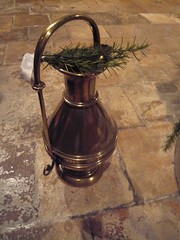
But what we really enjoy is the brass. Take the jug in the pic, taken four years ago when it hadn't been used in living memory. I've just finished polishing it, so it now gleams brassily - I think it looks like copper in the photo. We also did the holder for the Paschal Candle. Last week we did the brass lectern - that takes about 30 minutes if you do it properly - and the crucifix on the altar, and the altar candles. We washed the tiles in the sanctuary. I polished the bookstand ...
For two pins we'd have censed the church while we worked, but we were a bit pushed for time. The wood polish ran out, frustratingly, but I did the grubby pew ends where people's hands go and left the seats to be cleaned by ... well, bottoms, actually. I think some wood shampoo wouldn't go amiss - maybe after les travaux occasioned by the acquisition of a lottery grant?
But I mustn't get carried away. Right now if you breathe in Holy T you get paint flakes falling like dandruff on the carpet, and my cleaning days are over for another spell.
Besides, I don't clean my own house ...
Thursday, December 01, 2011
Magic in the Mass?
I've just been at a Roman Catholic mass for the first time in about 20 years. It wasn't your normal mass - it was the priest's Silver Jubilee and the church was packed, even on a hellish evening when the wind threatened to tear the car door from my hand and maybe take the hand with it ...
But that's enough of the gruesome maunderings. It wasn't just the local faithful who turned out in number - there was a great group of clergy (including two familiar from Island Parish on the telly) and the bishop and friends and family and former flock, all crammed into a church that by the end of the evening was so hot that the woman in front of me sank to her knees not in a moment of extreme piety but to avoid passing out. Before the mass, we were given a quick run-through of the bits of the music that might be unfamiliar, though in truth only one hymn was known to me and I was reduced, in the absence of any music, to a feeble twittering.
But what chiefly interested me was the completely different atmosphere from what I'm accustomed to. (And no, I don't just mean the heat.) The extreme rapidity of proceedings - responses hardly out of your mouth before we were off again - the matter-of-fact tones used by all the clergy, bishop included, and the music which in its banality defied any attempt at aural learning. The women in front of me who chatted at intervals throughout the proceedings, regardless of what was happening. And the new liturgy, introduced, I believe, only last week, was extraordinarily like what we have in our 1970 Grey Book, but with confusing details that caught this unwary Piskie out. But why, in the name of all that's holy (and I mean that) do they talk about Jesus taking the "chalice" at the Last Supper? Would it be likely that the vessel used then, as opposed to what it held, would have been accorded reverence at that moment? I'd be interested to know the thinking there.
Above all, I felt the sense of ... confidence. This is a church that still behaves as if Christian faith is the norm, and church attendance even more so. It spills over into demeanour, voices, physical attitudes. It is very unlike what I know and love in my own precarious little church. And whatworries interests me is that I would no more have been attracted by it than I was by its opposite number in Scotland. There's no magic.
And I need the magic.
But that's enough of the gruesome maunderings. It wasn't just the local faithful who turned out in number - there was a great group of clergy (including two familiar from Island Parish on the telly) and the bishop and friends and family and former flock, all crammed into a church that by the end of the evening was so hot that the woman in front of me sank to her knees not in a moment of extreme piety but to avoid passing out. Before the mass, we were given a quick run-through of the bits of the music that might be unfamiliar, though in truth only one hymn was known to me and I was reduced, in the absence of any music, to a feeble twittering.
But what chiefly interested me was the completely different atmosphere from what I'm accustomed to. (And no, I don't just mean the heat.) The extreme rapidity of proceedings - responses hardly out of your mouth before we were off again - the matter-of-fact tones used by all the clergy, bishop included, and the music which in its banality defied any attempt at aural learning. The women in front of me who chatted at intervals throughout the proceedings, regardless of what was happening. And the new liturgy, introduced, I believe, only last week, was extraordinarily like what we have in our 1970 Grey Book, but with confusing details that caught this unwary Piskie out. But why, in the name of all that's holy (and I mean that) do they talk about Jesus taking the "chalice" at the Last Supper? Would it be likely that the vessel used then, as opposed to what it held, would have been accorded reverence at that moment? I'd be interested to know the thinking there.
Above all, I felt the sense of ... confidence. This is a church that still behaves as if Christian faith is the norm, and church attendance even more so. It spills over into demeanour, voices, physical attitudes. It is very unlike what I know and love in my own precarious little church. And what
And I need the magic.
Sunday, August 07, 2011
Grey day transfigured
It's a grey morning. I'm already damp because my umbrella was in the car and I had to fight my way down the drooping garden so my legs are uncomfortable and I'm already chilled. As we swish up the back streets of Dunoon to church, I wonder what I'm doing. My mood matches the day; most of my summer activities are over; the sun has gone. I'd have been better staying in bed with a book. The organist seems in no better fettle, and I forgot to tell him we are supposed to be keeping the Transfiguration, so we don't really speak. Besides, we're a bit late.
There is no heating in church - it is, after all, summer - as I sort out hymnbook and liturgy (thank God - not the Grey Book). There are also no children, as the Rector is on holiday and has taken Mrs Rector who does the Godly play at the back of the church. Apart from some scraping and banging from the rear, later revealed as "sorting the electrics for the coffee", it is relatively quiet as the organ music begins. I recognise the music after the opening, drifting notes: the organist is improvising on a modern/traditional scottish folk tune. It is absolutely, heart-rendingly beautiful.
I am plainly not alone in thinking this. I hear a whisper from somewhere behind me: Ohhh - that's lovely. And a stillness falls on the people, even those who are still arriving. Prayer is suddenly possible, distraction and restlessness quietened by the lilting line, and I am glad I have come. Even when the music enters a dark, sombre place it seems entirely appropriate (I subsequently learn that the organist was distracted by the thundering down the aisle of Someone on A Mission and had to go where a wrong note took him) and the melody emerges, intact and serene, just in time for the final quiet cadence.
I am now in a place where anything can happen; the gloom has been dispelled and the transfiguration is possible. And reflecting on the experience, and the prayers and farewells and greeting of long-missed friends that took place when the Mass was over, I note that we need this variety. We need joy and noise and exuberance, and we need silence and mystery.
And somehow, in the profound silence, there is music at the very heart of things.

There is no heating in church - it is, after all, summer - as I sort out hymnbook and liturgy (thank God - not the Grey Book). There are also no children, as the Rector is on holiday and has taken Mrs Rector who does the Godly play at the back of the church. Apart from some scraping and banging from the rear, later revealed as "sorting the electrics for the coffee", it is relatively quiet as the organ music begins. I recognise the music after the opening, drifting notes: the organist is improvising on a modern/traditional scottish folk tune. It is absolutely, heart-rendingly beautiful.
I am plainly not alone in thinking this. I hear a whisper from somewhere behind me: Ohhh - that's lovely. And a stillness falls on the people, even those who are still arriving. Prayer is suddenly possible, distraction and restlessness quietened by the lilting line, and I am glad I have come. Even when the music enters a dark, sombre place it seems entirely appropriate (I subsequently learn that the organist was distracted by the thundering down the aisle of Someone on A Mission and had to go where a wrong note took him) and the melody emerges, intact and serene, just in time for the final quiet cadence.
I am now in a place where anything can happen; the gloom has been dispelled and the transfiguration is possible. And reflecting on the experience, and the prayers and farewells and greeting of long-missed friends that took place when the Mass was over, I note that we need this variety. We need joy and noise and exuberance, and we need silence and mystery.
And somehow, in the profound silence, there is music at the very heart of things.
Wednesday, April 27, 2011
Of plain chant, coal heavers and feathers...

I was first drawn to this music in my impressionable youth - before I had anything to do with church other than as a musician. In the late 60s, there was not much of it around, certainly not on the Third Programme, but when I turned up in the summer of 1969 to sing Evensong in The Cathedral of The Isles with the newly-formed St Maura Singers, we had to learn quickly - a new psalm or two, the Magnificat to Tonus Peregrinus - and I had my first go at deciphering neums and four-line staves.
All this was a long time ago, I remember ... anyway, I've sung the psalms and Compline to plain chant over the years since then, and have discovered a thing or two. The first was that I found it easy to read once I had the hang of it, and to work out where the semitones fell (always the pitfall if you don't) and the implications of the interesting groupings of notes (that last link, by the way, gives considerably more detail). But after that, the biggest discovery was the wonderful sense of control, of the line conveying the words without the need for any irritating "interpretation" on my part, of the flexibility when a trained group (or a solo cantor) is able to give slightly different emphasis to one word by lingering infinitesimally on it - all this seemed to me to allow for meditation actually to take place without getting in the way. The pause at the central colon in the psalms turned out to be just right for the breath required for the second half, and the antiphonal singing allowed for the smooth flow from one verse to the next, without worry, without the need for any mnemonic. It felt relaxed and prayerful.
It isn't always thus. People can sing this stuff without any feeling for it at all and ruin the effect. Sometimes I've heard plainchant that might as well be someone selling coal in the street (they don't, any more, but I recall the cry of "coaaaaaal briquettes" from my youth). However, the same goes for any music, and there are murderous performances to be heard on the internet any day of the week. But if you're lucky enough to find yourself in a position where you can enjoy the feather on the breath of God that is eloquent plain chant, or better still to take part in making it happen, you'll know what music you'll hear in at least one of the many mansions of heaven.
Sunday, January 23, 2011
Hats from the past

This morning it felt as if my obsession was spreading. For reasons I shall not go into*, I found myself in church, at the start of the service, standing with the small children who have so miraculously appeared in our congregation. They, and I, were wearing strange hats, kindly handed out by Andrew. As if by magic (no, I know it isn't - he reads blogs) he gave me a hat just like the one in the photo on the left, which shows my father sitting in the door of his bivvy somewhere in the Western Desert, probably in 1942. It felt absolutely right to jam the RAF forage cap on the side of my head, not just because I'd been uploading this photo the other day but also because when I was a small child I used to play for hours wearing father's forage cap. (There was also a proper, hard, peaked cap, but I didn't like it as my head was too small and it tended to birl round on the top of my pigtails as if it had a life of its own).
Maybe it's a sign of age that the past suddenly becomes precious - but I wonder what that formidable intellect with whose words I am working would make of all this.
*Oh, all right then. Andrew was introducing the theme of "calling" by getting people to assign roles to hats. If you get me.
Monday, September 27, 2010
Montserrat and Deus Absconditus
All the guide books and sites tell you that a visit to Montserrat from Barcelona is a must. We did the trip on a pretty overcast day, when the famously jagged peak of the mountain - or peaks, for there are so many of them, great rounded fingers of rock pointing into the sky - were drifted with cloud and the Benedictine Abbey overhung with gloom. The crowds were huge - the weather didn't seem to have put anyone off, and by the time we entered the Abbey church we had to hunt for a seat.
It was not that we were all overcome by a need to be holy - of that more in a minute - but that the famous boys' choir sings at 1pm daily. And sure enough, after a few prayers in several languages, there they were. Beautiful voices, yes - though nothing that those of us familiar with the English Cathedral tradition wouldn't recognise. The direction, however, left much to be desired, with a slack beat and flaccid rhythm, and the arrangement of the traditional song they performed was wooden and uninspired.
This pause in the church, however, left space for reflection. The original monks who had struggled up here to found their community were presumably seeking God in the solitude and the silence of the peaks, and in the photo I've chosen you can perhaps get some sense of that - I've managed to lose most of the crowds. But nowadays hordes of tourists flock there, as we did, lighting candles, taking photos (with varying degrees of aggression), shuffling, eating and shopping - and I had the distinct impression of a Deus absconditus, a God who wasn't there any more.
It's at moments like these that I think of our own empty mountains, or of the wind howling through the peaks when the tourists have gone, and experience a strong fellow-feeling with those who say they don't need church to find the presence of God. We humans, we have a terrible tendency - do we not? - to crowd God out, to replace the divine with the digital and the spiritual with the sensual.

It was not that we were all overcome by a need to be holy - of that more in a minute - but that the famous boys' choir sings at 1pm daily. And sure enough, after a few prayers in several languages, there they were. Beautiful voices, yes - though nothing that those of us familiar with the English Cathedral tradition wouldn't recognise. The direction, however, left much to be desired, with a slack beat and flaccid rhythm, and the arrangement of the traditional song they performed was wooden and uninspired.
This pause in the church, however, left space for reflection. The original monks who had struggled up here to found their community were presumably seeking God in the solitude and the silence of the peaks, and in the photo I've chosen you can perhaps get some sense of that - I've managed to lose most of the crowds. But nowadays hordes of tourists flock there, as we did, lighting candles, taking photos (with varying degrees of aggression), shuffling, eating and shopping - and I had the distinct impression of a Deus absconditus, a God who wasn't there any more.
It's at moments like these that I think of our own empty mountains, or of the wind howling through the peaks when the tourists have gone, and experience a strong fellow-feeling with those who say they don't need church to find the presence of God. We humans, we have a terrible tendency - do we not? - to crowd God out, to replace the divine with the digital and the spiritual with the sensual.
Sunday, February 28, 2010
We are marching
Every now and then, someone at church remarks on the apparent miracle of the suitability of the hymns (chosen by Mr B) for the lectionary of the day, and while it is true that Mr B chooses the hymns with great care and does in fact read the lectionary readings while doing so, he is helped by a useful RSCM publication which lists a multitude of suggestions from a variety of hymnbooks. One of the suggestions for today's final hymn was We are Marching in the light of God.
At first it seemed an odd choice. Lent. Mainstream church. A particularly trying time for our diocese and for our congregation, as the challenges of our Victorian buildings multiply and with them the tradesmens' bills. But in fact it turned out to be just right. This African song, with its origins in protest, lifted us on this freezing Sunday so that we sang, and clapped (on the back beat too!), and felt warmer, and found ourselves smiling. Yes, things are hard in our church just now - but we aren't alone, are we?
And I'd never in a month of Sundays have thought the congregation of Holy T would swing so well!
At first it seemed an odd choice. Lent. Mainstream church. A particularly trying time for our diocese and for our congregation, as the challenges of our Victorian buildings multiply and with them the tradesmens' bills. But in fact it turned out to be just right. This African song, with its origins in protest, lifted us on this freezing Sunday so that we sang, and clapped (on the back beat too!), and felt warmer, and found ourselves smiling. Yes, things are hard in our church just now - but we aren't alone, are we?
And I'd never in a month of Sundays have thought the congregation of Holy T would swing so well!
Monday, November 02, 2009
Pipe to the spirit ...
Thought I'd join the hymn fray before it's all over bar the singing ...
It's harder these days to find hymns that I can bear to sing, actually. The big, ponderous hymns that we used to bash out regardless leave me cold, even if they have wonderful tunes, as some of them do. Maybe too much exposure to them is part of the problem - they're boring after the nth repetition. So even Come Down O Love Divine (to Down Ampney) feels like a drag these days, and in a way that makes me sad. Part of the problem could be that it's not the same sung by half a dozen people with the rest a gentle murmuring in the rear - a proper choir at least gave me the pleasure of balanced harmony and colour as we sang.
I used to be thrilled by Let all mortal flesh keep silence (Picardy). This hymn was completely new to me when I first encountered the Episcopal church, in the cathedral on Cumbrae, and is forever associated for me with firsts - incense, communion, the sense of the holy. I can still feel the hairs rise when we get to the alleluias, and the imagery is so poetic that there is little sense of the banal or the absurd. The same could be said for Lo he comes at Advent - I'd never heard it until I had moved to Dunoon, and it bowled me over.
Otherwise, I still find plainsong powerful. Ancient words tend to be timeless, somehow - the imagery so obviously not to be taken literally that I can just enjoy the poetry of it. I love Be still my soul and Lead kindly light, just as I love There is a Redeemer. I find the Taizé stuff we do a true vehicle for meditation and a way out of the ordinary, and I get the hair-on-end moments when we do Ubi Caritas with the solo verses as found in HON - especially if it's Bishop Martin or Mr B singing them.
But I'm at once fussy and fortunate. I rarely have to listen to inadequate organ playing, and I expect a high standard of harmonisation of last verses. If there isn't a decent musician around, I'd rather have said services than fight against flaccid rhythms or duff harmonies, and I've had enough Victorian bombast to last me an eternity. In the end heard melodies are sweet, but those unheard are sweeter ... no?
It's harder these days to find hymns that I can bear to sing, actually. The big, ponderous hymns that we used to bash out regardless leave me cold, even if they have wonderful tunes, as some of them do. Maybe too much exposure to them is part of the problem - they're boring after the nth repetition. So even Come Down O Love Divine (to Down Ampney) feels like a drag these days, and in a way that makes me sad. Part of the problem could be that it's not the same sung by half a dozen people with the rest a gentle murmuring in the rear - a proper choir at least gave me the pleasure of balanced harmony and colour as we sang.
I used to be thrilled by Let all mortal flesh keep silence (Picardy). This hymn was completely new to me when I first encountered the Episcopal church, in the cathedral on Cumbrae, and is forever associated for me with firsts - incense, communion, the sense of the holy. I can still feel the hairs rise when we get to the alleluias, and the imagery is so poetic that there is little sense of the banal or the absurd. The same could be said for Lo he comes at Advent - I'd never heard it until I had moved to Dunoon, and it bowled me over.
Otherwise, I still find plainsong powerful. Ancient words tend to be timeless, somehow - the imagery so obviously not to be taken literally that I can just enjoy the poetry of it. I love Be still my soul and Lead kindly light, just as I love There is a Redeemer. I find the Taizé stuff we do a true vehicle for meditation and a way out of the ordinary, and I get the hair-on-end moments when we do Ubi Caritas with the solo verses as found in HON - especially if it's Bishop Martin or Mr B singing them.
But I'm at once fussy and fortunate. I rarely have to listen to inadequate organ playing, and I expect a high standard of harmonisation of last verses. If there isn't a decent musician around, I'd rather have said services than fight against flaccid rhythms or duff harmonies, and I've had enough Victorian bombast to last me an eternity. In the end heard melodies are sweet, but those unheard are sweeter ... no?
Friday, October 23, 2009
Sponged, again
 Yesterday evening I was in a packed church - and St John's, Princes Street is quite a size to pack - to hear Bishop Jack Spong talk about the difficult subject of eternal life. Difficult? From my early teens I've realised how difficult, when my father used to quizz me: what kind of eternal life did I envisage? Would I fancy it as a spotty adolescent, or would it be more like an eternity of arthritis? He knew, and even then I knew, that these were facetious questions masking an uncomfortable reality - Richard Dawkins would have felt quite at home chez nous in the early sixties. And of course, it's the simplistic notions that the Dawkinites, and plenty of people who actually simply know very little about religion, keep insisting are the bread and butter of the Christian faith and any other you might care to mention. No wonder they dismiss us as daft. And no wonder we get fed up.
But Jack Spong had this crowd feeling anything but fed up, if the applause was anything to go by. He's just brought out another book: Eternal Life: A New Vision, and reading it would give you a better idea of his drift than reading this post. But a few bits stick: the God-filled man that was Jesus showing that the Kingdom of God was within him, and telling us that it is also within us; the living of a life of loving that aligns us with God who is timeless; the self-conscious humanity that is at once our original sin and our saving grace. And a joyous recognition of the impossibility of sharing our experience of God in words, in this question: Can a horse tell another horse what it means to be human?
The laughter showed the relief of those who had realised that the high and crazy and the low and lazy were not for them, and that sharing their own experience didn't fill pews. That's not our job, said the bishop in his wonderfully American way. We're not here to do that. The faith we hold is not to bring peace, but to help us to grasp reality and have the courage to go on facing it. It takes, he said, a lot of courage to be human and realise that we are finite - the whole nature of humanity is to be anxious.
In the end, I can't even redeliver this talk, any more than I can redeliver religious experience without resorting to art. But the realisation that there are so many of us - including people we met whom we know in more conservatively Christian circles - was thrilling. Our churches may be falling down around our ears, they may be populated by people of my age and older - but maybe that's as it should be, at this time. And for sure I came away with the conviction that if the church is diminishing, it should probably not moan about the failings of society.
It's time to take a long, hard look at our own failings. And then? I don't know. But it should be good ...
As Richard Holloway, winding up the evening, put it: we'd been well and truly Sponged. I recommend the treatment!
Wednesday, March 25, 2009
1984 : finis
Before drawing the curtain on my 1984, a few last thoughts. Writing about it was strangely cathartic, and I wonder if I would have felt less affected had I been able to blog about it at the time. Certainly I became aware during the fall-out period that the priest involved in making sure we wouldn't still be around our church by the time the Presiding Bishop of ECUSA (the Episcopal church in the USA) visited the congregation that autumn was terrified Mr B would bring a case of wrongful dismissal - he even had a tame lawyer on hand to dig him out of the hole. At the time no-one was interested in what had actually happened; the priest was more to be believed than those pinko peace people. Actually, that's not true: one couple invited us for dinner and asked us to tell the story.
In the end, I grew tired of the pressure. After appearing in three TV programmes - the most notable being Northern Frontier - and taking on several speaking engagements and after realising that my phone conversations were not private I decided to back off a bit and concentrate on teaching. I didn't go near the Episcopal church for several years, and I still haven't resolved that bit of my past. The people who were involved in making things unpleasant are mostly dead now, and the ones who remain are old. Their places have been taken by a new generation of Christians who practice what they preach - and yes, some of them do preach. There is a great deal more honesty around, though I never take it for granted. And most of them don't have the remotest idea of what happened during the Miners' Strike of '84. Site One has gone, and the pier where we demonstrated looks decrepit. The only Americans are holidaymakers, more or less, and their housing schemes transformed by the very Scottish gardens of their new owners.
Would I do it again? There's only one answer. Yes, I would.
In the end, I grew tired of the pressure. After appearing in three TV programmes - the most notable being Northern Frontier - and taking on several speaking engagements and after realising that my phone conversations were not private I decided to back off a bit and concentrate on teaching. I didn't go near the Episcopal church for several years, and I still haven't resolved that bit of my past. The people who were involved in making things unpleasant are mostly dead now, and the ones who remain are old. Their places have been taken by a new generation of Christians who practice what they preach - and yes, some of them do preach. There is a great deal more honesty around, though I never take it for granted. And most of them don't have the remotest idea of what happened during the Miners' Strike of '84. Site One has gone, and the pier where we demonstrated looks decrepit. The only Americans are holidaymakers, more or less, and their housing schemes transformed by the very Scottish gardens of their new owners.
Would I do it again? There's only one answer. Yes, I would.
Subscribe to:
Posts (Atom)