I very rarely write about clothes. Dresses even less often. But there's a family wedding on the horizon, and it will still be summer (stop laughing) and the usual black elegant breeks seem ... well, black. And besides they've been round the block a bit, beginning with the time they climbed out of an Argyll ditch after a car crash, and that wasn't yesterday. The good news, I suppose, is that they remained elegant and that they still fit. But I digress.
In the interests of trying, I send for a dress that caught my eye in a sale. Lovely material - silk/cotton - lovely subtle slatey colour, potentially flattering lines and length. And it arrives, and it fits. But there's the rub. I don't like myself in it. I hitch up the skirt to see if the new knee-length would have been any better, but find it as unflattering as ever. (I don't think knee-length cuts it unless you wear killer heels and have a long tibia. Or two.) I realise my ankles are looking ... well, old. The bump from the sprain a month ago doesn't help, and I daresay they'd be improved by tights - another horror. Loathe tights.
I think I'm in danger of looking like the matronly aunt-in-law that I actually am. I can't bear myself in this mode. What to do? I shall give the shops one last try. I'm not holding out much hope. But I'd like to issue a warning to any of the generation that might be having any ideas: I'm not up for this dressing-for-a-wedding caper. It's not me.
Now, what about a nice little fascinator ...?
Monday, June 27, 2011


Friday, June 24, 2011
Who's Corpus Christi?

I've been to only one other celebration of Corpus Christi in my day - perhaps 15 years ago now, when Dale Grey was the Warden at Cumbrae and laid on a joyous service with a visiting choir (not one I was in) and a procession round the grounds of the Cathedral there. I had some idea of what to expect in the way of ceremony and I knew there would be rose petals, but I had no notion of how I might react. This is how it feels now:
I have a renewed appreciation of the power of ritual. When ritual is beautifully done, with conviction and authority and no attempt to make it ordinary or contemporary, it is capable of sweeping the participants into its self-forgetting rhythm. This is what happened. The sacrament was there in the monstrance (left) and was paraded round the church in a procession of incense (from two thuribles!) preceded by a rain of rose petals from an ever-replenished basin (there are more photos on Kelvin's blog on the link above). And as it passed we turned, like subjects of old, so as to have our eyes always on the monstrance and what it contained. Suddenly it became real, in the sense that we talk, as Kelvin did, about the Real Presence: I knew that in that circle of gold there was a wafer of unleavened bread, but when it passed me I bowed low - not once, but three times, each time it passed. That felt right. I didn't have to think about it.
We encountered here the power of symbolism - and symbolism that was appropriate and in-your-face and glorious. Usually I worship in relatively modern English, sing everything in sight, strain to hear all that is said above the noise of Godly Play, and know everyone around me. Last night's Mass was sung by a choir, in Latin; there was silence (apart from the traffic in Great Western Road) and there was glorious, thundering organ music that came reverberating through the soles of our feet, there was the all-pervading scent of the incense and I knew about three people and the celebrant. It was strange and it was exotic; it was liberating and funny and it was joyful; it was - or seemed to be - completely assured and unselfconscious.
Guess that's the key, really: unselfconsciousness. We can't be self-conscious and embarrassed, we mustn't feel we always have to justify our joyful eccentricities, we can't be apologetic Christians all the time or we've had it. Kevin introduced what was about to happen with a small joke: someone had asked "Who's this Corpus Christi that you're celebrating?" His last words at the end of the service reminded us of this question. Who is this Corpus Christi?
And the answer? It's us. Wow.
Note: There's a whole set of photos here.
Sunday, June 19, 2011
And God saw that it was good

But I couldn't help noticing the huge lift it gave us all on this, our Patronal festival, to see the light streaming in above the altar once more, after the weeks shrouded in tarpaulins, and the increased resonance of the organ as it banished all memories of the little keyboard Mr B had to play while his organ (hush!) was swathed in dust sheets and polythene. And there was an added frisson, for me at least, in realising during the long OT lesson - the entire Creation story - that I could hear Mary's voice at the back of the church, where the children have their Godly Play until we can accomodate them in the tower (not as bad as it sounds), echoing in a whisper the words of the story: "And God saw that it was good".
I think God would perhaps see that today was good.
Saturday, June 18, 2011
Emerging from chaos ...

So here you see the chancel arch minus the peeling blue paint that has disfigured it for the past ten years, and the pristine ingoes (I just learned this word) of the sanctuary windows. The scaffolding is down, and after a month of a nave altar in front of green tarpaulin we can now see the east windows again. The tower is drying out nicely and the bells are once again safe to ring. (That's what they tell me: I'm doing it tomorrow.)
The stour left was daunting, but this morning a small band of us got rid of it. The tiles were vacuumed and washed, the eagle had his orifices poked before he was polished, and the wide open spaces left by the removal of the now redundant choir stalls have us thinking of liturgical possibilities and ... polished wood flooring. There. I've said it.
It's just that as we prepare for our Patronal festival tomorrow, everything seems possible. Though I have to add that I don't clean my own house .... Strange, isn't it?
Friday, June 17, 2011
Twittering respectably
I've been catching up on some old friends' blogs - you can thank the weather for that, chaps! - and came across this post from Neil Winton just as I was pondering again (or anew, as the hymn hath it) the business of officialdom and social media. When I left the classroom - god, it's been six years - I could still look at flickr and some blogs on the school system, though Richard Holloway's work was largely taboo because, it seemed, he'd used naughty words. So NetGear said anyway. Now, apparently, it is hard in schools to access any of the sites I've grown accustomed to using daily. Everyone and their grannies now know what Twitter is, but heaven forfend that our young should be able to use it.
Stupid logic, of course. I've been using Twitter since, November 2006. An earlyish adopter, then. I've been blogging for a year or so longer. And I've been evangelical about the power of social media for most of the intervening years. But now I'm no longer involved in schools and education at large; my forum tends to be in church circles. So I've stood up at Synods both General and Diocesan and begged for blogs to be used to communicate and for Bishops to use Twitter. And back then - some 4/5 years ago - I was scoffed at, either gently or violently. But gradually we saw bloggers doing their slightly risky thing on the sidelines of Synod, and then Twitter took over as comments were tweeted and shared live. Bishops blogged and had Facebook accounts. There were lunchtime meetings to help the uninitiated get over their fears (I'm talking General Synod here - all two and a half days of it) and, finally, official guidelines in the Synod papers for kind and responsible Tweeting. Social media had, on the face of it, arrived.
But we need to be careful here. There are still many, many people who have "no time" for Twitter and "all that stuff" - and that "no time" can be factual or pejorative in intent. And all too often they are the people who run organisations - because suddenly they see the huge potential for ... what? Anarchy? Revolution? Criticism?
Yes. Of course. All of these things. That's why repressive regimes block Facebook. I'm reminded, probably because of the context in which I now operate, of how the Bible used to be forbidden fruit to the common people, and then to women - much safer to keep it in Latin and in the hands of the priests, much more seemly for women to take their men's word for what was in this dangerous book. But hey - we all read the Bible now, if we feel so inclined, and we sometimes find new and exciting things in it, in our unschooled, lay fashion. And the job of the professionals is to help all of us to read sensibly, not to make basic errors in comprehension, to put it in a historical context and so on. The church as it is today, shrinking as it may be, seems to me a healthier and more alive organism for the active participation of its members.
And what, do you ask, has this to do with Twitter? Well, Twitter and other social media exist. People have become accustomed to using them to broadcast their status. Not all people are sensible, and some users of social media are downright silly - they're just people. But you can't stop them making fools of themselves, in public or not. You can assume that people at a gathering like Synod will, for the most part, have a modicum of intelligence and a large helping of goodwill - they wouldn't be there otherwise. I've already remarked on the lack of much tweeting during the last Synod - because someone, apparently, thought fit to warn them off at one point. I missed that bit, so I don't know how it was done. But for next year, I'd like to see a Twitter live backchat channel on the screens, so that everyone in the hall can see what's being said as it's said - and the people up front can have the chance to react to it.
Going back to the trigger for this post - the drive to have social media become normal in schools - I'm pushed into wondering if official blessing is in fact the one way to kill something off. I think our young might well tell us it is ...
Thursday, June 16, 2011
Lilies in the wind

But I'm not. For a start they're too early: these are real end-of-term scents, the scents of warm summer evenings coming home late from school concerts or prizegivings, and it's not just that I am no longer involved in such matters upsetting things. The lilies were out before the end of May, presumably hastened by the almost-forgotten warmth of March and April, and now they hang over the path beaten out of shape by the rain that dominated last month. And warm it is not: after a promising start we had cloud and now there's a brisk and chilly wind. This may be global warming, or it may just be another example of the variable weather of the west. Either way, it's got me jangled.
I think I need another holiday. But we've not yet passed Trinity Sunday ...
Tuesday, June 14, 2011
Fiddling at Synod?
Oh dear. I've been remiss in my blogging - but I've been away. Not more continental junketings, alas, but at the General Synod of the Scottish Episcopal Church. I seem to have participated rather often in this gathering over the years, but realise it's because I was a diocesan alternate before I was chosen as a representative ... but I maunder. Don't expect an official or exhaustive take on proceedings, however - you can find that here - my impressions are very patchy this year.
This is largely because I missed quite a chunk of things, including the task of facilitating discussion - I'd been looking forward to that - because I was no weel. Quite apart from my scheduled trip to Glasgow to have a small bit of me removed, I suffered horribly from our diocesan dinner and missed a whole morning on Mission; by the time I returned I realised I felt the way I used to after an absence from school: you caught measles or somesuch and when you went back you found out that everyone else had learned to do long division and you were totally lost.
And it's hard to get back into things in those circumstances. I was led to ponder how vital it is that individual speakers engage with their audience - it is so easy to switch off and let the mind wander as some voice drones on about ... but if I'm specific I shall pinpoint the offenders, and it is not my intention to wound. Rather I would beg that speakers are instructed in the art of eye contact, tonal variation and register - indeed, in the whole art of public speaking that they would have learned in Standard Grade had they been in my classroom. Maybe there's a job there for a certain bishop on the verge of retirement: having muttered resentfully about the boredom of one address, and having been rebuked by a more charitable neighbour on the grounds that this was after all the graveyard slot, I found myself once more engaged - and amused - by said bishop in his follow-up comments. Graveyard? I reckon he could make the dead laugh ...
Just to show that I'm not all girns and detachment, I should add here how much I enjoyed the break from traditional tedium offered by the indaba process. I was in a feisty group which in the end had to agree to disagree, but it was such a relief to be able to test responses on others rather than one's unfortunate neighbour or the twitterverse at large - though I had the feeling, confirmed later, that the twitterers had been somewhat discouraged while I was away being poorly. Someone had got it into their head that to tweet meant to be insensitive and crass and that it had therefore to be spelled out when tweeting would be inappropriate. I fear that is what happens when a spontaneous activity becomes respectable ... and I'm glad I didn't know about it, for that would have made me much, much worse.

But you'll be glad to know that my old friend the complacent male was at Synod. This was a cunningly camouflaged wee dinosaur, but his message was the same: it's a waste of time - in fact, it's navel-gazing - to fret about gender imbalance in church matters. He said it so quietly, slipping it in after one of the more mind-numbing exegeses, that we were onto the next item before I'd clocked it and got my hackles working - I told you I'd been no weel - and I was left frustrated. I shoulda said something. But then it was pointed out to me that his comment had been met by a wall of silence. And it was suggested that I should perhaps think about this silence. What did it mean? Well for a start it sure wasn't applause - and we'd had plenty of applause for other speakers, so people were by no means apathetic. As a teacher and speaker, I know there is nothing more disheartening than silence - for I take silence to show indifference or apathy, or perhaps that everyone has gone to sleep. So maybe I wasn't needed after all - maybe the church as a body is getting past the Mesozoic age (I had to look that up) and his remark was indeed seen as crass by the majority of those present. Maybe my more normal kneejerk reaction would have merely confirmed him - and others, for I'm sure he's still not quite alone - that women (or other excluded groups) are only interested in their own causes and don't care that creation burns (see pic). The silence on the part of all the Saturday Synod survivors might even have taught him that he really shouldn't say these things. (It may be too late for him not to think them - he was not in his first youth)
But I feel I'm going on a bit. I shall finish with what, after cooling down slighly, I tweeted as my last word on the Synod:
The day a woman stands up and says we should not fuss about gender balance, all will be well. #pisky #secsynod
Wednesday, June 01, 2011
On the march again
Having caught up on most of my life, thanks to a dreich day with no huvtaes, I find I have time to reflect on my holiday with HF last week. We were walking in the Dordogne, in the neighbourhood of Sarlat, with what turned out to be a wonderfully interesting group of people from New York State, England and New Zealand. I've blogged about HF before, but I came home once more convinced of the merits of this kind of holiday - to say nothing about my enthusiasm for this part of France, new to me despite my frequent visits to more northern areas.
The photo shows pale grey skies on the first full day, replaced for most of the week by flawless blue, but the line of walkers shows for the sceptical how not every moment of a walk is filled with conversation - and reflects the fact that I had sprained my ankle, infuriatingly, within 10 minutes of starting off. (I subsequently completed the 10 mile hike, and resumed the programme after a day by the pool, but I'm not telling the quack)
So what do I remember? Birdsong, poppies, warmth, mellow golden stone, undulating landscape, the river deep in its gorge, the amazing troglodyte dwellings at Roque St Christophe ... singing "Veni Creator" in a stolen moment in a wonderful church in a tiny village when everyone else had moved off and hearing it soar in the awesome acoustic ... fascinating conversations with interesting people ... talking about all the so-called forbidden subjects as Mina took my mind off my ankle by discussing politics and religion ... food so good that we all looked forward to the leisurely dinners cooked by the chefs who came nightly to our hotel to cook for us.
Ok, so this is becoming a list, and therefore boring. Enough to say that the week was far from boring, and that my French felt much more useful than in the past. I enjoyed conversations in French on my day off, and I shared the poolside with a lizard in the hot sun. I'd love to be there now, and start to look forward to my next trip.
Itchy feet? Moi?
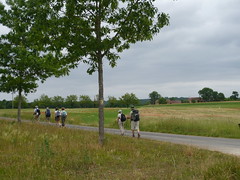
The photo shows pale grey skies on the first full day, replaced for most of the week by flawless blue, but the line of walkers shows for the sceptical how not every moment of a walk is filled with conversation - and reflects the fact that I had sprained my ankle, infuriatingly, within 10 minutes of starting off. (I subsequently completed the 10 mile hike, and resumed the programme after a day by the pool, but I'm not telling the quack)
So what do I remember? Birdsong, poppies, warmth, mellow golden stone, undulating landscape, the river deep in its gorge, the amazing troglodyte dwellings at Roque St Christophe ... singing "Veni Creator" in a stolen moment in a wonderful church in a tiny village when everyone else had moved off and hearing it soar in the awesome acoustic ... fascinating conversations with interesting people ... talking about all the so-called forbidden subjects as Mina took my mind off my ankle by discussing politics and religion ... food so good that we all looked forward to the leisurely dinners cooked by the chefs who came nightly to our hotel to cook for us.
Ok, so this is becoming a list, and therefore boring. Enough to say that the week was far from boring, and that my French felt much more useful than in the past. I enjoyed conversations in French on my day off, and I shared the poolside with a lizard in the hot sun. I'd love to be there now, and start to look forward to my next trip.
Itchy feet? Moi?
Sunday, May 15, 2011
The Collection

In the event, there was much with which we were all too familiar. The people who had no money (it's Sunday). The man who said "I'm afraid I'm the only one in," and shut the door. The people who had already been given an envelope by their own church (come on, chaps, they're for door-to-door collections, you know - not for an easy way out for all concerned). Less familiar were the lovely people who gave us these envelopes for our bag notwithstanding, and the people who invited us in for a chat regardless of our hiking boots (you go prepared for anything in this part of the world). Most annoying moment of the afternoon was reserved for four persistent and very rude small boys who dogged our way round one group of houses making such a racket that we were sure the forewarned denizens of the place lay low as one man. It's the difficulty of remembering that I'm a Christian Aid collector and therefore must bite my tongue that really gets to me in these moments.
And then there were the dogs. I don't care for dogs. Fortunately Mrs H does, and fielded most of them. I had one great success in ordering one beast back into his house; it went, and its owner offered to hire me to complete the animal's training. I declined.
All this time it rained. Most of the time it was a fine, wetting drizzle, with occasional outbursts of something more substantial. As we trailed up the half-made road to the last houses in our patch, we reflected on how different it is doing this sort of thing in a city. I once helped a friend in a residential area of the Edinburgh suburbs; she did one side of the road and I did the other and the whole operation took us half an hour and yielded a heavy haul of filled envelopes. Where we collect in Dunoon, we have to reckon on at least two hours to get round our allocated houses, and will be lucky to have half the amount of the city collection. But I'm not complaining - not really. Except about the churches who make our journey a waste of time.
And next year I'd like it to be warm and sunny. Please?
Friday, May 13, 2011
Climbing through the past
Well, that was fun. Two hours spent in a building that seemed (predictably) to have shrunk and (less predictably) to have become an unfamiliar maze reduced me to giggling exhaustion - though the giggles didn't come on till after this photo was taken, as I hadn't met someone I used to know by then. The stair I'm on here actually looks much as it always did - worn, glossy stone treads, tiled walls - though in the 50s the paintwork was cream and there were no pupils' paintings on the walls. But elsewhere, dreadful things have happened in the name of safety, and whole staircases have been dismantled and moved to places that don't fit at all with the architecture. It was, as I said in my last post, always a challenging place to find your way round the central stairwell, but now it's impossible.
Upwards was the clue. If we kept climbing, we arrived first at the top landing under the glass cupola, a space now sadly diminished by a new partition wall and the addition of fluorescent lights round the Parthenon frieze (replica). Beyond that, I knew, was The Attic, where I used to go for sewing classes between 3 - 4pm Monday, Tuesday and Wednesday. I saw a dingy stair heading up into the gloom and followed it - only to find that we seemed to be in a building site, linked to the rest of the school by a corrugated iron corridor with a wonky floor. We crept carefully along this, and emerged on the Attic landing: it was the fire escape. And of course we'd all have died hideously in the 50s if a fire had happened lower down in the school, as there was only the one exit, down the central stairwell. We never gave it a moment's thought - and neither, presumably, did our parents.
Because of the nature of Hillhead until the mid-70s, the returning FPs of my generation tended to share a pretty recognisable set of characteristics, including self-confidence and articulate self-expression. I was totally amused to meet up over a mass school photo with someone whom I remembered, with increasing clarity, from the 2nd violins of the school orchestra. She'd been in the year below me, along with Alison, and her hair had been very dark. I now realise I also knew her brother - even after we left school. Her pal I knew less well, but remembered her big sister - and their father had been a colleague of my own. She knew several people in my life, including one ABF who comments on this blog. It was all very incestuous and great fun.
I am grateful to the mother of a current pupil, who let me out into the shed apparently closed off because of an unsafe roof - her daughter assured me the pupils still go into it. And I was amused by the closed-in area under the school which used to be the boys' shed, open all down one side and used when it was just too wet for footie in the playground. I don't know how they got on playing footie round the pillars - I imagine it led to increased ball skills.
I was hugely impressed by the amount of work obviously done by the present teachers, and by the quality of the work on display. And I realised early on what a nightmare the building has become, with the cramped conditions imposed by the alterations and the leaking windows and unstable stonework in the attic. I had a vision of some of the classrooms as they had been - large, square, well-lit by tall windows, 40 pupils sitting in rows at desks with flap-down seats attached and the teacher at the front at the high desk - and realised I was in another world.
Take it for all in all, I think I prefer where we are now..
Note: I've had to repost this, as it vanished during Blogger's recent sickness. Hence the wrong date - it belongs, like myself, to yesterday.
Wednesday, May 11, 2011
Time travelling today ...

But I loved school; I loved it wholeheartedly and was as sad to leave at 18 as any heroine of a girls' school story. I never even noticed that the outdoors toilets were a barbaric and chilly idea - and they froze solid in a cold winter and we were all sent home - nor cared that the arrangement of stairs in the Primary School was such that some classrooms could only be reached from the left-hand stair. (I did, however, quail at the idea of asking the fierce teachers in the middle landing for passage through their classrooms if I got it wrong - I preferred to sprint downstairs and start again.) We played all the traditional games in their proper seasons - skipping, ball-games against the wall, scrap-swapping (a winter pursuit, carried out in the shed) - and wildly dangerous ones, like first dreeping off a ten-foot wall and then learning to jump off it without breaking anything. I still remember the concussion of landing on the concrete - and I was a skinny wee thing.
I shall doubtless return to this topic after this evening. The school is to be moved to another site, amalgamating with two others, and I have yet to discover the future of the building in Cecil Street. I shall take my camera, and there is a chance that the visit might destroy some memories. But I doubt it.
Monday, May 09, 2011
The Revolution: a traditional English teacher’s take.

"Poetry, like all the arts, is useless."
Thus began an introductory note, written in the 1940s for Higher English students on the subject of poetry – a wonderful note which went on to demonstrate that although a knowledge of poetry would not clothe or put a roof over the heads of those who knew how to approach it, it was nevertheless one of the most fulfilling cultural activities for students of English.
The question for an English teacher who is sensitive to the need both for the cultural aspects of the subject and for the transactional writing that underpins half the subjects in the secondary curriculum is how to achieve a balance within a revolutionised school curriculum. This is one vision – the vision of an English teacher who has bridged the period between “Projects in Practice” and Higher Still, and who sees Curriculum for Excellence as a half-baked attempt to have a bloodless revolution.
1. Transactional English in immersion learning through a central topic:
If a whole school were immersed in a core topic such as Climate Change, dealing with everything from the Physics and Chemistry of the process through the social aspects and physical impact of change to the politics and journalism of dealing with it, then English writing and comprehension would be an integral part of the study. English specialists would have to be timetabled to be present in the area where such work was going on, to be a constant resource on the ground, to enable the best possible communication and expression of what was being done at all levels.
2. Expressive and cultural input – especially from S3 upwards – in English:
This is where the biggest change might be seen to take place. It would be perfectly possible to deliver the kind of lesson that has always brought, say, a poem to life to a much larger group than has been traditional since the days when partitioned classrooms used to be opened up to allow one teacher to take 60 pupils in time of absence of staff shortage. I’m thinking Big Lesson, followed by group work by pupils with teacher participation, followed by plenary feedback with some kind of projected backdrop showing the results of the discussions. This would free up timetable time to allow for more flexibility.
[It always seemed a waste to me to have a whole year timetabled to be doing the same course at the same time when some of the work was suitable for this kind of treatment. It also seemed a shame for some pupils to be stuck with the one teacher for the two years, say, of S grade, when they could easily have a shot of someone who inspired them. There were often instances of pupils of one teacher coming to another for advice which was lacking in the class they were in]
3. Technology as the glue as well as the instrument:
If pupils were not isolated in the womb-like classroom of individual teachers (I’ll speak for English classes now) for up to 6 hours a week, but could because of flexible working spaces have access to technology and subject specialists when they needed it, provision of an adequate number of computers should be less of a problem – and the maintenance of them might be made simpler if 20 computers were not buried in the room of a cack-handed technophobe who didn’t ensure they were properly functional. I think the formative assessment of students involved in both the cultural and the transactional stages of English could be transformed by their doing all their working-out online, so that both the process and the input of the teacher could be publicly visible (whether in the wider world or on a closed school site). This would save teacher-hours in repeating the same mantras (eg about the embedding of quotation in a Critical Essay for Higher English) and allow learning to take place through study of past materials (something I always did, but which was limited by having limited copies of exemplars). Incidentally, it would also facilitate staff CPD - for teachers are not equally skilled or indeed educated in their field, and the open nature of the work I advocate would allow for continuing but not overt acquisition of new skills. Final work could be submitted on paper if required, but I like the openness and accountability of the blog/ning model for ongoing assessment and appraisal. If twitter or other short-form communication were to be built in to the system, the resulting flexibility would expedite learning, mentoring, teaching, assessment and feedback – and none of these would be limited to the physical classroom or the 9-4 day.
4. The integration of the extra-curricular:
When I taught in Dunoon Grammar School, I ran a very successful magazine. Its operational heart was my classroom where the iMac lived, and almost all the work was done at lunchtimes, after school, and in evenings when we were often racing to escape from the building before it was locked up for the night. But before we were deemed sufficiently successful to purchase our own computer, we relied on the machines in the Business Studies department - a situation fraught with the potential for strife. It strikes me that if something like The Pupils’ View had been a more collaborative activity, we would have had the Business Studies people onside teaching effective skills in typing and layout instead of fighting over when we could use their computers – and there was much useful learning going on with phone skills, advertising, layout & design, sweet-talking advertisers, selling papers. None of that was ever recognised.
Obviously timetabling and resources, school buildings and staffing are at the heart of this, but it seems to me a way of developing new ideas so that the interesting and purely cultural aspects of the subject are not subordinated. And I have taken no account whatsoever of the matter of discipline and the disaffected pupil.
In my experience, there is a great deal of slack time and wasted effort in teaching as it currently stands.
Saturday, May 07, 2011
And now it's all over ...
Wow. In the rainy aftermath of the Scottish election there's time to think, to read the papers and the blogs, to realise how different life feels. I hope Ewan's cool with my use of his wordle, because it - and the manifesto it sums up - says it all: it's about Scotland, and it's all positive.
I love an election. I love it when the lampposts bloom with placards and you find George Galloway orating in the middle of Buchanan Street when really you're looking for your lunch. But this election did more, didn't it? And when Kelvin Mackenzie opined on last night's BBC News that the sooner we held a referendum - and let him and his fellow-English off the hook of having to prop us up - the better, I no longer felt the kind of impotent rage that the Thatcher years engendered. Suddenly the people running my country are recognisably the kind of people I know - and I like that feeling.
Things have been looking up for the past eleven years, and this election set the seal on it. Here's to the next five years, and to an exciting future.

I love an election. I love it when the lampposts bloom with placards and you find George Galloway orating in the middle of Buchanan Street when really you're looking for your lunch. But this election did more, didn't it? And when Kelvin Mackenzie opined on last night's BBC News that the sooner we held a referendum - and let him and his fellow-English off the hook of having to prop us up - the better, I no longer felt the kind of impotent rage that the Thatcher years engendered. Suddenly the people running my country are recognisably the kind of people I know - and I like that feeling.
Things have been looking up for the past eleven years, and this election set the seal on it. Here's to the next five years, and to an exciting future.
Friday, May 06, 2011
Doomsday without spoilers

And now I've re-read it, wondering if it was as good as I had remembered. I guess it was, as I'm once more suffering that lost, bereaved feeling common to all who lose themselves in novels and don't want to return to their own life. Not that the life described in this story is an easy one - but it is convincing. Pay no attention to the absurd cover illustration on my copy - it bears no resemblance to what is within.
In mid-21st century Oxford University, a young historian - Kivrin - is sent back in time to the fourteenth century, despite the misgivings of her tutor who worried that the preparation for such a long "drop" - so far back in time - has been inadequate. We then follow the two parallel stories: Kivrin's experiences in an Oxfordshire village in the 1300s - interspersed with her first-hand description in the "corder" implanted in her wrist - and Mr Dunworthy's struggles in 2050 as a crisis links the two time-zones and puts everyone in danger.
There. I'm not going to say any more, for one of the interesting things about a third read was that I realised exactly what was going on and the reasoning behind the suggestions that cropped up through the plot. No spoilers, eh? But what I am interested in this time is how science hasn't developed quite as Willis, writing in 1992, envisaged. In fact, much of the development has occurred since I first read the book, as I was hardly aware of the discrepancies first time round.
A major flaw is obvious in that people in 2050 don't have personal cell-phones. Indeed, many of Dunworthy's problems arise from his never being able to get hold of a phone, or contact vital people on the phone. It adds hugely to the tension, and I soon slipped into acceptance of this mode of thought, but it made me smile nonetheless. The phones, however, are cordless and have video. People don't seem to have personal computers - not portable ones anyway. Medical practice seems slick, with "temps" that give temperature readings when swallowed, though aspirin still seems to be a remedy of choice. And Kivrin's medical knowledge, such as it is, is of little help when she seems to be stranded in the past.
Of course, I was interested in the portrayal of religion - a huge part of 14th century life, but still very much a feature of 21st century Christmas. Willis is obviously keen to show the reality of faith in the past as well as its failings, and the way in which she does so is convincing and very moving. But above all, she creates a grim picture of life in a village of the time, with its filth, brutality and kindness, where people lived and died and loved their children. She apparently spent five years on the writing of this book.
I hope you lay your hands on a copy.*
*Of course, if more than one person reads this post, you'll need many copies. Good hunting!
Tuesday, May 03, 2011
One for the flight bag

Grace is in a penitentiary in Canada. She is a notorious murderess - or is she? Her story is told partly in her own words, as well as through the third person experiences of Dr Jordan, who is allowed to interview her in an attempt to find out what exactly happened that dreadful day in 1840 when Nancy and Mr Kinnear were killed and Grace's mind went blank. Or did it?
And this is the interesting thing about the book. Despite learning of Grace's childhood in Ireland, the family's hellish journey to Canada, her becoming a servant and escaping her drunken father, despite a first-hand account of the day her employer and housekeeper died, I never felt sure of the extent of the narrator's guilt or innocence. Neither does Dr Jordan. The outcome is satisfying without being conclusive.
Atwood writes so wonderfully that I was immersed from the start. Brutality, cruelty, sexuality and murder are all dealt with in the same clear, consistent prose of what the Independent on Sunday called "a sensuous, perplexing book". If you haven't read it, take it in your flight bag.
Monday, May 02, 2011
Still singing after all these years ...
Readers of this blog will know that I sing a bit. Yesterday the group with which I have done more singing than any other came to Dunoon to perform in Holy Trinity - my church. It is something that rarely happens - we do most of our performing in the Cathedral of The Isles - and it meant a great deal to me. To make "our" music in "our" place, at last, felt as if a story was being completed.
The story began 42 years ago - and that horrifies me, when I write it. In 1969 the St Maura Singers formed and sang Evensong, as I mentioned in my last post, and we've been at it ever since. Our soprano - wearing a purple jacket in the pic - moved away and mutated into an alto; her place was taken by a teenager just out of school (dark green jacket). Yesterday we were all together, along with another bass (white beard) and an instrumental ensemble, giving a re-run of our 40th birthday programme.
It was a lovely afternoon. The weather was perfect, the afternoon tea on the lawn unsurpassable, the audience a good size - and mostly drawn from outwith the HT congregation, which was healthy for the coffers. The church itself proved what we who worship there have always known: it has a superb acoustic and a wonderful atmosphere, peeling paintwork notwithstanding. It doesn't suffer from the curse of wealthier churches - thick pile carpeting and cushioned seats - and the hassocks had all been piled away to increase resonance.
Personally, I was soaring on adrenaline. A combination of singing first alto in "When David Heard" and making a decent job of John McIntosh's* settings of Dave Whyte songs left me wrung out after it was over - and starving. I was as high as the proverbial kite, and as always found myself wondering how long we'll be able to do this.
At 65, I realise it can't be much longer. Our soprano is the only one not in that age range. But what a privilege still to be performing like this - I only hope I'll know myself when it's time to give up!
*OK - he's Mr B. But he has another life ...
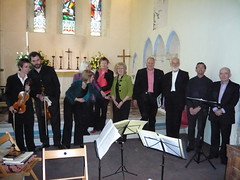
The story began 42 years ago - and that horrifies me, when I write it. In 1969 the St Maura Singers formed and sang Evensong, as I mentioned in my last post, and we've been at it ever since. Our soprano - wearing a purple jacket in the pic - moved away and mutated into an alto; her place was taken by a teenager just out of school (dark green jacket). Yesterday we were all together, along with another bass (white beard) and an instrumental ensemble, giving a re-run of our 40th birthday programme.
It was a lovely afternoon. The weather was perfect, the afternoon tea on the lawn unsurpassable, the audience a good size - and mostly drawn from outwith the HT congregation, which was healthy for the coffers. The church itself proved what we who worship there have always known: it has a superb acoustic and a wonderful atmosphere, peeling paintwork notwithstanding. It doesn't suffer from the curse of wealthier churches - thick pile carpeting and cushioned seats - and the hassocks had all been piled away to increase resonance.
Personally, I was soaring on adrenaline. A combination of singing first alto in "When David Heard" and making a decent job of John McIntosh's* settings of Dave Whyte songs left me wrung out after it was over - and starving. I was as high as the proverbial kite, and as always found myself wondering how long we'll be able to do this.
At 65, I realise it can't be much longer. Our soprano is the only one not in that age range. But what a privilege still to be performing like this - I only hope I'll know myself when it's time to give up!
*OK - he's Mr B. But he has another life ...
Saturday, April 30, 2011
Grauniad alive and well and better online

Back came a mail saying they'd use it. I'd seen the online tale about Gwyneth Paltrow badmouthing her grandma; I expected to see my stuff online. A phone call later in the afternoon, however, told me it'd be in the paper as well, so I duly bought one of Dunoon's limited stock of guardians the following morning.
To put it briefly, my piece was crap. It had been edited out of all recognition, into a jaggedly unimaginative lump devoid of paragraphs ( I know - space restrictions) with the sequencing altered and so drastically cut that it didn't actually make sense. They didn't even get my "comment is free" name right. Someone who knows me well said it didn't sound like me at all, and I was glad to hear this. I gave heartfelt thanks that usually I write only for myself, and that our local paper treats what I write with respect. I know newspapers have to consider column inches and that once a paper's out that's it - it can't be changed - but I had never really considered the implications for print journalists.
Thing is, I'm not a print journalist. I'm not a journalist at all. Putting that castrated rubbish in the paper makes it look as if "amateurs" can't write to save themselves, and makes this "amateur" determined that she won't do anything so silly again. But if they're going to invite submissions, the Guardian needs to think about what they're doing.
To balance all this, I have to report that when the online version appeared - and you can read it here - it was more or less what I had written, and - better still - the mistakes I pointed out to @commentisfree Jessica were immediately remedied. Maybe this happens every time anyone writes for print media - and maybe that's why I'm becoming such a fan of online reporting.
But there's still something nice about seeing it in print ...
Wednesday, April 27, 2011
Of plain chant, coal heavers and feathers...

I was first drawn to this music in my impressionable youth - before I had anything to do with church other than as a musician. In the late 60s, there was not much of it around, certainly not on the Third Programme, but when I turned up in the summer of 1969 to sing Evensong in The Cathedral of The Isles with the newly-formed St Maura Singers, we had to learn quickly - a new psalm or two, the Magnificat to Tonus Peregrinus - and I had my first go at deciphering neums and four-line staves.
All this was a long time ago, I remember ... anyway, I've sung the psalms and Compline to plain chant over the years since then, and have discovered a thing or two. The first was that I found it easy to read once I had the hang of it, and to work out where the semitones fell (always the pitfall if you don't) and the implications of the interesting groupings of notes (that last link, by the way, gives considerably more detail). But after that, the biggest discovery was the wonderful sense of control, of the line conveying the words without the need for any irritating "interpretation" on my part, of the flexibility when a trained group (or a solo cantor) is able to give slightly different emphasis to one word by lingering infinitesimally on it - all this seemed to me to allow for meditation actually to take place without getting in the way. The pause at the central colon in the psalms turned out to be just right for the breath required for the second half, and the antiphonal singing allowed for the smooth flow from one verse to the next, without worry, without the need for any mnemonic. It felt relaxed and prayerful.
It isn't always thus. People can sing this stuff without any feeling for it at all and ruin the effect. Sometimes I've heard plainchant that might as well be someone selling coal in the street (they don't, any more, but I recall the cry of "coaaaaaal briquettes" from my youth). However, the same goes for any music, and there are murderous performances to be heard on the internet any day of the week. But if you're lucky enough to find yourself in a position where you can enjoy the feather on the breath of God that is eloquent plain chant, or better still to take part in making it happen, you'll know what music you'll hear in at least one of the many mansions of heaven.
Sunday, April 24, 2011
The Cross gets in the way ...
 |
| Paschal Candle in Holy Trinity by Sharon Barnard |
Where am I going with this? Let me give another snapshot, this one of a moment as we were drifting to the door at the end of this morning's Eucharist. I overheard possibly the oldest member of the congregation declare to the person next to him that he didn't care for the big cross in the choir, and her reply that she liked it but it had got in the way, rather. It came to me that there was something to be said about that ordinary remark - because the Cross does "get in the way", keeps getting in the way, and the significance of it can be a stronger influence on people than the day of Resurrection - the day in which we all suddenly become cheerful and joyous and tell each other that Christ has risen. I think it's the sudden cheer that leaves me reeling, not sure how to be, not sure how ...
I think I'm not far off what it must have been like, back then. I cannot see how the all-too-human followers of Jesus could feel anything but exhausted and incredulous at the news that his body was no longer there, and I imagine Mary Magdalene hardly daring to hope that what had happened to her wasn't a wishful dream. In a way it doesn't matter if that's how she and they reacted - what does matter is what happened as a result of this day. The long-term view, in a way.
I can still remember my first real Easter, the first time it had an effect on me. It was in 1973, and that's a lot of Easters ago. I think I'll perhaps post about that first Holy Saturday in the scented darkness of the Cathedral of The Isles (yes - there again) but not now. And I need to write about some of the other things I hold dear. But today - God showed us something, and we stand amazed. Exhausted, and amazed. And we don't really know what to do with our knowledge ... or at least, this writer doesn't.
Resurrection is profoundly disturbing, after all.
Saturday, April 23, 2011
Birdsong in Gethsemane
In the darkling garden
a lone bird drops
liquid notes like dark blood
beneath the quiet trees. And then
silence. And in the silence
the old struggle surges
as flesh and soul pull
apart. The body aches
to be the prayer, to feel
the God’s warmth
in the darkness. But
there is only stillness
and the blood’s song
and the everlasting longing
as somewhere far away
innocence sleeps.
C.M.M. 04/11
Subscribe to:
Posts (Atom)