What does someone of mature years who tries to live under/up to a belief-system that encourages compassion say about the passing of Margaret Thatcher? If she's wise, perhaps she says nothing. But if she's not as wise as she might be, is not as Christian as she ought to be and in addition is a blogger, what then? Blog as catharsis has always been a reason to keep writing, and despite my best intentions to think of something else, it keeps coming back to this ... this toothache of an internal dialogue. Besides, the media - social and professional - keep banging on about it; I hear politicians mouthing blandly political platitudes while others leap to condemn any outbursts of unseemly celebration.
So, for what it's worth, my take. I've just caught up on what Russell Brand had to say, and found myself sympathising. But he was a child of the Thatcher years, and I was an adult. I had somehow avoided any interest in politics in my student days, then I'd had a family and stopped thinking at all for a bit (you did that, in these days - your job wasn't kept open for you when you had a baby) - and then Thatcher came along and suddenly I was involved in the single-issue politics of CND and the US Navy Nuclear Submarine base, Site One, in the Holy Loch. We had a Tory MP in Argyll, the hectoring tones of Thatcher were omnipresent, and I have never felt so alienated or disenfranchised in my life as I felt in these days. I met miners at demonstrations, chanted "Maggie Maggie Maggie! Out Out Out!" at EIS rallies, met more veggie anarchists than I knew existed, gave evidence at the trials of Greenham women and was suddenly no longer welcome in the only church I knew.*
She came to Dunoon one day - must have been in 1976, I think - and was outside the baker's as I walked past (no, I didn't shake her hand). Her car passed as I and #1 son were waiting for a bus; she waved, and son treacherously waved back - and yet then I only knew she was a Tory. Presumably she was supporting the local candidate - but I didn't really know, then, what I came to know in the early 80s. And the strange thing is that hearing that voice on the radio the last couple of days brings it all back - even the genius who voiced her Spitting Image puppet evoked the same sick feeling. Not rational, really - gut feelings of the most basic sort. Not arguable, not at all.
So where on earth am I going? The thoughts that crowd in include this: We shall all die. Some of us will grow old first, and some of us will be frail or demented or both. But we shall still be the people we are now, and the people we were before. And, you know, I think I want people to think of me in some putative future as they do now. I've always believed in not patronising old people, just as I don't believe in patronising the young.
Thatcher's last word on her eviction from office by her party was that she would never forgive them. Fine. She was a politician who chose her job and stuck to it ruthlessly, and in the end her fellow-Tories were ruthless in getting rid of her. She set back the cause of women in high office by years - and I can think of other women in politics whom I admire and have admired far in excess of any reluctant admiration Meryl Streep's film might have engendered.
So I can't face even thinking about what the proposed funeral arrangements imply in terms of divisiveness, the reopening of old sores, the effect on people struggling through their lives under the current Tory economies, the cost of policing and the threat to public order. I shall do my best to avoid the media coverage. And I shall try to say as little as possible.
De mortuis nil nisi bonum? Aye, right.
*Everything changes. That too, I'm glad to say.
Wednesday, April 10, 2013


Friday, April 05, 2013
A pivot into eternity
Sometimes in life there is an epiphany, quite unexpected, quite unsought. So it was this evening, towards the end of a meal that I had enjoyed, sitting at table with the candles lit but the sky outside still a clear, pale, perfect blue. We were listening to Martha Argerich playing the slow movement of Ravel's G major piano concerto, and as a certain cadence which seemed to be a gentle pivot into eternity yielded a gentle trickle of notes on the piano I felt the miracle of a life that could encompass such things.
There are days when life seems very short - even the Beatles sang of it - but in that brevity we are allowed such riches of experience that they seem unfathomable. I felt in that moment of listening that this was an evening piece, this slow movement - that I couldn't imagine listening to it in a morning, and certainly not hearing it in this way. But to analyse that quietly soaring moment would be to dissipate its power, so I shall merely remark its passing, and my gratitude for having encountered it.
There are days when life seems very short - even the Beatles sang of it - but in that brevity we are allowed such riches of experience that they seem unfathomable. I felt in that moment of listening that this was an evening piece, this slow movement - that I couldn't imagine listening to it in a morning, and certainly not hearing it in this way. But to analyse that quietly soaring moment would be to dissipate its power, so I shall merely remark its passing, and my gratitude for having encountered it.
Friday, March 29, 2013
After the ninth hour

dead inside my head, dead
inside my heart as we lift the dead
weight of our friend who was more
than just our friend and take his
dead body to this raw tomb that
just happens to be waiting for him.
Was it all meant to work out
like this? What about the two
hanging, groaning, haranguing,
praying? Praying in extremis.
Everyone does that.
There is no feeling left
for a time like this. Only the
raw hole where the emotion
raged and the terror flared
and burned all else to black
as the sky darkened
and the woman bustles
home and her thoughts
turn to food and tasks
and children make their
demands that obliterate
all dialogue with self
and leave you safe
from this empty pain.
Leave the heavy weight
of body and the weighty spice
to scent the darkness
till another day.
Leave the dark sky
light a lamp
do not let the pictures
fill your head
the hammer blows
your inward ear
the dull thud of wood
in the hard ground.
No. It is finished.
But how, God, how
do we live now
in the world that is so changed?
©C.M.M. Good Friday ’13.
Friday, March 22, 2013
Love your neighbours?
How does a Christian know she is living out her faith in her everyday life? (I'm not excluding chaps here, not at all, but I'm a she and it was going to be tedious to keep giving both pronouns. Forgive me.) This was something that came up in discussion at our Lent group yesterday; we reached no conclusion other than that it can be difficult to have any certainty for oneself, no matter how you may look up to others. At least, that's what I took from it.
But of course one example of living a Christ-inspired life is all over the news at the moment, because the Reverend Isaac Poobalan of St John's Episcopal Church in Aberdeen has invited the Muslims from a neighbouring mosque to share his church building rather than pray outside in the snow when there were too many of them for the space available. Presumably his vestry members also approved this move, so there's some more people doing real Christian stuff. And, as Jesus himself predicted, discipleship like this brings abuse.
For Fr Poobalan is being subjected to a torrent of abuse from internet trolls, according to the Huffington Post. Apparently they call themselves Christians, these trolls. Up this way we might call them something very different, but I shall restrain myself.
Instead, I'm going to say something positive. Fr Poobalan's action and continuing determination to love his neighbours makes me proud. Proud to be a member of the Scottish Episcopal Church where such things happen, proud to say I'm a Christian.
It's as simple as that.
But of course one example of living a Christ-inspired life is all over the news at the moment, because the Reverend Isaac Poobalan of St John's Episcopal Church in Aberdeen has invited the Muslims from a neighbouring mosque to share his church building rather than pray outside in the snow when there were too many of them for the space available. Presumably his vestry members also approved this move, so there's some more people doing real Christian stuff. And, as Jesus himself predicted, discipleship like this brings abuse.
For Fr Poobalan is being subjected to a torrent of abuse from internet trolls, according to the Huffington Post. Apparently they call themselves Christians, these trolls. Up this way we might call them something very different, but I shall restrain myself.
Instead, I'm going to say something positive. Fr Poobalan's action and continuing determination to love his neighbours makes me proud. Proud to be a member of the Scottish Episcopal Church where such things happen, proud to say I'm a Christian.
It's as simple as that.
Monday, March 11, 2013
Yes, I'm still reading ...
It's been a while since I last reviewed a book - November saw the last, I think - and I've almost forgotten what I've read since then. However, two of the books are sitting on the desk beside me, mute reproaches, and if I deal with them now they can find a home on a shelf. If there's any room, that is.
 The first of them takes up the story of Robert Merivel, who first appeared in Restoration. In Merivel, A Man of his Time, Rose Tremain shows us a much more mature Merivel, a man in his late 50s who considers himself "much decayed" (ouch) with a life to look back on and one last great adventure to undertake. There is a lover, a trip abroad, a bear. There is the King, now also much decayed, and there is the melancholy of the end of a life imperfectly lived. Merivel is self-mocking and sad, and Tremain and her hero take us expertly through a world in which glitter disguises squalor and favour is given and withdrawn in turn. I was absorbed by the writing and made melancholy by the inevitability of ending, whether of a novel or of a life. So there.
 And then I read Toby's Room by Pat Barker. A strange, inconclusive story of the 1914-18 war, of a brother and sister and their friend whose face is destroyed by shrapnel, it is described as "a riveting drama of identity and damage, of intimacy and loss", and "Pat Barker's most powerful novel yet". I dunno about that; I found myself driven to explore some of the history of Queen Mary's Hospital and the work of the artists who recorded the progress of early plastic surgery there, and in some ways I wish I hadn't. Having read the bood some months ago now, I find I've forgotten the conclusion of the narrative and can recall as it were the incidentals - but incidentals that are themselves far more important than any fiction could be.
 I'd saved up the fat paperback The Villa Triste by Lucretia Grindle for a trip - the other two were hardbacks - and was engrossed by her story of wartime Italy and its resulting deaths in modern Tuscany. The time-switching typographical devices became easy after the first time, and the mystery remained - for me anyway - a mystery until satisfyingly late in the story. I liked Palliotti, Grindle's detective, and I loved Florence and the descriptions of backstreets and Sunday family eating.
And now I'm reading War and Peace, in the new translation. I've read about 200 pages of very small print, and there are another 1000 to go. I'm enjoying it more now than I was at first, having arrived in a War bit rather than the opening Peace section, and I shall certainly say more once I've finished it. Suffice it to say that I've learned from a translator's note that Russians consider the book an easy read, and I'm actually seeing why ... but of that more anon. Just don't give me any more books till I've finished it!


And now I'm reading War and Peace, in the new translation. I've read about 200 pages of very small print, and there are another 1000 to go. I'm enjoying it more now than I was at first, having arrived in a War bit rather than the opening Peace section, and I shall certainly say more once I've finished it. Suffice it to say that I've learned from a translator's note that Russians consider the book an easy read, and I'm actually seeing why ... but of that more anon. Just don't give me any more books till I've finished it!
Sunday, March 10, 2013
Costly love
It seems to have been several years since we observed Mothering Sunday in Holy T - if my files of past Intercessions are anything to go by, we've stuck to Lent 4 for years, and I had nothing to plunder for my prayers for today. In the event, it took me some time to think about and produce same, but it was a rewarding sort of time. The readings helped, of course - that wonderful line at the end of the Gospel: "And a sword shall pierce your own soul also", and the story of Moses in the basket among the reeds.
Why did these strike such a chord? I was thinking of the costliness of the love shown by mothers across the ages and over today's world. I was thinking of mothers who had to watch their children die or suffer; I was thinking of the lines of women leading tired children to a hazardous safety in Jordan, leaving behind the ruination of their lives in Iraq. I was thinking of how many mothers will do anything for their child, and how letting the tendrils of love for each new life twine around the heart is taking a step that will never be retraceable. And I thought of how often we forget to tell our own mothers what they mean to us - forget until it's too late. And I thought of how that kind of love would know anyway. But I still wished I'd said something explicit.
But people like me don't say these things explicitly. Where they emerge is often oblique, there to be seen if you look hard. And sometimes poetry has to do it. It was poetry that summed up the enormity of what that Levite woman had done to save her baby son, poetry I wrote the last time, I think, that we read that lesson in church. I've published it before, on Frankenstina, along with a picture of the font we floated our messages on in paper boats, but because I used it today I'm putting it here.
ONCE ...
In the hot silence
while he slept
and only the flies sang
she made the basket
strong with love
to hold this one most precious thing
and gave it, dry-eyed,
to the waiting flood.
© C.M.
Why did these strike such a chord? I was thinking of the costliness of the love shown by mothers across the ages and over today's world. I was thinking of mothers who had to watch their children die or suffer; I was thinking of the lines of women leading tired children to a hazardous safety in Jordan, leaving behind the ruination of their lives in Iraq. I was thinking of how many mothers will do anything for their child, and how letting the tendrils of love for each new life twine around the heart is taking a step that will never be retraceable. And I thought of how often we forget to tell our own mothers what they mean to us - forget until it's too late. And I thought of how that kind of love would know anyway. But I still wished I'd said something explicit.
But people like me don't say these things explicitly. Where they emerge is often oblique, there to be seen if you look hard. And sometimes poetry has to do it. It was poetry that summed up the enormity of what that Levite woman had done to save her baby son, poetry I wrote the last time, I think, that we read that lesson in church. I've published it before, on Frankenstina, along with a picture of the font we floated our messages on in paper boats, but because I used it today I'm putting it here.
ONCE ...
In the hot silence
while he slept
and only the flies sang
she made the basket
strong with love
to hold this one most precious thing
and gave it, dry-eyed,
to the waiting flood.
© C.M.
Saturday, March 09, 2013
A Lenten poem
 |
| Road through the Nevada desert |
One pale, quiet morning,
I open my soul’s eyes
unarmed with faith or company,
responsibility or joy,
and see quite plain
the vastness of it all, the loneliness,
the very impossibility of life.
A hand in the desert -
will there be a hand?
Someone who knows the way
to travel this grey distance
and find the distant hills?
The question hangs
in the still air. But
in the birdless silence
is that the gentle ripple
not mocking or sardonic
but inviting, is that -
oh please, is that -
a companionable laugh?
© C.M. 03/13
Friday, March 08, 2013
A ridgewalk with the Third Age

A suitably splendid scene for a brief retrospect on last week's Argyll and The Isles Diocesan Synod, the above photo shows the moment when Bishop Kevin installed the new Dean, Andrew Swift, in the Cathedral in Oban. I was right at the back of the Cathedral, having arrived at the very last minute from Taynuilt, where we were staying and where we had gone to change into gladder rags for the Synod dinner, but a phone waved speculatively in the air seemed to do not badly, thank you.
Anyway, enough of the formalities. Argyll is unlike the more urban dioceses in that it holds its synodical gatherings over three days. After all, people take to planes and boats to get there - it seems only fair to give them a decent time to socialise, no? And anyone who cares to can attend, especially the pre-Synod day. This year's speaker, Ann Morisey, was the best yet. She talked about the Ages of our lives - not seven, as Shakespeare described them, nor the three of past generations, but the four ages we now see living: children (dependant); adults (generative, working); the active retired (new!); the old (dependant, letting-go). And of course, more than half of her listeners were the active retired on whom the church depends, and of whom, dear reader, I am one.
I'm not going for a blow-by-blow here. But I started thinking about the business of loss of status - the loss of status that is part of letting go. We all, I suppose, acquire varied status during our lives, and some people have the dickens of a job letting it go. Retirement can spell doom and depression for some, rather than joyous freedom. Men seem more bothered than women. I also thought about the things that apparently keep us going for longer - singing seems to be one, dancing another, and church membership and activity seems to be jolly good for one.
But this status thingy. People acquire status in church circles - and suffer a new bereavement when it is taken from them. We all know the criticism voiced of people who hang onto jobs in church - but do we think of why these jobs are so dear to these people? Should we all be practising letting go of things, sitting lightly on our little importances so that the wrench will be less?
Maybe it depends on why we do these things in the first place. And an echo of the instruction to pray secretly in your own room comes to me when I think of this. We do love to dress up in our church, and there is much to be said for the depersonalisation of the individual that is one result of this. But I wonder if every one of us, for our own future good, needs to think about why we cling to our assumed responsibilities.
In a voluntary organisation there will always be a need for someone to step forward. There was much talk this year of ridgewalking, with all the excitement and danger that the term implies. Suddenly it feels as if the diocese has set off on its precarious ridge walk with a song in its heart - and the Third Age to the fore.
Tuesday, February 26, 2013
Seeing the daffodils

Yesterday I posted about suddenly realising I could still feel what it was like to experience the world as when I was a child. And today I read the next bit in Michael Mayne's This Sunrise of Wonder and began to think again about this business of how we see the world around us. Is it simply the realisation that our time here is so limited - and getting shorter by the day? Is it also the fact that as we shed responsibilities - job, mortgage, family, aged parents - we are allowed to become like children again? (And if so, it's the best argument yet for not raising the retirement age).
Anyway, this is what John Updike has to say on the matter: (and yes, Mayne is quoting Updike; I'm not quite at the bonkers stage yet) :
Like my late Unitarian father-in-law am I now in my amazed, insistent appreciation of the physical world, of this planet with its scenery and weather - that pathetic discovery which the old make that every day and season has its beauty and its uses, that even a walk to the mailbox is a precious experience, that all species of tree and weed have their signature and style and that the sky is a pageant of clouds. Ageing calls us ... into the lowly simplicities that we thought we had outgrown as children ... The act of seeing is itself glorious.
Today, the sky is a perfect blue. The sea is darker, and in the open water there are small, north-wind-driven waves. But under the wall that faces the sun, there are daffodils in bloom.
Monday, February 25, 2013
LIfe in the bubble of wonder
Do you remember being a child? Oh, yes ... all these years ago ... But do you really remember? Do you ever find yourself re-inhabiting that wonderful bubble that could enclose you when you were small, when your imaginative world was the be all and end all; when the world of adults was an enabling machine, but little to do with you? Or are you so caught up in the business of being a grown-up that the bubble has long since burst, scattered like the rainbow, now only a damp circle on the concrete of your life?
I'm reading Michael Mayne's book This Sunrise of Wonder - at last, Jim, if you're reading this! - and it's fair got me thinking. Especially after last weekend, when I was visiting a Thomas the Tank Engine paradise with my four grandchildren and their assorted parents. Before we all headed away from the hotel and the theme park, we spent a couple of hours in a nearby playpark. The contrast with the theme-park rides was striking. Yes, there were swings and roundabouts, but there were also climbing frames and the wonderful galleon in the photo. And it was the galleon that kept all four of them playing together the longest. I could hear the oldest allotting roles to the others, who weren't really paying much attention; the smallest child was ferrying sand to the top of the chute that is just visible exiting the hull in the bottom corner; another had purloined a bottle of water the better to demonstrate the drainage the same chute afforded. There was another hiding under the deck, and the strange child that found himself in the middle of the gang was pressed into service as a pirate. And no-one wanted to come away.
And the combination of the book and the grandchildren's enjoyment of imaginative play brought an epiphany. I could remember my childhood bubble. And what was better: I could remember it in such a way that I could feel it again, feel it the way I did when I was under ten (the family moved house when I was ten; it's a useful watershed in my library of mental images of childhood). Here are some of the stand-outs:
Sitting on the grass in front of our holiday house in Arran, around 6pm on the first of July, gazing at the hills at the head of Glen Cloy, smelling the bog-myrtle on the breeze, ready to burst with happiness because the summer was a lifetime long and I was back in the place I loved more than any other.
Walking behind the rest of my family after a trip to the cinema - alone, because I was in a movie and Byres Road was actually Dodge City and a dangerous environment.
Playing under and on top of the kitchen table, because it was a boat. The trick was to get onto the top without falling into the sea of the rest of the floor.
Spending hours in a hollowed-out rhododendron bush with a few friends as the Arran rain teemed down, happy as could be because our 'house' kept the rain out.
Looking forward to time alone - on a bus, on a train, in my bed - because I wanted to "think" - which I now realise was re-entering a bubble which was always there.
Climbing rocks on the shore in the conviction that I was on a sheer rock-face on some distant mountain.
I could actually go on all day. Even writing these makes me feel I want to go out to play. The point is that it was all wonderful. Imagination took me way beyond what anyone else would have seen. On the odd occasion when I have a grandchild to myself, I like to put that child into a situation where they too will wonder at something I love - is this because I now need an excuse to be child-like?
Dammit. I don't need excuses. I'm fortunate in that I worked with young people for my whole life - ok, they were teenagers, not tots, but they were amazingly easy to make young again with a little encouragement. I was able to avoid growing up. I grow old, I grow old ... but I'm not going to succumb to the equivalent of Eliot's rolled trouser-bottoms: no. I may have reached the cardigan/tweed skirt era beloved of a previous grown-up generation, but there's nothing appealing there. Who cares what the world thinks?
I've had a taste of life in the bubble again. The life of wonder has been re-awakened, and it's ... wonderful.
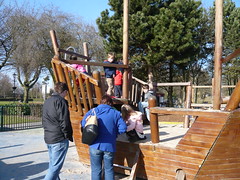
I'm reading Michael Mayne's book This Sunrise of Wonder - at last, Jim, if you're reading this! - and it's fair got me thinking. Especially after last weekend, when I was visiting a Thomas the Tank Engine paradise with my four grandchildren and their assorted parents. Before we all headed away from the hotel and the theme park, we spent a couple of hours in a nearby playpark. The contrast with the theme-park rides was striking. Yes, there were swings and roundabouts, but there were also climbing frames and the wonderful galleon in the photo. And it was the galleon that kept all four of them playing together the longest. I could hear the oldest allotting roles to the others, who weren't really paying much attention; the smallest child was ferrying sand to the top of the chute that is just visible exiting the hull in the bottom corner; another had purloined a bottle of water the better to demonstrate the drainage the same chute afforded. There was another hiding under the deck, and the strange child that found himself in the middle of the gang was pressed into service as a pirate. And no-one wanted to come away.
And the combination of the book and the grandchildren's enjoyment of imaginative play brought an epiphany. I could remember my childhood bubble. And what was better: I could remember it in such a way that I could feel it again, feel it the way I did when I was under ten (the family moved house when I was ten; it's a useful watershed in my library of mental images of childhood). Here are some of the stand-outs:
Sitting on the grass in front of our holiday house in Arran, around 6pm on the first of July, gazing at the hills at the head of Glen Cloy, smelling the bog-myrtle on the breeze, ready to burst with happiness because the summer was a lifetime long and I was back in the place I loved more than any other.
Walking behind the rest of my family after a trip to the cinema - alone, because I was in a movie and Byres Road was actually Dodge City and a dangerous environment.
Playing under and on top of the kitchen table, because it was a boat. The trick was to get onto the top without falling into the sea of the rest of the floor.
Spending hours in a hollowed-out rhododendron bush with a few friends as the Arran rain teemed down, happy as could be because our 'house' kept the rain out.
Looking forward to time alone - on a bus, on a train, in my bed - because I wanted to "think" - which I now realise was re-entering a bubble which was always there.
Climbing rocks on the shore in the conviction that I was on a sheer rock-face on some distant mountain.
I could actually go on all day. Even writing these makes me feel I want to go out to play. The point is that it was all wonderful. Imagination took me way beyond what anyone else would have seen. On the odd occasion when I have a grandchild to myself, I like to put that child into a situation where they too will wonder at something I love - is this because I now need an excuse to be child-like?
Dammit. I don't need excuses. I'm fortunate in that I worked with young people for my whole life - ok, they were teenagers, not tots, but they were amazingly easy to make young again with a little encouragement. I was able to avoid growing up. I grow old, I grow old ... but I'm not going to succumb to the equivalent of Eliot's rolled trouser-bottoms: no. I may have reached the cardigan/tweed skirt era beloved of a previous grown-up generation, but there's nothing appealing there. Who cares what the world thinks?
I've had a taste of life in the bubble again. The life of wonder has been re-awakened, and it's ... wonderful.
Thursday, February 14, 2013
Just war memories in Lent
I went to the first meeting of the Lent Course today and found myself involved - or perhaps trying not to get too involved, or trying not to talk too much which is an associated matter - in a brief discussion of Just War Theory. I first came across this a long time ago, when I attended my first RCC* in Edinburgh and had to second a motion put by the man who many years subsequently became our bishop. At the time of agreeing, I hadn't realised that seconding a motion would mean rather more than simply sticking my hand up, and I was horrified to find out that I was expected to speak to the gathering for about 10 minutes.
Of course, once I had prepared what I wanted to say, and typed it out double-spaced on, I think, A5 sheets of paper, I found the whole thing rather shockingly enjoyable. At the time, I had not yet returned to teaching after the weans, and it had been some six years or so since I had addressed a class, but the combination of a microphone, a largish audience and the applause at the end proved irresistible. It was also the fatal move that had me not only going along to a local CND group (in 1980 this was quite radical in a US Navy garrison town) but also becoming publicly vocal, and TV and radio interviews followed, as well as requests for copy from Peace News and other publications. Heady stuff, which didn't end till the navy left and I was not anywhere to be seen in the public deliberations of the Scottish Episcopal Church.
It fascinates me now to see how mainstream such thinking has become in church circles, how we can discuss the ethics of Christians and violence without polarisation. My disappearance from church matters was directly linked to my CND activities, and I didn't enjoy much of the fallout. But today I relived that early introduction to the dilemmas of violence and proportionality, and I felt glad that I'd gone through the four minutes to midnight era and emerged into the morning.
But I do love a good demo ...
*Representative Church Council - where most of the laity functioned. The Provincial Synod at the time had 10 lay members, if I remember correctly - I was one of them.
Of course, once I had prepared what I wanted to say, and typed it out double-spaced on, I think, A5 sheets of paper, I found the whole thing rather shockingly enjoyable. At the time, I had not yet returned to teaching after the weans, and it had been some six years or so since I had addressed a class, but the combination of a microphone, a largish audience and the applause at the end proved irresistible. It was also the fatal move that had me not only going along to a local CND group (in 1980 this was quite radical in a US Navy garrison town) but also becoming publicly vocal, and TV and radio interviews followed, as well as requests for copy from Peace News and other publications. Heady stuff, which didn't end till the navy left and I was not anywhere to be seen in the public deliberations of the Scottish Episcopal Church.
 |
| I went to Greenham Common too ... |
But I do love a good demo ...
*Representative Church Council - where most of the laity functioned. The Provincial Synod at the time had 10 lay members, if I remember correctly - I was one of them.
Wednesday, February 13, 2013
A fashion for penitence?

So where am I going with this? To a question: did we always hear so much about "giving up something for Lent"? (It may well be that we just hear more about everything in the Times of Twitter, but that's another kettle of communications). Brought up in a questioning Presbyterian environment, I never even heard about Lent - not at home, not at school. There was one girl who appeared with ash on her head and tales of an exotic church where people dressed up and had wine out of gold cups, but at ten I tended to write her off as a romantic. Having spent my first years in the privation of post-war rationing (I mainly remember the butter ration of a "big week" and a "wee week" and the sweets that had to be hoarded before we went on holiday as we couldn't get them on Arran), I wasn't about to enquire about self-induced abstinence, and my parents never mentioned it. And then I became a Piskie.
Nothing changed, at first. But a friendship with a clergy family who arrived here - kids the same age as ours, one just starting school - made me aware that other people Did Things Differently. Mainly it was the booze and the chocolate thing, presented as firmly and as unquestioningly as the need to clean one's teeth regularly. It began to seep in to my consciousness. Should I try this?
Now, this is where I ought to lead on to a life spent enjoying increasingly holy Lenten observances and self-denial, but it wasn't quite like that. In fact, it barely registered as more than an annual niggle, like a transient toothache. Not that I didn't give it a go, once. At the time I had returned to teaching and came home ravenous for a quick snack at lunchtime. I got into the habit of finishing off with a Twix (remember them? Not the big double one, but the smaller fun-sized one - no excess here). One Lent, I decided I enjoyed this so much I'd give it up, and eat a banana instead. Six weeks on, I discovered I'd become addicted to bananas instead, and had lost a pound or two. I'd also gone off Twixes. Not much self-denial there, eh?
On another occasion, I was spending a couple of nights at the house of dear friends who gave me these mini-holidays as I recuperated from surgery. Usually we had a drink with dinner, or just before it. Then Lent hit. And there I was, on a Monday evening, really wanting a drink. No, I don't have a problem - I'd just spent a week in hospital with nary a drop - but the more I realised they had no wine, no sherry, the more desperate I became. To cut a long and potentially embarrassing story short, I ended up with an elderly can of Guinness which had lurked in the back of their fridge since the visit of a son at Christmas. I rarely drink Guinness, but ...
But to retreat from the anecdotal: There are several things that I'm not liking about my current awareness of Lent. People post on their Facebook status that they're about to give up ... whatever ... for Lent; others make sure they tell you why they won't have a glass of wine, thank you (all very proselytising - or is it?); there are jokes by the thousand (the Pope's imminent retirement provides the meat for this year's). Whatever happened to the idea of praying secretly in your closet? The entire Anglican community (I exaggerate) - to say nothing of RCs - seems to erupt in the twitter-era equivalent of sackcloth and ashes. Or people tell you what they're "taking on" instead, with the expectation that you'll match them.
But I won't. Because I don't think I'm asked to do any of these things. So I can tell the world that I have been practising portion control for 7 months and have lost 9 lb as a result - but that was for me, not for God. And besides, I feel smug about it. I've started reading "War and Peace" - but that's because I feel ignorant, and I feel it's something to do before I die (I could die trying...). And success may well make me feel smug. Again. I could give up my one drink a day, or my one chocolate a day - but I don't think that would make any difference to anything at all.
This is our life. We're given it as a gift, given the world and its beauty, given minds, tastes, delights, friends ... I know this. I don't need to turn from any of it to know it better.
Since I began writing this post, I have heard that the car is still poorly and in bits at the garage. So we shall be walking the half-mile up the road in the slush to church. Just remember - it's not a penance. Not for me. I shall enjoy it.
Friday, February 08, 2013
Pure dead relevant

I've decided I like going back these days, though buildings like this have transformed the campus from my student days. I found it personally fascinating to sit in a lecture theatre and be enthused about a subject of which I know next to nothing, and to talk to researchers about their work - the two I spent some time with did a pretty good job of making their specialisms intelligible to an ignoramus like me. Clever, enthusiastic, committed people - what's not to like?
I have to add here that I share Mr B's sense of the evening's reminding him of those tales of a pal of a med student who donned a white coat and snuck into an operating theatre only to pass out at the sight of blood - so many of the guests were obviously medics, some of them possibly of Lister's era (I exaggerate, but ...) who had at least a handle on what was happening. I felt the need to preface every conversation with the apology "We're Arts graduates, but ..."
But it made me think. What use had my degree been to anyone? The Medical School is enormous and forward-looking and I'm glad - but I studied English Lit., Early English language, Latin ... cui bono? So that I can use tags like that and know why? So that I can slip bits of Shakespeare or Eliot into a Tweet and wonder if anyone will notice? I know that there are things going on inside my mind that are informed by what I learned all those years ago - but what did I ever do with them, what help were they to my fellow-creatures?
That's where I'm stuck at the moment. It must be wonderful to do something that directly affects life itself. One of the speakers on Wednesday had been delayed because he'd been called away to see a new stroke patient - how good to feel that something you know or propose might mean the difference between that patient's recovering or not. How completely relevant to us all. Does it matter (I ask myself) if that doctor lapses into comma-splice in a communication?
They served some mean canapés afterwards as well.
Thursday, February 07, 2013
Talking posh
Just before I left the house this morning, I caught a snatch of Call Kaye on the radio. Should we be insisting that our children talk 'properly'? Sadly, in Scotland that tends to mean adopting a Pan Loaf accent - and, worse, using the first person of the personal pronoun regardless of grammatical context. And so it was, as I hovered over the off switch, that I heard with a crushing sense of inevitability a brief skit of a family scene. Pan loaf Mum, Glesgae Dad, silent wean. Mum: "You don't want to disgrace your father and I."
Grrrrr.
- Posted using BlogPress from my iPhone
Grrrrr.
- Posted using BlogPress from my iPhone
Location:Dunoon ferry
Sunday, February 03, 2013
Rebus in arduis *
It's Sunday. You've celebrated Candlemas, because you could - a day late, but in the boondocks you can't celebrate too often and get people there. It's been a joyous service, and at least one person has confessed to having their heart up in the air and tears running down their face because of the music. So you're happy. Actually, you were happy before they said that, in all sorts of ways involving children, young people capable of reading the lectionary as if it made sense, lovely imagery, a vision of how things can be ... I could go on, but I suspect I already have.
And then you go to the social area at the back of the church, greet someone standing alone - not a stranger, someone who's been coming on and off for decades - and he informs you, quite firmly, that he didn't know any of the hymns except for the first one and he'd hated them all anyway.
Time was I'd have felt wounded at that moment, for church sometimes leaves you vulnerable to the kind of barbs we don't often get thrown these days. But I've been around a lot of barb-fests, and I merely, mildly even, point out that what he derides as "happy clappy" music didn't form part of my tradition either (Church of Scotland, seduced by singing Byrd and Palestrina, in Latin) and that Mr B never chose happy crappy (sic) music and that this chap should perhaps widen his horizons ... Again, I could go on. I did, a bit - something about singing sentimental verse full of lamentable poetic diction set to dreary tunes - but I won't.
But I do wonder,sometimes often, about the future of parish worship. If I were faced with the prospect of worshipping where there was a diet of Victoriana, badly played at funereal tempi, led, perhaps, by a choir whose sopranos had voices that weren't, any more, I think I'd give up. On t'other hand, if there was an indifferent praise band with a very powerful amplifier, I fear it too would drive me away. So what am I looking for?
Easy. Either a competent musician, on any instrument, who has the gift of inspiring people to sing (and that often comes down to rhythm) - or silence. We sing too many hymns, mostly - and this is especially evident when actually hardly anyone sings anyway. They leave it to someone else. And I'm looking for hymns whose words are theologically meaningful, whose imagery I relate to, which don't ask me to think that God made us high and lowly and so on. I reckon that hymns tend to reflect the folk music of their day. That being the case, we shouldn't object to the odd bit of syncopation here and there. They also tend to reflect the world which informs their words - so we balk these days at singing that all must love the human race "in heathen, Turk or Jew", and some of us at least rejoice in discovering the songs of Christians in other countries, because the world has shrunk and we have access to a far wider song-pool than we did a century ago.
I didn't let all of this fly at the misery in the church; I'm letting go here instead. I didn't even ask him what made it all right for him to girn this way at someone who doesn't actually choose the music but who obviously had enjoyed singing it - or even just at someone who had offered him a friendly greeting. Long ago I made the decision to try to be Pollyanna till I got home - or to keep out of the way of temptation if I felt unduly volatile.
But sometimes, just sometimes, I want to throw something.
*Aequam memento rebus in arduis servare mentem : Horace. Means Remember to keep an even temper in difficult situations.
And then you go to the social area at the back of the church, greet someone standing alone - not a stranger, someone who's been coming on and off for decades - and he informs you, quite firmly, that he didn't know any of the hymns except for the first one and he'd hated them all anyway.
Time was I'd have felt wounded at that moment, for church sometimes leaves you vulnerable to the kind of barbs we don't often get thrown these days. But I've been around a lot of barb-fests, and I merely, mildly even, point out that what he derides as "happy clappy" music didn't form part of my tradition either (Church of Scotland, seduced by singing Byrd and Palestrina, in Latin) and that Mr B never chose happy crappy (sic) music and that this chap should perhaps widen his horizons ... Again, I could go on. I did, a bit - something about singing sentimental verse full of lamentable poetic diction set to dreary tunes - but I won't.
But I do wonder,
Easy. Either a competent musician, on any instrument, who has the gift of inspiring people to sing (and that often comes down to rhythm) - or silence. We sing too many hymns, mostly - and this is especially evident when actually hardly anyone sings anyway. They leave it to someone else. And I'm looking for hymns whose words are theologically meaningful, whose imagery I relate to, which don't ask me to think that God made us high and lowly and so on. I reckon that hymns tend to reflect the folk music of their day. That being the case, we shouldn't object to the odd bit of syncopation here and there. They also tend to reflect the world which informs their words - so we balk these days at singing that all must love the human race "in heathen, Turk or Jew", and some of us at least rejoice in discovering the songs of Christians in other countries, because the world has shrunk and we have access to a far wider song-pool than we did a century ago.
I didn't let all of this fly at the misery in the church; I'm letting go here instead. I didn't even ask him what made it all right for him to girn this way at someone who doesn't actually choose the music but who obviously had enjoyed singing it - or even just at someone who had offered him a friendly greeting. Long ago I made the decision to try to be Pollyanna till I got home - or to keep out of the way of temptation if I felt unduly volatile.
But sometimes, just sometimes, I want to throw something.
*Aequam memento rebus in arduis servare mentem : Horace. Means Remember to keep an even temper in difficult situations.
Wednesday, January 30, 2013
A very Pisky hoolie
Other people have posted about last Saturday's lovely service in the Cathedral of The Isles on Cumbrae - not least Dean Swift (I love writing that!) whose day it was - or, more accurately, whose half-day it was: the Provost of the Other Cathedral was also being installed as a Canon, and all stops were duly pulled out for the occasion. So let's start with the image that cliché evokes: the organist for the day was Jonathan Cohen, remembered fondly by a certain age-range as the pianist in Playaway. He came from London specially to play for the Cathedral Choir, all of whom had also made a special effort to be there - from Edinburgh and Glasgow as well as from Dunoon. We took with us another Dunoon alto who had never been in the cathedral before - she was well bowled over. As usual, we had to rehearse first - a scratch choir is an interesting beast, especially when there are no more than 3 voices to a part. The excitement of what is going on is amplified, if you like, by the frisson of wondering if we all know the notes well enough to come in as and when required, and if that person who claims not to have received the music in advance will lose his/her nerve at the crucial moment. So that, chums, is where my main photo comes from - that intense rehearsal when we not only deal with the music, but whether the new singer will find a red robe to fit without tripping her up - and would it be advisable to process in single file because of all the extra bodies in the nave?
Readers of this blog will know that my association with the cathedral goes back over 40 years, and that I have always sung there, and always in small groups. But there were people there to whom it was all new, and I found myself almost envying them the thrill of the experience, the whiff of incense, the sight of the candles and the gleaming brass, the pattern on the organ pipes from the sun through the windows. On the other hand, I had the thrill of singing Mr B's new anthem - a short setting of the Celtic Blessing "May the road rise to meet you" that had the hairs rising on the back of several necks.
I mentioned, jokingly, the Other Cathedral - the Cathedral of St John the Divine in Oban. Time was when I regarded Oban as a distant place where all the big diocesan happenings took place, but in recent years we have seen a distinct growth in the recognition of the special nature of the Cathedral of The Isles - not least because of the obvious delight felt by successive bishops in being there. A diocese operates most successfully when everyone in it feels tied in some way to everyone else, whether through personal ties made at Synod and meetings, or through the common links to the Bishop and his clergy. (I say "his" not out of sloppy traditionalism but simply because we have not yet appointed a woman to the post). And it will flourish the more when everyone feels welcome at both of the cathedrals and in every church in Argyll and The Isles.
Our visiting alto's enthusiasm for what she had been a part of bubbled out all the way home through the rain and the rising gales. And what had made the biggest impression? Not +Idris' sermon, not +Kevin, not even the music she had so enjoyed singing - wonderful though each of these had been in their own distinctive ways. No. "Everyone was so friendly - and seemed so happy," she said.
And this is a mission tool that every charge can operate. Smile, children, smile ...
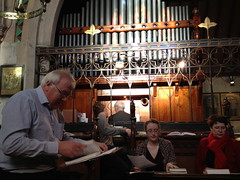
Readers of this blog will know that my association with the cathedral goes back over 40 years, and that I have always sung there, and always in small groups. But there were people there to whom it was all new, and I found myself almost envying them the thrill of the experience, the whiff of incense, the sight of the candles and the gleaming brass, the pattern on the organ pipes from the sun through the windows. On the other hand, I had the thrill of singing Mr B's new anthem - a short setting of the Celtic Blessing "May the road rise to meet you" that had the hairs rising on the back of several necks.
I mentioned, jokingly, the Other Cathedral - the Cathedral of St John the Divine in Oban. Time was when I regarded Oban as a distant place where all the big diocesan happenings took place, but in recent years we have seen a distinct growth in the recognition of the special nature of the Cathedral of The Isles - not least because of the obvious delight felt by successive bishops in being there. A diocese operates most successfully when everyone in it feels tied in some way to everyone else, whether through personal ties made at Synod and meetings, or through the common links to the Bishop and his clergy. (I say "his" not out of sloppy traditionalism but simply because we have not yet appointed a woman to the post). And it will flourish the more when everyone feels welcome at both of the cathedrals and in every church in Argyll and The Isles.
Our visiting alto's enthusiasm for what she had been a part of bubbled out all the way home through the rain and the rising gales. And what had made the biggest impression? Not +Idris' sermon, not +Kevin, not even the music she had so enjoyed singing - wonderful though each of these had been in their own distinctive ways. No. "Everyone was so friendly - and seemed so happy," she said.
And this is a mission tool that every charge can operate. Smile, children, smile ...
Thursday, January 10, 2013
An anniversary
 |
| George Douglas, 1888-1973. |
 |
| Poster in Largs ferry terminal |
The day of his funeral was rather like today - grey, cold, still. We travelled down from Glasgow to Cumbrae, noting the number of clerics on the ferry as we sailed. The four of us rehearsed while the clergy gathered, changed, did what clergy do. We felt bleak. Death and funerals were still strange to us - not least to me, who never darkened the door of a church other than to sing. There was no sense of the epiphany that lay ahead for me. Afterwards, the coffin was driven slowly to the town pier through Millport, the few people on the streets stopping, taking hats off, bowing heads. The sailors carried the coffin onto the MV Keppel and laid it on the deck. The Bishop, Richard Wimbush, stood beside it in his duffle coat, absurdly boyish black hair blowing in the wind. We had lunch in Nardini's to fortify us for Greenock Crematorium - another first, and deeply depressing until the assorted clergy took over. I had no idea what would become of me and the tiny flame that had been kindled. We didn't talk about how we felt, and we didn't talk about the Dean. It was too much that he was gone.
 |
| Altar, Cumbrae, with the Dean's missal |
Thursday, January 03, 2013
The road goes ever on and on ...

And stunning they were. There were some amazing interiors - the dwarves' kingdom, the huge lair of the trolls - but what I loved most was the sweep of the New Zealand landscape. And of course there are some amazing actors in this film, and there was the distraction of identifying who lay behind the beards and noses of the dwarves: sometimes it was only the voice that gave the clue. Richard Armitage's name (or Lucas North, if you like) only came to us later; James Nesbitt and Ken Stott were vocally unmistakable. Martin Freeman (Dr Watson) makes a very convincing Bilbo while Sylvester McCoy, FP of Dunoon Grammar School, is a batty addition to a trio of wizards (Iain McKellen and Christopher Lee, natch, are the others). I never clocked Barry Humphries; if you haven't seen the film yet, see if you do.
And the film itself? Well, there's too much of it. That's it, really - the book can be read from cover to cover in a matter of hours, and yet it is given the same three-film treatment that the massive Lord of the Rings had and needed. (It took me an eight-day illness to read that way back in my youth). So there were moments when I found myself thinking "get on with it", and there were, as Mr B observed, too many creatures rushing about and too many bangs and thumps: both are thrilling in small helpings but tedious when they recur every time someone stops talking. (My father used to relate how he fell asleep while a spectator of the Battle of Alamein, in his signals truck). I realise that three films make far more money than one, and when you've hauled all these actors to NZ and set everything up there's a temptation to get more out of them - apparently action scenes from the desert war movie The Desert Fox reappeared in The Desert Rats a couple of years later - but it makes for a thinning of the narrative, a slowing down of pace that has to be compensated for. So we have racing wolves (scary teeth), racing rabbits (scary ride for Radagast) and hordes upon hordes of racing Trolls.
The opening of the film makes a neat - but over-long - reference to the first part of Lord of the Rings, and the music provides a subliminal linkage, landing me with an earworm that lasted the rest of the day. I knew I had been sucked into Middle Earth again when I saw the departing audience as trolls flooding down dark stairways, and found myself looking behind me in the street outside when an unexpected noise seemed suddenly threatening. But it's a lazy sort of enjoyment, the sort of enjoyment I sought when I re-read Lord of the Rings over the years as an antidote to stress instead of tackling a new book (I must have been incredibly stressed - I think I've read it seven times). I didn't see it in 3D, and I'm glad - wearing two pairs of specs for so long would have been incredibly tiring, and would also have brought on one of my heads...
Don't be put off, however, if you enjoyed the other trilogy. But do treat yourself to a good meal after the movie rather than before. You'll stay awake better, and you'll be pleasantly peckish.
Unless you go for the popcorn ...
I'm writing this on Tolkien's birthday, by the way.
Saturday, December 29, 2012
Lights in the darkness
All right - I'm late with a blog post on Christmas . Tough. I've not had a minute at my own proper computer till now, and I draw the line at blogging on my phone while entertaining a two-year-old - of which more, perhaps, anon. But now, after a restorative walk on the fringe of the forest with my pal, I want to remember what happened before the post-Christmas church takes over and moves us 12 years on before we've had the Magi yet.
For it was a splendid season, crowded but splendid. Having retained the Advent feel right up to the quiet Eucharist with the surprisingly large congregation on Advent 4, we had a full church again that afternoon for a Carol Service. Our choral group 8+1 sang, the children paraded up and down with camels, shepherds and random sheep, the mulled wine flowed and we all grew mellow and cheerful. And then, in the close proximity that had seemed so impossible in prospect - how to gear up again so soon? - we came back to church for Midnight Mass. The pic shows what we saw. And although we had to put the nave lights on because people might need to see words of carols and such, this is more or less what I saw throughout the service. There are benefits from sitting in the front row .... There were carols serious and carols frivolous: the former during communion, the latter during the serving of the cider cup (we're dead versatile when it comes to beverages). Mr B and I had our annual fun singing with our friends who happen to sing tenor and soprano. There was incense. And - joy - the crib was under the altar, and looked amazing. The starry backdrop paper was a final stroke of genius, and I recognised the packing straw from one of our presents ...
And then .... Well, then we had the annual dash to Edinburgh on Christmas morning, on a ferry staffed by Santa and his crew, and the joy of a dinner cooked by the hand of another and the conflagration of the pudding cooked by mine. And the children were as high as kites and very amusing, and ... and ... and we forgot to take the remains of our cake home and had to go back for it, turning off the westbound M8 at Livingstone. Think another hour on the journey - worth it, I reckon.
Today, however, it's hard to realise that less than a week has passed since that magical night. And really this is what has fuelled this post. The anticipation, the emotion, the celebration - these are all features of birth itself, human birth in human homes. I feel sad for the people who have their houses decorated at the beginning of December, who have no concept of Advent, of waiting, and who then tear down their lights and throw out their trees and say thank heavens that's over before it's even New Year's day. I can't help wondering how they'd see it if their standard response were to be applied to the birth of a child in their family. Picture it:
Four weeks before the baby is born, the family start decorating the house with all manner of lights, greenery and so on. The pregnant mother helps a bit, but her mind is, understandably, on other things. Occasionally there are drunken parties, all themed around the approaching birth. On the night of the birth itself, the family assemble, fight a bit. Next day they have a massive party, eat themselves sick and drink themselves into oblivion. But three days later, when the mother brings the baby home, she finds that the house is bare, tidy but bleak, and everyone has gone home. There are no more celebrations, no sense of joy. As far as everyone's concerned, it's all over until the next baby - or something.
Silly, isn't it. But some of us have only really been celebrating for less than a week, and we're still really happy about remembering what happened and demonstrating that happiness. Because what we are celebrating changed everything, just the way the birth of a new baby changes everything. And you can't put change back in the loft till next year.

For it was a splendid season, crowded but splendid. Having retained the Advent feel right up to the quiet Eucharist with the surprisingly large congregation on Advent 4, we had a full church again that afternoon for a Carol Service. Our choral group 8+1 sang, the children paraded up and down with camels, shepherds and random sheep, the mulled wine flowed and we all grew mellow and cheerful. And then, in the close proximity that had seemed so impossible in prospect - how to gear up again so soon? - we came back to church for Midnight Mass. The pic shows what we saw. And although we had to put the nave lights on because people might need to see words of carols and such, this is more or less what I saw throughout the service. There are benefits from sitting in the front row .... There were carols serious and carols frivolous: the former during communion, the latter during the serving of the cider cup (we're dead versatile when it comes to beverages). Mr B and I had our annual fun singing with our friends who happen to sing tenor and soprano. There was incense. And - joy - the crib was under the altar, and looked amazing. The starry backdrop paper was a final stroke of genius, and I recognised the packing straw from one of our presents ...
 |
| Rudolph takes tickets |
Today, however, it's hard to realise that less than a week has passed since that magical night. And really this is what has fuelled this post. The anticipation, the emotion, the celebration - these are all features of birth itself, human birth in human homes. I feel sad for the people who have their houses decorated at the beginning of December, who have no concept of Advent, of waiting, and who then tear down their lights and throw out their trees and say thank heavens that's over before it's even New Year's day. I can't help wondering how they'd see it if their standard response were to be applied to the birth of a child in their family. Picture it:
Four weeks before the baby is born, the family start decorating the house with all manner of lights, greenery and so on. The pregnant mother helps a bit, but her mind is, understandably, on other things. Occasionally there are drunken parties, all themed around the approaching birth. On the night of the birth itself, the family assemble, fight a bit. Next day they have a massive party, eat themselves sick and drink themselves into oblivion. But three days later, when the mother brings the baby home, she finds that the house is bare, tidy but bleak, and everyone has gone home. There are no more celebrations, no sense of joy. As far as everyone's concerned, it's all over until the next baby - or something.
Silly, isn't it. But some of us have only really been celebrating for less than a week, and we're still really happy about remembering what happened and demonstrating that happiness. Because what we are celebrating changed everything, just the way the birth of a new baby changes everything. And you can't put change back in the loft till next year.
Saturday, December 22, 2012
Prayer and prayers.

The focal point of her life is the Eucharist, and the occupation without which, she told us, is prayer, contemplative prayer. I think I knew this already, but I found myself thinking about solitary prayer in a different way. Apparently, Sister Wendy gets up at midnight and spends seven hours in contemplative prayer. Put like that, it sounds to the would-be Christian such as I am like a penance. Seven hours for me would end either in sleep or in complete distraction. Someone like me gapes at the thought and - in her more self-chastising moments - wonders if she ought to try harder. But listening to Sr. Wendy speak, it became apparent that the hours spent thus are for her an enormous pleasure. It seemed to me that she sinks into prayer in much the same manner as someone who is looking after a young baby, say, sinks into bed; she longs for the time in prayer as a sleep-deprived person longs for oblivion.
The brief moments of such prayer that I have achieved were enough to convince me that such attentiveness can be hugely rewarding, and I suddenly saw this apparently rigorous lifestyle as something chosen, something pleasurable, not something to feel humbled by. Wendy herself admitted that she doesn't need people, she needs God; she may be wonderful on the telly talking about art but really what she was going to miss on this putative desert island was the Eucharist. Someone, she said, once remarked how she didn't need other people, and she didn't think it was necessarily a compliment.
People like me need other people, connections, feedback, performance. Solitude requires distraction. In a way, I suppose you could regard the contemplative life as one spent largely in the silent company of one person. Extend the metaphor to communication: if prayer is a phone call to God, it can be brief or it can go on for hours. But often in human existence these days, it is enough to receive a brief but loving call - or even a message on social media. It's the checking in that counts. So I'm going to recognise that my full life isn't a drawback or a hindrance, or something to be deplored. It's the way I thrive, and as long as I make frequent phonecalls it doesn't matter how long they last.
And just once in a while, if I'm lucky, I'll manage to stay on the phone longer.
Subscribe to:
Posts (Atom)