Saturday, June 30, 2012

Hamlet, revenge!

I was interested to see that at least one person had offered on Amazon the very copy of Michael Innes's Hamlet, Revenge that I have just finished reading for the first time since my teens. I first read the book - this copy of the book - when I had just been studying Hamlet for the first time, in school - for we all know Shakespeare wrote the play for Higher English students - and was firmly in its grip, to the extent of learning soliloquies off by heart because I wanted, in some way, to own the words. I have a feeling, in fact, that this would be the very first Michael Innes I read, having recently embarked on my parents' shelves of Edmund Crispin and realised the joy of the green Penguin.

I'd like to look briefly at some of the things about this old favourite that caught my attention this time round. I was pretty certain I remembered who had committed the murder, though not how or why, though there were big tracts of the detection that had escaped me. And I noted that this, like the later A Private View, is a proper detective novel as distinct from the crazier fantasies that I've previously reviewed. I have a horrid feeling that I prefer the fantasy, and have tended to become bored by the minutiae of detection presented in the more traditional examples of the genre, but I'm justifying the frivolity of my current reading matter by paying proper attention to it - should I really be thinking of a PhD in the subject?

But I digress. What actually struck me most is the realisation that I used to feel quite comfortable with the social distinctions underlined in these books - whether among the toffs at Scamnum Court or the academics at Oxford; whether poking fun at foreigners or caricaturing Scots and their way of life. Now  the word most commonly used to describe a black man leaps out of the page and the fact that it is actually being applied to an Indian academic seems doubly odd, and the affable quiddities of the Duke of Horton seem anachronistic and not to be indulged. There is the threat of the impending war (Hamlet, Revenge was first published in 1937) and there are no mobile phones. In fact, much detective fiction would not exist in its original form, it seems to me, if mobile communications had been available - when Appleby, now an Assistant Commissioner of Police, embarks on a foolhardy solo venture in A Private View, a phone in his pocket would have ended the whole escapade before it got under way.

But I am still entertained. The language is beautifully precise and stimulating - did readers of detective fiction simply have more erudition half a century ago? (or more, dammit - or more!) Or is it like Shakespeare, now the preserve of an elite but once much more widely enjoyed? Did readers read and non-readers toil merely? I am in a world that comforts strangely, despite the murders and the fogs. Perhaps it is just that it is the world in which I was young - for the fifties are a far-off land nowadays - the world in which my well-read parents provided an endless supply of reading matter to a voracious child, where escape from whatever small ills might afflict me was within reach whenever I chose to take refuge in it. (I still remember my father denying knowledge of where I was when small friends came to the door asking 'can Christine come out to play': did he know, I wonder, that I was deep in a book?)

Yes, I am still entertained. But I grow a-weary of the smell of old, yellowing paper ...

Tuesday, June 26, 2012

A mug's game ...

I wouldn't describe myself as a royalist. Nor do I collect china - I've never even owned a display cabinet, something I feel marks me out as one who has not yet arrived. But the other day I nipped into the local Dunoon Ceramics shop (where the mugs are cheaper than elsewhere) and bought the mug on the right, the gold and white job celebrating the Queen's Jubilee. Why? Because it struck me that, together with the other two in the picture, it might some day be of interest, if not value, to my afterbears. So in a sense, this post is for the attention of my sons, lest in a moment of impatience when I/we are no longer around, they chuck the entire contents of the cupboard in the hall into a skip.

I don't know if there were mugs commemorating the Silver Jubilee - probably they exist. I don't have one. I only had sons at the time, and no mini-afterbears to inherit. But the other two are of interest. The one on the left is an early example of the kind of thing Dunoon Ceramics turned out in their early days. The factory arrived in Dunoon in the same year as we did - 1974 - and turned out thick stoneware mugs and pots, seconds of which sold in The Pot Shop for much less than the perfect articles. I think the Silver Jubilee mug is an obvious second - you can see the imperfections in the glaze, and the handle has some odd chips. It might, of course, have been one of the slung mugs in Mr B's 1977 performance of Britten's Noye's Fludde, in which case it's had a hard life. I don't think I've ever drunk from it.

The Coronation mug, on the other hand, actually bears the marks on the glaze made by my teeth over many years. I think this one came free with the labels from several tins of drinking chocolate. I was seven, and it came to me at the same time as I lost my tonsils, just before the Coronation in 1953. In fact, Coronation Day was the first time I was allowed out of the house after the operation, when we all crammed into the flat below ours to watch the only television in the close. This was where Sanchia Peilou the harpist lived, and we sat surrounded by four concert harps in her elegant Hyndland drawing room which rather dwarfed the television screen at the end opposite the bay windows. The adults drank whatever it was adults drank on these occasions, and there were canapés that tasted odd to me, though I may have been tasting with a distempered appetite at the time.

Anyway, there they are. More curious than valuable, they might amuse some day.

Sunday, June 24, 2012

The Pisky and the Press

The astute/interested/bored reader of this blog will know that I've been otherwise engaged these last few days - benign activities to do with grandmotherhood have taken all my energies. But normal service has now, sadly, been resumed and I need to pick up on the story that flitted by in a haze last week, when the visiting grandchild was sleeping in the study and the computer visited only briefly.

The story is the one that appeared last week in Scotland on Sunday. You can read it, and you can fill yourself in on another point of view here, where another Pisky blogger was quicker off the mark than I am. A week ago I merely reflected that I had been, perhaps, fortunate, in that I too had received a request: This year instead of the printed Synod Summary, there will be an extra edition of inspires online. We are asking different people from around the province to write up the various sessions and wondered whether you would be willing to write 450 words about the final session - but had in the end not been able to write about the Standing Committee because I was prevented from attending the final session. Fortunate? Well, yes - because by the last morning of Synod I tend to be a bit brain-dead and I'd have had to listen carefully and understand what was going on, but even more so because I'd probably have indulged in some light-hearted comment and got myself lampooned in the press for so doing.


Actually, it's not the press I'm cross about. If Scotland on Sunday has nothing better to report on from a Synod that displayed common sense and humanity on several issues, that's their problem. Their sales dropped by almost 10,000 in the past year, declining, it would seem, at a rate that would make the church blanch. No, I'm afraid its the anonymous church spokespersonman who disowned a lighthearted remark about the potential wiping out of synod members by legionella as being "insensitive and unfortunate". 


So why am I so fed up? In one way, it's because I'm not surprised. And how depressing is that? Do I still feel, as I used to, that actually people like me have no place in this church? People who like a joke, who think unruly thoughts, who ... who are actually ordinary? Maybe it's also a bit of a drawback being young? In addition, I'm fed up because it reminds me of how it feels when you think you're doing something good as a Christian and a church member, only to find that the church disowns you. It can take a while to get over that sort of thing, in my own experience. Maybe one never does. Certainly, the church that seems to have no sense of humour, that bends before a feeble bit of journalism, that seems anxious to toe whatever line a secular society sets for it - that's not an institution I want to be associated with.


But let's end on a positive note. Had I been approached for my take on the original story, I'd have told the newspaper, politely but firmly, that there was no problem in someone having a humorous slant on something we were all talking about at Synod (for we were, and there was much black humour, even among the elderly who might be expected to take umbrage). But let me also say this:
Being a Christian does not mean I've had a humour bypass. Being a Christian does not mean I have no temper. Being a Christian does not automatically make me  less outspoken, less prone to irritation or rushes of blood to the head. Being a Christian may have made me more aware of elements in me that I need to think about - but I do not feel it requires me to be subnormal. Above all, it does not require me to be boring, dull.


I respect - and indeed love - many of the people I know through the Pisky church. I find them stimulating, inspiring and gracious. And that, I guess, is why this story makes me so very fed up.


Saturday, June 23, 2012

After the rain

I have just realised something wonderful. I've suspected it for a few weeks, but today I was sure. I seem to have got my sense of smell back after two years of ... well, nothing, really.

That's not quite true. Be accurate, woman. After a particularly foul bout of sinusitis, I realised I couldn't smell things. It began with the azeleas - the common, yellow ones that have such a strong smell. Other seasonal plants came and went and I couldn't smell them either. Cooking tended to smell of hot metal - although curries made it through to the brain. Nasty smells eluded me too, so I began to fret about the possible consequences ...

Enough. Today the sun came out after hours and hours of rain, and we went for a walk - through the Arboretum, along the path through the woods. And I realised I was being drowned in the incense of the wet pine trees in the sunshine, the tang of the eucalyptus, the intensity of the cut wood by the path. It was wonderful, and I thought I'd lost it forever.

The Philadelphus in the garden had come out while we were walking - its bubble-gum sweetness, along with the stink of the turk's cap lilies beside it, always said solstice, holiday-time ..... I shall be able to smell the bog-myrtle that has always been the Arran of childhood, I shall enjoy the hot smell of rain on the dusty road.  I used to think that if I had to lose a sense, smell would be a no-brainer. But I shall never think of it so lightly again.

Maybe we need to lose something before we truly appreciate it ...

Friday, June 15, 2012

Never Seconds trends on Twitter

I love it. The power of Twitter, that is. I can't be said to love the council for whom I used to work and in whose area I live, nor the idiocy that had them ban a blog about school dinners, nor the illiteracy of the hapless employee who was chosen to write Argyll & Bute's public statement about their reasons for such an action. And I fear, from the relative silence of the council's Twitter stream, that they will currently be buckling under the strain of the incoming flak - I've had to delete the column as it updates too rapidly for me to read at the moment. The blog in question has attracted 2543350 hits and the stat counter shows a new hit every second. You can go and look for yourself while I ramble happily here.

When I ran a school newspaper in an Argyll & Bute school, they did a feature on school meals. We didn't actually think this was out of line - that's not a royal 'we', despite the Jubilee season, it's my pupil editors with my approval - but rather something that would appeal to anyone who'd ever eaten school dinners. As as result, my articulate and wonderful editors - and gosh, haven't they done well in later life? - were hauled over the coals and told that a school meals supervisor had left her job ... Did that really happen? I don't remember being brought into the fray, as the pupils in question assured me there was no need, in another example of fortitude under fire and independence of thought and other worthy attributes that I was proud to help foster.

I've had my ups and downs over social media this week, but today's outpouring shows, perhaps, why people fear it so much. Yes, there is the odd numpty who uses a trending hashtag to post nonsense (usually sexual) on Twitter, but it was easy to filter them out of my screenshot and most of what I've seen reflects the mainstream view: that banning a pupil from taking photos of the food she has paid for and is about to eat is high-handed, authoritarian nonsense. Of course, they will justify it by saying they've banned mobile phones in schools or making some other similarly thoughtful response. People tend to want to ban anything that might expose their workings to public scrutiny - and nowadays, that's virtually impossible. The workings need, then, to be such that the organisation or individual is proud to have them on display - and that, chums, includes the food we feed our children. Martha, whose blog has caused all the furore, seems to rate most of her more recent meals pretty highly - do the council know something she (and we) don't?


I loved my time as teacher editor of The Pupils' View. I'm proud of what my former pupils have achieved, just as I was proud of them at the time. But right now I'm glad I don't teach any more, glad I don't work for Argyll & Bute council, glad I'm not answerable to anyone on this subject. I suspect I'd be too full of rage this morning to work effectively. But if I were still involved, I'd have the satisfaction of knowing that my MP, the Minister for Education, was on my side. How? Because I'd have read it on Twitter.


Footnote: and - again on Twitter - I learn that the Chief Executive of Argyll and Bute Council has reversed the decision to ban the blog. Cheers!

Monday, June 11, 2012

Proud - and twittering

Another Synod gone, and only one photo on my camera of the proceedings (it is surely appropriate that I use one of Fr. Kelvin addressing Synod) - the rest were all of socialising and food. I had more to do this Synod than in previous years, which was interesting and rewarding, and we sang the Sanctus from Mr B's Kilbride Mass at the Eucharist, which people joined in with gusto and seemed to enjoy, but the main event was, I suppose, the one that attracted most attention - the vote on the Anglican Covenant.  We seem to have spent forever kicking it around without actually shooting for goal, so it was good to get the the point of voting on whether or not the Scottish Episcopal Church was going to take it further or reject it.

The debate was civilised and serious - no ranting, no raised voices, but thoughtful points well made. One speaker summed up the Covenant wonderfully when he likened it to a blancmange with shards of glass in it - work that one out. Someone at some point had referred to a French proverb: fier comme un Ecossais. and for me the real surge of pride in my church came at the moment when the votes against adoption were called for. There was a sudden rustle as a sea of voting slips - pink, yellow, purple - rose into the air; people held them high, like so many eager pupils wanting to be seen, rather than the more usual nonchalant pose. The Covenant was firmly rejected, and it felt good then to go on and affirm our desire to remain as part of the Anglican Communion. (You can read a much more knowledgeable account of the proceedings here, where you'll also learn of other good things that took us out of any tendency to navel-gaze;  I'll stick with my own take).

We've come a long way since the 2006 Synod where I moaned about being patronised for blogging, but some things haven't changed. This year it was Twitter. Again. Someone stood to make the point that he'd been brought up to listen attentively to speakers, and that it surely wasn't right that people should sit distracted by tweeting, passing comments online and so on. No, this person wasn't a nonagenarian; he was still just the right side of forty, making me one of the generation that, apparently, had made him thus. And I learned today that the aforesaid Kelvin was at an event where he had been invited to contribute to a discussion on social media - but where all phones and computers were to be turned off. So it's obviously still an issue in too many circles for me not to have another wee rant.

These people who want to stifle digital discussion are, it seems to me, living in what I have just heard deliciously described on the radio as an imagined analogue past - a past where, as the speaker said, everyone read their newspapers from cover to cover and was wonderfully and diversely informed. I'd say this imagined past was also one in which people hung on every word of every speaker at events like Synod, be they never so tedious, and never doodled on their Synod papers; where no-one passed a note to his neighbour or - more disruptively - whispered to her pal. My first reaction to hearing this complaint the other day was to tweet about it - for one of the wonderful things about social media is that we no longer have to seethe internally when confronted with patent nonsense. 

I would contend that if someone speaks interestingly, arrestingly, movingly, that person will be heard with as much attentiveness as anyone could wish for. If they say something memorable, it may well be tweeted and retweeted - a way of sharing a special moment. Most of us turn to less respectful use of social media when we are bored. Stick up a boring speaker and people will either drift off into sleep or check on their email or share a ribald thought online - and that's fine, you know, because as far as I'm concerned the biggest sin in a speaker is to be a bore. I've called in the past for a live back-channel; this year we had a time-delayed one showing what was being said on Twitter after the session had ended, so we're moving forward. 

We're moving forward all right. No-one presented a paper which they then proceeded to read aloud to Synod - they reminded us of what page it could be found on and assumed we'd had the sense to read it. We were moved, entertained, and - largely - involved. But God preserve the church - and me - from the people who want to keep us in the imagined analogue past. Apparently Plato said that using writing would mean that our memories would suffer. We seem to have got past that without going entirely to the dogs, yes? I shall take heart from the knowledge that the perpetrator of the patronising remarks that so irritated me in 2006 is now an amiable blogger. Here's to the next Synod... 

Friday, June 01, 2012

Elizabeth's song


The babe leaps in my womb,
and the Spirit has filled all my soul:
blessed are you among women,
and blessed the fruit of your womb!
And why is it granted to me,
that the mother of my Lord should come?
For behold, when your voice came to me
the babe in my womb leaped for joy.
And blessed is she who believed
that the word of the Lord would in her
find fulfilment and dwell among men.

C.M.M.

Written a couple of years ago when a friend asked if I could write a song-like version of Elizabeth's words, posted this night after the celebration of the Visitation of the Blessed Virgin Mary to Elizabeth.

Tuesday, May 22, 2012

Old haunts again

Back at the old paperbacks again - my third Michael Innes in three weeks,  a reversion to almost-childhood with one of my favourites, Operation Pax. And before that, although I read a new book in between, I re-read Hare Sitting Up. I could remember very little of the latter; but the former - as its dog-eared appearance testifies - is another matter. Strangely, although I could remember whole chunks of the narrative, the outcome of the plot eluded me once again until I was nearing the end and began to pick up the clues that the incisive Sir John Appleby was noting.

You don't really read these books for the detection. I never did - I loved instead the frequently baroque plots and poised prose - even when I was 18, as I know I acquired this copy when it was newly out. It was the summer holidays before I began university, and I can't help wondering now if the Oxford-based setting of the plot gave me romantic illusions about the next three years.

The story is fantastical, rooted in its time (the early '50s) with ex-forces undergraduates and biological warfare to the fore. Innes recreates the language, the society and the preoccupations of the day in his books - so reading them 60 years after they were written brings a familiar echo to someone my age. (I'd be fascinated to know how a 30-something feels about them - chaps? got a moment?) And he is a master of the telling impression - the figure seen out of the corner of an eye, the sense of danger conjured up by a fleeting footstep, the shadow in the Oxford mists.  He is also the master of the literary nod: in Operation Pax the central character of the first section is Kenneth Graham's Toad if ever anyone was.

I shall doubtless soon return to modern fiction, give up the re-reading for new paths. But I have a journey coming up, the small Penguins beckon, and I feel self-indulgent and idle.

What's new?

Saturday, May 19, 2012

Grey May thoughts

The weather remains thoroughly and dispiritingly wintry - for winter in these maritime parts is just like this: raw winds, smirring rain with the odd downpour, grey skies, temperatures stubbornly below 10ºC (didn't get above 7º yesterday). The good weather came before the trees or the psychology were ready for it, and hasn't returned - so none of the joyous sense of life renewed has come to cheer as yet. And it's past mid-May. I think of all the songs, madrigals, rejoicing in this month - Now is the month of Maying, O lusty May - and have a wry smile.

And today we're celebrating a 60th birthday in what I think of as the younger end of my generation. At least two friends have just passed this landmark, one I look back at from what was supposed to be the sunlit uplands of retirement (never mind). Others are on the point of celebrating the Ruby wedding that we passed two years ago. And some are ill unto death. Life is very short, and I want the sun to shine.

I hope there will be champagne. That's all.

Sunday, May 06, 2012

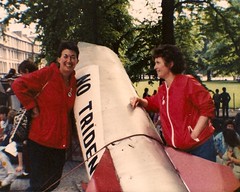
Miners' Gala 1984


Miners' gala
Originally uploaded by goforchris.
I’m riding on a lorry through
the Edinburgh streets. Beside
me is a missile, quite small,
made of cardboard painted
silver. Should be black.
Upturned faces in the sun
stare white; some shout:
Save oor pits, missus –
as if this missile
had the power to sweep away
the English government of the day
and blow it back to when
their fathers walked in
heavy boots, pale in the
morning sun and back,
black-faced at dusk
from hellish pits of endless toil
that now would end
and they would miss. And I
and my missile trundle on,
an incidental sideshow
in Thatcher’s Circus 84.

C.M.M 05/12

I don't know why this day all those years ago should suddenly come into my head - I was thinking, perhaps, about the expectation we have of people who put themselves forward in politics and how often that expectation is completely misplaced. In the '80s, my activities were focussed on getting rid of nuclear weapons, which came bound up with the Scottish hostility to the Thatcher government. All this seemed to come together at the annual Miners' Gala in Edinburgh during the now famous miners' strike.

Saturday, May 05, 2012

Hugh Lyons, RIP

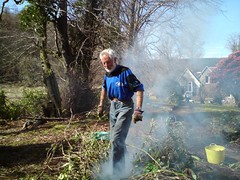
Hugh on the bonfire
Originally uploaded by goforchris.
Hugh Lyons was an adventurer. I was aware of him around Holy Trinity Church for some time before we really spoke with each other - that came about after the Eucharist one morning when he'd reappeared after one of his spells away. He told me that he'd attended the church in Cromwell, New Zealand, that we too had attended when we were staying with our friend Edgar. He'd discovered that we'd been there only a week before him because Edgar had just died and he told someone he'd known him. He'd been touring on his beloved bicycle, and he was full of wonder at the coincidence.

I think it is that sense of wonder that will remain with me now that Hugh is no longer going to reappear in Holy T, browner and leaner than ever, after one of his expeditions. That, and the wonderfully alive man who never seemed to feel the cold or bother about the rain; who wore shorts in the summer and jeans in the winter; who willingly directed traffic in the dark for winter night concerts and vanished into the dark without ever asking for a lift.

For Hugh was one of these people who just do things. Whether it was clearing out gutters, pottering round the bottom of the building pulling weeds from the perimeter, or leaping suicidally onto my bonfire one gardening session because the rhododendron branches weren't catching (see photo), Hugh was there with his own solution to the problem. And his eyes would light up with glee at what he'd achieved.

He died, suddenly and without warning, in Australia. His last conscious act was riding his bicycle. One of the last things he did in the grounds of the church was to cut back the cherry tree that menaced the windows. Some of us thought he'd killed it - but no. This year it's burgeoning again. It's hard to think that Hugh too might not be alive and flourishing on this bright day when his ashes were buried in the churchyard.

Rest in peace, Hugh - and rise in wonder.

Friday, May 04, 2012

Stylish nonsense

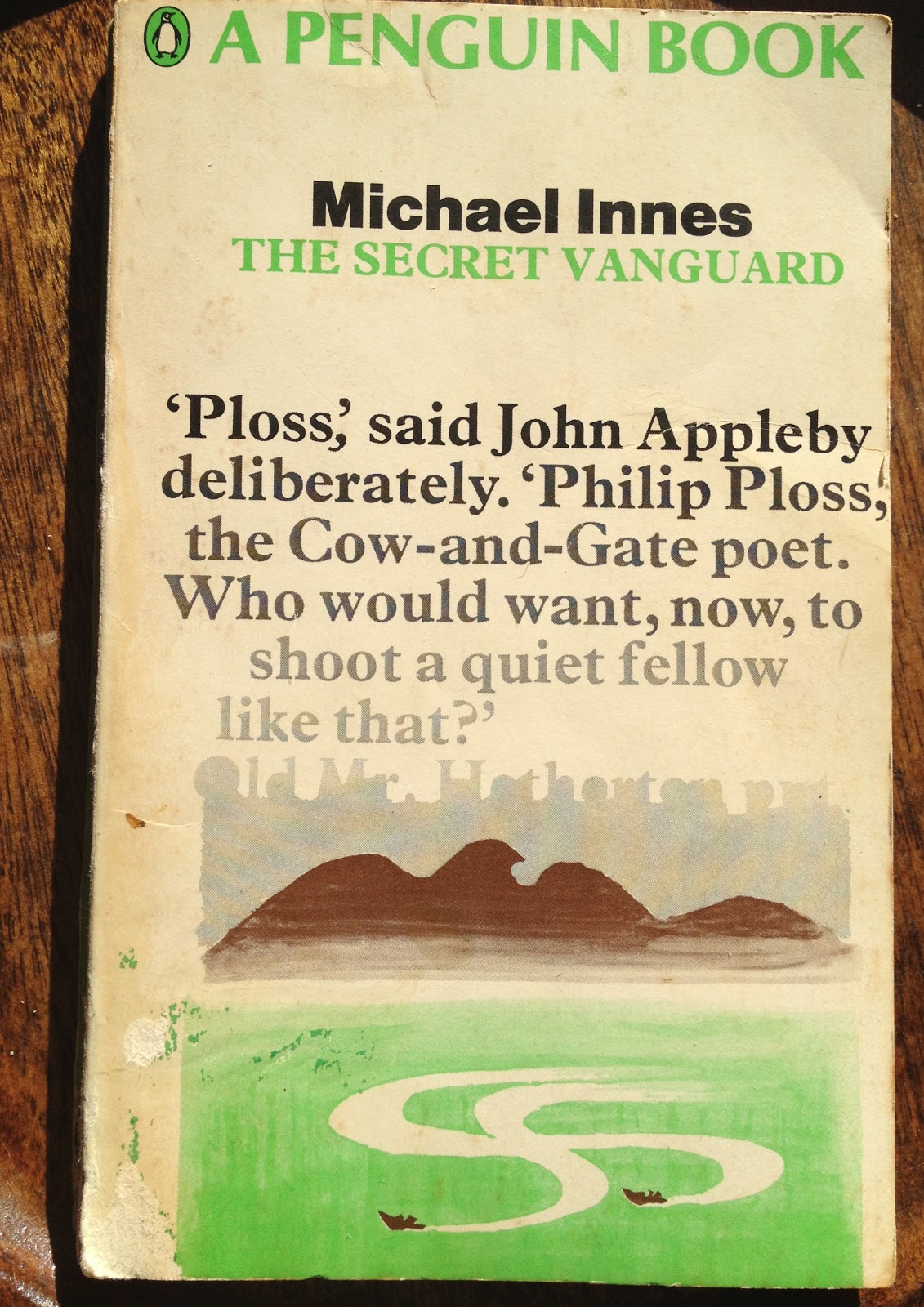
There are times when the brain shrinks and all one needs is the soothing assurance of a good friend - like, for instance, when one has a beastly cold and wants only to sit in the sun and read without being disturbed in body or in spirit. That's why I have been back at the shelves in my bedroom bookcase, the one with the neat shelves that will only hold old paperbacks (I've discussed such books before, yes?) The illustration is of my own copy of Michael Innes' The Secret Vanguard - you'll not find that on Amazon, I think, though there is a more modern printing out there - one dating from the late 1960s. The book itself was written in the early 1940s, a slim thriller rather than a detective novel, and a close relation of Buchan's The Thirty-Nine Steps.

I have been a devotee of the Buchan since before I was ten - I can picture myself reading it in the house we left in my eleventh year - and in the last few years of teaching English I read it aloud to a barely-literate class who sat with the books open in front of them: one of them sighed as we reached the end and told me, in all seriousness, That was the best book I've ever read. The Secret Vanguard is a rather more sophisticated take on the same themes of pursuit, betrayal, patriotism and looming war, and it is the sophistication of the writing that I love. As Sheila Grant, the heroine, is pursued through the Highlands by unknown foes to whom she gives wonderfully insane nicknames, the twists of the plot take place with minimal preparation: a supposed ally is suddenly a foe because he has chosen the wrong photo of himself; a haven becomes a den of villains when she reads its name upside-down on a piece of writing-paper. Innes never beats us about the head with his plot; we are expected to keep our wits about us and our inner eyes open wide to see what he is describing; we hear the tones of his educated protagonists and the mistakes made by those for whom English is a foreign language. And we never, ever, feel that the author will let us down with some clumsy over-explanation.

In many respects this is a silly book - there is no real development of character, no growth, no hidden message to send us off thoughtful. What it does do is provide the delight of impeccable prose, the absurdity of characters planted in unlikely situations, and the threat concealed under the call of a distant bird. If you've never read any Innes, this wouldn't be a bad place to start.

And then there will be so many further delights to look forward to...

*The Wikipedia entry for J.I.M. Stewart (Michael Innes) lists all his books as well as the information that he shared my birthday. I never knew that.

Wednesday, May 02, 2012

Rite of passage

I became acquainted with the writing of Michael Arditti through the meticulous and often hilarious Easter, and wishlisted his rite-of-passage novel A Sea Change on the strength of that. Perhaps my reading of Jubilate - and the ensuing comment-fest on that post - might have prevented me from continuing optimism, but I'm glad it didn't.

A Sea Change is a fictional story grafted onto history: the story of the SS St Louis, a German liner that left Hamburg in May 1939 carrying 900 Jewish refugees fleeing Nazi Germany after years of persecution and the terrors of Kristallnacht. During the voyage, 15 year old Karl grows up, becoming a man despite his earlier defiant refusal to be Bar Mitzvah. His perception of the events leading up to the sea journey is convincingly self-obsessed; we learn his ambivalent attitude to his family and their past even before they all set sail and witness how he manages to reconcile much of the turmoil within himself even as the world around him becomes more threatening.
SS St Louis in Havana

The story is told by Karl himself, recalling the events when he himself is an old man addressing his own grandchildren - so we never worry that he will not survive the voyage or its aftermath. In a way that focusses us on the plight of all the ordinary - and extraordinary - Jewish families on board; we are never reminded that this is fiction but carry instead the burden of the knowledge of the book's truth. I was fascinated by the attitudes of different characters to Jewishness, tradition and each other, and by the feeling of helplessness brought when money and previous status count for less than nothing.

So why do I still feel slightly cheated? Is it the tendency to long-windedness that creeps into the writing? The slightly banal over-description that I feel needs the pen of a good editor? After all, it's not as if the author is replicating the thought-process of a 15 year old: the 70+ year-old Karl is an academic who is, presumably, capable of sophisticated thought and writing even if he is doing it for his grandchildren. Is it the rather careful punctuation of over-long sentences in what should be a more rapidly-moving narrative? (This sounds odd, coming from a pedant like me.) I'm not sure. But this gave me a fascinating glimpse into a corner of the past of which I knew only a little, into the practices of Judaism, into the relationship with ordinary Germans as well as Nazis, and into the dehumanisation of a people which is the necessary precursor to abuse.

Monday, April 23, 2012

Fragmentation capured in a first novel

Writing on Shakespeare's birthday, I'm tempted to report that my withers are wrung by Samantha Harvey's The Wilderness.  This is a first novel, and it's masterful. From the opening section, written in the present tense, the confusion that so tellingly mirrors the state of Jake's mind began to seep into my understanding of what was happening: is Henry really in that prison? and why was Helen slumped at the kitchen table?

Jake is suffering from Alzheimer's, the condition progressing as does the novel. His story unfolds in a series of episodes, and if I were sitting down to do a study of it - as I might have had I still been teaching, for example - I would confirm for myself the precise uses of past and present tense: I suspect the sections in the past are reliable and rationally perceived while the present is used for the increasingly random impressions conjured up by Jake's disintegrating brain.

Harvey captures convincingly the struggle of the early moments of disease - the strategies adopted to disguise or foil its depredations, the ease with which others can cope with something that is filling the sufferer with dismay. The story goes on its fragmented way, some moments recurring while others open up aspects of the mysteries of life and relationships, until we reach what feels securely like the present - only to find that Jake has almost disappeared.

I can't say I enjoyed this book. It was too disturbing for that - too threatening of the glib reassurances we give ourselves. The writer is in her 30s, and I marvel at the depth of her imagination and - presumably - research. I don't know that I could bear to write such a novel at the age I am now.

But I'm glad to have read it.

Sunday, April 22, 2012

Haydn sets me off again ...

It happened again. That sudden tide of memory washing over and through, this time triggered by four notes: the opening of Hadyn's Symphony No. 104, The London Symphony. I opened the door to the room where the radio was on - Radio 3 - and the D minor introduction coincided with my arrival. That was all it took to whisk me back to another spring - yes, spring again - and the earnest preparation for the Glasgow Music Festival. I played second violin in this symphony, and if memory serves me correctly it was the last time our school orchestra competed and failed to win the senior class. The following year - when I was in S5 - we played Beethoven, and we won, and long after I had left my successors won again and again.

But that's not the point. What this memory took me to was a reminder of what a privileged education I had. I attended Hillhead High School in the days when it was a Glasgow Corporation grant-aided school: we paid minimal fees (£3.19.0 a term in secondary) and bought our own books and jotters. The classes were big - 40 was normal - and the classrooms bizarre because the corridors were open to the weather, with partitions that could be slid back to cool the room. Rumour had it that the school was designed for Kuala Lumpur and had somehow ended up in Glasgow. The music department had begun to grow when I was in P6, and by the time I reached The Big School and the Secondary orchestra there were two orchestras. By the time I left there were also several choirs and chamber music groups, and it was possible to forget that anything else actually went on in Hillhead. We played Mozart, Beethoven, Handel, Schubert, we sang madrigals and Parry, the chamber music groups tackled Gibbons. We did Haydn's "The Heavens are telling", complete with orchestra, choir and soloists. We were given no quarter when it came to repertoire, and we were expected to work till we could cope. We performed at the school concert in December - and after the St Andrews Halls burned down, we had three nights of these in the school hall to accommodate all who wished to attend them  - and at the Festival in May.

We took these performances very seriously. I never did learn how to deal with circles in Co-ordinate Geometry because the class did that bit when I was at an extra orchestra practice, and I would take the bus into Hillhead every afternoon of exam leave during my Highers because the Festival was always just after the exams ended. I had my first ever migraine during Festival week when I was in S6, brought on, I'm sure, by the stress of the occasion on my adolescent brain; it vanished the moment the results were announced (we won). I remember Herbert Howells, who was adjudicating one of the chamber music competitions, asking if this school covered the whole of Glasgow; there seemed to be at least one entry from Hillhead in every competition he judged. And I remember walking home with friends, all carrying our instruments, over Gilmorehill through the quiet May evenings, quite convinced that this was the best life would ever have to offer.

When I left school, it was the music that I was most distraught to leave behind. My experiences at school were certainly responsible for more of what happened in later life than any of the subjects I actually pursued formally, though I did study for a Higher Music in S6 and have Ordinary Music as a subject in my MA. But it is this time of year that brings it all back to me, Haydn and all.

Lucky. Pure, dead lucky. As my younger self would say..

Wednesday, April 18, 2012

Lilacs out of the dead land


April is the cruellest month - you bet it is. These light, chilly days, the sudden glimpse of primroses by a burn or a lone violet amidst a tangle of dead bracken: all these bring a curious mixture of hope, cheerfulness - and the sense of life passing. It's the cyclic thing again; the more uniform mid-season times, like a perpetual Trinity season, perhaps, make one less aware of the passing of years, while the sudden exclamations of delight over the signs of the season trigger transience all too readily.

I can remember with unlikely clarity being fifteen or sixteen at this time of year. We used to take days away from the city in the moveable Easter holidays of that time - mostly train rides to Helensburgh or Milngavie or Balloch, with at least one remembered trip to Dunoon. We didn't have a car, and all four of us went together - there was no question of staying at home to swot for O-grades or whatever. But what I most remember is the sudden sense of self - the scent of my own, slightly tanned skin, overlaid slightly with the first perfume I had ever owned, combined, bizarrely, with the small horror of a new smallpox vaccination on the scar of my infant one - for that was the era of a sudden requirement to have a valid vaccination certificate if you wanted to travel abroad, presumably because there had been an outbreak of smallpox in the UK such as the one described here.

I remember I went with a friend to my first ever opera at this time of year, and within four days of vaccination. I saw Bizet's The Pearl Fishers, and during it my arm began to itch ferociously and I began to feel distinctly odd. When I read the possible complications of vaccination here, I don't wonder at the latter, but at the time it was a matter of a disprin and getting on with school work.

So - a sudden welter of memories brought on by a bright day with nothing else to think about. Larkin's description of the lighted rooms inside your head  slips unsought into my own head, and I nod yet again to the poet's adept nailing of the minutiae of life. It's as well that normal life is full of music and people and books and East Enders ... did I mention that in these days we didn't even have a telly?

Sunday, April 15, 2012

Deeply satisfying

A couple of weeks ago now I finished reading Vikram Seth's An Equal Music - though if I'd read the review published on the Amazon page to which that link takes you, I don't know that I'd have bothered. This book is another of several lent to me by a good friend who knows my taste to such an extent that if she thinks I'd enjoy one I tend to give it a go, and so came to this book cold, as it were, with very little handle on what it was going to turn out to be.

It's a story of music, of love and of loss. The hero, Michael, plays second violin in a string quartet, and though he has a girlfriend - who is a less than satisfactory pupil on the violin - he is filled with regret and longing for the girl he loved when he himself was a student. So in that respect it is a love story, in which I felt he involved himself almost without will, as if he was unable to prevent any of the actions he took after seeing Julia on a London bus. It is significant that it is not the bus he is on at the time - they are bound in different directions and the tension of the situation builds gently but inexorably through the story.

The main player in this novel, however, is music. The tension between the members of the Maggiore quartet rings true, their individual temperaments as taut as the strings of their instruments, the differences between them sublimated in their combined music or - occasionally - wrecking it. I felt I knew these musicians and their constant preoccupation with their art, the way everything is seen in terms of how it will affect their music. When Michael is threatened with the loss of his violin, it is like an impending death; when a fridge in the house where they rehearse makes a noise somewhere between two notes it is identified and it disturbs. Bells sound a perfect G and music enters dreams. And when the Maggiore decide to play Bach's The Art of Fugue it takes over their lives.

The sense of loss permeates the story from the start, although at first I was not sure whose loss it was going to turn out to be. I'm not about to give away this most telling feature, but it works. Seth has brought off the feat of writing about music in such a way as to convince someone who is involved in music-making. And that is where I'll leave this deeply satisfying book.

Friday, April 06, 2012

The Garden


That night there was no
peace in the garden. The voice
beat randomly and wordless
on the shrinking sense as the flames
flickered irritably in the unseen chill.
The struggling prayer faltered
with each startling blow and
died as the God’s voice dwindled and
withdrew. And when the silence fell
blessedly and the night grew still
it was already over, this riven time,
and the marching feet, the harsher
shouts, the drawn steel glinting
in the dark – to this the prayer had led
and left the silence of the grave.

©C.M.M. 04/12

Sunday, April 01, 2012

Queasy among the palms

I think I have never felt good about Palm Sunday. Whether it was reading/hearing the whole of the Passion story, or concentrating on the events of the day itself, I was always so aware of the fickle nature of "the crowd" - and how convenient so to label them: people not like us, you know - we're better than that. Except that we're not, and the cheering, palm-waving crowds who welcomed Jesus on what was today described as a "hot-wired donkey" exemplify so much of what is wrong with us as we sway through life. Cheerful, fearful - and as we change our spots, someone else suffers. The friend we betray, the hurt we do by heedlessly altering an arrangement or blithely finding something else we want to do: all these resonances sound together with the hosannas and leave me with an unpleasant taste.

Was there even an echo of irony in the words of "All glory, laud and honour ..."?

Thursday, March 29, 2012

Never constituted to be a saint*

I finished reading Richard Holloway's Leaving Alexandria last week, but was overtaken by sunshine and the desire to be out of doors so that by the time I might have blogged about it I was too tired to make sense - and I feel that Richard himself might have approved of my priorities.

The book is subtitled A Memoir of Faith and Doubt, and while I was reading it I saw a tweet from an acquaintance opining that surely he'd talked enough about both these things. I disagreed - in 140 characters, natch - because it's obvious that both have been a presence for most of the author's life. If something matters, you talk about it, especially if your talking and your writing are fluent and persuasive.

I loved it. I loved the way it conjured up the childhood of the movies and the hills, and I was appalled at the thought of a boy of fifteen going to the school that would turn him out for ordination - or not - at the end of his studies there. Fifteen! Holloway is painfully honest about the guilt that the normal preoccupations of a teenage boy cost him; his description of his struggles with sex seems to hold at once the pity of the older man for his youthful self and the rawness of that self at the time.

The book was enlivened in another way by the familiarity of knowing not only the author but some of the people mentioned, being familiar with Old St Paul's both in the time when he was Rector there and again now, when I also know the house in which he and his curates lived and where that disastrous attempt at communal living took place. I found lights coming on in corners of my memory, of conversations illuminated decades after they took place. I laughed aloud at the thought of the matching donkey jackets, boots, trousers and bicycles, and was glad that the author too seemed to be laughing.

But it is in the defining of faith and doubt that this book makes its mark, and when it reaches the point at which Holloway resigns as Bishop of Edinburgh, he spells out the precise nature of his problem:
I felt glutted with the verbal promiscuity of religion and the absolute confidence with which it talked about what was beyond our knowing. The irony was that in one of Paul's great poems, God chose to empty himself of language and become a life. But along comes Christianity and turns it back into words, trillions of them, poured out incessantly in pulpit, book and on the airwaves, reducing the mystery of what is beyond all utterance to chatter.  (...) Religious language had ceased to be able to convey the mystery of the possibility of God for me because it confidently claimed to make present that which I experienced as absence; though it was an absence that sometimes feels like a presence ...

And then I am back in the words of another hero of mine, the poet R.S. Thomas, and realise that there is only one word more needed from me.

Amen.

* Leaving Alexandria, p.350
There is a great new review from Ruth here