Oh, I shall miss The Hour. Quite apart from plunging me into a frenzy of 50s nostalgia, it's had me on the edge of my seat as it developed; last night's final episode had me wide awake absurdly late as I watched my recording well after choir practice and the difficulties brought on by the dead battery in a car key, the intransigent nature of the tiny manual lock, the fact that the spare key was at home and the pouring rain. But I digress.
I don't want to review the series - I'm feeling idle and there is ironing to do. But I was contemplating the tense finale, as The Hour (the fictional programme in the drama) went out live as the Suez Crisis deepened and the denouement approached. And it came to me how much we've changed from the days when the media were the props of government - or have we? Is it merely the ease and efficiency with which secrecy is broached that has changed? Do we simply have different terrors under the metaphorical bed? Is it just our expectation that has altered?
I don't know. But out of it all came one thought. Spies, subversives and whoever it is that inhabits the underbed space of the day don't actually bring about the downfall of governments. The governments do that for themselves. All that the subversives do is bring the dirty tricks out into the open.
Is it ironic that I shall now look forward to the next run of Spooks?
"Blether - n. foolish chatter. - v.intr. chatter foolishly [ME blather, f. ON blathra talk nonsense f. blathr nonsense]" - Concise Oxford Dictionary.
Wednesday, August 24, 2011
Sunday, August 21, 2011
Helped by The Help
Belting through fiction as I am this summer, I feel that at least this one merited the (relatively brief) time I spent on it. I rattled through Kathryn Stockett's The Help in the way I recall from my childhood holidays, when friends would come calling at the door and I would be hidden upstairs reading something I couldn't bear to put down. And yet, as someone says on the Amazon page linked to above, it was also a book I was sorry to leave.
Set in Jackson, Mississippi, in 1962, the story is told in three different voices as Aibileen, Minny and Miss Skeeter tell their part in it. My heart sank a little at the beginning when I realised that at least one of the voices replicated the Southern speech of the narrator, for that was one of the things that stopped me from reading The Color Purple, but it's so cleverly accomplished that it soon became an integral part of my enjoyment. I think it may have to do with the complete lack of self-consciousness in the writing - there are no apostrophes underlining missing consonants, for example. It was no time at all before I was hearing these voices in my head, and relating them to my own contact with the Deep South a few years ago.
As with all novels set against a historical background, there is an inevitability about the grand sweep of events, but the individual experiences of the extremes of racial prejudice in Mississippi are gripping in their awfulness, their humour and their variety. The two maids and the lone white woman who takes their part against the prevailing mood are resourceful and brave - and cast a bright light not only on racial attitudes but also the assumption that 'help' is a necessity for a middle-class white woman and that white gloves and polished silverware are the norm in polite society.
I loved this book. At times I was horrified, at others I thought I knew what was coming and was proved wrong. Sometimes I had to put the book aside so that I could sleep. I loved the descriptions of the ... food, actually. I have eaten that food - the fried squash, the cornmeal, the grits - and it all came back in a flood. And over all I have a new respect for my dear friends Ruth and Ed, who lived through this time and fought for the rights of the black people of Alabama. The Help added another layer to the understanding that grew when I visited the Civil Rights Institute in Birmingham, and for that I am grateful.
But aside from all that, it's a great read.
Set in Jackson, Mississippi, in 1962, the story is told in three different voices as Aibileen, Minny and Miss Skeeter tell their part in it. My heart sank a little at the beginning when I realised that at least one of the voices replicated the Southern speech of the narrator, for that was one of the things that stopped me from reading The Color Purple, but it's so cleverly accomplished that it soon became an integral part of my enjoyment. I think it may have to do with the complete lack of self-consciousness in the writing - there are no apostrophes underlining missing consonants, for example. It was no time at all before I was hearing these voices in my head, and relating them to my own contact with the Deep South a few years ago.
As with all novels set against a historical background, there is an inevitability about the grand sweep of events, but the individual experiences of the extremes of racial prejudice in Mississippi are gripping in their awfulness, their humour and their variety. The two maids and the lone white woman who takes their part against the prevailing mood are resourceful and brave - and cast a bright light not only on racial attitudes but also the assumption that 'help' is a necessity for a middle-class white woman and that white gloves and polished silverware are the norm in polite society.
I loved this book. At times I was horrified, at others I thought I knew what was coming and was proved wrong. Sometimes I had to put the book aside so that I could sleep. I loved the descriptions of the ... food, actually. I have eaten that food - the fried squash, the cornmeal, the grits - and it all came back in a flood. And over all I have a new respect for my dear friends Ruth and Ed, who lived through this time and fought for the rights of the black people of Alabama. The Help added another layer to the understanding that grew when I visited the Civil Rights Institute in Birmingham, and for that I am grateful.
But aside from all that, it's a great read.
Wednesday, August 17, 2011
Scraps of memory
Does the pic above stir a flood of memories, dear reader? If it does, I fear you may be approaching the sere, the yellow leaf, as I am ... but let's have another wee wallow in the 50s, huh? For some reason I cannot fathom, I bethought me the other evening (what has happened to me? Shakepeareitis?) of the days when I used to collect scraps and, in the appointed season, to exchange them with other small girls in a highly ritualised form and always in the same place.
If you don't know what I'm talking about, I have to explain that Googling "scraps" tends to take you to strange places; "die-cut scraps" provides more information. And that's what they were - coloured pictures, of all manner of people/animals/flowers, die-cut either into squares (boring) or round the outline of the picture, as in the illustration above. These were sold in sheets, linked as shown, often but not always of the same picture. You carefully took them apart, trimmed the paper tags, and put them into your collection. Strangely, it was more fun to acquire sets of scraps by barter than be simply buying them. You would look out for pictures that you already had an example of - these blooming angels came in many sizes and cloud-colours - and traded your own less precious scraps to acquire them. The most precious of all were "pre-wars" - though now I look at example of Victorian scraps online I wonder which war we were referring to. They were identified by the muted quality of the printing - fewer dpi, I think - and the quaintly old-fashioned subjects, and they were worth any number of scraps bought just last week.
The sacred place for the Scrap Season (remember how there used to be a time for skipping, a time for ball games and a time for scrap swapping?) was the shed of the girls' playground in Hillhead Primary School. Along the wall on the right in this photo, there used to be a bench, and it was there that we sat, usually on wet days, with our scraps in convenient books, one scrap (or set, if you had different sizes of the same scrap) to a page. I had two such books, which I think were old school text books, with cloth covers and plenty of pages. When a potential customer came along, you handed over your own books and took hers; you then leafed through the pages looking at the scraps lying inside and when you found one you wanted, you put it up in the manner of a bookmark. The books were returned, and you then went through the marked scraps, either putting them back inside the book as not being available, or offering them for one you wanted yourself.
I feel sure my books are still lurking somewhere in the midden I call home, but I can picture them now. The top right corner of each page is dark grey with years of spitty fingers, and the books are entirely dog-eared. The Season came and went, and the scraps returned to obscurity until the next year. I don't know what made me think of it, but I have already spent over an hour looking for the collection. I can't see my grandchildren being at all interested, but I can't help wondering if the only people who might collect scraps nowadays will be my age. Take a look here if you're interested.
If you don't know what I'm talking about, I have to explain that Googling "scraps" tends to take you to strange places; "die-cut scraps" provides more information. And that's what they were - coloured pictures, of all manner of people/animals/flowers, die-cut either into squares (boring) or round the outline of the picture, as in the illustration above. These were sold in sheets, linked as shown, often but not always of the same picture. You carefully took them apart, trimmed the paper tags, and put them into your collection. Strangely, it was more fun to acquire sets of scraps by barter than be simply buying them. You would look out for pictures that you already had an example of - these blooming angels came in many sizes and cloud-colours - and traded your own less precious scraps to acquire them. The most precious of all were "pre-wars" - though now I look at example of Victorian scraps online I wonder which war we were referring to. They were identified by the muted quality of the printing - fewer dpi, I think - and the quaintly old-fashioned subjects, and they were worth any number of scraps bought just last week.
The sacred place for the Scrap Season (remember how there used to be a time for skipping, a time for ball games and a time for scrap swapping?) was the shed of the girls' playground in Hillhead Primary School. Along the wall on the right in this photo, there used to be a bench, and it was there that we sat, usually on wet days, with our scraps in convenient books, one scrap (or set, if you had different sizes of the same scrap) to a page. I had two such books, which I think were old school text books, with cloth covers and plenty of pages. When a potential customer came along, you handed over your own books and took hers; you then leafed through the pages looking at the scraps lying inside and when you found one you wanted, you put it up in the manner of a bookmark. The books were returned, and you then went through the marked scraps, either putting them back inside the book as not being available, or offering them for one you wanted yourself.
I feel sure my books are still lurking somewhere in the midden I call home, but I can picture them now. The top right corner of each page is dark grey with years of spitty fingers, and the books are entirely dog-eared. The Season came and went, and the scraps returned to obscurity until the next year. I don't know what made me think of it, but I have already spent over an hour looking for the collection. I can't see my grandchildren being at all interested, but I can't help wondering if the only people who might collect scraps nowadays will be my age. Take a look here if you're interested.
Friday, August 12, 2011
Jubilate fails to grip
I thoroughly enjoyed Michael Arditti's Easter - so much so that I laughed aloud at the first page and exclaimed with horrified delight at another. I recommended it and lent it to people. So when a friend recommended Jubilate by the same author I bought it with a click (I know - one-click ordering is very dangerous for me) and looked forward to reading it on holiday.
Sadly, the experience didn't repeat itself. I found myself quite readily putting it aside for a chat, or dozing in the sun with it on my lap. I found that by the end of the book I still had no feel for the main characters, and the other pilgrims were characterless. I didn't even feel the need to flip back to check which was which, as I had at the beginning of Easter (and a list of dramatis personae would have perhaps helped in Jubilate).
The religious experiences described didn't really do it for me either. Gillian's faith was a pale shadow in the background, and Vincent's glimpses of the divine lacked, I felt, any conviction. I wondered if the two points of view and the sequence of chapters somehow diluted the effect of the narration - Gillian's story begins at the end of a pilgrimage to Lourdes and Vincent's at the beginning - because the two stories were too similar. There wasn't enough revelation when each narrator came to key events, so that the technique that worked so well in Easter seemed to fall short in Jubilate.
All that said, I've learned enough about a pilgrimage to Lourdes to ensure that I never think of going on one - in a way it comes across as a festering blight on the face of the country - and I did finish the book. But I can't agree with Peter Stanford writing in The Guardian when he talks about the urgency of a great romance, and the metaphysical debate didn't exercise the grey cells much, I'm afraid. Maybe it was all a bit too close to reality, maybe it lacked the exaggeration that made Easter such a show-stealer. In fact, what I recall now is a sense that this is a dutiful record of a love story on a pilgrimage, but one that lacks passion of any kind. It might almost have been real - and sometimes that's not enough.
Sadly, the experience didn't repeat itself. I found myself quite readily putting it aside for a chat, or dozing in the sun with it on my lap. I found that by the end of the book I still had no feel for the main characters, and the other pilgrims were characterless. I didn't even feel the need to flip back to check which was which, as I had at the beginning of Easter (and a list of dramatis personae would have perhaps helped in Jubilate).
The religious experiences described didn't really do it for me either. Gillian's faith was a pale shadow in the background, and Vincent's glimpses of the divine lacked, I felt, any conviction. I wondered if the two points of view and the sequence of chapters somehow diluted the effect of the narration - Gillian's story begins at the end of a pilgrimage to Lourdes and Vincent's at the beginning - because the two stories were too similar. There wasn't enough revelation when each narrator came to key events, so that the technique that worked so well in Easter seemed to fall short in Jubilate.
All that said, I've learned enough about a pilgrimage to Lourdes to ensure that I never think of going on one - in a way it comes across as a festering blight on the face of the country - and I did finish the book. But I can't agree with Peter Stanford writing in The Guardian when he talks about the urgency of a great romance, and the metaphysical debate didn't exercise the grey cells much, I'm afraid. Maybe it was all a bit too close to reality, maybe it lacked the exaggeration that made Easter such a show-stealer. In fact, what I recall now is a sense that this is a dutiful record of a love story on a pilgrimage, but one that lacks passion of any kind. It might almost have been real - and sometimes that's not enough.
Tuesday, August 09, 2011
Very naughty indeed
When I was very small, I used to lie awake in the light summer evenings and dread the arrival overhead of the 8pm flight from Paris into Renfrew airport. As it roared above our top flat, I imagined the horror of a bomb falling from it onto my little bedroom (originally the maid's room in the early days of the building) and visualise the heavy sandstone block between the windows tilting and toppling into the back green. The war was a recent memory and stories of the bombing were still sufficiently commonplace for small children with big ears to pick up enough detail to terrify.
Now, living in the peace of Argyll, I visualise bits of London I know - like Croydon - ravaged by fire and anger. I think of the daytime activity of clearing up, in defiance of the possibility that night will bring more destruction. Last night I read the tweeted commentary of people in London and elsewhere, and realised from the responses of some of my contacts that there was a great tide of immoderate comment that was passing me by. Suggestions about dealing with the riots ranged from the sensible to the homicidal; reactions to these from the shocked to the angry.
And what business have I to comment? Here we have cool, fresh evenings in beautiful surroundings, and I live a comfortable, cushioned life in which the noise from the pubs coming out irritates rather than threatens. As someone who has taken part in demos and sung at police lines and learned how to remain safe during NVDA* I know how it is possible to demonise the forces of the law - but there's where the comparison ends. Last night I watched a report on YouTube by an incredibly brave guy in Clapham who was asking looters if they were proud of what they were doing as they looted the shops of electrical appliances (they left the bookshop alone, natch). "What's that about?" he asked. And on Twitter people demanded draconian clamp-downs that others said would make things worse; some offered to pray for London and others felt patronised by the offer; some seemed intent on appearing cool whatever happened.
Do I have a take on it? I don't know. I suspect that if I were living in the middle of it all I would be forgetting all my liberal instincts as fear took over - fear for my safety, for my property, for my livelihood. As it is, I worry about family and friends and am glad to hear they're ok. I look at angry youths being bestial and defensive women nicking tellies and I'm not surprised to see police wielding batons with a will. Fear and rage are powerful emotions and once things get going reason goes out of the window. So no, I don't know what I think, other than that it's hellish and I'm sorry for anyone who has to live with it. I'll stick right now with the wisdom of a two year old boy who saw the TV news this morning: "People are being very naughty."
Quite the most balanced response I've heard so far.
*NVDA: non-violent direct action
Now, living in the peace of Argyll, I visualise bits of London I know - like Croydon - ravaged by fire and anger. I think of the daytime activity of clearing up, in defiance of the possibility that night will bring more destruction. Last night I read the tweeted commentary of people in London and elsewhere, and realised from the responses of some of my contacts that there was a great tide of immoderate comment that was passing me by. Suggestions about dealing with the riots ranged from the sensible to the homicidal; reactions to these from the shocked to the angry.
And what business have I to comment? Here we have cool, fresh evenings in beautiful surroundings, and I live a comfortable, cushioned life in which the noise from the pubs coming out irritates rather than threatens. As someone who has taken part in demos and sung at police lines and learned how to remain safe during NVDA* I know how it is possible to demonise the forces of the law - but there's where the comparison ends. Last night I watched a report on YouTube by an incredibly brave guy in Clapham who was asking looters if they were proud of what they were doing as they looted the shops of electrical appliances (they left the bookshop alone, natch). "What's that about?" he asked. And on Twitter people demanded draconian clamp-downs that others said would make things worse; some offered to pray for London and others felt patronised by the offer; some seemed intent on appearing cool whatever happened.
Do I have a take on it? I don't know. I suspect that if I were living in the middle of it all I would be forgetting all my liberal instincts as fear took over - fear for my safety, for my property, for my livelihood. As it is, I worry about family and friends and am glad to hear they're ok. I look at angry youths being bestial and defensive women nicking tellies and I'm not surprised to see police wielding batons with a will. Fear and rage are powerful emotions and once things get going reason goes out of the window. So no, I don't know what I think, other than that it's hellish and I'm sorry for anyone who has to live with it. I'll stick right now with the wisdom of a two year old boy who saw the TV news this morning: "People are being very naughty."
Quite the most balanced response I've heard so far.
*NVDA: non-violent direct action
Monday, August 08, 2011
Reflecting on a link
I've been thinking about the most recent of the Letters from the Past, in which my father introduces the subject of the bomb dropped two days previously on Hiroshima. Two things struck me simultaneously: the fact that the bomb took fifth place, coming after my mother's health (she was only seven weeks off having me), the weather, the imminent demobilisation of a teacher colleague and the possible timing of his own; and the statement that he finds the news of this bomb "extremely depressing" - even though it will shorten the war and his own incarceration in the RAF.It also interests me that he should be so ready to link the invention and use of such a weapon with the tenets of conventional religious belief - and saddens me that I never thought of discussing such matters with him. I was, of course, too young, too selfishly caught up in my own life, too ignorant of politics, religion or indeed practically anything at all serious - too much of a child, even at the age of 32, to talk to him about anything that mattered. (He died when I was 32.) I now like to think that he would have approved of my activities in the '80s, marching with CND, making speeches, appearing on radio and several TV programmes, and that his assertion that I had "thrown reason out of the window" when I told him that I intended to be confirmed in the Episcopal Church after rejecting religion for the previous ten years would have been tempered by the struggles I had with that same church over my political activities.
Putting these letters online has been a fascinating experience, and the letters of August 1945 are the ones that inspired me to do it in the first place. Often I catch myself thinking they have been written to me - and then I see a speculative reference to my as yet unborn self and smile. But primarily their interest to others will lie in the authentic voice of a highly articulate and educated man of the time, expressing casually but succinctly what must have been in the minds of many like him. They come to an end in just over a month's time. I shall miss him...
Sunday, August 07, 2011
Grey day transfigured
It's a grey morning. I'm already damp because my umbrella was in the car and I had to fight my way down the drooping garden so my legs are uncomfortable and I'm already chilled. As we swish up the back streets of Dunoon to church, I wonder what I'm doing. My mood matches the day; most of my summer activities are over; the sun has gone. I'd have been better staying in bed with a book. The organist seems in no better fettle, and I forgot to tell him we are supposed to be keeping the Transfiguration, so we don't really speak. Besides, we're a bit late.
There is no heating in church - it is, after all, summer - as I sort out hymnbook and liturgy (thank God - not the Grey Book). There are also no children, as the Rector is on holiday and has taken Mrs Rector who does the Godly play at the back of the church. Apart from some scraping and banging from the rear, later revealed as "sorting the electrics for the coffee", it is relatively quiet as the organ music begins. I recognise the music after the opening, drifting notes: the organist is improvising on a modern/traditional scottish folk tune. It is absolutely, heart-rendingly beautiful.
I am plainly not alone in thinking this. I hear a whisper from somewhere behind me: Ohhh - that's lovely. And a stillness falls on the people, even those who are still arriving. Prayer is suddenly possible, distraction and restlessness quietened by the lilting line, and I am glad I have come. Even when the music enters a dark, sombre place it seems entirely appropriate (I subsequently learn that the organist was distracted by the thundering down the aisle of Someone on A Mission and had to go where a wrong note took him) and the melody emerges, intact and serene, just in time for the final quiet cadence.
I am now in a place where anything can happen; the gloom has been dispelled and the transfiguration is possible. And reflecting on the experience, and the prayers and farewells and greeting of long-missed friends that took place when the Mass was over, I note that we need this variety. We need joy and noise and exuberance, and we need silence and mystery.
And somehow, in the profound silence, there is music at the very heart of things.
There is no heating in church - it is, after all, summer - as I sort out hymnbook and liturgy (thank God - not the Grey Book). There are also no children, as the Rector is on holiday and has taken Mrs Rector who does the Godly play at the back of the church. Apart from some scraping and banging from the rear, later revealed as "sorting the electrics for the coffee", it is relatively quiet as the organ music begins. I recognise the music after the opening, drifting notes: the organist is improvising on a modern/traditional scottish folk tune. It is absolutely, heart-rendingly beautiful.
I am plainly not alone in thinking this. I hear a whisper from somewhere behind me: Ohhh - that's lovely. And a stillness falls on the people, even those who are still arriving. Prayer is suddenly possible, distraction and restlessness quietened by the lilting line, and I am glad I have come. Even when the music enters a dark, sombre place it seems entirely appropriate (I subsequently learn that the organist was distracted by the thundering down the aisle of Someone on A Mission and had to go where a wrong note took him) and the melody emerges, intact and serene, just in time for the final quiet cadence.
I am now in a place where anything can happen; the gloom has been dispelled and the transfiguration is possible. And reflecting on the experience, and the prayers and farewells and greeting of long-missed friends that took place when the Mass was over, I note that we need this variety. We need joy and noise and exuberance, and we need silence and mystery.
And somehow, in the profound silence, there is music at the very heart of things.
Tuesday, August 02, 2011
An hour in the past
I spent a joyfully sinful hour this morning catching up, appropriately enough, on The Hour, on iPlayer. I don't know why it should have felt so wicked - Presbyterian upbringing to the fore again, I think - but the combination of wonderful sound (on my iMac) and increasing involvement with this new drama was indeed a joy. But after I'd put it all to sleep and headed downstairs, I found myself somehow still immersed in the sounds and sights of my childhood - for when men wore braces and waistcoats and hats as a matter of course and everyone smoked, I was becoming sentient and this was the world that left the lasting impression.
So what was so different? I can't describe it all, but what about a list? So ...
dingy wallpaper, tending to dark colours; green paint to shoulder-height on office/school corridors; stockings and suspenders (on women, I mean - and hideously uncomfortable this skinny 15 year old found them, before the advent of the truly stretchy nylon whose generic name I forget); dim lights; fog; Humbers and Rovers for the better-off drivers, with the rear door handle at the front of the door; tiny- screened TVs in huge wooden cases (and only one of these in our close in Hyndland for the Coronation); dubious paste in white sandwiches; dark tea with milk (ok - this is a personal shudder not shared by all) ...
I could probably go on. So could you, if you're old enough - feel free to add more in the comments. But over all, and this is a memory reinforced by listening to Stephen Fry on the radio yesterday and to someone telling us how to bake scones as we hurtled up the M6 on Friday - over all these lie the accents of the near past, the cut-glass vowels of Received Pronunciation/BBC English. Even the Queen doesn't speak quite like that these days, though I'll bet there are still plenty of people around ready to judge you by the sounds that come out of your mouth. (Tip for today: try speaking with your molars firmly clenched together. Articulate as clearly as you can. You'll be amused by the instant resemblance to at least one member of the Windsor family).
The scones, by the way, were accompanied by a discussion on how to pronounce them. Skoanes, or skonns? I always understood it was the truly posh who used the former, but the programme suggested otherwise. When it comes to forehead, however, I seem to be ... well, posh. Forred. And we used to talk about the drawing room, which I used to wonder about: did people draw there? (I was told - it's a withdrawing room). Again, I'd be fascinated by any contributions that you, gentle readers, might care to make to this conversation. It all seemed to matter, back then.
I wouldn't go back to the '50s. There is too much around now that I'd miss - for heaven's sake, I'd have to write letters to people. I don't even know that I'd want to be 12 again. But just today, as I imagine the men I know adorned by trilby hats and the odd fairisle pullover, I shall reminisce. And I realise I can recall, quite clearly, the Suez Crisis - though it all happened on the radio, natch. Smoke, anyone?
So what was so different? I can't describe it all, but what about a list? So ...
dingy wallpaper, tending to dark colours; green paint to shoulder-height on office/school corridors; stockings and suspenders (on women, I mean - and hideously uncomfortable this skinny 15 year old found them, before the advent of the truly stretchy nylon whose generic name I forget); dim lights; fog; Humbers and Rovers for the better-off drivers, with the rear door handle at the front of the door; tiny- screened TVs in huge wooden cases (and only one of these in our close in Hyndland for the Coronation); dubious paste in white sandwiches; dark tea with milk (ok - this is a personal shudder not shared by all) ...
I could probably go on. So could you, if you're old enough - feel free to add more in the comments. But over all, and this is a memory reinforced by listening to Stephen Fry on the radio yesterday and to someone telling us how to bake scones as we hurtled up the M6 on Friday - over all these lie the accents of the near past, the cut-glass vowels of Received Pronunciation/BBC English. Even the Queen doesn't speak quite like that these days, though I'll bet there are still plenty of people around ready to judge you by the sounds that come out of your mouth. (Tip for today: try speaking with your molars firmly clenched together. Articulate as clearly as you can. You'll be amused by the instant resemblance to at least one member of the Windsor family).
The scones, by the way, were accompanied by a discussion on how to pronounce them. Skoanes, or skonns? I always understood it was the truly posh who used the former, but the programme suggested otherwise. When it comes to forehead, however, I seem to be ... well, posh. Forred. And we used to talk about the drawing room, which I used to wonder about: did people draw there? (I was told - it's a withdrawing room). Again, I'd be fascinated by any contributions that you, gentle readers, might care to make to this conversation. It all seemed to matter, back then.
I wouldn't go back to the '50s. There is too much around now that I'd miss - for heaven's sake, I'd have to write letters to people. I don't even know that I'd want to be 12 again. But just today, as I imagine the men I know adorned by trilby hats and the odd fairisle pullover, I shall reminisce. And I realise I can recall, quite clearly, the Suez Crisis - though it all happened on the radio, natch. Smoke, anyone?
Monday, August 01, 2011
The conversation
Under a pale sun - not cool,just
grey and calm - the words
flowed. Dissonance and history,
patronage and eternal things,
maths and music and the links or
not links were tossed about,
resolved and questioned,
worried and smoothed against the demons
that might darken a day.
And all around the earnest talk
the birdsong fluttered in the unthinking light,
the peerless technique of the singers
rising and falling among the flowers,
its challenge merely territorial
its beauty only in our minds.
©C.M.M 07/11
grey and calm - the words
flowed. Dissonance and history,
patronage and eternal things,
maths and music and the links or
not links were tossed about,
resolved and questioned,
worried and smoothed against the demons
that might darken a day.
And all around the earnest talk
the birdsong fluttered in the unthinking light,
the peerless technique of the singers
rising and falling among the flowers,
its challenge merely territorial
its beauty only in our minds.
©C.M.M 07/11
Sunday, July 31, 2011
Dancing Backwards for a holiday
I always save promising books for holidays - by which I mean time spent away from home - and almost always end up hardly reading at all because of whatever activity the holiday brings and the resulting torpor at the end of the day. But Dancing Backwards, by Salley Vickers, had me proposing 'a quiet morning' so that I could get on with it. All right, the weather was fine and the garden inviting and set in a favourite glen, so I wasn't exactly turning my back on life, but all the same ...
As with Miss Garnet's Angel, I found myself liking the principal character from the first page. Her dismayed reaction to the queues to join her expensive cruise ship struck a chord, as did her determination to have the windows open to the sea while she slept. I felt safe and engaged and ready to explore the ship, the other passengers and Violet's past - and I knew I had the breadth of the Atlantic in which to do it.
The prose is deceptively simple and calmly perfect. Past and present follow one another in illuminating pairings as Violet is prompted to remember by the events of the cruise. And as she recalls her past we learn more about the woman she has become, and understand why she becomes so involved with the people she meets. Her involvement with Dino, one of the professional dancers on the ship, completes this stage in her development and she leaves the ship in New York with a new ability to cope with the next stage in her life.
So yes, it was a good book for a holiday. I don't know how it makes me feel about a cruise, though ...
As with Miss Garnet's Angel, I found myself liking the principal character from the first page. Her dismayed reaction to the queues to join her expensive cruise ship struck a chord, as did her determination to have the windows open to the sea while she slept. I felt safe and engaged and ready to explore the ship, the other passengers and Violet's past - and I knew I had the breadth of the Atlantic in which to do it.
The prose is deceptively simple and calmly perfect. Past and present follow one another in illuminating pairings as Violet is prompted to remember by the events of the cruise. And as she recalls her past we learn more about the woman she has become, and understand why she becomes so involved with the people she meets. Her involvement with Dino, one of the professional dancers on the ship, completes this stage in her development and she leaves the ship in New York with a new ability to cope with the next stage in her life.
So yes, it was a good book for a holiday. I don't know how it makes me feel about a cruise, though ...
Wednesday, July 27, 2011
While life goes on ...
We attended a midday Eucharist today in All Saints, Hereford - an ancient, city centre church that was in a bad way until a cafe was set up at the back of the nave. I have been there several times, as the friend with whom I am staying celebrates at the Wednesday lunchtime Eucharist on a regular basis, and we tend to stay to have our lunch in the busy cafe that has been clattering with life and cutlery all through the service.
In a way, it's quite easy to blot out the noise, because it's a feature of the worship during the week: there is a fully-functioning commercial operation there which helps to keep the church open and in decent nick. There is even one of these marvellous pod loos which are the envy of the looless
everywhere. It always makes me think of what it must have been like in first century Jerusalem, where the events of Holy Week were played out against the backdrop of other people's noisy indifference.
In fact, it was harder as we ate our lunch to ignore the behaviour of two children, obviously set loose by their mother to let her eat in peace, who were on the rampage in the choir of the church. When she finally deigned to collect them - before, as she herself said, they trashed the place - she seemed quite oblivious to the fact that their behaviour was totally out of place and was causing considerable irritation to several people.
So what do we do? Do we go on the assumption that we can't snarl at the kids - or their mother - lest they are confirmed in some prejudice about church and religion? Or do we stand up for a sense of place and of decorum and insist that a place of worship isn't a playground where banging the seats up and down is all good clean fun? After all - where and when did we all learn how to behave?
Just asking ...
- Posted using BlogPress from my iPad
In a way, it's quite easy to blot out the noise, because it's a feature of the worship during the week: there is a fully-functioning commercial operation there which helps to keep the church open and in decent nick. There is even one of these marvellous pod loos which are the envy of the looless
everywhere. It always makes me think of what it must have been like in first century Jerusalem, where the events of Holy Week were played out against the backdrop of other people's noisy indifference.
In fact, it was harder as we ate our lunch to ignore the behaviour of two children, obviously set loose by their mother to let her eat in peace, who were on the rampage in the choir of the church. When she finally deigned to collect them - before, as she herself said, they trashed the place - she seemed quite oblivious to the fact that their behaviour was totally out of place and was causing considerable irritation to several people.
So what do we do? Do we go on the assumption that we can't snarl at the kids - or their mother - lest they are confirmed in some prejudice about church and religion? Or do we stand up for a sense of place and of decorum and insist that a place of worship isn't a playground where banging the seats up and down is all good clean fun? After all - where and when did we all learn how to behave?
Just asking ...
- Posted using BlogPress from my iPad
Location:Herefordshire
Wednesday, July 20, 2011
Being here
Being here has always mattered more
than where I’m going. So.
To be aware of the elusive scent
of myrtle in the sun, to catch
the distant gleam of wet rock
in the corrie’s dark recess,
to note the brown swirl of the timeless burn
- all this erodes its own path,
creates a time-worn journey in my soul,
a path to which I turn without a thought
of where it all might end.
The upturned wings glide overhead
- a whisper passing in the breeze –
and if I never know I have arrived
so be it. I am here.
©C.M.M. 07/12
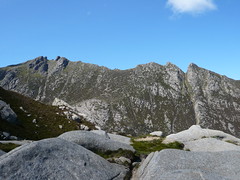
You can find this poem with the view I was seeing when the first sentence came into my head here, though in many ways it is more applicable to the place in this photo, where I have often stopped instead of climbing further. Because of the rules of Blipfoto, I couldn't use this pic for the entry.
than where I’m going. So.
To be aware of the elusive scent
of myrtle in the sun, to catch
the distant gleam of wet rock
in the corrie’s dark recess,
to note the brown swirl of the timeless burn
- all this erodes its own path,
creates a time-worn journey in my soul,
a path to which I turn without a thought
of where it all might end.
The upturned wings glide overhead
- a whisper passing in the breeze –
and if I never know I have arrived
so be it. I am here.
©C.M.M. 07/12
You can find this poem with the view I was seeing when the first sentence came into my head here, though in many ways it is more applicable to the place in this photo, where I have often stopped instead of climbing further. Because of the rules of Blipfoto, I couldn't use this pic for the entry.
Tuesday, July 12, 2011
Of crows (or not) and sinews
Another improbably lovely morning in Glen Rosa as the early clouds melt and a hot sun shines on the garden - a totally private and sheltered place by virtue of the enormous rhododendrons that surround it. Yesterday was spent, you might say, on the doorstep - if doorsteps can extend for about 5 miles and climb several hundred feet and take over seven hours to traverse! For those unfamiliar with the terrain, Glen Rosa is a perfect glaciated valley rising through its length to a well-defined saddle which separates it from Glen Sannox. That saddle is where we ate our picnic yesterday, as two large black birds - crows? ravens? - shambled over the rocks or swished overhead so close that we could hear the wind in their feathers. I think they might have been disappointed when we rose from a post-prandial snooze against a huge rock; they may have been looking forward to a mid-afternoon snack...
I was alarmed by the fact that my tendons seem to have gone like perished elastic since I last louped down this glen; the recently sprained ankle certainly made life more precarious despite the fact that it held up until the last stretch near the Garbh Allt. I found myself quoting Hamlet: And now my sinews, bear me stiffly up ...
This morning, they are merely stiff. And I have a blister on the ball of my foot. But I have already slipped into the Arran mode of not caring too much about eating out, not caring that shorts don't really do much for my looks any more, and I think today will involve another picnic and another walk. Seaside today, I think .... Blackwaterfoot? King' Caves? The wonderful butcher in the village?
Life's hard, innit?
I was alarmed by the fact that my tendons seem to have gone like perished elastic since I last louped down this glen; the recently sprained ankle certainly made life more precarious despite the fact that it held up until the last stretch near the Garbh Allt. I found myself quoting Hamlet: And now my sinews, bear me stiffly up ...
This morning, they are merely stiff. And I have a blister on the ball of my foot. But I have already slipped into the Arran mode of not caring too much about eating out, not caring that shorts don't really do much for my looks any more, and I think today will involve another picnic and another walk. Seaside today, I think .... Blackwaterfoot? King' Caves? The wonderful butcher in the village?
Life's hard, innit?
Sunday, July 10, 2011
Home, home ... In the glen
It's an odd feeling to be here - and an annoying feeling not to be able to send a photo of here to the blog: for some reason, despite an excellent signal, my phone has decided it can't cope with blogs and I don't have a lead for my camera here. Ah well. Aficionados of Glen Rosa, on Arran, can visualise for themselves the small white cottage to the right of the track, just before the campsite - the last house in the glen as you head for the Garbh Allt and the hills. And we are here, for a week.
I've been sitting outside on the wooden seat against the white-painted stone wall of this old cottage listening the the birds and the silence that enfolds their song. Last night, on a final visit to the garden in the gloaming, I found a rabbit calmly cleaning his paws, and this morning early there were two of them wetting their bottoms on the dew. (Actually I think it rained a bit in the night, but dew sounds more poetic) The Dutch Venture Scouts who were camping by the burn below us were admirably silent in the night, and by the time we surfaced this morning had folded their tents and stolen away. The summit of Goatfell, just visible from the garden gate, is clear and the morning calm.
What is so amazing for me is the sensation of living halfway to one of my favourite places, in the middle of the surroundings that sum up all I love about Arran. In a moment I shall make some coffee and take it out to that bench, and then we shall potter down to Brodick in search of a paper (no, not that paper). A spot of lunch, then off to walk another glen; we'll save the length of Glen Rosa for a day when we feel more energetic. In the meanwhile, I shall enjoy just being here.
And there's Wifi in the cottage. Joy!
I've been sitting outside on the wooden seat against the white-painted stone wall of this old cottage listening the the birds and the silence that enfolds their song. Last night, on a final visit to the garden in the gloaming, I found a rabbit calmly cleaning his paws, and this morning early there were two of them wetting their bottoms on the dew. (Actually I think it rained a bit in the night, but dew sounds more poetic) The Dutch Venture Scouts who were camping by the burn below us were admirably silent in the night, and by the time we surfaced this morning had folded their tents and stolen away. The summit of Goatfell, just visible from the garden gate, is clear and the morning calm.
What is so amazing for me is the sensation of living halfway to one of my favourite places, in the middle of the surroundings that sum up all I love about Arran. In a moment I shall make some coffee and take it out to that bench, and then we shall potter down to Brodick in search of a paper (no, not that paper). A spot of lunch, then off to walk another glen; we'll save the length of Glen Rosa for a day when we feel more energetic. In the meanwhile, I shall enjoy just being here.
And there's Wifi in the cottage. Joy!
Wednesday, July 06, 2011
Chew, don't swallow.
Another blog post, another novel. It's not that I've been devouring fiction more than usual, more a failure to blog that brings this about. I began Margaret Atwood's The Blind Assassin before I went to France - a mistake, as it is a fat book and not mine own, so I didn't want to stuff it into my flight bag. I had just begun to feel at home in the complexities of the tale when I left, and it took me a while to get back into it, for there are different voices narrating the components of Iris and Laura Chase's life together and I was, frankly, confused.
I think it was the effort required that initially put me off reading a book that's sat on the bookshelf for long enough to acquire a sun-tanned lower half (sorry, Morgane) - but it was self-disgust that kept me at it this time. I don't want to subsist on Mills & Boone in my declining years, after all ...
Iris Chase is remembering, as her body ages and her heart gives warnings of mortality. She is recalling the circumstances of her younger sister's death, and in doing this tells the story of their childhood together and their adult fates. As Iris is now old, the story covers much of the twentieth century - wars happen and mark the novel's protagonists, political events hinder their aspirations, society changes and with it their own lives.
The blind assassin of the title appears in the strange fiction that runs through the novel - much as the odd story of the sorcerer in Oranges are not the Only Fruit - but seems to seep out into reality as Laura Chase suffers in real life only to survive as a legend. Newspaper items surface as a contemporary commentary on Iris' memories, and Atwood's mastery of tense and person, of location and mood, pervades the whole, as it did in Alias Grace. I feel I've had an introduction to two centuries of Canada after these two books - and want to re-read the classics I read twenty years ago to check on what I found there.
Another holiday book for when you know you won't be disturbed - a book to chew rather than to swallow, and deeply satisfying.
I think it was the effort required that initially put me off reading a book that's sat on the bookshelf for long enough to acquire a sun-tanned lower half (sorry, Morgane) - but it was self-disgust that kept me at it this time. I don't want to subsist on Mills & Boone in my declining years, after all ...
Iris Chase is remembering, as her body ages and her heart gives warnings of mortality. She is recalling the circumstances of her younger sister's death, and in doing this tells the story of their childhood together and their adult fates. As Iris is now old, the story covers much of the twentieth century - wars happen and mark the novel's protagonists, political events hinder their aspirations, society changes and with it their own lives.
The blind assassin of the title appears in the strange fiction that runs through the novel - much as the odd story of the sorcerer in Oranges are not the Only Fruit - but seems to seep out into reality as Laura Chase suffers in real life only to survive as a legend. Newspaper items surface as a contemporary commentary on Iris' memories, and Atwood's mastery of tense and person, of location and mood, pervades the whole, as it did in Alias Grace. I feel I've had an introduction to two centuries of Canada after these two books - and want to re-read the classics I read twenty years ago to check on what I found there.
Another holiday book for when you know you won't be disturbed - a book to chew rather than to swallow, and deeply satisfying.
Saturday, July 02, 2011
Emma Donoghue's Room
I've always had a difficulty with books entirely written in a voice with which I'm uneasy. I never managed, for example, to read The Color Purple all the way through, because the narrator's English was so heavily Deep-South that the spelling of it gave me a headache. I managed with Sunset Song, but that is a masterpiece. And I managed with Room, by Emma Donoghue, although I nearly gave up after the first ten pages. And maybe the fact that I didn't points to the masterly handling that makes this book extraordinary.
We all read in horror, watch the news with unbelieving avidity, when a story breaks of someone held hostage, sexually abused, exploited, and then, miraculously, discovered and liberated. We unite in condemnation of the abusers, and wonder at the shadowy figures of their victims - but we don't often think about the effect on their lives of what they've been through. They're free, and we thank God, or the police, and move on.
This novel forces you to stay in captivity, physical and mental. It is told by Jack, who is five and was born in the room where he lives with his mother, Ma. He watches carefully regulated television, but the rest of his experience is of the confined space in which they live - a space where the beeps of the security lock on the door herald the nightly visits of Old Nick, the provider of Sunday Treats and the abuser of his mother - and Jack's father. The five-year-old's perception of what he experiences means that for a while after reading the book you too start seeing things differently, and even when he is able to experience Outside for the first time he has his own particular interpretation of what he finds there.
Jack is a captivating and fascinating narrator who has no judgement to pass on his prison because it is all that he knows. By the time he cuts off his long hair and finds that he still has the strength to cope with the world, we too have developed a changed perspective of our lives.
A book group would have a ball with this disturbing and engrossing novel.
We all read in horror, watch the news with unbelieving avidity, when a story breaks of someone held hostage, sexually abused, exploited, and then, miraculously, discovered and liberated. We unite in condemnation of the abusers, and wonder at the shadowy figures of their victims - but we don't often think about the effect on their lives of what they've been through. They're free, and we thank God, or the police, and move on.
This novel forces you to stay in captivity, physical and mental. It is told by Jack, who is five and was born in the room where he lives with his mother, Ma. He watches carefully regulated television, but the rest of his experience is of the confined space in which they live - a space where the beeps of the security lock on the door herald the nightly visits of Old Nick, the provider of Sunday Treats and the abuser of his mother - and Jack's father. The five-year-old's perception of what he experiences means that for a while after reading the book you too start seeing things differently, and even when he is able to experience Outside for the first time he has his own particular interpretation of what he finds there.
Jack is a captivating and fascinating narrator who has no judgement to pass on his prison because it is all that he knows. By the time he cuts off his long hair and finds that he still has the strength to cope with the world, we too have developed a changed perspective of our lives.
A book group would have a ball with this disturbing and engrossing novel.
Friday, July 01, 2011
End of an era
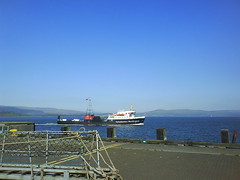
Ok, that's a hackneyed header. And it's in today's local paper - but my era is different. Everyone is discussing the end of the car ferry service from Gourock to Dunoon pier; I travelled on one of the last crossings on Thursday. But the era I'm talking about is personal, for we arrived in Dunoon at the same time as the car ferries Juno and Jupiter - the ship in the pic - and my trip t'other day was on MV Saturn, which started on the Rothesay run three years later, in 1977. So as well as wondering, along with the rest of us, how the replacement passenger service will work in the winter (we know already that one of the two ships, the Ali Cat, goes off in a breeze) and how big the queues of cars for Western Ferries will be (to say nothing of Cowal Games weekend) I'm reflecting on the years since 1974 from a personal perspective.
We came here with a 5 week old baby and moved into a school-owned council house in Ardenslate. Our first morning was marked by the main fuse's blowing and our worry that as the leccy came via the Hydro-electric, based in Perth, we wouldn't get it fixed till the Monday. (Didn't know they had local fixers ...). We had no telly and no phone - and no mobiles or internet, remember. I was alone with a five-week-old baby, once Mr B had gone to work; I didn't drive and I only knew one person and it rained a lot. I got the phone by stressing the baby-panics, and the telly arrived a few days later and provided some sanity. The church provided the rest. (Strange, but true).
And of course time passed. We met people in droves, and more importantly made good friends. We started a choir - the Hesperians - and performed with them. We bought the house we still live in and I learned to drive. The baby grew up and another one appeared and followed him; they both left at the age of 17 and never lived here again. (That's what happens to clever kids here. They go. Some return, but more stay gone). I returned to teaching and for five days a week we could have been living anywhere: a school's a school's a school. The American navy loomed large for a while - especially when I was big in the local CND - and then left. The town appeared less rented, more stable. New houses appeared in fields, sometimes with scant regard for the tendency of said fields to drown in the winter. Generations of school pupils passed through our lives, and some of them surfaced on Facebook.
And now I'm back where I started, in some ways. I don't work - at least, I don't do paid work and huvtaes - and the church is still the constant in a changing life. We still sing, though the Hesperian men have gone the way of all flesh and we're now a women's group. There are occasional babies in our house in the shape of visiting grandchildren, though the original babies show little inclination to return. In my Glasgow childhood, I always hankered for a life involving sea and hills; my own children seem drawn to cities and urban pursuits.
But through all that - a life, really - the Cal Mac ferries came and went, easily visible from my window. Now they're away, and the new boat still hasn't put in an appearance. And I can't help wondering if somewhere, hidden in the ferry saga, there isn't a metaphor for life.
But I haven't worked it out yet.
We came here with a 5 week old baby and moved into a school-owned council house in Ardenslate. Our first morning was marked by the main fuse's blowing and our worry that as the leccy came via the Hydro-electric, based in Perth, we wouldn't get it fixed till the Monday. (Didn't know they had local fixers ...). We had no telly and no phone - and no mobiles or internet, remember. I was alone with a five-week-old baby, once Mr B had gone to work; I didn't drive and I only knew one person and it rained a lot. I got the phone by stressing the baby-panics, and the telly arrived a few days later and provided some sanity. The church provided the rest. (Strange, but true).
And of course time passed. We met people in droves, and more importantly made good friends. We started a choir - the Hesperians - and performed with them. We bought the house we still live in and I learned to drive. The baby grew up and another one appeared and followed him; they both left at the age of 17 and never lived here again. (That's what happens to clever kids here. They go. Some return, but more stay gone). I returned to teaching and for five days a week we could have been living anywhere: a school's a school's a school. The American navy loomed large for a while - especially when I was big in the local CND - and then left. The town appeared less rented, more stable. New houses appeared in fields, sometimes with scant regard for the tendency of said fields to drown in the winter. Generations of school pupils passed through our lives, and some of them surfaced on Facebook.
And now I'm back where I started, in some ways. I don't work - at least, I don't do paid work and huvtaes - and the church is still the constant in a changing life. We still sing, though the Hesperian men have gone the way of all flesh and we're now a women's group. There are occasional babies in our house in the shape of visiting grandchildren, though the original babies show little inclination to return. In my Glasgow childhood, I always hankered for a life involving sea and hills; my own children seem drawn to cities and urban pursuits.
But through all that - a life, really - the Cal Mac ferries came and went, easily visible from my window. Now they're away, and the new boat still hasn't put in an appearance. And I can't help wondering if somewhere, hidden in the ferry saga, there isn't a metaphor for life.
But I haven't worked it out yet.
Monday, June 27, 2011
Frock it!
I very rarely write about clothes. Dresses even less often. But there's a family wedding on the horizon, and it will still be summer (stop laughing) and the usual black elegant breeks seem ... well, black. And besides they've been round the block a bit, beginning with the time they climbed out of an Argyll ditch after a car crash, and that wasn't yesterday. The good news, I suppose, is that they remained elegant and that they still fit. But I digress.
In the interests of trying, I send for a dress that caught my eye in a sale. Lovely material - silk/cotton - lovely subtle slatey colour, potentially flattering lines and length. And it arrives, and it fits. But there's the rub. I don't like myself in it. I hitch up the skirt to see if the new knee-length would have been any better, but find it as unflattering as ever. (I don't think knee-length cuts it unless you wear killer heels and have a long tibia. Or two.) I realise my ankles are looking ... well, old. The bump from the sprain a month ago doesn't help, and I daresay they'd be improved by tights - another horror. Loathe tights.
I think I'm in danger of looking like the matronly aunt-in-law that I actually am. I can't bear myself in this mode. What to do? I shall give the shops one last try. I'm not holding out much hope. But I'd like to issue a warning to any of the generation that might be having any ideas: I'm not up for this dressing-for-a-wedding caper. It's not me.
Now, what about a nice little fascinator ...?
In the interests of trying, I send for a dress that caught my eye in a sale. Lovely material - silk/cotton - lovely subtle slatey colour, potentially flattering lines and length. And it arrives, and it fits. But there's the rub. I don't like myself in it. I hitch up the skirt to see if the new knee-length would have been any better, but find it as unflattering as ever. (I don't think knee-length cuts it unless you wear killer heels and have a long tibia. Or two.) I realise my ankles are looking ... well, old. The bump from the sprain a month ago doesn't help, and I daresay they'd be improved by tights - another horror. Loathe tights.
I think I'm in danger of looking like the matronly aunt-in-law that I actually am. I can't bear myself in this mode. What to do? I shall give the shops one last try. I'm not holding out much hope. But I'd like to issue a warning to any of the generation that might be having any ideas: I'm not up for this dressing-for-a-wedding caper. It's not me.
Now, what about a nice little fascinator ...?
Friday, June 24, 2011
Who's Corpus Christi?
Bit slow off the mark, I'm afraid, as a visit to Glasgow for a service in the evening involves The Last Ferry and a rather late night. But I've just been reading the authoritative report of last evening's proceedings in St Mary's Cathedral and feel moved to make my own.
I've been to only one other celebration of Corpus Christi in my day - perhaps 15 years ago now, when Dale Grey was the Warden at Cumbrae and laid on a joyous service with a visiting choir (not one I was in) and a procession round the grounds of the Cathedral there. I had some idea of what to expect in the way of ceremony and I knew there would be rose petals, but I had no notion of how I might react. This is how it feels now:
I have a renewed appreciation of the power of ritual. When ritual is beautifully done, with conviction and authority and no attempt to make it ordinary or contemporary, it is capable of sweeping the participants into its self-forgetting rhythm. This is what happened. The sacrament was there in the monstrance (left) and was paraded round the church in a procession of incense (from two thuribles!) preceded by a rain of rose petals from an ever-replenished basin (there are more photos on Kelvin's blog on the link above). And as it passed we turned, like subjects of old, so as to have our eyes always on the monstrance and what it contained. Suddenly it became real, in the sense that we talk, as Kelvin did, about the Real Presence: I knew that in that circle of gold there was a wafer of unleavened bread, but when it passed me I bowed low - not once, but three times, each time it passed. That felt right. I didn't have to think about it.
We encountered here the power of symbolism - and symbolism that was appropriate and in-your-face and glorious. Usually I worship in relatively modern English, sing everything in sight, strain to hear all that is said above the noise of Godly Play, and know everyone around me. Last night's Mass was sung by a choir, in Latin; there was silence (apart from the traffic in Great Western Road) and there was glorious, thundering organ music that came reverberating through the soles of our feet, there was the all-pervading scent of the incense and I knew about three people and the celebrant. It was strange and it was exotic; it was liberating and funny and it was joyful; it was - or seemed to be - completely assured and unselfconscious.
Guess that's the key, really: unselfconsciousness. We can't be self-conscious and embarrassed, we mustn't feel we always have to justify our joyful eccentricities, we can't be apologetic Christians all the time or we've had it. Kevin introduced what was about to happen with a small joke: someone had asked "Who's this Corpus Christi that you're celebrating?" His last words at the end of the service reminded us of this question. Who is this Corpus Christi?
And the answer? It's us. Wow.
Note: There's a whole set of photos here.
I've been to only one other celebration of Corpus Christi in my day - perhaps 15 years ago now, when Dale Grey was the Warden at Cumbrae and laid on a joyous service with a visiting choir (not one I was in) and a procession round the grounds of the Cathedral there. I had some idea of what to expect in the way of ceremony and I knew there would be rose petals, but I had no notion of how I might react. This is how it feels now:
I have a renewed appreciation of the power of ritual. When ritual is beautifully done, with conviction and authority and no attempt to make it ordinary or contemporary, it is capable of sweeping the participants into its self-forgetting rhythm. This is what happened. The sacrament was there in the monstrance (left) and was paraded round the church in a procession of incense (from two thuribles!) preceded by a rain of rose petals from an ever-replenished basin (there are more photos on Kelvin's blog on the link above). And as it passed we turned, like subjects of old, so as to have our eyes always on the monstrance and what it contained. Suddenly it became real, in the sense that we talk, as Kelvin did, about the Real Presence: I knew that in that circle of gold there was a wafer of unleavened bread, but when it passed me I bowed low - not once, but three times, each time it passed. That felt right. I didn't have to think about it.
We encountered here the power of symbolism - and symbolism that was appropriate and in-your-face and glorious. Usually I worship in relatively modern English, sing everything in sight, strain to hear all that is said above the noise of Godly Play, and know everyone around me. Last night's Mass was sung by a choir, in Latin; there was silence (apart from the traffic in Great Western Road) and there was glorious, thundering organ music that came reverberating through the soles of our feet, there was the all-pervading scent of the incense and I knew about three people and the celebrant. It was strange and it was exotic; it was liberating and funny and it was joyful; it was - or seemed to be - completely assured and unselfconscious.
Guess that's the key, really: unselfconsciousness. We can't be self-conscious and embarrassed, we mustn't feel we always have to justify our joyful eccentricities, we can't be apologetic Christians all the time or we've had it. Kevin introduced what was about to happen with a small joke: someone had asked "Who's this Corpus Christi that you're celebrating?" His last words at the end of the service reminded us of this question. Who is this Corpus Christi?
And the answer? It's us. Wow.
Note: There's a whole set of photos here.
Sunday, June 19, 2011
And God saw that it was good
Here we are again - back in Holy Trinity for Trinity Sunday. The service has just ended, the crucifer is returning the cross to its stand, the candles are still lit. The flower power people are on holiday/sick, so there are no flowers, but that's fine. The aged seats from the long-vanished La Scala cinema (now the Dunoon branch of Mackay's) have gone from the sedilia, having finally succumbed to the damp, and have been replaced by hassocks, and the carpet, though cleanish, now shows clearly where furniture has preserved its original colour. Obviously there is still much to be done.
But I couldn't help noticing the huge lift it gave us all on this, our Patronal festival, to see the light streaming in above the altar once more, after the weeks shrouded in tarpaulins, and the increased resonance of the organ as it banished all memories of the little keyboard Mr B had to play while his organ (hush!) was swathed in dust sheets and polythene. And there was an added frisson, for me at least, in realising during the long OT lesson - the entire Creation story - that I could hear Mary's voice at the back of the church, where the children have their Godly Play until we can accomodate them in the tower (not as bad as it sounds), echoing in a whisper the words of the story: "And God saw that it was good".
I think God would perhaps see that today was good.
But I couldn't help noticing the huge lift it gave us all on this, our Patronal festival, to see the light streaming in above the altar once more, after the weeks shrouded in tarpaulins, and the increased resonance of the organ as it banished all memories of the little keyboard Mr B had to play while his organ (hush!) was swathed in dust sheets and polythene. And there was an added frisson, for me at least, in realising during the long OT lesson - the entire Creation story - that I could hear Mary's voice at the back of the church, where the children have their Godly Play until we can accomodate them in the tower (not as bad as it sounds), echoing in a whisper the words of the story: "And God saw that it was good".
I think God would perhaps see that today was good.
Saturday, June 18, 2011
Emerging from chaos ...
This rather poor photo doesn't do justice to the satisfaction it represents - a combination of a phone-camera, a gloomy day and hands trembling with the exertion of cleaning all these pews made for a weak effort in the photography department. This could not be said of the efforts the people of Holy Trinity Dunoon have made in the past year to ensure that their building ... well, worked, really.
So here you see the chancel arch minus the peeling blue paint that has disfigured it for the past ten years, and the pristine ingoes (I just learned this word) of the sanctuary windows. The scaffolding is down, and after a month of a nave altar in front of green tarpaulin we can now see the east windows again. The tower is drying out nicely and the bells are once again safe to ring. (That's what they tell me: I'm doing it tomorrow.)
The stour left was daunting, but this morning a small band of us got rid of it. The tiles were vacuumed and washed, the eagle had his orifices poked before he was polished, and the wide open spaces left by the removal of the now redundant choir stalls have us thinking of liturgical possibilities and ... polished wood flooring. There. I've said it.
It's just that as we prepare for our Patronal festival tomorrow, everything seems possible. Though I have to add that I don't clean my own house .... Strange, isn't it?
So here you see the chancel arch minus the peeling blue paint that has disfigured it for the past ten years, and the pristine ingoes (I just learned this word) of the sanctuary windows. The scaffolding is down, and after a month of a nave altar in front of green tarpaulin we can now see the east windows again. The tower is drying out nicely and the bells are once again safe to ring. (That's what they tell me: I'm doing it tomorrow.)
The stour left was daunting, but this morning a small band of us got rid of it. The tiles were vacuumed and washed, the eagle had his orifices poked before he was polished, and the wide open spaces left by the removal of the now redundant choir stalls have us thinking of liturgical possibilities and ... polished wood flooring. There. I've said it.
It's just that as we prepare for our Patronal festival tomorrow, everything seems possible. Though I have to add that I don't clean my own house .... Strange, isn't it?
Friday, June 17, 2011
Twittering respectably
I've been catching up on some old friends' blogs - you can thank the weather for that, chaps! - and came across this post from Neil Winton just as I was pondering again (or anew, as the hymn hath it) the business of officialdom and social media. When I left the classroom - god, it's been six years - I could still look at flickr and some blogs on the school system, though Richard Holloway's work was largely taboo because, it seemed, he'd used naughty words. So NetGear said anyway. Now, apparently, it is hard in schools to access any of the sites I've grown accustomed to using daily. Everyone and their grannies now know what Twitter is, but heaven forfend that our young should be able to use it.
Stupid logic, of course. I've been using Twitter since, November 2006. An earlyish adopter, then. I've been blogging for a year or so longer. And I've been evangelical about the power of social media for most of the intervening years. But now I'm no longer involved in schools and education at large; my forum tends to be in church circles. So I've stood up at Synods both General and Diocesan and begged for blogs to be used to communicate and for Bishops to use Twitter. And back then - some 4/5 years ago - I was scoffed at, either gently or violently. But gradually we saw bloggers doing their slightly risky thing on the sidelines of Synod, and then Twitter took over as comments were tweeted and shared live. Bishops blogged and had Facebook accounts. There were lunchtime meetings to help the uninitiated get over their fears (I'm talking General Synod here - all two and a half days of it) and, finally, official guidelines in the Synod papers for kind and responsible Tweeting. Social media had, on the face of it, arrived.
But we need to be careful here. There are still many, many people who have "no time" for Twitter and "all that stuff" - and that "no time" can be factual or pejorative in intent. And all too often they are the people who run organisations - because suddenly they see the huge potential for ... what? Anarchy? Revolution? Criticism?
Yes. Of course. All of these things. That's why repressive regimes block Facebook. I'm reminded, probably because of the context in which I now operate, of how the Bible used to be forbidden fruit to the common people, and then to women - much safer to keep it in Latin and in the hands of the priests, much more seemly for women to take their men's word for what was in this dangerous book. But hey - we all read the Bible now, if we feel so inclined, and we sometimes find new and exciting things in it, in our unschooled, lay fashion. And the job of the professionals is to help all of us to read sensibly, not to make basic errors in comprehension, to put it in a historical context and so on. The church as it is today, shrinking as it may be, seems to me a healthier and more alive organism for the active participation of its members.
And what, do you ask, has this to do with Twitter? Well, Twitter and other social media exist. People have become accustomed to using them to broadcast their status. Not all people are sensible, and some users of social media are downright silly - they're just people. But you can't stop them making fools of themselves, in public or not. You can assume that people at a gathering like Synod will, for the most part, have a modicum of intelligence and a large helping of goodwill - they wouldn't be there otherwise. I've already remarked on the lack of much tweeting during the last Synod - because someone, apparently, thought fit to warn them off at one point. I missed that bit, so I don't know how it was done. But for next year, I'd like to see a Twitter live backchat channel on the screens, so that everyone in the hall can see what's being said as it's said - and the people up front can have the chance to react to it.
Going back to the trigger for this post - the drive to have social media become normal in schools - I'm pushed into wondering if official blessing is in fact the one way to kill something off. I think our young might well tell us it is ...
Stupid logic, of course. I've been using Twitter since, November 2006. An earlyish adopter, then. I've been blogging for a year or so longer. And I've been evangelical about the power of social media for most of the intervening years. But now I'm no longer involved in schools and education at large; my forum tends to be in church circles. So I've stood up at Synods both General and Diocesan and begged for blogs to be used to communicate and for Bishops to use Twitter. And back then - some 4/5 years ago - I was scoffed at, either gently or violently. But gradually we saw bloggers doing their slightly risky thing on the sidelines of Synod, and then Twitter took over as comments were tweeted and shared live. Bishops blogged and had Facebook accounts. There were lunchtime meetings to help the uninitiated get over their fears (I'm talking General Synod here - all two and a half days of it) and, finally, official guidelines in the Synod papers for kind and responsible Tweeting. Social media had, on the face of it, arrived.
But we need to be careful here. There are still many, many people who have "no time" for Twitter and "all that stuff" - and that "no time" can be factual or pejorative in intent. And all too often they are the people who run organisations - because suddenly they see the huge potential for ... what? Anarchy? Revolution? Criticism?
Yes. Of course. All of these things. That's why repressive regimes block Facebook. I'm reminded, probably because of the context in which I now operate, of how the Bible used to be forbidden fruit to the common people, and then to women - much safer to keep it in Latin and in the hands of the priests, much more seemly for women to take their men's word for what was in this dangerous book. But hey - we all read the Bible now, if we feel so inclined, and we sometimes find new and exciting things in it, in our unschooled, lay fashion. And the job of the professionals is to help all of us to read sensibly, not to make basic errors in comprehension, to put it in a historical context and so on. The church as it is today, shrinking as it may be, seems to me a healthier and more alive organism for the active participation of its members.
And what, do you ask, has this to do with Twitter? Well, Twitter and other social media exist. People have become accustomed to using them to broadcast their status. Not all people are sensible, and some users of social media are downright silly - they're just people. But you can't stop them making fools of themselves, in public or not. You can assume that people at a gathering like Synod will, for the most part, have a modicum of intelligence and a large helping of goodwill - they wouldn't be there otherwise. I've already remarked on the lack of much tweeting during the last Synod - because someone, apparently, thought fit to warn them off at one point. I missed that bit, so I don't know how it was done. But for next year, I'd like to see a Twitter live backchat channel on the screens, so that everyone in the hall can see what's being said as it's said - and the people up front can have the chance to react to it.
Going back to the trigger for this post - the drive to have social media become normal in schools - I'm pushed into wondering if official blessing is in fact the one way to kill something off. I think our young might well tell us it is ...
Thursday, June 16, 2011
Lilies in the wind
The stinking lilies (left) are all out - I suspect they have a posh name, like Turk's Cap lilies or something, but their ammonia smell means that for the past 35 years I've thought of them as stinking. The Philadelphus, just behind them, is also beginning to come out, its sweet scent just making itself known over the ammonia. The sun is shining, albeit fitfully. I should be feeling mellow.
But I'm not. For a start they're too early: these are real end-of-term scents, the scents of warm summer evenings coming home late from school concerts or prizegivings, and it's not just that I am no longer involved in such matters upsetting things. The lilies were out before the end of May, presumably hastened by the almost-forgotten warmth of March and April, and now they hang over the path beaten out of shape by the rain that dominated last month. And warm it is not: after a promising start we had cloud and now there's a brisk and chilly wind. This may be global warming, or it may just be another example of the variable weather of the west. Either way, it's got me jangled.
I think I need another holiday. But we've not yet passed Trinity Sunday ...
But I'm not. For a start they're too early: these are real end-of-term scents, the scents of warm summer evenings coming home late from school concerts or prizegivings, and it's not just that I am no longer involved in such matters upsetting things. The lilies were out before the end of May, presumably hastened by the almost-forgotten warmth of March and April, and now they hang over the path beaten out of shape by the rain that dominated last month. And warm it is not: after a promising start we had cloud and now there's a brisk and chilly wind. This may be global warming, or it may just be another example of the variable weather of the west. Either way, it's got me jangled.
I think I need another holiday. But we've not yet passed Trinity Sunday ...
Tuesday, June 14, 2011
Fiddling at Synod?
Oh dear. I've been remiss in my blogging - but I've been away. Not more continental junketings, alas, but at the General Synod of the Scottish Episcopal Church. I seem to have participated rather often in this gathering over the years, but realise it's because I was a diocesan alternate before I was chosen as a representative ... but I maunder. Don't expect an official or exhaustive take on proceedings, however - you can find that here - my impressions are very patchy this year.
This is largely because I missed quite a chunk of things, including the task of facilitating discussion - I'd been looking forward to that - because I was no weel. Quite apart from my scheduled trip to Glasgow to have a small bit of me removed, I suffered horribly from our diocesan dinner and missed a whole morning on Mission; by the time I returned I realised I felt the way I used to after an absence from school: you caught measles or somesuch and when you went back you found out that everyone else had learned to do long division and you were totally lost.
And it's hard to get back into things in those circumstances. I was led to ponder how vital it is that individual speakers engage with their audience - it is so easy to switch off and let the mind wander as some voice drones on about ... but if I'm specific I shall pinpoint the offenders, and it is not my intention to wound. Rather I would beg that speakers are instructed in the art of eye contact, tonal variation and register - indeed, in the whole art of public speaking that they would have learned in Standard Grade had they been in my classroom. Maybe there's a job there for a certain bishop on the verge of retirement: having muttered resentfully about the boredom of one address, and having been rebuked by a more charitable neighbour on the grounds that this was after all the graveyard slot, I found myself once more engaged - and amused - by said bishop in his follow-up comments. Graveyard? I reckon he could make the dead laugh ...
Just to show that I'm not all girns and detachment, I should add here how much I enjoyed the break from traditional tedium offered by the indaba process. I was in a feisty group which in the end had to agree to disagree, but it was such a relief to be able to test responses on others rather than one's unfortunate neighbour or the twitterverse at large - though I had the feeling, confirmed later, that the twitterers had been somewhat discouraged while I was away being poorly. Someone had got it into their head that to tweet meant to be insensitive and crass and that it had therefore to be spelled out when tweeting would be inappropriate. I fear that is what happens when a spontaneous activity becomes respectable ... and I'm glad I didn't know about it, for that would have made me much, much worse.
But you'll be glad to know that my old friend the complacent male was at Synod. This was a cunningly camouflaged wee dinosaur, but his message was the same: it's a waste of time - in fact, it's navel-gazing - to fret about gender imbalance in church matters. He said it so quietly, slipping it in after one of the more mind-numbing exegeses, that we were onto the next item before I'd clocked it and got my hackles working - I told you I'd been no weel - and I was left frustrated. I shoulda said something. But then it was pointed out to me that his comment had been met by a wall of silence. And it was suggested that I should perhaps think about this silence. What did it mean? Well for a start it sure wasn't applause - and we'd had plenty of applause for other speakers, so people were by no means apathetic. As a teacher and speaker, I know there is nothing more disheartening than silence - for I take silence to show indifference or apathy, or perhaps that everyone has gone to sleep. So maybe I wasn't needed after all - maybe the church as a body is getting past the Mesozoic age (I had to look that up) and his remark was indeed seen as crass by the majority of those present. Maybe my more normal kneejerk reaction would have merely confirmed him - and others, for I'm sure he's still not quite alone - that women (or other excluded groups) are only interested in their own causes and don't care that creation burns (see pic). The silence on the part of all the Saturday Synod survivors might even have taught him that he really shouldn't say these things. (It may be too late for him not to think them - he was not in his first youth)
But I feel I'm going on a bit. I shall finish with what, after cooling down slighly, I tweeted as my last word on the Synod:
This is largely because I missed quite a chunk of things, including the task of facilitating discussion - I'd been looking forward to that - because I was no weel. Quite apart from my scheduled trip to Glasgow to have a small bit of me removed, I suffered horribly from our diocesan dinner and missed a whole morning on Mission; by the time I returned I realised I felt the way I used to after an absence from school: you caught measles or somesuch and when you went back you found out that everyone else had learned to do long division and you were totally lost.
And it's hard to get back into things in those circumstances. I was led to ponder how vital it is that individual speakers engage with their audience - it is so easy to switch off and let the mind wander as some voice drones on about ... but if I'm specific I shall pinpoint the offenders, and it is not my intention to wound. Rather I would beg that speakers are instructed in the art of eye contact, tonal variation and register - indeed, in the whole art of public speaking that they would have learned in Standard Grade had they been in my classroom. Maybe there's a job there for a certain bishop on the verge of retirement: having muttered resentfully about the boredom of one address, and having been rebuked by a more charitable neighbour on the grounds that this was after all the graveyard slot, I found myself once more engaged - and amused - by said bishop in his follow-up comments. Graveyard? I reckon he could make the dead laugh ...
Just to show that I'm not all girns and detachment, I should add here how much I enjoyed the break from traditional tedium offered by the indaba process. I was in a feisty group which in the end had to agree to disagree, but it was such a relief to be able to test responses on others rather than one's unfortunate neighbour or the twitterverse at large - though I had the feeling, confirmed later, that the twitterers had been somewhat discouraged while I was away being poorly. Someone had got it into their head that to tweet meant to be insensitive and crass and that it had therefore to be spelled out when tweeting would be inappropriate. I fear that is what happens when a spontaneous activity becomes respectable ... and I'm glad I didn't know about it, for that would have made me much, much worse.
But you'll be glad to know that my old friend the complacent male was at Synod. This was a cunningly camouflaged wee dinosaur, but his message was the same: it's a waste of time - in fact, it's navel-gazing - to fret about gender imbalance in church matters. He said it so quietly, slipping it in after one of the more mind-numbing exegeses, that we were onto the next item before I'd clocked it and got my hackles working - I told you I'd been no weel - and I was left frustrated. I shoulda said something. But then it was pointed out to me that his comment had been met by a wall of silence. And it was suggested that I should perhaps think about this silence. What did it mean? Well for a start it sure wasn't applause - and we'd had plenty of applause for other speakers, so people were by no means apathetic. As a teacher and speaker, I know there is nothing more disheartening than silence - for I take silence to show indifference or apathy, or perhaps that everyone has gone to sleep. So maybe I wasn't needed after all - maybe the church as a body is getting past the Mesozoic age (I had to look that up) and his remark was indeed seen as crass by the majority of those present. Maybe my more normal kneejerk reaction would have merely confirmed him - and others, for I'm sure he's still not quite alone - that women (or other excluded groups) are only interested in their own causes and don't care that creation burns (see pic). The silence on the part of all the Saturday Synod survivors might even have taught him that he really shouldn't say these things. (It may be too late for him not to think them - he was not in his first youth)
But I feel I'm going on a bit. I shall finish with what, after cooling down slighly, I tweeted as my last word on the Synod:
The day a woman stands up and says we should not fuss about gender balance, all will be well. #pisky #secsynod
Wednesday, June 01, 2011
On the march again
Having caught up on most of my life, thanks to a dreich day with no huvtaes, I find I have time to reflect on my holiday with HF last week. We were walking in the Dordogne, in the neighbourhood of Sarlat, with what turned out to be a wonderfully interesting group of people from New York State, England and New Zealand. I've blogged about HF before, but I came home once more convinced of the merits of this kind of holiday - to say nothing about my enthusiasm for this part of France, new to me despite my frequent visits to more northern areas.
The photo shows pale grey skies on the first full day, replaced for most of the week by flawless blue, but the line of walkers shows for the sceptical how not every moment of a walk is filled with conversation - and reflects the fact that I had sprained my ankle, infuriatingly, within 10 minutes of starting off. (I subsequently completed the 10 mile hike, and resumed the programme after a day by the pool, but I'm not telling the quack)
So what do I remember? Birdsong, poppies, warmth, mellow golden stone, undulating landscape, the river deep in its gorge, the amazing troglodyte dwellings at Roque St Christophe ... singing "Veni Creator" in a stolen moment in a wonderful church in a tiny village when everyone else had moved off and hearing it soar in the awesome acoustic ... fascinating conversations with interesting people ... talking about all the so-called forbidden subjects as Mina took my mind off my ankle by discussing politics and religion ... food so good that we all looked forward to the leisurely dinners cooked by the chefs who came nightly to our hotel to cook for us.
Ok, so this is becoming a list, and therefore boring. Enough to say that the week was far from boring, and that my French felt much more useful than in the past. I enjoyed conversations in French on my day off, and I shared the poolside with a lizard in the hot sun. I'd love to be there now, and start to look forward to my next trip.
Itchy feet? Moi?
The photo shows pale grey skies on the first full day, replaced for most of the week by flawless blue, but the line of walkers shows for the sceptical how not every moment of a walk is filled with conversation - and reflects the fact that I had sprained my ankle, infuriatingly, within 10 minutes of starting off. (I subsequently completed the 10 mile hike, and resumed the programme after a day by the pool, but I'm not telling the quack)
So what do I remember? Birdsong, poppies, warmth, mellow golden stone, undulating landscape, the river deep in its gorge, the amazing troglodyte dwellings at Roque St Christophe ... singing "Veni Creator" in a stolen moment in a wonderful church in a tiny village when everyone else had moved off and hearing it soar in the awesome acoustic ... fascinating conversations with interesting people ... talking about all the so-called forbidden subjects as Mina took my mind off my ankle by discussing politics and religion ... food so good that we all looked forward to the leisurely dinners cooked by the chefs who came nightly to our hotel to cook for us.
Ok, so this is becoming a list, and therefore boring. Enough to say that the week was far from boring, and that my French felt much more useful than in the past. I enjoyed conversations in French on my day off, and I shared the poolside with a lizard in the hot sun. I'd love to be there now, and start to look forward to my next trip.
Itchy feet? Moi?
Sunday, May 15, 2011
The Collection
I'm just back from doing the Christian Aid collection with my pal Mrs Heathbank. Because we are relatively lithe and active (I know, but that's church for you...) we undertake an area with a hill in it. On the very outskirts of town. This year's collection included not only the hill, and its strangely bleak little community in a new development which is unfinished and half empty, but also some new houses on the shore that we'd never visited before, so the afternoon promised some variety and a bit of interest.
In the event, there was much with which we were all too familiar. The people who had no money (it's Sunday). The man who said "I'm afraid I'm the only one in," and shut the door. The people who had already been given an envelope by their own church (come on, chaps, they're for door-to-door collections, you know - not for an easy way out for all concerned). Less familiar were the lovely people who gave us these envelopes for our bag notwithstanding, and the people who invited us in for a chat regardless of our hiking boots (you go prepared for anything in this part of the world). Most annoying moment of the afternoon was reserved for four persistent and very rude small boys who dogged our way round one group of houses making such a racket that we were sure the forewarned denizens of the place lay low as one man. It's the difficulty of remembering that I'm a Christian Aid collector and therefore must bite my tongue that really gets to me in these moments.
And then there were the dogs. I don't care for dogs. Fortunately Mrs H does, and fielded most of them. I had one great success in ordering one beast back into his house; it went, and its owner offered to hire me to complete the animal's training. I declined.
All this time it rained. Most of the time it was a fine, wetting drizzle, with occasional outbursts of something more substantial. As we trailed up the half-made road to the last houses in our patch, we reflected on how different it is doing this sort of thing in a city. I once helped a friend in a residential area of the Edinburgh suburbs; she did one side of the road and I did the other and the whole operation took us half an hour and yielded a heavy haul of filled envelopes. Where we collect in Dunoon, we have to reckon on at least two hours to get round our allocated houses, and will be lucky to have half the amount of the city collection. But I'm not complaining - not really. Except about the churches who make our journey a waste of time.
And next year I'd like it to be warm and sunny. Please?
In the event, there was much with which we were all too familiar. The people who had no money (it's Sunday). The man who said "I'm afraid I'm the only one in," and shut the door. The people who had already been given an envelope by their own church (come on, chaps, they're for door-to-door collections, you know - not for an easy way out for all concerned). Less familiar were the lovely people who gave us these envelopes for our bag notwithstanding, and the people who invited us in for a chat regardless of our hiking boots (you go prepared for anything in this part of the world). Most annoying moment of the afternoon was reserved for four persistent and very rude small boys who dogged our way round one group of houses making such a racket that we were sure the forewarned denizens of the place lay low as one man. It's the difficulty of remembering that I'm a Christian Aid collector and therefore must bite my tongue that really gets to me in these moments.
And then there were the dogs. I don't care for dogs. Fortunately Mrs H does, and fielded most of them. I had one great success in ordering one beast back into his house; it went, and its owner offered to hire me to complete the animal's training. I declined.
All this time it rained. Most of the time it was a fine, wetting drizzle, with occasional outbursts of something more substantial. As we trailed up the half-made road to the last houses in our patch, we reflected on how different it is doing this sort of thing in a city. I once helped a friend in a residential area of the Edinburgh suburbs; she did one side of the road and I did the other and the whole operation took us half an hour and yielded a heavy haul of filled envelopes. Where we collect in Dunoon, we have to reckon on at least two hours to get round our allocated houses, and will be lucky to have half the amount of the city collection. But I'm not complaining - not really. Except about the churches who make our journey a waste of time.
And next year I'd like it to be warm and sunny. Please?
Friday, May 13, 2011
Climbing through the past
Well, that was fun. Two hours spent in a building that seemed (predictably) to have shrunk and (less predictably) to have become an unfamiliar maze reduced me to giggling exhaustion - though the giggles didn't come on till after this photo was taken, as I hadn't met someone I used to know by then. The stair I'm on here actually looks much as it always did - worn, glossy stone treads, tiled walls - though in the 50s the paintwork was cream and there were no pupils' paintings on the walls. But elsewhere, dreadful things have happened in the name of safety, and whole staircases have been dismantled and moved to places that don't fit at all with the architecture. It was, as I said in my last post, always a challenging place to find your way round the central stairwell, but now it's impossible.
Upwards was the clue. If we kept climbing, we arrived first at the top landing under the glass cupola, a space now sadly diminished by a new partition wall and the addition of fluorescent lights round the Parthenon frieze (replica). Beyond that, I knew, was The Attic, where I used to go for sewing classes between 3 - 4pm Monday, Tuesday and Wednesday. I saw a dingy stair heading up into the gloom and followed it - only to find that we seemed to be in a building site, linked to the rest of the school by a corrugated iron corridor with a wonky floor. We crept carefully along this, and emerged on the Attic landing: it was the fire escape. And of course we'd all have died hideously in the 50s if a fire had happened lower down in the school, as there was only the one exit, down the central stairwell. We never gave it a moment's thought - and neither, presumably, did our parents.
Because of the nature of Hillhead until the mid-70s, the returning FPs of my generation tended to share a pretty recognisable set of characteristics, including self-confidence and articulate self-expression. I was totally amused to meet up over a mass school photo with someone whom I remembered, with increasing clarity, from the 2nd violins of the school orchestra. She'd been in the year below me, along with Alison, and her hair had been very dark. I now realise I also knew her brother - even after we left school. Her pal I knew less well, but remembered her big sister - and their father had been a colleague of my own. She knew several people in my life, including one ABF who comments on this blog. It was all very incestuous and great fun.
I am grateful to the mother of a current pupil, who let me out into the shed apparently closed off because of an unsafe roof - her daughter assured me the pupils still go into it. And I was amused by the closed-in area under the school which used to be the boys' shed, open all down one side and used when it was just too wet for footie in the playground. I don't know how they got on playing footie round the pillars - I imagine it led to increased ball skills.
I was hugely impressed by the amount of work obviously done by the present teachers, and by the quality of the work on display. And I realised early on what a nightmare the building has become, with the cramped conditions imposed by the alterations and the leaking windows and unstable stonework in the attic. I had a vision of some of the classrooms as they had been - large, square, well-lit by tall windows, 40 pupils sitting in rows at desks with flap-down seats attached and the teacher at the front at the high desk - and realised I was in another world.
Take it for all in all, I think I prefer where we are now..
Note: I've had to repost this, as it vanished during Blogger's recent sickness. Hence the wrong date - it belongs, like myself, to yesterday.
Upwards was the clue. If we kept climbing, we arrived first at the top landing under the glass cupola, a space now sadly diminished by a new partition wall and the addition of fluorescent lights round the Parthenon frieze (replica). Beyond that, I knew, was The Attic, where I used to go for sewing classes between 3 - 4pm Monday, Tuesday and Wednesday. I saw a dingy stair heading up into the gloom and followed it - only to find that we seemed to be in a building site, linked to the rest of the school by a corrugated iron corridor with a wonky floor. We crept carefully along this, and emerged on the Attic landing: it was the fire escape. And of course we'd all have died hideously in the 50s if a fire had happened lower down in the school, as there was only the one exit, down the central stairwell. We never gave it a moment's thought - and neither, presumably, did our parents.
Because of the nature of Hillhead until the mid-70s, the returning FPs of my generation tended to share a pretty recognisable set of characteristics, including self-confidence and articulate self-expression. I was totally amused to meet up over a mass school photo with someone whom I remembered, with increasing clarity, from the 2nd violins of the school orchestra. She'd been in the year below me, along with Alison, and her hair had been very dark. I now realise I also knew her brother - even after we left school. Her pal I knew less well, but remembered her big sister - and their father had been a colleague of my own. She knew several people in my life, including one ABF who comments on this blog. It was all very incestuous and great fun.
I am grateful to the mother of a current pupil, who let me out into the shed apparently closed off because of an unsafe roof - her daughter assured me the pupils still go into it. And I was amused by the closed-in area under the school which used to be the boys' shed, open all down one side and used when it was just too wet for footie in the playground. I don't know how they got on playing footie round the pillars - I imagine it led to increased ball skills.
I was hugely impressed by the amount of work obviously done by the present teachers, and by the quality of the work on display. And I realised early on what a nightmare the building has become, with the cramped conditions imposed by the alterations and the leaking windows and unstable stonework in the attic. I had a vision of some of the classrooms as they had been - large, square, well-lit by tall windows, 40 pupils sitting in rows at desks with flap-down seats attached and the teacher at the front at the high desk - and realised I was in another world.
Take it for all in all, I think I prefer where we are now..
Note: I've had to repost this, as it vanished during Blogger's recent sickness. Hence the wrong date - it belongs, like myself, to yesterday.
Wednesday, May 11, 2011
Time travelling today ...
Today I'm going to visit the school this grinning child attended: Hillhead Primary School in Glasgow. (And if you follow me on Twitter you'll recognise the young Mrs Blethers - the photo was taken when I was about six, I think, or maybe seven. My pigtails vanished when I was ten.) At the time, the uniform was strictly adhered to; the school was one of Glasgow Corporation's grant-aided selective schools for which an entrance exam had to be sat, a consequence of which being that you could be asked to leave it you were deemed unsuitable in any way. So there I was, in my navy gym-slip with the box pleats and the badge; the cream blouse (never, ever white for the girls); the navy tie with the gold and brown narrow stripes. My hair ribbons were navy blue and my knee-high socks an unpleasant brown.
But I loved school; I loved it wholeheartedly and was as sad to leave at 18 as any heroine of a girls' school story. I never even noticed that the outdoors toilets were a barbaric and chilly idea - and they froze solid in a cold winter and we were all sent home - nor cared that the arrangement of stairs in the Primary School was such that some classrooms could only be reached from the left-hand stair. (I did, however, quail at the idea of asking the fierce teachers in the middle landing for passage through their classrooms if I got it wrong - I preferred to sprint downstairs and start again.) We played all the traditional games in their proper seasons - skipping, ball-games against the wall, scrap-swapping (a winter pursuit, carried out in the shed) - and wildly dangerous ones, like first dreeping off a ten-foot wall and then learning to jump off it without breaking anything. I still remember the concussion of landing on the concrete - and I was a skinny wee thing.
I shall doubtless return to this topic after this evening. The school is to be moved to another site, amalgamating with two others, and I have yet to discover the future of the building in Cecil Street. I shall take my camera, and there is a chance that the visit might destroy some memories. But I doubt it.
But I loved school; I loved it wholeheartedly and was as sad to leave at 18 as any heroine of a girls' school story. I never even noticed that the outdoors toilets were a barbaric and chilly idea - and they froze solid in a cold winter and we were all sent home - nor cared that the arrangement of stairs in the Primary School was such that some classrooms could only be reached from the left-hand stair. (I did, however, quail at the idea of asking the fierce teachers in the middle landing for passage through their classrooms if I got it wrong - I preferred to sprint downstairs and start again.) We played all the traditional games in their proper seasons - skipping, ball-games against the wall, scrap-swapping (a winter pursuit, carried out in the shed) - and wildly dangerous ones, like first dreeping off a ten-foot wall and then learning to jump off it without breaking anything. I still remember the concussion of landing on the concrete - and I was a skinny wee thing.
I shall doubtless return to this topic after this evening. The school is to be moved to another site, amalgamating with two others, and I have yet to discover the future of the building in Cecil Street. I shall take my camera, and there is a chance that the visit might destroy some memories. But I doubt it.
Monday, May 09, 2011
The Revolution: a traditional English teacher’s take.
It's that time of the year - exam time, when suddenly the seniors have vanished and the tired teacher has time to reflect but finds she is too jaded to string together new ideas, finds she is thinking of sunlit beaches and cool drinks instead of technology in the classroom. It's still "that time of the year" for me, but now, having retired from the classroom, I find myself thinking about the job I left - and the job I wish I could be doing. This post is the result of that reflection.
"Poetry, like all the arts, is useless."
Thus began an introductory note, written in the 1940s for Higher English students on the subject of poetry – a wonderful note which went on to demonstrate that although a knowledge of poetry would not clothe or put a roof over the heads of those who knew how to approach it, it was nevertheless one of the most fulfilling cultural activities for students of English.
The question for an English teacher who is sensitive to the need both for the cultural aspects of the subject and for the transactional writing that underpins half the subjects in the secondary curriculum is how to achieve a balance within a revolutionised school curriculum. This is one vision – the vision of an English teacher who has bridged the period between “Projects in Practice” and Higher Still, and who sees Curriculum for Excellence as a half-baked attempt to have a bloodless revolution.
1. Transactional English in immersion learning through a central topic:
If a whole school were immersed in a core topic such as Climate Change, dealing with everything from the Physics and Chemistry of the process through the social aspects and physical impact of change to the politics and journalism of dealing with it, then English writing and comprehension would be an integral part of the study. English specialists would have to be timetabled to be present in the area where such work was going on, to be a constant resource on the ground, to enable the best possible communication and expression of what was being done at all levels.
2. Expressive and cultural input – especially from S3 upwards – in English:
This is where the biggest change might be seen to take place. It would be perfectly possible to deliver the kind of lesson that has always brought, say, a poem to life to a much larger group than has been traditional since the days when partitioned classrooms used to be opened up to allow one teacher to take 60 pupils in time of absence of staff shortage. I’m thinking Big Lesson, followed by group work by pupils with teacher participation, followed by plenary feedback with some kind of projected backdrop showing the results of the discussions. This would free up timetable time to allow for more flexibility.
[It always seemed a waste to me to have a whole year timetabled to be doing the same course at the same time when some of the work was suitable for this kind of treatment. It also seemed a shame for some pupils to be stuck with the one teacher for the two years, say, of S grade, when they could easily have a shot of someone who inspired them. There were often instances of pupils of one teacher coming to another for advice which was lacking in the class they were in]
3. Technology as the glue as well as the instrument:
If pupils were not isolated in the womb-like classroom of individual teachers (I’ll speak for English classes now) for up to 6 hours a week, but could because of flexible working spaces have access to technology and subject specialists when they needed it, provision of an adequate number of computers should be less of a problem – and the maintenance of them might be made simpler if 20 computers were not buried in the room of a cack-handed technophobe who didn’t ensure they were properly functional. I think the formative assessment of students involved in both the cultural and the transactional stages of English could be transformed by their doing all their working-out online, so that both the process and the input of the teacher could be publicly visible (whether in the wider world or on a closed school site). This would save teacher-hours in repeating the same mantras (eg about the embedding of quotation in a Critical Essay for Higher English) and allow learning to take place through study of past materials (something I always did, but which was limited by having limited copies of exemplars). Incidentally, it would also facilitate staff CPD - for teachers are not equally skilled or indeed educated in their field, and the open nature of the work I advocate would allow for continuing but not overt acquisition of new skills. Final work could be submitted on paper if required, but I like the openness and accountability of the blog/ning model for ongoing assessment and appraisal. If twitter or other short-form communication were to be built in to the system, the resulting flexibility would expedite learning, mentoring, teaching, assessment and feedback – and none of these would be limited to the physical classroom or the 9-4 day.
4. The integration of the extra-curricular:
When I taught in Dunoon Grammar School, I ran a very successful magazine. Its operational heart was my classroom where the iMac lived, and almost all the work was done at lunchtimes, after school, and in evenings when we were often racing to escape from the building before it was locked up for the night. But before we were deemed sufficiently successful to purchase our own computer, we relied on the machines in the Business Studies department - a situation fraught with the potential for strife. It strikes me that if something like The Pupils’ View had been a more collaborative activity, we would have had the Business Studies people onside teaching effective skills in typing and layout instead of fighting over when we could use their computers – and there was much useful learning going on with phone skills, advertising, layout & design, sweet-talking advertisers, selling papers. None of that was ever recognised.
Obviously timetabling and resources, school buildings and staffing are at the heart of this, but it seems to me a way of developing new ideas so that the interesting and purely cultural aspects of the subject are not subordinated. And I have taken no account whatsoever of the matter of discipline and the disaffected pupil.
In my experience, there is a great deal of slack time and wasted effort in teaching as it currently stands.
"Poetry, like all the arts, is useless."
Thus began an introductory note, written in the 1940s for Higher English students on the subject of poetry – a wonderful note which went on to demonstrate that although a knowledge of poetry would not clothe or put a roof over the heads of those who knew how to approach it, it was nevertheless one of the most fulfilling cultural activities for students of English.
The question for an English teacher who is sensitive to the need both for the cultural aspects of the subject and for the transactional writing that underpins half the subjects in the secondary curriculum is how to achieve a balance within a revolutionised school curriculum. This is one vision – the vision of an English teacher who has bridged the period between “Projects in Practice” and Higher Still, and who sees Curriculum for Excellence as a half-baked attempt to have a bloodless revolution.
1. Transactional English in immersion learning through a central topic:
If a whole school were immersed in a core topic such as Climate Change, dealing with everything from the Physics and Chemistry of the process through the social aspects and physical impact of change to the politics and journalism of dealing with it, then English writing and comprehension would be an integral part of the study. English specialists would have to be timetabled to be present in the area where such work was going on, to be a constant resource on the ground, to enable the best possible communication and expression of what was being done at all levels.
2. Expressive and cultural input – especially from S3 upwards – in English:
This is where the biggest change might be seen to take place. It would be perfectly possible to deliver the kind of lesson that has always brought, say, a poem to life to a much larger group than has been traditional since the days when partitioned classrooms used to be opened up to allow one teacher to take 60 pupils in time of absence of staff shortage. I’m thinking Big Lesson, followed by group work by pupils with teacher participation, followed by plenary feedback with some kind of projected backdrop showing the results of the discussions. This would free up timetable time to allow for more flexibility.
[It always seemed a waste to me to have a whole year timetabled to be doing the same course at the same time when some of the work was suitable for this kind of treatment. It also seemed a shame for some pupils to be stuck with the one teacher for the two years, say, of S grade, when they could easily have a shot of someone who inspired them. There were often instances of pupils of one teacher coming to another for advice which was lacking in the class they were in]
3. Technology as the glue as well as the instrument:
If pupils were not isolated in the womb-like classroom of individual teachers (I’ll speak for English classes now) for up to 6 hours a week, but could because of flexible working spaces have access to technology and subject specialists when they needed it, provision of an adequate number of computers should be less of a problem – and the maintenance of them might be made simpler if 20 computers were not buried in the room of a cack-handed technophobe who didn’t ensure they were properly functional. I think the formative assessment of students involved in both the cultural and the transactional stages of English could be transformed by their doing all their working-out online, so that both the process and the input of the teacher could be publicly visible (whether in the wider world or on a closed school site). This would save teacher-hours in repeating the same mantras (eg about the embedding of quotation in a Critical Essay for Higher English) and allow learning to take place through study of past materials (something I always did, but which was limited by having limited copies of exemplars). Incidentally, it would also facilitate staff CPD - for teachers are not equally skilled or indeed educated in their field, and the open nature of the work I advocate would allow for continuing but not overt acquisition of new skills. Final work could be submitted on paper if required, but I like the openness and accountability of the blog/ning model for ongoing assessment and appraisal. If twitter or other short-form communication were to be built in to the system, the resulting flexibility would expedite learning, mentoring, teaching, assessment and feedback – and none of these would be limited to the physical classroom or the 9-4 day.
4. The integration of the extra-curricular:
When I taught in Dunoon Grammar School, I ran a very successful magazine. Its operational heart was my classroom where the iMac lived, and almost all the work was done at lunchtimes, after school, and in evenings when we were often racing to escape from the building before it was locked up for the night. But before we were deemed sufficiently successful to purchase our own computer, we relied on the machines in the Business Studies department - a situation fraught with the potential for strife. It strikes me that if something like The Pupils’ View had been a more collaborative activity, we would have had the Business Studies people onside teaching effective skills in typing and layout instead of fighting over when we could use their computers – and there was much useful learning going on with phone skills, advertising, layout & design, sweet-talking advertisers, selling papers. None of that was ever recognised.
Obviously timetabling and resources, school buildings and staffing are at the heart of this, but it seems to me a way of developing new ideas so that the interesting and purely cultural aspects of the subject are not subordinated. And I have taken no account whatsoever of the matter of discipline and the disaffected pupil.
In my experience, there is a great deal of slack time and wasted effort in teaching as it currently stands.
Saturday, May 07, 2011
And now it's all over ...
Wow. In the rainy aftermath of the Scottish election there's time to think, to read the papers and the blogs, to realise how different life feels. I hope Ewan's cool with my use of his wordle, because it - and the manifesto it sums up - says it all: it's about Scotland, and it's all positive.
I love an election. I love it when the lampposts bloom with placards and you find George Galloway orating in the middle of Buchanan Street when really you're looking for your lunch. But this election did more, didn't it? And when Kelvin Mackenzie opined on last night's BBC News that the sooner we held a referendum - and let him and his fellow-English off the hook of having to prop us up - the better, I no longer felt the kind of impotent rage that the Thatcher years engendered. Suddenly the people running my country are recognisably the kind of people I know - and I like that feeling.
Things have been looking up for the past eleven years, and this election set the seal on it. Here's to the next five years, and to an exciting future.
I love an election. I love it when the lampposts bloom with placards and you find George Galloway orating in the middle of Buchanan Street when really you're looking for your lunch. But this election did more, didn't it? And when Kelvin Mackenzie opined on last night's BBC News that the sooner we held a referendum - and let him and his fellow-English off the hook of having to prop us up - the better, I no longer felt the kind of impotent rage that the Thatcher years engendered. Suddenly the people running my country are recognisably the kind of people I know - and I like that feeling.
Things have been looking up for the past eleven years, and this election set the seal on it. Here's to the next five years, and to an exciting future.
Friday, May 06, 2011
Doomsday without spoilers
If I tell you that the copy of Connie Willis' Doomsday Book in the photo was one I actually ordered from the US because Amazon UK was no longer selling it at that time, and that I therefore paid more for the postage than for the book itself, you'll perhaps realise that I really, really wanted to have a copy. I'd actually read it once already, but in the school library, in a rush, when I should have been doing something else, like teaching/correcting/preparing ... anyway, I wanted to enjoy it in peace.
And now I've re-read it, wondering if it was as good as I had remembered. I guess it was, as I'm once more suffering that lost, bereaved feeling common to all who lose themselves in novels and don't want to return to their own life. Not that the life described in this story is an easy one - but it is convincing. Pay no attention to the absurd cover illustration on my copy - it bears no resemblance to what is within.
In mid-21st century Oxford University, a young historian - Kivrin - is sent back in time to the fourteenth century, despite the misgivings of her tutor who worried that the preparation for such a long "drop" - so far back in time - has been inadequate. We then follow the two parallel stories: Kivrin's experiences in an Oxfordshire village in the 1300s - interspersed with her first-hand description in the "corder" implanted in her wrist - and Mr Dunworthy's struggles in 2050 as a crisis links the two time-zones and puts everyone in danger.
There. I'm not going to say any more, for one of the interesting things about a third read was that I realised exactly what was going on and the reasoning behind the suggestions that cropped up through the plot. No spoilers, eh? But what I am interested in this time is how science hasn't developed quite as Willis, writing in 1992, envisaged. In fact, much of the development has occurred since I first read the book, as I was hardly aware of the discrepancies first time round.
A major flaw is obvious in that people in 2050 don't have personal cell-phones. Indeed, many of Dunworthy's problems arise from his never being able to get hold of a phone, or contact vital people on the phone. It adds hugely to the tension, and I soon slipped into acceptance of this mode of thought, but it made me smile nonetheless. The phones, however, are cordless and have video. People don't seem to have personal computers - not portable ones anyway. Medical practice seems slick, with "temps" that give temperature readings when swallowed, though aspirin still seems to be a remedy of choice. And Kivrin's medical knowledge, such as it is, is of little help when she seems to be stranded in the past.
Of course, I was interested in the portrayal of religion - a huge part of 14th century life, but still very much a feature of 21st century Christmas. Willis is obviously keen to show the reality of faith in the past as well as its failings, and the way in which she does so is convincing and very moving. But above all, she creates a grim picture of life in a village of the time, with its filth, brutality and kindness, where people lived and died and loved their children. She apparently spent five years on the writing of this book.
I hope you lay your hands on a copy.*
*Of course, if more than one person reads this post, you'll need many copies. Good hunting!
And now I've re-read it, wondering if it was as good as I had remembered. I guess it was, as I'm once more suffering that lost, bereaved feeling common to all who lose themselves in novels and don't want to return to their own life. Not that the life described in this story is an easy one - but it is convincing. Pay no attention to the absurd cover illustration on my copy - it bears no resemblance to what is within.
In mid-21st century Oxford University, a young historian - Kivrin - is sent back in time to the fourteenth century, despite the misgivings of her tutor who worried that the preparation for such a long "drop" - so far back in time - has been inadequate. We then follow the two parallel stories: Kivrin's experiences in an Oxfordshire village in the 1300s - interspersed with her first-hand description in the "corder" implanted in her wrist - and Mr Dunworthy's struggles in 2050 as a crisis links the two time-zones and puts everyone in danger.
There. I'm not going to say any more, for one of the interesting things about a third read was that I realised exactly what was going on and the reasoning behind the suggestions that cropped up through the plot. No spoilers, eh? But what I am interested in this time is how science hasn't developed quite as Willis, writing in 1992, envisaged. In fact, much of the development has occurred since I first read the book, as I was hardly aware of the discrepancies first time round.
A major flaw is obvious in that people in 2050 don't have personal cell-phones. Indeed, many of Dunworthy's problems arise from his never being able to get hold of a phone, or contact vital people on the phone. It adds hugely to the tension, and I soon slipped into acceptance of this mode of thought, but it made me smile nonetheless. The phones, however, are cordless and have video. People don't seem to have personal computers - not portable ones anyway. Medical practice seems slick, with "temps" that give temperature readings when swallowed, though aspirin still seems to be a remedy of choice. And Kivrin's medical knowledge, such as it is, is of little help when she seems to be stranded in the past.
Of course, I was interested in the portrayal of religion - a huge part of 14th century life, but still very much a feature of 21st century Christmas. Willis is obviously keen to show the reality of faith in the past as well as its failings, and the way in which she does so is convincing and very moving. But above all, she creates a grim picture of life in a village of the time, with its filth, brutality and kindness, where people lived and died and loved their children. She apparently spent five years on the writing of this book.
I hope you lay your hands on a copy.*
*Of course, if more than one person reads this post, you'll need many copies. Good hunting!
Labels:
Connie Willis,
Doomsday Book,
history,
novel,
review,
science fiction
Location:
Argyll and Bute, UK
Tuesday, May 03, 2011
One for the flight bag
I finished reading Margaret Atwood's Alias Grace just before the busyness of Holy Week began, and now wish I'd saved it for a holiday. Based on a true story, this book has all the ingredients that make for a joyful picking-up of the thread every time the reader has a moment, making for yet another bereavement when I finished it.
Grace is in a penitentiary in Canada. She is a notorious murderess - or is she? Her story is told partly in her own words, as well as through the third person experiences of Dr Jordan, who is allowed to interview her in an attempt to find out what exactly happened that dreadful day in 1840 when Nancy and Mr Kinnear were killed and Grace's mind went blank. Or did it?
And this is the interesting thing about the book. Despite learning of Grace's childhood in Ireland, the family's hellish journey to Canada, her becoming a servant and escaping her drunken father, despite a first-hand account of the day her employer and housekeeper died, I never felt sure of the extent of the narrator's guilt or innocence. Neither does Dr Jordan. The outcome is satisfying without being conclusive.
Atwood writes so wonderfully that I was immersed from the start. Brutality, cruelty, sexuality and murder are all dealt with in the same clear, consistent prose of what the Independent on Sunday called "a sensuous, perplexing book". If you haven't read it, take it in your flight bag.
Grace is in a penitentiary in Canada. She is a notorious murderess - or is she? Her story is told partly in her own words, as well as through the third person experiences of Dr Jordan, who is allowed to interview her in an attempt to find out what exactly happened that dreadful day in 1840 when Nancy and Mr Kinnear were killed and Grace's mind went blank. Or did it?
And this is the interesting thing about the book. Despite learning of Grace's childhood in Ireland, the family's hellish journey to Canada, her becoming a servant and escaping her drunken father, despite a first-hand account of the day her employer and housekeeper died, I never felt sure of the extent of the narrator's guilt or innocence. Neither does Dr Jordan. The outcome is satisfying without being conclusive.
Atwood writes so wonderfully that I was immersed from the start. Brutality, cruelty, sexuality and murder are all dealt with in the same clear, consistent prose of what the Independent on Sunday called "a sensuous, perplexing book". If you haven't read it, take it in your flight bag.
Monday, May 02, 2011
Still singing after all these years ...
Readers of this blog will know that I sing a bit. Yesterday the group with which I have done more singing than any other came to Dunoon to perform in Holy Trinity - my church. It is something that rarely happens - we do most of our performing in the Cathedral of The Isles - and it meant a great deal to me. To make "our" music in "our" place, at last, felt as if a story was being completed.
The story began 42 years ago - and that horrifies me, when I write it. In 1969 the St Maura Singers formed and sang Evensong, as I mentioned in my last post, and we've been at it ever since. Our soprano - wearing a purple jacket in the pic - moved away and mutated into an alto; her place was taken by a teenager just out of school (dark green jacket). Yesterday we were all together, along with another bass (white beard) and an instrumental ensemble, giving a re-run of our 40th birthday programme.
It was a lovely afternoon. The weather was perfect, the afternoon tea on the lawn unsurpassable, the audience a good size - and mostly drawn from outwith the HT congregation, which was healthy for the coffers. The church itself proved what we who worship there have always known: it has a superb acoustic and a wonderful atmosphere, peeling paintwork notwithstanding. It doesn't suffer from the curse of wealthier churches - thick pile carpeting and cushioned seats - and the hassocks had all been piled away to increase resonance.
Personally, I was soaring on adrenaline. A combination of singing first alto in "When David Heard" and making a decent job of John McIntosh's* settings of Dave Whyte songs left me wrung out after it was over - and starving. I was as high as the proverbial kite, and as always found myself wondering how long we'll be able to do this.
At 65, I realise it can't be much longer. Our soprano is the only one not in that age range. But what a privilege still to be performing like this - I only hope I'll know myself when it's time to give up!
*OK - he's Mr B. But he has another life ...
The story began 42 years ago - and that horrifies me, when I write it. In 1969 the St Maura Singers formed and sang Evensong, as I mentioned in my last post, and we've been at it ever since. Our soprano - wearing a purple jacket in the pic - moved away and mutated into an alto; her place was taken by a teenager just out of school (dark green jacket). Yesterday we were all together, along with another bass (white beard) and an instrumental ensemble, giving a re-run of our 40th birthday programme.
It was a lovely afternoon. The weather was perfect, the afternoon tea on the lawn unsurpassable, the audience a good size - and mostly drawn from outwith the HT congregation, which was healthy for the coffers. The church itself proved what we who worship there have always known: it has a superb acoustic and a wonderful atmosphere, peeling paintwork notwithstanding. It doesn't suffer from the curse of wealthier churches - thick pile carpeting and cushioned seats - and the hassocks had all been piled away to increase resonance.
Personally, I was soaring on adrenaline. A combination of singing first alto in "When David Heard" and making a decent job of John McIntosh's* settings of Dave Whyte songs left me wrung out after it was over - and starving. I was as high as the proverbial kite, and as always found myself wondering how long we'll be able to do this.
At 65, I realise it can't be much longer. Our soprano is the only one not in that age range. But what a privilege still to be performing like this - I only hope I'll know myself when it's time to give up!
*OK - he's Mr B. But he has another life ...
Subscribe to:
Posts (Atom)