Showing posts with label Russia. Show all posts

Wednesday, December 19, 2012

Random Russian phone notes

The White Lake, from Kirilov

I was pottering about on my phone the other day - the sort of thing you do while sitting on the ferry - and discovered the notes I'd made randomly during our Russian trip. As the notes were made on the hoof, as it were, they are necessarily brief, and some of them so obscure that they fail as prompts. But I thought in a last roundup before I finish off a possible slide show for the new year, I'd recall a few of them.

The first one reminds me that in St Petersburg they can expect to see 20 - 30 sunny days per year. How lucky were we, then, to have sun on three consecutive days of our stay there? Let alone that early October sun being warm enough for me to sit on my balcony for an hour with a book?  And I was told that St Petersburg stands on no fewer than 42 islands; I suppose a close look at the map would have helped me there, but it's a lot of islands - and a lot of inland waterways and bridges. Later, presumably in a restaurant, I was told how to say "Just a little" in Russian - it's  чуть-чуть, pronounced choo-choot.

On another day, another note, in Yaroslavl, I was shown the church of St John Chrysostom, where the congregation are Old Believers. You can read a daunting history of that schism here, but briefly it seems to have arisen over the influence of Greek Orthodoxy and the Latinising favoured by Peter the Great which the schismatics disapproved of. I think. We also heard of how during the siege of Leningrad cats from Yaroslavl were sent to hunt the Leningrad rats, and their descendants now live a privileged life in the Hermitage.

I dare say that I could spend time reading history and guide books, but at this stage I have found that the stimulus of being there and having odd bits of information drip-fed in situ makes a far more lasting impression. I have a suspicion that this may always be the case. It would certainly transform history lessons.

As a result of the phone revelations, I have revised my post about Julia, our little onboard guide. On the last day of sailing, when some of the young interpreters told us about their lives, she revealed that she was a Kalmyk. There was never quite enough time to take it all in - but I'm catching up.

No, I shall never forget Russia.

Wednesday, November 07, 2012

Do not forget Russia


On a trip such as our Russian one, people become pretty important. Our first night on board we realised at dinner that we were surrounded by Australian voices. Not surprising: APT is an Aussie company. Later we discovered Kiwis, a Dutch/German couple, an Italian couple - and a Scottish couple, she from Millport and he from Glasgow and a former pupil of my uncle more years ago than he cared to recall. All this on a Russian ship in the north of Russia. Amazing. But the people in the first pic were also important. The musicians, in national dress, entertained us every evening, helped the Russian class to sing "Kalinka" and sang "Happy Birthday" to several

guests during the cruise, me included. It turned out that the soprano knew our friend Jurij, who in turn told me that she had toured with Voskresenije. In the same pic you can see the captain (just - on the left), the doctor (who rather alarmingly told one woman who was suffering from an allergy to avoid red foods), two senior officers and the chefs.

The pic on the right shows our guide in St Petersburg - a very interesting and articulate woman who would have engaged the most rebellious class and who made some interesting political and social observations. She was typical of the guides on this trip - a very professional lot.

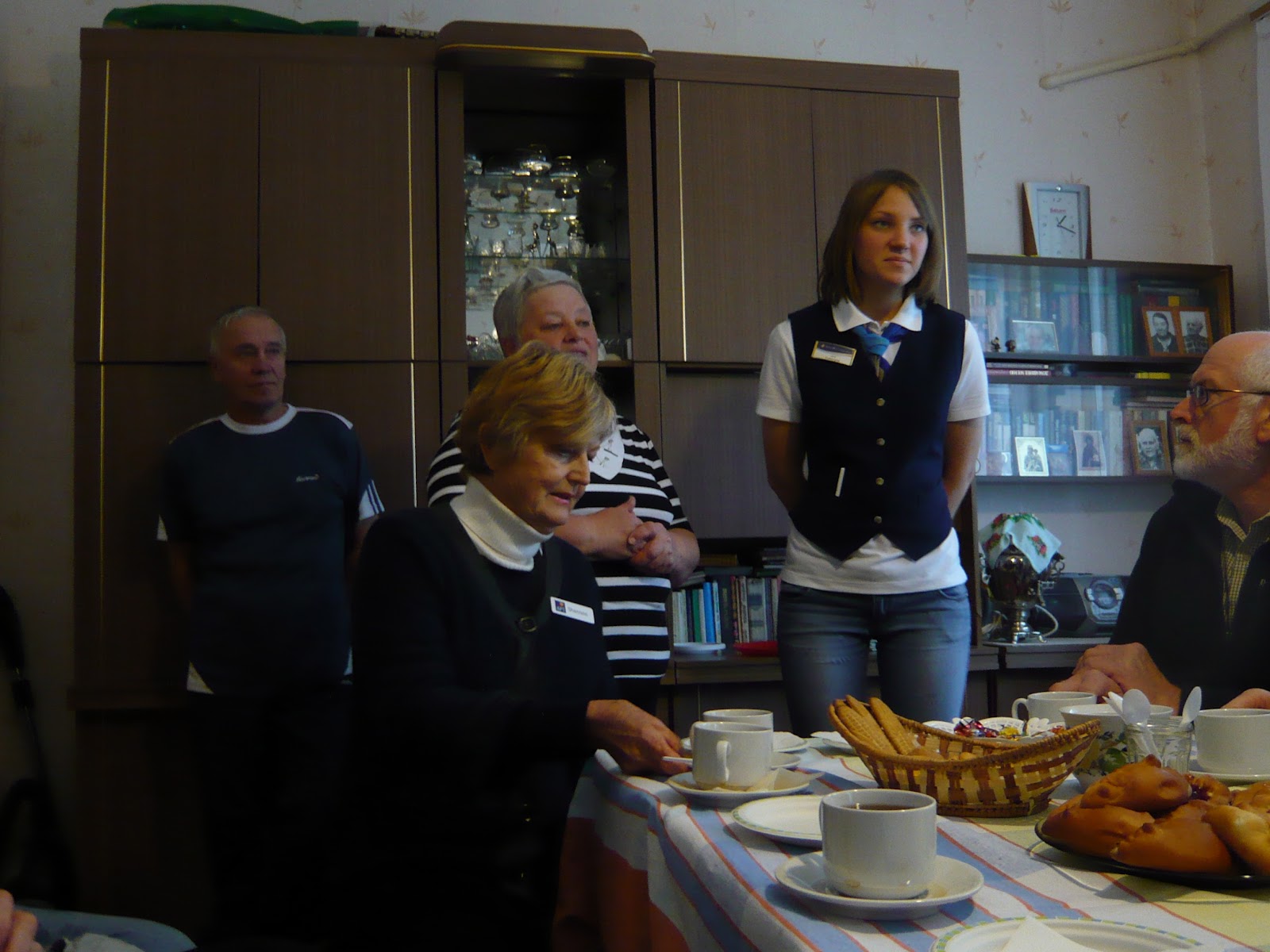
On the left we are visiting the house of a couple in Svirstroy - a retired midwife (in the stripy jersey) and her retired engineer husband. She told us about life in this small riverside town - growing vegetables, storing them in the basement below the kitchen, clearing snow, making pickles - and I've never seen anyone more serene and apparently content with what seemed a difficult and fairly arduous existence. The lovely girl in the  jeans was one of the onboard interpreters - they were an impressive lot, these language students, and utterly charming.

The girl in 19th century dress on the right was also charming, as Mr B found as a result of serious research - she was one of three guides who showed us round the Governor's House in Yaroslavl, in the personae of the Governor's daughters, and when it came to walzing in the first-floor salon, she asked him to dance with her. Turned out she was a language student on a holiday job, and they chatted away quite the thing while Mr B expired gently with the exertion of doing and old-fashioned walz in a pair of Brasher walking shoes, fleece-line Rohan trousers and a fleece pullover. While open-air Yaroslavl was chilly and windy, the Governor's House was, like every other interior we visited, boiling. All that centrally provided hot water ...

The little girl in the pic below was the person we thought of as "our" on board guide. Julia is Kalmyk, a Buddhist of Mongolian origin,  from one of the primarily Muslim states to the east of the Caspian Sea, and was fluent in
English and French as well as piano playing. She told us that

so many people wouldn't believe that she was Russian, because she didn't look like a Russian, and that she always told them "but I have a Russian soul". Perhaps a Russian soul is what makes the Russians we met such a serious group of people. All of them seemed devoid of flippancy, they seemed dedicated to doing their jobs well and to making us happy, and they seemed immensely well educated. The guide in the picture taken in the Moscow metro (below), holding a blue "lollipop) was the daughter of two doctors, and had a degree from the Moscow State University. Her parents, she said, had given up a great deal to send her there, and she had loved it.


Because the Russian language and the Cyrillic alphabet are so dauntingly unfamiliar, it is easy to succumb to the temptation to stick with other tourists, to avoid even attempting to interact with the people. But when we did get into conversations with our Russian contacts, the two of us loved their seriousness, their culture, their clear-sighted comments. It was from them that we learned that most Russian couples will have only one child; that they all live in flats in the cities; that no-one can get a worthwhile job unless they live in a city; that Russian society is still in a sort of 1950s timewarp.

And when we left, when we said "goodbye" to the people we had met, they all, without exception, said the same thing: "Do not forget Russia."

I don't think I ever will.


Monday, October 22, 2012

A Tale of Two Cities


 I suppose this church, St Basil's in Red Square, Moscow, is what I perhaps thought of seeing when I was in Russia. And indeed, when I emerged from the underpass that had taken us safely from the coach  park, I almost couldn't believe I was actually standing in front of such an iconic building. But what I want to explore in this post is the different way I felt about Moscow from my feelings in St Petersburg, where, if I'm honest, I'd already seen as dazzling an onion-domed church, as well as all the others seen on our long sail.

Primarily, I felt disbelief in Moscow. Disbelief that I was actually there, in the place that for all of my life had been synonymous with Soviet rule, used as a symbol for The Other Side in the Cold War, a backdrop for missiles, marching and fur-hatted rulers on Lenin's tomb (left). It seemed hardly credible that we could take photos unhindered, that the guide was talking about where "Our President" worked hard in his nearby office, that I was really in the heart of the Moscow Kremlin and could see the long street which forms the background for foreign news editors on the ten o'clock news on the BBC.

It became apparent to me in Moscow that this was where 'my' history lay, rather than in the more European splendours of St Petersburg. Look at the picture on the right: St Isaac's Cathedral in the heart of St Petersburg is one of the world's largest cathedrals (and is still a museum, as it was in Soviet times). It was designed by Auguste de Montferrand and opened in 1858, and it could be in Paris. The wide square in front of it is flanked by the Astoria hotel, and there are large foreign cars parked at the kerb. It felt like Europe. Peter the Great would have been pleased, but I realised that I was looking for a Russia defined last century.

Actually, Moscow doesn't really work very well right now. The picture on the left was taken from a bus, at teatime. The traffic was already heavy, but fortunately the Northern River Terminal was on the same side of the city centre, which is surrounded by three concentric roads linked by radiating highways like the spokes of a wheel. On our last day, we had to travel back across the city, from Sparrow Hills, and the drive, at snail's pace, took us 90 minutes. We watched as ambulances wormed their way past queuing cars, and noted which siren seemed more effective.  It was hard to imagine doing this daily, and we saw the power of the Metro. But the new Russia means that people want cars, and that desire is paralysing the city.

In contrast, St Petersburg seemed spacious and wide-skied. This could have been attributed to the weather, or to the fact that much of our travelling was done by river. We did see one or two examples of grim "Khruschev" architecture (building styles are designated by the era in which they were built), but far less than in Moscow. Perhaps we were visiting palaces more than housing schemes and universities; there seemed less of the ordinary in the places we saw, and the most mundane was probably the area where we were docked during our stay there.

In Moscow, we caught a glimpse of the Presidential motorcade as it swept over the cobbles of the Kremlin. We travelled on the Metro (train every minute) and made an unscheduled stop in a cafe because of the rain. We visited a beautiful lake by a convent and thought of Tchaikovsky, and we saw the Israeli ambassador laying a wreath at the eternal flame round the corner from Red Square (Rachmaninov this time, and much goose-stepping). We bought chocolate in GUM and saw a rainbow over the city from the amazing Victory Park. We saw a Lenin lookalike street performer in Red Square, and didn't buy a Marshal Zhukov cap from a street stall. I had loved my time in St Petersburg, but in Moscow I felt I had arrived in a bit of history I knew. The final photo shows the decrepit Northern River Terminal building - fenced off, riddled with concrete cancer, but still illuminated every night. It was directly opposite our balcony. It had a revolving red star on the top of it. It was Russia.

Friday, October 19, 2012

Falling for Mother Russia


 The holiday I've just taken in Russia began and ended in cities. We joined a river cruise in St Petersburg, spent three sunny days there, and six days later we arrived in Moscow. And these were wonderful places, and deserve a blog post to themselves. But when I think of this journey - because it felt more journey than holiday - it is a scene such as the one above that plays on the screen in my head. This was the very first place we stopped at after sailing all night from St Petersburg up the Neva river for 150 miles: Svirstroy. Every cruise that goes along these waterways stops here, it seems, but apart from a small enclosure of wooden stalls selling crafts and traditional goods, the village - population c.1,000 - seems utterly isolated. It began to rain as we went ashore, and the golden leaves lay everywhere on the muddy roads. The people selling their goods were quiet and it made me embarrassed to be a tourist - the very fact of our being there meant we were rich. But we passed so many of these small settlements of wooden houses, with their hens (firmly fenced in because of wolves in the forest) and their vegetable gardens, the produce from which was being stored in cellars before the winter, that they seem to have become "Russia" in my mind.

Of course, there were special sites to visit. Kizhi Island, on the vast Onega Lake, is a World Heritage Site in Russian Karelia of wooden churches, chapels and houses rebuilt there to preserve them. The church in the photo - the 22-dome Church of the Transfiguation - dates from 1714, and you can read more about it here. We walked along gravel paths in wonderfully clear air, the sound of bells - deep from the church, tinkling and musical from a distant chapel - constantly in our ears. I wanted to stay.
We visited more churches than I've ever seen on a holiday. I learned that the word that has become synonymous with Soviet rule - Kremlin - is in fact the term used for the central fortified area in any town, often centred on a monastic foundation. So in a little town called Uglich, I was amused to hear our guide say nonchalantly that the Kremlin walls, being wooden, had disintegrated and the local authorities had decided not to rebuild them. There were a few monks living in the monastery in the upper pic, at Kirilov, but most of the buildings are now museums of various kinds, fascinating in other ways. And yet the people - or the state - are rebuilding churches from scratch - the cathedral in Yaroslavl, on the left, is new - they are still finishing the decorative tiling on the exterior. It was extraordinary to see this.


 Kirilov was some distance from the port we landed at - Goritsi, on the Volga-Baltic waterway south of Lake Onega. It was becoming colder, and the sky was grey, the sun was grey - even the trees had fewer leaves. The picture on the right is  shot from our coach back to the boat - I wanted to show the kind of houses in the village, with their tin roofs and vegetable plots. There was little sign of life there - it seemed that all the locals had gone to the port to sell hats and linen shirts to the visitors. A dog tried to follow us onto the ship.
By the time we reached Uglich (left) we knew this carefree time of slipping through the countryside was nearing an end. The demands of the city and the long days of sightseeing would be upon us again. No more vodka-tasting (4 glasses of different vodkas in an hour), doll-painting or Russian lessons; no more swooping ashore for a few hours to dance walzes in the Governor's House in Yaroslavl, whereMr B was favoured with a dance with a beautiful Russian girl in 19th century dress and nearly died of heat in his winter togs. Soon we would be negotiating terrifying road-crossings, epic traffic jams and unfamiliar street-signs again, and then we would have to pass the nerve-racking scrutiny of the border guards at the airport and hope that our visa was still valid. We were cruise virgins in a vast land in a ship full - or as near as dammit - of Australian tourists, but guided by a dashing Russian captain with a saturnine smile. I loved it. There are hundreds more photos going up on my Flickr stream that may do more justice than these words.

When we said goodbye to people who had looked after us - the lecturer on Russian history, the lovely deputy cruise director - they said "Do not forget our country". We had been given the bread and salt on our arrival on board, and when we came ashore at Uglich. Perhaps that helped to cement us to the land. Whatever happened, there is a part of me still gliding through the dark water, with the golden woods of Mother Russia slipping past on either side.


*I've been defeated, in the end, in my attempt to lay this post out pleasingly. Too many photos, I reckon.