Showing posts with label Remembrance. Show all posts

Thursday, November 13, 2014

November - a poem for the season of remembrance

NOVEMBER

The month of remembering -
the lines of men in the stubble fields
the hideous scramble over a muddy
parapet, the cringing death in the
eye’s blink - this month recalls
wars past and wars still trailing
death and mutilation in their wake.
But not just that.
This month of remembering 
lines up before our wavering prayers
the souls of Saints, the souls
of our beloved dead, guttering
like candles in the fitful 
illumination of our faith.
The tears come, yes - 
but do we weep for them, or do we
shrink at the sudden blinding glimpse
of our too frail mortality?
We who live trudge on to where
our companion dead are waiting
among the red flowers at the years’ end
in that land to which we go.


©C.M.M. 11/14

This owes its conclusion to a fraction of an idea from R.S.Thomas, whose words tend to haunt my subconscious and of whom I will always be in awe.

Saturday, November 12, 2011

Remembering stories

This was where my parents had reached that evening...
I've been reading Rev Ruth's remembrance memories (if that's not tautologous) and found some of the memories that were part of my childhood flooding back. I was born just after the last World War ended, as anyone who's followed my father's Wartime Letters will know, so the memories are not my own, but they were among the first stories I ever heard. Stories, for example, of a time when, because they'd heard the All Clear and it was a beautiful evening, my parents went for a walk up Novar Drive in Glasgow. Just as they reached the top of the hill, the sirens sounded again and shrapnel began falling all around them. They clutched their tin hats to their heads and ran, apparently, laughing at the horror of it, back to their flat. This was a top flat in a red sandstone tenement, and their custom was to sit out the raids in the lobby press which protected them from flying glass (it was windowless) but precious little else. My mother calmed her nerves by doing the crosswords in old copies of the Glasgow Herald which were stashed in the cupboard, and her stomach with Rennies.

The rest of the inhabitants of 66 Novar Drive apparently congregated in the same cupboard of the bottom flat, four floors beneath them. History does not relate how they reacted my my father's assurance that they were all doomed there because if the building collapsed my mother's piano - now mine - would land on their heads and crush them all. (There is a full account of the worst action to hit Hyndland here.)

Tales like this, and that of the woman found carting her front windows out in two buckets and telling them that she now had a diamond-studded piano, made it all sound somehow exciting to a small child, but even then I could sense the horror of my mother's lone vigil in that same house after my father had gone overseas with the RAF, to live in a tiny tent in the Western Desert. Her own parents lived only 10 minutes' walk away, and she often stayed with them, but every now and again had to return home to look after it and ensure that it wasn't requisitioned for rehousing in her absence.

When the war was still a recent memory and the gap sites from demolished buildings still somewhere to play and the underground air-raid shelters even better, I used to wonder how anyone coped with being normal while it went on. I still wonder - just as I wonder how the families of serving soldiers do today. I think they were made of stern stuff, my parents - and I can't help thinking their life together after it was all over must have been an unthinkable joy for them.

And that's worth remembering too.

Monday, November 09, 2009

Slip of the tongue?

A wonderful, poignant moment at this morning's Remembrance Sunday service. One of our few old servicemen went out to stand at the altar during the two minutes' silence, waiting to take the wreath out to the churchyard where there is a war grave, of a serviceman who died in 1918. After the silence he spoke the usual words - only this year we all heard him say: "They shall not grow cold as we who are left grow cold".

Dead right too. The heating hadn't gone on in time to make much difference, and someone had left the door to the tower open so that any heat was vanishing as quickly as it was created. The miracle was that no-one so much as sniggered. Guess we were all so cold we didn't really think about it till afterwards.

Monday, November 10, 2008

Difficult remembering

Remembrance Sunday has been a difficult day for as long as I can remember. From the day my three-year-old self wondered why my normally cheerful mother would become tearful because of whatever-it-was on the radio, right through to the years when I was stuck in the choir in church resenting the inclusion of the national anthem in the day's hymns, struggling to reconcile the religious faith which had landed me in CND, demonstrating, making speeches and appearing on TV and radio to deplore the deployment of nuclear weapons with the church which at that time seemed to deplore what I was doing... it's not been a day with which I felt safe.

And then I end up in my current role as a member of our lay worship team having to preach a Remembrance Sunday sermon. It was the most difficult of all I've done, mainly because I couldn't actually imagine myself doing it. I didn't know where to start. I think I had visions of people who knew my past standing up and hurling things - no matter what I said.

It didn't happen. I realised as I worked on the sermon that we all move on, and that compassion had replaced anger as the overwhelming emotion of the day. But I wonder if I'd ever have realised that if I hadn't had to stand up in public and address the issue.

Monday, November 13, 2006

Not forgetting


After the weekend of remembrance, both public spectacle and the much smaller scale of a tiny church observing the silence at the morning Eucharist, I read - belatedly: Sunday is always too busy for much dissecting of the papers - that Jon Snow, the newsreader, refused to wear a poppy to read the news. He referred to "poppy fascism". And I read about this in Muriel Gray's column, and discovered that she was as critical of his words and his action as she also seemed critical of the wearing of a white poppy.

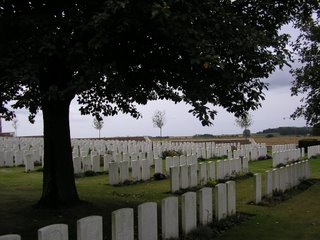
Now, I'm as fascinated by the horrors of WW1 as anyone, and took the photo above on a visit to the battlefields of The Somme, when four of us walked in silence among the many graves and stood on the crackling white stubble of the fields where men had died. I felt my heart stop at the sight of a row of figures advancing over the fields with guns sloped at the ready - the shooting season had begun, but it was a strange wrinkle in time - and looked at the photos in a museum nearby of young men made old by horror. I stood in silence in church and felt moved at the sight of our old soldier carrying the poppy wreath out to the graveyard.

But I did not wear a poppy, and it's a long time since I did. Although now we no longer have to stand and sing "God save the Queen" in our church, there was a time when we did, and as a member of the choir I was expected to lead in this. I came in for a lot of flak when I wouldn't sing - I stood, but in silence - because I didn't think the eucharist a proper place for such nationalism. I felt, in fact, that my "remembrance" was being forced on me by people with a different agenda from my own. These same people pilloried my membership of CND and labelled me a communist for my activities at the Holy Loch - then a US naval base. I used to feel angry on Remembrance Sunday, and longed for a diplomatic illness to get me off the hook.

Now we seem to have moved on - all of us. The church seems to talk with a different voice, and a bishop washes the feet of peace marchers in Edinburgh. I thought in the silence of the young men and women dead in the muddle of our foreign adventures, and of the photo in The Guardian last Thursday of the children killed by Israeli shelling in Gaza. We heard a meditative sermon on the "stories" we tell of our experience - the way a country makes sense of its recent history, in a way - and wondered how this decade's "story" will end. The armies nowadays are professional soldiers, not frightened conscripts - but the children and women who die are conscripted merely by an accident of geography. How do we make their "story" anything but tragic?

Muriel Gray talked about people's "moral posturing". I daresay I'm one of the people she despises - religious, non-poppy-wearing switherer that I am. But I will not be conscripted into going along with everyone else just because it shows solidarity, for if I did I think I'd be pharisaical.

Freedom, after all, is what it's about. Isn't it?