"Blether - n. foolish chatter. - v.intr. chatter foolishly [ME blather, f. ON blathra talk nonsense f. blathr nonsense]" - Concise Oxford Dictionary.
Showing posts with label General Synod. Show all posts
Tuesday, June 16, 2015
There, then, you have it. Synod recollected in tranquillity.
We used to have an English teacher, a formal, pin-suited, begowned sort of chap, who was in the habit of saying "There, then, you have it" at the conclusion of any discussion. It's the phrase that comes into my head as I sit down to recall the events of last week's General Synod of the Scottish Episcopal Church, perhaps because in all likelihood it will be my last. If it is, I'm glad I made it so far; glad I was able to make a contribution to the effort to move my church forward in its recognition of the diversity and sanctity of human relationships. Others - notably Kelvin and Beth - have been much quicker off the mark, blogging in the evening what had happened during each day; I blame the fact that I only had my phone with me to excuse my failure to do more than tweet at the time.
It began, really, with the motion showing on the screen in the photo. There were other motions that seemed more promising, but this was the starting point. We'd all (I hope) read the Doctrine Committee's lengthy report, and receiving it was a start. The thing was that every time - were there three times in all? - the issue came up, people debated. Some contributed considerable points; others expressed bitterness. There were clearly people who felt that their traditional stance was no longer being given a chance - and believe me, it was traditional. I worry when someone says with calm certainty that they know what God wants. But there were also contributions on the side of change delivered in the measured tones of compassion and reason - words spoken by people I have grown to respect and admire - and I could feel a change in the atmosphere as we moved towards the vote that would result in Synod's deciding to ask the Doctrine Committee to remove the first section of Canon 31. ( The Doctrine of this Church is that Marriage is a physical, spiritual, and mystical union of one man and one woman, created by their mutual consent of heart, mind, and will thereto, and is a holy and lifelong estate instituted of God.) Apparently - and I hadn't realised it - this section dates only from 1980 or thereabouts, and was inserted by the last Provincial Synod, of which I was possibly the youngest member, after the debate on the remarriage in church of divorced persons. I well recall that debate; it seemed such a big thing at the time.
You can read more details in other places. Don't come to me for details. I'm inside my memories now, and they're not especially precise. At the end of the first day's debate, I spoke on the nature of marriage in relation to the idea of man and wife being one flesh. That makes it sound measured, considered - "I spoke". But it wasn't like that. I was prompted to my feet when someone said something that I couldn't let pass, and then sat there waiting my turn with nothing in my head but scraps of Shakespeare - Hamlet saying "Husband and wife are one flesh; therefore my mother ...". I didn't know how I would begin, even, until I stood up. And then it came, and I said my piece fluently and I enjoyed saying it (I love a microphone) and people clapped. The following day I was bowled over by the words of another woman of my own generation - and people clapped. A bishop made it clear that sexual ambiguity is in all of us, and did so by recounting his own experience, and the silence as we listened was one in which I felt that something hugely hopeful had come into our midst.
But when later that day the votes were counted, there was no applause. No-one punched the air, and the sense was one of relief rather than triumph. It was as if none of us dared to believe that after all these years the church had taken the first hesitant step towards recognising that the God we believe in made us all the way we are. I was aware of tension lifted; there were tears from those that in the end we had been discussing all those years. There was a knot of people sitting together who had voted against the motion and against the idea. Their faces were tight, expressionless. It will be hard for them, though not, in my opinion, as hard as it has been all those years for the excluded and the patronised, those who, like all of us, have no choice in the matter of their sexuality.
One thing seemed to lurk like a cloud on a sunny day, and that was the defeat of the Rule 10 motion on Saturday. In a house depleted of those who didn't attend on the last morning, a majority wanted to discuss the possibility that the bishops would look again at their decree that no-one in an equal marriage could be considered for ordination.* But it was not the required 2/3 majority, so we didn't even get to discuss why they might decide to let it stand. I know that at least one bishop voted for the motion, but the Primus did not. Oh yes, there's a kind of logic to this apparent failure of logic: the change to Canon 31 will take over 2 years to become law, and has to pass through two readings and debate at diocesan level before it can do so - therefore let's not pre-empt the outcome by even thinking about changing our minds on this one. No hope held out, then, to someone in a same-sex marriage who might long to put herself forward for consideration and training; they will have to wait even longer.
It must be tough being the chairman of the board, the Primus inter Pares (first among equals) who has to front the decisions and - presumably - carry the can for whatever goes wrong. The Primus presumably doesn't want further to dislocate the noses of those who are sure we're all heading to hell in a handcart. But at least one of his equals felt we should be discussing further thought, and I thank God for him and for all the brave souls who have spoken selflessly and thoughtfully for change. It is they who inspire confidence in our church and its future.
Despite that last-minute barrier to change, it is once more a church to which I feel able to belong with joy.
*As has been pointed out elsewhere, you can apparently be considered for ordination if you are in a civil partnership, or merely quietly getting on with whatever arrangements you like to make for yourself. It's marriage that's the bar.
Tuesday, June 17, 2014
Time to think ... about Synod
| P's & G's, complete with MDF gallery? |
Having been one of the signatories to a Rule 10 motion that would have hastened us along the path to legislating for same-sex marriage in church, I was pretty fed up when the motion failed to attract the two-thirds majority that would have allowed us to deal with the subject in open debate. Synod wanted the debate - but not quite enough of us wanted it. I have a strong suspicion that the secret ballot, as we tautologously referred to it, along with the confusion resulting from a bishop-led objection to a show of hands, led to several inattentive or merely poor souls voting the wrong way - in other words, not as they actually thought they were voting.
This raises another scunner (no, auto-correct, not scanner: I'm Scottish.) The venue for this year, the once-grand and now modernised cavern of P's & G's, didn't make for the same contact with the chair as we had in the more regimented but better-lit surroundings of Palmerston Place. Punters in the middle or rear of the space couldn't communicate confusion or unreadiness without a great deal of palaver involving roving mikes and the bearers of the mikes peering into the throng to try to find the confused/challenged/challenging one. This being the case, it was more than ever important for the various chairs to speak with clarity and decision, and certainly not to rely on the overhead screens to make up for the deficiencies in their own communication skills. (People don't always cast their eyes screenwards in moments of stress, especially when they're rummaging through their Synod papers and have their reading glasses on anyway.) And, as every teacher knows, you can't simply assume that everyone is paying attention the moment you open your mouth; the table-group layout makes (again, as every teacher knows) for covert communication or simple distraction.
But the single thing that got to me this year was the sudden descent of a whole bunch of protagonists into fuzzy, warm and ultimately vapid religious jargon. And tone. There. That's it. There's a whole raft of expressions that belong in this jargon, and some others that are pressed into service and will never be quite the same again (like Francis of Assisi after Margaret Thatcher had appropriated his words). "Unpack" comes to mind, and they're not talking about the messages (shopping, if you're not from these parts). No-one called a spade a spade, let alone a bloody shovel, and there was no place for what one commentator has described as "honest fury". Those who were feeling such fury had nowhere to go, because it would have been smothered in soft fuzziness, smiled at and forgiven.
Now, I was personally grateful for individual kindness and concern in the aftermath, even as I still raged for friends old and new whose hurt and frustration were all too apparent - but I have huge problems for this kind of institutionalised, forced gentleness. For a start, I think it betrays the god I believe in. I think it castrates the prophet and makes a virtue of passivity. And where was the passion, the leadership that would have given some sense of a vibrant community realising its past and grasping the opportunity to move into a new, juster present?
I can't at the moment think if I'm actually at the end of my time on Synod, or if I have another year to go. Maybe someone reading this will be able to tell me. The Primus gave us a sliver of hope that things may move in 2015, but who knows whereI'll be then? A friend gave me even more hope in that his perceptions have changed post-Synod, and that is joyous news. That's the news that makes me glad I waited to post this, as there would have been nothing to redeem the situation had I leapt in. But if anyone is planning any more soft play areas for the church, any more padded "conversations", I'll be returning to a quip that was going the rounds on Facebook recently:
If anyone asks you "What would Jesus do?", remember that overturning tables is always an option.
Tuesday, February 25, 2014
How long, O Lord ...?
I've been putting off writing for myself about church and state and same-sex marriage. I've exploded, once, on the Primus' blog; now I think it's time to work out what is, a couple of weeks on, still explosive. And my main feeling, reading and listening, picking up rumours about the SEC process with the issue and so on, is that I'm ashamed. I haven't walked out of the church - not yet, anyway - but I'm not happy about claiming kinship with people who can write, carefully and thoughtfully, something like this:
I wasn't brought up an Episcopalian. People who know me well know that my upbringing didn't really encourage anything so rash as faith, so that my confirmation at the age of 28 was actually an act of rebellion (sad, isn't it?). At that time, the Grey Book version of the Scottish Liturgy was in its infancy and a phone call from George our then bishop told me, as the youngest member of the old Provincial Synod, not to vote for women priests. (At that same Synod, our then rector bemoaned the time spent discussing this as "unimportant".) It's as well to remember these things, and to remember that there are still people in the church who prefer to pray in Jacobean English and accept that "Father knows best" at every turn.
Why is it as well to remember? Think about it. It seems like another life to me. The young woman who stood up at Synod and demanded clarification over deaconesses who were women and deacons who held a post to which women could never aspire - that was me. At that same time the mother of someone who became a bishop in the SEC told me that it was women like me who should be going for ordination, and I was amazed. But in global terms, it's not so long ago, is it? To be precise, it's half a lifetime. And now things have changed where before they seemed immutable.
I have been going to the current General Synod for too long, as an alternate and then as an elected representative, and it's time I quit. But I long for someone to stand up and say this. Two years is nothing if there is hope at the end of it. Two years is nothing if people look seriously at a canon about a word - "marriage": stay with me - and realise that it is only a word and that it's not the word of God but a human word about a human institution that has existed since a time when people were ignorant of genetic differences.
The Primus says that we expect our clergy and our members to acknowledge and respect this historic position. No. I respect that it is history. Four hundred years ago the Church excommunicated Galileo. That's history too. We progress. We know now that people don't choose their sexuality - and a moment's thought would show the lunacy of supposing that any Christian would choose to adopt a lifestyle that would bring them so much pain and exclusion. Bit like choosing to be a woman, until recently ...
So are we going to be hung up on a historical fallacy while loving couples wait to have their union celebrated in the church they still - and God must wonder why - adhere to? Because the faith I still cling to encourages me to have hope, I still cherish a shred of optimism that someone in a position of authority will have the courage to lead the SEC back to where it was some years ago - and on, into a place where society will have less justification in consigning us to the scrap-heap of irrelevance.
And then, perhaps, I will feel less ashamed of the church that brought me, all these years ago, to God.
But it produces an interesting situation for churches and faith groups who, like the Scottish Episcopal Church, have a historic position expressed in our Canons – or church law – that marriage is between one man and one woman for life. That is our position. We expect our clergy and our members to acknowledge and respect it – even if in some cases they do not agree with it and aspire to change it. To change it would need a significant process over two years in our General Synod and would require two thirds majorities.
I wasn't brought up an Episcopalian. People who know me well know that my upbringing didn't really encourage anything so rash as faith, so that my confirmation at the age of 28 was actually an act of rebellion (sad, isn't it?). At that time, the Grey Book version of the Scottish Liturgy was in its infancy and a phone call from George our then bishop told me, as the youngest member of the old Provincial Synod, not to vote for women priests. (At that same Synod, our then rector bemoaned the time spent discussing this as "unimportant".) It's as well to remember these things, and to remember that there are still people in the church who prefer to pray in Jacobean English and accept that "Father knows best" at every turn.
Why is it as well to remember? Think about it. It seems like another life to me. The young woman who stood up at Synod and demanded clarification over deaconesses who were women and deacons who held a post to which women could never aspire - that was me. At that same time the mother of someone who became a bishop in the SEC told me that it was women like me who should be going for ordination, and I was amazed. But in global terms, it's not so long ago, is it? To be precise, it's half a lifetime. And now things have changed where before they seemed immutable.
I have been going to the current General Synod for too long, as an alternate and then as an elected representative, and it's time I quit. But I long for someone to stand up and say this. Two years is nothing if there is hope at the end of it. Two years is nothing if people look seriously at a canon about a word - "marriage": stay with me - and realise that it is only a word and that it's not the word of God but a human word about a human institution that has existed since a time when people were ignorant of genetic differences.
The Primus says that we expect our clergy and our members to acknowledge and respect this historic position. No. I respect that it is history. Four hundred years ago the Church excommunicated Galileo. That's history too. We progress. We know now that people don't choose their sexuality - and a moment's thought would show the lunacy of supposing that any Christian would choose to adopt a lifestyle that would bring them so much pain and exclusion. Bit like choosing to be a woman, until recently ...
So are we going to be hung up on a historical fallacy while loving couples wait to have their union celebrated in the church they still - and God must wonder why - adhere to? Because the faith I still cling to encourages me to have hope, I still cherish a shred of optimism that someone in a position of authority will have the courage to lead the SEC back to where it was some years ago - and on, into a place where society will have less justification in consigning us to the scrap-heap of irrelevance.
And then, perhaps, I will feel less ashamed of the church that brought me, all these years ago, to God.
Monday, June 11, 2012
Proud - and twittering
Another Synod gone, and only one photo on my camera of the proceedings (it is surely appropriate that I use one of Fr. Kelvin addressing Synod) - the rest were all of socialising and food. I had more to do this Synod than in previous years, which was interesting and rewarding, and we sang the Sanctus from Mr B's Kilbride Mass at the Eucharist, which people joined in with gusto and seemed to enjoy, but the main event was, I suppose, the one that attracted most attention - the vote on the Anglican Covenant. We seem to have spent forever kicking it around without actually shooting for goal, so it was good to get the the point of voting on whether or not the Scottish Episcopal Church was going to take it further or reject it.
The debate was civilised and serious - no ranting, no raised voices, but thoughtful points well made. One speaker summed up the Covenant wonderfully when he likened it to a blancmange with shards of glass in it - work that one out. Someone at some point had referred to a French proverb: fier comme un Ecossais. and for me the real surge of pride in my church came at the moment when the votes against adoption were called for. There was a sudden rustle as a sea of voting slips - pink, yellow, purple - rose into the air; people held them high, like so many eager pupils wanting to be seen, rather than the more usual nonchalant pose. The Covenant was firmly rejected, and it felt good then to go on and affirm our desire to remain as part of the Anglican Communion. (You can read a much more knowledgeable account of the proceedings here, where you'll also learn of other good things that took us out of any tendency to navel-gaze; I'll stick with my own take).
We've come a long way since the 2006 Synod where I moaned about being patronised for blogging, but some things haven't changed. This year it was Twitter. Again. Someone stood to make the point that he'd been brought up to listen attentively to speakers, and that it surely wasn't right that people should sit distracted by tweeting, passing comments online and so on. No, this person wasn't a nonagenarian; he was still just the right side of forty, making me one of the generation that, apparently, had made him thus. And I learned today that the aforesaid Kelvin was at an event where he had been invited to contribute to a discussion on social media - but where all phones and computers were to be turned off. So it's obviously still an issue in too many circles for me not to have another wee rant.
These people who want to stifle digital discussion are, it seems to me, living in what I have just heard deliciously described on the radio as an imagined analogue past - a past where, as the speaker said, everyone read their newspapers from cover to cover and was wonderfully and diversely informed. I'd say this imagined past was also one in which people hung on every word of every speaker at events like Synod, be they never so tedious, and never doodled on their Synod papers; where no-one passed a note to his neighbour or - more disruptively - whispered to her pal. My first reaction to hearing this complaint the other day was to tweet about it - for one of the wonderful things about social media is that we no longer have to seethe internally when confronted with patent nonsense.
I would contend that if someone speaks interestingly, arrestingly, movingly, that person will be heard with as much attentiveness as anyone could wish for. If they say something memorable, it may well be tweeted and retweeted - a way of sharing a special moment. Most of us turn to less respectful use of social media when we are bored. Stick up a boring speaker and people will either drift off into sleep or check on their email or share a ribald thought online - and that's fine, you know, because as far as I'm concerned the biggest sin in a speaker is to be a bore. I've called in the past for a live back-channel; this year we had a time-delayed one showing what was being said on Twitter after the session had ended, so we're moving forward.
We're moving forward all right. No-one presented a paper which they then proceeded to read aloud to Synod - they reminded us of what page it could be found on and assumed we'd had the sense to read it. We were moved, entertained, and - largely - involved. But God preserve the church - and me - from the people who want to keep us in the imagined analogue past. Apparently Plato said that using writing would mean that our memories would suffer. We seem to have got past that without going entirely to the dogs, yes? I shall take heart from the knowledge that the perpetrator of the patronising remarks that so irritated me in 2006 is now an amiable blogger. Here's to the next Synod...
Friday, June 17, 2011
Twittering respectably
I've been catching up on some old friends' blogs - you can thank the weather for that, chaps! - and came across this post from Neil Winton just as I was pondering again (or anew, as the hymn hath it) the business of officialdom and social media. When I left the classroom - god, it's been six years - I could still look at flickr and some blogs on the school system, though Richard Holloway's work was largely taboo because, it seemed, he'd used naughty words. So NetGear said anyway. Now, apparently, it is hard in schools to access any of the sites I've grown accustomed to using daily. Everyone and their grannies now know what Twitter is, but heaven forfend that our young should be able to use it.
Stupid logic, of course. I've been using Twitter since, November 2006. An earlyish adopter, then. I've been blogging for a year or so longer. And I've been evangelical about the power of social media for most of the intervening years. But now I'm no longer involved in schools and education at large; my forum tends to be in church circles. So I've stood up at Synods both General and Diocesan and begged for blogs to be used to communicate and for Bishops to use Twitter. And back then - some 4/5 years ago - I was scoffed at, either gently or violently. But gradually we saw bloggers doing their slightly risky thing on the sidelines of Synod, and then Twitter took over as comments were tweeted and shared live. Bishops blogged and had Facebook accounts. There were lunchtime meetings to help the uninitiated get over their fears (I'm talking General Synod here - all two and a half days of it) and, finally, official guidelines in the Synod papers for kind and responsible Tweeting. Social media had, on the face of it, arrived.
But we need to be careful here. There are still many, many people who have "no time" for Twitter and "all that stuff" - and that "no time" can be factual or pejorative in intent. And all too often they are the people who run organisations - because suddenly they see the huge potential for ... what? Anarchy? Revolution? Criticism?
Yes. Of course. All of these things. That's why repressive regimes block Facebook. I'm reminded, probably because of the context in which I now operate, of how the Bible used to be forbidden fruit to the common people, and then to women - much safer to keep it in Latin and in the hands of the priests, much more seemly for women to take their men's word for what was in this dangerous book. But hey - we all read the Bible now, if we feel so inclined, and we sometimes find new and exciting things in it, in our unschooled, lay fashion. And the job of the professionals is to help all of us to read sensibly, not to make basic errors in comprehension, to put it in a historical context and so on. The church as it is today, shrinking as it may be, seems to me a healthier and more alive organism for the active participation of its members.
And what, do you ask, has this to do with Twitter? Well, Twitter and other social media exist. People have become accustomed to using them to broadcast their status. Not all people are sensible, and some users of social media are downright silly - they're just people. But you can't stop them making fools of themselves, in public or not. You can assume that people at a gathering like Synod will, for the most part, have a modicum of intelligence and a large helping of goodwill - they wouldn't be there otherwise. I've already remarked on the lack of much tweeting during the last Synod - because someone, apparently, thought fit to warn them off at one point. I missed that bit, so I don't know how it was done. But for next year, I'd like to see a Twitter live backchat channel on the screens, so that everyone in the hall can see what's being said as it's said - and the people up front can have the chance to react to it.
Going back to the trigger for this post - the drive to have social media become normal in schools - I'm pushed into wondering if official blessing is in fact the one way to kill something off. I think our young might well tell us it is ...
Stupid logic, of course. I've been using Twitter since, November 2006. An earlyish adopter, then. I've been blogging for a year or so longer. And I've been evangelical about the power of social media for most of the intervening years. But now I'm no longer involved in schools and education at large; my forum tends to be in church circles. So I've stood up at Synods both General and Diocesan and begged for blogs to be used to communicate and for Bishops to use Twitter. And back then - some 4/5 years ago - I was scoffed at, either gently or violently. But gradually we saw bloggers doing their slightly risky thing on the sidelines of Synod, and then Twitter took over as comments were tweeted and shared live. Bishops blogged and had Facebook accounts. There were lunchtime meetings to help the uninitiated get over their fears (I'm talking General Synod here - all two and a half days of it) and, finally, official guidelines in the Synod papers for kind and responsible Tweeting. Social media had, on the face of it, arrived.
But we need to be careful here. There are still many, many people who have "no time" for Twitter and "all that stuff" - and that "no time" can be factual or pejorative in intent. And all too often they are the people who run organisations - because suddenly they see the huge potential for ... what? Anarchy? Revolution? Criticism?
Yes. Of course. All of these things. That's why repressive regimes block Facebook. I'm reminded, probably because of the context in which I now operate, of how the Bible used to be forbidden fruit to the common people, and then to women - much safer to keep it in Latin and in the hands of the priests, much more seemly for women to take their men's word for what was in this dangerous book. But hey - we all read the Bible now, if we feel so inclined, and we sometimes find new and exciting things in it, in our unschooled, lay fashion. And the job of the professionals is to help all of us to read sensibly, not to make basic errors in comprehension, to put it in a historical context and so on. The church as it is today, shrinking as it may be, seems to me a healthier and more alive organism for the active participation of its members.
And what, do you ask, has this to do with Twitter? Well, Twitter and other social media exist. People have become accustomed to using them to broadcast their status. Not all people are sensible, and some users of social media are downright silly - they're just people. But you can't stop them making fools of themselves, in public or not. You can assume that people at a gathering like Synod will, for the most part, have a modicum of intelligence and a large helping of goodwill - they wouldn't be there otherwise. I've already remarked on the lack of much tweeting during the last Synod - because someone, apparently, thought fit to warn them off at one point. I missed that bit, so I don't know how it was done. But for next year, I'd like to see a Twitter live backchat channel on the screens, so that everyone in the hall can see what's being said as it's said - and the people up front can have the chance to react to it.
Going back to the trigger for this post - the drive to have social media become normal in schools - I'm pushed into wondering if official blessing is in fact the one way to kill something off. I think our young might well tell us it is ...
Tuesday, June 14, 2011
Fiddling at Synod?
Oh dear. I've been remiss in my blogging - but I've been away. Not more continental junketings, alas, but at the General Synod of the Scottish Episcopal Church. I seem to have participated rather often in this gathering over the years, but realise it's because I was a diocesan alternate before I was chosen as a representative ... but I maunder. Don't expect an official or exhaustive take on proceedings, however - you can find that here - my impressions are very patchy this year.
This is largely because I missed quite a chunk of things, including the task of facilitating discussion - I'd been looking forward to that - because I was no weel. Quite apart from my scheduled trip to Glasgow to have a small bit of me removed, I suffered horribly from our diocesan dinner and missed a whole morning on Mission; by the time I returned I realised I felt the way I used to after an absence from school: you caught measles or somesuch and when you went back you found out that everyone else had learned to do long division and you were totally lost.
And it's hard to get back into things in those circumstances. I was led to ponder how vital it is that individual speakers engage with their audience - it is so easy to switch off and let the mind wander as some voice drones on about ... but if I'm specific I shall pinpoint the offenders, and it is not my intention to wound. Rather I would beg that speakers are instructed in the art of eye contact, tonal variation and register - indeed, in the whole art of public speaking that they would have learned in Standard Grade had they been in my classroom. Maybe there's a job there for a certain bishop on the verge of retirement: having muttered resentfully about the boredom of one address, and having been rebuked by a more charitable neighbour on the grounds that this was after all the graveyard slot, I found myself once more engaged - and amused - by said bishop in his follow-up comments. Graveyard? I reckon he could make the dead laugh ...
Just to show that I'm not all girns and detachment, I should add here how much I enjoyed the break from traditional tedium offered by the indaba process. I was in a feisty group which in the end had to agree to disagree, but it was such a relief to be able to test responses on others rather than one's unfortunate neighbour or the twitterverse at large - though I had the feeling, confirmed later, that the twitterers had been somewhat discouraged while I was away being poorly. Someone had got it into their head that to tweet meant to be insensitive and crass and that it had therefore to be spelled out when tweeting would be inappropriate. I fear that is what happens when a spontaneous activity becomes respectable ... and I'm glad I didn't know about it, for that would have made me much, much worse.
But you'll be glad to know that my old friend the complacent male was at Synod. This was a cunningly camouflaged wee dinosaur, but his message was the same: it's a waste of time - in fact, it's navel-gazing - to fret about gender imbalance in church matters. He said it so quietly, slipping it in after one of the more mind-numbing exegeses, that we were onto the next item before I'd clocked it and got my hackles working - I told you I'd been no weel - and I was left frustrated. I shoulda said something. But then it was pointed out to me that his comment had been met by a wall of silence. And it was suggested that I should perhaps think about this silence. What did it mean? Well for a start it sure wasn't applause - and we'd had plenty of applause for other speakers, so people were by no means apathetic. As a teacher and speaker, I know there is nothing more disheartening than silence - for I take silence to show indifference or apathy, or perhaps that everyone has gone to sleep. So maybe I wasn't needed after all - maybe the church as a body is getting past the Mesozoic age (I had to look that up) and his remark was indeed seen as crass by the majority of those present. Maybe my more normal kneejerk reaction would have merely confirmed him - and others, for I'm sure he's still not quite alone - that women (or other excluded groups) are only interested in their own causes and don't care that creation burns (see pic). The silence on the part of all the Saturday Synod survivors might even have taught him that he really shouldn't say these things. (It may be too late for him not to think them - he was not in his first youth)
But I feel I'm going on a bit. I shall finish with what, after cooling down slighly, I tweeted as my last word on the Synod:
This is largely because I missed quite a chunk of things, including the task of facilitating discussion - I'd been looking forward to that - because I was no weel. Quite apart from my scheduled trip to Glasgow to have a small bit of me removed, I suffered horribly from our diocesan dinner and missed a whole morning on Mission; by the time I returned I realised I felt the way I used to after an absence from school: you caught measles or somesuch and when you went back you found out that everyone else had learned to do long division and you were totally lost.
And it's hard to get back into things in those circumstances. I was led to ponder how vital it is that individual speakers engage with their audience - it is so easy to switch off and let the mind wander as some voice drones on about ... but if I'm specific I shall pinpoint the offenders, and it is not my intention to wound. Rather I would beg that speakers are instructed in the art of eye contact, tonal variation and register - indeed, in the whole art of public speaking that they would have learned in Standard Grade had they been in my classroom. Maybe there's a job there for a certain bishop on the verge of retirement: having muttered resentfully about the boredom of one address, and having been rebuked by a more charitable neighbour on the grounds that this was after all the graveyard slot, I found myself once more engaged - and amused - by said bishop in his follow-up comments. Graveyard? I reckon he could make the dead laugh ...
Just to show that I'm not all girns and detachment, I should add here how much I enjoyed the break from traditional tedium offered by the indaba process. I was in a feisty group which in the end had to agree to disagree, but it was such a relief to be able to test responses on others rather than one's unfortunate neighbour or the twitterverse at large - though I had the feeling, confirmed later, that the twitterers had been somewhat discouraged while I was away being poorly. Someone had got it into their head that to tweet meant to be insensitive and crass and that it had therefore to be spelled out when tweeting would be inappropriate. I fear that is what happens when a spontaneous activity becomes respectable ... and I'm glad I didn't know about it, for that would have made me much, much worse.
But you'll be glad to know that my old friend the complacent male was at Synod. This was a cunningly camouflaged wee dinosaur, but his message was the same: it's a waste of time - in fact, it's navel-gazing - to fret about gender imbalance in church matters. He said it so quietly, slipping it in after one of the more mind-numbing exegeses, that we were onto the next item before I'd clocked it and got my hackles working - I told you I'd been no weel - and I was left frustrated. I shoulda said something. But then it was pointed out to me that his comment had been met by a wall of silence. And it was suggested that I should perhaps think about this silence. What did it mean? Well for a start it sure wasn't applause - and we'd had plenty of applause for other speakers, so people were by no means apathetic. As a teacher and speaker, I know there is nothing more disheartening than silence - for I take silence to show indifference or apathy, or perhaps that everyone has gone to sleep. So maybe I wasn't needed after all - maybe the church as a body is getting past the Mesozoic age (I had to look that up) and his remark was indeed seen as crass by the majority of those present. Maybe my more normal kneejerk reaction would have merely confirmed him - and others, for I'm sure he's still not quite alone - that women (or other excluded groups) are only interested in their own causes and don't care that creation burns (see pic). The silence on the part of all the Saturday Synod survivors might even have taught him that he really shouldn't say these things. (It may be too late for him not to think them - he was not in his first youth)
But I feel I'm going on a bit. I shall finish with what, after cooling down slighly, I tweeted as my last word on the Synod:
The day a woman stands up and says we should not fuss about gender balance, all will be well. #pisky #secsynod
Sunday, June 13, 2010
Synod - a personal take
I spent the end of the week at the General Synod of the Scottish Episcopal Church. You can read all about it here, where you can also listen to the speech from the Presiding Bishop of the Episcopal Church of the USA (pictured, rather distantly, with my phone), and you can pick up more personal takes on blogs like Kenny's. I didn't take my laptop - too heavy, too uncomfortable to sit in the pews at the side where the bloggers lurk, and to be honest, too tempting to sit surfing in moments of tedium.
And there were such moments. It is my contention that no-one aspiring to address a hall full of people should be allowed to be boring, no matter what they're talking about. Balance-sheets, maybe - but there are interesting nuggets hidden away in there, like the average giving of each communicant in the church (quite shockingly low), or the discrepancy between numbers on rolls and actual bums on seats on the Sunday next before Advent. But I'm pushing a point here. I know there has to be a business-like approach to pensions and quota and all the stuff I find personally so daunting. However, we are all sent the papers in ample time to read them from cover to cover - and yes, we can all read. So why, in the name of charity, do speakers insist on putting up Powerpoint slides and then reading them out aloud? Or explaining maps that we're quite capable of interpreting?
And another thing. When is everyone going to realise that if they're going to read every word of an address, verbatim, from the paper in front of them, they will have to work hard to produce a paper in the register of speech? It is soul-destroying to sit, on an aching posterior, with a sore back and restless feet, listening to a monotone voice reading a written report which the speaker shows no signs of having mastered sufficiently to interpret in any way. Surely if someone has worked with a committee and laboured over its report, they can then set aside the written document and speak about the highlights?
I'd like to suggest a self-check for speakers: Are you enjoying yourself? Are you gripped by the thing you're saying, right now? Are you communicating that passion? No? Then think again. Try another tack. For if you're bored, or unable to convey the sense of that convoluted sentence without hesitating, what chance do your listeners have? In fact, what chance is there that they're still awake?
Of course there were great moments, witty speeches, ad-libbing and hilarity. But apart from the social aspect of Synod, I regard attendance at it as a kind of penance. And that's a shame.
On a brighter note, this morning I returned to the worship of my own wee church. Last week I worshipped with a bevy of bishops, a clutch of clergy, several dozens of delegates. The organ was loud and the singing confident. The liturgy was at times involving (though at times the reverse). But nothing happened. Not for me, anyway. This morning there was no priest - he was in Rothesay - and there was a congregation of about 15. The singing was gentle (but in tune!) and the organ is a computer (but in the hands of a fine musician). We received communion from the Reserved Sacrament.
But the magic was there, there in a way that reminded me of why I hadn't headed for the hills. Whew!
And there were such moments. It is my contention that no-one aspiring to address a hall full of people should be allowed to be boring, no matter what they're talking about. Balance-sheets, maybe - but there are interesting nuggets hidden away in there, like the average giving of each communicant in the church (quite shockingly low), or the discrepancy between numbers on rolls and actual bums on seats on the Sunday next before Advent. But I'm pushing a point here. I know there has to be a business-like approach to pensions and quota and all the stuff I find personally so daunting. However, we are all sent the papers in ample time to read them from cover to cover - and yes, we can all read. So why, in the name of charity, do speakers insist on putting up Powerpoint slides and then reading them out aloud? Or explaining maps that we're quite capable of interpreting?
And another thing. When is everyone going to realise that if they're going to read every word of an address, verbatim, from the paper in front of them, they will have to work hard to produce a paper in the register of speech? It is soul-destroying to sit, on an aching posterior, with a sore back and restless feet, listening to a monotone voice reading a written report which the speaker shows no signs of having mastered sufficiently to interpret in any way. Surely if someone has worked with a committee and laboured over its report, they can then set aside the written document and speak about the highlights?
I'd like to suggest a self-check for speakers: Are you enjoying yourself? Are you gripped by the thing you're saying, right now? Are you communicating that passion? No? Then think again. Try another tack. For if you're bored, or unable to convey the sense of that convoluted sentence without hesitating, what chance do your listeners have? In fact, what chance is there that they're still awake?
Of course there were great moments, witty speeches, ad-libbing and hilarity. But apart from the social aspect of Synod, I regard attendance at it as a kind of penance. And that's a shame.
On a brighter note, this morning I returned to the worship of my own wee church. Last week I worshipped with a bevy of bishops, a clutch of clergy, several dozens of delegates. The organ was loud and the singing confident. The liturgy was at times involving (though at times the reverse). But nothing happened. Not for me, anyway. This morning there was no priest - he was in Rothesay - and there was a congregation of about 15. The singing was gentle (but in tune!) and the organ is a computer (but in the hands of a fine musician). We received communion from the Reserved Sacrament.
But the magic was there, there in a way that reminded me of why I hadn't headed for the hills. Whew!
Saturday, June 14, 2008
Synod - taking it personally
Whew. Free at last! And managed, despite an hour's traffic halt on the M8, to have some time in the sun after being closeted in Synod. As others have commented live and reflectively on the proceedings, and the official website* does an excellent job of knowing what actually transpired, I'm going to stick to the personal: how was it for me?
Well, quietly satisfying, actually. This time last year I posted this about what I wanted to see happening, including training for people who need modern communications technology, and this year I learned that there will indeed be training. And two years ago, after my first Synod, I wrote this about my plea to think about blogging as a tool for ministry and sharing. I was despairing and dispirited. But this year? We had a lunchtime session on The Blogging Church, and the whole process of blogging commended to Synod - officially, rather than by a pink-haired newcomer. So things are happening, and I'm happy to be a small part of the process.
And for the rest? Well, I have a confession. I agree with the statement in the Synod papers about the importance of the shared Morning and Evening Prayer which framed each day of Synod. But on Friday my participation in prayer was marred. Overcome with the unpleasantness of the harmonies for the Antiphon to Psalm 4, I was completely distracted from asking for the light of the Lord's countenance as I realised that the source of my discomfort was nasty parallel fifths. And a further confession: I was delighted that, forty years after my last formal music education at university, I was able both to hear and see parallel fifths.
Pedantry can take many forms. Usually it's the split infinitive. I'm diversifying ...
*If you listen to the first audio report from Thursday, you'll hear me, sounding ... anything but profound. Ah well.
Well, quietly satisfying, actually. This time last year I posted this about what I wanted to see happening, including training for people who need modern communications technology, and this year I learned that there will indeed be training. And two years ago, after my first Synod, I wrote this about my plea to think about blogging as a tool for ministry and sharing. I was despairing and dispirited. But this year? We had a lunchtime session on The Blogging Church, and the whole process of blogging commended to Synod - officially, rather than by a pink-haired newcomer. So things are happening, and I'm happy to be a small part of the process.
And for the rest? Well, I have a confession. I agree with the statement in the Synod papers about the importance of the shared Morning and Evening Prayer which framed each day of Synod. But on Friday my participation in prayer was marred. Overcome with the unpleasantness of the harmonies for the Antiphon to Psalm 4, I was completely distracted from asking for the light of the Lord's countenance as I realised that the source of my discomfort was nasty parallel fifths. And a further confession: I was delighted that, forty years after my last formal music education at university, I was able both to hear and see parallel fifths.
Pedantry can take many forms. Usually it's the split infinitive. I'm diversifying ...
*If you listen to the first audio report from Thursday, you'll hear me, sounding ... anything but profound. Ah well.
Wednesday, June 11, 2008
A sedentary Synod
Steeling myself to pack and leave for Edinburgh and the General Synod of the Scottish Episcopal Church, I find myself dreading one thing above all other: the thought of having to sit in one place for just over two days. I know there are people whose jobs are almost entirely sedentary - teaching never was, as far as I'm concerned - but three years of what you might call freedom to roam have given me a complete lack of tolerance of inactivity.
That said, I'm always struck by the seriousness and dedication of the people responsible for the business of Synod - people who show me up for the flippertigibbet I've become, and maybe always was. I shall do my best to maintain my rapidly declining attention-span, to avoid eating too much bread at lunchtime (sends me to sleep afterwards) and to sit in such a way as not to induce or exacerbate the dreaded spinal lurgie. And next week, I shall walk it all off.
Saturday, June 09, 2007
Back in the Boondocks
I don't feel up to further reflection on the Synod right now, but would echo Bishop David's thoughts about the amazing levels of competence on display during the past three days. There are some very impressive people working for and in our church structures. Right now, however, I'm happy to be back in the sticks - even if I do have to do the intercessions tomorrow.
Friday, June 08, 2007
Casting the Bishops
Moblogging from Synod just to show I can is all very well, but not being sixteen I am woefully slow at texting on a phone and find I can really only write the odd blogbite. However, for anyone actually wanting an early summary of what has been happening, Kelvin (wonderfully slender, as you will have noted) has speedily got his act together and provided same.
I'll stick with the frivolous and report that our College of Bishops, once more restored to the full complement of seven, was being referred to as The Magnificent Seven. Taking this further, +Martin bagged Steve McQueen's character as his own, made passing reference to the obvious Yul Brynner lookalike, and observed that Moray had just appointed Charles Bronson as their bishop. He reminded us that Robert Vaughn's character had turned out to be the coward.
There were no casting votes...
I'll stick with the frivolous and report that our College of Bishops, once more restored to the full complement of seven, was being referred to as The Magnificent Seven. Taking this further, +Martin bagged Steve McQueen's character as his own, made passing reference to the obvious Yul Brynner lookalike, and observed that Moray had just appointed Charles Bronson as their bishop. He reminded us that Robert Vaughn's character had turned out to be the coward.
There were no casting votes...
The tech.

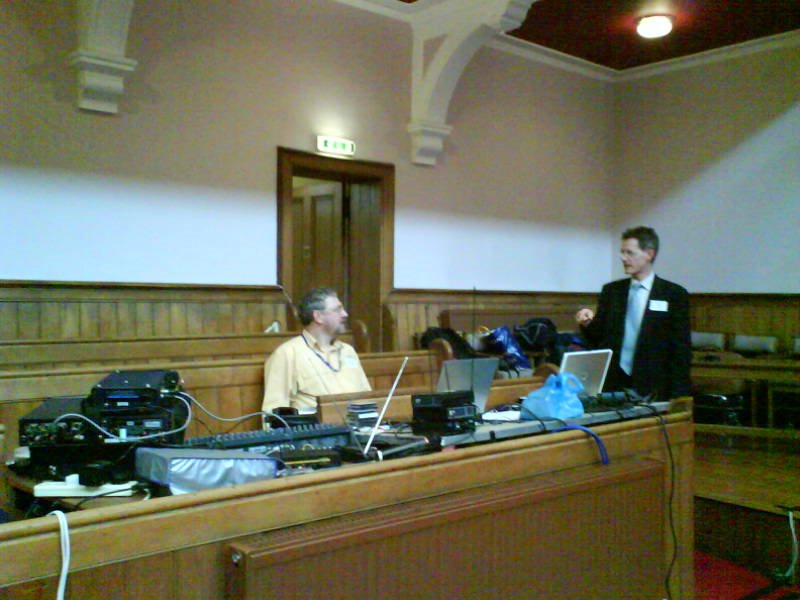
This is the tech on show at the synod this year. I made a plea earlier today for some up to date training in technology for the church, the kind of stuff LTS does for secular education. There was a resounding silence. But one of the techies, ex LTS, has just thanked me - and would be available. Someone was listening!
Thursday, June 07, 2007
Wednesday, June 06, 2007
Was that it?
You didn't really think you were going to get rid of me so easily, did you? Here I am in Edinburgh, waiting with bated breath for the opening of the General Synod of the Scottish Episcopal Church. Oh, all right - I'm exaggerating, if not actually being economical with the truth.
I shan't be lugging the laptop up to Palmerston Place tomorrow - wifi-less, I believe. Like a bachelor pad. Sorry. I'm looking forward to meeting up with some folk I don't see often, but really I hate meetings. Must be having to sit quietly.
I've been reading ab's thoughts about what blogging does, and when he'll stop doing it. I took the chance to unload in a comment some of the thoughts I've been having the last couple of days, occasioned by the veritable stushie that sprang up on my own comment column. I suppose it comes back to how we regard comment, and how we feel about saying (writing) things so publicly. And there is the additional question of what constitutes rudeness and what is merely a robust exchange. Often, of course, it is possible to disguise criticism and hostility by using, say, the impersonal third person to make your point rather than the second person, which always comes across as more direct. But most readers are perfectly capable of sussing the hostility/jibes/criticism anyway - so is it more honest just to say what you think? And then there are people who make a game of that sort of thing - just listen to Prime Minister's Questions and hear what I mean.
I dunno. I'm always aware of potential readers when I write, and try not let the side down stylistically or in any other way. I won't be shutting away the laptop any day soon - I've kept a diary for 50 years, dammit, and it's still on the go too. In a way, there's a frustrated journo lurking in me, and I'm sure blogging's as good as Dr Kawashima for stimulating the brain cells.
Maybe I'll try a wee moblog tomorrow ....
I shan't be lugging the laptop up to Palmerston Place tomorrow - wifi-less, I believe. Like a bachelor pad. Sorry. I'm looking forward to meeting up with some folk I don't see often, but really I hate meetings. Must be having to sit quietly.
I've been reading ab's thoughts about what blogging does, and when he'll stop doing it. I took the chance to unload in a comment some of the thoughts I've been having the last couple of days, occasioned by the veritable stushie that sprang up on my own comment column. I suppose it comes back to how we regard comment, and how we feel about saying (writing) things so publicly. And there is the additional question of what constitutes rudeness and what is merely a robust exchange. Often, of course, it is possible to disguise criticism and hostility by using, say, the impersonal third person to make your point rather than the second person, which always comes across as more direct. But most readers are perfectly capable of sussing the hostility/jibes/criticism anyway - so is it more honest just to say what you think? And then there are people who make a game of that sort of thing - just listen to Prime Minister's Questions and hear what I mean.
I dunno. I'm always aware of potential readers when I write, and try not let the side down stylistically or in any other way. I won't be shutting away the laptop any day soon - I've kept a diary for 50 years, dammit, and it's still on the go too. In a way, there's a frustrated journo lurking in me, and I'm sure blogging's as good as Dr Kawashima for stimulating the brain cells.
Maybe I'll try a wee moblog tomorrow ....
Subscribe to:
Posts (Atom)