I've just been reading a most unedifying church magazine. It's called SATNav, and purports to help the good people of Ayr to navigate the life and witness of Holy Trinity Church in the centre of that town. The very first item is, unsurprisingly, the Rector's letter, which begins thus:
All scripture is inspired by God and is useful for teaching, for reproof, for correction, and for training in righteousness, so that everyone who belongs to God may be proficient, equipped for every good work.
2 Timothy 3: 16
The July/August edition of SAT Nav contained a press release about The General Synod of the Scottish Episcopal Church’s decision to move, over the forthcoming two General Synods, toward the introduction of same-sex marriage being permitted within the SEC’s churches. I thought it appropriate that I let you know my views on this matter…
... And then he reveals that he has signed the declaration of the statement of the Scottish Episcopal Evangelical Fellowship issued shortly after General Synod. This states:
In contrast to [the decision of General Synod to "delete any reference to marriage as being between a and a woman"], we reaffirm the doctrine of marriage as given in the Old Testament in Genesis 2:24, reaffirmed by Jesus in Matthew 19:5 and by Paul in Ephesians 5:31 - ‘For this reason a man will leave his father and mother and be united to his wife, and the two will become one flesh.’
At the end of the statement, he invites people to add their names to it by email. Lest they should hesitate over this step, he adds:
What General Synod has done then, is not only to take a major departure from authentic Biblical Christianity as practised by the overwhelming majority of churches worldwide, but to hasten the decline and possible final extinction of the SEC.
He backs all this up with this sweeping assertion:
As the SEEF statement makes clear above, God’s wish since the dawning of time for all humanity is that marriage between one man and one woman is the only place for sex to take place and that everyone else, irrespective of their sexual orientation, should lead a life of celibacy. That is because, in God’s design, through marriage, men and women are meant to complement one another in many ways, not just for reasons of procreation; ways that are just not possible in same-sex relationships.
I become terribly worried when people assert that they know God's wishes in this fashion. We could all do that, could we not? No. Surely such dogmatic insistence trivialises belief. For Christians like me, only one command comes through with that kind of clarity, and that is the demand that we love one another as God has loved us. Heaven knows, that's hard enough without adding man-made conditions (and yes, I mean man-made).
We are then assured that there will be no same-sex marriages in his incumbency, but that anyone who comes to the church will be loved and cared for regardless ... etc etc. Presumably his flock will conveniently forget that they will only experience this care up to a certain point - or might indeed simply note that no priest in the SEC is allowed at the moment to conduct such ceremonies and wonder what he's going on about.
The letter ends thus:
As a church, ahead of forthcoming Diocesan and General Synods, there will be plenty of opportunity to further discuss General Synod’s decision.
On an entirely different subject, I am looking forward to the Holy Trinity tea parties we'll be hosting at the rectory and in members’ homes from this month. (You'll find more about this on the back page.)
If you read my blog post of yesterday - which I wrote about an hour before seeing the above - you will know that the scones and stereotypes kind of mission is alive and well in Ayr, but that's a wry comment rather than the main point of my putting all this stuff here. What I'm asking is this: How would you feel if this arrived in your inbox, as a member of Holy Trinity Ayr? What happened to all the thoughtful discussion that went on at Synod? What happened to the care for ministry to all that would prevent a rector from coming out with such a bold statement of personal prejudice? Did he, I wonder, tell the vestry who appointed him that he was mired in the first century and would admit of no further growth in understanding?
He refers to the imminent demise of the church if it chooses to remove the clause about men and women from the canon on marriage. Does he know that that specificity was a recent addition to the canon?
But I'm becoming incoherent. I'm putting this stuff here because I am realising what we're up against when it comes to moving forward in the church I want to remain in. The person who forwarded the newsletter to me did so with the comment that now I would know why she was never going back to Holy Trinity Ayr. She's not a stereotypical agitator - she's a straight woman in her 60s who is furious. How is she being ministered to? She can't just go down the road and find another church - it's not easy when a team rector's influence covers a wide geographical area.
I know how fortunate I am at the moment. My local church is ministered to by a thoughtful, forward-looking priest who is careful to take everyone with him and who thinks about the consequences of his words. This could change in the future, for clergy move on. But to my mind, tea-parties and bigotry make up the poison that is eating at the credibility of our church, and if numbers indeed flock to hear their ignorant prejudices confirmed on a weekly basis it's not a church that I want to have any part of.
So - a sour note to start the week after the exuberant joy of Saturday. God help us.
Showing posts with label SEC. Show all posts
Showing posts with label SEC. Show all posts
Tuesday, August 25, 2015


Tuesday, June 16, 2015
There, then, you have it. Synod recollected in tranquillity.

We used to have an English teacher, a formal, pin-suited, begowned sort of chap, who was in the habit of saying "There, then, you have it" at the conclusion of any discussion. It's the phrase that comes into my head as I sit down to recall the events of last week's General Synod of the Scottish Episcopal Church, perhaps because in all likelihood it will be my last. If it is, I'm glad I made it so far; glad I was able to make a contribution to the effort to move my church forward in its recognition of the diversity and sanctity of human relationships. Others - notably Kelvin and Beth - have been much quicker off the mark, blogging in the evening what had happened during each day; I blame the fact that I only had my phone with me to excuse my failure to do more than tweet at the time.
It began, really, with the motion showing on the screen in the photo. There were other motions that seemed more promising, but this was the starting point. We'd all (I hope) read the Doctrine Committee's lengthy report, and receiving it was a start. The thing was that every time - were there three times in all? - the issue came up, people debated. Some contributed considerable points; others expressed bitterness. There were clearly people who felt that their traditional stance was no longer being given a chance - and believe me, it was traditional. I worry when someone says with calm certainty that they know what God wants. But there were also contributions on the side of change delivered in the measured tones of compassion and reason - words spoken by people I have grown to respect and admire - and I could feel a change in the atmosphere as we moved towards the vote that would result in Synod's deciding to ask the Doctrine Committee to remove the first section of Canon 31. ( The Doctrine of this Church is that Marriage is a physical, spiritual, and mystical union of one man and one woman, created by their mutual consent of heart, mind, and will thereto, and is a holy and lifelong estate instituted of God.) Apparently - and I hadn't realised it - this section dates only from 1980 or thereabouts, and was inserted by the last Provincial Synod, of which I was possibly the youngest member, after the debate on the remarriage in church of divorced persons. I well recall that debate; it seemed such a big thing at the time.
You can read more details in other places. Don't come to me for details. I'm inside my memories now, and they're not especially precise. At the end of the first day's debate, I spoke on the nature of marriage in relation to the idea of man and wife being one flesh. That makes it sound measured, considered - "I spoke". But it wasn't like that. I was prompted to my feet when someone said something that I couldn't let pass, and then sat there waiting my turn with nothing in my head but scraps of Shakespeare - Hamlet saying "Husband and wife are one flesh; therefore my mother ...". I didn't know how I would begin, even, until I stood up. And then it came, and I said my piece fluently and I enjoyed saying it (I love a microphone) and people clapped. The following day I was bowled over by the words of another woman of my own generation - and people clapped. A bishop made it clear that sexual ambiguity is in all of us, and did so by recounting his own experience, and the silence as we listened was one in which I felt that something hugely hopeful had come into our midst.
But when later that day the votes were counted, there was no applause. No-one punched the air, and the sense was one of relief rather than triumph. It was as if none of us dared to believe that after all these years the church had taken the first hesitant step towards recognising that the God we believe in made us all the way we are. I was aware of tension lifted; there were tears from those that in the end we had been discussing all those years. There was a knot of people sitting together who had voted against the motion and against the idea. Their faces were tight, expressionless. It will be hard for them, though not, in my opinion, as hard as it has been all those years for the excluded and the patronised, those who, like all of us, have no choice in the matter of their sexuality.
One thing seemed to lurk like a cloud on a sunny day, and that was the defeat of the Rule 10 motion on Saturday. In a house depleted of those who didn't attend on the last morning, a majority wanted to discuss the possibility that the bishops would look again at their decree that no-one in an equal marriage could be considered for ordination.* But it was not the required 2/3 majority, so we didn't even get to discuss why they might decide to let it stand. I know that at least one bishop voted for the motion, but the Primus did not. Oh yes, there's a kind of logic to this apparent failure of logic: the change to Canon 31 will take over 2 years to become law, and has to pass through two readings and debate at diocesan level before it can do so - therefore let's not pre-empt the outcome by even thinking about changing our minds on this one. No hope held out, then, to someone in a same-sex marriage who might long to put herself forward for consideration and training; they will have to wait even longer.
It must be tough being the chairman of the board, the Primus inter Pares (first among equals) who has to front the decisions and - presumably - carry the can for whatever goes wrong. The Primus presumably doesn't want further to dislocate the noses of those who are sure we're all heading to hell in a handcart. But at least one of his equals felt we should be discussing further thought, and I thank God for him and for all the brave souls who have spoken selflessly and thoughtfully for change. It is they who inspire confidence in our church and its future.
Despite that last-minute barrier to change, it is once more a church to which I feel able to belong with joy.
*As has been pointed out elsewhere, you can apparently be considered for ordination if you are in a civil partnership, or merely quietly getting on with whatever arrangements you like to make for yourself. It's marriage that's the bar.
Sunday, December 21, 2014
Crisis? What crisis?

In what has been described as the biggest crisis to engulf it in living memory, over 50 Scottish Episcopalian Church (SEC) clergy – around one in six – have signed a letter condemning the stance of their bishops over same-sex marriage.
Gosh. Two pieces in the paper - The Herald, even - in one week. Almost as good as the SNP ... But I get ahead of myself. Normally the Scottish Episcopal Church doesn't generate much news, but what the Bishops' Statement on Equal Marriage started in Wednesday's paper rumbled on into the weekend with a new story, the tale of an insurrection in the ranks.
It's this word 'crisis' that interests me. For a start, it's a crisis that hasn't engulfed an awful lot of the worshippers that turned out this morning - the conversations I've had on the subject could be numbered on the fingers of one hand, and these were all with interested parties or senior clergy. But I know all about it, I've been part of the process that - surprisingly - ended up in this odd place, and I simply don't feel it's a crisis. Quite the reverse.
The fact that a good number of clergy - and, as the paper points out, a good proportion of those serving the church - have seen fit to think for themselves and say No, this is not what we think right, and have felt sufficiently confident in their own minds to stand up and be counted, this is not a crisis. This is a high point. This is exciting. This is the SEC doing what its own publicity says it does.
When I posted the letter here the other day, I said I was proud of the signatories. I'm still proud. And I'm proud to belong to a church that numbers such people among its leaders. I'm thrilled that suddenly we're talking about the elephant in the room, and that conversations - real conversations, not this ridiculously neutered Cascade malarkey - are beginning to happen in real life, in churches, in sitting rooms, and not just on social media. We're showing that our faith can actually inform our decisions, guide our words, make us brave. We're showing that we can think for ourselves, as mature Christians who recognise that a great historical mistake is in danger of being perpetuated.
What I'm looking for now is some brave leadership from the top, from the Bishops who are supposed to provide a focus for this thoughtful and courageous process. It's still not too late for these men to recover some moral authority by showing some of the courage that their priests and lay leaders have demonstrated.
And then the papers can stop talking about crisis and talk about joy instead.
Thursday, December 18, 2014
A letter to the Bishops
The following letter speaks for itself. I am proud of the signatories, and proud to add my name by posting it here.
Dear Bishops of the Scottish Episcopal Church,
We read with dismay the Guidance for Clergy and Lay Readers in the light of the Marriage and Civil Partnership (Scotland) Act 2014.
We appreciate that we are bound by the law, and that until our canons are changed, we cannot legally perform same-sex marriages. However, we are disappointed by both the timing and the tone of the document. We have been urged by you to enter into ‘cascade conversations’ in a spirit of open and sensitive listening with people of all views on this matter. This document only makes this process much harder for us, even impossible for some. Far from acknowledging the reality of differing experience and views in the church, it gives the impression of a definitive answer to the question we have yet to discuss or debate. The document ought to make it clear that the restrictions it describes may be temporary, if the church decides to change its canons. Because of the confusion created by this document, we now believe that such canonical change should be decided in Synod as soon as possible.
But we were especially dismayed by the section of the document which refers to clergy, lay readers, and ordinands, should they be in a same-sex relationship and wish to be married. In particular, we find the warnings to ordinands, both currently training and those who might be training in the future, to be unrepresentative of the generous and communal characteristics of the Scottish Episcopal Church. Even though our church has not yet agreed to solemnise same-sex marriages, they will nevertheless become a civil institution which we will recognise like everyone else under the law. It is our firm belief therefore that any prohibition on obtaining a civil marriage is outwith the moral and canonical authority of a bishop.
We acknowledge that this process is one which creates anxiety for all church leaders, and bishops in particular. We empathise with the difficult situation that you as bishops are in, and reaffirm our desire to support you in your leadership of our church, and as fellow members of it.
Nevertheless, some of us are now uncomfortable about solemnising marriages at all until such time as all can be treated equally, and all of us will continue to feel morally compromised in our ministries, and wish to make clear our continuing commitment to affirm and support all people in our church, and to recognise and rejoice in all marriages, of whatever sexual orientation, as true signs of the love of God in Christ.
Yours sincerely,
Revd Carrie Applegath,
Revd Philip Blackledge,
Revd Maurice Houston,
Revd Canon John McLuckie,
Revd Canon Ian Paton,
Revd Kate Reynolds,
Revd Martin Robson,
Revd Malcolm Aldcroft,
Dr Darlene Bird (lay reader),
Revd Jim Benton-Evans,
Revd Cedric L. Blakey,
Revd Andrew Bowyer,
Revd Canon Bill Brockie,
Revd Tony Bryer,
Revd Steve Butler,
Revd Christine Barclay,
Revd Lynsay M Downes,
Revd Markus Dünzkofer,
Revd Canon Anne Dyer,
Revd Janet Dyer,
Revd Jennifer Edie,
Revd John L Evans,
Revd Samantha Ferguson,
The Revd Canon Zachary Fleetwood,
Kennedy Fraser,
Revd Kirstin Freeman,
Revd Frances Forshaw,
Revd Ruth Green,
Revd Bob Gould,
Very Revd Kelvin Holdsworth,
Revd Ruth Innes,
Revd Ken Webb,
Rev’d Canon Mel Langille,
Revd Kenny Macaulay,
Revd Simon Mackenzie,
Revd Duncan MacLaren,
Very Revd Nikki McNelly,
Very Revd Jim Mein,
Revd Nicola Moll,
Revd Bryan Owen,
Revd Canon Clifford Piper,
Revd Donald Reid,
Revd Colin Reed,
Revd Canon John Richardson,
Revd Malcolm Richardson,
The Revd Gareth J M Saunders,
Very Revd Alison J Simpson,
Very Revd Andrew Swift,
Kate Sainsbury (lay reader),
Patsy Thomson (lay reader),
Prof Revd Annalu Waller
Long ago, in a universe far away ...
I have been thinking I ought to write to the College of Bishops about that pronouncement that is now all over yesterday's Herald, quite apart from anywhere else, but my exhibitionist side actually prefers to ruminate here, where anyone can see it and no-one can decide to interpret it in their own way in private. Strangely, it was learning of the death of Bishop Michael Hare-Duke that stirred up the memories that, it seems to me, make this latest situation so absurd.
Long long ago, when I was very young and had only been a member of the SEC for 5 years, I was chosen to be one of the two lay representatives from Argyll and The Isles to sit on the Provincial Synod. This relatively small body met annually in Perth, and it was with some trepidation that I travelled there that first year (it was 1978, the day Pope John Paul 2 was elected) to find that I was the youngest person in the Synod and hadn't a clue what was expected of me. I remember spending many hours debating the language of the New Liturgy - what is now the 1982 Liturgy and itself regarded as positively old hat. As the years passed - during which the Provincial Synod abolished itself and the RCC and I vanished from the wider church and concentrated on my day job - I became aware of what was going on and who was who in the hierarchy - and one of the most interesting of the bishops was Bishop Michael, the poet and thinker who did so much to shape the 1982 Liturgy.
But to my point. One of the first issues I recall being involved in voting about was The Remarriage in Church of Divorced Persons. This gave rise to much heated discussion and seemed a Very Important Matter Indeed. And then there were women. In the run-up to this particular Synod my husband answered a phone-call (I was out). The conversation ran thus:
"May I speak to Christine, please?"
"I'm sorry, she's out. Who's calling?"
"It's George."
(Suspiciously) "George who?"
(Plaintive)"George the bishop."
"Oh. Hello. She's not here."
"Give her a message, will you? For God's sake tell her not to vote for women priests."
"Oh. Right. I'll tell her."
And he did. At the Synod the next week, a lovely older woman (maybe the age I am now) told me I was the kind of woman who ought to be ordained. I didn't know whether to be gratified or horrified. Her son became one of our bishops, incidentally, but he is no longer with us.
It should be painfully obvious why I'm telling these anecdotes. I'm now older than any of the current diocesan bishops, and have a far longer memory than to be able to let their current burst of ill-placed authoritarianism pass without asking them what in all seriousness they think they're at. If it weren't so serious, so damaging to people I care about and the institution I still, after all the years and all the setbacks, care about also, I'd laugh. I'd laugh the way I do when I hear small children playing - "Let's make it that you're the mummy and I'm the daddy"... "Let's make it sound as if we can actually tell people what to do/think/believe."
I'm sorry. We're adult Christians. We've learned about justice, compassion, equality, fairness - not to mention common sense. And long ago, Bishop Michael Hare-Duke exemplified these qualities to a very young, very inexperienced new Christian. The last time I met him was some 7 years ago - at the first Provincial conversation about the status and experiences of gay Christians. We were both much older - but he at least hadn't changed.
Long long ago, when I was very young and had only been a member of the SEC for 5 years, I was chosen to be one of the two lay representatives from Argyll and The Isles to sit on the Provincial Synod. This relatively small body met annually in Perth, and it was with some trepidation that I travelled there that first year (it was 1978, the day Pope John Paul 2 was elected) to find that I was the youngest person in the Synod and hadn't a clue what was expected of me. I remember spending many hours debating the language of the New Liturgy - what is now the 1982 Liturgy and itself regarded as positively old hat. As the years passed - during which the Provincial Synod abolished itself and the RCC and I vanished from the wider church and concentrated on my day job - I became aware of what was going on and who was who in the hierarchy - and one of the most interesting of the bishops was Bishop Michael, the poet and thinker who did so much to shape the 1982 Liturgy.
But to my point. One of the first issues I recall being involved in voting about was The Remarriage in Church of Divorced Persons. This gave rise to much heated discussion and seemed a Very Important Matter Indeed. And then there were women. In the run-up to this particular Synod my husband answered a phone-call (I was out). The conversation ran thus:
"May I speak to Christine, please?"
"I'm sorry, she's out. Who's calling?"
"It's George."
(Suspiciously) "George who?"
(Plaintive)"George the bishop."
"Oh. Hello. She's not here."
"Give her a message, will you? For God's sake tell her not to vote for women priests."
"Oh. Right. I'll tell her."
And he did. At the Synod the next week, a lovely older woman (maybe the age I am now) told me I was the kind of woman who ought to be ordained. I didn't know whether to be gratified or horrified. Her son became one of our bishops, incidentally, but he is no longer with us.
It should be painfully obvious why I'm telling these anecdotes. I'm now older than any of the current diocesan bishops, and have a far longer memory than to be able to let their current burst of ill-placed authoritarianism pass without asking them what in all seriousness they think they're at. If it weren't so serious, so damaging to people I care about and the institution I still, after all the years and all the setbacks, care about also, I'd laugh. I'd laugh the way I do when I hear small children playing - "Let's make it that you're the mummy and I'm the daddy"... "Let's make it sound as if we can actually tell people what to do/think/believe."
I'm sorry. We're adult Christians. We've learned about justice, compassion, equality, fairness - not to mention common sense. And long ago, Bishop Michael Hare-Duke exemplified these qualities to a very young, very inexperienced new Christian. The last time I met him was some 7 years ago - at the first Provincial conversation about the status and experiences of gay Christians. We were both much older - but he at least hadn't changed.
Saturday, December 13, 2014
On rage, and prophetic leadership
I've not been blogging for a bit, and it'd be good to be able to post another Advent piece, a poem perhaps or something I wrote previously that could do with an airing, but my Advent attempts at calm meditation have been disturbed by two things. One is ok, actually - I've been working on a sermon for Advent 3, all John the Baptist and making straight the way of the Lord, and though the results are perhaps more prophetic in tone than is entirely seemly in a lay preacher, I feel the contemplation that produced said results were a suitable occupation. The other, however, is not at all ok. It all began with reading a blog post which took me to a statement by the bishops of the only church I've ever actually belonged to. And this statement, about what The Church had to say about the things gay people may and may not do within its rapidly diminishing sphere of influence, disturbed me to such an extent that I've thought of little else all week.
And this morning the same blogger posted this very measured and gracious piece, and I felt disturbed all over again. Because I'm not feeling at all measured and gracious, and I have made no promises about maintaining peace and unity and besides I'm feeling restless and rebellious. And in writing this, I hope to do two things.
The first is to apologise to anyone, gay or straight, within the church or - more likely - outside it and looking on incredulously, and to tell them not to write off all Christians, all Episcopalians, as being firmly stuck in the ignorant past and willing to sacrifice the wonderful gift of life in all its fullness on the altar of a variety of respectability and prejudice that was common in the 1950s. Some of us are raging because the church we love has turned its back on people we love and value - people who also love the church and want to play a full and joyful part in it.
And the raging brings me to the second thing. Rage in debate is seldom helpful, but sometimes it leads one to a vision of what leadership is all about. John the Baptist certainly didn't mince his words, and Jesus had a less than temperate way with those who ground down the poor, the outsider - the ones who didn't conform. We've had prophetic leadership in the SEC in the past, and we've seen that it's never easy for such leaders. But I long for such leadership. Where is the inspiration, the vision that would allow our church to shine as an example to 21st century society?
Finally, I realise I have a big problem with the way things are being done just now. If those in authority tell me privately that they're on the same wavelength as I am but they have to keep everyone on board, I'm not sure this is a lifeboat I want to continue in. If the captain and some very capable sailors tell you that the closest land is due east, and some of the more timid passengers want to go on sailing to America even though it's five times further because that's where they were originally going before the liner sank, which way would you want to go?
People, look east, I say. People, look east.
And this morning the same blogger posted this very measured and gracious piece, and I felt disturbed all over again. Because I'm not feeling at all measured and gracious, and I have made no promises about maintaining peace and unity and besides I'm feeling restless and rebellious. And in writing this, I hope to do two things.
The first is to apologise to anyone, gay or straight, within the church or - more likely - outside it and looking on incredulously, and to tell them not to write off all Christians, all Episcopalians, as being firmly stuck in the ignorant past and willing to sacrifice the wonderful gift of life in all its fullness on the altar of a variety of respectability and prejudice that was common in the 1950s. Some of us are raging because the church we love has turned its back on people we love and value - people who also love the church and want to play a full and joyful part in it.
And the raging brings me to the second thing. Rage in debate is seldom helpful, but sometimes it leads one to a vision of what leadership is all about. John the Baptist certainly didn't mince his words, and Jesus had a less than temperate way with those who ground down the poor, the outsider - the ones who didn't conform. We've had prophetic leadership in the SEC in the past, and we've seen that it's never easy for such leaders. But I long for such leadership. Where is the inspiration, the vision that would allow our church to shine as an example to 21st century society?
Finally, I realise I have a big problem with the way things are being done just now. If those in authority tell me privately that they're on the same wavelength as I am but they have to keep everyone on board, I'm not sure this is a lifeboat I want to continue in. If the captain and some very capable sailors tell you that the closest land is due east, and some of the more timid passengers want to go on sailing to America even though it's five times further because that's where they were originally going before the liner sank, which way would you want to go?
People, look east, I say. People, look east.
Tuesday, June 17, 2014
Time to think ... about Synod
 |
| P's & G's, complete with MDF gallery? |
Having been one of the signatories to a Rule 10 motion that would have hastened us along the path to legislating for same-sex marriage in church, I was pretty fed up when the motion failed to attract the two-thirds majority that would have allowed us to deal with the subject in open debate. Synod wanted the debate - but not quite enough of us wanted it. I have a strong suspicion that the secret ballot, as we tautologously referred to it, along with the confusion resulting from a bishop-led objection to a show of hands, led to several inattentive or merely poor souls voting the wrong way - in other words, not as they actually thought they were voting.
This raises another scunner (no, auto-correct, not scanner: I'm Scottish.) The venue for this year, the once-grand and now modernised cavern of P's & G's, didn't make for the same contact with the chair as we had in the more regimented but better-lit surroundings of Palmerston Place. Punters in the middle or rear of the space couldn't communicate confusion or unreadiness without a great deal of palaver involving roving mikes and the bearers of the mikes peering into the throng to try to find the confused/challenged/challenging one. This being the case, it was more than ever important for the various chairs to speak with clarity and decision, and certainly not to rely on the overhead screens to make up for the deficiencies in their own communication skills. (People don't always cast their eyes screenwards in moments of stress, especially when they're rummaging through their Synod papers and have their reading glasses on anyway.) And, as every teacher knows, you can't simply assume that everyone is paying attention the moment you open your mouth; the table-group layout makes (again, as every teacher knows) for covert communication or simple distraction.
But the single thing that got to me this year was the sudden descent of a whole bunch of protagonists into fuzzy, warm and ultimately vapid religious jargon. And tone. There. That's it. There's a whole raft of expressions that belong in this jargon, and some others that are pressed into service and will never be quite the same again (like Francis of Assisi after Margaret Thatcher had appropriated his words). "Unpack" comes to mind, and they're not talking about the messages (shopping, if you're not from these parts). No-one called a spade a spade, let alone a bloody shovel, and there was no place for what one commentator has described as "honest fury". Those who were feeling such fury had nowhere to go, because it would have been smothered in soft fuzziness, smiled at and forgiven.
Now, I was personally grateful for individual kindness and concern in the aftermath, even as I still raged for friends old and new whose hurt and frustration were all too apparent - but I have huge problems for this kind of institutionalised, forced gentleness. For a start, I think it betrays the god I believe in. I think it castrates the prophet and makes a virtue of passivity. And where was the passion, the leadership that would have given some sense of a vibrant community realising its past and grasping the opportunity to move into a new, juster present?
I can't at the moment think if I'm actually at the end of my time on Synod, or if I have another year to go. Maybe someone reading this will be able to tell me. The Primus gave us a sliver of hope that things may move in 2015, but who knows whereI'll be then? A friend gave me even more hope in that his perceptions have changed post-Synod, and that is joyous news. That's the news that makes me glad I waited to post this, as there would have been nothing to redeem the situation had I leapt in. But if anyone is planning any more soft play areas for the church, any more padded "conversations", I'll be returning to a quip that was going the rounds on Facebook recently:
If anyone asks you "What would Jesus do?", remember that overturning tables is always an option.
Sunday, March 02, 2014
Of straight talking and overturning tables

Perhaps that's why I'm blogging again - the frustration of not being able to speak, the space to read what people are writing and to reflect for myself. And I've been thinking some more about this absurd position I find myself in, belonging all these years to a church which is now, I believe, shutting itself off from the message of the gospels as firmly as it is shutting itself off from society. Yes, I'm thinking about the Equal Marriage situation, but I'm not going to go on about it right now.
What bothers me is that my years in the church have brought me into contact with so many people whom I like and feel concern for. My choice - made in this very spot I've pictured - to go along with the sudden conviction that what I'd been singing about and hearing about had meaning for me, a choice that led to confirmation and all the tortuous journey that has followed since, now lands me in a place where I can't just let it go, let people think it's ok to set up talking shops and to procrastinate and hope that the problem might dangle quietly till it's no longer their responsibility, let my period of involvement in the wider church end without doing my best to make a difference. And that's probably going to land me in a jaggy place, where either I will offend people I would prefer to have with me, or I will be deeply pissed off by their being patronising or dismissive.
When I was in my 30s, I felt very new and very inexperienced in the governing bodies of the church. (I'm talking the Scottish Episcopal Church, for any new reader who stumbles on this). I listened to elegant cassock-clad figures (one with Dundrearies adorning his aquiline features) and wondered at the enthusiasm for rewriting canons just so. The man sitting next to me took snuff periodically, and I felt I was living in a dream. Sometimes, it struck me that these men who were running the show were less than kind to one another, and I wondered about that. They did it so ... subtly. I found it illuminating, but I had little to say for myself. Half a lifetime later, I know most of the people who tell us what's what. I have opinions of my own. And sometimes I want to speak plainly. I want to use the language I would use in my professional life, I want there to be no doubt and no obfuscation. Only thing is, people often find that difficult. Aggressive, even. Not ... nice.
I spent some time every year of my teaching career on that word "nice", so I'm using it here with a heavy dose of irony, using it in the way I taught generations of pupils not to use it, using it to point out what I think is wrong with the church right now. Think of the things that are not "nice" in church circles and you'll see what I mean. And then think of what "being nice" entails in the way of not saying exactly what you mean, of hiding behind words and platitudes and pious expressions of brotherhood, of not upsetting people.
And then remember that it probably wasn't "nice" to have your table overturned and your money scattered over the ground - and wonder what has become of the church that follows the man who overturned the tables. Society has got there before us, I fear.
Tuesday, February 25, 2014
How long, O Lord ...?
I've been putting off writing for myself about church and state and same-sex marriage. I've exploded, once, on the Primus' blog; now I think it's time to work out what is, a couple of weeks on, still explosive. And my main feeling, reading and listening, picking up rumours about the SEC process with the issue and so on, is that I'm ashamed. I haven't walked out of the church - not yet, anyway - but I'm not happy about claiming kinship with people who can write, carefully and thoughtfully, something like this:
I wasn't brought up an Episcopalian. People who know me well know that my upbringing didn't really encourage anything so rash as faith, so that my confirmation at the age of 28 was actually an act of rebellion (sad, isn't it?). At that time, the Grey Book version of the Scottish Liturgy was in its infancy and a phone call from George our then bishop told me, as the youngest member of the old Provincial Synod, not to vote for women priests. (At that same Synod, our then rector bemoaned the time spent discussing this as "unimportant".) It's as well to remember these things, and to remember that there are still people in the church who prefer to pray in Jacobean English and accept that "Father knows best" at every turn.
Why is it as well to remember? Think about it. It seems like another life to me. The young woman who stood up at Synod and demanded clarification over deaconesses who were women and deacons who held a post to which women could never aspire - that was me. At that same time the mother of someone who became a bishop in the SEC told me that it was women like me who should be going for ordination, and I was amazed. But in global terms, it's not so long ago, is it? To be precise, it's half a lifetime. And now things have changed where before they seemed immutable.
I have been going to the current General Synod for too long, as an alternate and then as an elected representative, and it's time I quit. But I long for someone to stand up and say this. Two years is nothing if there is hope at the end of it. Two years is nothing if people look seriously at a canon about a word - "marriage": stay with me - and realise that it is only a word and that it's not the word of God but a human word about a human institution that has existed since a time when people were ignorant of genetic differences.
The Primus says that we expect our clergy and our members to acknowledge and respect this historic position. No. I respect that it is history. Four hundred years ago the Church excommunicated Galileo. That's history too. We progress. We know now that people don't choose their sexuality - and a moment's thought would show the lunacy of supposing that any Christian would choose to adopt a lifestyle that would bring them so much pain and exclusion. Bit like choosing to be a woman, until recently ...
So are we going to be hung up on a historical fallacy while loving couples wait to have their union celebrated in the church they still - and God must wonder why - adhere to? Because the faith I still cling to encourages me to have hope, I still cherish a shred of optimism that someone in a position of authority will have the courage to lead the SEC back to where it was some years ago - and on, into a place where society will have less justification in consigning us to the scrap-heap of irrelevance.
And then, perhaps, I will feel less ashamed of the church that brought me, all these years ago, to God.
But it produces an interesting situation for churches and faith groups who, like the Scottish Episcopal Church, have a historic position expressed in our Canons – or church law – that marriage is between one man and one woman for life. That is our position. We expect our clergy and our members to acknowledge and respect it – even if in some cases they do not agree with it and aspire to change it. To change it would need a significant process over two years in our General Synod and would require two thirds majorities.
I wasn't brought up an Episcopalian. People who know me well know that my upbringing didn't really encourage anything so rash as faith, so that my confirmation at the age of 28 was actually an act of rebellion (sad, isn't it?). At that time, the Grey Book version of the Scottish Liturgy was in its infancy and a phone call from George our then bishop told me, as the youngest member of the old Provincial Synod, not to vote for women priests. (At that same Synod, our then rector bemoaned the time spent discussing this as "unimportant".) It's as well to remember these things, and to remember that there are still people in the church who prefer to pray in Jacobean English and accept that "Father knows best" at every turn.
Why is it as well to remember? Think about it. It seems like another life to me. The young woman who stood up at Synod and demanded clarification over deaconesses who were women and deacons who held a post to which women could never aspire - that was me. At that same time the mother of someone who became a bishop in the SEC told me that it was women like me who should be going for ordination, and I was amazed. But in global terms, it's not so long ago, is it? To be precise, it's half a lifetime. And now things have changed where before they seemed immutable.
I have been going to the current General Synod for too long, as an alternate and then as an elected representative, and it's time I quit. But I long for someone to stand up and say this. Two years is nothing if there is hope at the end of it. Two years is nothing if people look seriously at a canon about a word - "marriage": stay with me - and realise that it is only a word and that it's not the word of God but a human word about a human institution that has existed since a time when people were ignorant of genetic differences.
The Primus says that we expect our clergy and our members to acknowledge and respect this historic position. No. I respect that it is history. Four hundred years ago the Church excommunicated Galileo. That's history too. We progress. We know now that people don't choose their sexuality - and a moment's thought would show the lunacy of supposing that any Christian would choose to adopt a lifestyle that would bring them so much pain and exclusion. Bit like choosing to be a woman, until recently ...
So are we going to be hung up on a historical fallacy while loving couples wait to have their union celebrated in the church they still - and God must wonder why - adhere to? Because the faith I still cling to encourages me to have hope, I still cherish a shred of optimism that someone in a position of authority will have the courage to lead the SEC back to where it was some years ago - and on, into a place where society will have less justification in consigning us to the scrap-heap of irrelevance.
And then, perhaps, I will feel less ashamed of the church that brought me, all these years ago, to God.
Sunday, August 11, 2013
Of fear, cheese and a shoogly crozier...
Two rants in a row. Never mind, today feels more positive. Largely, that's the doing of two Argyll and The Isles clergy who managed to assuage the wrath stirred up by The Bigot of Ardentinny and the hapless local paper (do they really think about what they print?), so today I'm celebrating that.
We're so lucky. When you have a Dean who can cheerfully put into amusing perspective the lunacy found in some threads of Christianity and a Bishop whose sermons never fail to inspire, it seems almost worth the angst of worshipping on a badminton court (Andrew, I thank thee for that word). And when the local paper's intransigence and lack of savvy releases you from the tedium of writing half-baked localpaperese (I just made that up) after lunch on a Sunday, you find you have the energy to celebrate on your own blog.
So, from today, my mental image is of +Kevin, behind the altar, singing his own descant to "Sing Hosanna" at the top of his voice. There are others - the shoogly crozier at the beginning, the mitre at a jaunty angle as +K waited to be allowed to bless us (we needed to sing first). And it seems from Facebook that there may have been some cheese-throwing; one hopes it was inadvertent, but one never knows.
The local paper, remember, turned down a piece because it was too theological, didn't have enough "news" So here's today's news.
Do not be afraid.
Or a headline? NO MORE FEAR, SAYS GOD.
Good, eh?
We're so lucky. When you have a Dean who can cheerfully put into amusing perspective the lunacy found in some threads of Christianity and a Bishop whose sermons never fail to inspire, it seems almost worth the angst of worshipping on a badminton court (Andrew, I thank thee for that word). And when the local paper's intransigence and lack of savvy releases you from the tedium of writing half-baked localpaperese (I just made that up) after lunch on a Sunday, you find you have the energy to celebrate on your own blog.
So, from today, my mental image is of +Kevin, behind the altar, singing his own descant to "Sing Hosanna" at the top of his voice. There are others - the shoogly crozier at the beginning, the mitre at a jaunty angle as +K waited to be allowed to bless us (we needed to sing first). And it seems from Facebook that there may have been some cheese-throwing; one hopes it was inadvertent, but one never knows.
The local paper, remember, turned down a piece because it was too theological, didn't have enough "news" So here's today's news.
Do not be afraid.
Or a headline? NO MORE FEAR, SAYS GOD.
Good, eh?
Sunday, August 07, 2011
Grey day transfigured
It's a grey morning. I'm already damp because my umbrella was in the car and I had to fight my way down the drooping garden so my legs are uncomfortable and I'm already chilled. As we swish up the back streets of Dunoon to church, I wonder what I'm doing. My mood matches the day; most of my summer activities are over; the sun has gone. I'd have been better staying in bed with a book. The organist seems in no better fettle, and I forgot to tell him we are supposed to be keeping the Transfiguration, so we don't really speak. Besides, we're a bit late.
There is no heating in church - it is, after all, summer - as I sort out hymnbook and liturgy (thank God - not the Grey Book). There are also no children, as the Rector is on holiday and has taken Mrs Rector who does the Godly play at the back of the church. Apart from some scraping and banging from the rear, later revealed as "sorting the electrics for the coffee", it is relatively quiet as the organ music begins. I recognise the music after the opening, drifting notes: the organist is improvising on a modern/traditional scottish folk tune. It is absolutely, heart-rendingly beautiful.
I am plainly not alone in thinking this. I hear a whisper from somewhere behind me: Ohhh - that's lovely. And a stillness falls on the people, even those who are still arriving. Prayer is suddenly possible, distraction and restlessness quietened by the lilting line, and I am glad I have come. Even when the music enters a dark, sombre place it seems entirely appropriate (I subsequently learn that the organist was distracted by the thundering down the aisle of Someone on A Mission and had to go where a wrong note took him) and the melody emerges, intact and serene, just in time for the final quiet cadence.
I am now in a place where anything can happen; the gloom has been dispelled and the transfiguration is possible. And reflecting on the experience, and the prayers and farewells and greeting of long-missed friends that took place when the Mass was over, I note that we need this variety. We need joy and noise and exuberance, and we need silence and mystery.
And somehow, in the profound silence, there is music at the very heart of things.

There is no heating in church - it is, after all, summer - as I sort out hymnbook and liturgy (thank God - not the Grey Book). There are also no children, as the Rector is on holiday and has taken Mrs Rector who does the Godly play at the back of the church. Apart from some scraping and banging from the rear, later revealed as "sorting the electrics for the coffee", it is relatively quiet as the organ music begins. I recognise the music after the opening, drifting notes: the organist is improvising on a modern/traditional scottish folk tune. It is absolutely, heart-rendingly beautiful.
I am plainly not alone in thinking this. I hear a whisper from somewhere behind me: Ohhh - that's lovely. And a stillness falls on the people, even those who are still arriving. Prayer is suddenly possible, distraction and restlessness quietened by the lilting line, and I am glad I have come. Even when the music enters a dark, sombre place it seems entirely appropriate (I subsequently learn that the organist was distracted by the thundering down the aisle of Someone on A Mission and had to go where a wrong note took him) and the melody emerges, intact and serene, just in time for the final quiet cadence.
I am now in a place where anything can happen; the gloom has been dispelled and the transfiguration is possible. And reflecting on the experience, and the prayers and farewells and greeting of long-missed friends that took place when the Mass was over, I note that we need this variety. We need joy and noise and exuberance, and we need silence and mystery.
And somehow, in the profound silence, there is music at the very heart of things.
Tuesday, June 14, 2011
Fiddling at Synod?
Oh dear. I've been remiss in my blogging - but I've been away. Not more continental junketings, alas, but at the General Synod of the Scottish Episcopal Church. I seem to have participated rather often in this gathering over the years, but realise it's because I was a diocesan alternate before I was chosen as a representative ... but I maunder. Don't expect an official or exhaustive take on proceedings, however - you can find that here - my impressions are very patchy this year.
This is largely because I missed quite a chunk of things, including the task of facilitating discussion - I'd been looking forward to that - because I was no weel. Quite apart from my scheduled trip to Glasgow to have a small bit of me removed, I suffered horribly from our diocesan dinner and missed a whole morning on Mission; by the time I returned I realised I felt the way I used to after an absence from school: you caught measles or somesuch and when you went back you found out that everyone else had learned to do long division and you were totally lost.
And it's hard to get back into things in those circumstances. I was led to ponder how vital it is that individual speakers engage with their audience - it is so easy to switch off and let the mind wander as some voice drones on about ... but if I'm specific I shall pinpoint the offenders, and it is not my intention to wound. Rather I would beg that speakers are instructed in the art of eye contact, tonal variation and register - indeed, in the whole art of public speaking that they would have learned in Standard Grade had they been in my classroom. Maybe there's a job there for a certain bishop on the verge of retirement: having muttered resentfully about the boredom of one address, and having been rebuked by a more charitable neighbour on the grounds that this was after all the graveyard slot, I found myself once more engaged - and amused - by said bishop in his follow-up comments. Graveyard? I reckon he could make the dead laugh ...
Just to show that I'm not all girns and detachment, I should add here how much I enjoyed the break from traditional tedium offered by the indaba process. I was in a feisty group which in the end had to agree to disagree, but it was such a relief to be able to test responses on others rather than one's unfortunate neighbour or the twitterverse at large - though I had the feeling, confirmed later, that the twitterers had been somewhat discouraged while I was away being poorly. Someone had got it into their head that to tweet meant to be insensitive and crass and that it had therefore to be spelled out when tweeting would be inappropriate. I fear that is what happens when a spontaneous activity becomes respectable ... and I'm glad I didn't know about it, for that would have made me much, much worse.

But you'll be glad to know that my old friend the complacent male was at Synod. This was a cunningly camouflaged wee dinosaur, but his message was the same: it's a waste of time - in fact, it's navel-gazing - to fret about gender imbalance in church matters. He said it so quietly, slipping it in after one of the more mind-numbing exegeses, that we were onto the next item before I'd clocked it and got my hackles working - I told you I'd been no weel - and I was left frustrated. I shoulda said something. But then it was pointed out to me that his comment had been met by a wall of silence. And it was suggested that I should perhaps think about this silence. What did it mean? Well for a start it sure wasn't applause - and we'd had plenty of applause for other speakers, so people were by no means apathetic. As a teacher and speaker, I know there is nothing more disheartening than silence - for I take silence to show indifference or apathy, or perhaps that everyone has gone to sleep. So maybe I wasn't needed after all - maybe the church as a body is getting past the Mesozoic age (I had to look that up) and his remark was indeed seen as crass by the majority of those present. Maybe my more normal kneejerk reaction would have merely confirmed him - and others, for I'm sure he's still not quite alone - that women (or other excluded groups) are only interested in their own causes and don't care that creation burns (see pic). The silence on the part of all the Saturday Synod survivors might even have taught him that he really shouldn't say these things. (It may be too late for him not to think them - he was not in his first youth)
But I feel I'm going on a bit. I shall finish with what, after cooling down slighly, I tweeted as my last word on the Synod:
This is largely because I missed quite a chunk of things, including the task of facilitating discussion - I'd been looking forward to that - because I was no weel. Quite apart from my scheduled trip to Glasgow to have a small bit of me removed, I suffered horribly from our diocesan dinner and missed a whole morning on Mission; by the time I returned I realised I felt the way I used to after an absence from school: you caught measles or somesuch and when you went back you found out that everyone else had learned to do long division and you were totally lost.
And it's hard to get back into things in those circumstances. I was led to ponder how vital it is that individual speakers engage with their audience - it is so easy to switch off and let the mind wander as some voice drones on about ... but if I'm specific I shall pinpoint the offenders, and it is not my intention to wound. Rather I would beg that speakers are instructed in the art of eye contact, tonal variation and register - indeed, in the whole art of public speaking that they would have learned in Standard Grade had they been in my classroom. Maybe there's a job there for a certain bishop on the verge of retirement: having muttered resentfully about the boredom of one address, and having been rebuked by a more charitable neighbour on the grounds that this was after all the graveyard slot, I found myself once more engaged - and amused - by said bishop in his follow-up comments. Graveyard? I reckon he could make the dead laugh ...
Just to show that I'm not all girns and detachment, I should add here how much I enjoyed the break from traditional tedium offered by the indaba process. I was in a feisty group which in the end had to agree to disagree, but it was such a relief to be able to test responses on others rather than one's unfortunate neighbour or the twitterverse at large - though I had the feeling, confirmed later, that the twitterers had been somewhat discouraged while I was away being poorly. Someone had got it into their head that to tweet meant to be insensitive and crass and that it had therefore to be spelled out when tweeting would be inappropriate. I fear that is what happens when a spontaneous activity becomes respectable ... and I'm glad I didn't know about it, for that would have made me much, much worse.

But you'll be glad to know that my old friend the complacent male was at Synod. This was a cunningly camouflaged wee dinosaur, but his message was the same: it's a waste of time - in fact, it's navel-gazing - to fret about gender imbalance in church matters. He said it so quietly, slipping it in after one of the more mind-numbing exegeses, that we were onto the next item before I'd clocked it and got my hackles working - I told you I'd been no weel - and I was left frustrated. I shoulda said something. But then it was pointed out to me that his comment had been met by a wall of silence. And it was suggested that I should perhaps think about this silence. What did it mean? Well for a start it sure wasn't applause - and we'd had plenty of applause for other speakers, so people were by no means apathetic. As a teacher and speaker, I know there is nothing more disheartening than silence - for I take silence to show indifference or apathy, or perhaps that everyone has gone to sleep. So maybe I wasn't needed after all - maybe the church as a body is getting past the Mesozoic age (I had to look that up) and his remark was indeed seen as crass by the majority of those present. Maybe my more normal kneejerk reaction would have merely confirmed him - and others, for I'm sure he's still not quite alone - that women (or other excluded groups) are only interested in their own causes and don't care that creation burns (see pic). The silence on the part of all the Saturday Synod survivors might even have taught him that he really shouldn't say these things. (It may be too late for him not to think them - he was not in his first youth)
But I feel I'm going on a bit. I shall finish with what, after cooling down slighly, I tweeted as my last word on the Synod:
The day a woman stands up and says we should not fuss about gender balance, all will be well. #pisky #secsynod
Wednesday, December 15, 2010
Another Advent poem
I've posted another Advent poem on frankenstina. I'm grateful for the commission that led me to write it, and hope that as the magazine in which it now appears (the SEC's lovely publication Inspires, which seems to me to grow in stature with each edition, my own contribution notwithstanding) is out in the public domain it is now all right for me to post the poem.
The idea of a recurring need in our deepest places – for warmth, for love, for reassurance – seems to me especially poignant and powerful in the last months of the year. As the days shorten after the equinox, this can be felt as a disturbance, a restlessness of spirit reflected in the irregular rhythms of the free verse of the opening section of the poem. This settles into metre to reflect the idea of this experience recurring every year through the ages, a sort of incantatory passage in homage to our Celtic ancestors for whom the coming of the light was in every sense such an important event.
Sunday, June 13, 2010
Synod - a personal take
I spent the end of the week at the General Synod of the Scottish Episcopal Church. You can read all about it here, where you can also listen to the speech from the Presiding Bishop of the Episcopal Church of the USA (pictured, rather distantly, with my phone), and you can pick up more personal takes on blogs like Kenny's. I didn't take my laptop - too heavy, too uncomfortable to sit in the pews at the side where the bloggers lurk, and to be honest, too tempting to sit surfing in moments of tedium.
And there were such moments. It is my contention that no-one aspiring to address a hall full of people should be allowed to be boring, no matter what they're talking about. Balance-sheets, maybe - but there are interesting nuggets hidden away in there, like the average giving of each communicant in the church (quite shockingly low), or the discrepancy between numbers on rolls and actual bums on seats on the Sunday next before Advent. But I'm pushing a point here. I know there has to be a business-like approach to pensions and quota and all the stuff I find personally so daunting. However, we are all sent the papers in ample time to read them from cover to cover - and yes, we can all read. So why, in the name of charity, do speakers insist on putting up Powerpoint slides and then reading them out aloud? Or explaining maps that we're quite capable of interpreting?
And another thing. When is everyone going to realise that if they're going to read every word of an address, verbatim, from the paper in front of them, they will have to work hard to produce a paper in the register of speech? It is soul-destroying to sit, on an aching posterior, with a sore back and restless feet, listening to a monotone voice reading a written report which the speaker shows no signs of having mastered sufficiently to interpret in any way. Surely if someone has worked with a committee and laboured over its report, they can then set aside the written document and speak about the highlights?
I'd like to suggest a self-check for speakers: Are you enjoying yourself? Are you gripped by the thing you're saying, right now? Are you communicating that passion? No? Then think again. Try another tack. For if you're bored, or unable to convey the sense of that convoluted sentence without hesitating, what chance do your listeners have? In fact, what chance is there that they're still awake?
Of course there were great moments, witty speeches, ad-libbing and hilarity. But apart from the social aspect of Synod, I regard attendance at it as a kind of penance. And that's a shame.
On a brighter note, this morning I returned to the worship of my own wee church. Last week I worshipped with a bevy of bishops, a clutch of clergy, several dozens of delegates. The organ was loud and the singing confident. The liturgy was at times involving (though at times the reverse). But nothing happened. Not for me, anyway. This morning there was no priest - he was in Rothesay - and there was a congregation of about 15. The singing was gentle (but in tune!) and the organ is a computer (but in the hands of a fine musician). We received communion from the Reserved Sacrament.
But the magic was there, there in a way that reminded me of why I hadn't headed for the hills. Whew!

And there were such moments. It is my contention that no-one aspiring to address a hall full of people should be allowed to be boring, no matter what they're talking about. Balance-sheets, maybe - but there are interesting nuggets hidden away in there, like the average giving of each communicant in the church (quite shockingly low), or the discrepancy between numbers on rolls and actual bums on seats on the Sunday next before Advent. But I'm pushing a point here. I know there has to be a business-like approach to pensions and quota and all the stuff I find personally so daunting. However, we are all sent the papers in ample time to read them from cover to cover - and yes, we can all read. So why, in the name of charity, do speakers insist on putting up Powerpoint slides and then reading them out aloud? Or explaining maps that we're quite capable of interpreting?
And another thing. When is everyone going to realise that if they're going to read every word of an address, verbatim, from the paper in front of them, they will have to work hard to produce a paper in the register of speech? It is soul-destroying to sit, on an aching posterior, with a sore back and restless feet, listening to a monotone voice reading a written report which the speaker shows no signs of having mastered sufficiently to interpret in any way. Surely if someone has worked with a committee and laboured over its report, they can then set aside the written document and speak about the highlights?
I'd like to suggest a self-check for speakers: Are you enjoying yourself? Are you gripped by the thing you're saying, right now? Are you communicating that passion? No? Then think again. Try another tack. For if you're bored, or unable to convey the sense of that convoluted sentence without hesitating, what chance do your listeners have? In fact, what chance is there that they're still awake?
Of course there were great moments, witty speeches, ad-libbing and hilarity. But apart from the social aspect of Synod, I regard attendance at it as a kind of penance. And that's a shame.
On a brighter note, this morning I returned to the worship of my own wee church. Last week I worshipped with a bevy of bishops, a clutch of clergy, several dozens of delegates. The organ was loud and the singing confident. The liturgy was at times involving (though at times the reverse). But nothing happened. Not for me, anyway. This morning there was no priest - he was in Rothesay - and there was a congregation of about 15. The singing was gentle (but in tune!) and the organ is a computer (but in the hands of a fine musician). We received communion from the Reserved Sacrament.
But the magic was there, there in a way that reminded me of why I hadn't headed for the hills. Whew!
Sunday, May 16, 2010
New blog on the block
There's a new blogger on the Pisky scene. The Revd Andrew Swift arrives in Dunoon this week, and it's high time his aptly named blog, Dances with Midges, appeared on pisky blogrolls. Please pay him a visit and encourage him as he prepares to move to the very heart of midgeland.
Saturday, April 10, 2010
Burning zeal
After a frustrating 24 hours of internetlessness, now mercifully resolved, I managed to save today in all its loveliness by having a bonfire. It isn't possible for us to indulge in such soothing pyromania chez nous, surrounded as we are by other houses, but the church's huge - and sometimes daunting - grounds are just calling out for such activity and today had been designated for a clear-up of grounds and Rectory - the former after a hard winter, the latter after les travaux, big-style.
I have always been a pyromaniac at heart, the kind of child who played with matches and loved cooking sausages on a stick over a fire (charred on the outside, raw within); the child who lit fires in underground air-raid shelters; the adult who today offered to take care of all the rhododendrons which the chaps were howking out of the ground while the Marthas toiled in the Rectory.
At one point, I thought I'd bitten off more than I could chew (don't be silly. It's a figure of speech. I wasn't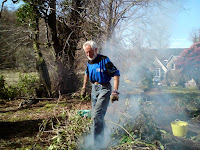 eating rhoddies) when only a thin trickle of smoke was coming from the shoulder-high pile of branches and glossy green leaves with the odd bramble waving destructively from somewhere in its midst. Most of the Marthas had gone home for luch, and I was left with Mrs Heathbank and Hugh, soon to be known as Hugh the Martyr after he jumped onto the pile to drive it down onto the flames. (The martyrdom was aborted when he succeeded in suppressing the fire completely). My despair deepened when Mrs H went home for lunch and Hugh went off to attack yet another bush. What would I do?
In fact, all I needed to do was open a wee cave in the foot of the fire. I propped the mound up with a curving branch, rather in the manner of a Greenham woman's bender, letting in a tiny wind that had conveniently chosen this moment to blow. A sudden crackling from deep within the pile suggested that all was not lost, and minutes later the flames burst through the top, the heat intensified, there was ash flying everywhere and it was all I could do to rake the fire together without being singed. Fifteen minutes later, all that was left was the small pile of ash you can see smoking in the photo, and I was satisfied.
But I think we may need another wee tidy of the fallen sticks on the lawn - and maybe another wee fire?

I have always been a pyromaniac at heart, the kind of child who played with matches and loved cooking sausages on a stick over a fire (charred on the outside, raw within); the child who lit fires in underground air-raid shelters; the adult who today offered to take care of all the rhododendrons which the chaps were howking out of the ground while the Marthas toiled in the Rectory.
At one point, I thought I'd bitten off more than I could chew (don't be silly. It's a figure of speech. I wasn't
 eating rhoddies) when only a thin trickle of smoke was coming from the shoulder-high pile of branches and glossy green leaves with the odd bramble waving destructively from somewhere in its midst. Most of the Marthas had gone home for luch, and I was left with Mrs Heathbank and Hugh, soon to be known as Hugh the Martyr after he jumped onto the pile to drive it down onto the flames. (The martyrdom was aborted when he succeeded in suppressing the fire completely). My despair deepened when Mrs H went home for lunch and Hugh went off to attack yet another bush. What would I do?
In fact, all I needed to do was open a wee cave in the foot of the fire. I propped the mound up with a curving branch, rather in the manner of a Greenham woman's bender, letting in a tiny wind that had conveniently chosen this moment to blow. A sudden crackling from deep within the pile suggested that all was not lost, and minutes later the flames burst through the top, the heat intensified, there was ash flying everywhere and it was all I could do to rake the fire together without being singed. Fifteen minutes later, all that was left was the small pile of ash you can see smoking in the photo, and I was satisfied.
But I think we may need another wee tidy of the fallen sticks on the lawn - and maybe another wee fire?
Tuesday, June 02, 2009
Loud twittering
Is Twitter the big thing these days, then? Yesterday a media job was advertised through Twitter and the applicant twittering about his success later on in the afternoon; the BBC website advocates using Twitter to keep up to date with Swine Flu news and advice.
In education, of course, we have the fear factor – the recent furore over the twittering teacher is proof enough of the success of the medium – and it remains for twitterers in educational circles to make the breakthrough that everyone else in the know has made already.
Over a year ago I suggested that Twitter would be a great way to keep us up to date with the peregrinations of our bishop, only to be told that there was no time for such stuff. (Sadly, many teachers still think this. And cooncillors.) It’ll be interesting to see how persuasive the communications people (pity they’re using a Twitter virgin as their advocate) at the SEC Synod will be this year. But I shall be in the Big Smoke - I shall have to rely on Twitter to find out.
In education, of course, we have the fear factor – the recent furore over the twittering teacher is proof enough of the success of the medium – and it remains for twitterers in educational circles to make the breakthrough that everyone else in the know has made already.
Over a year ago I suggested that Twitter would be a great way to keep us up to date with the peregrinations of our bishop, only to be told that there was no time for such stuff. (Sadly, many teachers still think this. And cooncillors.) It’ll be interesting to see how persuasive the communications people (pity they’re using a Twitter virgin as their advocate) at the SEC Synod will be this year. But I shall be in the Big Smoke - I shall have to rely on Twitter to find out.
Wednesday, March 25, 2009
1984 : finis
Before drawing the curtain on my 1984, a few last thoughts. Writing about it was strangely cathartic, and I wonder if I would have felt less affected had I been able to blog about it at the time. Certainly I became aware during the fall-out period that the priest involved in making sure we wouldn't still be around our church by the time the Presiding Bishop of ECUSA (the Episcopal church in the USA) visited the congregation that autumn was terrified Mr B would bring a case of wrongful dismissal - he even had a tame lawyer on hand to dig him out of the hole. At the time no-one was interested in what had actually happened; the priest was more to be believed than those pinko peace people. Actually, that's not true: one couple invited us for dinner and asked us to tell the story.
In the end, I grew tired of the pressure. After appearing in three TV programmes - the most notable being Northern Frontier - and taking on several speaking engagements and after realising that my phone conversations were not private I decided to back off a bit and concentrate on teaching. I didn't go near the Episcopal church for several years, and I still haven't resolved that bit of my past. The people who were involved in making things unpleasant are mostly dead now, and the ones who remain are old. Their places have been taken by a new generation of Christians who practice what they preach - and yes, some of them do preach. There is a great deal more honesty around, though I never take it for granted. And most of them don't have the remotest idea of what happened during the Miners' Strike of '84. Site One has gone, and the pier where we demonstrated looks decrepit. The only Americans are holidaymakers, more or less, and their housing schemes transformed by the very Scottish gardens of their new owners.
Would I do it again? There's only one answer. Yes, I would.
In the end, I grew tired of the pressure. After appearing in three TV programmes - the most notable being Northern Frontier - and taking on several speaking engagements and after realising that my phone conversations were not private I decided to back off a bit and concentrate on teaching. I didn't go near the Episcopal church for several years, and I still haven't resolved that bit of my past. The people who were involved in making things unpleasant are mostly dead now, and the ones who remain are old. Their places have been taken by a new generation of Christians who practice what they preach - and yes, some of them do preach. There is a great deal more honesty around, though I never take it for granted. And most of them don't have the remotest idea of what happened during the Miners' Strike of '84. Site One has gone, and the pier where we demonstrated looks decrepit. The only Americans are holidaymakers, more or less, and their housing schemes transformed by the very Scottish gardens of their new owners.
Would I do it again? There's only one answer. Yes, I would.
Subscribe to:
Posts (Atom)