Showing posts with label thrillers. Show all posts

Friday, May 04, 2012

Stylish nonsense

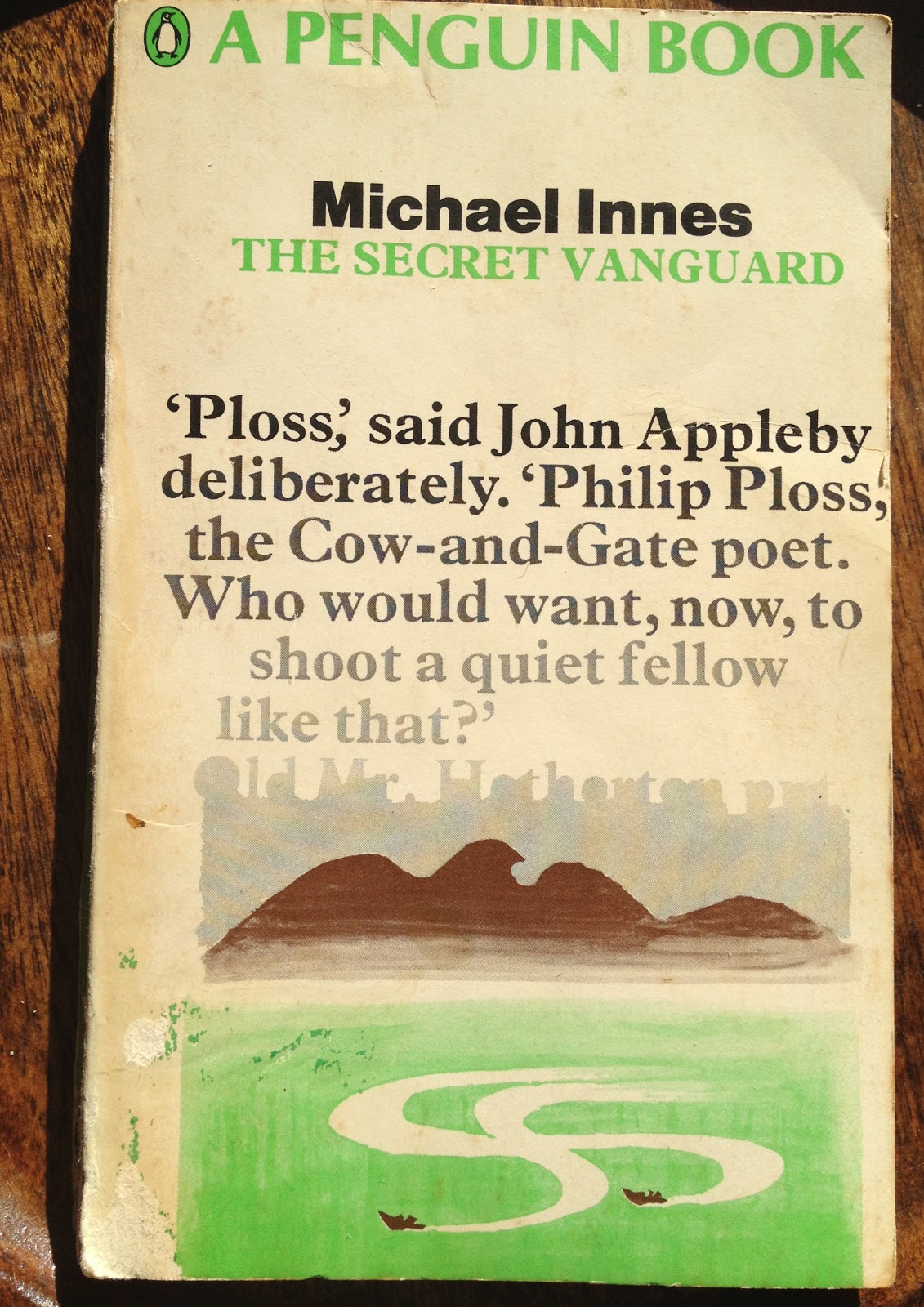
There are times when the brain shrinks and all one needs is the soothing assurance of a good friend - like, for instance, when one has a beastly cold and wants only to sit in the sun and read without being disturbed in body or in spirit. That's why I have been back at the shelves in my bedroom bookcase, the one with the neat shelves that will only hold old paperbacks (I've discussed such books before, yes?) The illustration is of my own copy of Michael Innes' The Secret Vanguard - you'll not find that on Amazon, I think, though there is a more modern printing out there - one dating from the late 1960s. The book itself was written in the early 1940s, a slim thriller rather than a detective novel, and a close relation of Buchan's The Thirty-Nine Steps.

I have been a devotee of the Buchan since before I was ten - I can picture myself reading it in the house we left in my eleventh year - and in the last few years of teaching English I read it aloud to a barely-literate class who sat with the books open in front of them: one of them sighed as we reached the end and told me, in all seriousness, That was the best book I've ever read. The Secret Vanguard is a rather more sophisticated take on the same themes of pursuit, betrayal, patriotism and looming war, and it is the sophistication of the writing that I love. As Sheila Grant, the heroine, is pursued through the Highlands by unknown foes to whom she gives wonderfully insane nicknames, the twists of the plot take place with minimal preparation: a supposed ally is suddenly a foe because he has chosen the wrong photo of himself; a haven becomes a den of villains when she reads its name upside-down on a piece of writing-paper. Innes never beats us about the head with his plot; we are expected to keep our wits about us and our inner eyes open wide to see what he is describing; we hear the tones of his educated protagonists and the mistakes made by those for whom English is a foreign language. And we never, ever, feel that the author will let us down with some clumsy over-explanation.

In many respects this is a silly book - there is no real development of character, no growth, no hidden message to send us off thoughtful. What it does do is provide the delight of impeccable prose, the absurdity of characters planted in unlikely situations, and the threat concealed under the call of a distant bird. If you've never read any Innes, this wouldn't be a bad place to start.

And then there will be so many further delights to look forward to...

*The Wikipedia entry for J.I.M. Stewart (Michael Innes) lists all his books as well as the information that he shared my birthday. I never knew that.

Friday, March 09, 2012

Another for the suitcase

I've just finished Erin Kelly's novel The Poison Tree. If you follow the link to Amazon, you can watch a short video of the author talking about the story and the impulse behind it, so in a way all I need to say it that I found it gripping, well-written and alarmingly convincing.

It's set in 1997 London and ten years later in a house on the Suffolk coast, and it is only now, as I start to write this, that I remember the Prologue that I read a couple of weeks ago, and how it set up the tension and mystery that persists throughout that long hot summer (was it hot in Scotland? - must check) and resurfaces in the later time period. This is a coming-of-age story, but it is also the story, ultimately, of a woman who has everything to lose and the strength to protect what she loves.

There is murder at the heart of the story, but until it happened I was unable to predict who would die and how. I was sometimes unable to read it at bedtime - I try to avoid over-stimulation past midnight - but I knew I was drawn into the life in the big house beside the wood and the recklessly amoral life of Biba who befriends the narrator, Karen. Kelly manages to demolish the intervening years, no matter how many, to revive our own time of hedonism and irresponsibility, whether in the '90s or - as in my case - the '60s, though on reflection I recognise my own relief at not being stranded in a life of sex, drugs, rock & roll by simple virtue of living at home. The seductive nature of such freedom and its corrosive effect creep out of the heat and the haze of spliff-smoke, all of which vanish like smoke after the evening of murder and its results.

The Poison Tree ends in the dark, in the wind, in the cold. There will be life after the story ends - but Karen is no longer who she was, in more ways than one.

Great for the suitcase.

Sunday, April 11, 2010

Journey into an old friend

I've just been re-reading Eric Ambler's thriller Journey into Fear, not in the Penguin Modern Classics edition shown here but in a Fontana edition of 1973. The book itself was first published in 1940, and there are reminders of its vintage in the length of the sentences, the complexity of the syntax, and the fact that the hero and his nemesis discuss philosophy and ancient history at length over a meal rather than have the content of their conversation swiftly summarised by the author. Graham Greene - and I'm now re-reading one of his novels - described Ambler as "unquestionably our best thriller writer", and there are similarities in style between the two writers' work. I found myself vaguely recalling that so-and-so was found dead, and that thingummyjig turned out to be a baddie, but these memories served only to sharpen the suspense, which is that of the skilfully-handled closed environment (in this case a steamer) in which the protagonists must constantly interact.

But the thing that struck me most forcibly while I was reading was the size of the book. Remember when paperbacks used to be small? Little, lightweight things that could be stuffed in a pocket? That you could read in bed without fearing a broken nose should you fall asleep while reading? When did they become large-format tomes with lots of white space and big print? I found I really enjoyed this foray into the past: the yellowing pages and 9-point text seemed suited to the slightly formal prose and the menace of travel in the early part of the war, and I remember my mother telling me that she used to send paperbacks out to Egypt for my father to read. I can imagine a small Fontana book pulled from a battledress pocket in a desert bivvie - but not a fat, glossy, self-satisfied modern edition.

More blasts from the literary past to follow ...