Showing posts with label detective novels. Show all posts

Saturday, June 30, 2012

Hamlet, revenge!

I was interested to see that at least one person had offered on Amazon the very copy of Michael Innes's Hamlet, Revenge that I have just finished reading for the first time since my teens. I first read the book - this copy of the book - when I had just been studying Hamlet for the first time, in school - for we all know Shakespeare wrote the play for Higher English students - and was firmly in its grip, to the extent of learning soliloquies off by heart because I wanted, in some way, to own the words. I have a feeling, in fact, that this would be the very first Michael Innes I read, having recently embarked on my parents' shelves of Edmund Crispin and realised the joy of the green Penguin.

I'd like to look briefly at some of the things about this old favourite that caught my attention this time round. I was pretty certain I remembered who had committed the murder, though not how or why, though there were big tracts of the detection that had escaped me. And I noted that this, like the later A Private View, is a proper detective novel as distinct from the crazier fantasies that I've previously reviewed. I have a horrid feeling that I prefer the fantasy, and have tended to become bored by the minutiae of detection presented in the more traditional examples of the genre, but I'm justifying the frivolity of my current reading matter by paying proper attention to it - should I really be thinking of a PhD in the subject?

But I digress. What actually struck me most is the realisation that I used to feel quite comfortable with the social distinctions underlined in these books - whether among the toffs at Scamnum Court or the academics at Oxford; whether poking fun at foreigners or caricaturing Scots and their way of life. Now  the word most commonly used to describe a black man leaps out of the page and the fact that it is actually being applied to an Indian academic seems doubly odd, and the affable quiddities of the Duke of Horton seem anachronistic and not to be indulged. There is the threat of the impending war (Hamlet, Revenge was first published in 1937) and there are no mobile phones. In fact, much detective fiction would not exist in its original form, it seems to me, if mobile communications had been available - when Appleby, now an Assistant Commissioner of Police, embarks on a foolhardy solo venture in A Private View, a phone in his pocket would have ended the whole escapade before it got under way.

But I am still entertained. The language is beautifully precise and stimulating - did readers of detective fiction simply have more erudition half a century ago? (or more, dammit - or more!) Or is it like Shakespeare, now the preserve of an elite but once much more widely enjoyed? Did readers read and non-readers toil merely? I am in a world that comforts strangely, despite the murders and the fogs. Perhaps it is just that it is the world in which I was young - for the fifties are a far-off land nowadays - the world in which my well-read parents provided an endless supply of reading matter to a voracious child, where escape from whatever small ills might afflict me was within reach whenever I chose to take refuge in it. (I still remember my father denying knowledge of where I was when small friends came to the door asking 'can Christine come out to play': did he know, I wonder, that I was deep in a book?)

Yes, I am still entertained. But I grow a-weary of the smell of old, yellowing paper ...

Tuesday, May 22, 2012

Old haunts again

Back at the old paperbacks again - my third Michael Innes in three weeks,  a reversion to almost-childhood with one of my favourites, Operation Pax. And before that, although I read a new book in between, I re-read Hare Sitting Up. I could remember very little of the latter; but the former - as its dog-eared appearance testifies - is another matter. Strangely, although I could remember whole chunks of the narrative, the outcome of the plot eluded me once again until I was nearing the end and began to pick up the clues that the incisive Sir John Appleby was noting.

You don't really read these books for the detection. I never did - I loved instead the frequently baroque plots and poised prose - even when I was 18, as I know I acquired this copy when it was newly out. It was the summer holidays before I began university, and I can't help wondering now if the Oxford-based setting of the plot gave me romantic illusions about the next three years.

The story is fantastical, rooted in its time (the early '50s) with ex-forces undergraduates and biological warfare to the fore. Innes recreates the language, the society and the preoccupations of the day in his books - so reading them 60 years after they were written brings a familiar echo to someone my age. (I'd be fascinated to know how a 30-something feels about them - chaps? got a moment?) And he is a master of the telling impression - the figure seen out of the corner of an eye, the sense of danger conjured up by a fleeting footstep, the shadow in the Oxford mists.  He is also the master of the literary nod: in Operation Pax the central character of the first section is Kenneth Graham's Toad if ever anyone was.

I shall doubtless soon return to modern fiction, give up the re-reading for new paths. But I have a journey coming up, the small Penguins beckon, and I feel self-indulgent and idle.

What's new?

Friday, May 04, 2012

Stylish nonsense

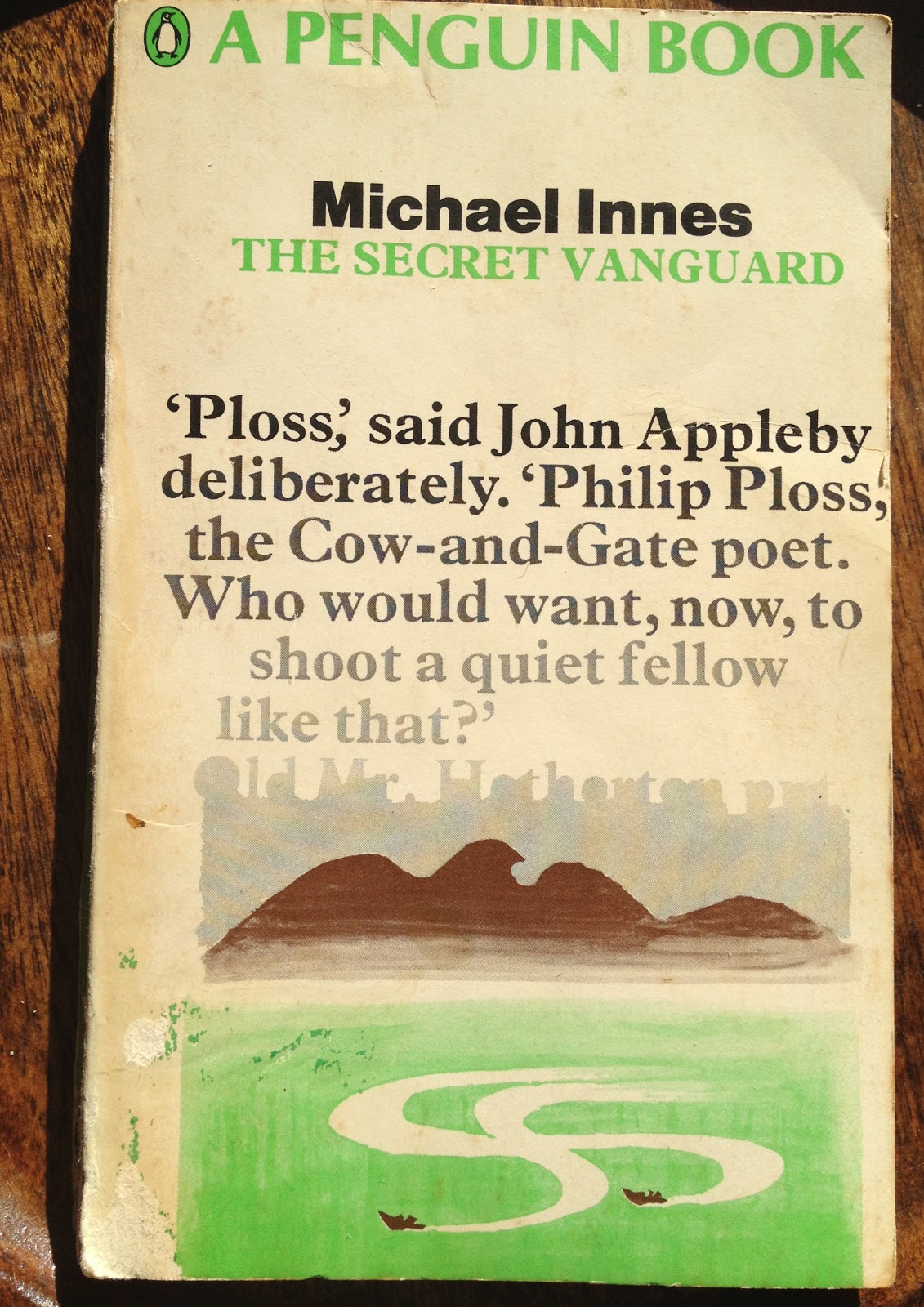
There are times when the brain shrinks and all one needs is the soothing assurance of a good friend - like, for instance, when one has a beastly cold and wants only to sit in the sun and read without being disturbed in body or in spirit. That's why I have been back at the shelves in my bedroom bookcase, the one with the neat shelves that will only hold old paperbacks (I've discussed such books before, yes?) The illustration is of my own copy of Michael Innes' The Secret Vanguard - you'll not find that on Amazon, I think, though there is a more modern printing out there - one dating from the late 1960s. The book itself was written in the early 1940s, a slim thriller rather than a detective novel, and a close relation of Buchan's The Thirty-Nine Steps.

I have been a devotee of the Buchan since before I was ten - I can picture myself reading it in the house we left in my eleventh year - and in the last few years of teaching English I read it aloud to a barely-literate class who sat with the books open in front of them: one of them sighed as we reached the end and told me, in all seriousness, That was the best book I've ever read. The Secret Vanguard is a rather more sophisticated take on the same themes of pursuit, betrayal, patriotism and looming war, and it is the sophistication of the writing that I love. As Sheila Grant, the heroine, is pursued through the Highlands by unknown foes to whom she gives wonderfully insane nicknames, the twists of the plot take place with minimal preparation: a supposed ally is suddenly a foe because he has chosen the wrong photo of himself; a haven becomes a den of villains when she reads its name upside-down on a piece of writing-paper. Innes never beats us about the head with his plot; we are expected to keep our wits about us and our inner eyes open wide to see what he is describing; we hear the tones of his educated protagonists and the mistakes made by those for whom English is a foreign language. And we never, ever, feel that the author will let us down with some clumsy over-explanation.

In many respects this is a silly book - there is no real development of character, no growth, no hidden message to send us off thoughtful. What it does do is provide the delight of impeccable prose, the absurdity of characters planted in unlikely situations, and the threat concealed under the call of a distant bird. If you've never read any Innes, this wouldn't be a bad place to start.

And then there will be so many further delights to look forward to...

*The Wikipedia entry for J.I.M. Stewart (Michael Innes) lists all his books as well as the information that he shared my birthday. I never knew that.

Saturday, February 11, 2012

Wrestling with Swedish hornets

I managed, for reasons associated with where I live, not to see the film of The Girl with the Dragon Tattoo, though I wish I had and still hope to. But at Christmas, I was given the book on the left. "You like detective stories, yes?" said Ewan. And yes, I do - right back to when I began with Edmund Crispin. So I began on my Christmas books with this one, thinking "fat book, get it read before I go on holiday". But I'd reckoned - as, I imagine, had Ewan - without the travails induced by reading the third book of a trilogy in which all the characters have appeared from the start - or so I imagine - and have, furthermore, Swedish names that stubbornly resist internal pronunciation and therefore memory.

That said, I ended up thoroughly enjoying The Girl who kicked the Hornets' Nest.  Perhaps there was an element of triumph in my enjoyment, but it meant that I ended up lugging the two-thirds finished tome all the way to Dubai in my cabin bag so that I could read it on the long flight.

Apart from the intricately worked-out plot that had me thumbing backwards to find out where the clues were laid (and to check out which Swedish name belonged to which plot element) I found myself revelling in the hacking that formed the backbone of the latter part of the story. (How sad is that?) I regretted my inadequate knowledge of Swedish geography and the lack of a map at the front of this book, and I marvelled at what Swedes seem to eat for breakfast. It was such an engrossing experience that I found myself bereft beneath the palm trees when I finished it in a late afternoon after a swim, and it was hard to start on another book - which I may also review - that evening.

Several people have offered to lend me the other two books - I shall be ready to start one in about a fortnight, the way my life is looking right now. And I want to see the movie ...

Wednesday, November 09, 2011

Another small discovery

I've mentioned before how wonderful old Penguin books are for travelling. Compact little things, with small print and little in the way of fanfare or decoration, they are just what is needed for a train journey to Glasgow, or even - as recently - a trip to the hairdresser, involving, as it does for me, a rather chancy ferry service and subsequent irritating waits when I've just missed one. The book on the right, Josephine Tey's mystery story The Franchise Affair, has been back and forward across the Clyde several times, resulting in a certain degree of dog-earing and culminating in yesterday's trip to wait for Mr B in Inverclyde Hospital. It was there that I finished it, and was so aware of the loss of my distraction that I began to make a nuisance of myself ...

But I digress. This is another book that's been on my shelf for years, and I don't know why I never got round to reading it. Published in 1948, it would have been completely contemporary in its language, mood and setting - former soldiers in all walks of civilian life but possessed of unlikely skills, life in a small English town returning to quiet normality, church and tea-shops the centre of life and gossip. The mystery concerns the accusations made against two women who live in a dilapidated big house, The Franchise, to the effect that they kidnapped and beat up the fifteen-year-old girl who accuses them. The burden of helping them falls on a local lawyer, whose quietly contented life is changed for ever as a result. The story was apparently based on a similar event from the 1800s.

I find it hard to pin down what makes me so sorry to have finished it. The language is quietly perfect, the descriptions of life in Milford, 'where the last post goes out at 3.45', effective and completely suited to be the voice of Robert Blair, bachelor, golfer and the senior partner in Blair, Hayward and Bennet. The details describe much of my childhood, so that the women in their hats and gloves step obediently into line and the subtle differences in class and breeding are as soothing as they would now seem hilariously anachronistic. Perhaps it's simply the business of feeling safe in a novel - safe from grammatical blunders as much as from any device of the plot.

The detection side of the story is less complicated and less requiring of any genius on the part of the main protagonist than many, with the result that once the last piece fell into place the result was a forgone conclusion, but the characterisation and the subsequent lives of the women and Robert himself were of sufficient interest to keep me gently involved. The novel seems at some time to have been made into a film, and I could see it being a TV series that would pander to the Downton audience (I know - there are 30 years between them, but ...). It is, however, the book I have enjoyed so thoroughly. I'm glad I discovered it, lurking there ...

Sunday, April 10, 2011

A plank of the past

I first read The Moving Toyshop in my teens. In fact, I may have been swotting for my Highers, or maybe the few O Grades I was compelled to sit in case I didn't make Higher (Science, Maths - that kind of thing). Be that as it may, I have a strong recollection of sitting in the small park in Marlborough Avenue, in the leafy environs of Glasgow's Broomhill, laughing aloud in the sunshine, to the distress  - and I think this is in itself a Crispinism - of all animate nature. And it was The Moving Toyshop that was so entertaining me that irregular French verbs didn't get a look in, though why I would be reading in the park instead of the garden I can't think - unless I knew I would be caught not swotting if I stayed at home.

I didn't read the book again - you tend to remember the plot of a 'tec if you re-read it too soon - and found that the intervening decades had in fact wiped all memory of plot clean from my slate, and left me with only the quotations that have become part of my daily discourse. I can only give a flavour here: this moment comes so near the beginning of the novel that my delight at having begun a re-read was unbounded. Cadogan, a poet, has missed the last train and hitched a late-night lift from a lorry driver. As he climbs into the cab of the lorry, this conversation ensues:

 "The Ancient Mariner did this better than me," said Cadogan cheerfully as they started off. "He at least managed to stop one of three."
"I read abaht 'im at school," the driver replied after a considerable pause for thought. "'A thahsand, thahsand slimy things lived on and so did I.' And they call that poetry." He spat deprecatingly out of the window.

I will leave the present reader to deduce what kind of life has allowed me to quote that bit of Ancient Mariner in that particular accent. Frequently.

Oh all right - I know it's a specialised sort of amusement, but it is so beautifully written - and I'd just love to replicate the moment when a bell-boy wanders through the bar of a hotel calling "telephone call for Mr T.S. Eliot" and Fen, the amateur sleuth who is also Oxford Professor of Eng. Lit., says "that's me" and leaves the room. (Oh all right again - I'd have to be Sylvia Plath or somesuch...). And it was in this very book, before I'd ever darkened the door of an Anglican church, that I learned that the Lord's Prayer at Evensong is curtailed before  "...for thine is the Kingdom..."

So there you have it. An education in itself, beautifully written, extremely silly, utterly dated - and completely hilarious. I'm going to go back to another Crispin soon ...

Wednesday, February 02, 2011

Enjoying an old 'tec

In keeping with my current preoccupation, I've dipped back into my childhood years again with this excellent Penguin Classic, The Tiger in the Smoke by Margery Allingham. I'm sorry about the blurred illustration - it's the one I found on Amazon which is identical to my own copy, and I was delighted to be able to slip it into my reticule for a flight to London last week. I've remarked before on how wonderfully practical these older Penguins are, with their small bulk and small print - have we all become averse to reading something that looks densely-packed on the page?

I first read my parents' hardback copy of this book in my early teens, and although I haven't read it since, the sense of menace lingered over the years. It's a wonderfully-written 'tec novel; the language is sophisticated and delightful and never misses a beat. I knew I would love it afresh on the first page - "The fog had crept into the taxi where it stood panting in a traffic jam" - and this Eliot-like fog is the "smoke" of the title. As a novel, it obeys the classic unities of place and time for over three quarters of its length, taking place over two days in a restricted area of London in a dense post-war fog.

The tension throughout is maintained by that fog, and by the sense that the forces of evil are somehow connected to even the most innocent-seeming protagonist in the story. And although I began to remember just as the denouement came into sight, the need to pursue the plot to its conclusion was as powerful as I can recall experiencing. This is one of Allingham's later stories involving Albert Campion, and all the better for it - though I may find myself scouring Amazon for one of the earlier ones.

If you haven't tried any of these stories, this is a good place to start. I envy you.

Sunday, January 02, 2011

Kate Atkinson, again

Just before the Christmas holiday (and yes, retired people can have them, when they give up cooking and visit their families and abdicate responsibility for their own lives) I finished reading Kate Atkinson's latest novel, Started Early, Took my Dog. I sat up late reading so that I'd finish it before Christmas took over, and I'm glad that I did - though I think I shall want to read it again.

This is the fourth book to feature Jackson Brodie, who sidles into the plot some time after I became hooked on the story of Tracy, ex-cop, security firm owner, lonely and overweight. It was Tracy and her acquisition of a child that had me reluctant to move around the plot - for Atkinson never leaves you with only one strand to follow - and Brodie and the dog that enters his life who had me laughing aloud, sometimes in horror. The story is dark in places, and complex in its interweaving of time-scales and histories, which is where the second reading will come in - I don't feel I'll fully appreciate the book until I do this. I loved the details of the past - Vesta curries, Smash instant mash - and the fact that they shared a place with the use of Twitter and Facebook. Too often, I feel, novelists opt for a present that seems never to have changed - kind of Orwellian, in a way - and forget that readers might share a past with the characters.

I don't think I've really explained why I'd recommend this, other than that it's the usual well-written, gripping story with a twist in its tail. You can see my first thoughts on it here, but apart from that just go and read it for yourself.

Sunday, December 12, 2010

An old friend rediscovered

Have you ever spent years, on and off, looking for something, becoming convinced that a malevolent guest has nicked it, or that you somehow never had it in your house in the first place, and then discovered it lurking in plain view on the bookshelf where it ought to have been all along? No. Must just be me then. The book in the picture has eluded me for ages, and now there it lies. And why would you care, do I hear you ask? Therein lies my tale - or part of it anyway.

I grew up reading this book, this very edition. It's old (published in 1937), the cloth and card cover is frayed and faded, the pages yellowing at the edges. It has a Glasgow Corporation Education Department stamp in it, but I never took it from a school - it must have been one of the many books brought home by my father to meet my insatiable demands for reading material in the days when I was always ill (and therefore stuck in bed) and devoured print voraciously. My most vivid memory is of lying propped up on one arm in bed in the tiny maid's room where I used to sleep (see post about winter, below) early on a Sunday morning, reading this and eating Pontefract Cakes. (I know - liquorice before breakfast. But it pins it down as a Sunday, for I was only allowed to buy sweets on a Saturday) The room in which I was reading means I was not yet 10 years old, for we moved house when I was 10.

So here I am, reading Conan Doyle's Sir Nigel and its prequel, The White Company (set in the period after Sir Nigel but written first) not once, but several times, in my childhood. My relatively early childhood - probably eight at the first reading. I remember that I found Sir Nigel an easier read, but that may have been the size of the print - my copy of The White Company belonged to my mother, and was printed in 1930. But having just found it, I'm reading Sir Nigel again - and marvelling. For a start, I realise how much historical knowledge I picked up from these books - and the reader isn't spared the details, or the long description, or the mediaeval ballad sung by the hero. But the main boggle is reserved for the language. Here's a wee sample:
"I am no subject of yours, proud Abbot!" he cried at last. "My house has ever been vavasor to the king. I deny the power of you and your court to lay sentence upon me. Punish these your own monks, who whimper at your frown, but do not dare to lay your hand upon him who fears you not, for he is a free man, and the peer of any save only the king himself."

No wonder I grew up with a grasp of English that I never found in my pupils. "These your own monks"! Wow! And the complexity of the syntax - and I never questioned, never faltered, for I was caught up in the story and had already fallen for Nigel - and I'm only on page 54. And randomly, from page 307, I find the sentence: "Then it was he that I heard behind us". Not much chance of mixing up subjects and objects and the anomaly of the verb "to be" after that lot, was there?

I could go on, but life calls. I must just point out that what sent me looking for this was a summer holiday in the early '90s, in Benodet on the coast of Brittany. A wet day sent us driving inland in search of the sun. We found it - in Josselin. And the name tweaked at my memory, and sent me to the Michelin guide. Sure enough, the monument to the Bataille des Trentes - if you've looked up the first link, to Wikipedia, you'll find out about this - was close by. Actually it took some finding, being stuck between two bits of motorway down a narrow lane, but it was there, and I had never really known it was real. We looked, we came home, and I went hunting the book. I couldn't find it. I don't know why or how it has returned to my shelves, but I am glad to see it.

Right glad, in fact - the language is getting to me.

Wednesday, December 08, 2010

The anatomy of enjoyment ...

I've dragged myself away from the latest Kate Atkinson (Started Early, Took my Dog) partly in an effort not to gallop through it too swiftly (memories of childhood again: after the Saturday trip to the library I had to be careful to leave myself at least one book for the school week evenings), partly to note what I'm so enjoying in the process of exposition that I'm currently reading.

So - I note the skill with which the characters are introduced and are linked, like a flow-chart or the diagram of some organic chemistry process (very dimly recalled from school), as someone on the fringes of one character's observation becomes the focus of the next chapter, and so on. And I love the skill with which the necessary details are drawn in - the mental asides, the references to each character's past which give us just what we need to empathise, but never enough to bore with superfluity. I already feel I know two new people, as well as having a progress update on her recurring hero, Jackson Brodie (clever, that, to ensure that a newcomer to her books will know enough, without boring the afficionado).

And the writing. I now recognise what's going on - the fluidity of syntax which sits comfortably with the internal monologue that is part of all our lives, that conveys context and emotions, reaction and reasons. Much of it uses what in another context might be regarded as a spot of comma-splice, but it isn't: the stream of consciousness rarely makes mistakes but rather defies the rigidity from which in another life I fought to release my students.

Right. I think I'm about to have another Lemsip and read some more. But can I share one final joy? I'm reading the book in hardback (it was a gift) - and it has its own silky attached bookmark, like the ones in a lectern bible. How civilised is that?

Wednesday, October 13, 2010

Guilty pleasures

Just spent a guilty hour (reading fiction in the afternoon - heavens) finishing one of my birthday books. What's a girl to do, when her sister gives her three novels and a box of sinfully melting chocs? Reader, I did it. Blame the post -injection lassitude if you like. I still feel guilty.

Trouble is, Kate Atkinson is so gripping. She has a wonderful way with atmosphere, with weaving stories in such a way that though you suspect there will be connections you can't for the life of you see where they lie ... I'm hooked. I'm getting to know Jackson, the retired cop, retired soldier, dispirited investigator with the sad history that's revealed only piecemeal - and I'm beginning to ache with his toothache, sympathise with his undramatic acceptance of the misfortunes that keep careering through his life.

I've always loved a good detective novel, ever since I found Edmund Crispin and Michael Innes in my parents' bookshelves, going on through Dorothy Sayers to P.D. James. My tastes tend to the literary, so Agatha Christie was never a starter, not even when I was fifteen. Now I've discovered a new seam to mine, and I'll have to resist starting another one right away. Case Histories is a complex, moving tragi-comedy, so if you've got a holiday coming up, or a duvet day, or simply a nice box of chocs waiting for your attention, go for it.

Enjoy the guilt!

Saturday, January 10, 2009

Sic transit dies ...

I'm glad today has darkened into evening - it's barely been more than crepuscular all day and after the fun of watching the waves drown the rash cars venturing along the front this morning (above) the tide receded and I had to work. And after hours at the computer writing the minutes of a meeting in November - I should'a done them immediately - I was left with a numb behind and a numb brain. I feel marginally better after a walk in the dark - it's still quite dramatic out there, with the shingle roaring under each breaker.

And I've finished my book. The Private Patient by P.D. James has been a companion for the past week or so, in the quieter aftermath of the Christmas socialising, and I feel the regret that I always feel by the time the relationship comes to an end. There are hints towards the end of the novel that Adam Dalgliesh wonders if this case will be his last as he moves into a new phase in his life; I wonder if the author herself wonders how many more novels she will write.

This one has all the hallmarks of a successful mystery - the closed environment, the limited cast, the revelation of past complications and red herrings. But more than any of these I relish the depth of characterisation of the regulars - Dalgliesh the poet-detective, Kate his number two - which is sketched in with economy and a light touch. And I enjoy reading a book where I don't have to worry about infelicities of style or syntax: James is in full control of both.

Actually, the euphoria of the found music has made today bearable despite weather, minutes and THE END - heaven only knows what it'd have been like if we'd still been searching.