I was interested to see that at least one person had offered on Amazon the very copy of Michael Innes's Hamlet, Revenge that I have just finished reading for the first time since my teens. I first read the book - this copy of the book - when I had just been studying Hamlet for the first time, in school - for we all know Shakespeare wrote the play for Higher English students - and was firmly in its grip, to the extent of learning soliloquies off by heart because I wanted, in some way, to own the words. I have a feeling, in fact, that this would be the very first Michael Innes I read, having recently embarked on my parents' shelves of Edmund Crispin and realised the joy of the green Penguin.
I'd like to look briefly at some of the things about this old favourite that caught my attention this time round. I was pretty certain I remembered who had committed the murder, though not how or why, though there were big tracts of the detection that had escaped me. And I noted that this, like the later A Private View, is a proper detective novel as distinct from the crazier fantasies that I've previously reviewed. I have a horrid feeling that I prefer the fantasy, and have tended to become bored by the minutiae of detection presented in the more traditional examples of the genre, but I'm justifying the frivolity of my current reading matter by paying proper attention to it - should I really be thinking of a PhD in the subject?
But I digress. What actually struck me most is the realisation that I used to feel quite comfortable with the social distinctions underlined in these books - whether among the toffs at Scamnum Court or the academics at Oxford; whether poking fun at foreigners or caricaturing Scots and their way of life. Now the word most commonly used to describe a black man leaps out of the page and the fact that it is actually being applied to an Indian academic seems doubly odd, and the affable quiddities of the Duke of Horton seem anachronistic and not to be indulged. There is the threat of the impending war (Hamlet, Revenge was first published in 1937) and there are no mobile phones. In fact, much detective fiction would not exist in its original form, it seems to me, if mobile communications had been available - when Appleby, now an Assistant Commissioner of Police, embarks on a foolhardy solo venture in A Private View, a phone in his pocket would have ended the whole escapade before it got under way.
But I am still entertained. The language is beautifully precise and stimulating - did readers of detective fiction simply have more erudition half a century ago? (or more, dammit - or more!) Or is it like Shakespeare, now the preserve of an elite but once much more widely enjoyed? Did readers read and non-readers toil merely? I am in a world that comforts strangely, despite the murders and the fogs. Perhaps it is just that it is the world in which I was young - for the fifties are a far-off land nowadays - the world in which my well-read parents provided an endless supply of reading matter to a voracious child, where escape from whatever small ills might afflict me was within reach whenever I chose to take refuge in it. (I still remember my father denying knowledge of where I was when small friends came to the door asking 'can Christine come out to play': did he know, I wonder, that I was deep in a book?)
Yes, I am still entertained. But I grow a-weary of the smell of old, yellowing paper ...
"Blether - n. foolish chatter. - v.intr. chatter foolishly [ME blather, f. ON blathra talk nonsense f. blathr nonsense]" - Concise Oxford Dictionary.
Showing posts with label Michael Innes. Show all posts
Saturday, June 30, 2012
Tuesday, May 22, 2012
Old haunts again
You don't really read these books for the detection. I never did - I loved instead the frequently baroque plots and poised prose - even when I was 18, as I know I acquired this copy when it was newly out. It was the summer holidays before I began university, and I can't help wondering now if the Oxford-based setting of the plot gave me romantic illusions about the next three years.
The story is fantastical, rooted in its time (the early '50s) with ex-forces undergraduates and biological warfare to the fore. Innes recreates the language, the society and the preoccupations of the day in his books - so reading them 60 years after they were written brings a familiar echo to someone my age. (I'd be fascinated to know how a 30-something feels about them - chaps? got a moment?) And he is a master of the telling impression - the figure seen out of the corner of an eye, the sense of danger conjured up by a fleeting footstep, the shadow in the Oxford mists. He is also the master of the literary nod: in Operation Pax the central character of the first section is Kenneth Graham's Toad if ever anyone was.
I shall doubtless soon return to modern fiction, give up the re-reading for new paths. But I have a journey coming up, the small Penguins beckon, and I feel self-indulgent and idle.
What's new?
Friday, May 04, 2012
Stylish nonsense
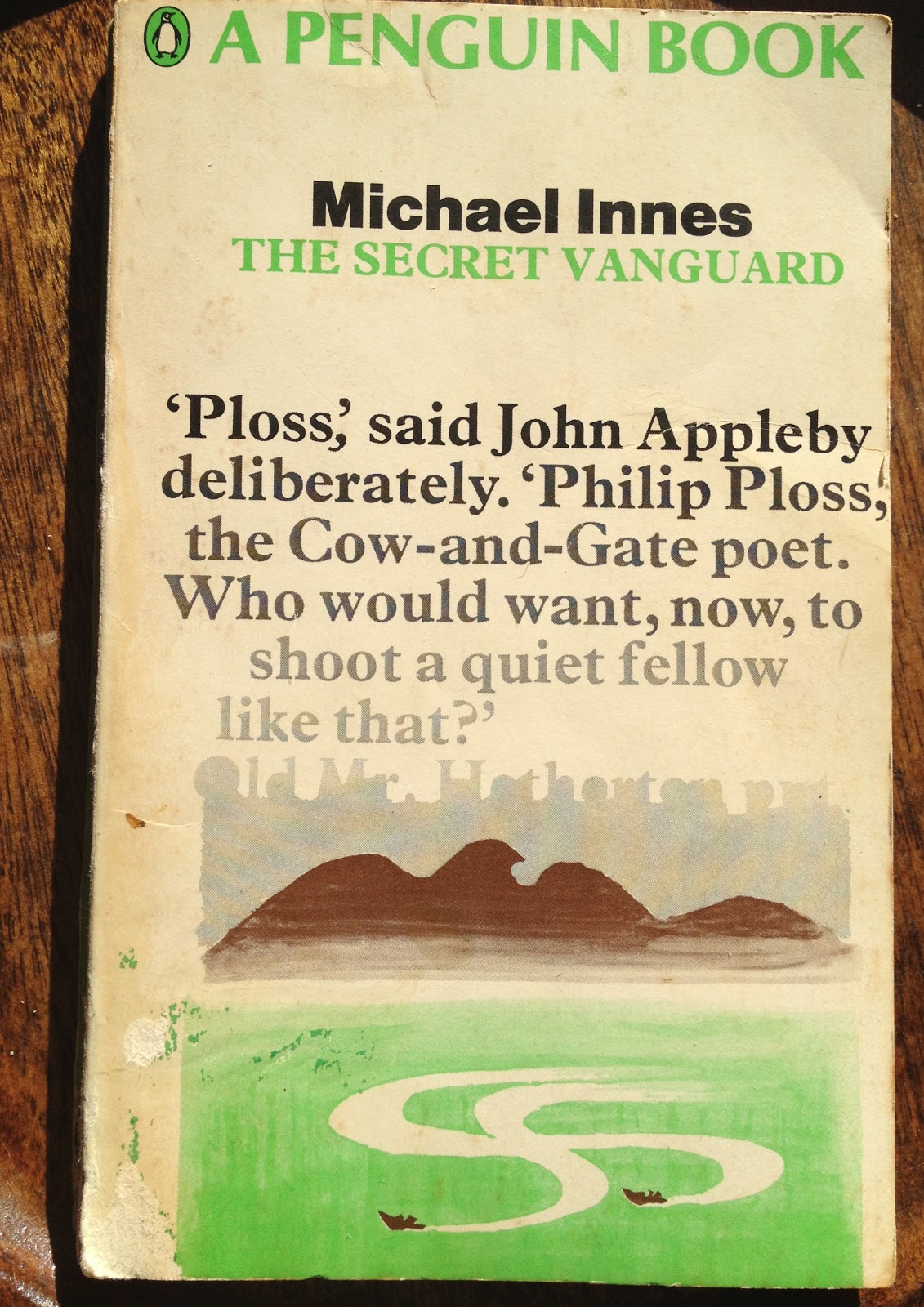
There are times when the brain shrinks and all one needs is the soothing assurance of a good friend - like, for instance, when one has a beastly cold and wants only to sit in the sun and read without being disturbed in body or in spirit. That's why I have been back at the shelves in my bedroom bookcase, the one with the neat shelves that will only hold old paperbacks (I've discussed such books before, yes?) The illustration is of my own copy of Michael Innes' The Secret Vanguard - you'll not find that on Amazon, I think, though there is a more modern printing out there - one dating from the late 1960s. The book itself was written in the early 1940s, a slim thriller rather than a detective novel, and a close relation of Buchan's The Thirty-Nine Steps.
I have been a devotee of the Buchan since before I was ten - I can picture myself reading it in the house we left in my eleventh year - and in the last few years of teaching English I read it aloud to a barely-literate class who sat with the books open in front of them: one of them sighed as we reached the end and told me, in all seriousness, That was the best book I've ever read. The Secret Vanguard is a rather more sophisticated take on the same themes of pursuit, betrayal, patriotism and looming war, and it is the sophistication of the writing that I love. As Sheila Grant, the heroine, is pursued through the Highlands by unknown foes to whom she gives wonderfully insane nicknames, the twists of the plot take place with minimal preparation: a supposed ally is suddenly a foe because he has chosen the wrong photo of himself; a haven becomes a den of villains when she reads its name upside-down on a piece of writing-paper. Innes never beats us about the head with his plot; we are expected to keep our wits about us and our inner eyes open wide to see what he is describing; we hear the tones of his educated protagonists and the mistakes made by those for whom English is a foreign language. And we never, ever, feel that the author will let us down with some clumsy over-explanation.
In many respects this is a silly book - there is no real development of character, no growth, no hidden message to send us off thoughtful. What it does do is provide the delight of impeccable prose, the absurdity of characters planted in unlikely situations, and the threat concealed under the call of a distant bird. If you've never read any Innes, this wouldn't be a bad place to start.
And then there will be so many further delights to look forward to...
*The Wikipedia entry for J.I.M. Stewart (Michael Innes) lists all his books as well as the information that he shared my birthday. I never knew that.
I have been a devotee of the Buchan since before I was ten - I can picture myself reading it in the house we left in my eleventh year - and in the last few years of teaching English I read it aloud to a barely-literate class who sat with the books open in front of them: one of them sighed as we reached the end and told me, in all seriousness, That was the best book I've ever read. The Secret Vanguard is a rather more sophisticated take on the same themes of pursuit, betrayal, patriotism and looming war, and it is the sophistication of the writing that I love. As Sheila Grant, the heroine, is pursued through the Highlands by unknown foes to whom she gives wonderfully insane nicknames, the twists of the plot take place with minimal preparation: a supposed ally is suddenly a foe because he has chosen the wrong photo of himself; a haven becomes a den of villains when she reads its name upside-down on a piece of writing-paper. Innes never beats us about the head with his plot; we are expected to keep our wits about us and our inner eyes open wide to see what he is describing; we hear the tones of his educated protagonists and the mistakes made by those for whom English is a foreign language. And we never, ever, feel that the author will let us down with some clumsy over-explanation.
In many respects this is a silly book - there is no real development of character, no growth, no hidden message to send us off thoughtful. What it does do is provide the delight of impeccable prose, the absurdity of characters planted in unlikely situations, and the threat concealed under the call of a distant bird. If you've never read any Innes, this wouldn't be a bad place to start.
And then there will be so many further delights to look forward to...
*The Wikipedia entry for J.I.M. Stewart (Michael Innes) lists all his books as well as the information that he shared my birthday. I never knew that.
Subscribe to:
Posts (Atom)