Showing posts with label holidays. Show all posts

Sunday, September 14, 2014

Normandy Fahrt: Day 1


I've been away. And although I've been back for several days now, my days in Normandy are still very much with me - so much so that I feel a diarist's approach might be better than trying to encompass everything in one post. So here we are with Day1: the journey...

By the time the 2014 Fahrt (German for 'journey', natch, but capable of other interpretation) arrives on the Continent, it has already been on the road for 24 hours. (Collective noun in use, as well as 'road' standing also for 'sea'). Around 40 people have been gathered into a coach from Linlithgow lay-byes, Asda carparks and the like and driven to Hull - a city which, as Philip Larkin apparently observed, people only visit if they have business there. Our business was the P&O ferry to Zeebrugge, on which we had booked basic cabins (no porthole, bunk beds). Some of us chickened out of this and paid for upgrades ... The food and service were excellent; most of us have slept. I have not. I blame the decaff. I think it wasn't.

But onward. Onward south and west, into France and on to the Chateau du Molay, where we are staying in the accommodation usually used by school trips. We have visited our first war graves, in the War Graves Commission cemetery in Bayeux (above). There we have laid a wreath in memory of a Linlithgow soldier buried there, and have been moved by the sight of so many graves and the sound of the Last Post echoing through the birdsong of early evening. (Mr B had his iPod and Bose dock with him). I am forcibly struck by the dates of birth on so many of the stones - so many of these soldiers had been born in the years when my parents were born and I realise that we represent the children they never had.

We soon find, Mr B and I, that although we have to consign our luggage to the lift and will henceforth be scampering up 3 flights of stairs to reach our room, which is in the roof and has a Velux window, we are blessed with two single beds (some rooms have multiple bunks) and a kettle. I even seem to have a feather pillow. My cup is already full before I eat; the rest of me is soon full of an excellent dinner. The noise level in the dining room is startling. Mr B and I slip out as the Fahrters head for the bar. Outside, the moon is shining and it is silent apart from the residual hum in our ears. The chateau looks romantic and peaceful. It is going to be a good Fahrt.


Sunday, June 01, 2014

Turkish saga - not a Saga holiday

I'm going to tell you a story. It's a true story, and it's already been told  in the form of a letter to a holiday company, but I feel the need to tell it with less restraint. Are you sitting comfortably? Then I'll begin ...

Kayaköy
It's another glorious day in the area of Fethiye, Turkey, the second last day in a week of guided walking among the hills of the this beautiful place. Our group, the one doing the more challenging walk of the day, has enjoyed a morning hike over the hills into a lovely valley, a lunch of mezze and beer and Turkish coffee, an amble down the road to see some Lycian tombs. Now we are going to be taken to the entrance to the deserted village of Kayaköy, where our Turkish guide will show our leader - who is new to the area but has a map, of sorts, and instructions - which route to take in order to end up on the right path to get us all, eventually, to the Blue Lagoon at Olu Deniz. So far, so ...

So bloody disastrous, actually. For this is where the story really begins. Bear with me.

We feel we're  being rushed through Kayaköy, the village that inspired Louis de Berniere's novel "Birds without Wings", a sad, ghostly testament to the folly of politics. If we were closer, we might be able to see our leader's worried expression and be worried ourselves - for we know he's already lost the way on an earlier walk. But we take our photos, and wonder where the church is, the one we're supposed to be able to see inside, and by the time we arrive at the upper limits of the village the onward path has been chosen and we're ready to head out of the valley and down to the sea.

For a while, it seems ok. Even when we have to retrace our steps uphill when a chosen path (all way- marked, but with varying degrees of authority) proves to be leading in the opposite direction to the way we want to go, even then we feel we might be heading, eventually, to the Blue Lagoon. After all, is that not sea ahead, is it not vivid blue, is that not a pleasure-boat we can see through the trees ...? And we come to a halt.
Not the Blue Lagoon

We are on a small cliff, beside a stone water-cistern. The path leads to the left - the correct direction - and peters out. We try a short foray, return to the cistern. Our leader by this time has disappeared down the hill. Someone has heard him mention a boat. We think it's a joke - but hey, that big pleasure-yacht-thingy is still moored below us, belting out pop music. We sit on the ground under the trees; we drink some water; some of us obey the call of nature. I check my phone - great signal, so can see Google maps ... and we're a very long way indeed from where we should be. I point this out to a few people, but it is a rule on these holidays that the Leader has to be followed and obeyed or the company takes no responsibility for you. (We later learned that the Turkish guide had been told to accompany us to the start of the hill path. Had he misunderstood?)

And so it is that we find ourselves on a small beach, with the promise of a boat. The large boat with the music is preparing to sail - but to sail out of the bay, not towards us. We can see an inflatable dinghy beside a jetty; there is a rowing-boat, and there is a speed boat with an outboard motor. We are still making jokes, wondering how many will be left behind, when a man in a sports jacket appears magically (I must have been looking elsewhere; it seems magical) in the speedboat, fires up the engine, makes a showy sweep round the headland and returns to the jetty: our lift.
Waiting for the speedboat

The boat looks ... small. I later find it has a maximum capacity of 10. We are twelve, and we have rucksacks, walking boots and poles. Somehow, we are all squeezed onto the hard plastic seats and told to hang on. Some manage to get their packs off; mine is still fastened firmly to my back. There is not a life preserver to be seen - other than the decorative traditional lifebelt in front of the tiny wheelhouse. We move away from the jetty. The man driving us turns to me. "You will get wet," he says.

I shrug. What can I do? The woman next to me gives me a spare jacket to cover my camera, make me feel better, just as a wave curls over the boat and soaks me, and her, and the other two women in the stern. The engine roars as we hit the open sea and the open sea hits us. Through sea-streaked sunglasses I can see Mr Blethers and our friend Leo, who is next to him, rise into the air as the prow lifts with the acceleration. He seems to bounce, crash down again. I duck as more sea heads my way. When I look again Leo is crouched in the bottom of the boat. She later told me she'd slid off the seat and at that point was untying her boot laces in case she ended up in the sea. To port (notice the nautical terminology), uncomfortably close, there is a grey rocky cliff - the end of the promontory we'd have had to walk over had there been a path. To starboard, the large pleasure-boat, still playing pop music, scooshes along, swifter even than us, adding its wake to the turbulence of the open sea. I can see people looking at us, smiling. I have no spare energy to curse them.

I don't know how long this goes on. There is little to hold on to, and I am soaked. I have my hat clasped over my camera which is strapped to my chest; my poles are in my left hand and with my right I'm straining to keep hold of the plastic side of the hull (fibreglass?) I feel there is a strong possibility that I may throw up. Then the engine slows, and the sea stops coming in beside us: we are in Olu Deniz bay and the beach lies ahead. The beach ... sloping quite steeply into the waves, which are breaking enthusiastically, the beach where there is ... no sign of a jetty.

Before the significance of this can register, I become aware that our gallant rescuer, still unsullied and unsoaked in his sports jacket, is on his phone. And gradually, as we cruise in gentle circles just beyond the surf, we realise that he is negotiating our transfer to another boat, one with a prow gangplank that will let us land without risking his boat. The first to offer is rejected as being too high out of the water, with no scramble nets (come on, you're joking ...) but another, smaller craft is approaching. (I'm a strong swimmer. Would it be better to swim?)

Now I need you, dear, empathising reader, to picture this moment. You may have been lulled into imagining a boatload of fit, lithe forty-somethings having an adventure, but it's time for the reality check. There may be as many as four of us under the age of 60, though I doubt it. I know that at least three are 70 or over, and that the oldest is 75. Normal pensioners we are not - we have already hiked at least 40 miles of Turkish countryside over the past four and a bit days. But transferring from a small boat to a larger one in a lumpy sea is not easy, and this is a truly unpleasant moment.

I am in the last four to make the transfer, as we have been in the stern. I have just watched the oldest of our group, an indomitable Irish Californian woman, launch herself onto her belly on a table in the bigger boat. Now it's my turn. As our boat rises on a wave, our driver shouts "Go, lady!" I put my foot onto the side of the bigger boat, shove my poles ahead to give me two free hands, grab the rail of the big boat. At that moment, the speedboat - and my left foot, on which my weight is still balanced - drops a couple of feet and I am left stranded, hanging on like grim death, my right foot on the big boat, my rucksack pulling me back,  and my right knee bent at a tighter angle than it's experienced in a decade. I can see Mr B's anxious face suddenly vanish as he is pushed aside by some macho soul, then a young Turkish seaman grabs my belt and pulls and I find myself sprawled in the bar of the boat we've boarded.
Preparing to land

It isn't quite over - no sooner are we all aboard when the cry goes up that we've to remove our boots and prepare to enter the water. (After all that ...) The gangplank can't reach the beach, but is waving in the air about four feet out in the surf. So I end up edging along an increasingly slippy gangplank, now holding my boots and socks in one hand (along with my poles) and the rail of the gangway in the other. The Normandy landings flash into my mind as I take the hand of a seaman and jump - and find myself scrabbling up the shingly sand onto dry land.

And there, best beloved, I shall leave us, lying like beached whales in a row just above the surf line. It has not been what we signed up for, on this walking holiday, but I will admit one thing.

It makes for a great story ...

Friday, February 21, 2014

A high old time ...


Before it vanishes into the dream-like recesses of memory, a few words on our January holiday. We were walking with a holiday company called HF - no reason for originally choosing this lot other than the name, familiar from my parents' tales of pre-war holidays in the Highlands, but now a firm favourite. We had a week in Gran Canaria, staying in Puerto de Mogàn, which is apparently one of the prettiest of the former fishing villages on the south coast. As I've found on previous winter breaks in the Canaries, I think I would soon have been bored had we spent the entire week in this pretty village - there was a beach, and it was sunny, and there were cafés and tapas bars, but ...

But in the interior of the island there were mountains. A fantastic, volcanic landscape of huge calderas and bright green and red streaks of volcanic deposits, of steep-sided valleys and beautiful villages high on the shoulders of the mountains, where the almond-blossom told of much longer hours of sunshine than their opposite numbers far below. We spent five days walking there on wonderful paths - not your Munro-baggers' paths to a summit here or a distant peak there, but real paths built for communication, for mules and donkeys and people to pass between the valleys and the villages. Dramatic balcony paths used the split between two layers of rock to creep across the precipitous hillside; the occasional levada carried water across dry high plateaux. And we were able to walk here, to traverse ridges and ascend peaks and come down in quite another valley from where we had started, because we were being guided and because we knew that the mini-bus would turn up for us in some village square at an appointed time and whisk us back to our hotel.

I loved every minute of it. The walks, as promised, went on getting better as the week progressed, culminating in a hike to the dramatic Roque Nublo in the geographic centre of the island - we could see El Teide on Tenerife floating in the blue west from our path as we walked.  Our two leaders - for there are always two groups, so that the less energetic can choose a less strenuous option - were wonderful, setting just the right pace so that we progressed without feeling pressured, covering the miles with an easy stride that left plenty of energy for the hilarity that seemed to accompany us wherever we went. (It might give some flavour of said hilarity that one day was occupied by an argument as to whether or not Paul was riding a beast at the time of his conversion on the road to Damascus ...)

Most of our pick-up stops had a café, but whatever the day brought it ended in icy cold beer before we changed out of our boots and dusty clothes. We would march into our hotel bar like something out of a Western, and line up along the counter. Then the inevitable baths/showers/cups of tea/making sandwiches for the next day before the evening briefing and the scamper down to the neighbouring hotel for dinner. (Our hotel, where we had whole apartments as opposed to mere bedrooms, was refurbishing its dining room). We ate prodigiously and went to bed early. And then we'd rise in the chilly dawn (for it was chilly at 6.30am!) and start all over again.

We must have walked between 50-60 miles that week, and climbed or ascended several thousands of feet (people kept talking, confusingly, in metres ...). We were fit, and we all caught the sun despite our shady hats. I loved every minute of it. And I've just booked another HF holiday for May ...

Friday, September 27, 2013

Ruins, wild goats and a grey Fiat


 The real journey in Sicily began in a car. A not-very-comfortable, faintly tatty Fiat in battleship grey. We picked it up at Catania airport, drove south for 40 minutes, saw the red oil warning light, stopped at a petrol-station cum café. Several phone calls and a coffee later, we drove back to the airport, to be told all was well and it was the computer. We drove off again. The picture on the left shows the last stretch of two-way road, with a wonderful set of stations of the Cross leading to an imposing - what? Church? Convent? Sanctuary? (it was called that). After that, the road became single-track, without passing-places, rounding a gorge and crossing a worryingly small bridge until I suddently recognised the road I'd followed on Google Earth. We found the entrance, dogs barked, I phoned the number we'd been given. How did we get in?

But we did. We had arrived at Borgo Alveria, a collection of buildings on the site of an ancient monastery, destroyed in the earthquake of 1692 but rebuilt using so many of the original stones that we kept finding stray heraldic devices in the middle of the garden wall, and bits of pillars randomly deployed as garden ornaments. Our room (above) was amazing: I could have climbed some of the walls, and the bathroom was a cast iron cube in the corner with a glass ceiling through which you could see the rafters of the entire room. At night, lights came on in the grounds until midnight; after that it was dark and totally silent. During the day the most noticeable noise was that of the cicadas. It was blissful.

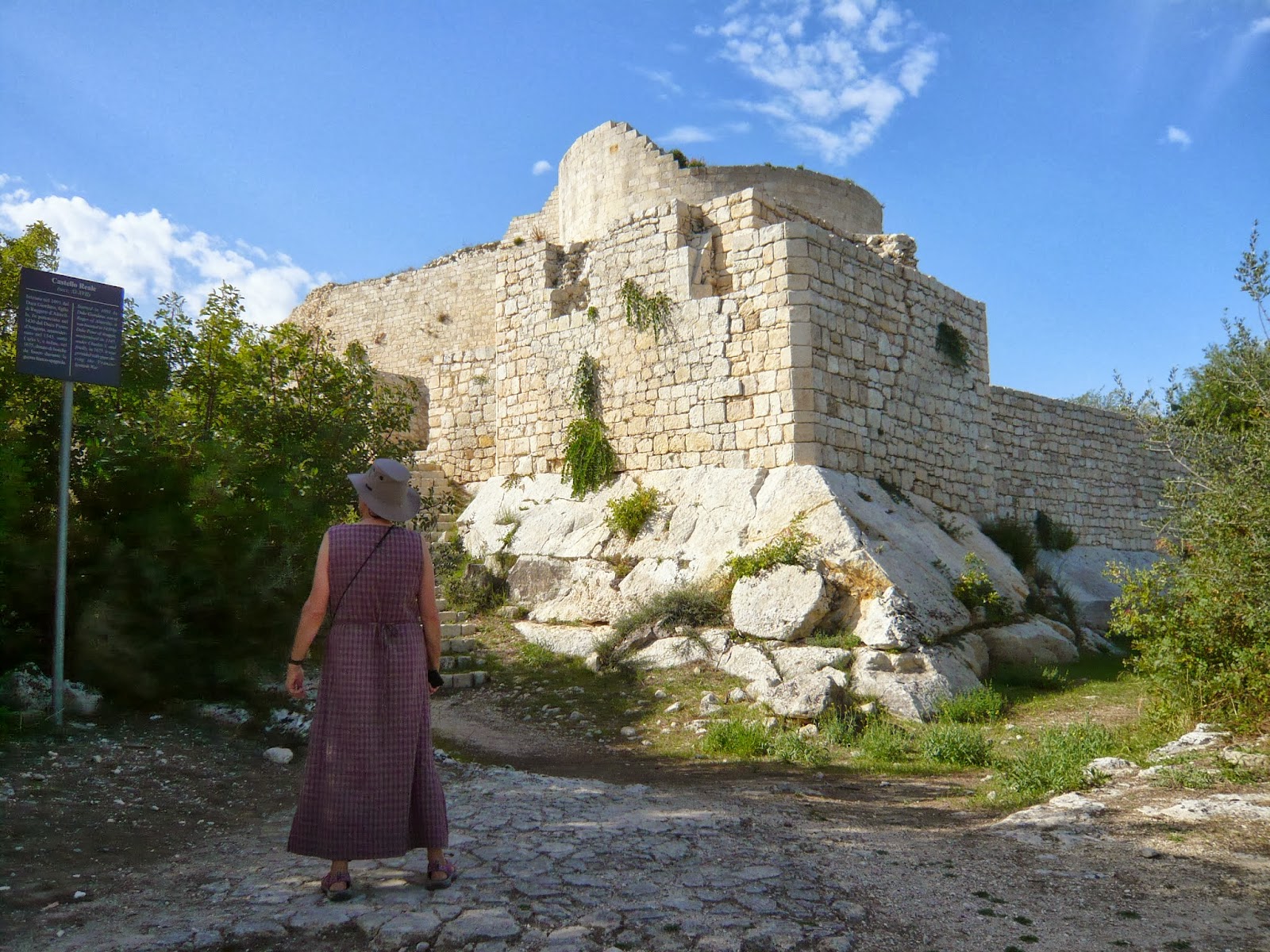
There were two Notos in our area - the baroque town twenty hair-raising minutes away by car (see above) and the other, Noto Antica, which was ten minutes from our door on foot. It wasn't just because we could walk there that I loved the latter - a whole walled town, destroyed by the earthquake and just left there, the inhabitants told to abandon the shanty town that they made in the aftermath of the destruction and some of the stones removed, as far as I could determine, to use elsewhere. We walked for hours among the vegetation that would suddenly reveal the shape
of the Jesuit college or some great palace, and we saw hardly a soul.
The picture on the left is of the partially reconstructed Porta Aurea taken from inside the gates, and the one below of the castle and prison to the left of the gate inside. I fear we were perhaps odd in our attitude to our surroundings - we preferred walking in the wooded area around the ruins, a sort of natural parkland which started opposite our front gate and wandered down towards the old city through a variety of trees - eucalyptus, conifers - which smelled wonderful in the sun. There were wild goats that popped up to look at us, cicadas by the thousand in the trees, birds singing and sailing
 above us, and lizards darting everywhere.On Sunday the stone tables and solid BBQ areas near the road were thronged with families enjoying a day out together - some of them stayed for hours, and the small children played quietly or slept in shady corners while the men did manly things with fires and grew increasingly vocal. We didn't walk in the woods on Sunday ...

We did make a couple of excursions. We felt people might remark our oddity if we didn't see anything but our immediate surroundings - would they think we should just have stayed in Scotland? So we drove to Ragusa Ibla, a four-hour drive for two hours in a town that
apparently features in Inspector Montalbano. We missed the best road
on the way there - the sign for it was hidden in a tree, a common feature of route-finding in Sicily - but persevered over a massive viaduct and through the fringes of the modern town till we found the proper car-park, with the steps up to the old city just as we'd been promised. This was another earthquake story, except that the inhabitants of the old town of Ragusa insisted on staying put. We also spent a fascinating day in Palazzola Acreide, where extensive Greek ruins sit on top of a hill, in Akrai. And yes, it was to Akrai that we toiled up the hill in the midday heat, and we spent a wonderful time wandering round the Greek Theatre from the 3rd century BC and various catacombs and carvings.

A common feature of all our jaunts was angst about the car. Not only did the oil warning light stay on throughout the week; when we were in Palazzola Acreide - actually in a sort of housing scheme on the outskirts, where we had originally thought of abandoning the car because there was plenty of parking space - we discovered that the footwell on the driver's side was ... wet. Very wet. Wet and slippery. After a brief period of panic we decided it was water from the air-conditioning, which we ran constantly. Its jet must have become blocked. We never found out. And then there was the matter of where we left the car. Our first trip down to Noto saw us more or less abandoning it in the second street we passed that seemed to point in the right direction. We had walked two blocks downhill when the thought struck us that we might never find it again. Back we toiled. I took its photo. I noted its number on my phone. I dropped a pin on Google Maps, thereby discovering the name of the street - for signs with this helpful information are rare. And we noted that the building we had to pass on our return seemed to be a prison, housed in a former monastery. I took to following this routine every time we left the car anywhere. A dusty grey Fiat in Italy is hardly a stand-out, after all.

That all sounds very stressful. I know. On day one, it was. But by the time we left I felt sorted. The sun shone, the mellow stone was the perfect colour, I discovered granita, my Italian, supplemented by French, seemed to be working. The car was never comfortable, and the road was always a challenge, but our hilltop Borgo was heavenly and the company right up our alley. When we snuck out in the rosy-fingered dawn (Homer was right, by the way) I didn't want to leave.

I'd have wanted to leave even less had I known how we were going to get lost finding the road back to Catania, and the twelve-year-olds on the moped who finally got us back onto the right one, but that's another story ...


Friday, July 12, 2013

Of minnows, flounders and me


I've decided I'm a simple soul, really. The picture above - and that's my footprint on the right - represents a perfect end to a perfect week and we've hardly spent a penny on all this perfection. I climbed a hill (Beinn Donich) on Monday, walked the Crinan Canal on Wednesday, and finished off with what must be the seal-setter on the proper Scottish holiday experience: I swam in the sea and it was warm. There were shoals of minnows, tiny flounders, and the odd crab. Oh, and some of these wee clear jellyfish with the purple bits that we used to throw at each other. It's an odd sensation to hit one when you're swimming. I wished my grandchildren could have been there, because they would have loved it, but I had fun doing my own thing.

When I say we didn't spend much, I'm glossing over two sizeable drives, one to Lochgilphead and one to the beach which is the gem of Argyll's Hidden Shore (yes, it's a tourist description) - but we began and ended each day in our own house and bought no tickets and only modest food. But this afternoon I was ecstatic, to get a swim at the time of year when the childhood holidays demanded and with Arran, my favourite place in the world, on the horizon. Better still, we had to walk a mile to reach the beach - just as I did in my car-less childhood.

Is it what you do in childhood that in the end demands you return to these experiences? When I was a small child we spent 8 weeks in Arran every summer, in the same cottage, doing the same things. On days such as today, we went to the beach and went into the sea. Other days we climbed hills or walked the glens. We came home in the evening to boiled eggs, floury muffins with strawberry jam - this last memory is so powerful that today I found myself thinking of a boiled egg despite having had one for lunch. We would never eat what I've just cooked and eaten (baked salmon of some splendour, strawberries ditto, a nice crisp white wine), though I suspect I'd miss the step up in culinary standards these days.

But I rabbit on, and I'm tired and sun-sated. I've showered away the salt (it doesn't half prickle under your shirt, especially on a bit of sunburn) and shaken the sand out of my sandals. I feel as if I might still be ten years old. I believe the weather is going to be different tomorrow, and I shall be off to Rothesay for work, not pleasure. But I don't care.

Tonight is good, and I know it. Hurrah.

Saturday, September 29, 2012

Big weans: Avignon Fahrt, part 3.


Retreat
Originally uploaded by goforchris.
Sometimes - often, in fact, our Avignon trip made me feel like a teenager. A young teen - say 15, or as I was at 15 - and I felt I was in the right company. Two incidents might illustrate this, quite aside from the ongoing lightheartedness that comes from submitting all to the care of The Person In Charge, a carefree approach that I remember fondly as I prepare for a more adult, responsible trip.

The first took place in the Fondation Vasarely, where a couple of guides took our divided group through a series of cube-shaped exhibition halls and attempted to explain what the artist had in mind. I think. Our group had the less able guide; it was a warm afternoon; we had eaten lunch and not been able to find coffee; the couches were comfortable. I found myself wondering how I would help this guide to made her presentation engaging. It would have helped if she'd done her homework, I suspect, as she read, laboriously, from a pamphlet. She may even have been doing simultaneous translation: clever, but not calculated to hold the wandering attention. And in the end, wandering happened. We wandered off, drifting past one screen into another space, peeping round corners, finding the stairs to the upper gallery. The photo shows our guide, in her red dress, sloping off. She might have been mopping a tear, but I suspect she was on the phone, seeking transport, rescue from the philistines - something like that.

The other event was spontaneous, crazy and fun. There is a carousel in the middle of the Place de l'Horloge in Avignon, just down the road from our hotel. It is an old-fashioned, two-tier roundabout, with traditional horses and other carriages. One evening, as the horde - there were 48 of us - headed out for dinner, the carousel stood waiting, empty - and probably about to shut up shop for the night. And suddenly we were all leaping aboard. I got a horse - I loved the horses as a kid. We didn't think about paying - The Leader would take care of that. Round and round we went, up and down, laughing like zanies. We could see people stopping, taking photos - you can make out a man in a cafe doing just that on the right of the photo. The music struck up, and suddenly we were all singing "I'm getting married in the morning". At the top of our voices. The crowd grew. Someone remarked to The Leader - for he was not aboard - that it was wonderful to see old people enjoying themselves so much. We must have looked utterly absurd - the youngest was probably 60 - but we didn't care.

The music stopped, we clambered - stiffly - down. People applauded, and we went on our way. Big weans, all of us.

Monday, September 24, 2012

Of bulls, flamingoes and rice

A feature of our recent trip to France was the journeys we made around the area - we had a bus and driver at our command throughout (the driver looked to be about 12 years old). On the Sunday we went south, to Arles, arriving mid-morning. All we knew about the day was that we'd had to change our eating arrangements: a restaurant where we were booked for lunch had been obdurately and mysteriously closed after the booking had been made. When we  arrived, it looked as if Arles had also been closed, and the bus dropped us off at the end of a blocked-off street. The barriers were over head height, and wired together - you can make them out in the photo on the left. Apparently we had arrived on the Feria du Riz and had no idea of what might happen. We set off on our walking tour, accompanied by an excellent American guide. (Oh, the joy of a good guide, and oh, the tedium of a poor one). We were delighted by the garden of the hospital where Van Gogh was taken minus his ear, and by being able to snap the cafe he famously painted at night and see that it was much the same even if the street wasn't. And we loved the way the Roman remains were somehow mingled with buildings still in use, so that the whole effect was somehow casual and random.

We arrived at lunchtime. We'd already seen the huge vats of paella being cooked on ever corner, and the backstreet cafés were tempting, but we had a notion to be close to the action. Having heard the wild roars from the Roman Amphitheatre, we had a taste for the excitement of the promised bull run; we wanted to see what was happening. We sat at a table beside the barricaded road. Bands played, vying with one another. Lines of horsemen - and women - paraded up and down the road with what looked like spears (they weren't). They wore the kind of hats that made them look special, and sat with their legs straight in long stirrups. They were Camargue cowboys, and they looked invincible. We waited for paella and action. A gun went off. There was a distant roar, and then the clattering of hooves on tarmac. By this time I was peering through the barrier, just in time to see a swirl of horses, dust, and - fleetingly - the small, black bulls corralled in the centre of the horses. This was how it worked, then: they had to keep the bulls under control as they all pelted along. Just where I was standing, a bull escaped, turned round, started back the way it had come. Great horsemanship, more swirling, and it was back in the equine corral. Youths dashed after them, trying to catch the tail of a bull. Later - for they did it about 10 times - young boys joined in and with the reduction in speed were able to catch up, wrestle the bull's horns. One of our party, wine-glass in hand, chased after them too. She spilled not a drop. I thought fleetingly of health and safety. I also thought more about how exciting I'd found it - I'd thought I might be crippled by disapproval. I even wrote a poem about it, which you can see, along with a great photo by a friend, here.

The afternoon saw us wandering the paths of a bird sanctuary in the Camargue. It couldn't have been more of a contrast. There were flamingoes, egrets and mosquitoes - though we only became aware of these the next day, when we realised that we hadn't spread the repellent under sleeves. One even bit me through my t-shirt. It was hot, and the tall grasses rustled in a gentle breeze. I loved it. And I loved the restaurant in which we ate the meal we hadn't had in the Camargue. La Cuisine de Dimanche in Avignon has inspired me now I'm home and cooking again - you can read what I wrote about it on Trip Advisor.

And now I feel I've written enough for now. I may have to share what happened with a Carousel, and in a modern art gallery. But I have another trip to prepare for ...

Friday, September 14, 2012

Avignon Fahrt: episode 1

Pont St Bénezet
Before last week, I think I knew two things about Avignon. There was a bridge, and there had been popes there. You can read about the popes here - suffice it to say that they were on the whole French, or rather Occitane, and they preferred not to leave France - and as for the bridge, the photo shows how it is now only half a bridge. You can read why here; its other name is the Pont St Bénezet. And that's all I've got to say about that, because the trip I've just been on had so much more about it than simple history.

Bedroom, Hotel Palais des Papes
I was on a Fahrt - in this case, a group of 48 or so people who all knew most of the others, either from past trips or through mutual friends. For me this had the effect of rendering me child-like: instead of feeling any responsibility for anything, I simply went with the flow and trusted our leader to make it all work. And it did. We were only there for five nights, but we saw and did so much that it both passed in a flash and felt like a longer visit. Avignon itself was lovely, and the hotel - not the first choice: we were apparently gazumped by a German group - an inspired location for such a group. Picture it: right next to the palace of the popes, with another square, the Place de l'Horloge to the front, in an old stone building with narrow corridors, a spiral staircase and stone walls left as a feature in the bedrooms, filled completely with Fahrters. (This last feature was just as well - any normal person finding themselves there with us might have been less than happy). Our room had a view of an internal courtyard and our friends' bedroom windows; we were happy because it was silent and we had air-con and felt no need to open the window at all. The beds were four-posters minus the drapes - we hung our hats on the posts - and we had two doubles, for some reason.

The faces of the staff (behind) reflect apprehension
The food in the hotel dining room was just great - though I feared for the effects of the multiple chocolate puddings on the first night. The low point came on the Monday morning; we didn't have an early start, which may have encouraged the management to set our petit déjeuner outside on the terrasse. It was a lovely warm, still morning; the town was coming to life around us; the tour-groups would soon begin to pass and be beguiled by the sight of these jolly, friendly people chatting away at the little tables - surely this must be a charming place to be, they would doubtless think - and all seemed wonderful. And then the lorry turned up. Think Dyno-rods. Two men stuck a clear (my god) plastic hosepipe into a drain and turned on the suction. We tried not to look, but soon the stink of diesel was joined by another smell and our leader went to remonstrate. Big gallic shrug - was this specially for our benefit? The sewer must be cleared or .... This is where the benefit of Farhting became apparent. (No pun intended, but have it if you will). We laughed. Hysterically. It was then that a second lorry hove to, slightly to one side, and a man leapt out and began hosing down the street and watering plant pots. He too had an engine running. And then the third lorry arrived: the street sweeper. It swept slowly past. It was bedlam.

By the time it was quiet again, a last flock of oriental tourists was treated to the spectacle of the late breakfasters sitting with scarlet faces, tears running down their cheeks. Peaceful it was not - but we'll not forget Avignon in a hurry.

This post has gone on long enough. I'll return to some of our days out another time. À la prochaine ...

Sunday, February 05, 2012

Off the beach ...


Fort among the palms:al Bitnah
Originally uploaded by goforchris.
Eight hours after arriving at Dubai airport, we set off on a trip to the Eastern Emirates. Yes, the shock of getting only 4 hours in bed made it feel a bit like Christmas morning, but I'm glad we did this first, on what turned out to be the coolest weather of our week, for we learned a great deal from our German guide and saw a very different side of life from the luxurious lazing of the rest of our holiday. The fort of Al Bitnah, one of the foremost heritage sites in the country, sat among palm trees far below where we stood, but the dusty colour of the stone and the brown hills were a far cry from the blue-green sea that dominated our view from the hotel, and the Al Hajar mountains were as high and as rocky as you could wish for (about 3,000' ; the name is Arabic for 'stone mountains'). It was there that we heard our second call to prayer that day - the first had echoed over the fish market in Diba al Fujeirah at midday - and the sound, mingling with the wind, was strangely enough a moving reminder of what united rather than divided us. You can hear a bit of it on the short clip that sits next to this photo on flickr - click through to find it. At another fort, Fujeirah, I saw four green parrots fly past.

It was on this trip that I found out that fewer than 20% of the population of Dubai are native emiratis - everyone else is a foreigner, and we heard English all over the place as the common means of communication. We realised even sooner, in the car that took us from the airport to the hotel, the dire working hours of many of them; our driver, from Nepal, often worked 18 hours a day. But out here at the foot of the mountains we saw a man herding goats among the palms, and you can see vegetables growing on the bottom left of the photo. And I learned the origin of the double rope that forms part of the Bedouin headgear: it was used to hobble a man's camel in the desert.

Camel in pickup, courtesy of Mr B
On the road back to Dubai, we were told that the fences along the side of the road were partly to restrain wandering camels - we saw some, grazing on bits of scrub - and partly to protect the desert from - wait for it - picnickers. Apparently the natives of Dubai like to return to their desert roots every now and then, so pile into their big 4x4s and head out of town, to park just off the road and fire up a barbeque. The story went that they aren't too careful with their rubbish, and it's easier to clean up after them if it's not scattered over acres of empty sand. Talking of camels: you may think of the ships of the desert and all that stuff, but did you know they tend to be flown in to the UAE from the Sudan? Or that they sometimes travel rather like sheepdogs, in the back of a pickup?

I fear I may be becoming a bore. I shall desist. I couldn't live there, for all sorts of reasons - forget the clothes restrictions: they have no home postal delivery, for heaven's sake. Imagine having to go for your mail and finding it full of Orvis catalogues ...

Monday, January 30, 2012

Why Dubai?

Why are you going there? they said. Dubai's a horrible place, someone else informed me. Never mind the oddity of telling someone that when they've just told you they've booked a holiday there - how sweeping a statement, and how ignorant of the possibilities that exist alongside the world's biggest shopping mall (we didn't even see it) and the enormous but rather inefficient airport. We went there, we stayed five nights which gave us four complete days, and I feel like a new woman.

I chose the picture on the left to sum up part of what was so good. The hotel had a lovely garden, full of pert birds that sang beautifully and were very tame, and there were comfortable loungers scattered throughout it. There were large, soft blue towels. When you had been on your lounger for a short while, a waiter - in a cricket hat and cream/fawn uniform, including trainers, would come over and offer to get you ... anything, really. We tended to opt for tea, green or peppermint.  We were easy pleased. And it was warm, warm like a perfect summer day in Scotland - hot, high sun, but a cool air which meant we could enjoy it for long enough to read, sleep, chat. I suppose it was about 24ºC in the first part of the afternoon. We both swam in the sea - though to be honest, it was so exhilaratingly bouncy that we tended to surf the waves rather than swim. The sea was also a bit Scottish summer - not warm, not the way it is when it's 40º on the beach - and had the same bracing effect. I loved it.

We were asked when we came home if we'd been able to wear swimsuits. Around the hotel, all we were asked in this Muslim country was that we wore a minimum of shirts and shorts - so we were spared the sight of fat men in semmits. On the beach, anything went, from the full cover-up of the black-clad women to the smallest bikinis and trunks.

What else did I love, other than the conditions that allowed me to relax so completely? One of the striking things about the hotel was the way the staff made a huge, international hotel feel like a bed and breakfast - because they were so friendly, so attentive, so ready to help, so smiling and cheerful even at the end of what must have been a long day. One of the waiters, a boy from Goa, told us that his name, Frezer, did indeed, somewhere in his family story,  have the Scottish connection that the sound if not the spelling suggested. I have to say I could get used to having someone anticipate my every whim - and even to being called "madame" at every turn. I guess that's what you pay for in the better hotel chains - the predictably good service and pleasant surroundings. The food was wonderful too - we never ate lunch as the breakfast buffet was amazing.

The hotel was right on a wonderful beach - Jumeirah Beach - and our balcony faced the sunset. In the pic on the right you can see the black shapes of the people who seemed to congregate there in the evening just to stand and watch as the sun dived towards the line of the Arabian Gulf. We walked along that beach in the mornings - it took about 90 minutes to walk to the end and back - collecting shells and watching sky-divers drifting down to land. It was spotlessly clean and felt somehow calm. I had wondered if I would be bored, but never got near boredom. I loved it.

Conspicuous consumption, a holiday like this? Well, no, not really. We could easily have gone much further upmarket on The Palm, for instance. Yes, it was an expensive four days, but it was a real holiday from greyness, cold, wet, winds, sinus infections, dark mornings and early nights, endless huvtaes. I will post more about things I saw and thought and learned, but this post is just to say it was worth every penny and I loved it.

Tuesday, December 13, 2011

Off the hook...

Me, Morgane, Catriona and, yes, baby Anna on our camels, Mich... on Twitpic

Ok. I know I've been fretting about this holiday my offspring has taken his family on. But goodness, that does look like fun. And it's sunny!

Sunday, July 31, 2011

Dancing Backwards for a holiday

I always save promising books for holidays - by which I mean time spent away from home - and almost always end up hardly reading at all because of whatever activity the holiday brings and the resulting torpor at the end of the day. But Dancing Backwards, by Salley Vickers, had me proposing 'a quiet morning' so that I could get on with it. All right, the weather was fine and the garden inviting and set in a favourite glen, so I wasn't exactly turning my back on life, but all the same ...

As with Miss Garnet's Angel, I found myself liking the principal character from the first page. Her dismayed reaction to the queues to join her expensive cruise ship struck a chord, as did her determination to have the windows open to the sea while she slept. I felt safe and engaged and ready to explore the ship, the other passengers and Violet's past - and I knew I had the breadth of the Atlantic in which to do it.

The prose is deceptively simple and calmly perfect. Past and present follow one another in illuminating pairings as Violet is prompted to remember by the events of the cruise. And as she recalls her past we learn more about the woman she has become, and understand why she becomes so involved with the people she meets. Her involvement with Dino, one of the professional dancers on the ship, completes this stage in her development and she leaves the ship in New York with a new ability to cope with the next stage in her life.

So yes, it was a good book for a holiday. I don't know how it makes me feel about a cruise, though ...

Tuesday, July 12, 2011

Of crows (or not) and sinews

Another improbably lovely morning in Glen Rosa as the early clouds melt and a hot sun shines on the garden - a totally private and sheltered place by virtue of the enormous rhododendrons that surround it. Yesterday was spent, you might say, on the doorstep - if doorsteps can extend for about 5 miles and climb several hundred feet and take over seven hours to traverse! For those unfamiliar with the terrain, Glen Rosa is a perfect glaciated valley rising through its length to a well-defined saddle which separates it from Glen Sannox. That saddle is where we ate our picnic yesterday, as two large black birds - crows? ravens? - shambled over the rocks or swished overhead so close that we could hear the wind in their feathers. I think they might have been disappointed when we rose from a post-prandial snooze against a huge rock; they may have been looking forward to a mid-afternoon snack...

I was alarmed by the fact that my tendons seem to have gone like perished elastic since I last louped down this glen; the recently sprained ankle certainly made life more precarious despite the fact that it held up until the last stretch near the Garbh Allt. I found myself quoting Hamlet: And now my sinews, bear me stiffly up ...

This morning, they are merely stiff. And I have a blister on the ball of my foot. But I have already slipped into the Arran mode of not caring too much about eating out, not caring that shorts don't really do much for my looks any more, and I think today will involve another picnic and another walk. Seaside today, I think .... Blackwaterfoot? King' Caves? The wonderful butcher in the village?

Life's hard, innit?

Sunday, July 10, 2011

Home, home ... In the glen

It's an odd feeling to be here - and an annoying feeling not to be able to send a photo of here to the blog: for some reason, despite an excellent signal, my phone has decided it can't cope with blogs and I don't have a lead for my camera here. Ah well. Aficionados of Glen Rosa, on Arran, can visualise for themselves the small white cottage to the right of the track, just before the campsite - the last house in the glen as you head for the Garbh Allt and the hills. And we are here, for a week.

I've been sitting outside on the wooden seat against the white-painted stone wall of this old cottage listening the the birds and the silence that enfolds their song. Last night, on a final visit to the garden in the gloaming, I found a rabbit calmly cleaning his paws, and this morning early there were two of them wetting their bottoms on the dew. (Actually I think it rained a bit in the night, but dew sounds more poetic) The Dutch Venture Scouts who were camping by the burn below us were admirably silent in the night, and by the time we surfaced this morning had folded their tents and stolen away. The summit of Goatfell, just visible from the garden gate, is clear and the morning calm.

What is so amazing for me is the sensation of living halfway to one of my favourite places, in the middle of the surroundings that sum up all I love about Arran. In a moment I shall make some coffee and take it out to that bench, and then we shall potter down to Brodick in search of a paper (no, not that paper). A spot of lunch, then off to walk another glen; we'll save the length of Glen Rosa for a day when we feel more energetic. In the meanwhile, I shall enjoy just being here.

And there's Wifi in the cottage. Joy!

Wednesday, June 01, 2011

On the march again


On the march again
Originally uploaded by goforchris.
Having caught up on most of my life, thanks to a dreich day with no huvtaes, I find I have time to reflect on my holiday with HF last week. We were walking in the Dordogne, in the neighbourhood of Sarlat, with what turned out to be a wonderfully interesting group of people from New York State, England and New Zealand. I've blogged about HF before, but I came home once more convinced of the merits of this kind of holiday - to say nothing about my enthusiasm for this part of France, new to me despite my frequent visits to more northern areas.

The photo shows pale grey skies on the first full day, replaced for most of the week by flawless blue, but the line of walkers shows for the sceptical how not every moment of a walk is filled with conversation - and reflects the fact that I had sprained my ankle, infuriatingly, within 10 minutes of starting off. (I subsequently completed the 10 mile hike, and resumed the programme after a day by the pool, but I'm not telling the quack)

So what do I remember? Birdsong, poppies, warmth, mellow golden stone, undulating landscape, the river deep in its gorge, the amazing troglodyte dwellings at Roque St Christophe ... singing "Veni Creator" in a stolen moment in a wonderful church in a tiny village when everyone else had moved off and hearing it soar in the awesome acoustic ... fascinating conversations with interesting people ... talking about all the so-called forbidden subjects as Mina took my mind off my ankle by discussing politics and religion ... food so good that we all looked forward to the leisurely dinners cooked by the chefs who came nightly to our hotel to cook for us.

Ok, so this is becoming a list, and therefore boring. Enough to say that the week was far from boring, and that my French felt much more useful than in the past. I enjoyed conversations in French on my day off, and I shared the poolside with a lizard in the hot sun. I'd love to be there now, and start to look forward to my next trip.

Itchy feet? Moi?

Thursday, September 23, 2010

Sunny Barcelona!


Sunny Barcelona!
Originally uploaded by goforchris.
This is where I've been for the past week - not stuck on the beach, natch, but indulging in various cultural pursuits and some less so, in the company of 52 other people. Think a school trip for adults and you'll get the flavour: a holiday where the individual participant only has to worry about being in the right place at the right time to catch the bus. You can find further information on the concept of the Fahrt (for this, Best Beloved, is its name) on Rev Ruth's blog, along with the actual diary of what we did; rather than reduplicate her work I shall allow myself the luxury of random comment.

There was something surreal in our swift transition from the rain and the dark of Linlithgow at 5am (for Fahrts are based in that august town), via the instant porridge that I ate at Prestwick Airport, to the warm sun and superb beach at Barcelona. I'd seen the forecast and was determined to swim in the sea - not something I've done so far this summer - and did just that, returning up the road to the hotel with the unmistakable holiday feeling of sand between the toes and salty skin.

Out hotel, the Villa Olympic, was one built for the Barcelona Olympics; Bruce our Obersturmbannführer (love the wee dots; not so sure about the spelling) told us to expect quite a swish hotel in an area reminiscent of Leith before gentrification set in. It was noteable chiefly for the interesting layout of the rooms - the first thing you saw when you opened the door was the bath, and there was a great deal of glass, strategically frosted - and the unpredictability of the lifts. It was not uncommon to find frustrated Fahrters soaring from ground floor to sixth and back again when they really wanted floor 2, and you had to use your key to activate it unless you were going straight down and hadn't fouled everything up so that it ground to a halt. This was especially entertaining on the night of The Flood, when a sudden burst pipe in one of the group's rooms dripped down two floors into the foyer and along the corridor. Fiona was in the middle of a hysterical ride when I joined her in the lift and promptly jiggered it; I had a vision of us having to break out through the roof but survived.

By the time we went to bed on the first night a night club was throbbing incessantly a couple of streets away, and the second day saw most of us who had rear-facing rooms switching to the front of the hotel. It also saw us visit La Sagrada Familia - but that's another story for another day. The flooded Fahrters, by the way, were rehoused. In a suite. It's tough being a Fahrter.

Tuesday, May 11, 2010

Bere bannocks

I've been on holiday - and though I took my laptop and had wifi in my excellent B&B I was too busy being on holiday to blog about anything. We were in Orkney (on Orkney?) and it was wonderful, and I shall say more about it when I stop watching news programmes and haring about the diocese. But today I want to share a culinary first and a little bit of Orkney with anyone who's interested in easy, wonderful-tasting food.

I made bannocks. Not just ordinary bannocks, but bere bannocks. That's them in the picture, almost ready to take off the griddle which is actually a beautiful pan for making crepes which I bought in Quimper many years ago. I bought a lovely big brown paper sack of bere meal in the shop on Shapinsay during a wonderful day of ancestor-hunting, and the owner of the shop, Thomas Sinclair, offered to have a recipe written out for me when I came by to collect it before we went for the ferry. This is the recipe, and the results were delicious.

BERE BANNOCKS

1 cup of bere meal
1 cup of plain flour (I used strong white)
1 teaspoon salt
1 heaped teaspoon baking soda
buttermilk to mix (I used a carton which was about the same size as a tall cup)

Mix all ingredients together into a soft dough, and knead thoroughly. Divide into two or three pieces depending on how many/big you want your bannocks to be.
Cook on a griddle till the squishy bit in the middle has just turned firm (I poked to make sure - Mr Sinclair's recipe just said 'cook till done')
Split down the middle and put delicious things on it. (Mr S suggested razor clams, but I had other ideas)
Enjoy!

Monday, February 22, 2010

New poem/prayer

There's a new poem - or maybe it's a prayer - over on frankenstina, which I used as the meditation during Morning Prayer on our last morning at the House of Prayer on Iona last weekend.

I shall return to this visit when I've done with my holiday on Lanzarote, from which we returned two nights before we left for Iona. Two very different experiences to build body and soul as we come to the end of winter.

Wednesday, February 17, 2010

Blogging off

I've been neglecting this blog for the past fortnight - away walking in Lanzarote for a week, of which more anon, and now off to Iona for a couple of days. Normal service will be resumed as soon as possible, but in the meantime there are a few Lanzarote pics on flickr

Wednesday, September 30, 2009

All this, and Heaven too ....

There are some things we have to do in life which almost no-one else understands. My have-to is to return ever so often to the island of Arran, and once there, to walk up Glen Sannox - one of the most perfect glaciated valleys I have ever seen. Today, to mark my birthday, I did these things. And it didn't actually matter that every now and again the cliffs of The Saddle were hidden by drifting curtains of rain, nor that I wasn't actually going to climb these cliffs through the secret key - an eroded whin stone dyke through which my younger self has clambered to emerge triumphant on the broad slabs of the col between the glens Sannox and Rosa.

Right now I am enjoying the free Wi-fi in the bar of the fairly luxurious hotel where I'm staying, as the log fire glows and murmers beside me and the wonderful dinner I ate an hour or so ago begins to sink slightly. But as we walked down the glen this aftenoon, the bellowing and belching sounds of rutting stags dying in the purple and brown hillside on the far side of the burn, I reflected on how the natural ending to such a day would have been, perhaps, a boiled egg and a floury muffin with strawberry jam - or, more recently, spag bol and a slug of red from a winebox followed by the sleep of the just as the sun set and the telly muttered unnoticed in a holiday cottage. For I have been visiting this island for the past 63 years, and in all that time this will be the first night I have spent in a hotel, the first time I have not had to find the food at the end of a day in the hills.

And yes, as I mark the passing of another year (with champagne, and foi gras, and partridge, and free wifi, and Arran Aromatics in the shower) I think that I could go back to the days of boiled eggs and muffins - and being seven, and having all life to look forward to. But that would be incredibly sentimental, wouldn't it?

PS: Photos will follow on Flickr, but right now I'm too comatose to find my phone, and I don't have my camera lead with me ...