Darn. The other day I read that Ning networks will have to be paid for - you can read it for yourself here. Now I always wonder just how all these wonderfully useful sites actually make any money for their creators - how they even pay their way at all - though I know that advertising comes into it. But I'm sad about the Ning story simply because I've just created a new network for a small group doing distance learning for a module on reading the Bible. It's a closed network, so that I have to invite people to join it, and as such provides a safe space for homework, work in progress and discussion about difficulties and enthusiasms.
It is particularly important because the members of this group are scattered over such a wide area, with only two of them even in the same part of Argyll. It would be prohibitively expensive, not to say draining, to meet face-to-face as frequently as the course requires, and it is actually quite difficult to share relatively complex ideas over a telephone conference. The Ning network gives members a chance to experiment with, among other things, writing styles in preparation for the formal assignments which will have to be assessed, and it gave me as facilitator the opportunity to offer a bit of practical help on essay-writing. I have yet to try out the chat facility - haven't managed to coincide online with anyone yet - and would be interested to know if anyone out there has used it. Ideally, it'd be great to be able to be reading someone's stuff and commenting on it live.
I know there are other options for this kind of thing, but I plumped for a Ning because it is relatively unthreatening for people who tend not to use any kind of social networking sites. It doesn't really work for the one person on the course who doesn't yet have broadband, and there are still hiccups with people learning where to put comments, but I was optimistic - until now. The participants on the course have already paid to be on it, and the budget is small. Is it only a matter of time before we have to pay for all our social networking?
Sunday, April 18, 2010


Friday, April 16, 2010
Unregistered at last
It's official. I am no longer eligible to teach in Scotland - I have the letter telling me so. I thought it was time to give up any pretence that I might one day feel the need to re-enter the classroom; in the past four-and-a-half years I have not been even remotely tempted. I stayed registered during that period, I suppose, in case boredom or penury should prove too much for me in my retired state, but it has not been so. The letter from the GTC thanked me for the time I have given to the teaching profession in Scotland, and wished me well for the future.
I take heart from their assurance that I still have a future, but today I was reflecting on the past, for the setting up of the GTC coincided with my time at university, when I was already sure that I would teach. Before that, I remember the dreaded "non-certificated" teachers who occasionally made an appearance in our classrooms, usually in times of prolonged staff illness. They never lasted, and even as teenagers we knew they didn't quite cut it. The GTC, I reckon, has been A Good Thing. And like all good things, for me, it has come to an end.
I take heart from their assurance that I still have a future, but today I was reflecting on the past, for the setting up of the GTC coincided with my time at university, when I was already sure that I would teach. Before that, I remember the dreaded "non-certificated" teachers who occasionally made an appearance in our classrooms, usually in times of prolonged staff illness. They never lasted, and even as teenagers we knew they didn't quite cut it. The GTC, I reckon, has been A Good Thing. And like all good things, for me, it has come to an end.
Wednesday, April 14, 2010
Laughter, pure and simple
Just had to share this on somewhere I could find it again - the most wonderful example of total mirth and involvement. I don't know what Catriona was laughing at - though it sounds as if it's her Dad - but it makes me giggle just watching her.
Tuesday, April 13, 2010
Conservative anarchy?
Well what was all that about? David Cameron's launch of the Tory Manifesto left me visualising the kind of mayhem that might result from his notion of handing power to the people. What people, pray? I thought that was what democracy was about - we elect people to do all that stuff for us, pay them to take the time to do it full-time and not fit it in on a night when there's nothing to watch on the telly. What kind of people would be manning the barricades over the local post offices or starting up their own schools?
Ok, I sound scathing about ... well, people. And politicians are people too, but the point is that they do work at it full-time, give it their full attention for the span of a parliament. If they're rubbish, we don't vote them in again, and it looks as if their party gets rid of them if they're caught being naughty. And of course, if they use Twitter unwisely they don't even get the chance. Maybe the Tories want to do without Parliament at all, then? Return to village councils and local barons? Wicked sheriffs? Maybe not.
But it looks like a recipe for anarchy to me.
Ok, I sound scathing about ... well, people. And politicians are people too, but the point is that they do work at it full-time, give it their full attention for the span of a parliament. If they're rubbish, we don't vote them in again, and it looks as if their party gets rid of them if they're caught being naughty. And of course, if they use Twitter unwisely they don't even get the chance. Maybe the Tories want to do without Parliament at all, then? Return to village councils and local barons? Wicked sheriffs? Maybe not.
But it looks like a recipe for anarchy to me.
Sunday, April 11, 2010
Journey into an old friend
 I've just been re-reading Eric Ambler's thriller Journey into Fear, not in the Penguin Modern Classics edition shown here but in a Fontana edition of 1973. The book itself was first published in 1940, and there are reminders of its vintage in the length of the sentences, the complexity of the syntax, and the fact that the hero and his nemesis discuss philosophy and ancient history at length over a meal rather than have the content of their conversation swiftly summarised by the author. Graham Greene - and I'm now re-reading one of his novels - described Ambler as "unquestionably our best thriller writer", and there are similarities in style between the two writers' work. I found myself vaguely recalling that so-and-so was found dead, and that thingummyjig turned out to be a baddie, but these memories served only to sharpen the suspense, which is that of the skilfully-handled closed environment (in this case a steamer) in which the protagonists must constantly interact.
But the thing that struck me most forcibly while I was reading was the size of the book. Remember when paperbacks used to be small? Little, lightweight things that could be stuffed in a pocket? That you could read in bed without fearing a broken nose should you fall asleep while reading? When did they become large-format tomes with lots of white space and big print? I found I really enjoyed this foray into the past: the yellowing pages and 9-point text seemed suited to the slightly formal prose and the menace of travel in the early part of the war, and I remember my mother telling me that she used to send paperbacks out to Egypt for my father to read. I can imagine a small Fontana book pulled from a battledress pocket in a desert bivvie - but not a fat, glossy, self-satisfied modern edition.
More blasts from the literary past to follow ...
Saturday, April 10, 2010
Burning zeal
After a frustrating 24 hours of internetlessness, now mercifully resolved, I managed to save today in all its loveliness by having a bonfire. It isn't possible for us to indulge in such soothing pyromania chez nous, surrounded as we are by other houses, but the church's huge - and sometimes daunting - grounds are just calling out for such activity and today had been designated for a clear-up of grounds and Rectory - the former after a hard winter, the latter after les travaux, big-style.
I have always been a pyromaniac at heart, the kind of child who played with matches and loved cooking sausages on a stick over a fire (charred on the outside, raw within); the child who lit fires in underground air-raid shelters; the adult who today offered to take care of all the rhododendrons which the chaps were howking out of the ground while the Marthas toiled in the Rectory.
At one point, I thought I'd bitten off more than I could chew (don't be silly. It's a figure of speech. I wasn't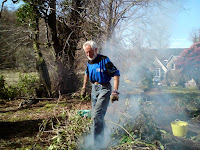 eating rhoddies) when only a thin trickle of smoke was coming from the shoulder-high pile of branches and glossy green leaves with the odd bramble waving destructively from somewhere in its midst. Most of the Marthas had gone home for luch, and I was left with Mrs Heathbank and Hugh, soon to be known as Hugh the Martyr after he jumped onto the pile to drive it down onto the flames. (The martyrdom was aborted when he succeeded in suppressing the fire completely). My despair deepened when Mrs H went home for lunch and Hugh went off to attack yet another bush. What would I do?
In fact, all I needed to do was open a wee cave in the foot of the fire. I propped the mound up with a curving branch, rather in the manner of a Greenham woman's bender, letting in a tiny wind that had conveniently chosen this moment to blow. A sudden crackling from deep within the pile suggested that all was not lost, and minutes later the flames burst through the top, the heat intensified, there was ash flying everywhere and it was all I could do to rake the fire together without being singed. Fifteen minutes later, all that was left was the small pile of ash you can see smoking in the photo, and I was satisfied.
But I think we may need another wee tidy of the fallen sticks on the lawn - and maybe another wee fire?

I have always been a pyromaniac at heart, the kind of child who played with matches and loved cooking sausages on a stick over a fire (charred on the outside, raw within); the child who lit fires in underground air-raid shelters; the adult who today offered to take care of all the rhododendrons which the chaps were howking out of the ground while the Marthas toiled in the Rectory.
At one point, I thought I'd bitten off more than I could chew (don't be silly. It's a figure of speech. I wasn't
 eating rhoddies) when only a thin trickle of smoke was coming from the shoulder-high pile of branches and glossy green leaves with the odd bramble waving destructively from somewhere in its midst. Most of the Marthas had gone home for luch, and I was left with Mrs Heathbank and Hugh, soon to be known as Hugh the Martyr after he jumped onto the pile to drive it down onto the flames. (The martyrdom was aborted when he succeeded in suppressing the fire completely). My despair deepened when Mrs H went home for lunch and Hugh went off to attack yet another bush. What would I do?
In fact, all I needed to do was open a wee cave in the foot of the fire. I propped the mound up with a curving branch, rather in the manner of a Greenham woman's bender, letting in a tiny wind that had conveniently chosen this moment to blow. A sudden crackling from deep within the pile suggested that all was not lost, and minutes later the flames burst through the top, the heat intensified, there was ash flying everywhere and it was all I could do to rake the fire together without being singed. Fifteen minutes later, all that was left was the small pile of ash you can see smoking in the photo, and I was satisfied.
But I think we may need another wee tidy of the fallen sticks on the lawn - and maybe another wee fire?
Tuesday, April 06, 2010
Sacred Hearts and their secrets
 I've just finished reading Sacred Hearts by Sarah Dunant - though I see they've brought out a new (and cheaper) edition with an unfamiliar cover. Never mind. It seemed a strangely appropriate book to be reading at the end of Lent - even though all the time I fretted uselessly about the fact that I was yielding to the temptation to read fiction rather than the serious reading I'd lined up all those weeks ago.
Set in the convent of Santa Caterina, in 1570 Ferrara, the novel tells the story of one reluctant novice and her fight to escape the prison of convent life to which she has been condemned by her father after an unsuitable love affair. Her mentor, the scholarly Suora Zuana, works in the dispensary, and we see the story through her eyes and through those of Serafina, the novice, although the use of 3rd person narrative keeps a certain distance and balance.The sense of convent life unfolding inevitably is intensified by the use throughout of the present tense - there is no feeling that anyone in the novel already knows what has happened in this momentous year; no omniscient narrator to hold our hands as the changes in the Church threaten the stability of what some might see as a home for women who are brides of Christ only because they have not become brides of anyone else.
Dunant again creates a believable picture of life in Renaissance Italy in what one critic described as "A rip-roaring tale in which gutsy vulgarity and ferocious academic intelligence go hand in hand". She also shines a probing light on such fascinating topics as holy anorexia, lesbianism among nuns, pre-modern teenagers and music in convents at this period. But in among all this scholarly knowledge there is a sixteen-year-old girl who could belong to this century in the turbulence of her emotions and her rebellious spirit, whose attitude to the faith she is supposed to embrace would seem familiar to many of us. And, despite the odd syntactical glitch, it's an absorbing read. I couldn't put it down.
Sunday, April 04, 2010
We are an Easter people ...
Easter morning. The sun shone, the church was full of the sound of Alleluias. In the Lady Chapel, the scene of Mary Magdalene's encounter with the risen Christ was recreated on the altar - though few know that the highly painted Mary was given this look, eyeshadow and all, by an American woman of the US Navy days who had been to a cake-decorating class, or that a former rector as well as the two garden-creators had risked life and limb retrieving the figures from the shell of the tower, currently out of bounds after the discovery of ... well, everything destructive. But at Easter anything is possible.
The Paschal Candle seemed to have burned down hardly at all overnight, and was still alight. We were unable, at the last minute, to have incense because of the inability of some of the congregation to tolerate the smoke - though yours truly did cense the church after they'd gone: we don't have incense nearly as often as we used to and it was just sitting there, asking to be lit.
Holy Week came at the end of a difficult Lent - it's much less easy to be quietly introspective/studious/prayerful when you're involved in the providing side of services. But the Triduum was as powerful as ever, the services moving and the atmosphere holy, and the repeated shouts of "He is risen indeed - Alleluia!" sounded heartfelt, not to say hearty.
Hugh's sermon today pointed to the congregation - bickering, bumbling us - as the risen body of Christ. Quite a challenge. Alleluia!

The Paschal Candle seemed to have burned down hardly at all overnight, and was still alight. We were unable, at the last minute, to have incense because of the inability of some of the congregation to tolerate the smoke - though yours truly did cense the church after they'd gone: we don't have incense nearly as often as we used to and it was just sitting there, asking to be lit.
Holy Week came at the end of a difficult Lent - it's much less easy to be quietly introspective/studious/prayerful when you're involved in the providing side of services. But the Triduum was as powerful as ever, the services moving and the atmosphere holy, and the repeated shouts of "He is risen indeed - Alleluia!" sounded heartfelt, not to say hearty.
Hugh's sermon today pointed to the congregation - bickering, bumbling us - as the risen body of Christ. Quite a challenge. Alleluia!
Saturday, April 03, 2010
Paschal Alleluias
 Allejuia! The New Fire was lit, the Paschal Candle processed into the dark church, the old readings heard, the Litany sung. Now the candle burns in the darkness, to be there when we return to church in the morning, where the risen Christ will greet us in the breaking of bread ...
It never fails, that dark service, the tiny lights that grow in the gloom as the candles around are lit from that first fire. Always the thrill, always something different and much that is timeless. Tonight a sudden wind threatened the fire, making the lighting of it difficult - and raising the possibility of a server or two losing an alb to the flame - but when it came, in a rush of gold in the gloaming, it was all the more triumphant. Tonight it was so dark and our tiny candles so compelling that we who read could not see the floor, feeling our way to the lectern as if we had just learned to walk. Tonight I sang the plainsong of the Paschal Litany rather than the Exsultet, and felt there was no reason for the song to stop.
And it is so, so satisfying to know that the Paschal candle has been left burning, left in this era of Health and Safety, this time of Insurance Risks - our candle will be there burning in the morning. Allelulia!
Friday, April 02, 2010
Comment moderation
I've had to implement comment moderation for the blog because of a troll called Ronnie. I haven't the least idea who he is, but he's currently trailing slime over everything I write. I hope this won't put normal commenters off: you'll see your comments appear as usual after I've approved them.
Thinking on Good Friday
Good Friday. A difficult day - what an understatement, really, if you think about it. Sun and sudden warmth, a fat bee raising clouds of pollen on the catkins which the blue tits had just vacated after a morning's swinging: all this life, this rebirth contrasts with the stark interior of the church, the bare altar, the cross alone in the middle of it, the brass eagle lectern lying as if in sorrow on the front pew ...
How often have I experienced this strangeness? I suppose for me it's maybe been 36 years since I sang the Reproaches in the Cathedral of The Isles, wondering at the mystery of it all; I can have missed perhaps one Good Friday service since then. And the strangeness is compounded, always, by the unheeding world down the hill, in the town, and nowadays in the online community. It used to upset me; perhaps it's something you just become used to because now I merely observe. And this year, as always, I thought of Auden's poem Musee des Beaux Arts, which points out that suffering is always going on somewhere, unnoticed by all but those most closely involved.
So today I'm thinking about suffering, and about all innocents who suffer despite - or maybe because of - their innocence.
How often have I experienced this strangeness? I suppose for me it's maybe been 36 years since I sang the Reproaches in the Cathedral of The Isles, wondering at the mystery of it all; I can have missed perhaps one Good Friday service since then. And the strangeness is compounded, always, by the unheeding world down the hill, in the town, and nowadays in the online community. It used to upset me; perhaps it's something you just become used to because now I merely observe. And this year, as always, I thought of Auden's poem Musee des Beaux Arts, which points out that suffering is always going on somewhere, unnoticed by all but those most closely involved.
So today I'm thinking about suffering, and about all innocents who suffer despite - or maybe because of - their innocence.
Chilly repose
Another Maundy Thursday, another vigil by the Altar of Repose in the Lady Chapel at the back of the dark church - a chapel lit surprisingly brightly by the candles on the altar, but bitterly cold despite the heating which had been on all through the service. It is usually a chilly business, and tonight, as the temperature outside dropped to 0ºC and the draught fell on our heads from the hole opened in the ceiling to check for rot, it was all too easy to let the mind wander.
You could say the wandering, in my case, was vaguely relevant as I wondered how chilly it might be in Gethsemane that night at Passover time. I found myself thinking that at least the disciples of Jesus would have robes to pull over their heads, and wishing that I had one. Sleep, on the other hand, was not a possibility in our situation, and the fact that the disciples seem to have drifted off to sleep while Jesus prayed points to rather warmer air.
But we waited, four of us, extinguishing the candles in the wooden stands (one is just visible at each side of the photo) as they burned down in the eddying air and threatened to set the whole thing alight, until the final gospel reading. And then out, into the night where the stars seemed to nail the sky in place and our breath streamed warm in the frigid air, and down the hill to the town. Good Friday is almost upon us.

You could say the wandering, in my case, was vaguely relevant as I wondered how chilly it might be in Gethsemane that night at Passover time. I found myself thinking that at least the disciples of Jesus would have robes to pull over their heads, and wishing that I had one. Sleep, on the other hand, was not a possibility in our situation, and the fact that the disciples seem to have drifted off to sleep while Jesus prayed points to rather warmer air.
But we waited, four of us, extinguishing the candles in the wooden stands (one is just visible at each side of the photo) as they burned down in the eddying air and threatened to set the whole thing alight, until the final gospel reading. And then out, into the night where the stars seemed to nail the sky in place and our breath streamed warm in the frigid air, and down the hill to the town. Good Friday is almost upon us.
Thursday, March 25, 2010
Not a conjunction
It's happened again. I'm riveted by Sarah Dunant's latest novel and enjoying the intricacies of life in an Italian Renaissance convent and I'm pulled up sharp by a grammatical infelicity, such as happened in each of the other two novels I've read by this author. Each time it occurs in the latter stages of the story, and each time it comes as a shock because of the obvious linguistic skill displayed up to this point. What on earth happens? Does she too become so caught up in the story she's weaving that she grows careless?
I'll come back to this book when I've finished reading it, but for anyone out there who cares about such things, the sentence in question is this: "Instead, he, like she, had been a master of deception." "Like" is not a conjunction - I can hear my father's voice as I write this - and the subsequent pronoun should have been "her" - the object of the preposition "like".
Do dinosaurs say harrumph?
I'll come back to this book when I've finished reading it, but for anyone out there who cares about such things, the sentence in question is this: "Instead, he, like she, had been a master of deception." "Like" is not a conjunction - I can hear my father's voice as I write this - and the subsequent pronoun should have been "her" - the object of the preposition "like".
Do dinosaurs say harrumph?
Tuesday, March 23, 2010
Old-fashioned fun
When I was at secondary school, it was after S3 that we cut out of our curriculum those subjects we didn't intend to take Highers in. In my case this meant no more Art - and I regretted this, for though I was never a painter I had always enjoyed drawing. Life drawing turned out to be far more up my alley than I had suspected, and I can still recall producing perfectly recognisable pencil drawings of two friends whose turn it was to stand on desks in the middle of the art room. (Vera Campbell and Alison Goodall - are you still alive?)
My granddaughter has started drawing - she does a wonderfully confident circle as the starting point for mysterious heads with round, dark eyes and random facial markings - and this week demanded that I should have a go. Because she was wearing a very distinctive Peppa Pig cardi with big stripes and big buttons, it was a bit of a cheat, really, to gain instant recognition and acclaim for the figure I produced, but the exercise re-awakened all the joy I used to have in this sort of thing.
I recall sitting quietly, bored out of my skull, in the house of a friend of my aunt's. I must have been six, I think, or maybe seven. The whole afternoon was redeemed by my being given a small bit of paper - maybe out of a diary? - and a pencil. I drew the dresser - a massively intricate piece of furniture - and the patterned china sitting on the shelf. It took ages to finish, and I was engrossed. Much, much later - like maybe ten years ago - I amused myself during a "Please Take" in an Art class (sitting in the class of an absent colleague keeping the peace and supplying paper when required) by sketching the faces of the pupils around me. Great hilarity when one of them caught sight of what I was doing - I had to do the whole lot then. Great disciplinary tool, really.
Anyway, "Do another Catriona" resulted in a gallery of small stripey figures left behind as we returned yesterday. Who needs the computer?

My granddaughter has started drawing - she does a wonderfully confident circle as the starting point for mysterious heads with round, dark eyes and random facial markings - and this week demanded that I should have a go. Because she was wearing a very distinctive Peppa Pig cardi with big stripes and big buttons, it was a bit of a cheat, really, to gain instant recognition and acclaim for the figure I produced, but the exercise re-awakened all the joy I used to have in this sort of thing.
I recall sitting quietly, bored out of my skull, in the house of a friend of my aunt's. I must have been six, I think, or maybe seven. The whole afternoon was redeemed by my being given a small bit of paper - maybe out of a diary? - and a pencil. I drew the dresser - a massively intricate piece of furniture - and the patterned china sitting on the shelf. It took ages to finish, and I was engrossed. Much, much later - like maybe ten years ago - I amused myself during a "Please Take" in an Art class (sitting in the class of an absent colleague keeping the peace and supplying paper when required) by sketching the faces of the pupils around me. Great hilarity when one of them caught sight of what I was doing - I had to do the whole lot then. Great disciplinary tool, really.
Anyway, "Do another Catriona" resulted in a gallery of small stripey figures left behind as we returned yesterday. Who needs the computer?
Friday, March 19, 2010
It's life, Jim ...
The bird table continues to be a source of fascination as this frozen winter comes to an end. The latest mix of seeds (Bill Oddie's no mess mix!) is obviously infinitely preferable to the last lot and is hoovered up relentlessly every day - for the most part by a blackbird pair, who are becoming a permanent fixture. Mrs B is the biggest glutton - can she be eating for two yet? I don't know how these things work in bird circles - and seems to be more or less omnivorous.
Trouble is, I long to intervene. There are several chaffinches, a robin and a host of tits lurking in the bushes nearby, occasionally darting in at the table before a stern look from Mrs B (and this is not me, for once!) sends them packing again. As for the wee brown jobs with the delicate speckles on their backs and the funny wee tuft on top of their heads, forget it. They bounce gently on the willow branches beside the window, but rarely seem to get peace to eat - though I have noted one devouring something under the berberis near the table.
And this, of course, brings me to the mog in the photo. It has taken to visiting, and if you follow the link on the pic you will find more photos of its attempts to get close to the bird table - I've only chosen this photo because it gives such a good picture of its indignant expression if we stare at it. I worry, you see, for these wee brown birds on the ground - and shall be deeply sad if we are brought any Easter offerings. Intervention so far has been limited to encouraging the cat to move on - but I can't be there 24/7, and nature, red in tooth and claw and all that, has to take its course. Doesn't it?

Trouble is, I long to intervene. There are several chaffinches, a robin and a host of tits lurking in the bushes nearby, occasionally darting in at the table before a stern look from Mrs B (and this is not me, for once!) sends them packing again. As for the wee brown jobs with the delicate speckles on their backs and the funny wee tuft on top of their heads, forget it. They bounce gently on the willow branches beside the window, but rarely seem to get peace to eat - though I have noted one devouring something under the berberis near the table.
And this, of course, brings me to the mog in the photo. It has taken to visiting, and if you follow the link on the pic you will find more photos of its attempts to get close to the bird table - I've only chosen this photo because it gives such a good picture of its indignant expression if we stare at it. I worry, you see, for these wee brown birds on the ground - and shall be deeply sad if we are brought any Easter offerings. Intervention so far has been limited to encouraging the cat to move on - but I can't be there 24/7, and nature, red in tooth and claw and all that, has to take its course. Doesn't it?
Wednesday, March 17, 2010
Lighten our darkness ...
Anyone who read my last post will have thought: dismal. That's how she feels: dismal. And they'd have been right. And now I'm home again and I'm seriously tired - for whatever you feel, it's a demanding drive home after a long day - but I'm not dismal any more. Synod threw up things to concern and galvanise, and I may in time return to some of these things, but by teatime yesterday I'd cheered up.
Most of this transformation was effected by +Mark's sermon and charge to members of Synod at the Eucharist, where I found myself reaching for a truly old-fashioned medium ( the service booklet and a pencil) to record some of it. He was wearing a huge and extraordinary ring,* which had belonged to Bishop Forbes at the time of the 18th century Jacobite risings, and reminded us of the faithfulness it represents - the faithfulness of the Episcopal Church which over the years has fed others, not least the Episcopal Church in the USA. He exhorted us to a burning desire to proclaim the love of God in the communities we serve - serve as opposed to live in. The fact that at the moment we have no bishop does not stop our ministries, and we've not to let anyone tell us differently. Our task, he went on, is to be people who are open - open to the seeking of others, to those who will join us briefly and then move on; open to those who struggle elsewhere because of rules and regulations and find in our worship and our structures an openness and freedom. When we get bogged down in buildings and quinquennials we must ask: Who will I bring the light of God to today? This, said +Mark, is what we are about. The church has a voice - not of rules, commandments or exclusion, but simply a voice of love. He ended with the stirring reminder that today, in us, is the fulfilment of God's promise.
Somehow, that worked. And the good humour and yes, the love, survived the airless conditions of our windowless venue and the haphazard arithmetic of the tellers (why, I ask myself, was I chosen as a teller, again?) By the end of business this afternoon, we were ready to believe the bishop's closing words: we are a beautiful diocese, one which most people in the world want to visit, and whatever we might think, visitors find it wonderful to go to church on a Cal Mac ferry. We must stop moaning about long drives and difficulties, demolish the barriers that keep people from church, have the courage to speak about our church in the ordinary places where we find ourselves; we must enable the joy of faith and the love of God to be seen through us.
Yes, it worked. And I'm glad to have been proved unduly pessimistic: Moray diocese is fortunate in having a bishop who can light up a room, and we are lucky to have him on loan. Now we just need to find Another of The Same, as the old hymnbooks used to say. Here's to the election!
Most of this transformation was effected by +Mark's sermon and charge to members of Synod at the Eucharist, where I found myself reaching for a truly old-fashioned medium ( the service booklet and a pencil) to record some of it. He was wearing a huge and extraordinary ring,* which had belonged to Bishop Forbes at the time of the 18th century Jacobite risings, and reminded us of the faithfulness it represents - the faithfulness of the Episcopal Church which over the years has fed others, not least the Episcopal Church in the USA. He exhorted us to a burning desire to proclaim the love of God in the communities we serve - serve as opposed to live in. The fact that at the moment we have no bishop does not stop our ministries, and we've not to let anyone tell us differently. Our task, he went on, is to be people who are open - open to the seeking of others, to those who will join us briefly and then move on; open to those who struggle elsewhere because of rules and regulations and find in our worship and our structures an openness and freedom. When we get bogged down in buildings and quinquennials we must ask: Who will I bring the light of God to today? This, said +Mark, is what we are about. The church has a voice - not of rules, commandments or exclusion, but simply a voice of love. He ended with the stirring reminder that today, in us, is the fulfilment of God's promise.
Somehow, that worked. And the good humour and yes, the love, survived the airless conditions of our windowless venue and the haphazard arithmetic of the tellers (why, I ask myself, was I chosen as a teller, again?) By the end of business this afternoon, we were ready to believe the bishop's closing words: we are a beautiful diocese, one which most people in the world want to visit, and whatever we might think, visitors find it wonderful to go to church on a Cal Mac ferry. We must stop moaning about long drives and difficulties, demolish the barriers that keep people from church, have the courage to speak about our church in the ordinary places where we find ourselves; we must enable the joy of faith and the love of God to be seen through us.
Yes, it worked. And I'm glad to have been proved unduly pessimistic: Moray diocese is fortunate in having a bishop who can light up a room, and we are lucky to have him on loan. Now we just need to find Another of The Same, as the old hymnbooks used to say. Here's to the election!
*For more about this ring, see Hugh's comment on this post.
Monday, March 15, 2010
Argyll Synod
Diocesan Synod this week - and a meeting of the Electoral Synod that as yet does not have any electing to do. It means a two day visit to Oban, with people having to stay away from home and travel some of the most challenging roads in the country to get there. In past years I've felt a certain anticipation - there's a social element, a dinner, a sense of the diocese meeting for once instead of ploughing lonely furrows in scattered pockets of Episcopalianism. And for the past 5 years or so there's been Bishop Martin, and he always raised spirits just by being himself. I don't feel that sense of anticipation this year. We need to be able to elect another bishop, and one of our choosing - and Canon Law, like Time's winged chariot, is pressing down on us.
As we all head to Oban tomorrow, like so many bedraggled homing pigeons, we could do with the prayers of our friends, wherever they are, that all will be well.
As we all head to Oban tomorrow, like so many bedraggled homing pigeons, we could do with the prayers of our friends, wherever they are, that all will be well.
Saturday, March 13, 2010
Must be Spring!
Today reminded me of why I used to say I hated early March - that promise of warmth that turns out to be a chill wind; the clouds that whisk over the blue; the bleak dusk where before there was cosy darkness. Reminded me, that is, until we were heading back from a brisk walk along Loch Striven-side - in itself an antidote to bleakness as we watched a swathe of rain pass us by on the far side of the loch with only a sprinkling on our shore.
The wind had dropped suddenly, as it often does at the end of an afternoon, and in the sudden silence we heard ... a clucking sound. Not exactly chicken-like, but a sort of contented purring. It came from the ditch - the only bit of the ditch with water in it - and when we looked we could see that the muddy water was alive with movement. The photo shows the cause, but I'm too ignorant to know if this couple are frogs or toads. Someone can doubtless enlighten me.
Whatever they were, they were making the most of the afternoon - and they cheered me up no end.

The wind had dropped suddenly, as it often does at the end of an afternoon, and in the sudden silence we heard ... a clucking sound. Not exactly chicken-like, but a sort of contented purring. It came from the ditch - the only bit of the ditch with water in it - and when we looked we could see that the muddy water was alive with movement. The photo shows the cause, but I'm too ignorant to know if this couple are frogs or toads. Someone can doubtless enlighten me.
Whatever they were, they were making the most of the afternoon - and they cheered me up no end.
Thursday, March 11, 2010
A haunting novel
 Another good book, a first novel this time. Two women, one in the present, one in the mid-nineteenth century, as far as I can make out from the social history of the time. Both have suffered loss, and their shared experience seems to sensitise the present-day owner of the cottage to the presence of the past. But Baker doesn't just follow the story of Rachel, tidying out her parent's country retreat after the death of her mother; in equal measure we follow the life of Elizabeth at the time when her world and the society she inhabits are both shaken by the arrival of the Chartist movement.
By the end of the novel I was as moved by the plight of the ordinary countryfolk of the nineteenth century as I was by the emotional turmoil of both women. I had learned a bit about the roots of the democracy we now take - more or less - for granted, and the suffering of those who sought to break out of the tyranny of the master-servant mould. Not only that: I was delighted by the visual quality of Baker's prose and by the mastery of pace and rhythm.
Another recommendation for your next book group?
Wednesday, March 10, 2010
Huvtaes no more
I was working today. Well, sort of. That kind of voluntary stuff that has you heading off on the ferry with a briefcase full of papers (and a sandwich!) rather than a rucksack, wearing, if you can picture this, the kind of shoes you sit around in rather than the ones you hike up a muddy glen in. And yes, it was stuff for the church, dealing with the business of lifelong education and distance learning in Argyll and The Isles.
Quite apart from the revisited horror of spending hours closeted in a relatively gloomy and distinctly ecclesiastical-smelling room while the sun was splitting the sky, I recognised the sinking feeling that used to overtake me at Department Meetings when there was paperwork to shuffle and forms to fill in. In particular, I was reminded of the horror of the Modules which used to happen in schools before Higher Still came in and changed everything (again). I realised yet again why promotion to the paper-shuffling (or file-shuffling, if you like) echelons of the teaching profession had never been an option for me - the department would have fallen apart in a welter of missing documentation.
Not that I am incapable of keeping some sort of tabs on things I consider wildly relevant - the carefully-filed Standard Grade folios or the book of notes on Higher RPRs come to mind - but maintaining individual record-sheets for people used to drive me potty and my record of work tended to be composed retrospectively, with the help of the pupils. I long ago recognised that I was a performer, not an administrator, and that living in the moment was always preferable to planning for it - or writing said moment up later.
And so it was with joy that I was able to sit back this afternoon and note that my - what? line-manager? boss? superior? pal? - was going to bear the brunt of all this bumf. I'm retired, I heard myself murmuring (yes, I can do murmurs) and I don't have to do this. I can take holidays, I can suit myself about the hours I work ... but inside the voice of truth was adding its own tuppenceworth. I do what is fun for me to do - and when I'm not enjoying it any more, I stop.
I guess I was anticipating all this when I was asked by an acquaintance on the ferry if I was still working. (I musta looked businesslike). No, I said, I'm retired from teaching. But what I really meant was that I've retired from huvtaes - all of them.
*In certain educational circles, a "huvtae" is what in Dunoon we called a "Please Take" - the dread summons to cover the class of an absent colleague. I have appropriated it to cover all the compulsory elements of working life - set hours, set holidays and so on.
Quite apart from the revisited horror of spending hours closeted in a relatively gloomy and distinctly ecclesiastical-smelling room while the sun was splitting the sky, I recognised the sinking feeling that used to overtake me at Department Meetings when there was paperwork to shuffle and forms to fill in. In particular, I was reminded of the horror of the Modules which used to happen in schools before Higher Still came in and changed everything (again). I realised yet again why promotion to the paper-shuffling (or file-shuffling, if you like) echelons of the teaching profession had never been an option for me - the department would have fallen apart in a welter of missing documentation.
Not that I am incapable of keeping some sort of tabs on things I consider wildly relevant - the carefully-filed Standard Grade folios or the book of notes on Higher RPRs come to mind - but maintaining individual record-sheets for people used to drive me potty and my record of work tended to be composed retrospectively, with the help of the pupils. I long ago recognised that I was a performer, not an administrator, and that living in the moment was always preferable to planning for it - or writing said moment up later.
And so it was with joy that I was able to sit back this afternoon and note that my - what? line-manager? boss? superior? pal? - was going to bear the brunt of all this bumf. I'm retired, I heard myself murmuring (yes, I can do murmurs) and I don't have to do this. I can take holidays, I can suit myself about the hours I work ... but inside the voice of truth was adding its own tuppenceworth. I do what is fun for me to do - and when I'm not enjoying it any more, I stop.
I guess I was anticipating all this when I was asked by an acquaintance on the ferry if I was still working. (I musta looked businesslike). No, I said, I'm retired from teaching. But what I really meant was that I've retired from huvtaes - all of them.
*In certain educational circles, a "huvtae" is what in Dunoon we called a "Please Take" - the dread summons to cover the class of an absent colleague. I have appropriated it to cover all the compulsory elements of working life - set hours, set holidays and so on.
Sunday, March 07, 2010
White smoke at last
Whew! The white smoke was billowing metaphorically around Holy Trinity church, Dunoon, today - and in the other episcopal charges of the Cowal and Bute district - as we were at last able to acknowledge that a new priest had been appointed. The Reverend Andrew Swift, originally from Aberdeen, is currently a full-time curate in a semi-urban parish in Gloucester City, and before training for ministry worked in the shipbuilding industry.
For the first time in almost 30 years there will be a young family living in the Rectory, the last such family belonging to our recently-retired bishop, +Martin. At that time I was one of the young adults in the congregation, and some of us were reflecting the other day that we are now the Old Women of the tribe - though strangely we don't feel like it. Thirty years ago women of my age wore tweed skirts - remember these skirts with the pleats from each side of the hip? - and Pringle twinsets under their sensible jackets and above their sensible shoes. They perhaps wore pearls, or a Luckenbooth brooch. At yesterday's meeting there were jeans, technical-fabric trousers, trainers, hiking boots (so still sensible footwear!), fleeces and T-shirts. Presumably we now head to the grave dressed as we have since we left mini-skirts behind ... but I digress.
Life is short, but at least with a new priest it will be less demanding - just a bit - for the lay team, who may not have to write so many sermons. And it promises to be interesting. What more could we ask for?
For the first time in almost 30 years there will be a young family living in the Rectory, the last such family belonging to our recently-retired bishop, +Martin. At that time I was one of the young adults in the congregation, and some of us were reflecting the other day that we are now the Old Women of the tribe - though strangely we don't feel like it. Thirty years ago women of my age wore tweed skirts - remember these skirts with the pleats from each side of the hip? - and Pringle twinsets under their sensible jackets and above their sensible shoes. They perhaps wore pearls, or a Luckenbooth brooch. At yesterday's meeting there were jeans, technical-fabric trousers, trainers, hiking boots (so still sensible footwear!), fleeces and T-shirts. Presumably we now head to the grave dressed as we have since we left mini-skirts behind ... but I digress.
Life is short, but at least with a new priest it will be less demanding - just a bit - for the lay team, who may not have to write so many sermons. And it promises to be interesting. What more could we ask for?
Saturday, March 06, 2010
Illuminating the Lighted Rooms
 I've been reading Richard Mason's The Lighted Rooms - a book which might have appealed to me solely by its Larkin-inspired title had it not been lent to me for my recent holidays. An unusual study of dementia, it was at once gripping and illuminating - and no, that's not a pun - though occasionally the familiarity of a situation described would have me wincing in recognition. This was particularly true, I think, in the description of the expensive nursing home in which Joan, one of the main characters, takes up residence - all the "advantages" which distinguish such establishments from the hotels they seek to emulate add up to a prison in Joan's eyes and are so well described as to make any reader uncomfortable.
And yet this story conveys not pathos but a kind of joyous heroism, as Joan makes easy friendships with two very different young men, inspiring their loyalty and gratitude in a way which her competitive and successful daughter cannot. On the way to the"triumphant serenity" achieved by Joan at the novel's end, we learn about such diverse subjects as British concentration camps in South Africa during the Boer war and the operation of hedge funds, but it is in the illumination of the "Lighted Rooms" that Larkin thought might make up the sum of consciousness of old people that Mason's chief accomplishment lies. It seems not quite right to say I enjoyed the book, but I was riveted by it and recommend it wholeheartedly. And if you're looking for a Book Group subject, there are some helpful suggestions for discussion at the end.
Wednesday, March 03, 2010
Morning
This didn't begin life in poetic form, but morphed somehow in the telling. Anyway, it was yesterday, and it was perfect.
Walking on the Toward shore
the sea flat, a sheet of glass with
liquid, slightly moving edges,
the light blinding from its morning place
the hills splendidly white and pure
I found my being gripped with joy
so fierce that walking seemed too much
and stopped. And then I heard the quiet
crooning from the glistening rocks
where the conversationalists were quite
hidden till one stretched and looked
so like the duck it really was
that laughter bubbled in my throat.
And then I saw the crowds of them
all sitting in the morning sun
and burbling gently, as ducks do
until they flew towards the light
and skiffed like stones and circled round -
and all I knew was beauty. Mine. My land
and yet not mine as I pass through -
this need to possess the things we love
not new, but part of life itself,
this love of place, of light, of air,
of tiny waves against the shore.
This ache that takes the place of prayer.
©C.M.M. 03/10
Walking on the Toward shore
the sea flat, a sheet of glass with
liquid, slightly moving edges,
the light blinding from its morning place
the hills splendidly white and pure
I found my being gripped with joy
so fierce that walking seemed too much
and stopped. And then I heard the quiet
crooning from the glistening rocks
where the conversationalists were quite
hidden till one stretched and looked
so like the duck it really was
that laughter bubbled in my throat.
And then I saw the crowds of them
all sitting in the morning sun
and burbling gently, as ducks do
until they flew towards the light
and skiffed like stones and circled round -
and all I knew was beauty. Mine. My land
and yet not mine as I pass through -
this need to possess the things we love
not new, but part of life itself,
this love of place, of light, of air,
of tiny waves against the shore.
This ache that takes the place of prayer.
©C.M.M. 03/10
Sunday, February 28, 2010
We are marching
Every now and then, someone at church remarks on the apparent miracle of the suitability of the hymns (chosen by Mr B) for the lectionary of the day, and while it is true that Mr B chooses the hymns with great care and does in fact read the lectionary readings while doing so, he is helped by a useful RSCM publication which lists a multitude of suggestions from a variety of hymnbooks. One of the suggestions for today's final hymn was We are Marching in the light of God.
At first it seemed an odd choice. Lent. Mainstream church. A particularly trying time for our diocese and for our congregation, as the challenges of our Victorian buildings multiply and with them the tradesmens' bills. But in fact it turned out to be just right. This African song, with its origins in protest, lifted us on this freezing Sunday so that we sang, and clapped (on the back beat too!), and felt warmer, and found ourselves smiling. Yes, things are hard in our church just now - but we aren't alone, are we?
And I'd never in a month of Sundays have thought the congregation of Holy T would swing so well!
At first it seemed an odd choice. Lent. Mainstream church. A particularly trying time for our diocese and for our congregation, as the challenges of our Victorian buildings multiply and with them the tradesmens' bills. But in fact it turned out to be just right. This African song, with its origins in protest, lifted us on this freezing Sunday so that we sang, and clapped (on the back beat too!), and felt warmer, and found ourselves smiling. Yes, things are hard in our church just now - but we aren't alone, are we?
And I'd never in a month of Sundays have thought the congregation of Holy T would swing so well!
Wednesday, February 24, 2010
Powers of hell ...
A reminder of the power lurking just below the earth on Lanzarote hit us powerfully at Islote de Hilario,Timanfaya, where a residual chamber of magma remains close to the surface - what vulcanologists call a geothermic anomaly. Every ten minutes or so, a National Park employee in a strange, dust-coloured uniform entertains tourists with a demonstration of this power when he thrusts a scrub bush into a hole in the ground (see photo). Within seconds there was a strong smell of toast burning, and shortly afterwards it burst into flame - very hot flame. We also saw geysers produced by pouring water down a pipe in the ground, chicken being roasted over what looked like a well outside the restaurant but was in fact a pit of intense heat, and picked up small stones that were too hot to hold for any time.
All very entertaining - well, no, actually: more terrifying. There was nothing man could do to affect this energy - it just was. The smell of the volcanic dust was so prevalent that I can smell it still when I write of it, and the texture of the vocanic debris like nothing else I have walked on.
The Lanzarotenos (this should have a ~ above the second 'n', but I can't work out how to do it - Lanzaroteños - hurrah!) have an ambivalent attitude to this whole aspect of their island, protecting what was in effect a dreadful curse; everywhere we see evidence of the work of César Manrique who supervised the building of the Ruta de los Volcanes over which we were driven and designed the symbol of the park - and who decreed that no buildings should rise more than two storeys about ground level. This extraordinary level of control means that everywhere on the island you see little white boxes, with green window-frames (unless at the seaside, when they are blue). It makes our own National Park restrictions seem liberal indeed.
When I look back at the experience - we were on a walking holiday, and covered considerable ground on foot, along with an agreeable bunch of HF types - I feel that apart from the experience of summer weather in February there isn't much I'd go back to Lanzarote for. I feel it's a faintly melancholy island, with little going for it and a great deal to struggle with to make a living. I may be wrong - but that eruption in the 18th century dealt a blow that the island still has to work hard to recover from.
By the way - their roundabouts (on the roads) are magnificent. I kid you not.

All very entertaining - well, no, actually: more terrifying. There was nothing man could do to affect this energy - it just was. The smell of the volcanic dust was so prevalent that I can smell it still when I write of it, and the texture of the vocanic debris like nothing else I have walked on.
The Lanzarotenos (this should have a ~ above the second 'n', but I can't work out how to do it - Lanzaroteños - hurrah!) have an ambivalent attitude to this whole aspect of their island, protecting what was in effect a dreadful curse; everywhere we see evidence of the work of César Manrique who supervised the building of the Ruta de los Volcanes over which we were driven and designed the symbol of the park - and who decreed that no buildings should rise more than two storeys about ground level. This extraordinary level of control means that everywhere on the island you see little white boxes, with green window-frames (unless at the seaside, when they are blue). It makes our own National Park restrictions seem liberal indeed.
When I look back at the experience - we were on a walking holiday, and covered considerable ground on foot, along with an agreeable bunch of HF types - I feel that apart from the experience of summer weather in February there isn't much I'd go back to Lanzarote for. I feel it's a faintly melancholy island, with little going for it and a great deal to struggle with to make a living. I may be wrong - but that eruption in the 18th century dealt a blow that the island still has to work hard to recover from.
By the way - their roundabouts (on the roads) are magnificent. I kid you not.
Tuesday, February 23, 2010
Volcanic holiday
Lanzarote is a strange place. In fact I'd had no idea how strange - when I told people we were having a winter break in Playa Blanca they said "Oh, it's lovely" and left it at that, so when we arrived and I saw the black land everywhere and the low-rise white cubes of the houses and the pointed black and red hills I was aware that had I been there only to sunbathe and walk up and down the pleasant promenade of the town I'd have been depressed long before my week was up.
However, once I'd grasped some of the history of the landscape, I began to see things differently. Between 1730 and 1736, and again in 1824, huge volcanic eruptions, in one of the most spectacular eruptive processes in the Earth's volcanic history, drastically changed the shape of the island and left a quarter of it almost completely buried under a thick layer of lava and ash - 174 sq. kilometers of it. If you're interested in such things, the lava is of two types - the jagged "aa" lava, and corded "pahoe-hoe" lava, is completely impassable, and has been marked by very little human impact.
I was moved by a contemporary account of the first eruption - for this was happening when people in mainland Europe were listening to Bach, dressing in silk hose and full-bottomed wigs, even more recognisable as our forefathers than was Pliny when he wrote about Vesuvius, and somehow that made it all the more vivid. Don Andrés Lorenzo Curbelo, the priest in Yaiza, wrote this:
Today the volcanoes are silent, but their power is still apparent. I shall return to Timanfaya in another post.

However, once I'd grasped some of the history of the landscape, I began to see things differently. Between 1730 and 1736, and again in 1824, huge volcanic eruptions, in one of the most spectacular eruptive processes in the Earth's volcanic history, drastically changed the shape of the island and left a quarter of it almost completely buried under a thick layer of lava and ash - 174 sq. kilometers of it. If you're interested in such things, the lava is of two types - the jagged "aa" lava, and corded "pahoe-hoe" lava, is completely impassable, and has been marked by very little human impact.
I was moved by a contemporary account of the first eruption - for this was happening when people in mainland Europe were listening to Bach, dressing in silk hose and full-bottomed wigs, even more recognisable as our forefathers than was Pliny when he wrote about Vesuvius, and somehow that made it all the more vivid. Don Andrés Lorenzo Curbelo, the priest in Yaiza, wrote this:
On the first of September 1730, between 9 and 10 o'clock at night, the earth suddenly opened at close to Timanfaya, two leagues from Yaiza. On that first night, and enormous mountain rose up from the heart of the earth, and from its summit there escaped flames that continued to burn for nineteen days ... They were accompanied by a great quantity of lapilli, dust and ash that spread over the surrounding areas and from all sides drops of water fell as rain. The thunderclaps and explosions that accompanied those phenomena, the darkness caused by the mass of ash and smoke that covered the island, forced the inhabitants to flee more than once...
Today the volcanoes are silent, but their power is still apparent. I shall return to Timanfaya in another post.
Monday, February 22, 2010
New poem/prayer
There's a new poem - or maybe it's a prayer - over on frankenstina, which I used as the meditation during Morning Prayer on our last morning at the House of Prayer on Iona last weekend.
I shall return to this visit when I've done with my holiday on Lanzarote, from which we returned two nights before we left for Iona. Two very different experiences to build body and soul as we come to the end of winter.
I shall return to this visit when I've done with my holiday on Lanzarote, from which we returned two nights before we left for Iona. Two very different experiences to build body and soul as we come to the end of winter.
Wednesday, February 17, 2010
Blogging off
I've been neglecting this blog for the past fortnight - away walking in Lanzarote for a week, of which more anon, and now off to Iona for a couple of days. Normal service will be resumed as soon as possible, but in the meantime there are a few Lanzarote pics on flickr
Wednesday, February 03, 2010
The Book Thief
 I've just finished reading The Book Thief by Markus Zusak. And I mean "just finished", which means that I'm still steeped in the smoke of burning Himmel Street in a small German town as the second world war turned against Germany, still caught in the mesh of words echoing the words of the book thief herself, regretful and bereft because it's finished.
This book is beautifully written. It's quirky and unusual and the narrator is Death - a narrator you soon learn to trust utterly. It tells of the wartime experience of a young girl, living with foster parents, learning to read after she steals her first book. In the end her books and her writing save others, save herself and have a profound effect on Death himself.
It's the best book I've read in ages.
Tuesday, February 02, 2010
Chimney pots but no smoke
No white smoke from Dunoon, but a tale of five chimneys - or rather, five Victorian chimney pots, the organist, and the organist's wife.
Yesterday, as the candidates for the post of Rector here were shown round the church and rectory, we noticed that the builders working on the roof had removed the massive chimney pots and set them in a row in the back garden. Now, it is a fact that these pots are much prized around these parts - indeed, the one that survived from our own chimney now stands in my garden with a small thyme bush growing in the top of it, and very ornamental it is too. It is a sadder fact that such objects left untended around these parts will be nicked - especially if no-one seems to be around.
It was decided, therefore, that the pots should be moved into what was once the coal-hole at the rear of the rectory. Now, for reasons I'm not going into, it came about that Mr B was unable to meet one of the three able-bodied men in the congregation at the hour appointed for this bit of heavy lifting, and rather than leave them out for another night he and I decided we would do the deed ourselves. As the light faded this afternoon, we headed for the back of the rectory - the very place where those entrusted with choosing our new incumbent were still closeted with the Dean. We crept inconspicuously up the slimy bank. The pots sat there, dauntingly large, at the top of the back green. We laid hands on the first one. The top of it turned out to be in two parts, the outer of which moved disconcertingly. Our hands were already covered in a noxious mix of soot and green slime, but we began to manhandle the brute towards the door, rotating it over the soggy grass.
I can't keep it up, this blow-by-blow account, but must hasten to the good bit that didn't quite happen. By the third pot I had hit on the brilliant idea of letting it topple onto its side and rolling it down the slight incline to just beside the step of the coal-hole. By the fourth, I was feeling bolder: the pots really moved quite rapidly if you helped them with a shove. But I have to tell you, Best Beloved, that the fourth pot almost got away. And if it had, it'd have careered down the bank and into the unfamiliar green car that presumably belonged to the Dean. So picture, if you will, the organist and his lady wife, doubled up in mirth, diving to restrain a slimy Victorian chimney pot while smothering hoots of laughter like a pair of naughty weans.
I have to report that a coffee-seeking church official saw us and opened the door, and that the chimney pots are now safely locked away with the dwindling supply of parish booze. But where, pray, will the white smoke come from?
Yesterday, as the candidates for the post of Rector here were shown round the church and rectory, we noticed that the builders working on the roof had removed the massive chimney pots and set them in a row in the back garden. Now, it is a fact that these pots are much prized around these parts - indeed, the one that survived from our own chimney now stands in my garden with a small thyme bush growing in the top of it, and very ornamental it is too. It is a sadder fact that such objects left untended around these parts will be nicked - especially if no-one seems to be around.
It was decided, therefore, that the pots should be moved into what was once the coal-hole at the rear of the rectory. Now, for reasons I'm not going into, it came about that Mr B was unable to meet one of the three able-bodied men in the congregation at the hour appointed for this bit of heavy lifting, and rather than leave them out for another night he and I decided we would do the deed ourselves. As the light faded this afternoon, we headed for the back of the rectory - the very place where those entrusted with choosing our new incumbent were still closeted with the Dean. We crept inconspicuously up the slimy bank. The pots sat there, dauntingly large, at the top of the back green. We laid hands on the first one. The top of it turned out to be in two parts, the outer of which moved disconcertingly. Our hands were already covered in a noxious mix of soot and green slime, but we began to manhandle the brute towards the door, rotating it over the soggy grass.
I can't keep it up, this blow-by-blow account, but must hasten to the good bit that didn't quite happen. By the third pot I had hit on the brilliant idea of letting it topple onto its side and rolling it down the slight incline to just beside the step of the coal-hole. By the fourth, I was feeling bolder: the pots really moved quite rapidly if you helped them with a shove. But I have to tell you, Best Beloved, that the fourth pot almost got away. And if it had, it'd have careered down the bank and into the unfamiliar green car that presumably belonged to the Dean. So picture, if you will, the organist and his lady wife, doubled up in mirth, diving to restrain a slimy Victorian chimney pot while smothering hoots of laughter like a pair of naughty weans.
I have to report that a coffee-seeking church official saw us and opened the door, and that the chimney pots are now safely locked away with the dwindling supply of parish booze. But where, pray, will the white smoke come from?
Sunday, January 31, 2010
Let us begin ...
Tomorrow Piskies in this corner of the church - Dunoon, Rothesay and Tighnabruaich, acting in their linked charge capacity for the first time - begin what we hope will be the last act in finding a new Rector. Tomorrow the visit to Rectory and church, the meeting with the Vestry and worship leaders, the informal conversations; on Tuesday the formal interviews. Three people are putting themselves through this process, and ten or so of us here in Dunoon are praying hard for guidance and harmony.
We're praying especially hard because it's been a long year, counting back to when we first heard of the impending departure of the previous incumbent. Some of us are beginning to feel a real hunger for the nourishment that wise leadership can bring. Today, because a former rector celebrated and preached, we were actually fed. I should have been preaching, but you can't run on empty. Tonight I'm thinking of all of us whose lives are about to be changed one way or another.
For now, anyway.
We're praying especially hard because it's been a long year, counting back to when we first heard of the impending departure of the previous incumbent. Some of us are beginning to feel a real hunger for the nourishment that wise leadership can bring. Today, because a former rector celebrated and preached, we were actually fed. I should have been preaching, but you can't run on empty. Tonight I'm thinking of all of us whose lives are about to be changed one way or another.
For now, anyway.
Saturday, January 30, 2010
Contrasts recalled

Found myself thinking back to our trip to las Vegas two years ago - one of our "let's escape the tail-end of the Scottish winter trips", another of which I shall soon be off on. A quick look at the flickr set of photos from the trip revealed a pleasing patchwork of colour; I've reproduced a section of it here.
The interesting thing for me is that this particular section represents what I most recall about the trip: the huge contrast between the silent tranquillity of the desert and the frenetic sounds and lights of the city. The desert is all pale blues and greys - even the vegetation has a blue-grey tinge - while the city, and in particular the Strip, is alive with colour. The liveliness, of course, is artificial, as fake as the interiors of the casinos replicating Rome, Venice, Paris. There, the noise is constant: the background of the tunes the one-armed bandits play incessantly, the changed chords for a win, the hum of machines rather than the sound of conversation.
But in the desert there is nothing. No birdsong, no sound of water, no wind, no smells. A purity of place that I have experienced nowhere else. And it is the desert that I remember.
Friday, January 29, 2010
Attitudes to nukes
 My February copy of "Nuclear-free Scotland" came yesterday, and two items caught my attention in such a way to remind me of my ongoing paranoia about the place in relation to the peace movement of the church to which I belong. The first was the poster replicated above. It's three years, I think, since last I attended a demo, and I feel the urge to do so again. This one looks as if it could be combined with a pleasurable family visit - though I don't know if her parents would allow my granddaughter to come with me. But the best bit of all came when I saw that tiny, red badge at the right of the list of supporters, just beside the nasty Trident sub. If you don't recognise it, it's the badge of the Scottish Episcopal Church. My church. And I think: yes, things have changed. I don't think I'd be chucked out of the Brownies quite so readily nowadays for being too vocal against nukes.
The second item of interest was chilling. In 1958, Prime Minister Harold MacMillan sent a memo to a member of his Cabinet, Dr Charles Hill. It read:
"It is most important that we should find some way of organising and directing an effective campaign to counter the current agitation against this country's possession of nuclear weapons. This is a question on which the natural emotions of ordinary people would lead them to be critical of the Government's policy, and to accept without question or reason the arguments which our opponents use. ....
...Can we persuade some influential publicists to write articles? Are there any reliable scientists? Or Church of England Bishops?"
Apparently MacMillan "considered whether (he) might write to the Archbishop of Canterbury asking him to warn local clergy not to help the (Aldermaston) demonstrators"
A week later, in a memo of April 2nd, he reported:
"Active steps are being taken to identify the intellectuals, Churchmen, scientist and others who support the Government in the controversy over this country's possession of nuclear bombs."
By the following year, Hill reported that "a modest beginning" had been made towards mobilising church support for the H-bomb programme. The folder which produced most of this information (PREM 11/2778) is followed by four others marked 'Closed for the next 100 years'.
Fascinating stuff. But not really so long ago - at a time when our churches were full on Sundays and clergy held in respect by most of society. Makes you wonder, really. I think we're a lot healthier nowadays - as long as senior clergy feel able to resist the temptation to climb onto fences.
Thursday, January 28, 2010
Thoughts of a domestic goddess
An unusual start to the day: three loads of washing done, and a pot of soup on the stove, and some niggly bits of cleaning in the kitchen - all before I allowed myself to come up to the study. Ok, I admit checking my mail and playing a move in Scrabulous before I even went down to breakfast ... but that doesn't count. Anyway, as I did all this virtuous labour, I thought about why it's not my usual pattern in these my declining years.
It's not that I like working in a scabby environment. I don't feel proud that the toaster as often as not is covered in crumbs, that the breadknife still bore the sticky remnants of the hot loaf it sliced yesterday, that the rings on the hob had burnt bits lurking round them even though I cleaned them - oh, must be a week ago. It's not even that, as I used to pronounce dramatically, I hate housework. Per se, it's even satisfying, in a quiet sort of way. And if vigorous enough it uses up a satisfactory number of calories. So where's the rub? (And isn't that a lovely pun?)
And today I reasoned that there are simply too many other things I'd rather be doing. When you're scrubbing a worktop or washing up the myriad bits that soup-making seems to produce you can listen to the radio, you can sing, you can, I suppose, recite poetry at the top of your voice. But you can't read, do a sudoku, write, surf, play Scrabulous, check Facebook/Twitter, go for a walk, swim, talk on the phone ...
In fact, most of what I did for that hour was think about housework. But at least my kitchen looks clean. For now.
It's not that I like working in a scabby environment. I don't feel proud that the toaster as often as not is covered in crumbs, that the breadknife still bore the sticky remnants of the hot loaf it sliced yesterday, that the rings on the hob had burnt bits lurking round them even though I cleaned them - oh, must be a week ago. It's not even that, as I used to pronounce dramatically, I hate housework. Per se, it's even satisfying, in a quiet sort of way. And if vigorous enough it uses up a satisfactory number of calories. So where's the rub? (And isn't that a lovely pun?)
And today I reasoned that there are simply too many other things I'd rather be doing. When you're scrubbing a worktop or washing up the myriad bits that soup-making seems to produce you can listen to the radio, you can sing, you can, I suppose, recite poetry at the top of your voice. But you can't read, do a sudoku, write, surf, play Scrabulous, check Facebook/Twitter, go for a walk, swim, talk on the phone ...
In fact, most of what I did for that hour was think about housework. But at least my kitchen looks clean. For now.
Wednesday, January 27, 2010
Distracting hands
'Straordinary. The BBC's political correspondent was talking tonight on the news and I haven't a clue what she was reporting on because I was totally distracted by ... her hands. No, she wasn't really waving them about much - no unseemly sempahoring - but rather kept them for much of the time discreetly hidden below the frame of the picture.
No, the distracting factor lay in the unsuitability of the woman's gloves. Dressed becomingly in a pale cream coat and an extremely pleasant pale blue scarf, fetchingly shot through with a gold that matched her hair, the reporter was sporting what looked like a pair of gardening gloves. In blue, with dark blue bits round the fingers. And they didn't even look like her own gloves, being large and cumbersome and rendering her fingers like a bunch of blue bananas.
Had some kindly cameraman lent her his gloves after a long wait in the cold? I think we should be told. But what was she talking about again...?
No, the distracting factor lay in the unsuitability of the woman's gloves. Dressed becomingly in a pale cream coat and an extremely pleasant pale blue scarf, fetchingly shot through with a gold that matched her hair, the reporter was sporting what looked like a pair of gardening gloves. In blue, with dark blue bits round the fingers. And they didn't even look like her own gloves, being large and cumbersome and rendering her fingers like a bunch of blue bananas.
Had some kindly cameraman lent her his gloves after a long wait in the cold? I think we should be told. But what was she talking about again...?
Sunday, January 24, 2010
Loudly reading
I was interested to read Neil Winton's post t'other day, and follow through to this post from Bill Boyd - both of them on the importance of reading aloud in the development - and the proof - of literacy skills and understanding of texts. They coincided with my own leading of a short workshop for adults who read aloud - or might want to read aloud - in the context of a church service, and because I'd been thinking about my teaching days after reading the blogs, I think I hit the ground running in a way I might have forgotten about.
Of course, a big hurdle in reading the Bible - in any version - is the sheer complexity of much of it. And perhaps nothing catches out the unwary reader in quite the same way as Paul's letter to the Hebrews, parts of which have begun to appear in the lectionary right now. With my sights firmly on the person who will have to tackle this next Sunday, I decided to base my teaching on just such a passage. The first sentence was five lines long, with crucial punctuation and a wandering "because" that belonged firmly, but to the unwary surprisingly, to the principal clause which followed later in the sentence. (Gosh: that sentence I've just written would be murder to read, huh?) It was great to see pennies dropping about changes in meaning if you got the "because" in the wrong tone of voice, or the destruction of meaning if you came to a halt before the end of the sentence; about the cause of this last fault in the shortness of breath of someone who doesn't know about support and voice production.
The best moment came when we were all ready to have a go at this passage. We'd talked a bit about the difficulty of church acoustics and the deaf lady who always sits in the back row, but working on that in the smallish confines of the church hall kitchen (for there were aspiring liturgists working in pairs in the main hall and we would have disturbed their composition) had its problems. Reader, I solved it. I shut each participant in turn inside the kitchen while the rest of us crammed onto the landing and listened from there. The effect was dramatic, as each in turn sought to communicate meaning to others they couldn't see, realising that a dropped voice or a slurred syllable would be lost and with it most of the sense.
I hope they enjoyed it. We were all pretty loud and hilarious by the end of the session, and everyone had had the chance to offer their take on what was going on. I felt a sense of satisfaction. It was, in fact, a bit like being the teacher ...
Of course, a big hurdle in reading the Bible - in any version - is the sheer complexity of much of it. And perhaps nothing catches out the unwary reader in quite the same way as Paul's letter to the Hebrews, parts of which have begun to appear in the lectionary right now. With my sights firmly on the person who will have to tackle this next Sunday, I decided to base my teaching on just such a passage. The first sentence was five lines long, with crucial punctuation and a wandering "because" that belonged firmly, but to the unwary surprisingly, to the principal clause which followed later in the sentence. (Gosh: that sentence I've just written would be murder to read, huh?) It was great to see pennies dropping about changes in meaning if you got the "because" in the wrong tone of voice, or the destruction of meaning if you came to a halt before the end of the sentence; about the cause of this last fault in the shortness of breath of someone who doesn't know about support and voice production.
The best moment came when we were all ready to have a go at this passage. We'd talked a bit about the difficulty of church acoustics and the deaf lady who always sits in the back row, but working on that in the smallish confines of the church hall kitchen (for there were aspiring liturgists working in pairs in the main hall and we would have disturbed their composition) had its problems. Reader, I solved it. I shut each participant in turn inside the kitchen while the rest of us crammed onto the landing and listened from there. The effect was dramatic, as each in turn sought to communicate meaning to others they couldn't see, realising that a dropped voice or a slurred syllable would be lost and with it most of the sense.
I hope they enjoyed it. We were all pretty loud and hilarious by the end of the session, and everyone had had the chance to offer their take on what was going on. I felt a sense of satisfaction. It was, in fact, a bit like being the teacher ...
Thursday, January 21, 2010
Worshipping teachers (not teachers worshipping!)
I found myself reading an account by Robert Service of his schooldays (In A Hillhead Album, if you're interested) in which he told of the blow to his hero worship of a teacher when he caught sight of said teacher reeling drunkenly from a pub one evening. The combination of his memories and the book they were in (and the fact that we both attended the same school, in our respective eras) had me wondering: do pupils still hero-worship teachers?
I have a feeling they may not. I think they may be more savvy, more exposed to media or sporting heroes, flawed or otherwise, in comparison with whom all mortals will appear pallid. And part of me thinks this is probably a good thing: what a huge responsibility to be the object of such worship, such unquestioning devotion, as well as for the literacy or numeracy or whatever of the child.
And yet I think back to my very first teacher, whom I loved; to the Primary 3 teacher who taught us all about wild birds; to the first male teacher I had, in Primary 6, who was the object of devotion of every one of the 20 or so girls in his class (of 40). Such innocent devotion, I fear, lasted only while we were in Primary school; thereafter there tended to be an element of a more gender-orientated frisson involved in my robustly mixed school and we pitied such friends as had been sent to the likes of Laurel Bank and had to suffer grass-green uniforms as well as a completely female environment. But were these teachers in fact more worthy of devotion than unknown celebrities? And does this sort of thing still happen?
So: if you're still in the classroom, are you aware of pupils adoring you? How do you feel about it if you are? Does it irritate you or flatter? And do you attempt to put them off? Or is this something belonging to a more innocent past when the world was a much smaller place?
I have a feeling they may not. I think they may be more savvy, more exposed to media or sporting heroes, flawed or otherwise, in comparison with whom all mortals will appear pallid. And part of me thinks this is probably a good thing: what a huge responsibility to be the object of such worship, such unquestioning devotion, as well as for the literacy or numeracy or whatever of the child.
And yet I think back to my very first teacher, whom I loved; to the Primary 3 teacher who taught us all about wild birds; to the first male teacher I had, in Primary 6, who was the object of devotion of every one of the 20 or so girls in his class (of 40). Such innocent devotion, I fear, lasted only while we were in Primary school; thereafter there tended to be an element of a more gender-orientated frisson involved in my robustly mixed school and we pitied such friends as had been sent to the likes of Laurel Bank and had to suffer grass-green uniforms as well as a completely female environment. But were these teachers in fact more worthy of devotion than unknown celebrities? And does this sort of thing still happen?
So: if you're still in the classroom, are you aware of pupils adoring you? How do you feel about it if you are? Does it irritate you or flatter? And do you attempt to put them off? Or is this something belonging to a more innocent past when the world was a much smaller place?
Wednesday, January 20, 2010
WiiFit has us in fits
One of the more hilarious activities of my week so far involved a visit to my sister to play with her new toy. Saying that makes me sound about ten years old; in many ways that's what it felt like as we explored the joys of the WiiFit.
If you don't know what this is, picture a plastic rectangle rather like a set of bathroom scales, set on the floor in front of the telly to which it is connected by a wire. You stand on this, preferably in your bare feet (ok, your socks if you prefer), holding in your hand what looks and feels like a cordless telephone handset. The difference is that this is securely attached to you by a wrist strap, for reasons that became obvious when I began the sword-fighting game ... but I'll come back to that.
We began sedately enough, standing on the floor pad while the machine calibrated our age as represented by our ability to be well-balanced ("Do you fall over frequently?") and told us how ideal (or not) our BMI was. The balance exercises include such sports as ski-ing down a slalom, ski-jumping and snowboarding, for which you turn the footboard so that you stand with one foot nearer the telly than the other. You get the picture? You direct your skis by swaying your body from one side to another; you go faster by leaning forward; you do a ski jump by straightening your legs and holding the tip-toe pose while your avatar soars through the air - or not.
I've gone through all this to create the scene when Mr B took to the board. By this time my sister and I were getting wellied into the prosecco, and as Mr B swayed and crashed his way down the virtual slopes, we sat on the sofa with our glasses, swaying in unison, shrieking and giggling helplessly. It was wonderful. Later, I brought out an aggressive streak when I attempted the sword fighting, lunging dangerously close to the screen while attacking my opponent to a chorus of "Watch the telly!" The next day I ached in all sorts of strange places. Guess it might even have had some physical effect.
But the best effect of all came from the unbridled hilarity. Go on - try it.
If you don't know what this is, picture a plastic rectangle rather like a set of bathroom scales, set on the floor in front of the telly to which it is connected by a wire. You stand on this, preferably in your bare feet (ok, your socks if you prefer), holding in your hand what looks and feels like a cordless telephone handset. The difference is that this is securely attached to you by a wrist strap, for reasons that became obvious when I began the sword-fighting game ... but I'll come back to that.
We began sedately enough, standing on the floor pad while the machine calibrated our age as represented by our ability to be well-balanced ("Do you fall over frequently?") and told us how ideal (or not) our BMI was. The balance exercises include such sports as ski-ing down a slalom, ski-jumping and snowboarding, for which you turn the footboard so that you stand with one foot nearer the telly than the other. You get the picture? You direct your skis by swaying your body from one side to another; you go faster by leaning forward; you do a ski jump by straightening your legs and holding the tip-toe pose while your avatar soars through the air - or not.
I've gone through all this to create the scene when Mr B took to the board. By this time my sister and I were getting wellied into the prosecco, and as Mr B swayed and crashed his way down the virtual slopes, we sat on the sofa with our glasses, swaying in unison, shrieking and giggling helplessly. It was wonderful. Later, I brought out an aggressive streak when I attempted the sword fighting, lunging dangerously close to the screen while attacking my opponent to a chorus of "Watch the telly!" The next day I ached in all sorts of strange places. Guess it might even have had some physical effect.
But the best effect of all came from the unbridled hilarity. Go on - try it.
New poem
I've posted a new poem on frankenstina - this year's somewhat bleak take on the journey of the Magi. I wonder how many of us look at people around us, on the same journey as ourselves, and wonder if they're as confident as they seem about it. Are they wondering, as Eliot's magi did, if this is all folly?
Saturday, January 16, 2010
We've (not) done it!

So the SEC – those in Glasgow and Galloway anyway - didn’t choose the first female bishop in the UK. And that’s what the media focus on, just as that was what they focussed on over the whole election. I bet there’s not a cheep out of the Beeb when it comes to the Episcopal election in Argyll and The Isles – not, unless, there’s a number of things which might and might not take place in the electoral procedure before the public stage.
A long, long time ago, when I was young and impressionable and did what Bishops told me, I was on the old Provincial Synod at the time when it was debating the ordination of women. I was, I think, the youngest lay person (not hard – we were in a small minority) and may have been the youngest person there. Just before we were due to travel to Perth for the meeting, Mr B received a phone call from the then Bishop of Argyll. Actually the call was for me, but I was out gadding. The message was brief and succinct: For God’s sake, our bishop said, just tell Christine not to vote for women priests.
The messages here are so glaring that, writing this down, I can scarcely believe it happened. Look at the assumptions: that I would do what my husband told me and what the bishop told me, that a message without discussion would suffice, that there was no need to make more of it because the idea was so crazy anyway. And you know, in that body at that time the idea was crazy. We’ve come a long way since I was the new kid on the SEC block.
But we haven’t come far enough.
Friday, January 15, 2010
Further adventures with a bi-lingual child
The other day Mr B and I took our granddaughter out to lunch. We allowed her mother and her French grandmother to come too, and you can see from the photo how at home Catriona is in a restaurant. What fascinated me, however, was a further exploration of the life of a bi-lingual child as her vocabulary and understanding expand at an incredible rate.
When we arrived, she was playing on the floor with Peppa Pig and company - and Mamie (French for "Grandma"). Every word of the conversation was in French. And then we arrived - and were addressed instantly in English. No hesitation, no trying out French on us: it simply wasn't appropriate.
During lunch, the same easy switch, depending on the person addressed: restaurant staff and ourselves in English, Mum and Mamie in French - unless Mum was speaking English. But when we had returned to the house and were being shown a new book I realised something else that has recently begun to dawn on me. The book in question was the story of the Three Little Pigs - in French. Like the first Babar book I ever owned, it had text written in a cursive style - lots of it. Now, I must admit that Catriona is currently more interested in the pictures of le Grand Méchant Loup - and yes, that's the order the words came in and this apparently happens, for I asked - with a mere paraphrase of what's happening to him. But I was fascinated to note that the subjunctive of a verb was used - of course it was! - without any fuss. Children don't know it's the subjunctive; they just use it because that's what you have to say in certain circumstances. And I thought of the wretchedly small number of subjunctives I actually know in French, and how late on in my French learning career I picked them up, and reflected on how good it was for my continuing education to read these books to my grandchild.
Add that to her precocious enjoyment of a silly voice I once used to say "Hello" - very deep and English-accented - and her ability to mimic it perfectly, and you have a wonderful five hours of exploring language. She, of course, was just having fun. And so was I.

When we arrived, she was playing on the floor with Peppa Pig and company - and Mamie (French for "Grandma"). Every word of the conversation was in French. And then we arrived - and were addressed instantly in English. No hesitation, no trying out French on us: it simply wasn't appropriate.
During lunch, the same easy switch, depending on the person addressed: restaurant staff and ourselves in English, Mum and Mamie in French - unless Mum was speaking English. But when we had returned to the house and were being shown a new book I realised something else that has recently begun to dawn on me. The book in question was the story of the Three Little Pigs - in French. Like the first Babar book I ever owned, it had text written in a cursive style - lots of it. Now, I must admit that Catriona is currently more interested in the pictures of le Grand Méchant Loup - and yes, that's the order the words came in and this apparently happens, for I asked - with a mere paraphrase of what's happening to him. But I was fascinated to note that the subjunctive of a verb was used - of course it was! - without any fuss. Children don't know it's the subjunctive; they just use it because that's what you have to say in certain circumstances. And I thought of the wretchedly small number of subjunctives I actually know in French, and how late on in my French learning career I picked them up, and reflected on how good it was for my continuing education to read these books to my grandchild.
Add that to her precocious enjoyment of a silly voice I once used to say "Hello" - very deep and English-accented - and her ability to mimic it perfectly, and you have a wonderful five hours of exploring language. She, of course, was just having fun. And so was I.
Thursday, January 14, 2010
Shiverclyde Royal
 This, one of my best online prezzies, came the other evening from my amigo Mad Priest. I have to tell you I feel I've arrived, blogistically, to be the subject of one of his creative flings. I shall bear it in mind when I go tomorrow for a second attempt at getting my blood to the lab over the water. Watch this space.
While on the subject of Inverclyde Royal, I have to say what a strange institution it is. For those who have never been, you reach it by driving off the Gourock-Glasgow road just as you leave Gourock town centre; you drive up and up an impossibly steep hill and then turn into a bleak road at the very top of the inhabited area. There, in a hollow at the top of the hills behind the town (so there's no view from the windows, despite the wonderful vista from the first steep road) lies a kind of Borg ship in brown, a great cube of a building surrounded by zillions of parked cars. (I once managed to park in this car park. Never again) You drive past it and turn into a large overflow car park on the opposite side of the road. At this altitude the snow, thawing elsewhere, is still lying thick and brown. You paddle through the slush to the road, turn in the teeth of the wind and march down to the main gate. A further brisk walk over three pedestrian crossings finds you at the main entrance, adorned by the usual shivering smokers.
I remarked to Mr B as we undertook this ordeal that I very much don't want to die in this hospital. Even without getting into it you feel the bleakness of the site; inside was no better. They are refurbishing the bit I was in, and the painters, joiners and electricians were everywhere. Apparently they don't finish one area before moving on to destroy the next, so the whole X-ray department was a building site. "Keep your shoes on," I was told; "the floor's filthy."
I used to think of hospitals as warm places, where at least taking off your outdoor clothes seemed a good idea. Not any more. Just think gooseflesh, cold gel for an ultrasound, a thin cotton goonie. The only aspect of the whole visit which bore some resemblance to what we hope for when we're out of sorts was the staff. The nurses and radiologists were cheerful, friendly and sympathetic. But they are working in a desert.
And they said they didn't think there were any vampires on the staff. They would, though - wouldn't they?
Tuesday, January 12, 2010
Bottle-fed vampires?
 As a fan of the BBC series Being Human, I might be forgiven the odd flight of fancy about the ubiquity of vampires and other interesting species. But in fact I have never thought twice about any such thing - until today. For today I had a phone call from the surgery, where last week I had a specimen of blood taken for analysis to find out why I had such a painful Christmas day.
The receptionist was apologetic. Could I, she wondered, come back to the surgery on Friday - and give them some more blood? Slight panic. Had my last lot thrown up some weird symptoms which required further analysis? No. Instead they had had a letter from the lab "on the other side" (not another allusion to vampires, but the local parlance for Inverclyde Royal) to say no specimen had been received.
Now, I reason that if the lab is writing about my blood, then they must have expected to have found some. Otherwise how did they know I even exist? And I certainly saw - and felt - the syringe full being withdrawn and carefully bottled and labelled. I should have suspected something when the practice nurse said cheerily "See you soon" - and been properly pessimistic when she added "There's been a lot of this stuff for the lab going missing recently."
The receptionist who rang today tells me that the labs have been supplying new bottles for samples in transit, and they seem to be the problem. But I think that's a truly lame explanation. No, I'm pretty sure there must be vampires in Inverclyde, vampires of a squeamish disposition who prefer their blood in bottles. Or maybe bottle-fed vampire infants.
Meanwhile I have to part with more blood. I'll have an empty arm at this rate. But I'd be fascinated to find out if anyone else has come across this most recent nonsense. Or even a better explanation.
Sunday, January 10, 2010
Poetic blethers?
I recently made a Tweet Cloud showing the chief preoccupations of my tweets. For ages now I've been meaning to take the results and turn them into a kind-of-poem; here, before the potatoes are ready to go in the oven, is the result. I rather like it.
Blethers
Practice happy rain late
watching blog stuff, remember
dinner people feel, singing maybe,
live, wonderful, gone strange night -
afternoon, nice weather, garden doing.
Warm looks road, ferry lovely.
Tweet writing hard, wondering
left look, preparing home.
Family. Glasgow. Post.
Thank, actually, evening photos,
coffee, love, news, sleep.
Dunoon flickr minutes glad -
tonight, morning meeting.
Sorry, sunny London - time
getting Catriona, Alan, hours
mean holiday round looking,
trip, thanks. Pics till Oban
there's walk hope
train choir heading
thinking tomorrow dark,
hair trying, waiting lunch.
Little life:
Edinburgh, Argyll -
church.
Blethers
Practice happy rain late
watching blog stuff, remember
dinner people feel, singing maybe,
live, wonderful, gone strange night -
afternoon, nice weather, garden doing.
Warm looks road, ferry lovely.
Tweet writing hard, wondering
left look, preparing home.
Family. Glasgow. Post.
Thank, actually, evening photos,
coffee, love, news, sleep.
Dunoon flickr minutes glad -
tonight, morning meeting.
Sorry, sunny London - time
getting Catriona, Alan, hours
mean holiday round looking,
trip, thanks. Pics till Oban
there's walk hope
train choir heading
thinking tomorrow dark,
hair trying, waiting lunch.
Little life:
Edinburgh, Argyll -
church.
Friday, January 08, 2010
Ups and downs in the ice age
 This beautiful, difficult, challenging, cheering weather! What a time to be without a camera (mine jammed on Boxing Day and won't even be seen by anyone till Monday, weather permitting) - the photo of the afterglow on the hills to the north was taken on my phone, cropped and digitised using
 shock my pic, a process which imparts a touch of the Van Gogh in place of the fuzzy focus of my phone in all but the best light. I hadn't realised what an addict I was until I couldn't take photos any more.
Now that we seem to have settled into a routine more familiar in Canada or Scandinavia (I exaggerate, but never mind) I have had time to think about the good and bad sides of this existence. Top of the bad pile must come the frozen waste pipe from our kitchen this morning. This pipe has frozen once before in our time here, during the fearsome cold snap which saw the first visit of Mrs Tosh to Dunoon. The chill in the house (because we kept going outside to empty the basin) and on the train journey home contributed to a determination never to return to Dunoon if the month had an r in it. (I'm glad she repented, slightly). Anyway, the pressure of trying to drain into this frozen pipe blew apart a join in the waste pipe from the washing machine, with a great rush of water behind the kitchen units driving me and Mr B into paroxysms of despair. But the good pile was crowned by the appearance, three hours later, of a plumber and his mate, who thawed the pipe with their blowtorch and reconnected the washing machine. The best bit was that the mate was once a renowned miscreant at school, who admitted to his name with a wry grin as we assured him that today, no matter what he had been, we loved him.
Another goody is the justification of my purchase, in November, of a super-warm, super-expensive goose-down gilet. Along with a fleece I bought 20 years ago and rarely wore because it was too warm, it has hardly been off my back. Ditto the expensive, 15 year old Italian fur-lined boots. Ditto the central heating we installed - our first - in August. Baddies? I'm tired of feeling like Michelin lady; I hate my hat-flattened hair; I'm bored with walking only on the shore road because Mr B has not yet managed to get spikey doo-dahs for his feet and the forest paths are lethal. And sometimes I'm fed up being so cold if I go outside without putting everything on.
But a last, positive thought: when you're cold, do you use up more calories in simply existing?
Wednesday, January 06, 2010
Twitching, slightly.
The Monday before Christmas, I bought this bird table. I've wanted one for ages, but lacked the will to do anything about it. But on that particular snowy morning, having my family - half of it anyway - visiting and making things seem possible (could be because I didn't have to find a way to get the already-made-up table up the hill from the shop: Neil carried it) I bought one of the last three remaining and stuck it up outside my dining-room window.
And it's been a joy, I have to say. I couldn't have known then how long this frozen weather would continue, so that there would be even more need for the stuff I put on it. But now there's a fat-ball hanging from a corner, and I put daily doses of warm water in a tiny bird-bath thingy in the border just beside the table, and stood earlier this afternoon watching a blue tit drink the water, pop onto the table, swing briefly from the peanut-frame under the roof, pick up a seed or two and fly off. Reader, I felt positively proprietorial.
Current regulars include a pair of beautiful ringed doves, that robin and an army of assorted tits. Others, under the generic title 'wee brown jobs' come and go. I need to get more of the black seeds that they all seem to prefer, but so far so ornithological. I never thought I'd see the day ...

And it's been a joy, I have to say. I couldn't have known then how long this frozen weather would continue, so that there would be even more need for the stuff I put on it. But now there's a fat-ball hanging from a corner, and I put daily doses of warm water in a tiny bird-bath thingy in the border just beside the table, and stood earlier this afternoon watching a blue tit drink the water, pop onto the table, swing briefly from the peanut-frame under the roof, pick up a seed or two and fly off. Reader, I felt positively proprietorial.
Current regulars include a pair of beautiful ringed doves, that robin and an army of assorted tits. Others, under the generic title 'wee brown jobs' come and go. I need to get more of the black seeds that they all seem to prefer, but so far so ornithological. I never thought I'd see the day ...
Sunday, January 03, 2010
Frozen assets
This photo shows why I live in this inconvenient place. It's stunningly beautiful just now - I can't recall a time when cold weather lasted so long or so fiercely here, where we're more used to grey skies and rain and any snow turning rapidly to slush. Today the temperature never got above freezing, despite the sun; it was, however, much less chilling than yesterday, when on this particular bit of coast the wind was blowing straight in our faces.
Actually, if this weather continues, we may get sick of always walking along the shoreline (everywhere away from the sea is a sheet of ice unless gritted) but for now, it's a joy. And it's a joy to be able to wear the really warm clothes I've had for years because they so seldom get out - the warm Goas of Rohan's back catalogue (fleece-lined windproof breeks), the double-sided fleece that usually makes me sweat just to look at it, the expensive goose-down gilet I splashed out on a couple of months ago.
But lest I sound too smug, here's where I record my sympathy for all my readers who have no water, whether in Arran or in Glen Lean or in Seil, those whose boilers (in Paisley) are malfunctioning. Just try to be your usual fragrant selves when next we meet, huh?

Actually, if this weather continues, we may get sick of always walking along the shoreline (everywhere away from the sea is a sheet of ice unless gritted) but for now, it's a joy. And it's a joy to be able to wear the really warm clothes I've had for years because they so seldom get out - the warm Goas of Rohan's back catalogue (fleece-lined windproof breeks), the double-sided fleece that usually makes me sweat just to look at it, the expensive goose-down gilet I splashed out on a couple of months ago.
But lest I sound too smug, here's where I record my sympathy for all my readers who have no water, whether in Arran or in Glen Lean or in Seil, those whose boilers (in Paisley) are malfunctioning. Just try to be your usual fragrant selves when next we meet, huh?
Saturday, January 02, 2010
What am I listening to?
I don't tend to listen to any particular music more than once in any given time unless I'm learning it: in a house full of live music and CDs and Radio 3 there seems not enough time in any life to go over and over the one piece. I suppose that's why I tend not to listen to music on my iPod - talking books or poetry seem more appealing. But after joining briefly in Kelvin's little chat about the perceived boredom factor of the King's College carol service, I found myself arrested by a lovely piece of music in a great performance and thinking: This is what I am listening to, right now, and it's special.
"This" was a piece of choral music, Nesciens Mater, by Jean Mouton. His real name was apparently Jean de Holluige, and scholars have yet to discover why he was known as "Mouton", but he was born in the Pas de Calais before 1459 and rose to become court composer to the French kings Louis XII and Francis I. The motet I was hearing is based partly on plainsong melodies, distributed among eight voices in an elaborate canon - but that's not what you hear. Instead the music transcends its mathematically precise construction to create a wonderfully spiritual, contemplative meditation on the Virgin Birth - magical, really. And the performance, by the Monteverdi Choir under John Eliot Gardner, was perfect.
And that brings me back to what I was trying to say about the King's service. Ok, I made the point that every time they sing this service there is someone coming to it for the first time - look here for this year's example of discovery - and it is good that what they hear should be flawless. But is it necessary to assume that the perfection born of months of practice and disciplined learning is boring? Boring for whom? Maybe those of us who grew up with Carols for Choirs may indeed feel we don't want to sing the Willcocks descant to "O Come all ye Faithful" again - but you try singing another one and you'll soon realise, if you're musical enough, why the Willcocks has survived so long.
I hinted a couple of posts ago that the magic does go out of some of the familiar seasonal rituals as we grow older. It's be a bit sad if it didn't. But I don't think we should equate our need to provide what we see as new and exciting with the need of others to experience it - expecially at Christmas. Now, go and find that BBC record* with the Jean Mouton on it, and forget everything else.
*BBC Music Magazine Collection, Vol.16 No.4: Christmas Choral Music
"This" was a piece of choral music, Nesciens Mater, by Jean Mouton. His real name was apparently Jean de Holluige, and scholars have yet to discover why he was known as "Mouton", but he was born in the Pas de Calais before 1459 and rose to become court composer to the French kings Louis XII and Francis I. The motet I was hearing is based partly on plainsong melodies, distributed among eight voices in an elaborate canon - but that's not what you hear. Instead the music transcends its mathematically precise construction to create a wonderfully spiritual, contemplative meditation on the Virgin Birth - magical, really. And the performance, by the Monteverdi Choir under John Eliot Gardner, was perfect.
And that brings me back to what I was trying to say about the King's service. Ok, I made the point that every time they sing this service there is someone coming to it for the first time - look here for this year's example of discovery - and it is good that what they hear should be flawless. But is it necessary to assume that the perfection born of months of practice and disciplined learning is boring? Boring for whom? Maybe those of us who grew up with Carols for Choirs may indeed feel we don't want to sing the Willcocks descant to "O Come all ye Faithful" again - but you try singing another one and you'll soon realise, if you're musical enough, why the Willcocks has survived so long.
I hinted a couple of posts ago that the magic does go out of some of the familiar seasonal rituals as we grow older. It's be a bit sad if it didn't. But I don't think we should equate our need to provide what we see as new and exciting with the need of others to experience it - expecially at Christmas. Now, go and find that BBC record* with the Jean Mouton on it, and forget everything else.
*BBC Music Magazine Collection, Vol.16 No.4: Christmas Choral Music
Wednesday, December 30, 2009
A different kind of Christmas
A rather different Christmas, that was - but captured in one of its best moments by the pic accompanying this post, which shows Mr B putting the final touches to a very pink doll's cradle, the recipient of which waits eagerly, doll at the ready. And for me this was always going to be the biggest difference: my first Christmas Day away from home since the year before the daddy of the cradle recipient was born. So farewell, Domestic Goddess, and welcome, leisured guest who spent a great deal of time playing with toys or spread somnolently on the sofa. And d'you know something? It was great.
But there are other memories. The triumphant sense of having helped to make the midnight mass happen, and the joy of singing with a skilled group before and during it, making up in some ways for the cancelled carol service. "Bethlehem Down" is quite tricky by candlelight - even if you do cheat with tiny LED lights. The huge delight of seeing both my grandchildren - to say nothing of their parents - together on Boxing Day, and managing to get photos of them sitting like angels before we ate (again). The relief of journeys safely completed and of knowing the London contingent made it home in one piece.
And there were other firsts. I can't recall when the weather was quite so adverse at this time of the year, making motorway driving as slow as single track road traffic and outings to Asda as perilous as the Rock Fall on Everest. (note hyperbole here). And I haven't spent time in hospital on Christmas Day before, and have nothing but praise for the people who chose to work in Edinburgh Royal on that day and exuded reassurance, pain relief and the exhortation to have some turkey and that glass of Rioja when I got back to the house. (I recovered. I slept a lot)
And where did the message of Christmas come in? I suspect in that last paragraph, actually, for the people who don't focus entirely on church and home but make it possible for others to do so are cheery treasures. As I get older, I realise the futility of trying to hold onto the thrill I felt as a child, the wonder I found as a student in the singing of carols I'd only heard on the radio and could now perform well, the excitement of your own family Christmas as stockings were filled and hung and presents piled beneath the tree. This year we opened our own presents at 2am over a glass of malt, and the rest as part of the excitement of another generation. And that's as it should be. I'm not going to manufacture something that's passing.
Instead, I'm going to enjoy the image created by Fr. Hugh in his midnight sermon, of the Christ Child elbowing aside the ox and the ass of greed and selfishness - an image which had me chuckling at the thought of an infant as muscular and determined as my grandson Alan. It's an image which doesn't depend on ritual or appropriate footwear and which I can carry with me into any future Christmas season. It also gives a better meaning to the platitudinous "Christmas is for children" - for in a sense it is, and for the child in all of us.
So Happy Christmas, children, whatever your age!


But there are other memories. The triumphant sense of having helped to make the midnight mass happen, and the joy of singing with a skilled group before and during it, making up in some ways for the cancelled carol service. "Bethlehem Down" is quite tricky by candlelight - even if you do cheat with tiny LED lights. The huge delight of seeing both my grandchildren - to say nothing of their parents - together on Boxing Day, and managing to get photos of them sitting like angels before we ate (again). The relief of journeys safely completed and of knowing the London contingent made it home in one piece.
And there were other firsts. I can't recall when the weather was quite so adverse at this time of the year, making motorway driving as slow as single track road traffic and outings to Asda as perilous as the Rock Fall on Everest. (note hyperbole here). And I haven't spent time in hospital on Christmas Day before, and have nothing but praise for the people who chose to work in Edinburgh Royal on that day and exuded reassurance, pain relief and the exhortation to have some turkey and that glass of Rioja when I got back to the house. (I recovered. I slept a lot)
And where did the message of Christmas come in? I suspect in that last paragraph, actually, for the people who don't focus entirely on church and home but make it possible for others to do so are cheery treasures. As I get older, I realise the futility of trying to hold onto the thrill I felt as a child, the wonder I found as a student in the singing of carols I'd only heard on the radio and could now perform well, the excitement of your own family Christmas as stockings were filled and hung and presents piled beneath the tree. This year we opened our own presents at 2am over a glass of malt, and the rest as part of the excitement of another generation. And that's as it should be. I'm not going to manufacture something that's passing.
Instead, I'm going to enjoy the image created by Fr. Hugh in his midnight sermon, of the Christ Child elbowing aside the ox and the ass of greed and selfishness - an image which had me chuckling at the thought of an infant as muscular and determined as my grandson Alan. It's an image which doesn't depend on ritual or appropriate footwear and which I can carry with me into any future Christmas season. It also gives a better meaning to the platitudinous "Christmas is for children" - for in a sense it is, and for the child in all of us.
So Happy Christmas, children, whatever your age!
Thursday, December 24, 2009
Angels in yellow waistcoats
 This jolly picture, taken on the path from the Rectory to Holy Trinity church, is not of a member of our congregation, though there were a few of us up there this morning. No, this is a jolly roads department employee - one of a crew who made our morning.
Here's the story. At 9am, five of us de-iced our cars and set off through the fog to meet at the Roads Depot. There we hoped to take some grit in buckets from the public bins and get it onto the really hairy bend on the church drive. We found the bins empty, though we could see a grit mountain inside the perimeter fence. But suddenly, after a short conversation with a foreman (or whatever - as far as I was concerned he was simply the first of this morning's angels, in a beard and woolly hat) we had not only the grit we needed, but also a lorry, three men, a small boy, several shovels and a hand-operated grit spreader.
By the time we'd all parked our cars out of the way and headed up the drive - where the work two of us had done on Tuesday had really paid off with two black pathways in the ice - the lorry was halfway up and the men were cheerily spreading grit - all the way up to the church, round the carpark, and up the steep bit to the rectory. I don't know if they had any church affiliation themselves, but they worked like Trojans in the best possible humour until the foreman pointed our that that was their teabreak time over and they ought to get back so that he could organise the next shift.
So there you have it. Angels in reflective waistcoats making it possible for us to have our Midnight Mass after all. And after a pretty grim Advent on my part, and a stressful week agitating about the church, this morning felt like the coming of the light.
Thanks, chaps. Oh - is it all right to call angels chaps?
Subscribe to:
Posts (Atom)