Readers of this blog will know that I sing a bit. Yesterday the group with which I have done more singing than any other came to Dunoon to perform in Holy Trinity - my church. It is something that rarely happens - we do most of our performing in the Cathedral of The Isles - and it meant a great deal to me. To make "our" music in "our" place, at last, felt as if a story was being completed.
The story began 42 years ago - and that horrifies me, when I write it. In 1969 the St Maura Singers formed and sang Evensong, as I mentioned in my last post, and we've been at it ever since. Our soprano - wearing a purple jacket in the pic - moved away and mutated into an alto; her place was taken by a teenager just out of school (dark green jacket). Yesterday we were all together, along with another bass (white beard) and an instrumental ensemble, giving a re-run of our 40th birthday programme.
It was a lovely afternoon. The weather was perfect, the afternoon tea on the lawn unsurpassable, the audience a good size - and mostly drawn from outwith the HT congregation, which was healthy for the coffers. The church itself proved what we who worship there have always known: it has a superb acoustic and a wonderful atmosphere, peeling paintwork notwithstanding. It doesn't suffer from the curse of wealthier churches - thick pile carpeting and cushioned seats - and the hassocks had all been piled away to increase resonance.
Personally, I was soaring on adrenaline. A combination of singing first alto in "When David Heard" and making a decent job of John McIntosh's* settings of Dave Whyte songs left me wrung out after it was over - and starving. I was as high as the proverbial kite, and as always found myself wondering how long we'll be able to do this.
At 65, I realise it can't be much longer. Our soprano is the only one not in that age range. But what a privilege still to be performing like this - I only hope I'll know myself when it's time to give up!
*OK - he's Mr B. But he has another life ...
Monday, May 02, 2011


Saturday, April 30, 2011
Grauniad alive and well and better online

Back came a mail saying they'd use it. I'd seen the online tale about Gwyneth Paltrow badmouthing her grandma; I expected to see my stuff online. A phone call later in the afternoon, however, told me it'd be in the paper as well, so I duly bought one of Dunoon's limited stock of guardians the following morning.
To put it briefly, my piece was crap. It had been edited out of all recognition, into a jaggedly unimaginative lump devoid of paragraphs ( I know - space restrictions) with the sequencing altered and so drastically cut that it didn't actually make sense. They didn't even get my "comment is free" name right. Someone who knows me well said it didn't sound like me at all, and I was glad to hear this. I gave heartfelt thanks that usually I write only for myself, and that our local paper treats what I write with respect. I know newspapers have to consider column inches and that once a paper's out that's it - it can't be changed - but I had never really considered the implications for print journalists.
Thing is, I'm not a print journalist. I'm not a journalist at all. Putting that castrated rubbish in the paper makes it look as if "amateurs" can't write to save themselves, and makes this "amateur" determined that she won't do anything so silly again. But if they're going to invite submissions, the Guardian needs to think about what they're doing.
To balance all this, I have to report that when the online version appeared - and you can read it here - it was more or less what I had written, and - better still - the mistakes I pointed out to @commentisfree Jessica were immediately remedied. Maybe this happens every time anyone writes for print media - and maybe that's why I'm becoming such a fan of online reporting.
But there's still something nice about seeing it in print ...
Wednesday, April 27, 2011
Of plain chant, coal heavers and feathers...

I was first drawn to this music in my impressionable youth - before I had anything to do with church other than as a musician. In the late 60s, there was not much of it around, certainly not on the Third Programme, but when I turned up in the summer of 1969 to sing Evensong in The Cathedral of The Isles with the newly-formed St Maura Singers, we had to learn quickly - a new psalm or two, the Magnificat to Tonus Peregrinus - and I had my first go at deciphering neums and four-line staves.
All this was a long time ago, I remember ... anyway, I've sung the psalms and Compline to plain chant over the years since then, and have discovered a thing or two. The first was that I found it easy to read once I had the hang of it, and to work out where the semitones fell (always the pitfall if you don't) and the implications of the interesting groupings of notes (that last link, by the way, gives considerably more detail). But after that, the biggest discovery was the wonderful sense of control, of the line conveying the words without the need for any irritating "interpretation" on my part, of the flexibility when a trained group (or a solo cantor) is able to give slightly different emphasis to one word by lingering infinitesimally on it - all this seemed to me to allow for meditation actually to take place without getting in the way. The pause at the central colon in the psalms turned out to be just right for the breath required for the second half, and the antiphonal singing allowed for the smooth flow from one verse to the next, without worry, without the need for any mnemonic. It felt relaxed and prayerful.
It isn't always thus. People can sing this stuff without any feeling for it at all and ruin the effect. Sometimes I've heard plainchant that might as well be someone selling coal in the street (they don't, any more, but I recall the cry of "coaaaaaal briquettes" from my youth). However, the same goes for any music, and there are murderous performances to be heard on the internet any day of the week. But if you're lucky enough to find yourself in a position where you can enjoy the feather on the breath of God that is eloquent plain chant, or better still to take part in making it happen, you'll know what music you'll hear in at least one of the many mansions of heaven.
Sunday, April 24, 2011
The Cross gets in the way ...
 |
| Paschal Candle in Holy Trinity by Sharon Barnard |
Where am I going with this? Let me give another snapshot, this one of a moment as we were drifting to the door at the end of this morning's Eucharist. I overheard possibly the oldest member of the congregation declare to the person next to him that he didn't care for the big cross in the choir, and her reply that she liked it but it had got in the way, rather. It came to me that there was something to be said about that ordinary remark - because the Cross does "get in the way", keeps getting in the way, and the significance of it can be a stronger influence on people than the day of Resurrection - the day in which we all suddenly become cheerful and joyous and tell each other that Christ has risen. I think it's the sudden cheer that leaves me reeling, not sure how to be, not sure how ...
I think I'm not far off what it must have been like, back then. I cannot see how the all-too-human followers of Jesus could feel anything but exhausted and incredulous at the news that his body was no longer there, and I imagine Mary Magdalene hardly daring to hope that what had happened to her wasn't a wishful dream. In a way it doesn't matter if that's how she and they reacted - what does matter is what happened as a result of this day. The long-term view, in a way.
I can still remember my first real Easter, the first time it had an effect on me. It was in 1973, and that's a lot of Easters ago. I think I'll perhaps post about that first Holy Saturday in the scented darkness of the Cathedral of The Isles (yes - there again) but not now. And I need to write about some of the other things I hold dear. But today - God showed us something, and we stand amazed. Exhausted, and amazed. And we don't really know what to do with our knowledge ... or at least, this writer doesn't.
Resurrection is profoundly disturbing, after all.
Saturday, April 23, 2011
Birdsong in Gethsemane
In the darkling garden
a lone bird drops
liquid notes like dark blood
beneath the quiet trees. And then
silence. And in the silence
the old struggle surges
as flesh and soul pull
apart. The body aches
to be the prayer, to feel
the God’s warmth
in the darkness. But
there is only stillness
and the blood’s song
and the everlasting longing
as somewhere far away
innocence sleeps.
C.M.M. 04/11
Friday, April 22, 2011
Holy Week observed
The picture here comes from the beginning of my personal Holy Week, when I spent three days at the Cathedral of The Isles on Cumbrae. I have done this for more years than I care to remember, and the effect is always to prepare me mentally for the Triduum - the experience of which would be difficult if approached from the business of my mind in the latter weeks of Lent.
So what is so special? Maybe a simple account will suffice. We arrived on Monday, worn out physically by a week of car journeys, singing, grandparenting and socialising - all good fun, but cumulatively exhausting. We were appalled to find, that morning, that our tenor was completely unable to sing because of a bug, and that one of our fellow-residents in the College was absolutely dripping with the cold and in fact grew more ill as the days passed. We carried hand gel everywhere and took to sniffing First Defence like addicts. We have, after all, two concerts coming up, one voice to a part. We could not catch a cold. We were not happy, and we wanted to go home.
However, we had a job to do - we had undertaken to sing Evensong for the three days; the Warden is a good tenor and loves to sing with us (he says, though he is not always serious ...); we had +Kevin to cheer us and Jonathan Cohen to play for us. And so we rehearsed, we sang plainsong, we made sure it was as perfect as we could make it. We attended Morning Prayer before breakfast, and Mass before lunch. The sun shone, we took walks by the sea and to the top of the island. And gradually the peace took a hold and we felt ourselves begin to relax.
The quiet rhythm of such a life is something hard to find when we're at home. At the Cathedral, we are free to concentrate on beauty, stillness and prayer. We were responsible only for our music-making; the organisation was in other hands. There was no cooking to do, no shopping, no phone ringing. There were interesting conversations, as well as utterly hilarious ones.
And now we are back in our home parish, and the experience goes on. We have responsibilities again, but personally I am better able to deal with them for having had none. And I am grateful, as always, for the opportunity to make music and worship in one of the most beautiful churches I can imagine.
I've sung in Cumbrae for 41 years. I fell off my metaphorical donkey in the same choir stalls as I now inhabit, and was confirmed there in September 1973. I used to pine every time I left, until I learned that I was able to return when I needed to. I have met and talked to some of the most significant people in my life there.
And it is there that I sing plainsong. I love plainsong. I'll be back ...

So what is so special? Maybe a simple account will suffice. We arrived on Monday, worn out physically by a week of car journeys, singing, grandparenting and socialising - all good fun, but cumulatively exhausting. We were appalled to find, that morning, that our tenor was completely unable to sing because of a bug, and that one of our fellow-residents in the College was absolutely dripping with the cold and in fact grew more ill as the days passed. We carried hand gel everywhere and took to sniffing First Defence like addicts. We have, after all, two concerts coming up, one voice to a part. We could not catch a cold. We were not happy, and we wanted to go home.
However, we had a job to do - we had undertaken to sing Evensong for the three days; the Warden is a good tenor and loves to sing with us (he says, though he is not always serious ...); we had +Kevin to cheer us and Jonathan Cohen to play for us. And so we rehearsed, we sang plainsong, we made sure it was as perfect as we could make it. We attended Morning Prayer before breakfast, and Mass before lunch. The sun shone, we took walks by the sea and to the top of the island. And gradually the peace took a hold and we felt ourselves begin to relax.
The quiet rhythm of such a life is something hard to find when we're at home. At the Cathedral, we are free to concentrate on beauty, stillness and prayer. We were responsible only for our music-making; the organisation was in other hands. There was no cooking to do, no shopping, no phone ringing. There were interesting conversations, as well as utterly hilarious ones.
And now we are back in our home parish, and the experience goes on. We have responsibilities again, but personally I am better able to deal with them for having had none. And I am grateful, as always, for the opportunity to make music and worship in one of the most beautiful churches I can imagine.
I've sung in Cumbrae for 41 years. I fell off my metaphorical donkey in the same choir stalls as I now inhabit, and was confirmed there in September 1973. I used to pine every time I left, until I learned that I was able to return when I needed to. I have met and talked to some of the most significant people in my life there.
And it is there that I sing plainsong. I love plainsong. I'll be back ...
Saturday, April 16, 2011
Episcopal hoolie on Cumbrae
Well, that was another wonderful Argyll and The Isles hoolie. And Bishop Kevin has now been seated in his southern cathedra - in the Cathedral of The Isles, on the island of Cumbrae. The photo I've chosen for this post seems to me to sum up what I love about these events - and this is the kind of thing I first did in 1973, when I felt as if I'd been transported into a Fellini film.
The prayer over choir and clergy having been made with due solemnity, the thurifer, who was also MC for the day, led us out of the Lady Chapel door, round the outside loo, along the path past the annexe, down the stairs, across the lawn and up the stairs to the main door, on which Bishop Kevin would shortly thunder with his staff. But there is no way this assorted crew was going to make an orderly procession of it, as choristers who only sing together for special occasions hitched up their Whoopie Goldberg choir robes and ambled after the smoke, and it was of this I thought as Bishop Idris, the former Primus, used an idea given to him by the PB of the Episcopal Church in the USA.
This came in his sermon, in which he asked why the Bishop always came at the rear of the procession - like a Western shepherd rather than an Eastern one. The picture painted was of a circus procession, in which there was always someone bringing up the rear, armed with a bucket and shovel. We were not, exhorted +Idris, to leave our Bishop to clean up our mess.
The choir, as I said, had met that morning for what turned out to be rather less than two hours of rehearsal together, only half of which was actually in the church: the clergy choreography took up the first hour and even so didn't cater for the drama of the snapped thurible chain and the singed altar-cloth. But despite the potential for chaos (the words herding and hens come to mind) the service was actually lovely, and in places extremely moving. For me, the high point came during the Litany, when the bishop knelt in front of the altar and a stillness grew where before there had been movement and drama.
And I can't believe I've come so far without mentioning The Purvey. The lunch in the cloisters before the service, and the fantastic tea after it, were both miracles of catering and far too moreish for people who had work to do. The socialising was noisy to the point of riotous - who says the church is dying?
Of course I know that it's not like this every day. There are days when there is a handful of people at a service, and the organist has to preach as well as play. But what I will say is that I have been attending such services here for the past forty years, and renewal and excitement have been there throughout. I'd like to think, however, that it'll be a good few years before another bishop knocks on the door of the cathedral - maybe long enough for this alto to have hung up her red robe?

The prayer over choir and clergy having been made with due solemnity, the thurifer, who was also MC for the day, led us out of the Lady Chapel door, round the outside loo, along the path past the annexe, down the stairs, across the lawn and up the stairs to the main door, on which Bishop Kevin would shortly thunder with his staff. But there is no way this assorted crew was going to make an orderly procession of it, as choristers who only sing together for special occasions hitched up their Whoopie Goldberg choir robes and ambled after the smoke, and it was of this I thought as Bishop Idris, the former Primus, used an idea given to him by the PB of the Episcopal Church in the USA.
This came in his sermon, in which he asked why the Bishop always came at the rear of the procession - like a Western shepherd rather than an Eastern one. The picture painted was of a circus procession, in which there was always someone bringing up the rear, armed with a bucket and shovel. We were not, exhorted +Idris, to leave our Bishop to clean up our mess.
The choir, as I said, had met that morning for what turned out to be rather less than two hours of rehearsal together, only half of which was actually in the church: the clergy choreography took up the first hour and even so didn't cater for the drama of the snapped thurible chain and the singed altar-cloth. But despite the potential for chaos (the words herding and hens come to mind) the service was actually lovely, and in places extremely moving. For me, the high point came during the Litany, when the bishop knelt in front of the altar and a stillness grew where before there had been movement and drama.
And I can't believe I've come so far without mentioning The Purvey. The lunch in the cloisters before the service, and the fantastic tea after it, were both miracles of catering and far too moreish for people who had work to do. The socialising was noisy to the point of riotous - who says the church is dying?
Of course I know that it's not like this every day. There are days when there is a handful of people at a service, and the organist has to preach as well as play. But what I will say is that I have been attending such services here for the past forty years, and renewal and excitement have been there throughout. I'd like to think, however, that it'll be a good few years before another bishop knocks on the door of the cathedral - maybe long enough for this alto to have hung up her red robe?
Sunday, April 10, 2011
A plank of the past

I didn't read the book again - you tend to remember the plot of a 'tec if you re-read it too soon - and found that the intervening decades had in fact wiped all memory of plot clean from my slate, and left me with only the quotations that have become part of my daily discourse. I can only give a flavour here: this moment comes so near the beginning of the novel that my delight at having begun a re-read was unbounded. Cadogan, a poet, has missed the last train and hitched a late-night lift from a lorry driver. As he climbs into the cab of the lorry, this conversation ensues:
"The Ancient Mariner did this better than me," said Cadogan cheerfully as they started off. "He at least managed to stop one of three."
"I read abaht 'im at school," the driver replied after a considerable pause for thought. "'A thahsand, thahsand slimy things lived on and so did I.' And they call that poetry." He spat deprecatingly out of the window.
I will leave the present reader to deduce what kind of life has allowed me to quote that bit of Ancient Mariner in that particular accent. Frequently.
Oh all right - I know it's a specialised sort of amusement, but it is so beautifully written - and I'd just love to replicate the moment when a bell-boy wanders through the bar of a hotel calling "telephone call for Mr T.S. Eliot" and Fen, the amateur sleuth who is also Oxford Professor of Eng. Lit., says "that's me" and leaves the room. (Oh all right again - I'd have to be Sylvia Plath or somesuch...). And it was in this very book, before I'd ever darkened the door of an Anglican church, that I learned that the Lord's Prayer at Evensong is curtailed before "...for thine is the Kingdom..."
So there you have it. An education in itself, beautifully written, extremely silly, utterly dated - and completely hilarious. I'm going to go back to another Crispin soon ...
Thursday, April 07, 2011
Riotous Science
What a day! My first ever visit to the Science Centre in Glasgow took place today in full-on Grandma mode, and very interesting it was too. The photo here shows the young children's area before it became wildly busy, but already my granddaughter is a blur in the middle distance as she sprints from the crawling tunnel complex back to the hydraulic play area.
I suppose it was a similar moment that led, some forty minutes later, to our losing her for five minutes - a heart-stopping five minutes of pounding round a multitude of small bodies looking for the one that answered to "Catriona". She had simply wandered in the wrong direction while my attention was elsewhere. I have now recovered, though Mr B, having suffered a second disappearance when Cat vanished through a door in Wonderland that was too small for him to follow, may never be quite the same again.
However, sanity was restored by a quiet visit to the African giant snails. They are truly huge - about the size of my hand - and chomp lettuce leaves with an alarming intensity that makes the Very Hungry Caterpillar look like an amateur. We acted out a conversation with the chomping one in French, much to the consternation of another child who happened along.
The Centre is a riotous place on a school holiday, but there is a wonderfully diverse range of things to do and see. And for the record: I was much better at getting the bike wheels to turn than Annabel Goldie on the telly t'other day. I felt quite smug.
Now, however, I merely feel my age ...

I suppose it was a similar moment that led, some forty minutes later, to our losing her for five minutes - a heart-stopping five minutes of pounding round a multitude of small bodies looking for the one that answered to "Catriona". She had simply wandered in the wrong direction while my attention was elsewhere. I have now recovered, though Mr B, having suffered a second disappearance when Cat vanished through a door in Wonderland that was too small for him to follow, may never be quite the same again.
However, sanity was restored by a quiet visit to the African giant snails. They are truly huge - about the size of my hand - and chomp lettuce leaves with an alarming intensity that makes the Very Hungry Caterpillar look like an amateur. We acted out a conversation with the chomping one in French, much to the consternation of another child who happened along.
The Centre is a riotous place on a school holiday, but there is a wonderfully diverse range of things to do and see. And for the record: I was much better at getting the bike wheels to turn than Annabel Goldie on the telly t'other day. I felt quite smug.
Now, however, I merely feel my age ...
Friday, April 01, 2011
Sin and self
Been thinking about sin. Or Sin, if you like. (It's Lent, after all.) In many ways it's an old-fashioned concept these days. It's also a word that is bandied about as an adjective in current thought, when applied to instances of badness - but that's a use which seems to let too many of us off, in a way.
After all, I haven't murdered anyone, nor have I cheated anyone out of their rights, or their money, or their partner. I tend not to lie, and I try to avoid fruit with a big food-miles tag. Most of the people I live among could say the same, I'm sure - especially, surely, all the good folk in church. And yet every week, or more often if we're particularly pious, we admit to having sinned in "thought, word and deed". What do we think we have done? Do we think at all? Do we just say these words because they're there?
I still have a long way to go in this line of thought. But I wonder if perhaps sin is rooted in self-absorption - from the inability to walk in someone else's shoes, or the refusal to do so. And if you're a religious person, you might recognise that as something that ensures that God doesn't get a look in. Not really. And then there will be a long string of consequences ...
Hmmm.
After all, I haven't murdered anyone, nor have I cheated anyone out of their rights, or their money, or their partner. I tend not to lie, and I try to avoid fruit with a big food-miles tag. Most of the people I live among could say the same, I'm sure - especially, surely, all the good folk in church. And yet every week, or more often if we're particularly pious, we admit to having sinned in "thought, word and deed". What do we think we have done? Do we think at all? Do we just say these words because they're there?
I still have a long way to go in this line of thought. But I wonder if perhaps sin is rooted in self-absorption - from the inability to walk in someone else's shoes, or the refusal to do so. And if you're a religious person, you might recognise that as something that ensures that God doesn't get a look in. Not really. And then there will be a long string of consequences ...
Hmmm.
Friday, March 25, 2011
Annunciation and burial

for Neil McKellar
A bird is singing
in the tall trees
over and over the same
liquid notes spilling over
the dug earth. A requiem,
perhaps, for the soul that is
gone into the sunlit morning.
Quiet words. Dust. The green
of the grass of this spring
surrounds the stones
as an old man is taken
home and the angel announces
to the startled girl
that a new life will come and be
God and the bird is joined
by all his fellows in a
sudden chorus of pure joy.
C.M.M. 25 March 2011
Wednesday, March 23, 2011
A country funeral
Yesterday, unbelievably when I look at this jolly photo from last June, we attended the funeral of Canon Roy Flatt, on the right of the pic. I've never been to a church service where more than half the congregation were outside the church: such was the crowd that turned up at Christ Church, Lochgilphead, that we stood in the grounds - some under awnings that (unnecessarily, as it turned out) sheltered the speakers that relayed the proceedings, some in the sun under the trees.
Roy had made up the order of service himself, and there was much poetry and good moments of silence in which we could hear the rooks in the tall trees of the churchyard. It felt very calm, and very natural. The coffin was carried past us at the end, to the strange combination of Nunc Dimittis and When the Saints go Marching in, and the burial took place opposite the church porch. Our feet sank in the moss, we moved from the chilly shade into the warm sun, and it was over.
This was the best kind of funeral: a day was full of calm and affirmation and warmth of greeting and friendship. The drive home was glorious, and the world felt peaceful.
RIP, Roy.

Roy had made up the order of service himself, and there was much poetry and good moments of silence in which we could hear the rooks in the tall trees of the churchyard. It felt very calm, and very natural. The coffin was carried past us at the end, to the strange combination of Nunc Dimittis and When the Saints go Marching in, and the burial took place opposite the church porch. Our feet sank in the moss, we moved from the chilly shade into the warm sun, and it was over.
This was the best kind of funeral: a day was full of calm and affirmation and warmth of greeting and friendship. The drive home was glorious, and the world felt peaceful.
RIP, Roy.
Wednesday, March 16, 2011
Spring contrasts
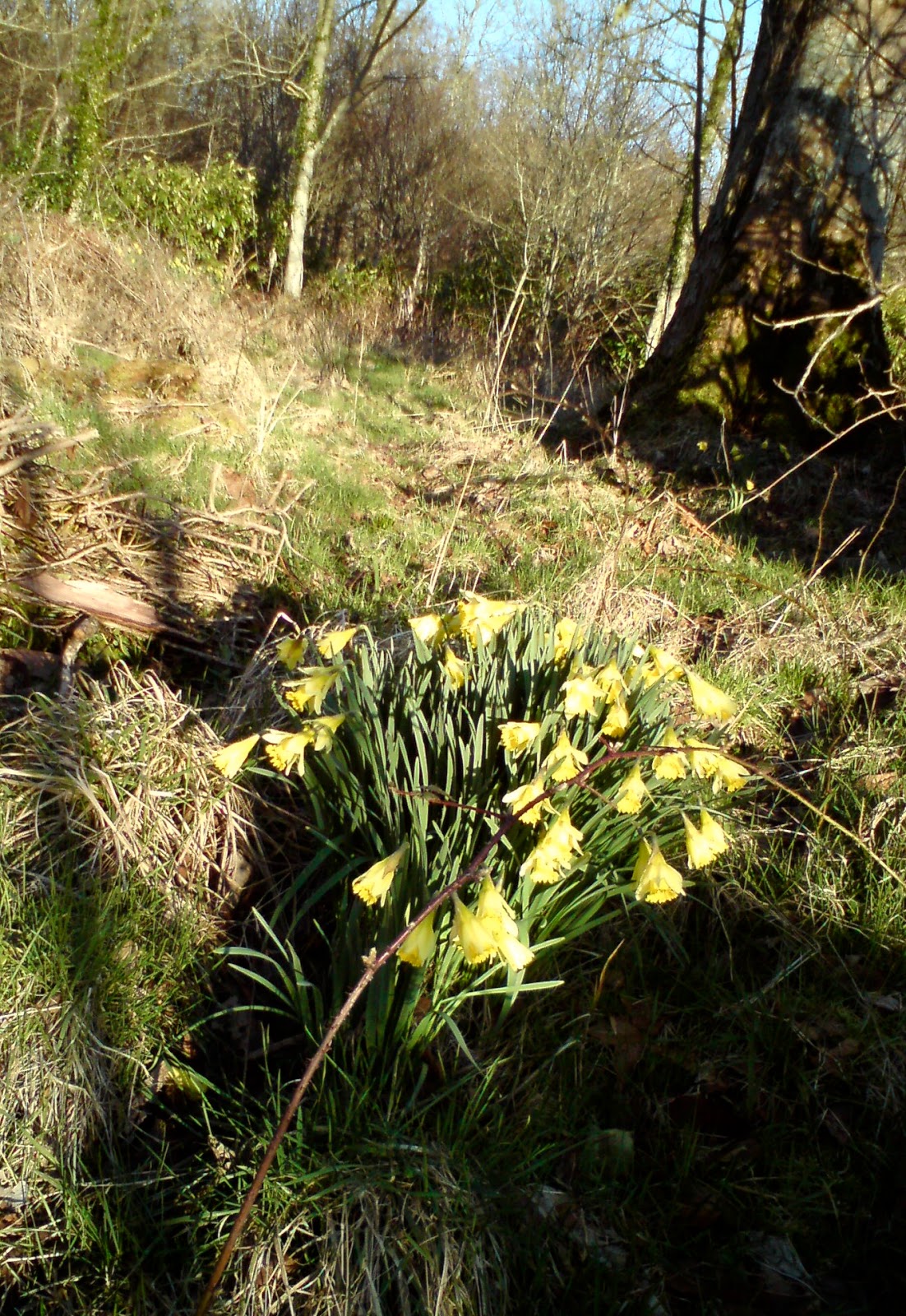
Around 2pm , there was a sudden lightening of the sky. By three o'clock the sun was shining, and half an hour later I was in this sunlit wood where the daffodils that lurk untended in the rough grounds of Toward Castle were golden among the brown tussocks.
Later, I walked by the calm sea. Peewits called in their creaky voices as five of them at least wheeled and dived above the fields. The sun gleamed on the water.
I felt my spirits rise.

The silence is broken by what sounds like crows calling. It looks cold, grey and sad. I cannot begin to imagine what it is like to have lost everything so suddenly and so completely. And now it seems as if there is further horror to come as control slips from those dealing - how heroically - with the threat of radiation from the damaged nuclear reactors.
And I was depressed?
Tuesday, March 15, 2011
Once more Ultreya ...
Last weekend saw the first Cursillo in Scotland weekend for almost two years, after a period of reflection leading to a determination to return to the basic ethos of the movement. And Cursillo #59 seems to have been worth the wait, with sixteen participants showing all the signs of having been overwhelmed by the dedication of the team and the love of God. At the Clausura, in Dunblane Cathedral for the first time, they spoke movingly - and in some cases wittily - about their experiences.
They spoke to a good crowd of the Fourth Day - the people who have been on previous weekends - who had braved the snow and sleet to be there to welcome them. This effort on the part of people who are for the most part not in their first youth, is typical of the commitment that puts the weekends on in the first place, for Cursillo is an extremely labour-intensive phenomenon. The amount of stuff that has to be transported, unpacked, set out, removed, inventoried, packed up and taken away again is remarkable - many, many heavy boxes-full. And yes, the people involved in doing the donkey-work can, like anyone else, become tired and scratchy. I was helping with some of it on Sunday, and by the time of the closing Eucharist I felt more like a bath and a lie-down than jolly hymn-singing.
But then the magic happened, just when it should, at the moment of Communion. As I received the chalice from someone I know from her own weekend, and from her service on team when I was Lay Rector, I knew once more the joy that all this service brings and returned to my place with an idiot grin on my face.
Mind, the evening was still spent in dribbling stupor ...
They spoke to a good crowd of the Fourth Day - the people who have been on previous weekends - who had braved the snow and sleet to be there to welcome them. This effort on the part of people who are for the most part not in their first youth, is typical of the commitment that puts the weekends on in the first place, for Cursillo is an extremely labour-intensive phenomenon. The amount of stuff that has to be transported, unpacked, set out, removed, inventoried, packed up and taken away again is remarkable - many, many heavy boxes-full. And yes, the people involved in doing the donkey-work can, like anyone else, become tired and scratchy. I was helping with some of it on Sunday, and by the time of the closing Eucharist I felt more like a bath and a lie-down than jolly hymn-singing.
But then the magic happened, just when it should, at the moment of Communion. As I received the chalice from someone I know from her own weekend, and from her service on team when I was Lay Rector, I knew once more the joy that all this service brings and returned to my place with an idiot grin on my face.
Mind, the evening was still spent in dribbling stupor ...
Thursday, March 10, 2011
Caught up in the past
I've been so taken up by the process of blogging my father's wartime letters that I find myself adopting his style of delivery on occasion, although this is not in fact something new for me. As a young teacher I was assailed by the chap who taught next door through the partition wall - he'd heard me sounding just like my father as I taught and recognised it from a time when they were colleagues. But I realise that as I knew him so well, I know when his tongue is firmly in his cheek - as when he is discussing the new family allowance scheme. His reference to the brutal and selfish father could hardly be further from himself, though he is right in describing my mother as an ardent feminist: nice to know it came from somewhere!
Another thing that struck me was the amount of the allowance: 5/-. How many of my readers say "five shillings" when they read that? It's a rare indicator of age, as is the relative value of money. Apparently the average wage for an agricultural labourer at the time was £3/7/101/2 for a 49.4 hour week, according to this site, while another fascinating site points me to a worth of £25.30 for that 5/- if calculated by reference to average earnings (though I'd be happy for someone to correct me in this if I've made my usual hash of reading statistics). It certainly gives a dimension to the other letters concerning money, and to my father's reckoning that he had far too much cash accumulating in his current account because of the lack of opportunity to spend any of his RAF pay.
I've been stymied in my attempts to find any really detailed history of Redlands private hospital for women in which I was born and where my own first son was born four years before it closed, though by that time it was run by the NHS in Glasgow. But it's a fascinating exercise, this digging in the past; my main regret is the unasked questions of my own youth. We don't tend to become interested in our parents till they're history?
Probably not.
I haven't a clue why the font of this - and the size - are so odd. Blogger is not always instinctive!
Another thing that struck me was the amount of the allowance: 5/-. How many of my readers say "five shillings" when they read that? It's a rare indicator of age, as is the relative value of money. Apparently the average wage for an agricultural labourer at the time was £3/7/101/2 for a 49.4 hour week, according to this site, while another fascinating site points me to a worth of £25.30 for that 5/- if calculated by reference to average earnings (though I'd be happy for someone to correct me in this if I've made my usual hash of reading statistics). It certainly gives a dimension to the other letters concerning money, and to my father's reckoning that he had far too much cash accumulating in his current account because of the lack of opportunity to spend any of his RAF pay.
I've been stymied in my attempts to find any really detailed history of Redlands private hospital for women in which I was born and where my own first son was born four years before it closed, though by that time it was run by the NHS in Glasgow. But it's a fascinating exercise, this digging in the past; my main regret is the unasked questions of my own youth. We don't tend to become interested in our parents till they're history?
Probably not.
I haven't a clue why the font of this - and the size - are so odd. Blogger is not always instinctive!
Monday, March 07, 2011
Playing away...

It was, quite simply, a great performance. It had all the tightness of a live event, the rhythm, the excitement. We were singing mostly popular stuff - Gershwin, Sting - with a few Spirituals and a bit of French thrown in - and the audience loved it. We could see flashes as people took photos - the one I've used is courtesy of Rob, biased by his being the other half of a soprano - but some at least belonged to the unattached. I haven't posted a link to a recording made of one song, simply because an iPhone recording, made off-centre, doesn't do this event justice. We had such a ball, and enjoyed every minute.
We've been invited back. I'm dead impressed by the good people of Rothesay - they were knowledgeable and gracious in their enthusiasm. They kept thanking us - I kept telling them we were having fun, and should be thanking them. And the people in St Paul's - they put on a great bunfight. Nothing seemed to be too much bother. It was well worth the journey.
And we have another gig on Friday ...
Thursday, March 03, 2011
Taking off in Argyll and The Isles

Reader, I was that angel. Seems I may be up for a new post: Bishop's Fool. It has a suitably Learian twist, I feel - Shakespeare, not Edward. It was all good clean fun and I ended up dancing, unwisely, in rubber-soled shoes: I don't usually stay for ra jigging.
Synod itself was wonderfully optimistic. Having arrived at a properly God-centred vision of our future, we were already well on our way to behaving as one always feels a church should be. The one cloud on the horizon as far as I was concerned, the one bit of contrary weather on the flight, was the revelation that we still carried some dinosaurs on board - the kind that have never realised how strange it feels these days for a church of which two thirds of the punters are women to use a creed with the words "who for us men and for our salvation". I felt moved to speech at that point, and they backed off into the swamp, but I have a feeling they may well resurface before we're finished.
But I niggle. No-one spoke for too long, and everyone seemed to depart in peace. The weather was kind and I managed to get to the deli for my lemon-infused olive oil and one or two other good things. We've taken off in a new direction and are travelling hopefully. Happy landings!
Sunday, February 27, 2011
Lilies of the field?

I'm a great one for a bit of symbolism, and tend to become inordinately excited when I'm surprised by something beautiful. I knew that last year I'd dumped the crocus bulbs under the hedge, to make room for something else in their pot, and I knew that I'd seen some insipid yellow flowers through the kitchen window, but I had no idea that today's sun would bring out the delicate mixture of colours in the picture. There there were, in all their fragile beauty, producing a huge swelling of delight as I came home from church in the early afternoon.
And the symbolism? Well we'd just had our new bishop, Kevin, celebrating the Eucharist in our church, three weeks after his consecration. The congregation was about double the size it had been a couple of years ago; the children were so ... uninhibited ... that I'd had to bellow the intercessions, and we'd had a jolly lunch party afterwards. And yet we all know how fragile our economy is, how easily the building could become too much to keep going, how people can die or drop away. There seems no sensible reason why we're there, why we keep going, why people put so much into making sure the beauty of the liturgy is there, week in week out.
But today it all came together. The sun shone, Cowal looked beautiful, the crocuses were in full bloom, and we had our new bishop in his church on the hill. And I thought of the lilies of the field, and how little I'd cared for these flowers that were so pleasing me today. And like all the best symbolism, there lay behind the coming together a greater truth, one that shatters or slips away in the moment when I try to express it, so I won't try any more. Let the picture be enough.
Friday, February 25, 2011
Out of the dark ...

It's amazing how a sudden change in the weather can make such a difference to life. Perhaps I should qualify that. When I lived in the city - and it's 37 years since I did - the weather was a backdrop, no more. I noticed if it wasn't raining, and can recall the peculiar smell of sun-warmed dust mingled with privet flowers in the late summer, but I have no recollection of prolonged gloom or subsequent depression on my part. Even in Dunoon, when I was at work, the main drawback of awful weather was the trail from the carpark to the main entrance - you could be soaked before you knew it - but I often felt how cheerful the yellow-painted English corridor was on a dark morning, and enjoyed the obvious delight my classes took in my similarly-painted classroom. It didn't really cross my mind to care about the weather - I was too busy, and didn't get out much except at weekends.
Now, however, it's different. This is the first winter I haven't gone abroad at all, and it's had an effect. The past week has been distinguished by a complete absence of sun - the rain hasn't fallen every day, but it's been dark. Some days it felt as if we were stuck on the edge of a huge ocean, as we could see nothing of the other side of the firth. Everyone you met mentioned it. It was hellish.
And then came today. The morning was like all the others - grey, misty, a hint of drizzle in a slight breeze. Until suddenly the wind got up and the clouds rolled back. The photo above was taken about 5pm, and shows the high tide completely covering the beach below the shore road at Toward. We walked along here, and out the Ardyne, and I felt like a new person. A squadron of oystercatchers flew overhead on some important mission; their cousins shared a field with the sheep and a scattering of curlews. The waves were brown and green in the low sunlight, and it was almost unbearably bright, as if we'd been in a cave for a week. The light reminded us, oddly, of the shore south of Monterey in California at the same time of year, though there were no tales of mountain lions to terrify.
And then the sun set and it was dark again. But the effect remained - and with it the thought that, as Larkin said, "It will be spring soon, it will be spring soon."
Friday, February 18, 2011
Notes on a letter from the past.
I've just been posting another of my father's wartime letters on Letters from the Past. In this one, he is rejoicing at the confirmation that my mother was expecting their first child: me. Obviously, it is fascinating for me, and much of this letter is taken up with the news rather than the progress of the war and service life. But I am especially struck by the fact that at this time I seem to have been going under the name Caroline Mary - a sort of working title with the same initials as the name I ended up with - Christine Margaret.
I shall be fascinated to discover if the change to the name occurs before the birth - and how, for heaven's sake, did they know that it was a girl? Dr Kate Harrower was well known as an outstanding practitioner, but this knowledge was surely well beyond her powers. And how old-fashioned and wonderful the insistence on my mother stopping work - the fiercely feminist Dr H was obviously having none of this!
On a sadder note, the Willie Skinner referred to in this letter was, I think, a close friend of my mother's younger brother. She used to become emotional at the mention of his death even when I was an adult - a real underlining of the agelessness of the young who die in war. As my father rarely mentioned the serious business of war, but chose in my youth to dwell on the humorous moments - as when he emerged naked from the Mediterranean to find Churchill and Monty standing on the beach - I had to remind myself frequently that war meant death and misery. This was one of the few deaths to touch our family personally.
I shall be fascinated to discover if the change to the name occurs before the birth - and how, for heaven's sake, did they know that it was a girl? Dr Kate Harrower was well known as an outstanding practitioner, but this knowledge was surely well beyond her powers. And how old-fashioned and wonderful the insistence on my mother stopping work - the fiercely feminist Dr H was obviously having none of this!
On a sadder note, the Willie Skinner referred to in this letter was, I think, a close friend of my mother's younger brother. She used to become emotional at the mention of his death even when I was an adult - a real underlining of the agelessness of the young who die in war. As my father rarely mentioned the serious business of war, but chose in my youth to dwell on the humorous moments - as when he emerged naked from the Mediterranean to find Churchill and Monty standing on the beach - I had to remind myself frequently that war meant death and misery. This was one of the few deaths to touch our family personally.
Thursday, February 17, 2011
Bubbling away

Apart from the danger of repetitive strain injury (I play with the middle finger of my right hand, if you're interested) there's the problem of seeing life as a series of bubbles to be burst. I realised I had it bad when I looked up from losing a game (I don't actually know how you win it) and visualised the black jacket of someone talking on the television suddenly disintegrating as a black bubble hit it.
I've recently found Tetris on Facebook, which may go some way to weaning me off Bubbles, but the lure is strong. Anyone got something else I can waste my time with?
Wednesday, February 16, 2011
Recycling gay marriage
Sometimes I can't help myself. It happened this morning. At least I didn't reach for the phone - but I did send a mail. What was it that so disrupted my peaceful breakfast? A phone-in on the radio. Call Kaye -without the eponymous Kaye - was looking at the proposed English legislation that will allow gay couples to be married in a religious ceremony. Apparently the Scottish government won't be following. The punters were asked to air their opinions. And afterwards, they could have their say about recycling.
Usually I turn off at this point. I find phone-ins an irritant I can do without. But this morning I let it get under my skin, and that was that. I don't intend to rehearse the whole sorry tale - none of it was new. But two things stuck out and drove me to action. The first was typified by the woman who took the "it's a sin and we don't believe in it" attitude; the second by the man who said, politely and less concisely than I am about to, that Christians are nutters and should be allowed to do what they liked because no-one outside cared.
Trouble is, the dogmatic attitude of the woman made the man's attitude perfectly understandable. It was when the presenter said that there hadn't been much coming in from Christians by way of support for the idea that I could bear it no longer. I didn't say much - just that this Christian felt ashamed of belonging to a church that felt bound to ideas formulated when it was assumed that people suffering from epilepsy were possessed by demons. It's annoying, though - I wanted to say so much more, but went for the soundbite. The good news is that as far as that bit of the programme was concerned, I had the last word.
Now ... recycling, anyone?
Usually I turn off at this point. I find phone-ins an irritant I can do without. But this morning I let it get under my skin, and that was that. I don't intend to rehearse the whole sorry tale - none of it was new. But two things stuck out and drove me to action. The first was typified by the woman who took the "it's a sin and we don't believe in it" attitude; the second by the man who said, politely and less concisely than I am about to, that Christians are nutters and should be allowed to do what they liked because no-one outside cared.
Trouble is, the dogmatic attitude of the woman made the man's attitude perfectly understandable. It was when the presenter said that there hadn't been much coming in from Christians by way of support for the idea that I could bear it no longer. I didn't say much - just that this Christian felt ashamed of belonging to a church that felt bound to ideas formulated when it was assumed that people suffering from epilepsy were possessed by demons. It's annoying, though - I wanted to say so much more, but went for the soundbite. The good news is that as far as that bit of the programme was concerned, I had the last word.
Now ... recycling, anyone?
Saturday, February 12, 2011
Class wars in Doyle

The left-hand page bears this dedication: To the hope of the future, the reunion of the English-speaking races, this little chronicle of our common ancestry is inscribed.
South Norwood, September 29, 1891.
This last information, incidentally, is particularly interesting to me now because of the fact that members of the greater Blethers clan now live in South Norwood; I try to picture Conan Doyle among the older houses there, perhaps using the same railway station that we frequent on our visits.
I'm not going to tell the story. You can buy it on Amazon if you're interested. And I've already gone on about how I read this stuff before I was ten, no doubt becoming in the process the finicky dinosaur I now seem to be. But what struck me most powerfully in this latest reading of it was the dreadful injustice of the class system of the time - the lordship of the Norman rulers, the haughty king who didn't deign to speak English, the automatic assumption that the squire of gentle birth would ultimately earn his spurs and his knighthood while the brave archer who saved everyone's bacon time and time again would marry the innkeeper woman who had looked after his feather bed and stagger about in his old age (about 50) and chase the pretty girls while the aged Lord Chandos would ride to battle in his late 60s and die gloriously.
Even worse was my realisation that in my childhood I accepted this hook, line and habergeon (go on - look it up). When the Jacks, the poverty-stricken country French, storm the castle of Villefranche in an episode that I used to be too scared to read in bed at night, they are described as bestial and sub-human, and their assault on our noble heroes seems shocking and an affront to the natural order of things. But did I notice, all these years ago, how Doyle sets the framework for the episode? The wife of the Seneschal of Villefranche describes how ugly the people are, how she "cannot bear it" and so "my trusty Raoul goes ever before me with a cudgel to drive them from my path" - to which her chaplain murmurs "Yet they have souls, fair lady, they have souls!" He is quickly slapped down, because the Seneschal has heard "that you have said to them that their souls are as good as ours". It were better, he goes on, if the priest were to stick to saying Mass.
I fear that as a nine-year-old I probably skipped through this bit to get to the awful moment when the body of the squire is dangled outside his friend's window in the dark. But I'm really glad I've re-read it, seen more of what was implied, realised that it's not just a tale of derring-do. I probably won't read it again.
Life, as they say, is too short.
Friday, February 04, 2011
'Tis done ... we have a Bishop!

But enough of the technical stuff. On a day when the wind threatened to lift the roof and the rain battered down on the alarmingly glass roof of the choir, an unfeasibly large number packed the cathedral to see Bishop Kevin consecrated and Bishop Mark give up the burden of looking after us - it's been a long haul, and he's been brilliant. There was a considerable invasion of Edinburgh folk, obviously loathe to let +Kevin go, and a selection of luminaries from other parts of the province, all interested by the Argyll weather and the possibility that gaiters might be worn (they weren't). Kilts there were, however, and some tartan trews, and tweed - not to mention the odd fleecy jumper.
The Right Reverend David Conner, Dean of Windsor, preached a sermon that drew heavily on Philip Larkin's poem Church Going. Written 60 years ago, it gives a picture of the poet - and Larkin himself took part in a TV film that showed him, bicycle and all - visiting a church, going in only when he is "sure there's nothing going on". Larkin, said the Dean, was like the Greeks in the Gospel of the day who wanted "to see Jesus". Although Larkin said he was "bored, uninformed", he nevertheless often found himself "tending to this cross of ground" because of what it held, what it had held over the ages, and this was a commonly-found attitude of the majority of people nowadays, who still have this hunger without really knowing what it is they seek. Bishop Kevin's role was to be a leader in mission, relentless in his prayerful quest to show the love of Christ in the world so that those who seek find not barriers and impenetrable theology but rather the answer to the need they might not fully understand, the "hunger ... to be more serious".
"Reach out, my friend," he said in conclusion, "reach out, but dig deep."
The digging will soon begin, but for this weekend, it seemed, the celebrations were paramount. And after a service lasting over two hours, the hungry horde scuttled along the road like so many Mary Poppinses under their billowing brollies and descended on the purvey in the Argyll Gathering halls. When we left, five hours after arriving, the rain was still falling steadily. We surfed home through the gathering gloom, crashing through the potholes that seemed to have multiplied since the morning. At least we didn't crash the car. Summer consecrations must be more dangerous - we drove into a ditch after the last one.
Thursday, February 03, 2011
Wild things
This wild and wooly day happened to coincide with a fairly long-standing arrangement to visit Edinburgh, so having chipped the ice from the windscreen this morning we set off in the sunshine across the calm Firth of Clyde to do just that. The journey took us just over two hours, door to door, and we arrived in time for coffee. Yeah, yeah - we'd heard the weather forecast; we knew it wouldn't last ...
We leave Newhaven as the wind begins to drive rain in our faces. We've enjoyed a lovely lunch, hugged our grandchildren, heard the new drum kit. It's 3.30pm and we reckon we'd better head for home. We are not even past the city boundary when we learn that Western Ferries have gone off - Cal Mac don't seem to have been running since mid-morning. The traffic is already nose to tail as we edge out onto the M8 and towards Glasgow.
In the four mile traffic jam before the Kingston Bridge we decide we're driving home over the Rest and Be Thankful, via the Erskine Bridge because we've ended up in the wrong lane to go along Great Western Road. By now, the motorway is flooded in the low-lying bits, and great gouts of water fly up from under wheels and crash onto our roof. Every so often a gust hits us with the force of a giant fist. We have heard the same news bulletins till we could repeat them verbatim, but we keep Radio Scotland on for the traffic updates as we whizz over the Erskine Bridge in a lull and on towards Loch Lomond. And it is as we embark on the lochside road that I realise we are listening to Get it On. Now, I have only just clocked this programme, thanks to Ewan, and it strikes me it might while away the drive if we make a request. I entrust this task to my pal Di, in the back seat with her iPhone. Ask for "I remember you", I instruct - they're looking for songs that should never be covered, and it's sure to come into that category.
And so it is, best beloved, that forty minutes later, after we have braved the dark battering of the Rest and the long run down Glen Croe, as we hurtle through Strachur, we hear a message for "Di and Chris, driving home" and find ourselves singing along with Frank Ifield at the top of our voices. What fun. The miles have sped by and we're as jolly as a school trip on speed. We don't even care that it's taken us four and a half hours to get home.
Pity Mr B (driving) has to spoil it all. He announces that he feels like the coach driver - on a Saga outing.
Ah well.
We leave Newhaven as the wind begins to drive rain in our faces. We've enjoyed a lovely lunch, hugged our grandchildren, heard the new drum kit. It's 3.30pm and we reckon we'd better head for home. We are not even past the city boundary when we learn that Western Ferries have gone off - Cal Mac don't seem to have been running since mid-morning. The traffic is already nose to tail as we edge out onto the M8 and towards Glasgow.
In the four mile traffic jam before the Kingston Bridge we decide we're driving home over the Rest and Be Thankful, via the Erskine Bridge because we've ended up in the wrong lane to go along Great Western Road. By now, the motorway is flooded in the low-lying bits, and great gouts of water fly up from under wheels and crash onto our roof. Every so often a gust hits us with the force of a giant fist. We have heard the same news bulletins till we could repeat them verbatim, but we keep Radio Scotland on for the traffic updates as we whizz over the Erskine Bridge in a lull and on towards Loch Lomond. And it is as we embark on the lochside road that I realise we are listening to Get it On. Now, I have only just clocked this programme, thanks to Ewan, and it strikes me it might while away the drive if we make a request. I entrust this task to my pal Di, in the back seat with her iPhone. Ask for "I remember you", I instruct - they're looking for songs that should never be covered, and it's sure to come into that category.
And so it is, best beloved, that forty minutes later, after we have braved the dark battering of the Rest and the long run down Glen Croe, as we hurtle through Strachur, we hear a message for "Di and Chris, driving home" and find ourselves singing along with Frank Ifield at the top of our voices. What fun. The miles have sped by and we're as jolly as a school trip on speed. We don't even care that it's taken us four and a half hours to get home.
Pity Mr B (driving) has to spoil it all. He announces that he feels like the coach driver - on a Saga outing.
Ah well.
Wednesday, February 02, 2011
Enjoying an old 'tec

I first read my parents' hardback copy of this book in my early teens, and although I haven't read it since, the sense of menace lingered over the years. It's a wonderfully-written 'tec novel; the language is sophisticated and delightful and never misses a beat. I knew I would love it afresh on the first page - "The fog had crept into the taxi where it stood panting in a traffic jam" - and this Eliot-like fog is the "smoke" of the title. As a novel, it obeys the classic unities of place and time for over three quarters of its length, taking place over two days in a restricted area of London in a dense post-war fog.
The tension throughout is maintained by that fog, and by the sense that the forces of evil are somehow connected to even the most innocent-seeming protagonist in the story. And although I began to remember just as the denouement came into sight, the need to pursue the plot to its conclusion was as powerful as I can recall experiencing. This is one of Allingham's later stories involving Albert Campion, and all the better for it - though I may find myself scouring Amazon for one of the earlier ones.
If you haven't tried any of these stories, this is a good place to start. I envy you.
Sunday, January 30, 2011
A fascinating letter
The letter I've just been posting on Letters from the Past is full of interest. My father must have been underemployed on duty that night, or simply more than usually fascinated by the current news. I've managed to find the speech of Churchill's that he comments on - I'm so impressed by what you can find online these days - and have linked to it; and the opinions he shares on Churchill, and on left-wing journalists, were quite at odds with what he calls my mother's "liberal sympathies" - though I never remember my father expressing political views in my hearing when I was of an age to take any notice of them.
There are also some insights into rationing and food - I realise with increasing clarity just how big a part food played in alleviating the tedium of service at home. It is worth noting, however, in the light of his penultimate paragraph, that he never, ever, became "really fat"!
There are also some insights into rationing and food - I realise with increasing clarity just how big a part food played in alleviating the tedium of service at home. It is worth noting, however, in the light of his penultimate paragraph, that he never, ever, became "really fat"!
Sunday, January 23, 2011
Hats from the past

This morning it felt as if my obsession was spreading. For reasons I shall not go into*, I found myself in church, at the start of the service, standing with the small children who have so miraculously appeared in our congregation. They, and I, were wearing strange hats, kindly handed out by Andrew. As if by magic (no, I know it isn't - he reads blogs) he gave me a hat just like the one in the photo on the left, which shows my father sitting in the door of his bivvy somewhere in the Western Desert, probably in 1942. It felt absolutely right to jam the RAF forage cap on the side of my head, not just because I'd been uploading this photo the other day but also because when I was a small child I used to play for hours wearing father's forage cap. (There was also a proper, hard, peaked cap, but I didn't like it as my head was too small and it tended to birl round on the top of my pigtails as if it had a life of its own).
Maybe it's a sign of age that the past suddenly becomes precious - but I wonder what that formidable intellect with whose words I am working would make of all this.
*Oh, all right then. Andrew was introducing the theme of "calling" by getting people to assign roles to hats. If you get me.
Saturday, January 22, 2011
Walking in the air
The photo accompanying this post shows how magical this afternoon was. After a morning swathed in dank fog, we set out from the still-foggy coast to climb through the forest above Blairmore - and came out into the last of the light as the sun set. The whole of the Firth of Clyde, as far as we could see in all directions, was swathed in fog, with the Inverkip Power Station chimney half its usual size and the hills above Gourock cut down to mere bumps. It felt like being in an aircraft - or, as Rob pointed out, like The Day After Tomorrow.
You can see the rest of my (phone) photos of the view by clicking on the one here.

You can see the rest of my (phone) photos of the view by clicking on the one here.
Friday, January 21, 2011
Stringent
My current preoccupation with Letters from the Past means I have less time - and fewer thoughts - to post on this blog, but after a flurry of suggestions from Ewan about how I could enrich its content I found myself examining my attitude to what I'm doing there.
For widening my remit, so to speak, sent me hunting for such things as photos, references to the RAF base from which the letters were written, links to other sites. I became aware of the huge numbers of photos and memories now preserved online, and I was seized by the need to tie my contribution to a larger picture. But in a sense, the letters I'm reproducing have something more relevant to my own field of interest, something that makes them stand alone. The writing in them is wonderfully clear, succinct and evocative of my father's voice - the last of which is, of course, of more personal interest. Today's entry , for example, describes the weather as being "stringently cold". I've never come across that particular use of "stringent", and it's perfect.
These were, of course, the letters of one highly-educated scholar of English to another. I can only imagine the pleasure his references gave when the letters arrived in war-grim Glasgow. And it is this kind of feature that brings me to realise that the real interest, for me, lies in the letters themselves.
There is a whole box of them.
For widening my remit, so to speak, sent me hunting for such things as photos, references to the RAF base from which the letters were written, links to other sites. I became aware of the huge numbers of photos and memories now preserved online, and I was seized by the need to tie my contribution to a larger picture. But in a sense, the letters I'm reproducing have something more relevant to my own field of interest, something that makes them stand alone. The writing in them is wonderfully clear, succinct and evocative of my father's voice - the last of which is, of course, of more personal interest. Today's entry , for example, describes the weather as being "stringently cold". I've never come across that particular use of "stringent", and it's perfect.
These were, of course, the letters of one highly-educated scholar of English to another. I can only imagine the pleasure his references gave when the letters arrived in war-grim Glasgow. And it is this kind of feature that brings me to realise that the real interest, for me, lies in the letters themselves.
There is a whole box of them.
Thursday, January 20, 2011
A blog from World War 2
For the past week I've been reading through a box of letters written by my father to my mother in 1945. Having spent a month or so in Glasgow on the first home leave in three years, he was posted to an RAF base in deepest Essex. From there he at first expected to be sent to Northern Europe - he was a cipher officer - but as the weeks went by he settled into a life of excruciating boredom, in which the hight points were the many letters he received from home and the weekly attempt at making a phone call to his wife.
During that period he must have written on average three letters per week, in tiny handwriting on miserable paper. Often delivery was held up, so that whole bundles of letters would arrive together - though this seems to have been more of a problem with letters from Essex. When it came to the Sunday evening phone call, he might have to book a slot 3 hours in advance, and then have to endure a bad line or an interrupted connection - a far cry from the instant communication we take for granted now. Nine months of these letters survive, with gaps; they end when he left for home to attend the birth of his first child: me.
The letters fall into three sections - the personal, obviously, much of which I have edited out; the literary, mainly dealing with the books he devoured as his main source of entertainment; and the political, as he comments on the progress of the war, the likelihood of demobilisation and the attitudes of his fellow-officers. Every now and again there is the casual mention of something huge, historically speaking, but they are fascinating primarily as an insight into our recent past.
You can find the letters, as well as photos from the desert war, on the blog Letters from the past.
During that period he must have written on average three letters per week, in tiny handwriting on miserable paper. Often delivery was held up, so that whole bundles of letters would arrive together - though this seems to have been more of a problem with letters from Essex. When it came to the Sunday evening phone call, he might have to book a slot 3 hours in advance, and then have to endure a bad line or an interrupted connection - a far cry from the instant communication we take for granted now. Nine months of these letters survive, with gaps; they end when he left for home to attend the birth of his first child: me.
The letters fall into three sections - the personal, obviously, much of which I have edited out; the literary, mainly dealing with the books he devoured as his main source of entertainment; and the political, as he comments on the progress of the war, the likelihood of demobilisation and the attitudes of his fellow-officers. Every now and again there is the casual mention of something huge, historically speaking, but they are fascinating primarily as an insight into our recent past.
You can find the letters, as well as photos from the desert war, on the blog Letters from the past.
Tuesday, January 18, 2011
Waste of parents?
I'm currently working on a fascinating project to put online a great collection of letters from my father written during 1945 and therefore covering the end of the war with Germany and the dropping of the atomic bombs on Japan - and I'll put up a link just as soon as I get started on the text. But in preparation for starting I've been reading these letters, and I've been learning.
Two things leap to mind. The first is of interest, probably, only to me: I was going to be called Caroline Mary. The initials are the same - but I can't so far find out when I became the me that I know instead. The other, however, is more profound. I was wondering why I knew so little about my own parents, so little about what they thought about the big things. I realised that in fact it was because I hadn't asked the right questions - especially of my father, who died when I was 32. Ok, you say - you were an adult. What stopped you asking the questions?
And the answer is, I think, that I didn't know what questions to ask. I also lacked the confidence to ask them. I don't think I became that confident questioner until ... well, until now, I suppose. I simply didn't know enough. They were my parents, and that was enough - a kind of force-field prevented my straying too far, and I didn't know the way anyway. So that feeling that keeps coming over me - the idea that we waste our parents, the resources that they represent - is something I have to recognise and, to quote Larkin, clothe as destiny. Maybe we are all destined to "waste" our parents; to dismiss their recollections as old hat or irrelevant, to assume that we know it all without recourse to their wisdom. Maybe the force-field is omnipresent between the generations, and maybe it is inevitable and even necessary.
So I forgive myself my thoughtlessness, and will attempt to make amends to myself now. And while I'm at it, I shall keep on growing up.
Maybe.
Two things leap to mind. The first is of interest, probably, only to me: I was going to be called Caroline Mary. The initials are the same - but I can't so far find out when I became the me that I know instead. The other, however, is more profound. I was wondering why I knew so little about my own parents, so little about what they thought about the big things. I realised that in fact it was because I hadn't asked the right questions - especially of my father, who died when I was 32. Ok, you say - you were an adult. What stopped you asking the questions?
And the answer is, I think, that I didn't know what questions to ask. I also lacked the confidence to ask them. I don't think I became that confident questioner until ... well, until now, I suppose. I simply didn't know enough. They were my parents, and that was enough - a kind of force-field prevented my straying too far, and I didn't know the way anyway. So that feeling that keeps coming over me - the idea that we waste our parents, the resources that they represent - is something I have to recognise and, to quote Larkin, clothe as destiny. Maybe we are all destined to "waste" our parents; to dismiss their recollections as old hat or irrelevant, to assume that we know it all without recourse to their wisdom. Maybe the force-field is omnipresent between the generations, and maybe it is inevitable and even necessary.
So I forgive myself my thoughtlessness, and will attempt to make amends to myself now. And while I'm at it, I shall keep on growing up.
Maybe.
Saturday, January 15, 2011
Voyage into 3D
I've come over all industrious in the last couple of days - started work on a new blog to make use of fascinating family archive material from World War 2 - but before I lose sight of it, I must record our recent outing to the movies. This is something we tend to do on average once a year - a post-Christmas treat involving the empty cinema (everyone else being back at work/school), a morning screening and a large and leisurely lunch afterwards. Because I believe that a big screen and superb sound effects merit a big movie and special features that wouldn't be the same on the telly, we didn't see the apparently excellent The King's Speech - we shall, but probably on DVD - but went to a 3D screening of The Voyage of the Dawn Treader - the third in the Narnia films.
Of the books, this was perhaps one I didn't particularly enjoy, but boy, did it make a good movie! There we sat, in our shades (modern 3D involves not red and green lenses, but things that look like pale sunglasses), captivated by the effects as Eustace the dragon swept at us out of the screen and the green fog (see picture) threatened to engulf us all. The moral transformation of said Eustace - which might well have seemed nauseating - was wonderfully acted, and Aslan (Liam Neeson) as ever sent shivers up the spine. It was a great outing - and the threatened sick-making effect of the 3D wasn't in evidence, despite the problem of getting the specs to balance comfortably over the ones already on my nose.
Magic, in fact.
Moving swiftly on: parenting and education
Considering my own childhood - and I realise it must seem odd to many - led me inexorably to think about my own role as a parent trying to encourage children to learn, do homework and so on. I was about to say that by comparison with my own parents' involvement, I was a complete failure - but then I thought about the outcome for both sons and decided that was a tad sweeping. So what do I remember?
The Word Tin. Son no.1 used to produce this, when he was in P1, with a look of doom. We had to pick words out of a tobacco tin (where on earth did I lay my hands on this item?) and he had to recognise them. At the time he was four and a half and it was torture. Later, there was more amusement to be had in thinking up outrageous sentences with which he could demonstrate the meaning of words. And that, I have to admit, is all I can remember from the Primary school years. I have very little recollection of what - if anything - I did to help no. 2 son. He used a thing called the word-maker, and progressed to a sentence-maker, but I didn't seem to do anything. Could this be because by then I'd gone back to work?
When your children attend the secondary school in which both parents teach, the experience is somewhat different from the norm. I was certainly involved in helping both sons with English - rescuing one from having to do North and South for Higher by spending a whole Easter holiday studying the Larkin set texts so that he could use them in the exam a month later actually involved me in the most God-awful scene with his class teacher, who happened to be my boss. I did a bit of Standard-grade Latin with both of them. And when no.1 son became editor of the school magazine, he recruited me as the Editor-in-chief because it was more convenient for him - and look where that got us.
Actually it got me into what I see as the most important single piece of education I ever undertook. I don't know how many evenings I spent in the school while both sons in turn ran the magazine, teaching myself to do desktop publishing (Adobe Pagemaker) when they left and the boy who knew how to do it let us down, sharing hilarious pressure with successive generations of student journalists when the photocopier jammed/ran out of ink/got too hot, going off with them to competitions in Edinburgh and to the Scottish Parliament, sitting in on interviews with Frank Pignatelli, then Director of Education for Strathclyde, and John Smith, leader of the Labour party. Pupils who were shy learned to use the phone, to contact advertisers, to sell advertising; others learned touch-typing without ever taking Business Studies, coaxed ancient Macintosh Classics to work years after they should have recycled, learned to use the scanner and the value of white space on the page.
Did this make up for the fact that we had television on every night? That there was a small telly in the older son's bedroom, linked to the ZX Spectrum but also to an aerial? That they both had radios and listened to music incessantly, from an early age? That we allowed an 11 year old to have a modem and a year's subscription to BT's precursor of the internet (what on earth was it called?) so that he would come and beg: "Can I go online now?" before he was in secondary school? At the time I felt I was failing, when I'd find one of them sweating over something for the magazine the night before some important exam, but now I'm less sure.
But there's so much more to think about in this early exposure to the medium I'm using now that I think I'd better leave it to another post. It's a long way from the Word Tin ...
The Word Tin. Son no.1 used to produce this, when he was in P1, with a look of doom. We had to pick words out of a tobacco tin (where on earth did I lay my hands on this item?) and he had to recognise them. At the time he was four and a half and it was torture. Later, there was more amusement to be had in thinking up outrageous sentences with which he could demonstrate the meaning of words. And that, I have to admit, is all I can remember from the Primary school years. I have very little recollection of what - if anything - I did to help no. 2 son. He used a thing called the word-maker, and progressed to a sentence-maker, but I didn't seem to do anything. Could this be because by then I'd gone back to work?
When your children attend the secondary school in which both parents teach, the experience is somewhat different from the norm. I was certainly involved in helping both sons with English - rescuing one from having to do North and South for Higher by spending a whole Easter holiday studying the Larkin set texts so that he could use them in the exam a month later actually involved me in the most God-awful scene with his class teacher, who happened to be my boss. I did a bit of Standard-grade Latin with both of them. And when no.1 son became editor of the school magazine, he recruited me as the Editor-in-chief because it was more convenient for him - and look where that got us.
Actually it got me into what I see as the most important single piece of education I ever undertook. I don't know how many evenings I spent in the school while both sons in turn ran the magazine, teaching myself to do desktop publishing (Adobe Pagemaker) when they left and the boy who knew how to do it let us down, sharing hilarious pressure with successive generations of student journalists when the photocopier jammed/ran out of ink/got too hot, going off with them to competitions in Edinburgh and to the Scottish Parliament, sitting in on interviews with Frank Pignatelli, then Director of Education for Strathclyde, and John Smith, leader of the Labour party. Pupils who were shy learned to use the phone, to contact advertisers, to sell advertising; others learned touch-typing without ever taking Business Studies, coaxed ancient Macintosh Classics to work years after they should have recycled, learned to use the scanner and the value of white space on the page.
Did this make up for the fact that we had television on every night? That there was a small telly in the older son's bedroom, linked to the ZX Spectrum but also to an aerial? That they both had radios and listened to music incessantly, from an early age? That we allowed an 11 year old to have a modem and a year's subscription to BT's precursor of the internet (what on earth was it called?) so that he would come and beg: "Can I go online now?" before he was in secondary school? At the time I felt I was failing, when I'd find one of them sweating over something for the magazine the night before some important exam, but now I'm less sure.
But there's so much more to think about in this early exposure to the medium I'm using now that I think I'd better leave it to another post. It's a long way from the Word Tin ...
Thursday, January 13, 2011
The parental role in education

The chat on the radio today was looking at the perceived failure of state schools adequately to prepare their students for the competition to enter the top universities, and asking how much parental pressure/support/coercion was needed to supplement the work of the school. As a teacher, a parent and - a long time ago - a child, I think I have quite a rounded picture of this - but in this post, I'd like to share the part my home played in ensuring that I succeeded in what I set out to do.
By the time I was ten, we lived in a Victorian terraced house in the West End of Glasgow, with four bedrooms and two public, as well as a large kitchen, a wash-house and a lined loft. Loads of room into which one could vanish - but in winter it was cold, and we tended to live between the dining-room and the kitchen. That meant piano practice was less assiduous than it might have been, but was generally done before the evening meal - perhaps on the premise that food would replace the heat lost during practice. Dinner was over by 6pm - both parents were teachers, both home at the same time as us. For the next three hours, my sister and I sat at the dining room table and did homework - and there was always a great deal of this. (We were at a grant-aided selective school, and we could be asked to leave if we didn't work). Until about 7pm, we weren't allowed to make a noise. In fact, I got hell once for throwing a pencil down on the table, as my father had fallen asleep in his chair and I woke him. Once his post-prandial kip was over, however, we had two hours in which both our parents took a hand in our struggles.
Father was always deeply critical of the teaching in the English department of our school, so we had a great deal of incredibly thorough input on texts we were studying. That went without saying. What was more remarkable, I thought, was that he would also work out from first principles what was going on in the Physics problems I had such trouble with - sums involving moment, I recall with horrifying clarity. My mother, meanwhile, would sit down with my tiny, battered copy of Caesar's Gallic Wars or, later, Virgil's Aeneid (Book 2) and, as she put it, "break the back of it" before I set to work on my preparation for the next day's terrifying oral translation session round the class. She also pushed us to work at French, which I personally hated because of the accent involved, and made several visits at parents' evenings to ask why we had so little written homework in French (lazy teacher; fluent as married to French woman but no fire in his chubby belly). That holiday in Paris, by the way, was by way of encouraging me at the end of S2 - I can still remember the chagrin when the lift man in our hotel corrected my pronunciation of "quatrième".
All this must have taken an enormous amount of dedication and energy on the part of two people who had already taught for a whole day - or even the half day done by my mother, who would then have had to shop (no car, so limited to what she could carry each time) and deal with our sizeable and dusty-corner-ridden house. There was no thought that my sister and I should do housework, other than during a holiday. But perhaps the biggest single contributing factor was the absence of a television. Despite my sense of deprivation at never having seen Quatermass or Emergency: Ward 10 my father refused to have a set until I had graduated (I lived at home when I was at Uni). He said I'd become an addict and that would be the end.
How right he was. I'll return to this subject - I want to think about my own deficiencies when it came to fulfilling the parental role - but for now, I'll indulge my latest addiction. Another go at Bubbles HD before I head out?
Monday, January 10, 2011
Catharsis in Walford

What nonsense all this is. The most unexpected people suddenly stop watching the programme, or write letters or post their ire on websites. People are upset to find this sort of thing in their living-rooms, and Mumsnet is raging. What's going on?
Classically, the purpose of drama - and particularly of tragedy - is catharsis: the purging of pity and terror. You watch the drama unfold, you become involved, you suspend disbelief, you weep, rage, gasp, feel fear and relief - and by the end, if it's been well done, you feel wrung out, devoid of all emotion. Judged by this set of criteria, EastEnders has got it about right, I'd say - except that people have forgotten the rules.
A few weeks ago I watched Patrick Stewart as Macbeth, in a strangely bleak production of Shakespeare's tragedy. For anyone who has forgotten the plot, Macbeth, a soldier, acts on the urgings of some strange women and murders his king. He then becomes king, but fears his best pal Banquo may suspect, so has him bumped off. He is more than somewhat annoyed that the inept thugs who do this for him fail to murder Banquo's wee boy. Later he has the wife and children of one of his former friends horribly murdered in their house as the children are getting ready for bed. That last bit is particularly horrid. I wasn't aware of cries of horror and demands that the play should never be put on again.
Or what about Hamlet, whom Shakespeare has plotting to murder his uncle for the whole length of a long play? In the course of trying to find the perfect moment, Hamlet bumps off the father of his girlfriend without knowing or caring who he is, sends his two best chums from school to certain death in a foreign country and acts in a totally unsuitable way towards his silly mother. Do people write angry letters about the portrayal of life with a step-father?
Course they don't. It's only a play, silly. So why do they think EastEnders is any different? Ronnie has been an unstable character for years - of course she's not going to get to be happy and fulfilled. Nor is she going to accept her lot if there's a chance of doing the dirty on someone else - we know this; we've been prepared for it. No-one would leave an hours-old baby in its cot in the care of its grandpa? Well yes, they would. People are wary of passing around a newborn - there's a sort of mystique, a fragility that binds a new baby to its mother, and if the mother is suddenly taken ill it's an alarming prospect for even the most gung-ho stranger to look after this tiny infant. And it was Hogmanay, and they were all drinking and Alfie is good-hearted but inept and Charlie has never been the most savvy of men.
If I were an EastEnders producer, I'd be thinking I'd succeeded here. Everyone's talking about it, it's on the news programmes and radio chat shows and in the serious Sundays as well as the red-tops. What more could they ask? So people seem to think it has to fulfil a public service role and show bereaved Ronnie behaving well and bravely - where's the mileage in that? This way, the story has legs. Jessie Wallace gets to act her socks off. It's not real life, whatever people have come to assume. It's a play. Fiction. Drama. Either watch it, or hit the remote.
THE END
Sunday, January 09, 2011
On lecterns, and cold hands
Brass eagles don't usually leap into the mind when the weather is cold - monkeys are much more likely. However, today I want to consider a brass eagle like this one, a lectern in a chilly church on an icy Sunday. Specifically, and not to detract from this magnificent specimen in the Cathedral of The Isles, I want to consider the lectern in Holy Trinity, Dunoon, and its effect on me this icy morning.
Today was my turn to preach. Having read the gospel (it was a lay-led service), I propped my notes on the lectionary as usual - and found that they wouldn't stay put unless I held on a bit. (The lectionary at this early point in the year lies a bit lop-sided when open at the right page). I tend to hang on to the wing-tips anyway, as it anchors the hands in a decorous sort of fashion.
Halfway through I had a vision. It was not an angelic vision, nor was it helpful. I pictured myself as in a heat-imager: starting off quite red and glowing, in my good wool coat to the ankles and the fur-lined boots. Within moments, my hands are blue, then black. The glowing red is drained out of my shape, passing instead to the eagle. By the end of the sermon, my frozen body retreats and the eagle, glowing like the Phoenix, takes off and soars down the church.
There you are. I told you it wasn't helpful. But I must try to do something different with my hands next time.
Or wear gloves ...

Today was my turn to preach. Having read the gospel (it was a lay-led service), I propped my notes on the lectionary as usual - and found that they wouldn't stay put unless I held on a bit. (The lectionary at this early point in the year lies a bit lop-sided when open at the right page). I tend to hang on to the wing-tips anyway, as it anchors the hands in a decorous sort of fashion.
Halfway through I had a vision. It was not an angelic vision, nor was it helpful. I pictured myself as in a heat-imager: starting off quite red and glowing, in my good wool coat to the ankles and the fur-lined boots. Within moments, my hands are blue, then black. The glowing red is drained out of my shape, passing instead to the eagle. By the end of the sermon, my frozen body retreats and the eagle, glowing like the Phoenix, takes off and soars down the church.
There you are. I told you it wasn't helpful. But I must try to do something different with my hands next time.
Or wear gloves ...
Friday, January 07, 2011
Hibernation ended

I've been thinking about this as I prepare a sermon for Sunday, and the idea of living through change in oneself has taken over. I can remember how overawed I became shortly after finding I was expecting my first child - I was standing at a bus-stop in Clarence Drive when I was suddenly overcome with the enormity of the changes this as yet invisible child would produce in my life. (If I'd known it would involve leaving the West End of Glasgow and living in Dunoon I might have panicked even more, but there you are). But now, all these years on, I look back calmly and with huge satisfaction at the way it all panned out: what was I afraid of?
Only thing is, I don't think satisfaction is what it's about. Not this change, not this Epiphany. I have a worrying feeling that it may be about continual growth, continuing challenge, continual willingness to try, to accept, to move on. Tonight I noticed it was significantly lighter at 4pm than it has been. Hibernation is not an option, is it?
Oh, darn ...
Sunday, January 02, 2011
Kate Atkinson, again

This is the fourth book to feature Jackson Brodie, who sidles into the plot some time after I became hooked on the story of Tracy, ex-cop, security firm owner, lonely and overweight. It was Tracy and her acquisition of a child that had me reluctant to move around the plot - for Atkinson never leaves you with only one strand to follow - and Brodie and the dog that enters his life who had me laughing aloud, sometimes in horror. The story is dark in places, and complex in its interweaving of time-scales and histories, which is where the second reading will come in - I don't feel I'll fully appreciate the book until I do this. I loved the details of the past - Vesta curries, Smash instant mash - and the fact that they shared a place with the use of Twitter and Facebook. Too often, I feel, novelists opt for a present that seems never to have changed - kind of Orwellian, in a way - and forget that readers might share a past with the characters.
I don't think I've really explained why I'd recommend this, other than that it's the usual well-written, gripping story with a twist in its tail. You can see my first thoughts on it here, but apart from that just go and read it for yourself.
Subscribe to:
Posts (Atom)