Friday, October 18, 2013

Home again!


We're ba..a...ck! (All right, that movie wasn't yesterday, but I can't resist the probably inappropriate allusion) A gang of us descended on Holy Trinity Church Dunoon this morning, fighting our way past the men in hard hats who warned us that once inside we'd not get out as they were dismantling scaffolding, negotiating the piles of scaffolding poles and discarded bits of mysterious metalwork to see inside the church we'd left looking desolate and dirty on Low Sunday. We weren't there merely to gawp, but to make it fit for use on Sunday. Gawping, however, came first. To the stranger, it might look as if little had actually changed; the sanctuary, for instance, has paintwork to be done and the central aisle has rough boards covering the space where the various heating systems have had their workings, but the hideous calamine-lotion coloured wooden dado has been replaced by dark red painted plaster and the whole floor is no longer the worm-eaten, rot-weakened potential disaster we had been sitting on top of for all these years. The strangely amateurish platform on which the choir stalls used to sit is gone, the whole area of the choir now restored to its original structure with not a carpet in sight. With any luck, that's how it'll stay. And those of us who've seen the photos of what has been done, we know the awfulness that has been transformed all around us.

The effect was strangely dreamlike - when I sat down as if for a service, I felt the unreality that accompanies dreams of familiar places, and I realised that there have been times in the past where I have indeed had near-nightmares about our church being taken over by people who changed everything so that it no longer felt like the same place. But there's a great feeling about this dream, a dream that includes using that marvellous space for musical performances that the carpetless acoustics can only enhance. And the narthex - just look at the picture of the narthex with its plaster gone and the stone laid bare - reminded me of the lovely buildings we stayed in in Sicily, where the bare stone contrasted with the modernity of the furnishings. I have visions of golden uplighters at floor-level ...

But all this - the enthusiasm with which we all set to work dusting and polishing (all the time hoping that the men on the scaffold tower in the photo don't make too much mess putting in the last window), the laughter, the marching through the rain carrying altar frontals and altar-rail kneelers, the determination to get rid of the foosty cardboard cups that had languished throughout the works in a cupboard under the tower and did odd things to the coffee - all this brought it home once again how important our building is to our worship and our life as a community. People have talked, recently and in the past, of how enlivening it could be for worship to be transferred to a modern space, perhaps one in the town centre where parking would be easy and more people might know we were there and come.

It's not been like that. After the initial hilarity induced by finding ourselves in a strange hall the worship turned out - for myself at least - to be difficult. On the days when I simply didn't feel like going, there was nothing in the environment to give me a nudge towards prayer or mystery. The music was hard going - the piano a sad thing, tending to die a little each time Mr B attacked the keys with anything like a forte; the dead acoustics accentuating the poor sound of the singing so that the less confident gave up singing altogether. The receiving of communion always seemed a tad strange, in that people didn't seem able to achieve a normal sort of progression from seats to front and back again without becoming entangled in each other. You can be jolly about this - and God knows we tried - but it becomes wearisome, a chore. It reminded me of wet days at the CSSM of my childhood holidays, when we had to have our services in a hall rather than on the beach - and there is no way I ever wanted these days back again.

So if anyone asks if this has been a positive experience, I would have to say that it may still turn out to have positive benefits in terms of valuing what you have - but I cannot say I shall miss any tiny bit of the worship over the past 6 months. I became an Episcopalian - I became a Christian, in fact - because of the enabling beauty and numinosity of the two church buildings in which I found myself, and I can't help thinking that we give our leaders an unnecessarily uphill task if we expect them to bring mystery to the mundane on a weekly basis. I don't think our congregation grew in any way because of the convenient location of the hall we were in, and I know for certain that my own spiritual growth was put on hold while I combatted the temptation to go for a walk on a Sunday morning.

Yes, it's good to be going back. And I must add one thing: somehow, we were given the right leader to see us through all this.  How often does that happen?


Friday, October 04, 2013

The men in the radio

We were listening to music on the radio the other night - hardly surprising; we do this every night in life - and for some reason discovered, Mr B and I, that we had both as children pictured tiny musicians inside the radio every time an orchestral concert came on. In these days, of course, there was considerably less music to listen to; the Third Programme didn't come on until after 6pm (heralded, I recall, by the wonderful theme used by Britten in his Young Person's Guide) and I went to bed shortly after (we're talking the 1950s here). Later, thanks to the acquisition of a more modern radio, I discovered Radio Luxembourg and pop music, though that was only audible after dark. (Don't ask me why; I suspect it may have something to do with Physics.) In the light evenings, you could barely hear Elvis through the static. The nostalgia trip was completed with the joy of finding a photo of the radio we had in the kitchen - can you not just see the tiny musicians, in their evening tails, ranged behind the golden cloth front?

We both hated, I discovered, the singing on "Listen with Mother" - on at 1.45 every weekday. I can still hear the voice of Daphne Oxenford in my mind's ear. The man who did the duets with Eileen Brown  ("Hob shoe hob ..." - aargh) was known as Uncle George. How sinister. You can see we had a fascinating ramble into our childhoods, separated by the width of the country but strangely similar in some ways.

Another moment of nostalgia, absolutely nothing to do with the above, came with the remembering of how I came to know what someone with a broken collar-bone might look. (If you follow me on Facebook or Twitter you'll know why I was speculating). There was this book, you see, a "Teach Yourself" book, on home nursing or some such terrifying area of self-improvement. It was blue, but apart from that looked like the book on the right. I think there were photos in it, but there were also the most terrifying line drawings, showing you how to bandage such injuries
as a fractured jaw, a fractured thigh (horror!) and - you've guessed it - a
broken collar bone. You would recognise the last injury by the forward
droop of the shoulder and limb, I recall, and the face of the victim would,
according to the illustration, bear a face of patient suffering. As I spent
quite a lot of time in the post-war years being ill with such things as measles and whooping cough (the first child caught everything. I was doomed) I tended to read anything that came to hand - and this book was one of the most gripping.

Another book I recall being horrified by was a collection of prints of work by war artists, the most worrying of which showed the aftermath of an air-raid. But my post-war traumas (not brought on by anything but my parents' conversations and the sight of the land-mine destruction along the road; I'm not that old) belong, I feel sure, to another post ...

Friday, September 27, 2013

Ruins, wild goats and a grey Fiat


 The real journey in Sicily began in a car. A not-very-comfortable, faintly tatty Fiat in battleship grey. We picked it up at Catania airport, drove south for 40 minutes, saw the red oil warning light, stopped at a petrol-station cum cafĂ©. Several phone calls and a coffee later, we drove back to the airport, to be told all was well and it was the computer. We drove off again. The picture on the left shows the last stretch of two-way road, with a wonderful set of stations of the Cross leading to an imposing - what? Church? Convent? Sanctuary? (it was called that). After that, the road became single-track, without passing-places, rounding a gorge and crossing a worryingly small bridge until I suddently recognised the road I'd followed on Google Earth. We found the entrance, dogs barked, I phoned the number we'd been given. How did we get in?

But we did. We had arrived at Borgo Alveria, a collection of buildings on the site of an ancient monastery, destroyed in the earthquake of 1692 but rebuilt using so many of the original stones that we kept finding stray heraldic devices in the middle of the garden wall, and bits of pillars randomly deployed as garden ornaments. Our room (above) was amazing: I could have climbed some of the walls, and the bathroom was a cast iron cube in the corner with a glass ceiling through which you could see the rafters of the entire room. At night, lights came on in the grounds until midnight; after that it was dark and totally silent. During the day the most noticeable noise was that of the cicadas. It was blissful.

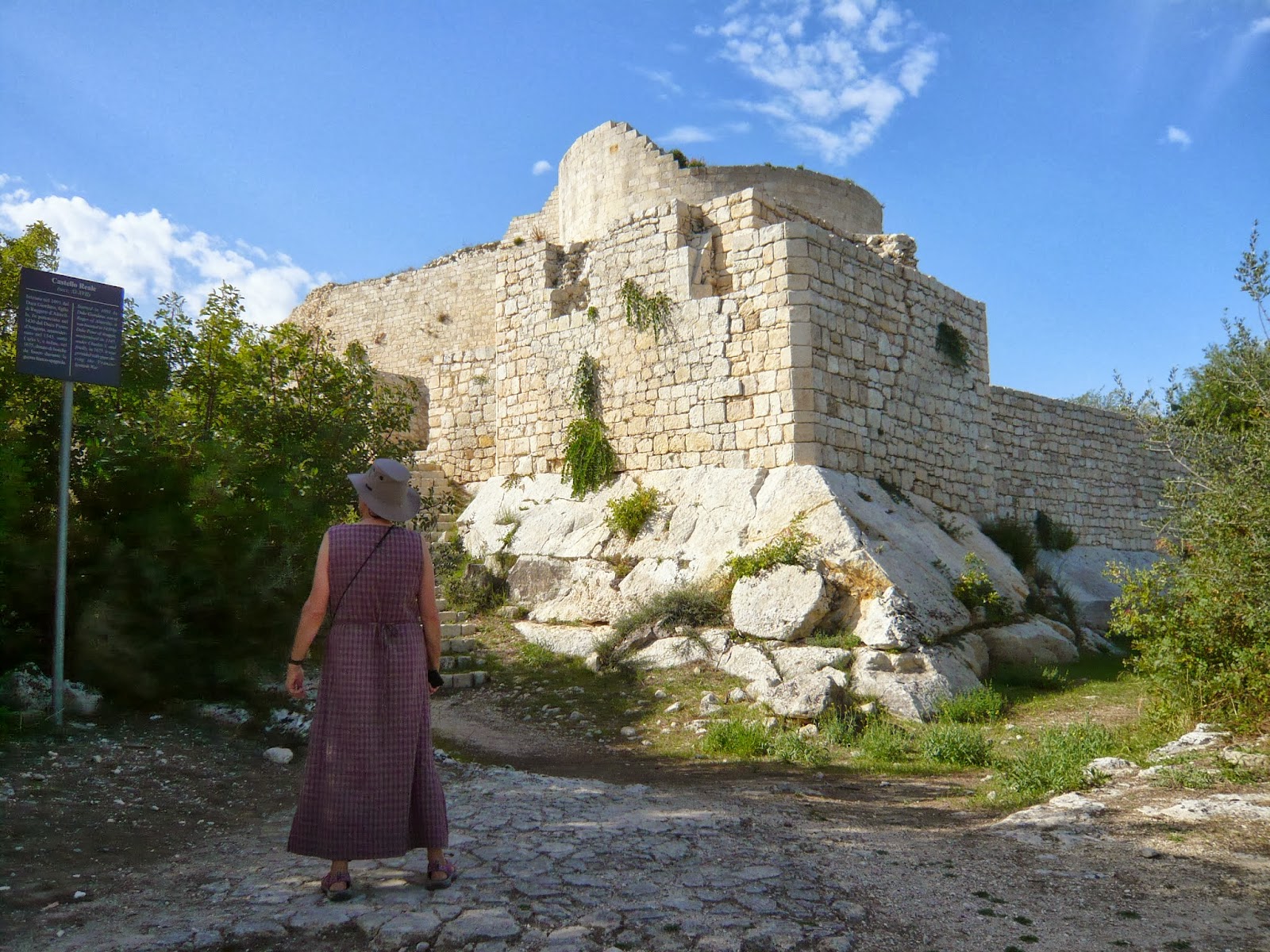
There were two Notos in our area - the baroque town twenty hair-raising minutes away by car (see above) and the other, Noto Antica, which was ten minutes from our door on foot. It wasn't just because we could walk there that I loved the latter - a whole walled town, destroyed by the earthquake and just left there, the inhabitants told to abandon the shanty town that they made in the aftermath of the destruction and some of the stones removed, as far as I could determine, to use elsewhere. We walked for hours among the vegetation that would suddenly reveal the shape
of the Jesuit college or some great palace, and we saw hardly a soul.
The picture on the left is of the partially reconstructed Porta Aurea taken from inside the gates, and the one below of the castle and prison to the left of the gate inside. I fear we were perhaps odd in our attitude to our surroundings - we preferred walking in the wooded area around the ruins, a sort of natural parkland which started opposite our front gate and wandered down towards the old city through a variety of trees - eucalyptus, conifers - which smelled wonderful in the sun. There were wild goats that popped up to look at us, cicadas by the thousand in the trees, birds singing and sailing
 above us, and lizards darting everywhere.On Sunday the stone tables and solid BBQ areas near the road were thronged with families enjoying a day out together - some of them stayed for hours, and the small children played quietly or slept in shady corners while the men did manly things with fires and grew increasingly vocal. We didn't walk in the woods on Sunday ...

We did make a couple of excursions. We felt people might remark our oddity if we didn't see anything but our immediate surroundings - would they think we should just have stayed in Scotland? So we drove to Ragusa Ibla, a four-hour drive for two hours in a town that
apparently features in Inspector Montalbano. We missed the best road
on the way there - the sign for it was hidden in a tree, a common feature of route-finding in Sicily - but persevered over a massive viaduct and through the fringes of the modern town till we found the proper car-park, with the steps up to the old city just as we'd been promised. This was another earthquake story, except that the inhabitants of the old town of Ragusa insisted on staying put. We also spent a fascinating day in Palazzola Acreide, where extensive Greek ruins sit on top of a hill, in Akrai. And yes, it was to Akrai that we toiled up the hill in the midday heat, and we spent a wonderful time wandering round the Greek Theatre from the 3rd century BC and various catacombs and carvings.

A common feature of all our jaunts was angst about the car. Not only did the oil warning light stay on throughout the week; when we were in Palazzola Acreide - actually in a sort of housing scheme on the outskirts, where we had originally thought of abandoning the car because there was plenty of parking space - we discovered that the footwell on the driver's side was ... wet. Very wet. Wet and slippery. After a brief period of panic we decided it was water from the air-conditioning, which we ran constantly. Its jet must have become blocked. We never found out. And then there was the matter of where we left the car. Our first trip down to Noto saw us more or less abandoning it in the second street we passed that seemed to point in the right direction. We had walked two blocks downhill when the thought struck us that we might never find it again. Back we toiled. I took its photo. I noted its number on my phone. I dropped a pin on Google Maps, thereby discovering the name of the street - for signs with this helpful information are rare. And we noted that the building we had to pass on our return seemed to be a prison, housed in a former monastery. I took to following this routine every time we left the car anywhere. A dusty grey Fiat in Italy is hardly a stand-out, after all.

That all sounds very stressful. I know. On day one, it was. But by the time we left I felt sorted. The sun shone, the mellow stone was the perfect colour, I discovered granita, my Italian, supplemented by French, seemed to be working. The car was never comfortable, and the road was always a challenge, but our hilltop Borgo was heavenly and the company right up our alley. When we snuck out in the rosy-fingered dawn (Homer was right, by the way) I didn't want to leave.

I'd have wanted to leave even less had I known how we were going to get lost finding the road back to Catania, and the twelve-year-olds on the moped who finally got us back onto the right one, but that's another story ...


Wednesday, September 25, 2013

I'm back

I've been away. Not just from the country - but yes, Sicily was wonderful, thanks - but also from my normal online activity. Instead of posting photos and writing posts, I've spent all my computer time recently fighting with my recalcitrant iPhoto library, full of duplicates and photos on their sides since my computer died and needed a heart transplant exactly two years ago, and backing up furiously as I fixed it so that my repairs weren't lost. I've been in and out of the Time Machine - and had the vapours when it too failed for a week - and I've rationalised the things I wanted to keep.

But now I'm back. I have a new machine, and am currently using the new keyboard that came with it (don't like it as well as the old one; it's wireless, which is ok, but the keys are less sensitive) and a trackpad instead of a mouse (jury's still out, though there are good things about it). I'm working on Safari instead of Chrome for a change (I originally left Safari cos I couldn't access all Blogger's features) and fighting to remember the tabs I had before. My files are rationally organised for the first time in two years - I only found out today that they were chaotic because of a saved backup when the new hard drive was installed.

I'm looking to get my photos out of the camera and the phone, into iPhoto and then onto Flickr. I hope to find some interesting things to write about instead of this self-regarding computer stuff; you can tell how obsessed I've been. But first I need to thank my pal Rob for spending so much time helping me today despite my tendency to squawk "what are you doing now?" at awkward moments. I'm looking forward to learning a bit more at the Apple store when I go for lessons - I'm interested in doing more with my photos for a start. Right now I'm off to put my grandchildren back on the desktop, and then I'm going to bed.

Rob, if you're reading this - I got the printer to work, all by myself!

Sunday, August 11, 2013

Of fear, cheese and a shoogly crozier...

Two rants in a row. Never mind, today feels more positive. Largely, that's the doing of two Argyll and The Isles clergy who managed to assuage the wrath stirred up by The Bigot of Ardentinny and the hapless local paper (do they really think about what they print?), so today I'm celebrating that.

We're so lucky. When you have a Dean who can cheerfully put into amusing perspective the lunacy found in some threads of Christianity and a Bishop whose sermons never fail to inspire, it seems almost worth the angst of worshipping on a badminton court (Andrew, I thank thee for that word). And when the local paper's intransigence and lack of savvy releases you from the tedium of writing half-baked localpaperese (I just made that up) after lunch on a Sunday, you find you have the energy to celebrate on your own blog.

So, from today, my mental image is of +Kevin, behind the altar, singing his own descant to "Sing Hosanna" at the top of his voice. There are others - the shoogly crozier at the beginning, the mitre at a jaunty angle as +K waited to be allowed to bless us (we needed to sing first). And it seems from Facebook that there may have been some cheese-throwing; one hopes it was inadvertent, but one never knows.

The local paper, remember, turned down a piece because it was too theological, didn't have enough "news" So here's today's news.

Do not be afraid.

Or a headline? NO MORE FEAR, SAYS GOD.

Good, eh?

Saturday, August 10, 2013

Bigots, homophobes and the love of God

I like living where I do. Most of the time. But today I'd rather have been in my native Glasgow. I'd rather have been with friends on the Gay Pride march - friends I know because of the church. My church, their church. But instead I was here, reading my local paper - for we all do, you know, even when it's depressing reading, because we don't know what you'll miss if we don't read it. I read the letters page, skipping over it to see if there was anything interesting - and came across one that took up more column inches than any of the others, and certainly more than I would tend to have written in my now defunct church reports.

It made me sick. It seems to be an answer to a letter I've missed - maybe when I was somewhere civilised. It's a homophobic rant in defence of "traditional and well-accepted marriage" which dismisses as "meanderings" the words of Desmond Tutu (presumably  "I would refuse to go to a homophobic heaven. No, I would say sorry, I mean I would much rather go to the other place," ) and accuses him of "erroneously" stepping outside "the clear and wholesome directives of his holy book".

In the past I often wished I had a public voice that wasn't dependent on the whims of some editor or - interestingly - newspaper owner. Now I have, and this is what I want to say to anyone who reads either this or the ghastly outpourings from Ardentinny: I do not wish to go to a homophobic heaven either. I wouldn't go near a homophobic church, and I rejoice in the welcoming openness of my own. All Christians are not homophobic (and this sounds like the start of a syllogism, which if pushed to its conclusion might be interesting ...) The teachings of the bible are anything but clear, obviously - because people like the bigot from Ardentinny don't get it. People who think it's clear scare me to bits.

But what is clear to me is this. I worship a God who loves all God's children equally. Equally = the same, each as much as the other, no distinctions made. We are not here to question that outrageous love, but to try to do likewise. 

Even when it comes to bigots and homophobes. Hard, huh?

Sunday, August 04, 2013

Not the Local Paper ...

It's Sunday afternoon. Ok, it's early evening, but the idea holds: another Sunday afternoon in which I wasn't writing anything for the local paper. Usually I write a report on what has gone on in our church - either I do it or my pal does it, and we have been in the habit for years now of making sure that one or other of us was able and willing to do this, covering for one another as necessary and getting hold of someone else to do it if we couldn't. But today - no. Pal didn't do it either, though we were both in church and perfectly able to do it. Sermon was interesting and relevant too - for although our American visitor knew it was Transfiguration Sunday, she didn't know where the lectionary had hidden the readings and had prepared to talk to us about greed and God. And this led us to talking a bit about Credit Unions, and how we might get involved ... as I said: relevant.

So why, do you ask, was one of us not spinning this worthy news for the local press?

I'll tell you why. It's my theory that too much contemporary relevance in the business of church triggers some negative response in a publication that still seems to want the churches at least to submit pieces from the "and a good time was had by all" school of journalism. Now, dear reader, I would rather poke out my eyes with a quill pen than write that sort of stuff, and to date I have resisted any pressure - only there hasn't been any. Working on the assumption that most churches tend not to generate any news worth reading unless it's the Good News that we're supposed to promote, we have for years now written as interestingly and cogently as lies in our power about the message of each Sunday's sermon. Sure, we've stuck in things like impending Episcopal visitations - we're having Bishop Kevin next Sunday, folks - but these things don't happen every week. The Gospel does.

A few weeks ago, I submitted a piece concentrating on the idea that the story of the Good Samaritan showed Jesus cutting through the strictures of The Law - a human creation, when all's said and done - and showing how much more important was God's law of love. As the preacher on the day had said, it was radical then and it's radical now. And yes, I had in mind the awful way some Christian churches treat people they consider beyond the pale - but I refrained from spelling it out.

Back came the mail: "We will not be considering your piece for publication as it is too theological." 

I didn't ask the hack who contacted me how he knew this, though I did suggest to him that it might simply have been too relevant. There was no reply, and none to my comment that every week we had people tell us in the street, in the supermarket, how much they'd enjoyed reading our reports.

We do these things, I suppose, for publicity. But what kind of publicity do we want to create? If we want our church life to come over as a cosy anachronism of blinkered self-absorption, then I suppose we'd write about how happy we are to have our visitors and the loan of the hall in which we currently worship, and nothing at all of the burning issues of the day that are at the heart of ordinary life. We'd write the same stuff every week, so that we could substitute an old report without anyone noticing, and we'd seem as boring as ...

I could go on. But I don't think I need to. I have a feeling that God, and what God does to the heads of thoughtful Christians, is probably too interesting for  a local paper.

And I feel better now. I've written my piece.

Thursday, August 01, 2013

Country mouse

Take a look at that photo on the left. Go on - enlarge it if you haven't got your specs on. See all these people? They're all dressed in summer clothes. See the sky? Blue, with white fluffy clouds. It's summer, right? But this is a summer scene in London, not Scotland, and although we've had wonderful weather for the past couple of weeks (now, sadly, a memory) it was somehow not like this. For a start, there's no sign, either in the sky or in the demeanour of the people, that for a half hour or so it had rained intermittently from a threatening darkness - for the rain vanished as suddenly as it had appeared, leaving the ground and the people seemingly as dry as ever and the air as warm as it had been.

And now, back in Scotland, I try to ignore the rain that has teemed down all day and the depressing gloom that still envelopes the view from the study window and remember how, in the midst of the sun and heat and busyness of the weekend, I kept saying how I couldn't cope with living in London. For all that I was brought up in a big city and for all that I enjoy holidays in hot, sunny places, the business of ordinary life in the heat of a city defeats me. It may make life feel simple to be able to head out for the day in a t-shirt and crops; it suits me fine to wear sandals all the time; everything tends to look better in the sunshine; I can down pints of lager and glasses of Pimms and feel equable and relaxed ... but it's hard work, and even harder when you have to brave crowded trains and hordes of people.

Mind, the hordes were out of the ordinary at the venue pictured - the Queen Elizabeth Park, where the Olympic Stadium is, on its Festival opening weekend. There was a touch of the Orwellian about the journey between station and park: loudhailers told us to keep moving, to cross the road when instructed, to keep going for the festival/station as required, to go through the barriers without tickets or tapping (it's an Oyster thing)... for yes: we all got on the high-speed train back into St Pancras without paying. It was all very jolly and good humoured, and totally exhausting.

I think I've been rusticated ...

Friday, July 12, 2013

Of minnows, flounders and me


I've decided I'm a simple soul, really. The picture above - and that's my footprint on the right - represents a perfect end to a perfect week and we've hardly spent a penny on all this perfection. I climbed a hill (Beinn Donich) on Monday, walked the Crinan Canal on Wednesday, and finished off with what must be the seal-setter on the proper Scottish holiday experience: I swam in the sea and it was warm. There were shoals of minnows, tiny flounders, and the odd crab. Oh, and some of these wee clear jellyfish with the purple bits that we used to throw at each other. It's an odd sensation to hit one when you're swimming. I wished my grandchildren could have been there, because they would have loved it, but I had fun doing my own thing.

When I say we didn't spend much, I'm glossing over two sizeable drives, one to Lochgilphead and one to the beach which is the gem of Argyll's Hidden Shore (yes, it's a tourist description) - but we began and ended each day in our own house and bought no tickets and only modest food. But this afternoon I was ecstatic, to get a swim at the time of year when the childhood holidays demanded and with Arran, my favourite place in the world, on the horizon. Better still, we had to walk a mile to reach the beach - just as I did in my car-less childhood.

Is it what you do in childhood that in the end demands you return to these experiences? When I was a small child we spent 8 weeks in Arran every summer, in the same cottage, doing the same things. On days such as today, we went to the beach and went into the sea. Other days we climbed hills or walked the glens. We came home in the evening to boiled eggs, floury muffins with strawberry jam - this last memory is so powerful that today I found myself thinking of a boiled egg despite having had one for lunch. We would never eat what I've just cooked and eaten (baked salmon of some splendour, strawberries ditto, a nice crisp white wine), though I suspect I'd miss the step up in culinary standards these days.

But I rabbit on, and I'm tired and sun-sated. I've showered away the salt (it doesn't half prickle under your shirt, especially on a bit of sunburn) and shaken the sand out of my sandals. I feel as if I might still be ten years old. I believe the weather is going to be different tomorrow, and I shall be off to Rothesay for work, not pleasure. But I don't care.

Tonight is good, and I know it. Hurrah.

Wednesday, July 03, 2013

Vernacular - a poem from a sermon. Sort of.

The opening two lines of this poem appeared unbidden in my mind as I was listening to the sermon in Holy Trinity last Sunday. Hugh, this is for you!

Vernacular

Abraham, Abraham - gonnae no?
Gonnae no dae that?
Is that how you might hear the God
these days, the moment that you’re poised 
to do whatever horrid thing seems suddenly 
a pressing need - the familiar
cadence of a homely voice? No
thundering winds, no wildfire roar
but unmistakably addressing you
with some urgency - no chance of
misunderstanding that.
You drop the knife right there, son,
and your boy lives.
How was it in the dark of night
when the Temple slept and the voice 
whispered through the echoing space
where the lamps flickered 
and the boy woke and heard
his name - Hey, Sam, Sam, 
gonnae waken up? 
And Elijah under his solitary bush?
Son, ye cannae sleep - Elijah 
eat your tea and get your strength and
get tae where ye’re gaun.
Are we bereft because we listen 
for the voice in perfect prose
preferably with a touch of
sixteen hundreds charm
and then we miss the total
urgency of what we need 
to hear, to heed, to know?
And so the cosmic words go on
in Babel tones among the crowd:
Écoute-moi - escucha -
 hören - ascoltare! The voice persists, 
the voice of  friend, of stranger
in a bar, a chance 
meeting by the way. So, all of yous
gonnae listen the noo?


©C.M.M. 06/13

Monday, June 24, 2013

It's Time - Scotland's equal marriage video [Equality Network]


It's midnight, or just past it. I should be asleep. We've got builders arriving in the morning to do destructive things to a wall inside our house. But I'm glad I stayed up to see this new video, and to share it, for the destructive things our society has done to people in all walks of life has been and still is far more destructive than anything the builders will do. I watched this video with a lift in my heart and hope for all my friends who are still denied equal status for their love in our society. It is indeed time for change, time for justice in our society.

Watch it.

Sunday, June 23, 2013

Elephants, Proms, and the American Mad Mouse

So the Kelvin Hall is to close. Gosh. It's taken me a while to catch up on this news, and it would seem that the arena was used for a final fling only last night. It's to reopen "by the end of the decade" as the - presumably very much bigger - Hunterian Museum, thereby merging two arenas, as it were, of memory, as far as I'm concerned.

So, as the space is cleared for whatever huge refashioning is to take place, I thought I'd take a totally gratuitous amble round my memory, beginning in childhood. I'm talking small child with parents, really, when I recall going to the Kelvin Hall Carnival - that magical time that straddled the Christmas holidays when the hall was filled with rides and amusements and the Circus lurked in the arena in the far left-hand corner of a space made bigger, it seemed to me, by the thundering machines that filled it. The Chairoplanes were always at the entrance - remember them? The whirling seats on the end of their chains, their screaming occupants high overhead, virtually horizontal as the momentum grew. I was never allowed to go on that (maybe because of this accident), and I don't know that I wanted to, but ... And the motorbikes, a faintly scarey ride of my almost-teenage years, a roundabout that at top speed made you feel as if you and your bike were heading straight down a dark tunnel, holding on for dear life as the centrifugal force tried to hurl you off.

My later memory of the Carnival involved going after school with three friends. We must have been about 15, I think, and the American Mad Mouse had arrived - a primitive and relatively small scale roller-coaster. The worst bit about it was the way you had to sit in the narrow, rocket-shaped car: astride a central seat with your legs out in front of you. I was stupid enough to go at the rear, and as we mounted the first steep incline, I realised I had three hefty schoolgirls to all intents and purposes sitting on my lap. Not a good moment.

I think I made it to the circus once. I was always being ill in the winter and you had to book. My parents probably gave up. I don't think I liked it much.

Later memories involve the SNO Proms. After the tragic destruction of the St Andrew's Halls, the Proms were rehoused in the Kelvin Hall arena. (We always said it smelled of elephants.) I shall never forget the rituals that quickly grew up - queuing just behind the red pillars at the front entrance (see photo) until the doors opened, then running like maniacs across the acres of empty floor to the entrance of the arena to get in the front row of the promenade area, where there was a bench laid all along the front of the stage, about three feet from the orchestra. Possession of a bums-width bit of bench meant you could sit out the hour's wait for the concert to begin, and go on sitting, if you wanted, during the concert. You were so close to the conductor and orchestra that you felt part of it, and you could catch the eye of players who might even - joy - wink at you. Who wanted to pay for a seat when you could have all this fun? I heard an astonishing amount of music this way over, I suppose, four or five years of prom-going.

And now it's closing. There's a sober chance I might never see it reopened. (Gosh. Again.) The hall is over - but the memories linger on ...

Sorry. Enough already.

Monday, June 17, 2013

Weighting

It always strikes me, in the
bright morning light
how the line on the cheap bathroom scales stops
always just short - or just long? -
of the magic figure that says
goal achieved. But I tell myself
and anyone else who will listen
that there’s a whole two big bags of spuds 
gone already
melting as by magic
from the bits a friend called
stout
what a potent word, that
 - stout - 
 and though the skinny form
of the almost-anorexic 
(a word we didn’t know, then)
will never again be smoothly taut
nevertheless that almost-line
makes me feel a bit of me
has beaten the clock
and drives me on:
another bag?


©C.M.M. 06/13

Monday, June 03, 2013

Last words

My last post, as anyone who still reads this blog will know, was an appreciation of an old friend. And I was glad (you can tell I sang this yesterday, but that's another story) to learn that there was an obituary * of Alastair Fulton in the Herald last week. And that is where the gladness began and ended.

Previously I have bemoaned inadequate funeral services as being unworthy of the deceased and unhelpful to those who loved them. Now I find myself bemoaning what I see as a sadly inadequate piece of writing, let alone a reminder of someone I knew. There seems to be a tradition (is there?) that newspaper obits have to be dry and factual, covering a linear model of a life that resembles nothing so much as the "thank-you" speech at the end of a charity event: don't forget the lady who does the flowers or your life won't be worth living. That sort of thing. And as far as that goes, if indeed that is the requirement for a respectable newspaper, then as far as I'm concerned respectable newspapers have indeed had their day.

And that may be a very personal reaction to a piece that some of my friends thought was good. They perhaps had the advantage of hearing more of the real ABF at the funeral I sadly missed. What is not merely personal preference, however, is my despair that someone so linguistically talented and knowledgable should have been commemorated in such weak syntax. From memory, lest I come over all red pen, I shall recall only the strange use of the pluperfect verb in the opening sentence and the misrelated participle in the penultimate one. ABF would not have missed these.

So, ABF, this post is for you. Missing the certainty of acerbic comment on my own epistolary infelicities, I offer this last thought. You were much, much more than a mere list of activities could convey. Pervixisti indeed.

*Of course, obits like this can also be read online, but the ethos remains...

Thursday, May 09, 2013

Pervixi ... in memoriam ABF

ABF and Mr B, 2012

I don't know what prompted me to take the above photo, but today I'm glad that I halted, called to the others to stop and smile in Great Western Road on a suddenly chilly Corpus Christi evening last year. It was my last but one meeting with one of my oldest friends. Alastair Fulton - forever ABF in my memory - died last week, and as I shall miss his funeral, in St Mary's Cathedral which we had just left when that photo was taken, this is my memory.


ABF was one of the first people I met outwith the 60-strong contingent of undergraduates from my old school when I went to Glasgow University as a fresher. He was a leading light in the Cecilian Society, and it was there that I realised what a wonderful comic actor he was - to say nothing of the wonderful tenor singing voice that years later joined the New Consort of Voices and brought him, memorably, to the Cathedral of The Isles on Cumbrae. On that occasion, he appeared at breakfast in the North College wearing yellow ochre pyjamas decorously covered by his borrowed surplice, having forgotten a dressing gown. Strangely, another ineradicable memory involves Alastair singing The Judge's Song from Trial by Jury wearing a white cardigan on his head: the Cecilian concert party used to perform for such oddly-named organisations as The Scottish Girls' Friendly Society (can this be real?) and in this particular concert performance ABF obviously felt the lack of costume and seized the cardi from one of the sopranos.

One year I invited him as my partner to the QM Ball; he was a splendid dancer and I've never been so entertained by any dance partner since (sorry, Mr B!).
The evening fled past on a wave of hilarity. Decades later, ABF loved to recount the memory of my father, appearing in his dressing gown at 3am to see his eldest daughter safely into the house and to engage this amusing young man in the kind of conversation he too loved. As ABF prepared to leave, my father told him that he would find "the usual offices", should he care to avail himself, on the landing.

Later, when I had left university and was a student at Jordanhill College, my school placement for teaching practice in Latin took me to Jordanhill College School, where ABF was now on the staff of the Classics department - a strange sense of continuity, of nothing really changing - and, five years further on, we found ourselves both on the staff of Hillhead High School, a happy coincidence that had Alastair turning up outside our marital home every morning to give me a lift to work and found us practising Byrd in a corner of the music department.

Over the years, the contact remained, intermittent but easy. ABF regarded Dunoon as dangerously rural; on one visit he became agitated as we walked along the (pavementless) coastal road at Toward. "There's someone coming," he hissed. There was indeed a distant figure, on the other side of the road, heading our way. "Do you know this person? Should we greet him?" More recently, sitting in the sun in our garden, it was he who realised that there was a thrush nesting in one of our shrubs, and carefully assisted me to retrieve the laundry from the line to avoid disturbing it. And constantly, over the years since I retired from teaching and took up blogging, he has been an assiduous and hilarious poster of comments - erudite, irascible, argumentative, hilarious. As he shared my tendency to midnight computing, I would often laugh myself into a state that rendered sleep impossible.

I realise I've only given a snapshot of a life here - the bits I saw and enjoyed. I know Alastair had his difficult times, and I know my mother used to enjoy meeting him in the cafés around Byres Road. I appreciated hugely his presence at her funeral, as I enjoyed sharing him with my family and friends at our Ruby Wedding party. I saw him twice last year - at the afore-mentioned occasion in St Mary's, and at the funeral of a friend's mother. He phoned me in Holy Week, amazingly upbeat and as amusing as ever despite the illness I'd only just heard about. His death came as a horrible surprise.

It's hard to write this in the knowledge that one of my favourite readers will not be commenting on it this evening; it's hard to think I have lost yet another person who would always have the answer to the difficult - or merely crazy - linguistic query. The heavenly choir may even now be rejoicing in the song of a new tenor - but down here the gap is immense.

Make sure they get the Latin right, Alastair ...

Pervixi; neque enim fortuna malignior unquam
Eripiet nobis quod prior hora dedit.

Petronius Arbiter

Saturday, May 04, 2013

A requiem for Philip II

As dawn breaks and church bells toll slowly all over Toledo, an elaborate funeral procession winds its way through the city's streets. Clad in black vestments of mourning, the Archbishop leads the procession, followed by the upper echelons of ecclesiastics and then the nobility, each in turn, according to his rank. The cortège stops at several pre-determined locations where the choir sings a responsory, each station representing a stage in the journey of the soul of the deceased towards eternal salvation. As the dignitaries enter the Cathedral, usually dark and sombre, they are overwhelmed by the light of thousands of candles covering the funeral monument, or catafalque, a vast construction as hight as the cathedral itself, engraved with Latin tributes in honour of the deceased. Silence descends upon the church, and the solemn invitatory Circumdederunt me gemitus mortis begins the Matins of the Dead.

On a wet Friday evening in Glasgow we experienced a wonderful performance of A Requiem for Philip II by Cristobal de Morales *(c.1500 - 1553) in the acoustically fantastic central hall of Kelvingrove Art Gallery and Museum. The above comes from the programme note, and Paul McCreesh, directing the Gabrieli Consort, set the scene before the singing began. We were told the performance would last about 70 minutes without a break, and would be liturgical in feel. As you can see from the photo of the performers' waiting seats (and bottles of water!), taken from my seat, we were at the front, very close to the singers.

The seventy minutes passed without my noticing them. I have never been so immersed in a performance, so swept along on a tide of plainsong and polyphony that I never once looked at my watch. The singing was peerless - four countertenors, two tenors, four baritones, two basses and, doubling the bass part, the muted bajon (dulcian) - with solo groups and tutti ensembles, solo plainsong prayers and readings  and the full-bodied singing of the mass. I felt I was a part of it; it's the kind of music I love to sing and I felt every cadence, every nuance, every false relation in such a way that when it was finished I was exhausted in the same exhilarated way that I feel after singing myself. The moment when the singers turned and walked off the stage and away in a long, singing procession round two of the adjoining galleries was electrifying. I also realise how privileged I am in that my education and subsequent experience in choirs mean that I can understand Latin well enough to participate in what is being sung without constantly referring to the programme, and that I was sufficiently familiar with the words of the mass and the plainsong customarily used for, say, the Sursum Corda to be immersed in the liturgy and to delight in the resonant tones of the bass singing the priest's part.

I realise as I write this that I'm doing a very inadequate job of conveying a very special occasion. The sizeable audience, completely silent and still for the whole performance, didn't erupt in applause; rather this began slowly, gently, as people shook themselves from their absorption, and grew to a sustained crescendo as the choir returned for several bows, only dying when the conductor had disappeared down the stairs away from the hall. We hurtled down the road to the ferry in a whirl of exuberance with our heads full of polyphony and caught a ferry within an hour of the last notes being sung.

The kind of evening I don't get very often, the kind of music that makes me glad to be alive...

*You can hear bits of the performance here, as well as buy it!


Thursday, April 25, 2013

Weeping and alleluias

Today I attended the funeral of someone I've known since I was twelve - when I started secondary school, even though we were at different schools, I inherited her copy of Paterson & MacNaughton's Approach to Latin Book 1. Her parents lived two doors from mine, and as I sat listening to the minister talking about the early life that been contiguous on mine I thought of how little she had changed, really, from the girl in the regulation school hat passing our gate of a morning. The west of Scotland can be a small place, really, so it was only mildly surprising that for several years we should be colleagues in Dunoon Grammar school or that Mr B should even more recently have met her every week at the fish van.

There were several things that struck me this morning. The first was the relief that the organ was being played by a decent organist - for this was not the case the last time I was in that church. The second was that it was warm, and the third to notice what a terrific photo was on the front of the service sheet. So far, so good. But it couldn't last. The last funeral I was at took place in the same church, and the same minister did what she did again today. She announced that we were going to pray. She began all right and I thought 'Maybe someone's told her ...' - but no. Suddenly God was being told where the deceased had lived as a child, what school she had attended, what qualifications she had gained. There was the odd attempt to redeem the situation by thanking God for this and that, but then we were back to the life story. It was so far from what was needed - for me anyway - that I gave up any pretence that I might be praying, and instead thought of the person I had known, the laughs over some absurdity in school, the cleverness, the passion we shared about accuracy in language. I don't know how CofS ministers are trained these days, and I'd love someone to tell me why they should think it's all right to tell all this stuff to a God who knows us from our mother's womb and I'd love to know how they can justify inflicting this on people at a funeral - people who might have no church connection other than funerals must get a very odd picture of God indeed.

We sat there, solidly, in rows. No-one said "Amen" to anything. Oh - I did. There was a strange hiatus at the end of the service. Would we still be sitting there as they processed out? Oh good - a man, on his own on the other side of the church leapt to his feet and we all followed. I whispered the Nunc Dimittis to myself as the coffin was carried out. We all peeled out after it.

And outside, in the sun, it felt suddenly like being back at work. We stood there, surrounded by former colleagues, only one of whom is still teaching. We were all dressed more or less as we did for work - I actually wore the black shoes I used to wear for a day on my feet in school. The woman who was always putting her foot in things at staff meetings was doing it again. We all looked older - we are older, dammit, but not old enough to die, not yet. Maybe that's it. Maybe we're never really old enough to die, to miss the sunshine of the long-awaited Spring, to leave the others and go on this last journey alone.

I've just had a conversation on Facebook about this business of eulogies. Apparently in Nova Scotia (Anglican?) churches Canon Law forbids eulogies at funerals. They are seen as focussing on loss and grief and negating Easter hope. I can't help wondering if disguising the eulogy as a prayer would slip past the net, but take the point. However, I have attended funerals that did indeed celebrate both the person and the hope of resurrection, funerals that made no compromises in the face of a largely faithless society, funerals that had mystery and joy and were in no way an ordeal. If anyone's listening, that's what I want.

But I do want one thing, and it's not necessarily a eulogy. I want the Kontakion for the departed, in English, well sung. I doubt there will be live singers around to sing it for me, but get a decent recording and play it at a decent volume. Don't be timid. It says it all - the weeping and the Alleluias. And that's what it's all about, for me. Weeping and alleluias.

Monday, April 15, 2013

A pilgrim church?

What makes a church? The answer, the obvious answer, the answer you know to be the right one, is the people. The community that worships together. That's the church. And it was in that spirit that we met today in the venue shown in the photo, the church hall where, once upon a lifetime, I took the Managing Editor of BBC Online and the CEO of No Tosh Ltd to play with their pals in Toddler Group and Playgroup; where the wife of our last Bishop and I told people of the lively worshipping community on Kilbride Hill and encouraged them to join us and bring their children. It is also the hall where for years we went to vote in elections, outside which I used to stand with a CND badge and a stack of leaflets, picketing all those going in to vote and putting up with the banter of the Tories ... I could go on. It's a place with a lot of memories for me, and today and for the next few months I'm going to acquire a new set as it stands in for Holy Trinity church, about to turn into a building site as the lottery-funded renovation gets going.

Interestingly, the hall, which now belongs to the High Kirk and which they are graciously letting us use as we require, used to be a Scottish Episcopal Mission Church - the Church of St Andrew - so in a sense we were returning, with our 19th Century chalice, to roots that predated even the oldest member of the congregation.

How was it for me, do I hear you ask? Well, despite the fact that most of us resolutely sat in the same relative positions as we do in church - you can see two doing that in the picture, setting the trend - it felt nothing like church as usual. That's not to say it was a negative experience, but it wasn't what I look forward to on a Sunday. In the hilarity that preceded the service, it felt being in a holiday house with a large family as people discovered they had a heater overhead and had to strip off layers of clothing, or dropped hymnbooks and rummaged on the floor to retrieve them. The piano turned out to have a broken damper, throwing Mr B into a gloom, though neither gloom nor busted bit seemed to affect the music which miraculously shut everyone up and produced a tense unignorable silence (thanks, Larkin) before the service began.

So the good bits? The children had a room for their activities, with a door that shut, meaning they could make all the noise they wanted and have fun. (I think they did too). It was cosy. We felt like a family, perhaps even more than usual - a family on an outing. The calamine-lotion coloured tongue-and-groove boarding and the Virgin Mary blue of the wall miraculously replicated the interior of Holy Trinity's colour scheme, which raised a smile of recognition when I should have been concentrating. And our priest made it all work with an assurance that was in itself reassuring, interestingly.

On the downside, there was the dead acoustic, the feeling of being crowded, the piano accompanying the singing instead of the organ, the lack of visual beauty, the missing sense of the numinous that pervades our church building. I've worshipped plenty of times in a similar kind of venue, and this felt like one of these ad hoc communions for a meeting - jolly, enthusiastic, but lacking.

Once upon a time we were threatened with the loss of our building, the possibility that we might like to think about some modern, town-centre place of worship. This experience gives us the chance to see what it might have been like. I for one am happy beyond words that hard work and circumstance - and the Heritage Lottery Fund - have made it a temporary one. This week, the work begins on our church on the hill, and late yesterday afternoon we returned there to make a recording, the story of which is told elsewhere.

It was exciting - the acoustic, already fine, was wonderfully lively with the exposure of the stone flagged floor. I look forward to going home ...

Wednesday, April 10, 2013

De mortuis

What does someone of mature years who tries to live under/up to a belief-system that encourages compassion say about the passing of Margaret Thatcher? If she's wise, perhaps she says nothing. But if she's not as wise as she might be, is not as Christian as she ought to be and in addition is a blogger, what then? Blog as catharsis has always been a reason to keep writing, and despite my best intentions to think of something else, it keeps coming back to this ... this toothache of an internal dialogue. Besides, the media - social and professional - keep banging on about it; I hear politicians mouthing blandly political platitudes while others leap to condemn any outbursts of unseemly celebration.

So, for what it's worth, my take. I've just caught up on what Russell Brand had to say, and found myself sympathising. But he was a child of the Thatcher years, and I was an adult. I had somehow avoided any interest in politics in my student days, then I'd had a family and stopped thinking at all for a bit (you did that, in these days - your job wasn't kept open for you when you had a baby) - and then Thatcher came along and suddenly I was involved in the single-issue politics of CND and the US Navy Nuclear Submarine base, Site One, in the Holy Loch. We had a Tory MP in Argyll, the hectoring tones of Thatcher were omnipresent, and I have never felt so alienated or disenfranchised in my life as I felt in these days. I met miners at demonstrations, chanted "Maggie Maggie Maggie! Out Out Out!" at EIS rallies, met more veggie anarchists than I knew existed, gave evidence at the trials of Greenham women and was suddenly no longer welcome in the only church I knew.*

She came to Dunoon one day - must have been in 1976, I think - and was outside the baker's as I walked past (no, I didn't shake her hand). Her car passed as I and #1 son were waiting for a bus; she waved, and son treacherously waved back - and yet then I only knew she was a Tory. Presumably she was supporting the local candidate - but I didn't really know, then, what I came to know in the early 80s. And the strange thing is that hearing that voice on the radio the last couple of days brings it all back - even the genius who voiced her Spitting Image puppet evoked the same sick feeling. Not rational, really - gut feelings of the most basic sort. Not arguable, not at all.

So where on earth am I going? The thoughts that crowd in include this: We shall all die. Some of us will grow old first, and some of us will be frail or demented or both. But we shall still be the people we are now, and the people we were before. And, you know, I think I want people to think of me in some putative future as they do now. I've always believed in not patronising old people, just as I don't believe in patronising the young.

Thatcher's last word on her eviction from office by her party was that she would never forgive them. Fine. She was a politician who chose her job and stuck to it ruthlessly, and in the end her fellow-Tories were ruthless in getting rid of her. She set back the cause of women in high office by years - and I can think of other women in politics whom I admire and have admired far in excess of any reluctant admiration Meryl Streep's film might have engendered.

So I can't face even thinking about what the proposed funeral arrangements imply in terms of divisiveness, the reopening of old sores, the effect on people struggling through their lives under the current Tory economies, the cost of policing and the threat to public order. I shall do my best to avoid the media coverage. And I shall try to say as little as possible.

De mortuis nil nisi bonum? Aye, right.

*Everything changes. That too, I'm glad to say.

Friday, April 05, 2013

A pivot into eternity

Sometimes in life there is an epiphany, quite unexpected, quite unsought. So it was this evening, towards the end of a meal that I had enjoyed, sitting at table with the candles lit but the sky outside still a clear, pale, perfect blue. We were listening to Martha Argerich playing the slow movement of Ravel's G major piano concerto, and as a certain cadence which seemed to be a gentle pivot into eternity yielded a gentle trickle of notes on the piano I felt the miracle of a life that could encompass such things.

There are days when life seems very short - even the Beatles sang of it - but in that brevity we are allowed such riches of experience that they seem unfathomable. I felt in that moment of listening that this was an evening piece, this slow movement - that I couldn't imagine listening to it in a morning, and certainly not hearing it in this way. But to analyse that quietly soaring moment would be to dissipate its power, so I shall merely remark its passing, and my gratitude for having encountered it.

Friday, March 29, 2013

After the ninth hour

Dead. That’s about it, really -
dead inside my head, dead
inside my heart as we lift the dead
weight of our friend who was more
than just our friend and take his
dead body to this raw tomb that
just happens to be waiting for him.
Was it all meant to work out
like this? What about the two
hanging, groaning, haranguing, 
praying? Praying in extremis.
Everyone does that. 

There is no feeling left
for a time like this. Only the 
raw hole where the emotion
raged and the terror flared
and burned all else to black
as the sky darkened
and the woman bustles
home and her thoughts 
turn to food and tasks
and children make their
demands that obliterate
all dialogue with self
and leave you safe
from this empty pain.

Leave the heavy weight 
of body and the weighty spice
to scent the darkness
till another day. 
Leave the dark sky
light a lamp
do not let the pictures
fill your head
the hammer blows
your inward ear
the dull thud of wood
in the hard ground.
No. It is finished.
But how, God, how
do we live now
in the world that is so changed?

©C.M.M. Good Friday ’13.

Friday, March 22, 2013

Love your neighbours?

How does a Christian know she is living out her faith in her everyday life? (I'm not excluding chaps here, not at all, but I'm a she and it was going to be tedious to keep giving both pronouns. Forgive me.) This was something that came up in discussion at our Lent group yesterday; we reached no conclusion other than that it can be difficult to have any certainty for oneself, no matter how you may look up to others. At least, that's what I took from it.

But of course one example of living a Christ-inspired life is all over the news at the moment, because the Reverend Isaac Poobalan of St John's Episcopal Church in Aberdeen has invited the Muslims from a neighbouring mosque to share his church building rather than pray outside in the snow when there were too many of them for the space available. Presumably his vestry members also approved this move, so there's some more people doing real Christian stuff. And, as Jesus himself predicted, discipleship like this brings abuse.

For Fr Poobalan is being subjected to a torrent of abuse from internet trolls, according to the Huffington Post. Apparently they call themselves Christians, these trolls. Up this way we might call them something very different, but I shall restrain myself.

Instead, I'm going to say something positive. Fr Poobalan's action and continuing determination to love his neighbours makes me proud. Proud to be a member of the Scottish Episcopal Church where such things happen, proud to say I'm a Christian.

It's as simple as that.

Monday, March 11, 2013

Yes, I'm still reading ...

It's been a while since I last reviewed a book - November saw the last, I think - and I've almost forgotten what I've read since then. However, two of the books are sitting on the desk beside me, mute reproaches, and if I deal with them now they can find a home on a shelf. If there's any room, that is.

The first of them takes up the story of Robert Merivel, who first appeared in Restoration. In Merivel, A Man of his Time, Rose Tremain shows us a much more mature Merivel, a man in his late 50s who considers himself "much decayed" (ouch) with a life to look back on and one last great adventure to undertake. There is a lover, a trip abroad, a bear. There is the King, now also much decayed, and there is the melancholy of the end of a life imperfectly lived. Merivel is self-mocking and sad, and Tremain and her hero take us expertly through a world in which glitter disguises squalor and favour is given and withdrawn in turn. I was absorbed by the writing and made melancholy by the inevitability of ending, whether of a novel or of a life. So there.

And then I read Toby's Room by Pat Barker. A strange, inconclusive story of the 1914-18 war, of a brother and sister and their friend whose face is destroyed by shrapnel, it is described as "a riveting drama of identity and damage, of intimacy and loss", and "Pat Barker's most powerful novel yet". I dunno about that; I found myself driven to explore some of the history of Queen Mary's Hospital and the work of the artists who recorded the progress of early plastic surgery there, and in some ways I wish I hadn't. Having read the bood some months ago now, I find I've forgotten the conclusion of the narrative and can recall as it were the incidentals - but incidentals that are themselves far more important than any fiction could be.

I'd saved up the fat paperback The Villa Triste by Lucretia Grindle for a trip - the other two were hardbacks - and was engrossed by her story of wartime Italy and its resulting deaths in modern Tuscany. The time-switching typographical devices became easy after the first time, and the mystery remained - for me anyway - a mystery until satisfyingly late in the story. I liked Palliotti, Grindle's detective, and I loved Florence and the descriptions of backstreets and Sunday family eating.

And now I'm reading War and Peace, in the new translation. I've read about 200 pages of very small print, and there are another 1000 to go. I'm enjoying it more now than I was at first, having arrived in a War bit rather than the opening Peace section, and I shall certainly say more once I've finished it. Suffice it to say that I've learned from a translator's note that Russians consider the book an easy read, and I'm actually seeing why ... but of that more anon. Just don't give me any more books till I've finished it!

Sunday, March 10, 2013

Costly love

It seems to have been several years since we observed Mothering Sunday in Holy T - if my files of past Intercessions are anything to go by, we've stuck to Lent 4 for years, and I had nothing to plunder for my prayers for today. In the event, it took me some time to think about and produce same, but it was a rewarding sort of time. The readings helped, of course - that wonderful line at the end of the Gospel: "And a sword shall pierce your own soul also", and the story of Moses in the basket among the reeds.

Why did these strike such a chord? I was thinking of the costliness of the love shown by mothers across the ages and over today's world. I was thinking of mothers who had to watch their children die or suffer; I was thinking of the lines of women leading tired children to a hazardous safety in Jordan, leaving behind the ruination of their lives in Iraq. I was thinking of how many mothers will do anything for their child, and how letting the tendrils of love for each new life twine around the heart is taking a step that will never be retraceable. And I thought of how often we forget to tell our own mothers what they mean to us - forget until it's too late. And I thought of how that kind of love would know anyway. But I still wished I'd said something explicit.

But people like me don't say these things explicitly. Where they emerge is often oblique, there to be seen if you look hard. And sometimes poetry has to do it. It was poetry that summed up the enormity of what that Levite woman had done to save her baby son, poetry I wrote the last time, I think, that we read that lesson in church. I've published it before, on Frankenstina, along with a picture of the font we floated our messages on in paper boats, but because I used it today I'm putting it here.

ONCE ...

In the hot silence
while he slept
and only the flies sang
she made the basket
strong with love
to hold this one most precious thing
and gave it, dry-eyed,
to the waiting flood.
© C.M.

Saturday, March 09, 2013

A Lenten poem

Road through the Nevada desert
Eyes wide open


One pale, quiet morning, 
I open my soul’s eyes 
unarmed with faith or company, 
responsibility or joy, 
and see quite plain
the vastness of it all, the loneliness, 
the very impossibility of life.
A hand in the desert - 
will there be a hand? 
Someone who knows the way
to travel this grey distance
and find the distant hills?

The question hangs
in the still air. But 
in the birdless silence
is that the gentle ripple
not mocking or sardonic
but inviting, is that -
oh please, is that -
a companionable laugh?

© C.M. 03/13

Friday, March 08, 2013

A ridgewalk with the Third Age


A suitably splendid scene for a brief retrospect on last week's Argyll and The Isles Diocesan Synod, the above photo shows the moment when Bishop Kevin installed the new Dean, Andrew Swift, in the Cathedral in Oban. I was right at the back of the Cathedral, having arrived at the very last minute from Taynuilt, where we were staying and where we had gone to change into gladder rags for the Synod dinner, but a phone waved speculatively in the air seemed to do not badly, thank you.

Anyway, enough of the formalities. Argyll is unlike the more urban dioceses in that it holds its synodical gatherings over three days. After all, people take to planes and boats to get there - it seems only fair to give them a decent time to socialise, no? And anyone who cares to can attend, especially the pre-Synod day. This year's speaker, Ann Morisey, was the best yet. She talked about the Ages of our lives - not seven, as Shakespeare described them, nor the three of past generations, but the four ages we now see living: children (dependant); adults (generative, working); the active retired (new!); the old (dependant, letting-go). And of course, more than half of her listeners were the active retired on whom the church depends, and of whom, dear reader, I am one.

I'm not going for a blow-by-blow here. But I started thinking about the business of loss of status - the loss of status that is part of letting go. We all, I suppose, acquire varied status during our lives, and some people have the dickens of a job letting it go. Retirement can spell doom and depression for some, rather than joyous freedom. Men seem more bothered than women. I also thought about the things that apparently keep us going for longer - singing seems to be one, dancing another, and church membership and activity seems to be jolly good for one.

But this status thingy. People acquire status in church circles - and suffer a new bereavement when it is taken from them. We all know the criticism voiced of people who hang onto jobs in church - but do we think of why these jobs are so dear to these people? Should we all be practising letting go of things, sitting lightly on our little importances so that the wrench will be less?

Maybe it depends on why we do these things in the first place. And an echo of the instruction to pray secretly in your own room comes to me when I think of this. We do love to dress up in our church, and there is much to be said for the depersonalisation of the individual that is one result of this. But I wonder if every one of us, for our own future good, needs to think about why we cling to our assumed responsibilities.

In a voluntary organisation there will always be a need for someone to step forward. There was much talk this year of ridgewalking, with all the excitement and danger that the term implies. Suddenly it feels as if the diocese has set off on its precarious ridge walk with a song in its heart - and the Third Age to the fore.